Archives

My Message?

The Orgasmic Birth fan page on Facebook was having a giveaway and to enter the contest the following question was posed:

You are given the chance to speak to the world about childbirth. What is your message?

What a great question! This was my response (as I re-read it, I see I answered as if I was only speaking to one person and not the world. Darn it. I want to speak to the world!):

Birth can be a beautiful, powerful, joyful celebration and a transformative experience. Women’s bodies have a deep knowing of how to give birth and I encourage you to choose a birth setting the supports the unfolding of this knowledge. Women can safely and joyfully give birth in any setting, but freedom, privacy, individualized care, and respect make a HUGE amount of difference in how readily you will be able to have the birth you imagine–so, choose carefully. You do have options. This baby will only be born once, so don’t wait for “next time” to have the birth that you and your baby both deserve.

The needs of mothers and babies during birth are intimately entwined–what is good for mother is also good for babies. Do not ever be misled into thinking that you have to choose between a “good birth” or a “healthy baby”–good, satisfying births are exactly the kind that are most likely to produce that healthy baby!

Birth Warrior?

On Memorial Day, I shared a “birth warrior” quote on Facebook (I was making a thematic connection). It prompted some interesting comments regarding the appropriateness or not of associating “war” or “fighting” with birth. I shared my personal reasons for enjoying the quote in a FB comment and decided to share those thoughts via my blog as well:

I recognize that not everyone connects with the “birth warrior” imagery and I have some personal thoughts to share about its relevance in my own experiences. I was surprised to find myself connect with the birth warrior metaphor in labor. Shortly after my first baby was born, I turned to my dear friend who had been present and said, “I feel like I’ve been in a war.” I distinctly recall my sense of vulnerability, amazement, and weariness in saying that. It was my fundamental and deep, heart assessment of how I felt at the time—I mostly associated it with the blood. I tend to have extremely bloody births and there was blood all over my arms, belly, etc. I felt like one of those bloody, battle-weary soldiers staggering off the battlefield. This is interesting imagery for me, because I tend towards the pacifist/antiwar type of mentality. The second birth also involved lots of blood—I had it streaked on my face, the bottoms of my feet, EVERYWHERE. In that birth and with my third as well, I connected with the “hero’s journey” type of metaphor. Like I had journeyed to my personal threshold and successfully, powerfully crossed it.

So, to me, the “birth warrior” image represents that experience of focusing and channeling and “riding” the waves of intense energy and the feeling of having climbed my mountain, run my marathon, swum my ocean, crossed my threshold, faced my self-doubt, taken my journey, felt my personal POWER, and brought home my prize.

I agree with Carla Hartley wholeheartedly that birth is not a time when a woman should have to *fight* for anything. I also feel like there is a place for the “warrior” archetype in the birthroom. To me, it represents the active nature of birth and dispels any sense of a passive “patient” lying in a bed accepting her “fate.”

And, as I often note, I think it is critical that each woman define her OWN experience—and likewise not try to put limits on other peoples’ experiences/descriptions of their feelings.

The Power of Noise in Labor

I believe with all my heart that women’s birth noises are often the seat of their power. It’s like a primal birth song, meeting the pain with sound, singing their babies forth. I’ve had my eardrums roared out on occasions, but I love it. Every time. Never let anyone tell you not to make noise in labor. Roar your babies out, Mamas. Roar.” –Louisa Wales

When I shared the above quote on the CfM Facebook page, it had the honor of being the most “liked” quote I’ve ever posted. Women responded powerfully with their own stories—with experiences of how they “roared” and experiences of being silenced. (The classic, “Don’t scare the other patients!”)

I gave birth to my first in a birth center and while the staff there were wonderful and kind, I still felt noise-inhibited and was pretty quiet, except for humming to myself and talking somewhat during pushing (saying things like, “how come some people say pushing feels good?!”). My second son was born at home and I roared and I LOVED it. There is a lot of power in that and when I read stories where women say, “I didn’t make any noise” the whole time, or “I was so calm people thought I was sleeping,” I feel like I, personally, wouldn’t have wanted to miss out of the sense of personal power that came with using my voice. The raw intensity of just doing what felt right, with NO inhibitions about what other other people are thinking or feeling. I have written another post about the association between “coping well” and “silence” in some people’s minds. If a woman WANTS to be silent during labor and that feels powerful to her, then obviously, I think that is great, but often when I hear “quiet and calm” stories I feel a little sad because I suspect perhaps she was in an environment where she didn’t feel safe enough to use her voice.

I am talker in real life and it makes a lot more sense to me that I would be noisy in labor rather than silent. I talked to/coached myself through the whole thing. My third labor I also talked myself through the whole thing—out loud, repeating certain things over and over, etc. What I do NOT like during labor is having anyone else talk to me—that was my number one item on my birth plan with my second baby, “no extraneous talking or noise.” I can talk, but no one else!

Noah’s Birth Story (Warning: Miscarriage/Baby Loss)

Since today is my due date (and also my own birthday), I wanted to take a minute to share Noah’s full birth story. I do have a separate blog where I keep most of my writing about miscarriage, but the birth stories of my other two boys are on this blog and I feel like his story deserves to be here also. And, since this is a blog about birth and since this is a birth story, I feel it has relevance in that sense as well. Not to mention that fact that miscarriage is part of the spectrum of childbearing experiences and that most childbirth educators should have some preparation in working with women who have had miscarriage experiences (I was very startled to discover when googling “childbirth educator” and miscarriage” that some of my own posts on the subject were on the top of the google hits—surely there are other childbirth educators out there who have had miscarriages and who write about them?!)

I wrote the story in my journal on November 10 (he was born Nov. 7) and have had it next to my computer to be typed up ever since that date. Finally, this weekend I typed it up. I have mentioned on my other blog that I feel the need to “close out” my pregnancy with him—almost like I’ve continued to be a “little bit pregnant” and it is time to close that “pregnancy” and to move on. Not to forget or to stop talking about it, but to acknowledge that NOW, finally, I “shouldn’t” be pregnant anymore. I felt almost driven this weekend to finally finish typing the story so that I could publish it on this day. Of course, I expected to have a different sort of birth story to share on this day (or somewhere around now), but this is what our story actually is (very long—I broke it into three chunks to make it a little easier to skim through if necessary):

Beginning—Finding Out

On Wednesday evening, November 4, at 14 weeks 2 days pregnant with my third baby, I had an appointment with a prospective midwife. I have not written much about this experience, because I did not want her to come across it online and feel badly. The short version is that the visit was like a “fear bath”—it was pretty intense the level of fear and “what ifs” she kept throwing out there, as well as personal insecurities. Also, she used the phrase, “you’re going to have a dead baby” at least five times during the conversation (said in reference to comments people make TO her regarding attending homebirths, however, the words made me want to curl protectively around MY baby and reassure him. And, given the way the rest of our story unfolded, in hindsight her words felt prophetic—or, like she cursed me!). When I left the fear bath, I had a headache. I woke the next morning feeling like my uterus hurt. I also became aware of contraction-like sensations coming every three minutes but only lasting about five seconds each. I lay down and rested until time for playgroup. By playgroup I was down to just uterus aching/hurting feelings, plus a low back ache. I talked to my friends Summer and Trisha about it and Summer reassured me and rubbed my belly, “your baby is strong and healthy.”

Thursday evening (November 5), I started to feel concerned. The contraction-like feeling was back. At 3:00 a.m. (my nightly wake-up time throughout the pregnancy to date) I got up to sit on the couch. I tried to be positive and think about a “bubble of peace” surrounding us and I also repeated to myself, “you are strong and healthy, your baby is strong and healthy.” I felt like I felt the baby move a little then and felt a little reassured. I had decided earlier that perhaps I had a UTI and that was what was causing the crampy feelings to come and go (urinary frequency also). I ended up throwing up later in the morning and was reassured by presence of morning sickness still. Between 3-5:00 a.m., I started to spot a little, but only when wiping. After seeing this, I began to feel extremely worried and scared. Spotting continued lightly in morning and I called a semi-local midwife to see if I could come and try to listen for a heartbeat. She was on her way to Montana however, so I made an appointment with t he nurse-practitioner at my doctor’s office for 2:45 that afternoon. I called my mom and my friend and rested in bed, waiting and worrying and repeating my healthy baby mantras.

I went ahead and packed for my class, then took the kids to Summer’s house and went to the doctor’s office, crossing my fingers that the diagnosis would be a UTI—I strongly felt it was going to be either-or, but it turned out to be both 😦 The NP said my urine looked infected and I felt my hope restored a bit. I truly thought the baby was going to be okay. She sent us downstairs for an ultrasound at 3:30. Though I tried to be hopeful, it was clear from the ultrasound tech’s non-communication that it was bad news. She didn’t show us the screen and I wish now that I would have asked to see it. I stared at the light in the ceiling and held onto my goddess of Willendorf necklace and to Mark’s hand. She clicked around with kind of a frown on her face and then finished and stood up. I said, “not good news?” and she said, “no, not good news,” put a box of tissues down said, “take as long as you need” and left. I told Mark that I couldn’t “do this” here and so we went back up to the NP and she confirmed (obliquely) that baby was dead. She said the tech said it was probably a fairly recent loss and that it was low in my uterus and my cervix was starting to dilate, so I would probably “pass it” this weekend. I felt like she expected me to be crying and I told her that I needed to “process” at home, not here. I called the college to cancel my class and that is when I started crying—I had to say the words, “I just found out I’m having a miscarriage.”

We went to Wal-Mart to pick up antibiotics for the UTI and I cried in the car while Mark went in. Then, to the post office to mail an ebay package. Again, I stayed in the car crying and wailing almost in my anguish, “MY BABY!” We got the kids from Summer’s and I cried in her arms briefly.

Mom brought over dinner in sympathy/empathy. I was still feeling some crampiness/uterus ache and that eased after dinner. I sat and read my miscarriage books—I had four on my shelf already, one from my time at RMHC and the others from my childbirth educator training. I talked with Mark for a while. I kept saying that I didn’t feel ready to let go and also that I didn’t know HOW to do this—should I walk around and try to get “labor” going or what? Decided to go to bed…

Birth

I woke at 1:00 a.m. (November 7) with contractions. I got up to use the bathroom and then walked around in the kitchen briefly, rubbing my belly, talking to the baby and telling him it was time for us to let go of each other—“I need to let go of you and you need to let go of me.” I looked at the clock and said to go ahead and come out at 3:00—“let’s get this done by 3:00.” I had woken every night at 3:00 a.m. throughout my pregnancy for no discernible reason and had said several times previously, “I’ll bet this means the baby is going to be born at 3:00!” (but in MAY, not November). I knelt on the futon by the bathroom door in child’s pose. I said again that I didn’t know HOW I was going to do this, but my body does. I realized that I needed to treat this like any other labor. I changed into soft, stretchy gray pants, leaving behind my pajama pants that felt too tight across the middle while crouching forward. These pants were Summer’s water-breaking pants—when she lent me her maternity clothes she said the only thing she was attached to getting back were these gray pants because her water had broken in them. I felt like they would be good energy birth pants. I was more comfortable right away upon changing into them. My contractions picked up to about 3 minutes apart and were just like with a full-term baby—starting in the back and spreading to a peak in the front. Mark rubbed my back and I talked to myself as I leaned forward in child’s pose with my head on my arms. I was going to “laborland”—that altered state of consciousness place of a birthing woman. I realized the only was to do it was to go through it. I asked Mark for my goddess pendant to wear (the one he gave me as a “happy new baby!” present in August when we found out I was pregnant). I held her and stared at my Trust Birth bracelet (and felt the irony). I had already put on my birth bracelet from Zander’s blessingway to help me feel strong.

When I was still having the “HOW?” questions, other women that I knew who had experienced miscarriage started to come to mind and I knew I could do it too. I told myself that I had to do what I had to do. I said out loud, “let go, let go, let go.” I said I was okay and “my body knows what to do.” The afternoon I found out the baby died, I’d received a package that included a little lavender sachet as a free gift with my order. When my labor began, for some reason I wanted the sachet and held and smelled it throughout the experience. As I chanted to myself, “let go, let go, let go,” I smelled my sachet (later, I read in one of my miscarriage books that in aromatherapy lavender is for letting go). I also told myself, “I can do it, I can do it” and “I’m okay, I’m okay.” I felt like I should get more upright and though it was very difficult to move out of the safety of child’s pose, I got up onto my knees and felt a small pop/gush. I checked and it was my water breaking. The water was clear and a small amount. I was touched that now these gray pants were my water-breaking pants too, but I was also worried about messing them up. I asked Mark to get me my leftover disposable undies from Zander’s birth and put them on (SO glad I still had them!) I went back into child’s pose and reminded myself to open and let go.

Contractions continued fairly intensely and I continue to talk myself through them while Mark rubbed my back. I coached myself to rise again and after I sat back on my heels, I felt a warm blob leave my body. I put my hand down and said, “something came out. I need to look, but I’m scared.” Then, “I can do it, I can do it,” I coached myself and went into the bathroom to check (it was extremely important to me not to have the baby on the toilet). I saw that it was a very large blood clot. I was a little confused and wondered if we were going to have to “dissect” the clot looking for the baby. Then I had another contraction and, standing with my knees slightly bent, our baby slipped out. It was 3:00. He landed face up on the clot with his arms raised over his head. I said, “Oh! It’s our baby!” and kind of shut my pants. Then, I opened them again and looked at him. He was clean and pink, about four inches in size, and well-formed with eyelids, nostrils, closed mouth, fingers, and toes.  I felt something else and saw his little cord—I showed Mark—it was spiraled like a big one, but thinner than a piece of yarn. It broke then and a whole bunch of clots came out and nearly covered the baby. His head and one arm were showing only.

No longer worried about having the baby on the toilet, I sat down on it then and took off my birth pants, feeling worried about getting blood on them (I didn’t get a drop on them though!). I tried to clean the baby off and wanted to check his gender and take some time to look at him, but he felt so soft and rubbery that I was extremely worried I was going to damage him. His mouth came open when I touched his face and I was stunned beyond words at the complexity of having a working jaw—this was a very developed little person and the magnitude of that complexity of development was unbelievable.

Then we had to set him aside to continue to deal with me. More clots came out then and I started to feel faint when I stood. I said I had to lie down and laid on the futon and smelled my lavender until I revived. I asked Mark for fizzy drink (Emergenc-C), which in hindsight I think I should have taken because I’ve read that too much Vitamin C can prolong bleeding—however, in my incredibly large collection of pregnancy and birth books, I could find NOTHING that would help me physically cope with a miscarriage in progress—no self-care suggestions, ideas of things to drink or eat. Nothing. I had Mark bring me various midwifery books and laid there bleeding and looking through them desperate to find some kind of ideas. I told him, “I’m going to write a book about this someday!” (and I am). I also had him bring me some Arnica and Rescue Remedy and later some Nux Vomica (which was in one of my books).

As I was lying there thinking about how to assess blood loss, I was also thinking about how in so many ways this had strangely been the birth I planned for, just not at the right time. And, that it was very much a birth, not “just a miscarriage.” The birth was unassisted—just my husband and me—the baby was born at a little after 3:00 in the morning, just as I had thought he would be, I had my futon “nest” on the floor as I had planned, and instead of trying to take a shower and clean up, I’d laid down when I felt I needed to. I was also thinking about how I felt good that I’d done it myself and that we’d given our baby a respectful and gentle and strong birth at home. I reflected on the similar endorphin-rush, “I did it! What an amazing person am I!” feelings I also had following my previous full-term births. In the midst of these thought processes, I was amused to notice the thought, “I obviously need to get into extreme sports!” There are probably lots easier ways to feel an endorphin rush and sense of physical prowess than in giving birth!

My contractions continued fiercely and I lost my “cool” then—after having the baby, I felt like it was “over” (the birth part anyway) and so my coping skills/altered state of consciousness diminished also—and just started saying, “ow, ow, OW!” over and over. I also said, “this is good! I’m doing good! My body is doing good work” (i.e. with my uterus clamping down and finishing up the process). This went on for some time and I kept feeling little gushes of blood with each contraction. I had Mark call my mom and dad to see if my dad could come check my blood pressure and pulse. They came and both stats were normal. Continued to have pain and to say OW and my mom suggested that perhaps getting up and using the bathroom would help. When I sat on the toilet, a giant grapefruit-sized clot came out. I immediately felt better and went to sit in a chair in the living room after that.  I had felt faint and woozy again with clot-viewing, but in the chair I felt like I was “coming back” and out of the woods after that clot was gone. Ate some cheese and crackers and drank some tea and more fizzy drink and later a pudding cup. Continued to feel contractions and little gushes of blood with each of them. Started to feel a little concerned about it and knew I had most definitely lost more than two cups of blood. Much more. More than both other kids combined.

I asked my parents if they wanted to see the baby and they went and looked at him and cried and cried. I got up to use the bathroom again and another grapefruit and some oranges came out. When I stood to pull up my pants, I held toilet paper to me to keep blood from dripping onto my clothes and when I did, blood came welling up and over the tissue and onto my fingers. My vision started to darken and I heard loud ringing in my ears and my family helped me back to sit in the chair. I felt thisclose to “going under” and sniffed my lavender desperately and put my head to my knees. Recovered a little bit, but still felt as if I was fading as well as losing more blood. I was completely white. No color. I could not differentiate any longer if I was “just fainting” or dying, so we decided I needed to go in. I said I was sad to go because I felt like I was proud of how I’d handled everything myself and that I had been strong, but that it is also strong to know when to ask for help and that I needed to go. It was around 8:00 a.m. at this point. The kids had woken up and we left them with my dad and my mom drove us to the emergency room. I laid in the back seat and hummed the song Woman Am I over and over again so that they would know I was still alive. I briefly thought about how I had so much more to do before I died and hoped it wasn’t time yet. I also thought how ironic it was that it was going to be birth that killed me. I expected at least a blood transfusion, but the hospital was fairly nonchalant about the whole thing and acted like everything was normal. I smelled my lavender and felt better almost as soon as we were there.

Aftermath—ER/Placenta

The ER staff was very casual and asked all the usual intake questions and a doctor came in to check me. She said, “this is very common. It is just natural selection,” which ranks as perhaps the very LEAST helpful thing to say to someone experiencing such an intense physical and emotional event (and, I beg to differ about “common,” since only about 1% of pregnancies end after 12 weeks). She tried to do a bimanual exam but couldn’t feel my cervix because of all the blood clots in the way and so had to do a more painful and traumatic exam using a speculum that I do not feel like writing more about because I do not want to give any space to her non-caring treatment and lack of compassion. She said the placenta was about 75% through the cervix and that was why the continued bleeding. She said I was not hemorrhaging (in sort of a, “you’re so silly and overreacting” tone) and that she expected the placenta would come out soon on its own. I was given a bag of fluids via IV, which again caused me to nearly “go under” and become completely white—vision darkening, ears ringing—the nurse seemed more understanding then of why we had come in, asking Mom and Mark, “is this how she looked when you decided to bring her in?” After the hour or so with the IV, I got up to use the bathroom. I asked first to use a commode in the room so we could see the placenta and was told to just use the regular bathroom, where the “placenta” came out, only to be whisked away by the automatic flushing action before I could see it (it was NOT the placenta however. The placenta came out six days later). Bleeding did immediately lessen then. The doctor checked me again and said my cervix was closed and there were no more clots. She gave me a prescription for an anti-inflammatory and for pain medication. We went to Wal-Mart for the scripts and then home. Getting home was HARD. Everything reminded me of what had just happened and Mark and I both cried and cried. Then slept.

My dad took the baby home to clean him up for us as well as provided a walnut Shaker box to bury him in. My mom crocheted a liner for the box and a matching blanket for the baby. I woke up at around 3:00 in the afternoon and started to collect things to add to the box. Mark and I talked about names for the baby. We thought perhaps the gender-neutral, Noa, based on a stillbirth dream I had had many years before in which we named the baby Noah. While Mark dug a hole by one of our cedar trees, I got a 2009 penny to put in the box, a purple goddess of Willendorf bead from Zander’s blessingway, one of my scrabble tile catch-your-own-baby birth power pendants, a rock and a shell from Pismo Beach, a picture of the boys, one of my womb labyrinth postcards, a hat I had crocheted, and my last “women healing the earth” postcard. Mark cut a sprig of our lavender to add. My parents came back at sunset with the boys. My dad asked if we wanted to know the baby’s gender and of course we did. He told us it was male. My mom added and elephant bead to the box and my dad had made a bead out of a log from their house. He split the bead in half so the two halves fit together—half to stay with me and half to go in the baby’s box.

I had chosen three readings from Singing the Living Tradition. I read the naming reading and since we now knew he was a boy, we announced the baby’s name was Noah after my previous dream. I read the other readings and the kids wanted to see the baby, so we all looked at him—he was much smaller than when he was first born (my dad measured him at 3.5 inches). Then, we put his box into the hole and each added a handful of dirt and said, “bye bye, baby” and cried and cried some more. (I have written more about the ceremony in these posts.)

I did not feel as if I had “lost” my baby, I felt like he died and I let him go.

“There is no footprint so small that it does not leave an imprint on the world,” or on his mother’s heart.

DVD Review: Dance of the Womb

DVD Review: Dance of the Womb: Belly Dance for Pregnancy and Birth
By Maha Al Musa, 2009
Red Polar Pictures
164 minute DVD, $49.95 (AUS)
http://www.bellydanceforbirth.com

Maha Al Musa has created a remarkable treasure for the birth world—an easy-to-follow, beautifully presented, step-by-step instructional bellydancing DVD called Dance of the Womb. Maha’s interest in Middle Eastern Dance was sparked by her Palestinian/Lebanese roots and she brings a lot of love and authenticity to her presentation of the dance techniques. Maha has also published a gorgeous companion book, Dance of the Womb (see previous review).

Dance of the Womb contains a 45-minute dance stretch warm-up. The exercises are comprehensive, gentle, and easy to follow. There are also six instructional dance technique chapters that cover specific beginning bellydance movements.

One of the special treats of this DVD is the included 50 minute video about Maha’s own homebirth journey with her third child (at age 46!). It also contains interviews with several homebirth midwives. The still photographs and birth footage are beautiful and brought a tear to my eye several times! Another bonus feature is a seven minute guided relaxation exercise.

Dance of the Womb is a great introduction to the basic physical elements of prenatal belly dance and also to some the spiritual and rhythmic aspects of giving birth. The DVD is a gentle and nurturing experience for both pregnant women and the women who serve them.


Disclosure: I received a complimentary copy of this DVD for review purposes.

Following Your Body’s Urges to Push…

Sense and Sensibility is having a blog carnival around Healthy Birth Practice #5: Avoid giving birth on your back and follow your body’s urges to push.

For this blog carnival, I feel like sharing my own personal experiences with following my body’s urges to push. I gave birth to my first son over six years ago in what was the only freestanding birth center in the state (related side note: when I told my landlord that my new baby was born in a freestanding birth center, she said, “oh, so does everyone there have them standing up?”;-D). When I arrived at the birth center, I was surprised to be ten centimeters dilated already. Fortunately, the midwife on duty said, “go ahead and push when you feel the urge,” and went about her business, rather than encouraging me to push simply because I was at ten or exhorting me to push with loud counting and the near-aggression as is so frequently depicted in the media. After some time, I decided to experiment with the “pressure” feeling I’d been feeling for several hours—as soon as I gave a couple of small, experimental pushes like that, my water broke. I stayed on my knees on the floor for some time—head and arms on the bed—and eventually the doctor suggested that I get up on the bed, where I ended up giving birth to my son in a semi-sitting position.

During this birth, I was very sensitive to suggestion and to “being good,” and so when the bed was mentioned, I felt I had no choices even in such a gentle birth setting. I feel if left to my own urges, I would have stayed kneeling on the floor.

With my second son, who was born at home, I was alone with my husband for nearly the entire labor. As I got closer to giving birth, I felt “driven” to my hands and knees where I began to push spontaneously (and again my water broke with the onset of pushiness). It was a very wild and rapid birth and I barely had conscious thought of whether or not I felt like pushing—it just happened! After several pushes on hands and knees, my son eased out where he was received by my midwife after her arrival five minutes prior.

My third son (second trimester m/c), was born at home with just my husband present.  My labor was again extremely rapid and I found myself kneeling on the floor in child’s pose. This position felt safe and protective to me, but I finally coached myself into awareness that the baby wasn’t going to come out with me crouched on the floor in that manner. I told myself that just like with any other birth, gravity would help. So, I pushed myself up into a kneeling position and my water broke right away. I crouched forward again—feeling fearful—and then told myself to move upright again. As soon as I was back on my knees, some blood clots emerged. I stood then, with knees slightly bent, and my baby was born.

For me, being nearly alone is the best way to follow my body’s own promptings. I feel it can be difficult to heed our bodies’ own wisdom when other people in the room are encouraging directed pushing or are “cheerleading” loudly. Freedom to move as desired and to push spontaneously according to the body’s own urges is a mother and baby friendly approach to birth.

Some of my other posts about second stage labor include: pushing the issue of pushing; waiting before pushing; and thoughts about pushing.

For more information about spontaneous pushing check out this video from Mother’s Advocate.

And, don’t forget my handout: helpful ways to use a hospital bed without lying down.

Thoughts About “Let”

“The effort to separate the physical experience of childbirth from the mental, emotional, and spiritual aspects of this event has served to disempower and violate women.” –Mary Rucklos Hampton

Related to my recent birth consumer post, I wanted to write a little bit more about the word “let.” One of my strongest birth-related pet peeves is the use of the word “let” when applied to birthing women. Women and providers and even doulas and CBEs often use terminology like “well, they let me get up for a while and walk around” or “my doctor is going to let me go to 41 weeks” or “the nurse let her get off the monitor for about 30 minutes” or “my husband won’t let me have a homebirth.” I do not like this phrase because of the “victim” mentality I feel like it conveys—-that women are passive and things are being “done to” them and they have no power of their own. I feel like it removes autonomy and empowerment and women’s control over their own bodies and births.

I often remind people that birth is not a time in a woman’s life when she should have to fight for anything. I also like to gently remind clients that no one can “let” them do anything. With colleagues, I occasionally have to clarify or explain my perception of the term as disempowering. Though in the end, sometimes I need to let (!) it go and realize that some people are perfectly satisfied with the term. And, I also have to acknowledge that the word DOES accurately describe many women’s experiences-—they are “let” or “not let” to do things even if I think it should be different and think they should have more power and control during their own births!

Becoming an Informed Birth Consumer

Though it may not often seem so, birth is a consumer issue. When speaking about their experiences with labor and birth, it is very common to hear women say, “they won’t let you do that here” (such as regarding active birth–moving during labor). They seem to have forgotten that they are customers receiving a service, hiring a service provider not a “boss.” If you went to a grocery store and were told at the entrance that you couldn’t bring your list in with you, that the expert shopping professional would choose your items for you, would you continue to shop in that store? No! If you hired a plumber to fix your toilet and he refused and said he was just going to work on your shower instead, would you pay him, or hire him to work for you again? No! In birth as in the rest of life, YOU are the expert on your own life. In this case, the expert on your body, your labor, your birth, and your baby. The rest are “paid consultants,” not experts whose opinions, ideas, and preferences override your own.

There are several helpful ways to become an informed birth consumer:

  • Read great books such as Henci Goer’s The Thinking Woman’s Guide to a Better Birth or Pushed by Jennifer Block.
  • Hire an Independent Childbirth Educator (someone who works independently and is hired by you, not by a hospital). Some organizations that certify childbirth educators are Childbirth and Postpartum Professionals Association (CAPPA), BirthWorks, Bradley, Birthing From Within, Lamaze, and Childbirth International. Regardless of the certifying organization, it is important to take classes from an independent educator who does not teach in a hospital. (I’m sure there are lots of great educators who work in hospitals, but in order to make sure you are not getting a “co-opted” class that is based on “hospital obedience training” rather than informed choice, an independent educator is a good bet.)
  • Consider hiring a doula—a doula is an experienced non-medical labor support provider who offers her continuous emotional and physical presence during your labor and birth. Organizations that train doulas include CAPPA, DONA, and Birth Arts.
  • Join birth organizations specifically for consumers such as Citizens for Midwifery or Birth Network National.
  • Talk to other women in your community. Ask them what they liked about their births and about their care providers. Ask them what they wish had been different.
  • Ask your provider questions. Ask lots of questions. Make sure your philosophies align. If it isn’t a match, switch care providers. This is not the time for misplaced loyalty. Your baby will only be born once, don’t dismiss concerns your may have over the care you receive or decide that you can make different choices “next time.”
  • Find a care provider that supports Lamaze’s Six Healthy Birth Practices and is willing to speak with you seriously about them:
  1. Let labor begin on its own
  2. Walk, move around and change positions throughout labor
  3. Bring a loved one, friend or doula for continuous support
  4. Avoid interventions that are not medically necessary
  5. Avoid giving birth on your back and follow your body’s urges to push
  6. Keep mother and baby together – It’s best for mother, baby and breastfeeding

Remember that birth is YOURS—it is not the exclusive territory of the doctor, the hospital, the nurse, the midwife, the doula, or the childbirth educator. These people are all paid consultants—hired by you to help you (and what helps you, helps your baby!).

Birthing Room Yoga Handout

In my classes, I teach a short little series of prenatal yoga poses called “Birthing Room Yoga.” I learned the series from the excellent video, Yoga for Your Pregnancy by Yoga Journal and Lamaze. My rationale for including the poses in all my classes is that while academic/intellectual information is useful (and is my personal learning style), birth happens in your body and not your head—-lots of us are uncomfortable with our bodies, so I try to get people to use their bodies a lot during classes. This helps women become comfortable with using their bodies, plus gets them out of their heads-space and into body-space, plus each exercise chosen has pregnancy or birth related benefits. Physical work is important for partners too—-birth is a physical event (both for the person helping and for the partner watching the pregnant woman work during labor).

I didn’t learn this series of poses until after my first two children were born. I was interested to see that I used all of the poses (or variations thereof—I also show a variety of variations during class) during my labor with my first son—even though I didn’t call it “yoga” or consciously “practice” during labor. I think that is a powerful reminder of the wisdom we carry in our bodies—as long as there is space and freedom in which to do so, this “birth yoga” arises spontaneously out of our own inherent wisdom, no training required!

Here is the Birthing Room Yoga handout I give with the pose reminders! The pelvic circles are particularly good and can be done seated on the edge of a hospital bed while having fetal monitoring.

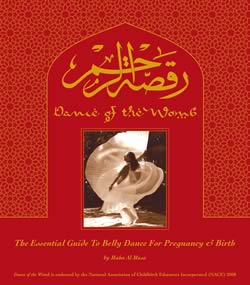
Book Review: Dance of the Womb

Dance of the Womb book cover

Book Review: Dance of the Womb: The Essential Guide to Belly Dance for Pregnancy and Birth
By Maha Al Musa, 2008
ISBN 978-0-646-48705-2
260 page hardcover book, $49.95 (AUS)
http://www.bellydanceforbirth.com

Reviewed by Molly Remer, MSW, ICCE

Some books simply feel good to hold in your hands. Dance of the Womb is one such book: it is beautiful, both in content and appearance. While priced a little higher than some birth books, I cannot emphasize enough what a high quality book it is—-it is not a traditional trade paperback, it is of textbook quality and size. Hardbound with a lovely cover and endpapers, Dance of the Womb is packed with full color, detailed, step-by-step instructional photographs leading the reader through a “belly dance for birth” journey.

Dance of the Womb is divided into several segments. The first section summarizes the benefits of belly dance and explores the physiology of birth. The next section walks the reader through a series of gentle warm-up exercises while the following sections progress through a variety of different specific belly dance movements. Nearing the conclusion of the text is a segment about labor movements with positions. Each section of the book is lavishly illustrated with very clear, easy to follow, step-by-step photographs.

The author’s own journey through pregnancy, birth, and mothering is skillfully interwoven throughout the text as well as her own feminine passage into understanding herself as a complete woman. Interspersed with the photographs and belly dance instructions, is the exploration of the author’s pregnancy and birth experiences, her relationship with her own mother and her parents’ culture. The book contains her personal birth stories as well as perspectives on belly dance for birth from three midwives.

The author, Maha Al Musa lives in Australia. Her interest in Middle Eastern Dance was sparked by her Palestinian/Lebanese roots and birthplace as well as her pilgrimage to explore her heritage and reconnect with her long-separated mother. Maha has also developed a Dance of the Womb step-by-step instructional belly dancing DVD (sold separately, review to follow) that includes a video of her own homebirth journey with her third child. She is also developing a one day foundation course in “bellydancebirth” for birth professionals with a plan to go international in 2011.

Dance of the Womb is a great introduction to not just the basic physical elements of prenatal belly dance, but also to the spiritual aspects of giving birth and life as a woman. It is written with an intimate tone that makes the reader feel as if the author has reached out across the miles to form a direct, personal connection. This book feels like a rich treasure to hold and is a gentle, nurturing, encouraging, and enriching voyage for pregnant women or the people who serve them.

—-

Disclosure: I received a complimentary copy of this book for review purposes.