Archives

Tuesday Tidbits: Teeth and Teaching

“Do not try to satisfy your vanity by teaching a great many things. Awaken people’s curiosity. It is enough to open minds; do not overload them. Put there just a spark. If there is some good inflammable stuff, it will catch fire.”
Anatole France (in The Earth Speaks)

A woman who writes has power, and a woman with power is feared.” —Gloria Anzaldúa, “Speaking in Tongues” (via The Girl God via Guerrilla Feminism)

Bits of the birth net:

It is old news, but this week a 2009 post from The Unnecesarean caught my eye: An OB’s Birth Plan: Obstetrician’s Disclosure Sent One Mom Running. The article describes the “doctor’s birth plan” a mother received from her medical care provider, which includes gems like this one:

“…I do not accept birth plans. Many birth plans conflict with approved modern obstetrical techniques and guidelines. I follow the guidelines of the American College of Obstetrics and Gynecology which is the organization responsible for setting the standard of care in the United States. Certain organizations, under the guise of “Natural Birth” promote practices that are outdated and unsafe. You should notify me immediately, if you are enrolled in courses that encourage a specific birth plan. Conflicts should be resolved long before we approach your due date. Please note that I do not accept the Bradley Birth Plan. You may ask my office staff for our list of recommended childbirth classes…”

One of many reasons to run far away from this doctor! One of my Facebook friends made a great point though: “at least he’s honest! I think there are other doctors with similar views who might not make it clear until it’s ‘too late.'” This is true–he said it, but you know a LOT of people are thinking it/acting on it. So, that IS good that he was up front. Another mother then commented to add her own similar experience: “We went to an OB who had us sign something saying we would not have a birth plan or hire a doula. It felt so creepy to sign away all involvement in my own child’s birth – and doing so at 9 weeks felt like I was signing that I’d keep my mouth shut throughout the pregnancy, too. But gratefully, as you’re saying, it was clear early on that way this was not the OB for us. I’m sure many don’t get to find out before labor.”

Speaking of teaching and igniting sparks, it isn’t too late to register for our next Birth Skills Workshop—rapidly approaching on February 2nd! This workshop is specifically designed not to be a lecture, but is a hands-on, skills-building workshop.

Also via ScoopIt, I shared this article: Bearing the Burden of Choice: A Young Feminist’s Perspective

“Based on personal observation, choices concerning women’s reproductive health are heavily concentrated in preventative action – what are the best practices to avoid pregnancy? Consequently, prevention inspired language lends to a negative association with child bearing. It is something to prevent rather than embrace…”

She goes on to address something that I find to be a reason why sometimes birth activists have trouble connecting to the larger feminist community:

Abortion is one of those issues that seems to leak into every “women’s issue” whether initially intended or not. Needless to say, we talked about abortion to the point of exhaustion. Not to take away from the weight of abortion to the feminist cause, I began to recognize a gap in our reproductive justice discussions. I found myself asking the question:What about the women who choose the path of childbearing?

Those women are basically why I’m here and why I do what I do. And, what has been on my mind recently is explored in my most recent post: What to tell a mother-to-be about the realities of mothering…

“Why didn’t anyone tell me?” and, “why isn’t anyone talking about this?” is a common refrain echoing in the postpartum tales of many mothers. So, why don’t we tell them? Or, what can we actually tell them? Is there a way to really do so? I kind of think there’s not

And, connecting the teaching and the sparks and the women’s issues and the women writing having power, I also made sure to sign this petition: Vigorously support women’s rights by fully engaging in efforts to ratify the 1972 Equal Rights Amendment. This is going to be one of the discussions towards the end of my current Social Policy class (I can’t really write much about it here, but suffice to say the class is extraordinarily challenging so far and we’re only to week three). I hope no one vigorously disagrees with it or I might FREAK OUT! When I shared it on Facebook, a friend commented: “I am enraged that women’s rights are an ‘issue.‘” To which I replied: “Isn’t that the truth?! I hate that. It boggles my mind that women’s rights are considered a political issue that anyone could have a ‘position’ on. The nerve!!! ARGH. FREAK OUT, I TELL YOU”

And now, the teeth…

This post is essentially all about what I shared on Facebook apparently (might as well get some mileage out of it!). This is what I wrote yesterday:

In case anyone cares, I’m totally sick of taking my kids to the dentist! All three had appointments in Sullivan today (1.25 hour drive one way). Alaina wasn’t cooperative and is clearly traumatized from prior dental experience and we will need to go back to a pediatric dentist for her (crowns on two molars). Zander’s were good and he got two seals. Lann had two extractions (previously filled teeth) and one filling. I’m exhausted!

I still haven’t written my planned blog post about the heartbreak of tooth decay. I came home yesterday all fired up to write it, but then I had to get caught up on grading instead. But, I did take these pictures of my little pearls-wearing, skirt-sporting, curly-haired, brave little girl:


20130128-175534.jpg

20130128-175545.jpg

I told her I wanted to take a picture of her face and she ran away from me like this!

20130128-175613.jpg

Two other Facebook kid updates from this week that were funny:

Alaina put a bracelet on pushed high on her arm. When she took it off, it left a red mark. She looked at the mark solemnly and said, “scar.” Poor little sugar. She said it very acceptingly. Like, yep, I’m scarred now…

And

Yesterday, my little entrepreneurs cooked up a plan to raise some money to buy a pug. They decided they should raise Dobermans and sell them…”When people see the big cage of Dobermans in our yard, we’ll just tell them, don’t worry…it’s for pugs!” Hmm. I see a couple of flaws with this plan…

Hearing this, it suddenly became clear to me how puppy mills were invented—a couple of pre-ten-year-olds (or, adults with similar critical thinking skills) hung around talking about money-making schemes…

Plucking out the heart of mystery

Birth is a great mystery. Yet, we live in a rational, scientific world that doesn’t allow for mystery. ‘In this day and age, there must be a better way to have a baby,’ implies that if you are informed enough, strong enough, you can control it. Any woman who has given birth, who can be honest, will tell you otherwise. There are no guarantees. It is an uncontrollable experience. Taking care of yourself and being informed and empowered are crucial, but so is surrender. Forget about trying to birth perfectly. Forget about trying to please anyone, least of all your doctor or midwife…” –Jennifer Louden (The Pregnant Woman’s Comfort Book)

Twelve Steps to a Compassionate Life Amazon affiliate link included in text/image.
I’m halfway through a year-long class based on the book Twelve Steps to a Compassionate Life. We’re examining and practicing compassion to ourselves and in personal relationships, community relationships, and to non-humans. The subject of our current month is, “making a place for others.” What does this mean? The author explains…

I began to notice how seldom we “make place for the other” in social interaction. All too often people impose their own experience and beliefs on acquaintances and events, making hurtful, inaccurate, and dismissive snap judgments, not only about individuals but about whole cultures. It often becomes clear, when questioned more closely, that their actual knowledge of the topic under discussion could comfortably be contained on a small postcard. Western society is highly opinionated. Our airwaves are clogged with talk shows, phone-ins, and debates in which people are encouraged to express their views on a wide variety of subjects. This freedom of speech is precious, of course, but do we always know what we are talking about?

Armstrong, Karen (2010-12-28). Twelve Steps to a Compassionate Life (Kindle Locations 1476-1481). Random House, Inc.. Kindle Edition.

I wonder about this sometimes in my own compulsion to blog—am I just adding to the digital cacophony out there, etc. and then that reminded me of a previously shared quote:

“A person who believes too earnestly in [her] own convictions can be dangerous to others, for absence of humor signals a failure in basic humanity.” –Thomas Moore (Original Self)

 Armstrong also makes this important observation:

Hindus acknowledge this when they greet each other by bowing with joined hands to honor the sacred mystery they are encountering. Yet most of us fail to express this reverence for others in our daily lives. All too often we claim omniscience about other people, other nations, other cultures, and even those we claim to love, and our views about them are frequently colored by our own needs, fears, ambitions, and desires.

Armstrong, Karen (2010-12-28). Twelve Steps to a Compassionate Life (Kindle Locations 1596-1599). Random House, Inc.. Kindle Edition.

We all do this so often. I find myself very annoyed when other people play “armchair psychologist” and yet still catch myself doing it as well. I also think about “gossip” and its role in human society. I think curiosity about the lives of others is normal and talking about other people’s behavior and experiences with them is also normal. I am most disturbed when those around me claim seemingly infallible understandings of the motives, characters, and psychology of others (in my classes, I remind students to “separate person from problem” and to “describe behavior rather than character”). It is very common for us not to even understand ourselves, so I find it interesting, frustrating, and surprising that we then seem to think we can have direct understanding of the inner workings and thought-processes of another person. “Instead of discoursing confidently on other people’s motives, intentions, and desires, we should recall the essential ‘mystery’ and realize that there is a certain sacrilege in attempting to ‘pluck out’ its heart to serve an agenda of our own.

What does this have to do with birth?

“Birth is life’s central mystery. No one can predict how a birth may manifest…Our dominant culture is anything but ‘natural’ so it is no surprise that childbirth, even with the most natural lifestyle lived by an individual family, sometimes needs intervention and medical assistance. This is not to say that any one mother’s efforts to have a natural childbirth are futile. Just that birth is bigger than one’s personal desires.” –Jeannine Parvati Baker (in The Goddess Celebrates: An Anthology of Women’s Rituals, p. 215)

When women’s choices are restricted in the birthroom or in access to compatible care providers, we’re plucking out the heart of mystery. When December 2012 073doctors or nurses “let” or “don’t let” a birthing woman do something, they’re plucking out the heart of mystery. When birth activists analyze a woman’s birth story for evidence of why things went “wrong,” we’re plucking out the heart of her rite of passage, of her story. When we fail to acknowledge the sociocultural context of breastfeeding OR when we cannot accept that a mother “couldn’t breastfeed,” we’ve plucked the heart of her mystery. When we need to have or know the “right answer,” chances are, we’re plucking the heart. And, we need to remember that…”Women’s surveillance of other women’s childbirth experiences–in this case, natural childbirth–can shape and constrain the individual choices women make in childbirth in much the same way medicalized assumptions about childbirth can.” (Christa Craven, Pushing for Midwives)

Armstrong goes on to explain…

Third, spend some time trying to define exactly what distinguishes you from everybody else. Delve beneath your everyday consciousness: Do you find your true self—what the Upanishads called the atman? Or does this self constantly elude you? Then ask yourself how you think you can possibly talk so knowingly about the self of other people. As part of your practice of mindfulness, notice how often you contradict yourself and act or speak in a manner that surprises you so that you say, “Now why did I do that?” Try to describe the essence of your personality to somebody else. Write down a list of your qualities, good and bad. And then ask yourself whether it really sums you up. Make a serious attempt to pin down precisely what it is that you love about your partner or a close friend. List that person’s qualities: Is that why you love him? Or is there something about her that you cannot describe? During your mindfulness practice, look around your immediate circle: your family, colleagues, and friends. What do you really know about each and every one of them? What are their deepest fears and hopes? What are their most intimate dreams and fantasies? And how well do you think they really know you?…How many people could say to you that you “pluck out the heart of my mystery”? In your mindfulness practice, notice how often, without thinking, you try to manipulate, control, or exploit others—sometimes in tiny and apparently unimportant ways. How often do you belittle other people in your mind to make them fit your worldview? Notice how upsetting it is when you become aware that somebody is trying to manipulate or control you, or when somebody officiously explains your thoughts and actions to you, plucking out the heart of your mystery…

Armstrong, Karen (2010-12-28). Twelve Steps to a Compassionate Life (Kindle Locations 1644-1658). Random House, Inc.. Kindle Edition.

The irony of the fact that I’ve just filled up a bunch of digital air space with my own opinions, instead of practicing this principle, isn’t lost on me. As I move through this month, in all contexts not just in birthwork, I would like to open more to this “heart of mystery” and to not knowing as well as to avoid the tendency to analyze and “understand” other people. I also wish to be mindful of plucking the heart out of anyone’s mystery—may I be a witness to their mystery and may they feel both seen and heard by me…

“Birth is always the same, yet it is always different. Like a sunset, the mystery is also the appeal to those who get up in the middle of the night to attend laboring women. While the sequence of birth is simple, the nature of the experience is complex and unique to each individual. No matter how much any of us may know about birth, we know nothing about a particular labor and birth until it occurs.” (emphasis mine) –Elizabeth Noble in Childbirth with Insight (previously shared here)

2012 blog year in review

I got an automatically generated report from WordPress this week with my 2012 year in review!

Here’s an excerpt:

About 55,000 tourists visit Liechtenstein every year. This blog was viewed about 180,000 times in 2012. If it were Liechtenstein, it would take about 3 years for that many people to see it. Your blog had more visits than a small country in Europe!

Apparently, I wrote 187 new posts and uploaded 746 pictures!

Click here to see the complete report.

(My family year-in-review update was already published in my Happy Holidays post.)

Here’s my own expanded version of my blog year-in-review…

In 2012, I finished my miscarriage memoir: Footprints on My Heart: A Memoir of Miscarriage & Pregnancy After Loss. I was thankful for My Tribe! I had some thoughts on epidurals, risk, and decision making

and, I changed visions which in part led to offering new birth workshops instead of traditional classes.

My most popular new post was All That Matters is a Healthy Husband (or: why giving birth matters), with my old stand bys, How do I know I’m really in labor? and In-Utero Practice Breathing, still coming in ahead hits-wise, closely followed by the ever-popular Good Foods to Eat in Labor.

A couple of other new posts were also popular:

What If…She’s Stronger than She Knows…

Breastfeeding as an Ecofeminist Issue

Miscarriage and Birth

Some reminders for postpartum mamas & those who love them

Can I really expect to have a great birth? (updated edition)

Becoming an Informed Birth Consumer (updated edition)

Case Study: Low Carb Diets and Breastfeeding Mothers

The Great Birth (of the Universe)

A Bias Toward Breastfeeding?

I wrote a series of posts that I really liked a lot:

The Rest and Be Thankful Stage

Spontaneous Birth Reflex

Birth Pause…

And some other posts I also like:

Blessingways and the role of ritual

Celebrating Pregnancy & Birth Through Art

Talk to Your Baby

Where are the women who know?

Ode to my nursling

I also had an awesome time discovering 300 Things.

And, I wrote a whole series of CAPPA re-cap posts. I also semi-accidentally started a series of posts on a taking it to the body theme, for which I see a lot of ways of continuing.

I reprinted several articles that were published earlier in various magazines:

Talk Less, Learn More: Evolving as an Educator

A Tale of Two Births

Incorporating Prenatal Yoga into Childbirth Education Classes

Breastfeeding as a Spiritual Practice

Breastfeeding as an Ecofeminist Issue

Domestic Violence During Pregnancy

The lifelong impact of breastfeeding support

Small Stone Birth Activism

I hit 300,000 hits (up an additional 46,000 now already) and had a celebration giveaway (for which I still need to draw the winner!) because I also started selling birth jewelry. And, I had my first Blog Break Festival!

What a good year it was 🙂

Happy New Year!

MollyNov 111

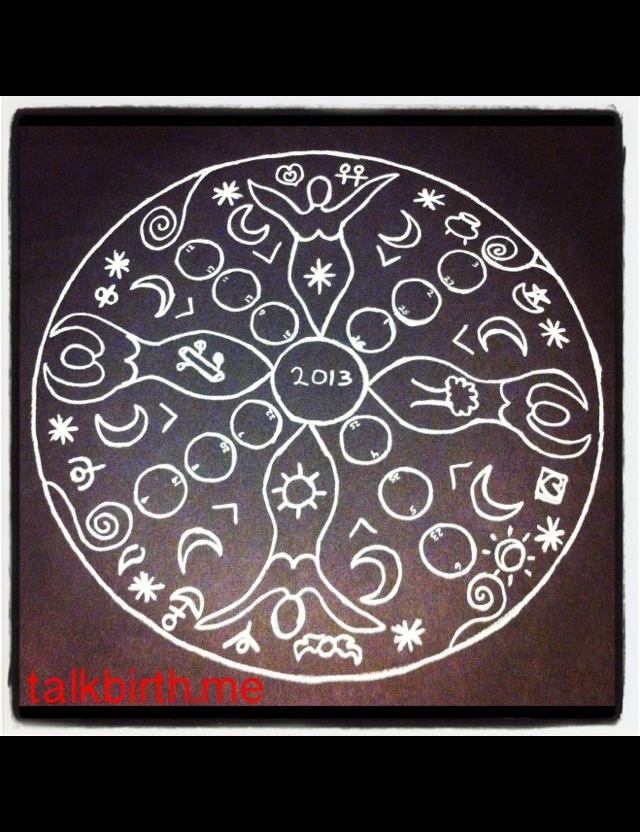
To kick off 2013, I drew a new Full Moon Calamandala!

20121231-011737.jpg

Taking it to the Body, Part 4: Women’s Bodies and Self-Authority

This is a somewhat shortened version of a prior post. I revised it to be a part of my taking it to the bodyDecember 2012 001 series.

I believe a potent source of female power lies in the female body and that body wisdom has been suppressed and denied over the course of many years as a means of oppression and control. One of the root issues of patriarchy is who “owns” women’s bodies—is it men, is it the government, is the medical system, or is it the woman herself? (you know my pick!).

Body wisdom and sources of power

Considering power, sources of power, and body wisdom, I appreciated reading Barbara Starrett’s essay The Metaphors of Power in the book The Politics of Women’s Spirituality. While she uses a different example, I have modified and paraphrased her thoughts to make the idea about birth. Starrett originally states, “We can create power centers both within and outside ourselves…Power is where power is perceived. Power resides in the mind. We can give or withhold power through our beliefs, our felt thoughts.” Medical professionals can make decisions about a woman’s body and birth choices effectively only as long as women believe that the professionals have the right to do this. When women reclaim the power to decide for themselves about birth, the doctors proclaim in a vacuum. Their power depends on the transference of our power, through our belief that this is right…Power is where power is perceived. This also means that in any given in-the-world situation, we can intentionally set up our own power centers. If we believe that power resides in those centers, it will. We will act successfully on this belief. Women’s organizations, unions, birth coalitions, etc., will never work unless we regard them, “as the legitimate centers of power…We must grant our own power to ourselves” (p. 191).

While this comes a little too close for comfort to me with the idea that “we create our own reality” (which I cannot fully embrace due to the logical extension into blaming the victim that it creates), I connect deeply with the idea that we must treat women’s organizations and work as legitimate power sources. I think of books/movements like Our Bodies, Ourselves, for example. To me, this is a definitive women’s health resource—by women, for women and separated from the medical establishment that often dehumanizes women. If we continue to believe our “alternative” structures are just that, “alternative,” then the dominant model is still the norm and still accepted, even by us, as “normal.”

Starrett continues her essay by sharing that “It is necessary for some women to risk total reclamation, to risk the direct and intentional use of power, in bold, even outrageous ways. It takes only a minority of women to alter present reality, to create new reality, because our efforts are more completely focused, more total.” (p. 193) This is the risk that the creators of Our Bodies, Ourselves took. It is the risk birth activists and women’s health activists continue to take.

Consult your health care provider?

In my own life, I am frustrated by the ubiquitous phrase, “Consult your health care provider.” No, thanks. I prefer consulting myself, my books, google, my own research, and my friends. Last time I checked, my doctor did not own my body nor did she have divine revelation as to what I need in my life. I am a breastfeeding counselor providing phone and email support to women who have breastfeeding questions. Women frequently receive very poor breastfeeding “advice” from their doctors—to the extent that I honestly think they’d receive better information by polling random strangers at Wal-Mart with their questions (and, yes, I will actually tell women this). One caller once used the phrase, “but, I don’t want to disobey my doctor” and I found this extraordinarily telling as well as depressing. I recognize that doctors have special training and can be life-saving, however, what does that say about mothering in our culture that a woman would not act on behalf of her own baby and herself because of fear of being disobedient to a professional that she has hired? She is a consumer of a service, not the subject of a ruler!

This brings me to a thought by Dr. Michelle Harrison, author of the book A Woman in Residence:

I used to have fantasies…about women in a state of revolution. I saw them getting up out of their beds and refusing the knife, refusing to be tied down, refusing to submit…Women’s health care will not improve until women reject the present system and begin instead to develop less destructive means of creating and maintaining a state of wellness.”

Indeed! And, in an essay by Sally Gearhart’s about womanpower, she notes: “…there’s no forcing any other woman into a full trot or a gallop; she will move at her own pace, but at her own pace we can be sure she will move. At this point I always remind myself that the patriarchal use of crash programs is antithetical to organic movement; in a crash program the theory goes that if you can get nine women pregnant you can have a baby in one month; it takes women, I suppose, to understand that it doesn’t work that way.” (p. 202-203)

Reclaiming power

So, how do women reclaim power? I think story holds a key to power reclamation in this context. As I’ve referenced before, Carol Christ describes it thusly, “When one woman puts her experiences into words, another woman who has kept silent, afraid of what others will think, can find validation. And when the second woman says aloud, ‘yes, that was my experience too,’ the first woman loses some of her fear.” As I touch on above, for me it is to see myself and my body as a source of wisdom and to refuse to participate in structures that do not honor my power and personal agency. It involves more often turning to my peers, to other women, for advice and comfort and support, rather than to experts.

I’ve written many times before that I am a systems thinker. Women’s choices about their bodies and about birth are not made in personal isolation, but in a complexly interwoven network of social, political, medical, religious, and cultural systems. As Gearhart notes, “There may be no ‘enemy’ except a system. How do we deal with ‘the enemy’? As seldom as possible but when necessary by opening the way for [their] transformation into not-the-enemy. What weapons do we use? Our healing, our self-protection, our health, our fantasies, our collective care…” (p. 203).

20121218-134856.jpg

Birth Activism Opportunities!

Recently I got an email letting me know that I’ve been nominated for the Health Activist Hero Award in this year’s WEGO Health Activist Awards! Nominations are open through December 31st, 2012, after which judging will begin. You can “endorse” my nomination by clicking on the badge. You can also follow the happenings on WEGO’s Pinterest board. You can also nominate someone!  There are 16 award categories and there’s no limit to the number of people you can nominate with this quick form.

Second, Freedom for Birth just released a free 15 minute version of their documentary online. Check it out!

Taking it to the body… (part 1)

The following is excerpted from one of my lessons in my recently finished Ecofeminism course.

20121203-150406.jpgIn Mara Keller’s essay in the ecofeminist anthology Reweaving the World, she explains that in our cells remember an ancient era of mother-centered life. As I observe in my own children’s relationship to me as their mother, this seems extremely logical to me. Keller writes: “The renewal I long for is a return of a reverence for Mother Earth and her abundant forces of creations; an affirmation of the sacredness of sexuality and enduring human love; and the belief in the inevitability of death and the immortality of the soul” (p. 51). Mother Earth is abundant and fertile and awe-inspiring, she can also be wild and unpredictable and dangerous and is deserving of reverence and respect.

Chellis Glendinning in The Politics of Women’s Spirituality sums up the consequences of patriarchy perfectly:

“When women are faced each day with enforced cesarean deliveries, birth control that maims and kills them, and doctors who think them dirty, when we encounter rape, violence in the streets, job discrimination, sexual slavery around the world, pollution and nuclear madness, we realize that reclaiming the integrative ways of our ancestors must involve our healing powers on all fronts—from the medical to the social to the environmental to the political to the psychological to the spiritual. Healing the divisions that were imposed during the patriarchal era is the survival issue of our time and our planet. A world that systematically sickens its women cannot survive.” [emphasis mine]

Returning to Reweaving the World, in a similar line of thought, Paula Allen states that “a society based on body hate destroys itself and causes harm to all of Grandmother’s grandchildren” (p. 53). I honestly think that many, many children enter the world in an atmosphere of body hate (this can be true regardless of birthing environment). I read an article recently by the famous French obstetrician Michel Odent who explains that the human species may actually be losing the capacity to give birth on its own. Odent sums up the sobering conclusion of current research with this chilling observation: “after just 3 or 4 generations of highly technological childbirth, it seems very possible that our human oxytocin system is weakening. In other words, our capacity to give birth is weakening…” What will it mean for society if our human women can no longer successfully carry and bear new members of the species without significant technological assistance?!

So, planetary healing may actually rest in body respect and love. Allen explains that rejoicing in our bodies is how we show our respect to the planet. We can heal our bodies…”our own dear body, our own dear flesh. For the body is not the dwelling place of the spirit, it is the spirit. It is not a tomb, it is life itself” (p. 56). Allen asks the reader to consider how often we deny the urgings of our bodies. I ask this of women also—how often do you respond to the first cue from your body to use the bathroom? Usually, we resist several times—sometimes even hours—before finally going. If this basic, daily function we each experience multiple times a day is a time in which to deny and ignore our bodies’ messages, how do we expect women to then speak up for themselves in birth? To ask for what they need and to follow the instinctive dance of their birthing bodies? These same questions can be expanded to other areas of our lives as well of course…

Allen also has a refreshing perspective that now is not the time for tranquility. So often in New Age writings and Western-adapted Buddhist and Zen types of thought we see admonishments towards calmness, serenity, peace, and so forth and in the non-attachment and “I create my own reality” and “there is no reality but the present moment.” I appreciate this call for action and for passion, rather than a stilling of the emotions.

And, finally, returning to the body theme, during a recent women’s retreat one of the guests brought us each a card that reads: “Trust yourself. Take it to the body. She always knows.” I loved this and will explain more in part 2

As dear as breathing…

20121126-151448.jpg

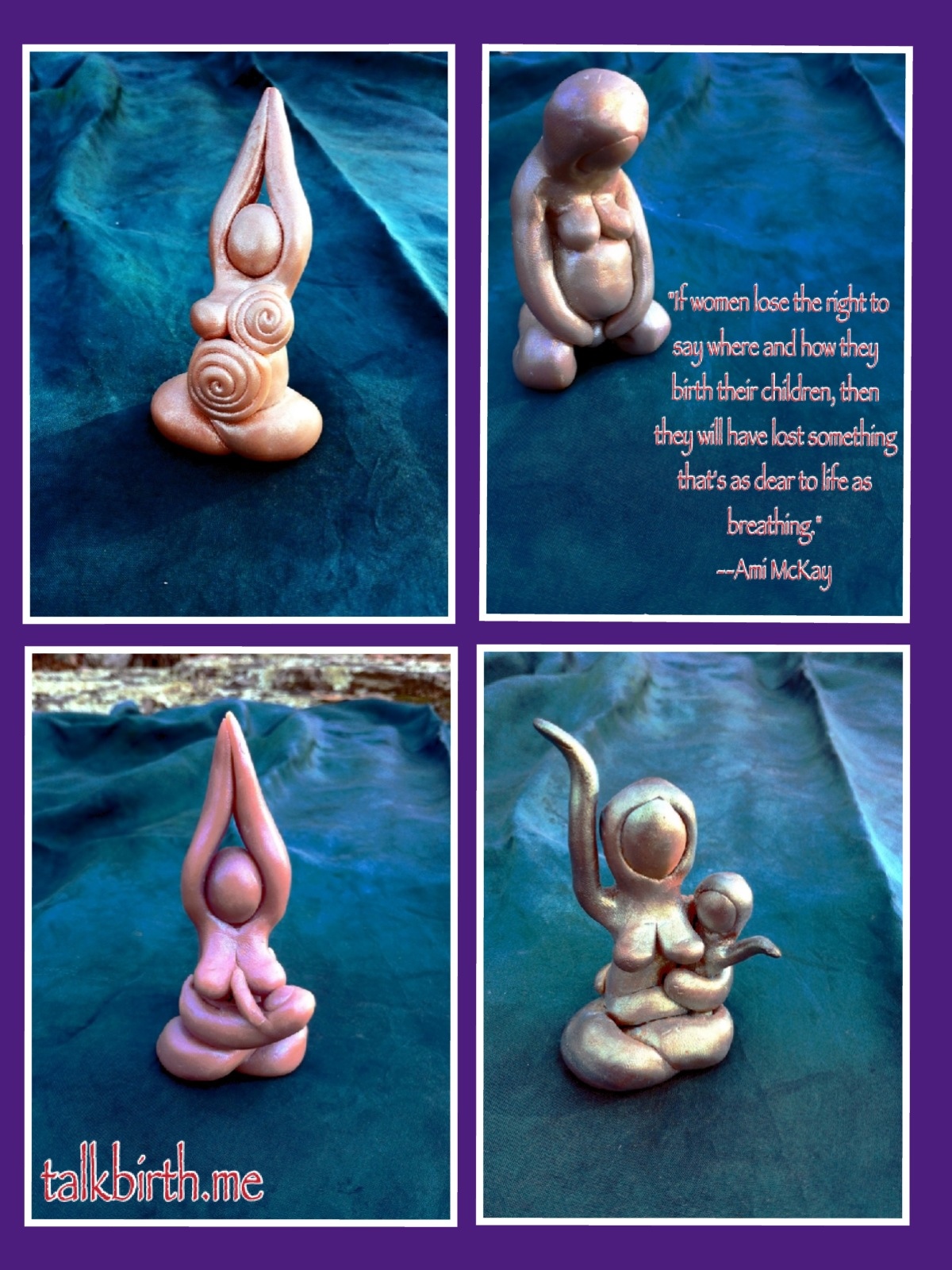
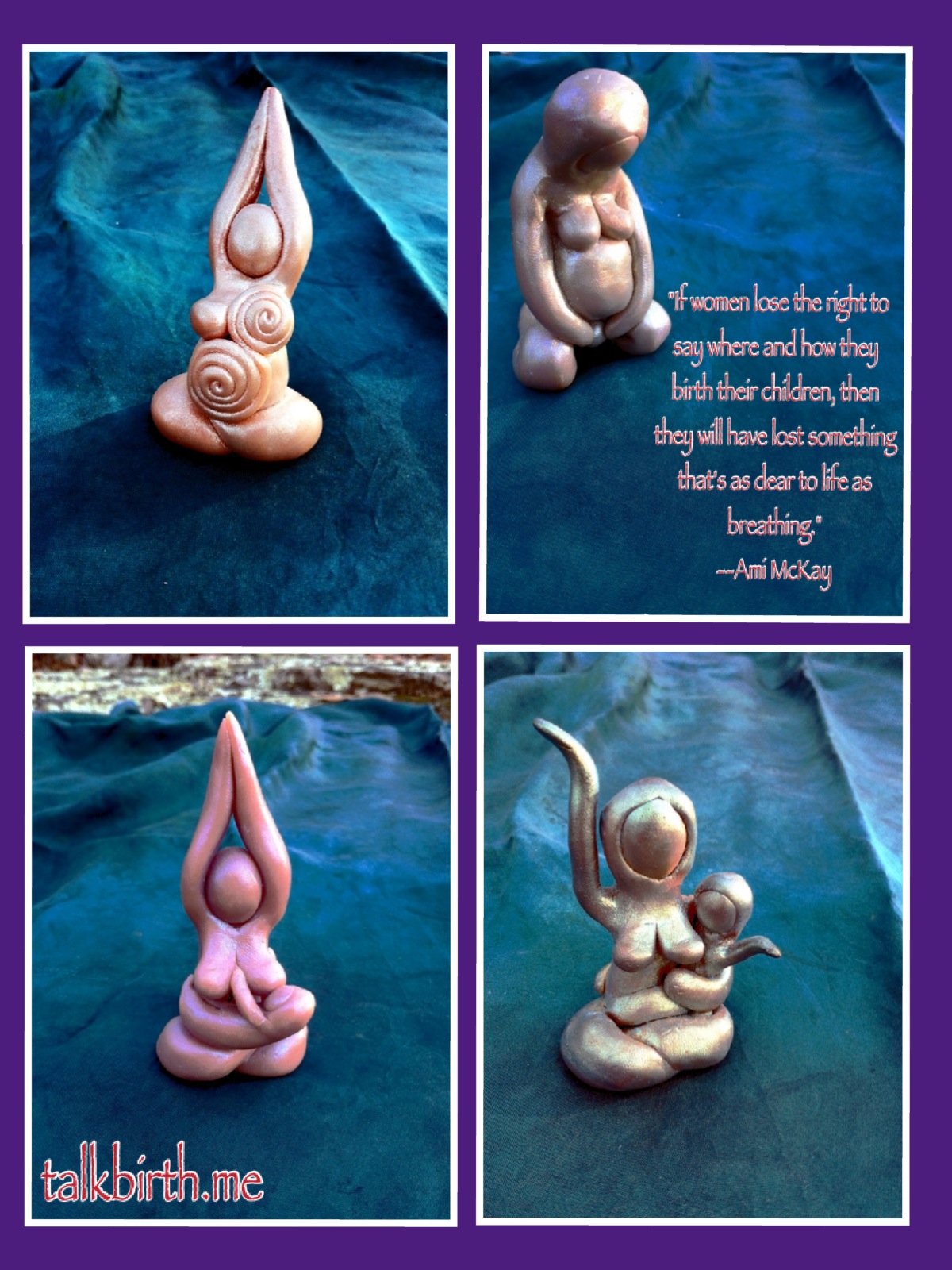
“If women lose the right to say where and how they birth their children, then they will have lost something that is as dear to life as breathing.” –Ami McKay

“Mothers need to know that their care and their choices won’t be compromised by birth politics.” – Jennifer Rosenberg

Birth politics have been on my mind this week as I’ve come across various debates from within the birth profession about the regulation of midwives and the question of licensure, and then also the seemingly ever-present critiques of homebirth from outside the homebirth community. I don’t feel as if I have time lately to fully follow all the issues, but Citizens for Midwifery’s recent response to ACOG’s newest homebirth and maternal rights smackdown contains some important thoughts:

AJOG editorial rejects the ethic that autonomy is a fundamental human right

This article represents a serious attack on home birth and on patient centered care in the United States. The attack is based on poor research and runs roughshod over established rights to bodily integrity…

…not only does the article attack home birth, it also represents an attempt to “export” to the rest of the world a position that the obstetric profession, not mothers, should have the final decision on birth, at a time when that isn’t even legally defensible here in the United States…

…One contradiction stands out as the authors call for “safe, respectful, and compassionate” hospital delivery. No hospital birth can be truly respectful if the birth is happening in the hospital because the physician disrespects the woman’s right to an alternative and has rigged the system to eliminate access to all legal alternatives…

via Citizens for Midwifery

Related thoughts:

Maternal-Fetal Conflict?

The Illusion of Choice

“Woman-to-woman help through the rites of passage that are important in every birth has significance not only for the individuals directly involved, but for the whole community. The task in which the women are engaged is political. It forms the warp and weft of society.” –Sheila Kitzinger

The Of COURSE response…

“As long as women are isolated one from the other, not allowed to offer other women the most personal accounts of their lives, they will not be part of any narratives of their own…women will be staving off destiny and not inviting or inventing or controlling it.” –Carolyn Heilbrun quoted in Sacred Circles

I recently finished taking a class in Ecofeminism, which makes connections between the exploitation and domination of women and the exploitation and domination of the planet. Naturally, as I also did with breastfeeding as an ecofeminist issue, I made many connections between the theme of the class and birth rights for women. The author of the book Ecofeminist Philosophy, Elizabeth Warren explains that when you are part of an unhealthy social system, you are likely to experience predictable, even “normal” consequences of living in that system: “This element of predictability explains the appropriateness of what I call the ‘Of course’ response: ‘Of course, you feel crazy when men say it’s your fault that you were raped, or that you could have prevented it.’ ‘Of course, your life has become unmanageable…'” we live in a culture that expects women to do it all and to always love parenting. If we look at our mainstream culture of birth as an unhealthy social system, I find the same response is appropriate. You really wanted to have a natural birth and then your doctor scared you into having an induction and you ended up with an epidural, of course you feel like you ‘failed.’ You feel healthy and beautiful, but now your doctor tells you that you’ve “failed” the GTT and are now “high risk,” of course, you feel stressed out and…like a high risk “patient.” You tried really hard to labor without medications, but you were “strapped down” with IV’s and continuous monitoring, of course, you felt like a trapped animal and like you had no other choices but medications. Of course, you feel upset and discouraged that your baby is ‘rejecting’ you and your breast after having been supplemented with bottles in the nursery. Of course, you are crying all the time and wondering if you are really cut out to be a mother, when your husband had to return to work after two days off and you are expected to be back at your job in five more weeks. And, so on and so forth.

“The ‘Of Course’ response affirms that those who feel crazy, powerless, alone, confused, or frustrated within unhealthy systems such as patriarchy are experiencing just what one would expect of them.” What the model of medical birth as an unhealthy social system reveals is that “no matter where one starts on the circle…one eventually comes round to one’s starting point. The circle operates as an insulated, closed system that, unchecked and unchallenged, continues uninterrupted…” How does one break free of an unhealthy system? “Getting the right beliefs by rearranging one’s thinking is an important part of the process, but it is not enough.” [emphasis mine. Here, Warren goes on to explore the issue of rape, but I have adjusted her words to be about birth instead] One can have the “right beliefs” about the prevalence of unnecessary cesareans, one’s rights as a childbearing woman, and the institutional nature of birth in our country and still experience an unwanted and unnecessary cesarean section. One can understand connections among faulty belief systems, language that devalues women, women’s bodies, and the birth process, and patriarchal behaviors of control and domination and still witness the catastrophic impact of this domination. “So, even if one must start with oneself and one’s belief system, one cannot end there. Since the problem is systemic, the system itself must be intervened upon and changed—by political, economic, social, and other means.” –Karen Warren in Ecofeminist Philosophy, p. 211. (emphasis mine)

Sometimes I honestly feel like I am one of the few people who really notices or labels the powerful systemic context in which women give birth in America. A lot of pregnancy and birth books and pregnancy and birth bloggers focus on individual responsibility and “education.” If women are always expected to “stand up for themselves” in the birth room and “get educated” so that they, personally, can prevent themselves from having unwanted interventions, of course our rates of unwanted interventions continue to rise.

“Through the act of controlling birth, we disassociate ourselves with its raw power. Disassociation makes it easier to identify with our ‘civilized’ nature, deny our ‘savage’ roots and connection with indigenous cultures. Birth simultaneously encompasses the three events that civilized societies fear–birth, death, and sexuality.” –Holly Richards (In Cultural Messages of Childbirth: The Perpetration of Fear,” ICEA Journal, 1993)

20121112-141422.jpg

Call for your experiences – the impact of birth trauma and beyond | Rebecca A. Wright

An online friend and sister birth professional, Rebecca Wright, emailed me recently to share some information about an important new project that she is launching:

I’m planning to write a book on birth trauma that will centre on women’s voices and experiences. It’s not going to be so much dwelling on birth trauma (though there will be an element of that as I want people to understand that whether an experience was ‘objectively’ traumatic or not, it can have an enormous impact – and I think a lot of women say to themselves, ‘my experience wasn’t as bad as some others I hear about’ and so don’t feel able to validate their own feelings and experience). What I really want to focus on is a) the impact of birth trauma (or of ‘difficult’ birth experiences) on mothers, babies, partners, families; b) the many individual paths to healing from birth trauma that people have walked; c) rediscovering your power in birth and motherhood following a difficult or traumatic experience.

She’d like to reach out to mothers, but also their partners, and doulas (midwives, nurses, doctors, etc.) and she’s also interested in hearing from practitioners of whatever sort who work with women and families around these issues.

Full details are available on her blog:

I want this book to be made of women’s voices (and men’s as well). I want it to be a place where the unspoken is spoken clearly and openly. I want it to be a book that honours the sacredness of each birth journey, and each path to healing. I want it to be a book that opens doorways for those who are feeling lost or alone so that they can find hope and a way forward that is suitable for them personally. Most of all, I want it to be a book that shows that it is possible to reclaim your personal power in birth and mothering following a difficult or traumatic experience in birth.

via Call for your experiences – the impact of birth trauma and beyond | Rebecca A. Wright.

Make sure to check out her project and see if you can lend your voice to what sounds like a beautifully healing book!

And, speaking of birth trauma, a while ago, I also received a question via Facebook asking for recommended resources for healing from traumatic birth. Check out the series on Giving Birth with Confidence about traumatic birth prevention and recovery. Or, look into Solace for Mothers.

Blogaversary birth jewelry giveaway!

***This giveaway is now closed. Sarah is the lucky winner!***

This month I not only hit 300,000 hits on my blog, but it is also my blogaversary! Five years ago, on October 29 I started this website with my first post. I had no idea where it would go from there! I know there are many other more popular bloggers with lots more hits than I have (especially in FIVE years!), but I feel very happy and comfortable with my level of traffic here and the contribution I am able to make. And, interestingly enough, over 150,000 of those hits were during this year alone. And, during just this month I had more hits than in my entire first year of blogging! That slow and steady progress and consistent presence makes me feel really good about my work here. So, to thank my readers for reading and to celebrate my blogaversary and the 300, 000 hits mark, I’m going to offer a giveaway of a beautiful Birth Dancer pendant by Wellstone Jewelry!

20121019-011719.jpg

“The sterling silver dancing goddess, nurturing her baby, preparing for birth.”

This is not a donated item—I bought it to resell, but decided I’d like to offer a happy giveaway instead!

There are lots of ways to enter to win this lovely pendant and the giveaway is going to last for a long time—basically through the duration of my ongoing blog festival, which will last until December 15. To enter, do any or all for the following:

  • Leave a happy-blogaversary comment on this post 🙂
  • Become a fan of Talk Birth on Facebook
  • Follow Talk Birth on Twitter
  • Tweet about the giveaway (and comment to tell me!)
  • Share the giveaway on Facebook (and comment to tell me!)
  • Suggest Talk Birth on Facebook to your friends.
  • Share self-care/self-renewal tips with me that I can pass along to my readers!
  • Comment and share your favorite post from Talk Birth (double entry for this one!)
  • Contribute to my ongoing blog festival and you will earn FIVE bonus entries (I’ve received some great contributions so far and will start publishing them next week. If you’ve already contributed, you will be automatically entered in the giveaway. But, seven weeks is a long time, so I could really use some more contributions! Remember that you can send me previously published posts that are your own personal favorites. This could be good exposure for your own writing/blogging! I do not want any pregnancy/birth 101 type of posts, but otherwise I’ll happily accept good quality posts on a variety of subjects).

I added an archive drop-down to the sidebar recently in honor of my blogaversary, so if you want to take a walk down Talk Birth memory lane, make sure to check it out on the right hand sidebar, halfway down —>

And, again, thank you. Thank you for reading, thank you for your comments, thank you for feedback and support, thank you for sharing my posts on Facebook and Twitter. Thank you for sharing yourselves with me. Thank you for letting me share myself with you. Thank you for caring. Thank you for participating. Thank you for providing me with the opportunity to share my voice and my thoughts and to be heard in the larger, virtual community, in addition to in my own small, in-person community. When I began writing here, I felt frustrated and uncertain about my ability to make a contribution to the birth world. I desperately wanted to transform the birth culture in the US. I felt blocked and denied in my access to the people I wished to reach. I felt frustrated and “held down” by the needs of my small children. Writing here offered me freedom and reach and enabled me to be a birth educator and activist in the wider world beyond my own rural home, as well as contributing to my local community. It has allowed me to make a (small) difference in many lives in many parts of the world—I have regular readers from Australia and Kenya and Serbia, for example. I could never have made those connections without my writing and I feel blessed to have found an avenue for my voice and ideas.

Thanks for your support!

After my brother’s wedding earlier this month.