Archives

Tuesday Tidbits: Birth Transformation

“Women are as nervous and unsure of themselves as ever, and they need to learn to trust their bodies. Birthing is much more that eliminating pain. It is one of life’s peak experiences.” –-Elisabeth Bing

via Thesis Tidbits: Exceptional Human Experiences | Talk Birth.
May 2015 146The mother of the Lamaze childbirth education movement in the U.S., Elisabeth Bing, died this week at age 100. She had a tremendous impact on the birth culture and was a very early activist in promoting the “radical” idea of birth as a transformative, powerful, important experience in a woman’s life.

…For years Ms. Bing led classes in hospitals and in a studio in her apartment building on the Upper West Side of Manhattan, where she kept a collection of pre-Columbian and later Native American fertility figurines.

Ms. Bing preferred the term “prepared childbirth” to “natural childbirth” because, she said, her goal was not to eschew drugs altogether but to empower women to make informed decisions. Her mantra was “Awake and alert,” and she saw such a birth as a transformative event in a woman’s life.

“It’s an experience that never leaves you,” she told The New York Times in 2000. “It needs absolute concentration; it takes up your whole being. And you learn to use your body correctly in a situation of stress.”

via Elisabeth Bing Dies at 100; ‘Mother of Lamaze’ Helped Change Childbirth – NYTimes.com.

Bing was also early to recognize that birth experiences can be traumatic for mothers. This week, I read another May 2015 164 interesting article about mothers’ experiences of birth trauma:
“…far too many women are left in the aftermath of a traumatic experience on the very day she is born as a mother. She is a new woman – amazing, strong and life-giving – ready to face the world. Holding her new baby in her arms and a smile (or not, depending on her acting skills) on the outside, with a broken heart, fractured spirit and shattered self-confidence on the inside. This is the result of traumatic birth…”

The Secret That Many Moms Are Keeping – Mothering.

Can part of the “cause” of traumatic births be the expectation that a “good birth” is a quiet and controlled birth? Nadia Raafat wrote a powerful article at the Huffington Post that touches on this possibility:

Contractions were outed, surges, came in, the un-gratifying word pain was ostracised from the semantics of childbirth and, across the nation, grateful midwives watched in awe as powerful, silent women breathed their way through drug-free labours.

That’s half the story. The other half concerns those who did not experience the blissful or natural birth outcome that hypnobirthing promised them; the many disappointed women whose labours were violent, or which deviated from the normal care pathway, women who found the experience not only painful, but shocking and traumatic – all the more so because they believed it might be painless. I have met many of these women – still processing their birth experience years later, still wondering what they did wrong? Their emotional and physical scars run deep and take many years to heal.

via Denying the Pain of Labour Is Like Denying the Pain of Life | Nadia Raafat.

Raafat goes on to advocate the full spectrum of the semantics of birth and birth experiences:

Childbirth is the most profound experience in a women’s life. It is awesome, challenging, brutal, visceral, joyful, transporting, awful, deeply physical, incredible, powerful, at times, calm and in-flow, at other times all-consuming and over-whelming. Our preparation and our semantics need to acknowledge the whole spectrum of the experience, not just the palatable colours.

via Denying the Pain of Labour Is Like Denying the Pain of Life | Nadia Raafat.

I have a long time interest in words and birth and how we “talk birth” in our culture:

…On the flip side, I’ve also read other writer’s critiques of an overly positive language of birth, labeling and mocking words like “primal” as “euphemisms” for hours of “excruciating” pain. But, that makes me think about the locus of control in the average birth room. It seems like it might more difficult to start an IV in a “triumphant” woman, so lets call her stubborn or even “insisting on being a martyr”? Could you tell someone making “primal” noises to be quiet? Probably not, but you can tell someone who is “screaming” to “stop scaring” others. Asserting that a painful and degrading language of labor and birth is “real” English and that the language of homebirth advocates are “euphemisms” is a way to deny women power and to keep the locus of control with medicine.

via Wordweaving | Talk Birth.

I’ve also thought a lot about the association between a quiet birth and good birth. “Quiet” during labor is often associated with “coping well” and noise is associated with not coping, which may not be the case:

…Occasionally, I hear people telling birth stories and emphasizing not making noise as an indicator, or “proof,” of how well they coped with birthing–“I didn’t make any noise at all,” or “she did really well, she only made noise towards the end…” Women also come to classes looking for ways to stay “in control” and to “relaxed.”

This has caused me to do some thinking. Though relaxation is very important and helpful, to me, the goal of “laboring well” is not necessarily “staying in control” or “staying relaxed” or “not making any noises.”

via What Does Coping Well Mean? | Talk Birth.

And, speaking of how we talk about experiences as well as pulling this post back around to Elisabeth Bing, I quoted some reflections on postpartum care from Bing in a past post:

“The degree of pleasure you take in your mothering is not the same thing as loving the baby or being an effective parent. Keep in mind there is a distinction between mother love and maternal satisfaction. You may love your baby very much but be dissatisfied with your life circumstances.”

via Talk Books: Laughter & Tears: The Emotional Life of New Mothers | Talk Birth.
May 2015 150

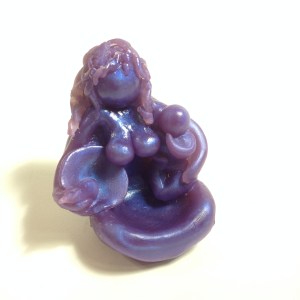
New Squatter’s Rights Sculpture

“Birth is not an event; it’s a series of sophisticated biological processes… Really, we’re talking about processes that should make us fall on our knees in awe.”

–Suzanne Arms

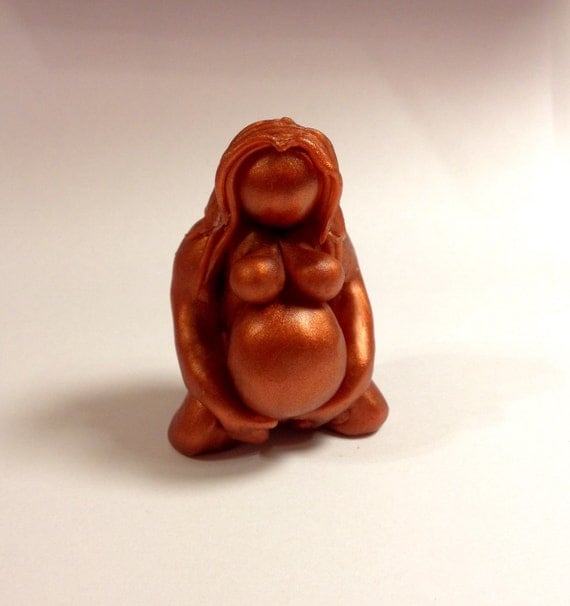
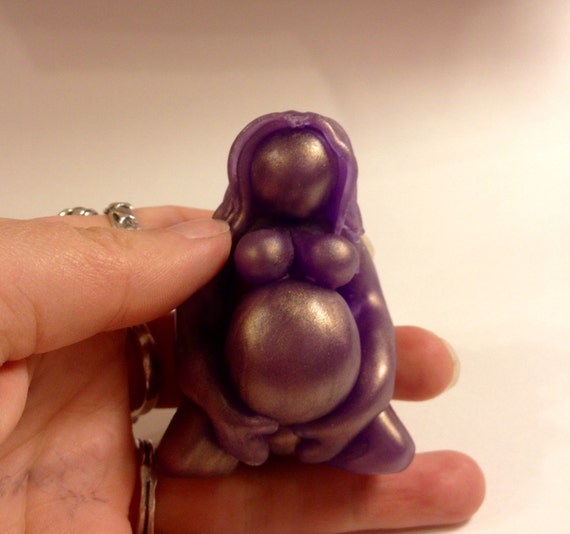
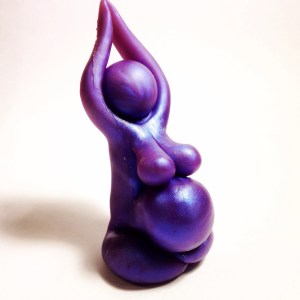
Squatter's Rights laboring mama birth goddess sculpture (birth art, unassisted birth), Birth Warrior.In our May newsletter from Brigid’s Grove, we introduced our new “Squatter’s Rights” sculpture of a mama catching her own baby. This sculpture has a lot of personal significance to me and I have found her image tremendously empowering for a long time. I have made a variety of different versions all expressing the same message: reach down and catch what’s yours.

…Would the new child coming from me be slippery like soap? I rubbed my fat belly. I loved each pound I gained, each craving I had, and every trip to the bathroom. Okay, maybe not every trip to the bathroom. But, I loved this growing baby. Tucked away like a pearl in the sea just waiting to be discovered. I was in a constant state of marvel.

Would I be able to physically do this? No, I don’t mean the labor, nor do I mean the birth. I knew I could do that. I got lost in thought as I planned in my head every moment that would come after my body did the work of labor. The moment would come once my body was ready and the crown of a child’s head pushed itself from me, the moment the child would emerge. That’s what I was planning for; I planned to catch my own baby…

via Guest Post: Squatter’s Rights | Talk Birth.

It is hard to express how much I love knowing about how these figures “speak” to the women who receive them. I started making them to express something within me and to speak to myself or remind me of my own power. I absolutely love knowing that they carry these messages to other women as well, not just me! An early customer of the Squatter’s Rights sculpture gave me permission to share her feedback on it:

I LOVE THIS!!!   I JUST got my lovely statue, she’s gorgeous, I am in awe of your work, and I caught myself choking up a bit at how I look at her and it pulls me back to that most empowering of moments, Me-birthing my little rainbow.. Completely uninhibited.. THANK YOU!…They will be in a sacred space, helping watch over me as I go through Midwifery school… Thank you, thank you!!

What a tremendous honor to be a small part of another woman’s journey in this way. It feels like a sacred trust.

Tuesday Tidbits: Cesarean Awareness Month

11148668_1614543705424512_3613965156253725168_nIt is Cesarean Awareness Month! We finished several new mama goddess designs this month and have a CAM-themed April newsletter ready to go out (subscriber freebie in this newsletter is a new birth education handout: “Can I really expect to have a great birth?” Sign up for the newsletter at Brigid’s Grove!)

Some Cesarean Awareness Month themed posts for this week. First, a meditation for before a cesarean:

You say you honor choices. 11108844_1614067252138824_1518757261202060615_n
Can you really honor mine?
I will always honor the process which
brought forth flesh of my flesh.
I honor your births too.
Can you ever honor my experience, or will I
forever be a part of your statistics on
the way things shouldn’t be?

via Birthrites: Meditation Before a Cesarean | Talk Birth.

And, some past thoughts on helping a woman give birth…what is the balance between birth interference and birth neglect?

There can be a specific element of “smugness” within the natural birth community that has been gnawing at me for quite some time. A self-satisfied assumption that if you make all the “right choices” everything will go the “right way” and women who have disappointing or traumatic births must have somehow contributed to those outcomes. For example, I’m just now reading a book about natural mothering in which the author states regarding birth: “Just remember that you will never be given more than you can handle.” Oh, really? Perhaps this is an excellent reminder for some women, and indeed, at its very core it is the truth—basically coming out alive from any situation technically means you “handled it,” I suppose. But, the implicit or felt meaning of a statement like this is: have the right attitude and be confident and everything will work out dandily. Subtext: if you don’t get what you want/don’t feel like you “handled it” the way you could or “should” have, it is your own damn fault. How does a phrase like that feel to a woman who has made all the “right choices” and tried valiantly to “handle” what was being thrown at her by a challenging birth and still ended up crushed and scarred? Yes, she’s still here. She “handled it.” But, remarks like that seem hopelessly naive and even insulting to a woman whose spirit, or heart, has been broken. By birth. Not by some evil, medical patriarchy holding her down, but by her own body and her own lived experience of trying to give birth vaginally to her child.

via Helping a Woman Give Birth? | Talk Birth.

An educational video and some cesarean infographics from Lamaze: Lamaze for Parents : Blogs : How to Avoid a Cesarean: Are You Asking the Right Questions?

And a VBAC Primer from Peggy O’Mara: VBAC Primer | Peggy O’Mara

Some thoughts on the flawed assumption of maternal-fetal conflict and how that impacts the climate of birth today:

I think it is fitting to remember that mother and baby dyads are NOT independent of each other. With a mamatoto—or, motherbaby—mother and baby are a single psychobiological organism whose needs are in harmony (what’s good for one is good for the other).

As Willa concluded in her CfM News article, “…we must reject the language that portrays a mother as hostile to her baby, just because she disagrees with her doctor.”

via Maternal-Fetal Conflict? | Talk Birth.

And some past thoughts on Birth Strength:

“Women are strong, strong, terribly strong. We don’t know how strong until we are pushing out our babies. We are too often treated like babies having babies when we should be in training, like acolytes, novices to high priestesshood, like serious applicants for the space program.” –Louise Erdrich, The Blue Jay’s Dance

via Birth Strength | Talk Birth.

(I would revise this slightly to say “until we have birthed our babies,” since strength is found in many different birth, postpartum, breastfeeding, and mothering experiences, not only in pushing out our babies. I still love the quote though!)

11150546_1614074768804739_5920468981887497904_n

Tuesday Tidbits: Birth Conditioning

IMG_3798
Thinking about the raw, emotional complexity and physical intensity of birth, I am reminded of a past post exploring the question of whether an epidural can really be considered an “informed choice” when it is considered in the context of enforced stillness during labor?

…In this case and in so many others around the nation every day, the physiologically normal and fully appropriate need for freedom of movement during labor ran smack into the hospital’s expectation of stillness. And, medication was a consequence of that stillness, not an inability to cope with normal labor–it was an inability to cope with enforced passivity that was directly counter to the natural urges of her birthing body. Where is the ‘opting’ here? When birthing women are literally backed into corners, no wonder epidural analgesia becomes the nationally popular ‘choice’…

Thoughts on epidurals, risk, and decision making | Talk Birth.

Considering movement during labor also brings us to the idea of sound during labor. What about the implied or explicit expectation of quiet during labor?

We decided that there is a major stigma around “quiet” birth. Why is “quiet” birth synonymous with a “good” birth? Why are we praised on our ability to stay “calm” in our birthing time??? This is crazy! Now let me quickly add: A quiet birth CAN be a beautiful birth, it can be the most beautiful kind, but so can the others.We talked to a mother who explained that in her birthing time she was very “calm and quiet” she also said she was suffering so deeply but everyone kept praising her abilities so she kept on going. How many women bite their tongue, how many women feel trauma and how many women were told they were “crazy, wild and loud”? And why are any of those words bad? We are having a baby, we are doing the most instinctual and primal work we will ever do as humans.

via Blog — TerraVie.

I addressed the interesting notion of a “quiet, calm” birth as synonymous with “coping well” in this past post:

“I believe with all my heart that women’s birth noises are often the seat of their power. It’s like a primal birth song, meeting the pain with sound, singing their babies forth. I’ve had my eardrums roared out on occasions, but I love it. Every time. Never let anyone tell you not to make noise in labor. Roar your babies out, Mamas. Roar.” –Louisa Wales

via What Does Coping Well Mean? | Talk Birth.

Our expectations in birth are shaped by the cultural conditioning, contexts, and environments around them whether we are conscious of them or not. In this past compilation of articles about the role of doulas, Michel Odent makes an interesting point:

…We must add that this cultural conditioning is now shared by the world of women and the world of men as well. While traditionally childbirth was ‘women’s business,’ men are now almost always present at births, a phase of history when most women cannot give birth to the baby and to the placenta without medical assistance. A whole generation of men is learning that a woman is not able to give birth. We have reached an extreme in terms of conditioning. The current dominant paradigm has its keywords: helping, guiding, controlling, managing…coaching, supporting…the focus is always on the role of persons other than two obligatory actors (i.e. mothers and baby). Inside this paradigm, we can include medical circles and natural childbirth movements as well…

–Michel Odent (exploring the role of doulas)

Tuesday Tidbits: The Role of Doulas… | Talk Birth.

And, here are some neat resources I’ve encountered this week…

I signed up to participate in this free telesummit on womb wisdom/nourishing the feminine: Womb Wisdom: Nourishing the Roots of the Feminine with Barbara Hanneloré — Womb Wisdom. (Thanks to Mothering Arts for the link!)

I’ve linked to these beautiful coloring books in past posts. I’m just entranced by them!

blissful birth 2


via Blissful Belly Coloring Journal: NOW until April 1st, Buy Both the Blissful Belly and Blissful Birth Coloring Books and Get 25% OFF. Coupon Code is 2blissful. Get it here

And, after participating in a free Spring Equinox event online that was hosted by the Sacred Sister Society (to which I won a year-long membership!), I’ve been enjoying different daily yoga practices using videos from Joy Fisheria from Everyday Chakras. The practice for your core strength is one of my favorites. 🙂

IMG_3783

New taller, mama goddess sculptures for birth altars!

Welcoming Tanner Matthias!

“There really was a baby!” –Me, in birth video

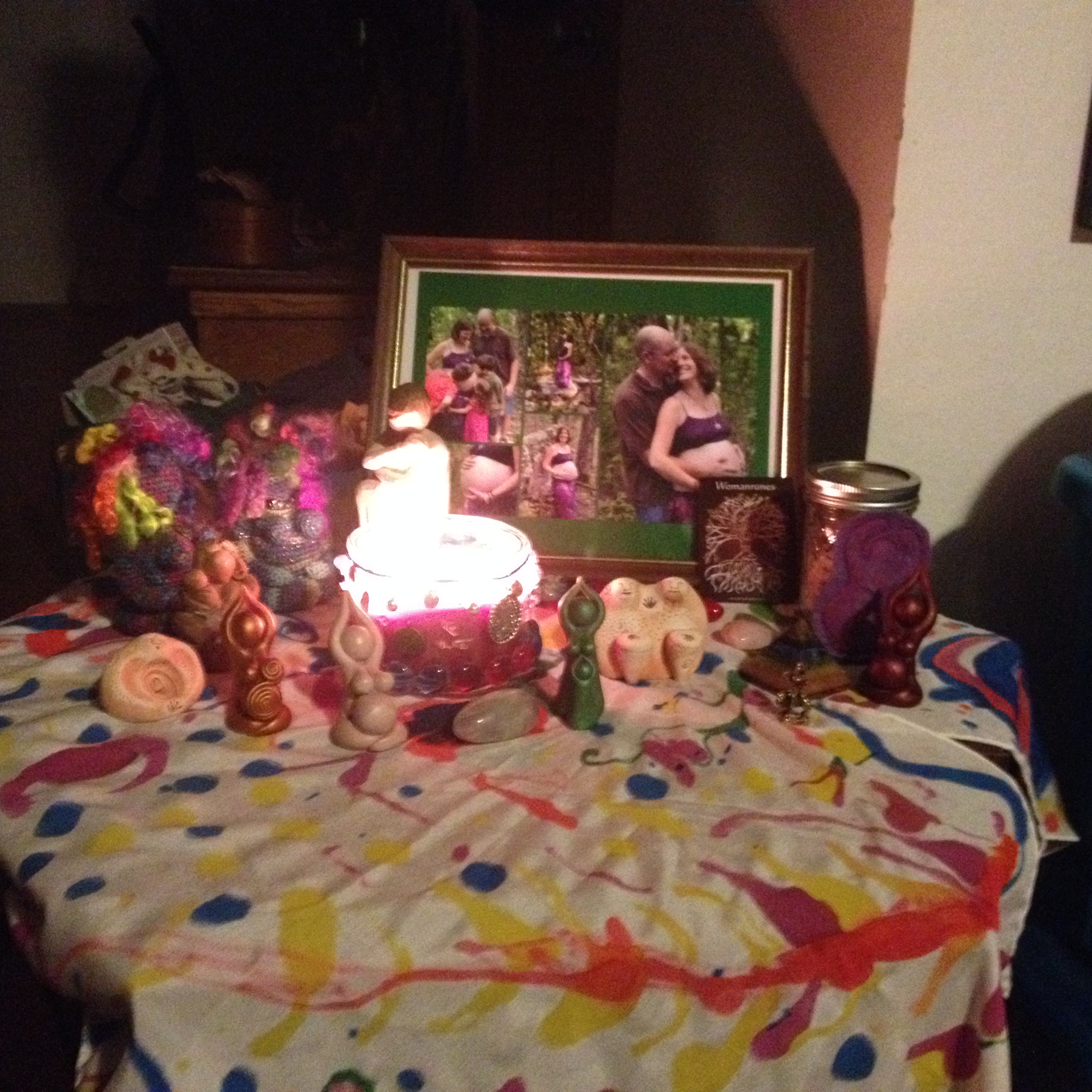
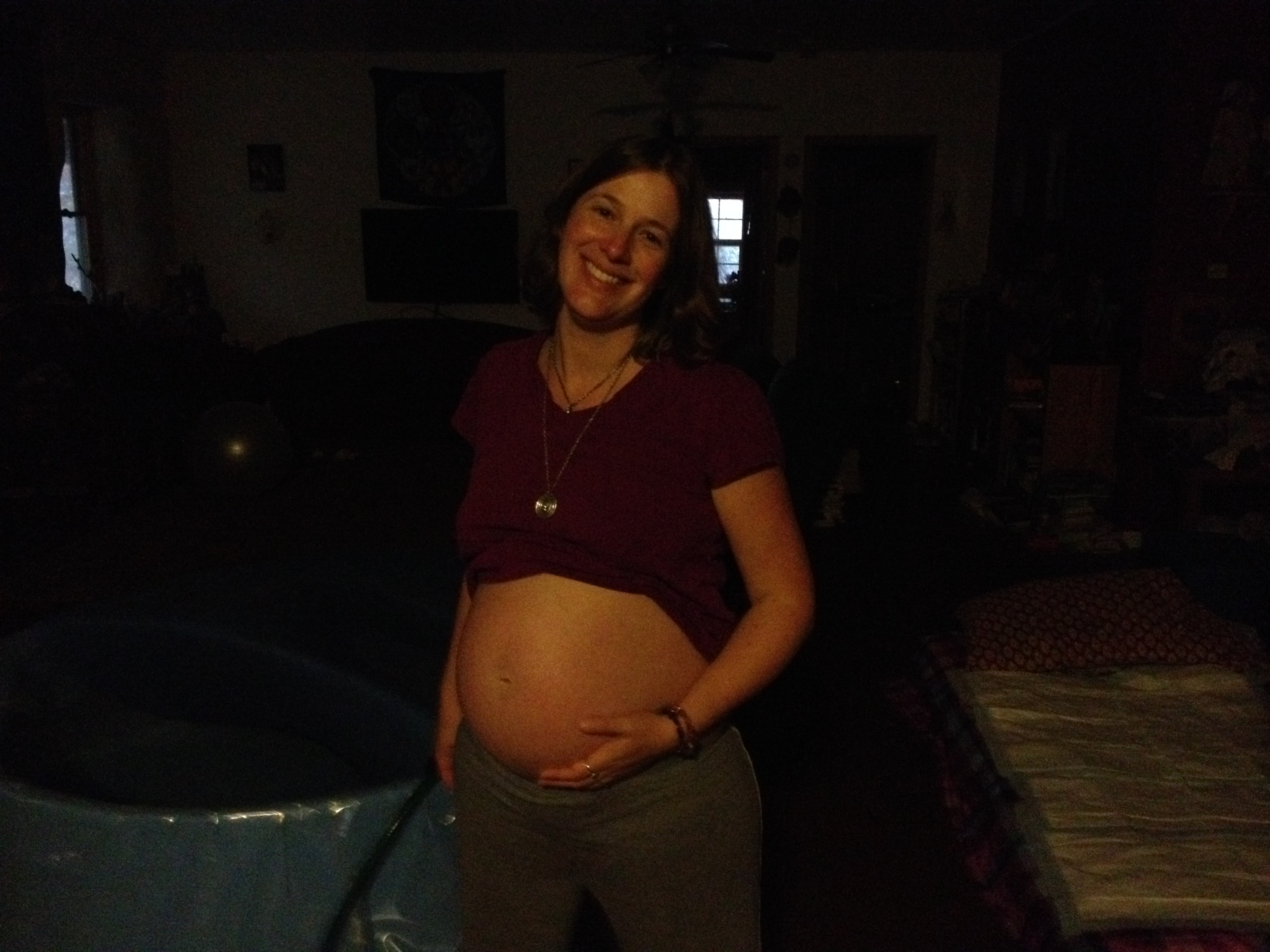
IMG_8557As was my pregnancy custom, on October 30th I woke up around 3:00 a.m. with definite contractions. They were spaced about 30 minutes apart, however, and I kept myself awake unnecessarily waiting for them to get bigger or closer together. I finally got up at 4:30 or 5:00 and Mark got up too. As I as I got up, contractions picked up to about three minutes apart. I couldn’t believe I’d “wasted time” by lying down, non-sleeping AND non-laboring! I felt very adrenaline filled and excited. The sense of urgency and “coming soon” was very familiar to Zander’s exceedingly fast labor, whereas my sense of need to call Mom during a contraction and then changing my mind afterward was similar to Lann’s. And, leaning on the kitchen half-wall as an ideal labor position was similar to Alaina’s. There was no slow lead-in here, these were sharp, strong, intense contractions that I already couldn’t talk through. Though they felt big and serious, they were also short in duration. I lit my birth altar candle and since I wanted to have clean, freshly washed hair, I decided to take a shower.

043 044After showering and even blowdrying my hair for cuteness in future pictures, the intensity of the contractions increased again. Mark got to work on filling the pool and heating more water as soon as I got out of the shower and he kept messing with the pool even though I was starting to feel like I needed him (also needed pool, so he wasn’t doing the wrong thing!). I felt sure that this was picking up FAST. We texted Mom and she contacted Robin and Summer (midwife and doula). I felt a weird sensation of time pressure then, looking out window, waiting and not wanting to be observed, waited for, or watched. The pool continued to take a lot of time and attention and was annoying. Plus, the hose popped out when Mark was in the laundry room and flooded the floor. I was saying things like, “this had better be the best thing ever, because right now I hate it!” I couldn’t decide if I should keep standing up or try something else like sit on the birth ball or try the water. It seemed early for water (except during contractions!), so I sat on the ball at which point contractions became HUGE, but, also only 8-10 minutes apart. I was confused and kept trying to figure out what made more sense—smaller, more frequent contractions while standing up, or bigger but far apart on the ball. I was laughing about my indecisiveness and kept saying, “so, tell me what to doooooooo!” (which is actually my most despised thing in labor). I opted to stay on the ball because I felt open there and when standing I felt like I was closing my legs together and tensing up. On the ball, I started humming the Sacred Pregnancy Standing at the Edge song I listened to so often during my pregnancy: standing at the edge…clinging to my innocence…one more tiny step…time is here and now…diving into the unknown. I believe in me, I believe in meee-eeee. I believe in me, I do, I do…

Later, in the pool, I turned on the rest of my Sacred Pregnancy playlist from the CD, which I both liked and didn’t like because I could no longer anchor myself then with the “I believe in me, I do” hum.  I talked and joked and laughed about stuff a lot. And, I would sing little things like: let’s find something else to say and not owie-zooooowie… I do not know how else to say that these were intense, big, powerful contractions. To my memory, they feel like they were the biggest, most painful contractions I’ve ever had—but slooooooowly far apart. The sensation of downward pressure was powerful already during each, but the distance between them very confusing. After back and forthing verbally for some time, I decided to get in the pool: this had BETTER be WORTH IT.

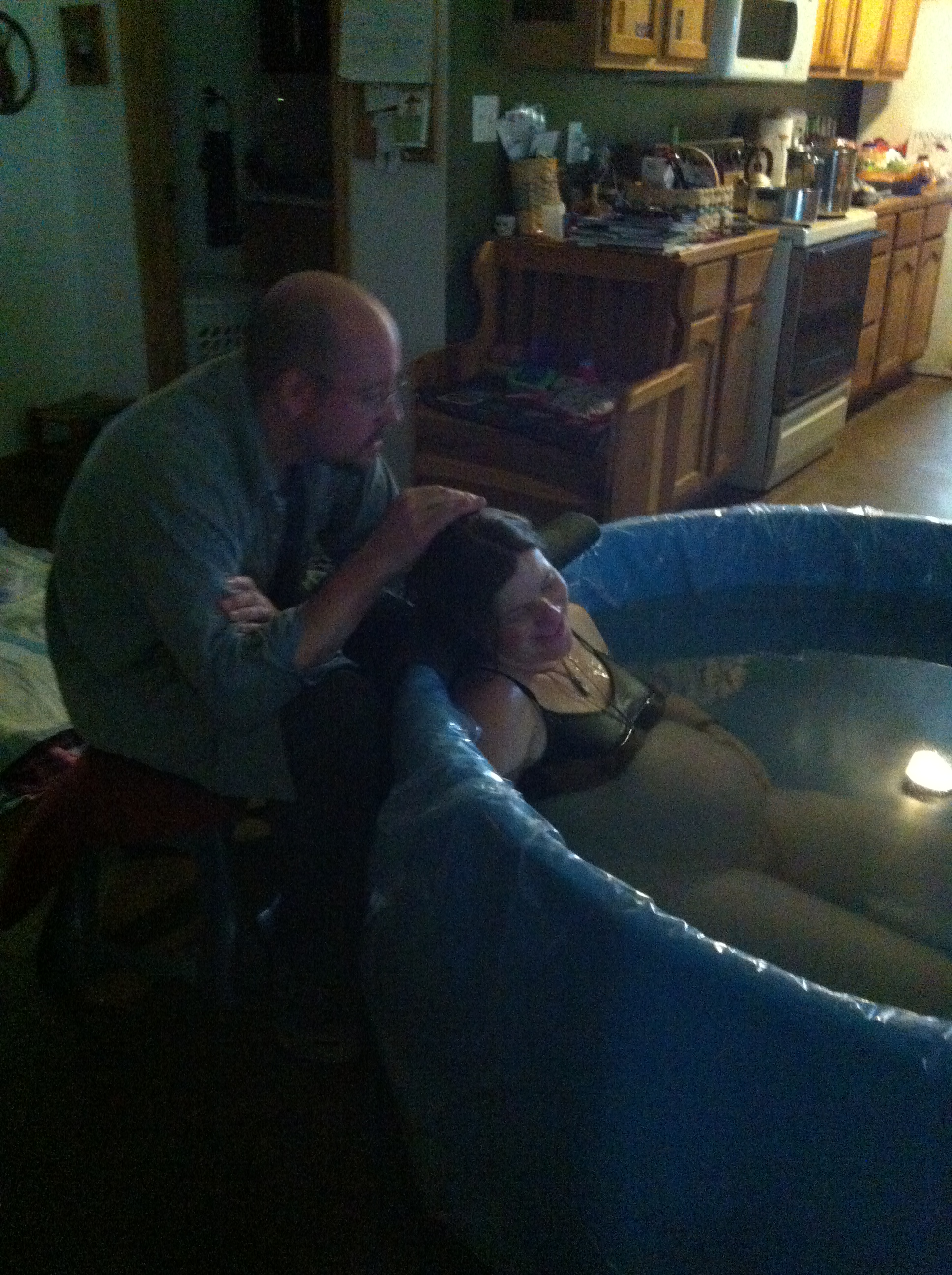
I loved the pool, but I also, intensely, felt like I was on “display” or being watched. I also felt a little isolated or separated and observed, even by my own mom (who, mindfully, went to sit on the couch to give me space). I kept feeling worried and pressured about my midwife and doula getting there any minute, even though we talked in advance about how I mainly needed them for immediate postpartum care and only wanted them to come in at the very end. I had never talked to my mom about specifically when to tell them to actually come though, so I kept thinking they were sitting in the driveway waiting for me (they weren’t, because they were being respectful of what they knew I wanted and needed). As with my other babies, I knew in my heart I wanted to birth alone, but then with immediate postpartum/follow-up care. This is hard to balance and gauge. And, I acknowledge that it isn’t really fair to the midwife either! My birth brain really needs to be alone and unwatched and I knew in the pool that I wanted to push my baby out before anyone else was there.

I took my favorite birth goddess sculpture into the pool with me where she kept me company and floated with me and reassured me until I was pushing and set her outside the tub (ever practical, I didn’t want her to get lost in what I knew would end up as bloody water!).

047

If you look close, you can spy the little goddess in my hand.

048

Here, I was laughing about feeling like a little toad in a pool.

My mom kept me supplied with food and drinks and occasional encouragement and Mark stayed close, touching me and being present. There was lots of waiting in the pool (I feel like) for those slow but BIG contractions. I got out to pee and finally saw some BLOOD. I always wait and wait for this sign because for me it is the herald of nearly full dilation. I have no blood or any leaking or discharge until I’m only a short distance from pushing out a baby! I shook and shook in the bathroom at this point too, which I think was related to the temperature change from getting out of the warm pool and not transition per se, but it could have been both.

Back to the pool and out one more time to pee (more blood! Yay! Blood is so fun! Really. It is super encouraging for me to see during labor at this point.) I started to weirdly fret about my bladder at this point getting in the way of baby’s head (potentially): this can happen, you know, I told my mom and Mark (even though I was totally peeing and had no signs of bladder being in the way). I could tell baby was moving down and getting close to pushing, but I felt impeded with the amniotic sac intact. I moved to hands and knees in the tub and talked to myself: it’s okay. You’re okay. We’re okay. I can do it. We can do it. You can come out baby. We want you. We want you. (I cried I tiny bit saying this.)

IMG_8532

I like how you can see my friendly little birth altar glowing in the background.

IMG_8533

I turned back over then and kept on smiling…

IMG_8535

One hour before birth.

IMG_8543Some time after this, I started feeling inside after each contraction and could feel a hard lump getting closer and closer every time I had a (now close together) contraction. I didn’t feel sure it was a head though, but that maybe I was somehow feeling my own pubic bone or some other mysterious part of my anatomy never before felt. It felt squishy kind of, though hard underneath. (Duh, because it was an amniotic sac around a baby head, Molly!), so then I imagined I wasn’t fully dilated and was somehow prolapsing my cervix instead of feeling a baby’s head. I think these types of thoughts are one of the hazards of being a birth professional. They are also proof, to me, that no matter what odd or frightening things you think, babies’ heads still move down and come out anyway! At this point, the baby began to have hiccups. He was so low that it basically felt like my anus was hiccupping. I had Mark feel them very low on my belly—just above my pubic bone—and then I laughed and saidthis counts as a fetal heart tones check!

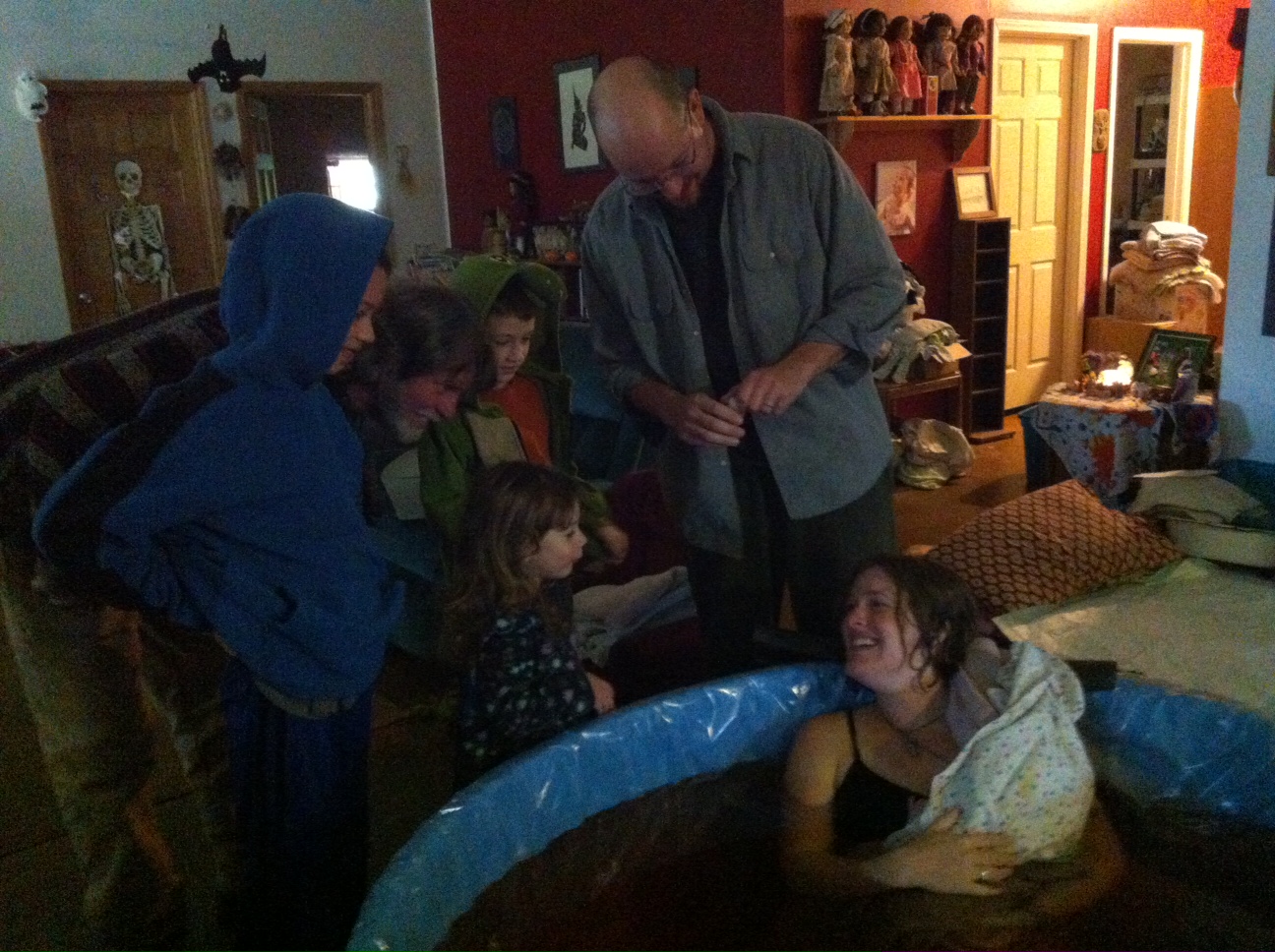
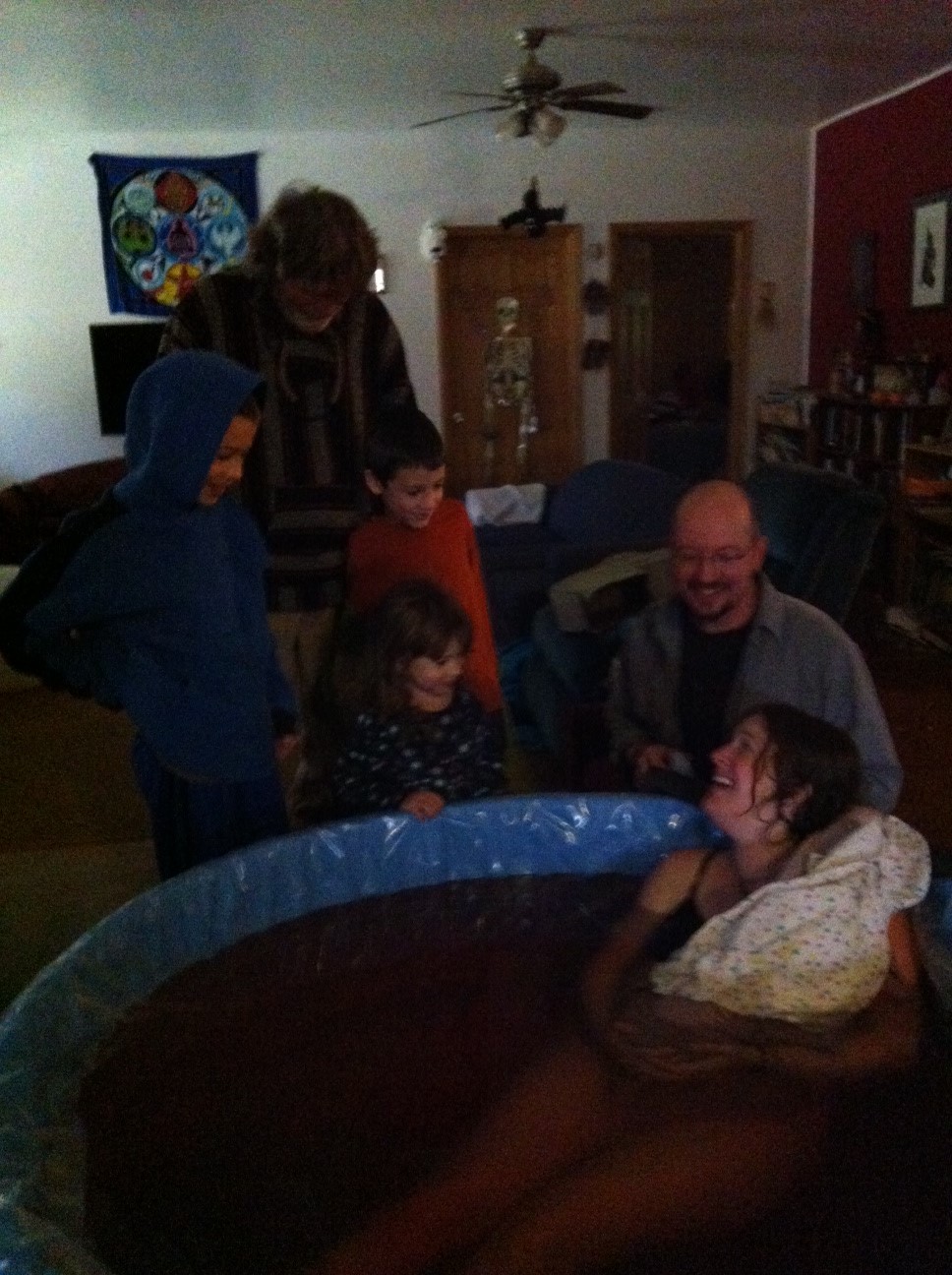
Finally, my water broke at last and I knew he was almost out. Pushing was intense and big and felt huge and hard and long. I became convinced baby weighed ten pounds and was probably not going to come out. I felt like it was taking a long time and a lot of work, but according to Mom and Mark it was about four pushes and date stamps on pictures reveal about 5-6 minutes total of this hard work. I also kept thinking someone else was going to come in. I felt the familiar burning on my front right side and knew I would tear again (labial/clitoral). It felt scary and I looked at my mom and said I was scared (she said, “I know”). I almost pushed through the burn, but then I stopped myself and waited for the next push and then his head was out, along with a bloom of blood in the water which does indicate tearing, but I didn’t get checked for tears (by my specific decision and request) so I don’t know for sure. A minimal follow-up push and his body came out into my hands. He bobbed to the top of the pool and I lifted him out of the water. He cried a little and was already reasonably pink. He was looking around and was a little bit gurgly. I talked to him and kissed his head and told him I loved him: oh my little one, oh my little one. Oh my goodness! Oh my goodness! There really was a baby! Oh, he’s CUTE! I noticed his cord was around his neck and arm and somewhat awkwardly moved it off. It was 10:20, a little over five hours after I got up.

We called my dad to bring the kids back over to see the baby and cut the cord and they arrived a few minutes before Summer and Robin got there.

053 054After Robin and Summer arrived, they helped me out the pool which I was eager to get out of, but had a lot of trouble actually doing, and onto my futon nest on the floor between the pool and bathroom. This is the part I didn’t like. So familiar and so not fun. The weak and wounded transition. But, Summer (doula) reminded me that the warrior moments are in feeling the vulnerability too. Sometimes the warrior is found in showing the vulnerability and needing the help.

After some lying on the futon and waiting for the placenta, I went to the bathroom (still holding baby attached with cord) and the placenta finally came out there (after it was washed, I swallowed a small piece of it). Zander and Alaina cut the cord as they had been waiting to do and then left for playgroup with my friend who was waiting patiently outside to take them. When the placenta was examined, they saw he had a velamentous cord, which is fairly rare and can actually be dangerous and possibly explains my widely spaced contractions (giving baby time he needed).

256

The baby’s temperature was low and it took us some time and effort to get him warmed up and that was probably because I was in the water a little long after birth and that is my only regret about this birth. When his temperature was normal, we weighed him and he only came up as 6lbs4oz. He then weighed 7lbs4oz at two days, which means he was really bigger than that at birth. He weighs eight pounds now at a week. So, he weighed something at birth, but the exact amount is unknown! He was 20 inches and had a 14 inch head.

As I laid on my futon and latched baby on for the first time, I realized that in all my planning and fretting and preparing and deadlining, I’d forgotten how very, very much love was possible.

Edited one year later to add that Tanner’s birth video is now available online: Welcoming Tanner Matthias (Home Water Birth Video) – Brigid’s Grove

Mother Blessings and the Power of Ritual

Mollyblessingway 116You are the
most powerful
intelligent
inspirational

Woman

Close to my heart.

You continue to
become
exponentially more amazing.

Always giving
others the step UP.

Force of the cosmos
connecting the Web

You are.

Thank you.

–Phanie


At the end of September, my friend sat on the floor during my mother blessing ceremony and wrote the above poem for me. When she gave it to me she said, “I’m not like you, I don’t write things and share them on the internet.” It was very powerful to receive the gift of written word from someone who does not often write, but who knows how deeply writing speaks to me. 

My mother’s circle of friends began holding mother blessing ceremonies for each other in the early 1980’s. At the time they called them “blessingways” in honor and respect for the Navajo traditions that inspired them to begin their own tradition. As awareness of cultural appropriation increased, we shifted our language to use “mother blessing ceremony” instead, though I confess that “blessingway” remains the term rooted in my heart for these powerful, mother-honoring celebrations of the power of the life-giving woman. After having been blessed with a ceremony during her last two pregnancies in the late 1980’s and having co-hosted coming-of-age blessing ceremonies for me and my sisters in the 90’s, my mother reintroduced the mother blessing ceremony to my own circle of friends during my first pregnancy in 2003. We’ve been holding them for women in the area ever since. I believe each pregnant woman deserves a powerful ritual acknowledging her transition through pregnancy and birth and into motherhood, regardless of how many children she has.

Early this year, I became unexpectedly pregnant with the baby who will arrive into our arms at the end of October as our fourth living child. I did not intend to have more children and it has been hard for me to re-open the space in my mind, heart, and family to welcome another baby when I had mentally and emotionally “shut the door” and moved on from the childbearing chapter of my life. (However, it turns out that writing blog posts about how you’re not having any more children is not, in fact, an effective means of birth control.)

In the book Rituals for Our Times, the authors Evan Imber-Black and Janine Roberts, identify five elements that make ritual work. Mother blessing ceremonies very neatly fulfill all of the necessary ritual elements (which I would note are not about symbols, actions, and physical objects, but are instead about the relational elements of connection, affection, and relationship):

  1. Relatingthe shaping, expressing, and maintaining of important relationships…established relationships were reaffirmed and new relationship possibilities opened. Many women choose to invite those from their inner circle to their mother blessings. This means of deeply engaging with and connecting with those closest to you, reaffirms and strengthens important relationships. In my own life, I’ve always chosen to invite more women than just those in my “inner circle” and in so doing have found that it is true that new relationship possibilities emerge from the reaching out and inclusion of those who were originally less close, but who after the connection of shared ritual, then became closer friends.
  2. Changingthe making and marking of transitions for self and others. Birth and the entry into motherhood—an intense and permanent life change—is one of life’s most significant transitions in many women’s lives. A blessingway marks the significance of this huge change.
  3. Healingrecovery from loss, special tributes, recovering from fears or scars from previous births or cultural socialization about birth. My mom and some close friends had a meaningful ceremony for me following the death-birth of my third baby. I’ve also planned several mother blessing ceremonies for friends in which releasing fears was a potent element of the ritual.
  4. Believingthe voicing of beliefs and the making of meaning. By honoring a pregnant woman through ceremony, we are affirming that pregnancy, birth, and motherhood are valuable and meaningful rites of passage deserving of celebration and acknowledgement.
  5. Celebratingthe expressing of deep joy and the honoring of life with festivity. Celebrating accomplishments of…one’s very being.

Notice that what is NOT included on this list is any mention of a specific religion, deity, or “should do” list of what color of candle to include! Mollyblessingway 177I’ve observed that many people are starved for ritual, but they may also be deeply scarred from rituals of their pasts. As an example from the planning of a past ceremony, we were talking about one of the songs that we customarily sing–Call Down Blessing–because we weren’t sure if we should include it in case it would feel too “spiritual” or metaphysical for the atheist-identified honoree (i.e. blessings from where?!). I also remembered another friend asking during a body blessing ritual we did at a women’s retreat, “but WHO’s doing the blessing?” As someone who does not personally come a religious framework in which blessings are bestowed from outside sources–i.e. a priest/priestess or an Abrahamic God–the answer, to me, feels simple, well, WE are. We’re blessing each other. When we “call down a blessing” we’re invoking the connection of the women around us, the women of all past times and places, and of the beautiful world that surrounds us. We might each personally add something more to that calling down, but at the root, to me, it is an affirmation of connection to the rhythms and cycles of relationship, time, and place. Blessings come from within and around us all the time, nothing supernatural required.

I also find that it is very possible to plan and facilitate women’s rituals that speak to the “womanspirit” in all of us and do not require a specifically shared spiritual framework or belief system in order to gain something special from the connection with other women.

In the book The Power of RitualRachel Pollack explains:

“Ritual opens a doorway in the invisible wall that seems to separate the spiritual and the physical. The formal quality of ritual allows us to move into the space between the worlds, experience what we need, and then step back and once more close the doorway so we can return to our lives enriched.”

She goes on to say:

You do not actually have to accept the ideas of any single tradition, or even believe in divine forces at all, to take part in ritual. Ritual is a direct experience, not a doctrine. Though it will certainly help to suspend your disbelief for the time of the ritual, you could attend a group ritual, take part in the chanting and drumming, and find yourself transported to a sense of wonder at the simple beauty of it all without ever actually believing in any of the claims made or the Spirits invoked. You can also adapt rituals to your own beliefs. If evolution means more to you than a Creator, you could see ritual as a way to connect yourself to the life force…

In the anthology of women’s rituals, The Goddess Celebrates, wisewoman-birthkeeper, Jeannine Pavarti Baker explains:

The entire Blessingway Ceremony is a template for childbirth. The beginning rituals are like nesting and early labor. The grooming and washing like active labor. The gift giving like giving birth and the closing songs/prayers, delivery of the placenta and postpartum. A shamanic midwife learns how to read a Blessingway diagnostically and mythically, sharing what she saw with the pregnant woman in order to clear the road better for birth.

Baker goes on to describe the potent meaning of birth and its affirmation through and by ritual acknowledgement:

Birth is a woman’s spiritual vision quest. When this idea is ritualized beforehand, the deeper meanings of childbirth can more readily be accessed. Birth is also beyond any one woman’s personal desires and will, binding her in the community of all women. Like the birthing beads, her experiences is one more bead on a very long strand connecting all mothers. Rituals for birth hone these birthing beads, bringing to light each facet of the journey of birth…

As my friends spoke to me at my own mother blessing ceremony, I felt seen and heard. They spoke to me of my own capacities, my Mollyblessingway 190strengths as a leader, teacher, and organizer. And, while I believe they were also actually trying to remind me of the opposite message, to take it easy and relax sometimes, one of the things I woke up the next day realizing is that yes, I do feel overwhelmed and overbooked and stretched thin at times. And, yes, I do whine and complain about it on Facebook sometimes, but in the end, I am always enough for whatever it is. I get it done anyway. I don’t think I’ve ever felt overwhelmed and then not done it (assuming “it” wasn’t a self-imposed expectation that I mercifully realized could be let go of). That is one my strengths: feeling the fear or the strain or the pressure or, yes, the excitement and thrill, and NOT getting paralyzed by it or letting myself off the hook. I work my way through and come out the other side, usually with my smile intact, my energy full, my head bubbling with ideas, and my eyes casting around for the next project. Occasionally, I do drop a ball, but pretty rarely, and when I do, I either find it or explain where it went and why I’m going to let it keep rolling away.

I discovered in this post-ritual reflection that it is just part of my personal process to be able to say, and be vulnerable enough to have people hear, see, or read, that I think maybe I can’t do something or that I’ve said yes to too much. The answer for me is not, “then don’t” or “stop” or “quit” or “take it easy,” it is to move forward and to see, again, that I was actually enough for what scared me or felt too big or too exhausting. I woke up the morning following the ritual in appreciation of my own capacities and how they continue to expand, even when I feel as if I’ve reached my own edges. I actually feel “too much,” “too intense,” “too big,” or “too fast” for people a lot, but what I don’t ever need is to be told to make myself smaller. I usually need to be able to say, “Yikes! What am I thinking?!” have that held for me for a minute, and then do it anyway. Just as those of us deeply invested in birthwork would never tell a laboring woman, “you’re right. You probably can’t do this. You should probably quit now,” my mother blessing ceremony reminded me that I am stretched thin precisely because I have it in me.

Mollyblessingway 258

I wish for you a life full of ritual and community.” –Flaming Rainbow Woman, Spiritual Warrior 

(in The Thundering Years: Rituals and Sacred Wisdom for Teens)

Molly is a priestess, writer, teacher, artist, and activist who lives with her husband and children in central Missouri. She is a doctoral student in women’s spirituality at Ocean Seminary College and the author of Womanrunes: A guide to their use and interpretation. Molly and her husband co-create at Brigid’s Grove: http://brigidsgrove.etsy.com.

Portions of this post are excerpted from our Ritual Recipe Kit booklet.

Adapted from a post at Feminism and Religion.

Other posts about mother blessings can be found here.

All photos by my talented friend Karen Orozco of Portraits and Paws Photography.

Mollyblessingway 372

Tuesday Tidbits: Pregnancy and Infant Loss Awareness Month

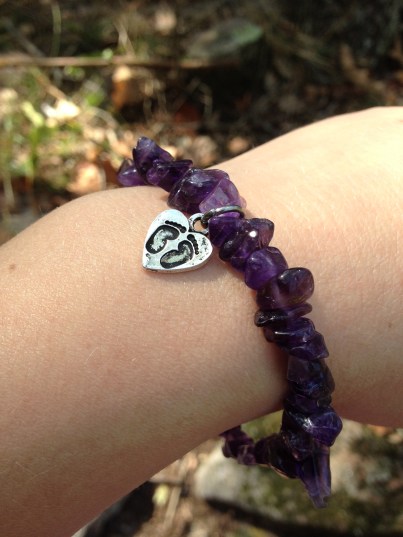
October is Pregnancy and Infant Loss Awareness Month. Many of us are all too aware of the face of pregnancy loss and the 1 in 4 women who will have this experience as part of their journey through the childbearing year. When my third baby died during my second trimester of pregnancy in 2009, I found the image of tiny footprints on my heart to be a very significant symbol. Since that time, I always keep footprints charms on hand to share with other mothers. I’d hoped to create a new sculpture in honor of this year’s awareness month, but didn’t manage to do so. Instead, in honor, we created a new memorial bracelet for mothers impacted by babyloss. A portion of the proceeds goes to benefit the local pregnancy loss support group in making jewelry items for memory boxes.

October 2014 061

Footprints on My Heart Memorial Bracelet by BrigidsGrove on Etsy.

Our shop also picks one organization a month for a donation to a nonprofit organization. Our October donation went to Brittany’s Blankets for Tiny Babies. We sent footprints charms and forget-me-knot charms:
New Etsy Pictures 004
My Sacred Postpartum class started on October 1st and our first week’s assignment was art journaling about our birth experiences. It has been almost five years since my first miscarriage-birth and while sometimes I feel like I seem weird or like I “shouldn’t” keep counting it, I’ve always given Noah’s birth equal weight as a birth experience in my childbearing life.  So, I included a page for his birth story in my art journal as well.
October 2014 045
(Side note: I have been seeing a chiropractor recently to make sure I’m in good alignment for my upcoming birth and it means a lot to me that she remembers and counts Noah’s birth experience too, saying things like, “well, since you’ve had four births before,” even though I’m in her office with only three kids.)
I’ve mentioned before how powerfully I needed other women’s stories after my own miscarriage experiences. My two favorite books for this are:

I’ve also shared the link to my friend’s miscarriage-birth story in a past post. It is one of the most powerfully written miscarriage stories I’ve ever read. October also marks her due date with that baby and so I want to honor her memory by sharing the link to their birth story again today:

…Three words. It only took me three words to tell you, friend, acquaintance, or stranger, what happened to me. I wonder how many more words it will take to tell myself — the MAMA, the bearer of lost life — what happened.

11 weeks. Saturday night. Walgreens bathroom. By myself. Cabernet Sauvignon in the public toilet. Doughnut-sized clots of tissue that just kept coming. The sensation of birthing jellyfish. Sticky red hands from trying to clean myself up, pulling red chunks out of my underwear. Staring into the toilet and wondering how in the world I could possibly flush it I did, after a long time and many tears. Drips running down my legs and polka-dotting my feet. Telling an employee there was a bloody mess in the bathroom. Walking out of Walgreens in blood-stained jeans.

Did you like it better when I had only said three words? I liked it better when I was still pregnant.

via Losing Susannah | Peace, Love, & Spit Up.

I did note in an article I just read this week via a different friend who recently experienced miscarriage, that personal stories can also be unhelpful to others though, especially when they redirect from the woman in front of us to our own experiences (though, I would venture to say that is because so many of us feel as if we have to hold our own stories close to our hearts, and therefore somewhat unresolved, because of a lack of cultural permission to talk about them normally):

I am left feeling more alone than I ever thought possible. Solicited or not, countless women say to me, “Why is no one talking about miscarriage. No one talks about postpartum depression either. All of these things women go through that nobody talks about. Why are we not talking about it if everyone is going through it?” It’s only now that I realize why I don’t want to share my experience as openly anymore. The more I talked about it, the less understood I felt.

All I yearn for is the simplest of engagement, “How are you feeling?” Four words. Nothing more.

Instead, I am bombarded by horror stories of women losing their longed for dream in a pool of blood or heroic war stories of women whose histories in no my way resemble mine and go on to have healthy children. Are the details of someone’s sister’s friend’s friends’ 4 consecutive miscarriages supposed to be heartening?Women use my openness about my loss as a springboard to delve into their reproductive aches and pains, recent or decades old. The sharing feels tinged — needing to be less this, more that, better than, more than, and most definitely triumphant in achieving their desired family size. I propose that we simply listen to one another, with presence of mind and heart, no matter the level of uncomfortability.

via Grand Losses: Musings on My Miscarriage | Christy Turlington Burns.

This article is extremely powerful and I highly recommend it. The author goes on to explore how women blame themselves for their reproductive losses:

Miscarriage is simpler than all of that. It is loss of life that wasn’t sustainable.

I have fantasies of shouting this from rooftops and tweeting random cryptic notes containing the facts about pregnancy loss in the hopes of galvanizing women’s perceptions of themselves. I daydream about pleading with women not to blame their beautiful bodies for their reproductive devastations. I wish I could dare every woman who has at some point or another wondered if they were somehow the root cause of a reproductive disappointment to turn that question on its head. “What if you are not the reason that this happened to you? What if it just is?” I can’t help but wonder if this would illicit more anger, more grief, more relief, and/or more hope. Or maybe something else completely. I am confident that it would engender less competitiveness, less perfectionistic strivings, and more self-love.

via Grand Losses: Musings on My Miscarriage | Christy Turlington Burns.

Related past posts:

Tuesday Tidbits: Miscarriage Care | Talk Birth.

Tuesday Tidbits: Miscarriage and Story-Sharing | Talk Birth.

Tuesday Tidbits: Miscarriage | Talk Birth.


Tuesday Tidbits: Creation and Distraction

“I have discovered nothing more stunning, nothing more emotionally stirring, nothing more intriguing than a woman as she creates life.” –Patrick Stull (in Evolve)

August 2014 085From the Celebrating Motherhood book I’ve been using for an intermittent series of posts, comes this thought about creativity from Meinrad Craighead:

Images are like children. Children come out of our bodies as distinct creatures with their own life form…They have come out of us, but they have their own energy separate from us.

Women create—we all create—out of our bodies…The creativity in women’s bodies, the potential in our bodies for making children from our many eggs is, I think, no different from the potential for making imagery from our many eggs…It is very important for we women to understand that whether we are creating biologically or metaphysically from those eggs, it is all the fruit of our body, the fruit of our creativity.

–Meinrad Craighead, from Sacred Stories quoted in Celebrating Motherhood (p. 43).

After quoting Craighead, I remembered I’ve quoted her previously and so I went looking for that quote, which was:

“Come into my lap and sit in the center of your soul. Drink the living waters of memory and give birth to yourself. What you unearth with stun you. You will paint the walls of this cave in thanksgiving.”

–Meinrad Craighead

This quote was used in the context of a post I wrote about my last computer-off week and “defragmenting” my brain, in which I eventually came to the conclusion:

I always have “too much to do,” technology or not. It is kind of how I’m built. I am packed with ideas and plans and goals all the time, so are my kids, so are my parents. I think it is genetic. Also, this makes us interesting people albeit perhaps not Zen enough for some as well as for my imaginary conception of how my life “should” be.

via Mental Defrag computer off week reflections | Talk Birth.

This post led me to another one musing about the “distractions” of technology:

I have to say that when I read content decrying technology as negative and lamenting the abundance of children on their “devices,” part of me hears: “these new-fangled kids driving cars instead of good old horses and buggies!” This is reality. In my specific family, technology and screen-time built my family’s financial security and our literal home. My husband made a living for years off of screens—eight hours a day in front of one in fact. I use one now to support my family and to, get this, be with my children. Using a computer (ipad, etc.) is how I teach, how I write, how I communicate, how I interact, how I earn money, how I sell my creations. My mom was on the phone a lot when I was a kid. I’m on the computer a lot. Maybe Idealized Mythical Past Mom was in the cotton field a lot, or washing laundry for others, or working in a lace factory, or milking cows, or shelling peanuts or making paper flowers, or keeping up the house, or taking care of younger children, or, or, or. Moms have never “not worked.” And, they’ve never been non-“distracted,” just the mode and texture of this “distraction” shifts with times, contexts, roles, activities, and availability of whatever. Perhaps it is all just life and living?! I am as interested by mindfulness and present moment awareness as the next person and yet I always wonder: “can’t I be typing this blog post in the present moment?!” Can’t I be thinking about my to-do list in the present moment? Can’t I be smelling this rose in the present moment? AND, can’t I also be sending this text in the present moment? Why does “present moment” have to be synonymous with no to-do list and no technology? I can very presently us both…right?!

via Tuesday Tidbits: Blogging, Busyness, and Life Part 2 | Talk Birth.

And, I’ve been thinking about the snappy feeling I have this week and how I can be both controlling and flexible, good-humored and humorless, happy Mom reading books aloud and crabby Mom saying, “get that out of my face,” on edge and content, often within the same day and same hour. This reminded me of a post I wrote quite a while ago about “dualism” and how we are received, perceived, and experienced by people can all be true:

And, I started to reflect that I guess I am all these things and how people experience me and my writing is in part up to me and in part up to them. Just like in real life. I can be gentle, kind, and nurturing. I can be critical, judgmental, and harsh. I can be helpful and I can be selfish. I can be patient and impatient. I can be friendly, I can be preoccupied. I can be energetic and enthusiastic and upbeat and I can be exhausted and defeated. I can be a fabulous, fun mother and I can be a distracted and grouchy mother. I can be funny and I can take myself too seriously. Different people, relationships, and environments bring out different expressions of who I am. Sometimes I really like myself a lot. I like who I am, I like how I move through the world, and I’m impressed with my own capacities. I have great ideas and solid values and principles and the ability to articulate those in writing. Sometimes I actually hate myself. I see only the bad parts and I wish I could just be better. I feel hypocritical and over aware of inconsistencies in my own thoughts/beliefs and my expression of my values in the world. I often want to be better than I am, but in rare moments of grace and self-compassion, I realize that I’m pretty good already. And, in some moments of self-righteousness and superiority, I actually feel better than some people in some areas/some ways!

via The dualism of blogging and life | Talk Birth.

I hope I can remember to extend enough compassion and grace to others to realize they are the same way and not write someone off based on one experience or encounter!

(Isn’t it convenient that I’ve already had all these thoughts already and can just go back to my blog to mine for them, rather than starting from scratch all the time? 😉 )

Returning to creation and motherhood though, I think this etsy shop (Shaping Spirit) has the most amazing and best driftwood sculptures of all time:

Reserved for Gillian, I Will Remember, Driftwood Sculpture by Shaping Spirit, Last PaymentAnd I wanted to share a new picture of our cesarean birth goddess design that we re-worked slightly and re-cast recently:

September 2014 030I thought of her as I read a beautiful article about why grieving for birth is selfless and not selfish (shared via Summer Birth Services):

Women grieve stolen birth experiences very deeply, but their grief often remains private because modern birth culture maintains that a healthy baby is the one and only goal. The roots of “the healthy baby lie” are found in the reality of birth, that the outcome is unknown and one potential outcome is, quite undeniably, death. But to women, birth means a great deal more than being alive afterwards. Birth is the introduction to their baby, it matters a great deal.

Mothers spend many months imagining birth, sometimes many years. They imagine feeling more love than they ever imagined when they set eyes on their new baby. The reality is that sometimes things go awry – women are not so stupid that they can’t grasp that – but when they reach out to tell their stories they are often told one of two things; that they should focus on their healthy baby; and that they had unrealistic expectations of birth. But it is not unrealistic to expect that you will feel joyful when you give birth…

via Grieving for Birth is Selfless Not Selfish – Whole Woman.

September 2014 023

“These are her endless years, woman and child, in dream molded and wet, a bowl growing on a wheel, no mud, not bowl, not clay, but this becoming, winter and split of darkness, years of wish.”

–Muriel Rukeyser (quoted in Celebrating Motherhood, p. 47)

Wednesday Tidbits: Mother Care

“I watch her face become alight with joy and ecstasy. ‘You’re here, oh look, you’re here! You’re so beautiful! I love you! We did it!’ It hasn’t been easy, but it was worth it…She knows–in a way that can never be taken from her–the story of her own courage and strength.”

–Jodi Green in SageWoman magazine

Photo: "I watch her face become alight with joy and ecstasy. 'You're here, oh look, you're here! You're so beautiful! I love you! We did it!' It hasn't been easy, but it was worth it...She knows--in a way that can never be taken from her--the story of her own courage and strength." </p><br /><br /> <p>--Jodi Green in SageWoman magazine
After talking with my doula last week about my own powerful need for postpartum care, I re-read my own past post about “birth regrets” and was reminded again how the theme of inadequate postpartum care in my own life resurfaces multiples times. I told my doula that I’ve never really been happy with my postpartum care, recovery, and experience until I hired her for my last birth and became very, very, very clear about exactly what I needed from the people around me following birth. This is despite having an extremely helpful mother who cooked and cared for me very well and lovingly after each birth AND an extremely involved, nurturing husband. I still needed MORE. Postpartum is hard! Many hands, helps, and small care-giving tasks are needed.

It is interesting to me to see that this is where my regrets and “things to fix” come from, rather than from the births themselves. It is kind of hard for me to write about clearly because I did get good care every time from my mom and from Mark, but I still needed MORE. And, I don’t think it is necessarily “fair” to them to skip bonding with the baby because they’re so busy helping me crawl to the bathroom, or whatever! I also didn’t take particularly good care of myself–emotionally, mainly–following birth.

Midwives are wonderful and midwife-attended birth is wonderful, but it feels like very often birth is the moment and then they fade away and the mother must pick up the early postpartum pieces herself, when perhaps her vulnerability and need for support and physical care is highest then, definitely more than prenatally and, I would argue, often more intensely than during the birth itself.

(Oh, and by the way, I still joke that what I’ve really needed is a continuous postpartum doula for the last 11 years…when my first son was born).

My birth regrets post is a companion to my “bragging rights” and birth post:

‘…Frankly, I think all mothers get bragging rights on their babies births. Birth is awesome and amazing and power-full. Every mother must face it. Sure, she may face it differently than me, but it IS a labyrinth we all go through. This is the way of life. So, mothers, brag away. Brag about whatever part of your labor and baby’s birth made you feel empowered….find that piece, even if it’s just a tiny moment, and cling to it. Shout it from the rooftops!…’

via Tuesday Tidbits: Bragging Rights | Talk Birth.

Speaking of doula Summer, Rolla area families should take note that she is available for a variety of different birth and postpartum packages as well as birth classes: Summer Birth Services. I’m looking forward to her care again in October when I have my baby!

And, still speaking of Summer, I am so excited to share that she is moving forward with the Womanspace community resource center idea that we have talked over and visioned for so many years.

…I visualize a center. A place where women can come together to learn, to talk, to develop, to grow. A safe place. A nurturing place. A supportive place. Hostess to LLL meetings, book clubs, birth circle, birth info nights, prenatal yoga classes, birth classes, birth art workshops, pregnancy retreats, journaling workshops, craft classes, crafty mamas meetings, a miscarriage support group, postpartum mamas support group, birth counseling/consultation sessions, dancing for birth, prenatal bellydance, drop-in support chats, blessingways, red tent events, meet the doulas night, Mother’s Guide to Self-Renewal groups, women’s spirituality circles, playgroups, baby massage classes, baby/tot yoga, girls’ coming of age classes, an ICAN chapter, Friends of Missouri Midwives meetings.

A gathering place. A woman’s place.

It will have a large, open meeting room, access to a bathroom and another, smaller room that could be an office, consult room, or playroom. We will have counter space to plug in some minimal cooking implements like a microwave. There will be comfy couches, chairs, toys, a lending library of books and films as well as perhaps toys/games/puzzles. There will be big pillows on the floor and beautiful art all over the walls. Other women wishing to have groups/classes for women, could also use the space for their groups/events.Think we can do it? And, if so, what can I not do to make space in my life for it? In a way, my vision is that this will be that classic “room of one’s one” that every woman needs access to. WomanSpace…

via WomanSpace | Talk Birth.

The above is an excerpt from a post I wrote four years ago! It is so exciting to have it going somewhere. Summer posted on her blog today with her expanded and deepened vision of this space: WomanSpace ~ Making the Vision a Reality

Related to celebrating women and mothers, I updated my mother blessing/women’s ritual page this week: Blessingways / Women’s Programs | Talk Birth.

And, returning to the need for mother care, it so important to recognize that women need support following birth regardless of the week of gestation at which she gives birth. Personally, I was knocked off my feet by my need for immediate support following my first miscarriage. I had never once dreamed miscarriage would be such an intense, physically demanding birth experience. I’m glad this information is now reaching others via Stillbirthday…

When a mother is experiencing pregnancy & infant loss, she needs immediate support.

If you’re a bereaved mother on facebook, it is extremely likely you’ve heard the cry of the newest bereaved mother, sharing that she just very recently endured the death and birth of her beloved baby.

What is some practical support she can use? We have three little buttons published in several places throughout the website, for support prior to, during and after birth in any trimester. Here’s a link for support in the earliest days and weeks after birth:

Photo: If you're a bereaved mother on facebook, it is extremely likely you've heard the cry of the newest bereaved mother, sharing that she just very recently endured the death and birth of her beloved baby.</p><br /><br /> <p>What is some practical support she can use?  We have three little buttons published in several places throughout the website, for support prior to, during and after birth in any trimester.</p><br /><br /> <p>Here's a link for support in the earliest days and weeks after birth:</p><br /><br /> <p>http://www.stillbirthday.com/after-the-birth/

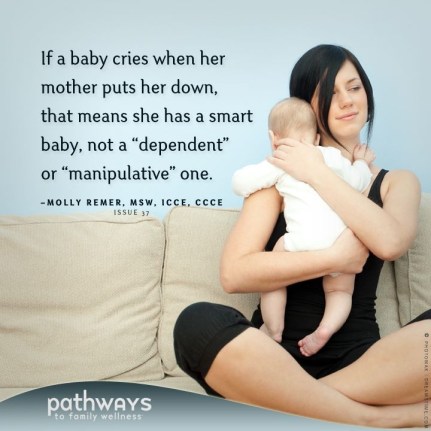
Switching gears somewhat, another one of my quotes from a Pathways magazine article was turned in a Facebook meme and has been shared on Facebook over 3,000 times. I again would have missed it except for two of my friends tagging me in the post!

August 2014 047Remember that in honor of National Breastfeeding Month, we’re offering a 10% off discount code on any of the items in our shop through the end of August: WBW10OFF.

I am 30 weeks pregnant now! I had a bit of an “OMG, can I actually DO this?!” moment last night when the new session of classes began for me. My students asked me how much longer I have left of my pregnancy and my answer was, “about ten weeks.” I have 8 weeks of class…

August 2014 046It is a hot time of year to be pregnant and while I feel good and healthy over all, I am noticing some different things compared to past pregnancies. I weigh 165 pounds now, which is pretty big! I have way more round ligament pain than I’ve ever had before, including just randomly while walking or sitting, rather than exclusively related to getting up “wrong” or twisting in a not pregnant-friendly way. I also keep having some mild heartburn. And, getting up from the floor is a much bigger challenge than ever before.

I’ve mentioned several times in recent posts that Mark and I have been working on birthing a big project together and it is finally here!
August 2014 049Our first collaborative book project! I did the writing and he did all the illustrations, layout, and formatting. This has been a project about 18 months in the making, a more significant undertaking and more significant expenditure of energy than I could have guessed when I began.

I like how the experience of the final stages of the book have paralleled my own pregnancy. As I mentioned a couple of posts ago, our co-creative work on our business endeavors this year is really entwined with the progress of gestating and preparing to welcome our new baby.

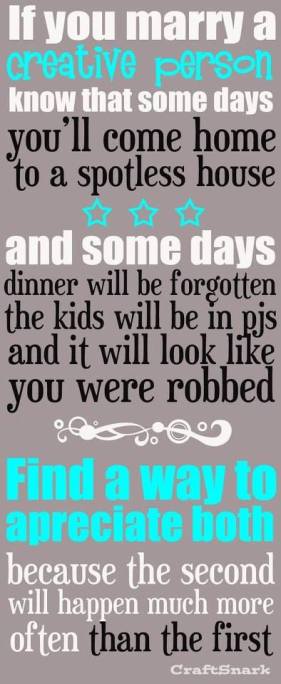
As we’ve worked over the last weeks on the final push to finish the book, I saw this meme on Facebook:1479335_10153562403855714_35111715_nI shared it on our page and noted that when you’re both creative and you’re both home, the effects may be even more dramatic!

Our Embrace Possibility pendant is the design that has perhaps always held the most personal meaning for me, but as we continue to focus in on our shared vision and to embrace new directions, ideas, and projects in the context of our co-created business, she returns to me as very personally meaningful.


“Encoded in her cells,
written on her bones…
The mantle settles around her shoulders.
Sinking into belly, bones, and blood,
until she knows,
without a doubt,
that this is who,
she really is…”

(Embrace Possibility Pewter Goddess Priestess by BrigidsGrove)

And, I shared this on our page recently since it has spoken to me anew in multiple ways this month:

“…These waves of power. February 2014 007
They are you.
You are doing it.
You ARE it.
This is energy, this power, this unfolding might of creation.
It’s you.
Your body
your power
your birth
your baby…”

Birth Spiral Chakra Blessing | Talk Birth.

Thesis Tidbits: Birth as an Initiation

“We owe it both to our children and to the world, to conceive, birth and welcome our children with as much love and prayerfulness as possible.” –Jackie Singer (Birthrites)

“Childbirth is a rite of passage so intense physically, psychologically, emotionally, spiritually, that most other events in a woman’s life pale next to it. In our modern lives, there are few remaining rituals of initiation, few events that challenge a person’s mettle down to the very core. Childbirth remains a primary initiatory rite for a woman.” –from the book MotherMysteries

via Thesis Tidbits: Birth as a Shamanic Experience | Talk Birth.

I recently finished reading a short book called Return to the Great Mother, which is very specifically focused on giving birth as an initiatory event. It includes a variety of birthing women’s voices and experiences with accessing the energy and wisdom of the “great mother,” be it archetype, an inner resource, or one face of the Sacred. The author, Isa Gucciardi, writes:

Giving birth is one of a series of important initiations a woman may experience in her lifetime. Initiations are intimately tied https://www.sacredstream.org/components/com_virtuemart/shop_image/product/b0e92ae33095ca07867acb0a841a9f05.jpgwith change. They bring the initiate from one state of being into a new state of being. Initiations accomplish this task by putting the initiate through a series of experiences that challenge them in a particular way and bring them into new ways of being and of understanding. The initiate must meet these challenges and overcome any obstacles in order for the initiation to succeed in bringing about these changes.

Today, many people going through initiations and many people managing initiations do not have a clear understanding of the nature of the power and vulnerability that is at the heart of initiation. Initiates must render themselves vulnerable to initiatory processes in order for initiations to become complete, and the power in that vulnerability must be managed carefully and thoughtfully. Most importantly, for an initiation to be successful, that power and vulnerability must be safeguarded and dedicated to the initiate.

The process of meeting an obstacle and overcoming it in order to ultimately gain greater insight and power is described by Joseph Campbell as the “hero’s journey.” The “hero’s journey” is an initiatory experience. Every woman takes this journey when she gives birth and it can be the primary initiation a woman undergoes in the course of her life.

Often a woman encounters herself in an entirely new way during the process of giving birth. She may encounter the effect of traumas long buried, or she may encounter fear long denied. She may also discover power deep within herself that she had never imagined.

When the processes of birth are allowed to take their course, a woman with the proper care has the opportunity to come to terms with whatever may arise. In doing so, she may experience a shift into a new way of being or understanding. Yet, when the birth process is interrupted, or not properly held, the power of the initiation is often lost or distorted… (p. 10)

We know that women do not always have full and free choice when it comes to decisions about their birthing bodies and childbearing years…so, how does this impact the initiatory process? Isa writes:

In modern births, the power of the initiation of birth is often co-opted by doctors, pharmaceutical companies, insurance companies, and hospitals. It is also co-opted by the fear of pain and the influence of friends and family. It is difficult for women to hold onto the power of the initiation of birth under these circumstances. The unfortunate implication here is that the subsequent initiations of women interrupted in this way will be affected by their inability to hold onto the power of their birthing process.

Based on the level of interruption of the birth initiation caused by unnecessary interventions in the birthing process today, it seems reasonable to suggest that many women experience incomplete initiations when giving birth…

(Personally, I would clarify that it is not that women are unable to hold onto the power of the birthing process, but rather that it is often systematically stripped from them.)

Each of my children’s birth experience was an initiatory event for me, but in varying ways. With my first, it was the initiation to motherhood, the mystery and anticipation of giving birth. The crucible moment for me with him was actually my journey through the harrowing landscape of postpartum. With my second son, giving birth rapidly and with great intensity and power, the initiation felt like it was in letting go and hanging on for the ride—letting my mind stop and my body go. With my third birth, which was my first miscarriage, the initiation was in the physically grueling and bloody aftermath of his birth and then the broad, deep, unknown, transformative path of grief and change. I still feel as if this was one of the most powerfully initiatory experiences of my life. (And, I did have an encounter with one face of the great mother.) After Alaina’s birthday this week, I was talking to my husband about my memories of this last birth and telling him that I do not review the details of her birth with the same sense of power or initiation as the births of my other children. It doesn’t hold that same “touchstone” energy for me as the births of my boys—experiences that I continued to draw strength from as I went on into other events in my life. I don’t return to her birth for strength or courage the way I remember returning to the births of each of my sons. And, then I said it was because with her, the pregnancy was the initiation. The long, long, path of pregnancy after loss and all the fear and all the hope and all the strain of feeling the feelings and doing it anyway. Her birth itself was the moment of relief. The end of a trial, rather than the triumph or peak experience of the births of my first two babies. So, while of course I still carry powerful and potent memories of her birth as well, it was the journey of pregnancy that holds the talismans of initiation for me.

In her classic book Shakti Woman, Vicki Noble describes giving birth as a central shamanic experience and perhaps the root of all shamanism:

“I believe I underwent an initiation of the most ancient variety, birth as a shamanic experience, the central act of female shamanism—the quintessential act that offers a woman a completed experience of facing and moving through her fears to the other side. It isn’t that birth is the only way for a woman to experience this initiation—many women climb mountains or face other kinds of physical endurance tests and also come through it reborn into their power. But biologically birth is a doorway, a given for most women on the planet. It is fundamental opportunity to become empowered. Most of us giving birth today do not have the full experience, which is co-opted and distorted beyond recognition, changed from an active process into something that is done to us, as if we don’t know how to do it ourselves. Reclaiming the right to birth in our own instinctual way is a shamanic act of courage that has unfortunately become as remote to us as our ability to fly through the night in the form of an owl or heal the sick with the power of the drum. It wouldn’t hurt if we began to think of our birthing and child rearing as central parts of our shamanic work…” (p. 223).

via Thesis Tidbits: Birth as a Shamanic Experience | Talk Birth.

I just finished a new sculpt for a medium sized version of our classic birth goddess pendant and Mark cast and finished some of them last night. I woke up this morning with a phrase from a past piece of poetry floating through my mind over and over:

Soft belly January 2014 088
no longer bearing children
I am pregnant with myself
ripe with potential,
possibility, power
I incubate my dreams
and give birth to my vision…

I also thought about what I hope to communicate to others through my sculptures and when I took the new pendant down to the woods with me, a little song emerged to go with her:

Birth mama
birth goddess

reaching out
to join the circle of mothers

feeling her way
finding her place
in the web of women

Birth mama January 2014 050
birth goddess

hold strong
hold steady

make way for baby
make way for baby

Body opens
heart opens
hands open to receive

Birth mama
birth goddess

she’s finding her way
she’s finding her way…

Disclosure: I received a complimentary digital copy of the book for review purposes.