Archives

Book Review: Pushing for Midwives


Book Review: Pushing for Midwives: Homebirth Mothers and the Reproductive Rights Movement
by Christa Craven
Paperback: 232 pages
Publisher: Temple University Press; 1 edition (October 28, 2010)
ISBN-13: 978-1439902202

Reviewed by Molly Remer, Talk Birth

Mainstream feminist groups have been slow to recognize the right to reproduce along with the right to be free from reproducing. A focus of the second-wave women’s movement was shaking off motherhood as what solely defined womanhood. So perhaps there has been a reluctance to watch over the process that makes women mothers. –Jennifer Block quoted in Pushing for Midwives

Framed as a health policy concern, Pushing for Midwives assesses the homebirth movement and midwifery activism in the context of the reproductive rights movement. The focus of the book is on legislation in Virginia, but is still of relevance and interest to activists from other states. Craven also tackles complicated topics that are often ignored in homebirth and midwifery texts, addressing issues of race, privilege, and socioeconomic status and the impact on access to care. She also takes a solid look at issues of political and religious diversity within the homebirth activist community.

Written in a densely academic style evocative of a dissertation, Pushing for Midwives, became tedious and dry in places and took a long time to finish reading. The very narrow focus on Virginia, while still applicable to other states, became tiresome by the final chapters.

I particularly enjoyed Craven’s exploration of the history of consumer activism in midwifery as well as the consideration of homebirth in the larger context of women’s health activism. I appreciated her exploration of the feminist movement and how it has historically neglected issues of birth advocacy and reform, while also looking the current relationship between feminism and midwifery activism, particularly how birth advocates choose to self-identify. Women’s health activists and midwifery advocates will likely find a lot of food for thought in the pages of Pushing for Midwives.

Disclosures: I received a complimentary copy of this book for review purposes.

Amazon affiliate links included in book title and image.

Can I really expect to have a great birth? (updated edition)

Given my limited situation, can I really expect to have a great birth today?” For the woman who asked me this question a homebirth, a birth center, a midwife, and a doula were all not remotely feasible options. My answer to her question is a qualified “yes!” and it really got me thinking about ways to help yourself have a great birth when your overall choices are limited. In fact, there is a long list of ideas of things that may help contribute to a great birth!

  • Choose your doctor carefully—don’t wait for “the next birth” to find a compatible caregiver. Don’t dismiss uneasiness with your present care provider. As Pam England says, “ask questions before your chile is roasted.” A key point is to pick a provider whose words and actions match (i.e. You ask, “how often do you do episiotomies?” The response, “only when necessary”—if “necessary” actually means 90% of the time, it is time to find a different doctor!). Also, if you don’t want surgery, don’t go to a surgeon (that perhaps means finding a family physician who attends births, rather than an OB, or, an OB with a low cesarean rate).
  • If there are multiple hospitals in your area, choose the one with the lowest cesarean rate (not the one with the nicest wallpaper or nicest postpartum meal). Hospitals—even those in the same town—vary widely on their policies and the things they “allow” (i.e. amount of separation of mother and baby following birth, guidelines on eating during labor, etc.) Try checking with Cesareanrates.com for local information!
  • When you get the hospital, ask to have a nurse who likes natural birth couples. My experience is that there are some nurses like this in every hospital—she’ll want you for a patient and you’ll want her, ask who she is! If possible, ask your doctor, hospital staff, or office staff who the nurses are who like natural birth—then you’ll have names to ask for in advance.
  • Put a sign at eye level on the outside of your door that reads, “I would like a natural birth. Please do not offer pain medications.” (It is much easier to get on with your birth if you don’t have someone popping in to ask when you’re “ready for your epidural!” every 20 minutes.)
  • You might want to check out either or both of these two books: Homebirth in the Hospital and/or Natural Hospital Birth
  • Work on clear and assertive communication with your doctor and reinforce your preferences often—don’t just mention something once and assume s/he will remember. If you create a birth plan, have the doctor sign it and put it in your chart (then it is more like “doctor’s orders” than “wishes”). Do be aware that needing to do this indicates a certain lack of trust that may mean you are birthing in the wrong setting for you! Birth is not a time in a woman’s life when she should have to fight for anything! You deserve quality care that is based on your unique needs, your unique birthing, and your unique baby! Do not let a birth plan be a substitute for good communication.
  • Two resources I particularly enjoy that shake up the notion of a birth plan are, 1. the birth as a labyrinth metaphor from Birthing from Within and 2. this article about how does one really PLAN for birth.
  • When making a birth plan, use the Six Healthy Birth Practices as a good, solid foundation.
  • Cultivate a climate of confidence in your life.
  • Once in labor, stay home for a long time. Do not go to the hospital too early—the more labor you work through at home, the less interference you are likely to run into. When I say “a long time,” I mean that you’ve been having contractions for several hours, that they require your full attention, that you are no longer talking and laughing in between them, that you are using “coping measures” to work with them (like rocking, or swaying, or moaning, or humming), and that you feel like “it’s time” to go in. If you’re worried about knowing when you’re really in labor, check out this post: how do I know if I’m really in labor?
  • Ask for the blanket consent forms in advance and modify/initial them as needed—this way you are truly giving “informed consent,” not hurriedly signing anything and everything that is put in front of you because you are focused on birthing instead of signing.
  • Have your partner read a book like The Birth Partner, or Fathers at Birth, and practice the things in the book together. I frequently remind couples in my classes that “coping skills work best when they are integrated into your daily lives, not ‘dusted off’ for use during labor.”
  • Practice prenatal yoga—I love the Lamaze “Yoga for Your Pregnancy” DVD—specifically the short, 5-minute, “Birthing Room Yoga” segment. I teach it to all of my birth class participants.
  • Use the hospital bed as a tool, not as a place to lie down (see my How to Use a Hospital Bed without Lying Down handout)
  • If you feel like you “need a break” in the hospital, retreat to the bathroom. People tend to leave us alone in the bathroom and if you feel like you need some time to focus and regroup, you may find it there. Also, we know how to relax our muscles when sitting on the toilet, so spending some time there can actually help baby descend.
  • Use the “broken record” technique—if asked to lie down for monitoring, say “I prefer to remain sitting” and continue to reinforce that preference without elaborating or “arguing.”
  • During monitoring DO NOT lie down! Sit on the edge of the bed, sit on a birth ball near the bed, sit in a rocking chair or regular chair near the bed, kneel on the bed and rotate your hip during the monitoring—you can still be monitored while in an upright position (as long as you are located very close to the bed). Check out the post Active Birth in the Hospital for some additional ideas.
  • Bring a birth ball with you and use it—sit near the bed if you need to (can have an IV, be monitored, etc. while still sitting upright on the ball). Birth balls have many great uses for an active, comfortable birth!
  • Learn relaxation techniques that you can use no matter what. I have a preference for active birth and movement based coping strategies, but relaxation and breath-based strategies cannot be taken away from you no matters what happens. The book Birthing from Within has lots of great breath-awareness strategies. I also have several good relaxation handouts and practice exercises that I am happy to email to people who would like them. One of my favorites is: Centering for Birth.
  • Use affirmations to help cultivate a positive, joyful, welcoming attitude.
  • Read good books and cultivate confidence and trust in your body, your baby, your inherent birth wisdom.
  • Take a good independent birth class (not a hospital based class).
  • Before birth, research and ask questions when things are suggested to you (an example, having an NST [non-stress test] or gestational diabetes testing). A good place to review the evidence behind common forms of care during pregnancy, labor, and birth is at Childbirth Connection, where they have the full text of the book A Guide to Effective Care in Pregnancy and Childbirth available for free download (this contains a summary of all the research behind common forms of care during pregnancy, labor, and birth and whether the evidence supports or does not support those forms of care).
  • When any type of routine intervention is suggested (or assumed) during pregnancy or labor, remember to use your “BRAIN”—ask about the Benefits, the Risks, the Alternatives, check in with your Intuition, what would happen if you did Nothing/or Now Decide.
  • Along those same lines, if an intervention is aggressively promoted while in the birth room, but it is not an emergency (let’s say a “long labor” and augmentation with Pitocin is suggested, you and baby are fine and you feel okay with labor proceeding as it is, knowing that use of Pitocin raises your chances of having further interventions, more painful contractions, or a cesarean), you can ask “Can you guarantee that this will not harm my baby? Can I have in writing that this intervention will not hurt my baby? Please show me the evidence behind this recommendation.
  • If all your friends have to share is horror stories about how terrible birth was, don’t do what they did.
  • Look at ways in which you might be sabotaging yourself—ask yourself hard and honest questions (i.e. if you greatest fear is having a cesarean, why are you going to a doctor with a 50% cesarean rate? “Can’t switch doctors, etc.” are often excuses or easy ways out if you start to dig below the surface of your own beliefs. A great book to help you explore these kinds of beliefs and questions is Mother’s Intention: How Belief Shapes Birth by Kim Wildner. You might not always want to hear the answers, but it is a good idea to ask yourself difficult questions!
  • Believe you can do it and believe that you and your baby both deserve a beautiful, empowering, positive birth!

I realize that some of these strategies may seem unnecessarily defensive and even possibly antagonistic—I wanted to offer a “buffet” of possibilities. Take what works for you and leave the rest!

I posted on my Facebook page asking for additional thoughts and suggestions and I appreciated this one from doula and educator, Rebecca:

“I think I’d tell people to stop closing doors on themselves you know? Stop making assumptions about what is possible and be open to creating new possibilities – maybe not perfect and exact but inviting in opportunity. No money doesn’t mean no doula in most cases.”

She’s right! A lot of doulas-in-training will offer free birth services, many doulas and midwives do barter arrangements or other trades, and many non-traditional birth professionals also have sliding scale rates.

Great births are definitely possible, in any setting, and there are lots of things you can do to help make a great birth a reality!

This post was revised (from this one) to participate in… And the Empowered Birth Awareness Blog Carnival!

Woman Centered Pregnancy and Birth

“Woman-centered childbirth recognizes the primary role of the mother, and allows labor to progress according to the mother’s natural rhythms.” —ALACE CBE training manual

Several years ago I wrote a popular and somewhat controversial post called What to Expect When You Go to the Hospital for a Natural Childbirth. The article took a look at what women can realistically expect from a “standard” hospital birth and included some thoughts on what they deserve, my conclusion being that what women can expect and what they deserve are often, sadly, very different things. The article was one of my widest-reaching pieces and it was republished on both the Unncesarean and on Navelgazing Midwife. I also converted it into an article that was published in Pathways magazine, laid out so beautifully and professionally I practically cried.

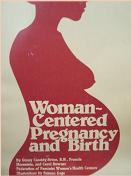
However, my idea for the post didn’t come from me alone, it was sparked by reading a similar list in the 1970’s book Woman-Centered Pregnancy and Birth, co-authored by Carol Downer. So, imagine my delight when I was contacted last month by her assistant, letting me know that they’d read and enjoyed my post and telling me this awesome news:

We recently published the book in its entirety online at: www.womenshealthinwomenshands.org/BirthingOurBabies.html.

That’s right, free online! Check it out!

For my conservative readers, do be aware that the book and website both come from a solidly feminist and pro-choice perspective!

“The whole point of woman-centered birth is the knowledge that a woman is the birth power source. She may need, and deserve, help, but in essence, she always had, currently has, and will have the power.” –Heather McCue

Previous thoughts on Why “Woman-Centered” Childbirth?

Book Review: Lady’s Hands, Lion’s Heart ~ A Midwife’s Saga

Lady’s Hands, Lion’s Heart: A Midwife’s Saga
by Carol Leonard, 2008. ISBN: 978-0-615-19550-6.
Bad Beaver Publishing, $15.00, 363 pages, soft cover.
www.badbeaverfarm.com

Reviewed by Molly Remer, Talk Birth

This memoir by experienced New Hampshire midwife, Carol Leonard, is a wonderful read. It is funny, compelling, exciting, and sad. I think it is the best midwife’s memoir I’ve ever read!

Spanning 13 years (1975-1987), the book represents not just her personal experiences and birth stories, but also chronicles the development of independent midwifery in New Hampshire and the birth of MANA and its emergence as an international presence.

Leonard is an engaging writer with a flair for the dramatic. The style of the book is present tense, so you get a sense of actually “being there” and the book reads with the pace of a novel.

The many birth stories in the book are riveting. She has her share of close calls and complications, as well as tons of strong, inspirational births. Her love of the work and of the women she serves shines throughout and I got a strong sense of the author as a deeply passionate and committed woman.

The book opens with her own birth story in a hospital in 1975, her only child, and chronicles her development into a midwife (a fascinating sub-story in the book is of the changes her local hospital goes through to make their maternity unit more mother-friendly). Be prepared for a sad ending.

The birth stories shared each represent an event or lesson learned. Leonard is a busy midwife (you get a sense in the book that she doesn’t have much time to take care of herself!) and she attends many births in her years of service. The births detailed here are carefully chosen for impact and purpose. (Side note: as an LLL Leader, I was saddened that her one experience with LLL [in the book] is a bad one).

More than a collection of birth stories or midwifery musings, Lady’s Hands, Lion’s Heart: A Midwife’s Saga, is a personal journey, as well as a spirited account of a larger journey occurring in the midwifery profession.

Disclosure: I received a complimentary copy of this book for review purposes

Review previously published at Citizens for Midwifery

Amazon affiliate link included in book title/image.

A Bias Toward Breastfeeding?

During World Breastfeeding Week, Lamaze’s Science and Sensibility blog published an interesting and thought-provoking guest post called “Instructor Has A Clear Bias Toward Breastfeeding!” The post explores a birth educator’s experience with teaching breastfeeding classes and receiving the title phrase on one of her evaluations. She is very disturbed by the evaluation and offers this profound and potent reminder: “We must not leave mothers less than whole.”

While I very much appreciate this observation and reminder, we also absolutely need to remember that biased means to exhibit “unfair prejudice”–it simply IS NOT “biased” to support breastfeeding as the biological norm and most appropriate food for babies. I was very concerned to read the comments on the post from other educators talking about their own “biases” toward physiologic birth or breastfeeding and how carefully they guard against exhibiting any such bias in their classes. Hold on! Remember that the burden of proof rests on those who promote an intervention—birth educators and breastfeeding educators should not be in a position of having to “prove” or “justify” the biological norm of unmedicated births or breastfed babies. I hate to see birth instructors being cautioned to avoid being “biased” in teaching about breastfeeding or birth, because in avoiding the appearance of bias they’d be lying to mothers. You can’t “balance” two things that are NOT equal and it is irresponsible to try out of a misplaced intention not to appeared biased. So, while I appreciate some of this educator’s points, I do think she’s off the mark in her fear/guilt and her acceptance of the word “bias.” The very fact that making a statement that someone has a bias toward breastfeeding can be accepted as a reasonable critique is indicative of how very deeply the problem goes and how systemic of an issue it is. If I say that drinking plenty of water is a good idea and is healthier for your body than drinking other liquids, no one ever accuses me of having a “bias towards water.” Breastfeeding should be no different. But, as we all know, breastfeeding occurs in a social, cultural, political, and economic context, one that all too often does not value, support, or understand the process.

This reminds me of an excellent section in the book Mother’s Intention: How Belief Shapes Birth about judgment and bias. The author also address how the word “balanced” is misused in childbirth education–as in, “I’m taking a class at the hospital because it will be more balanced.” Balance means “to make two parts equal”–-what if the two parts aren’t equal though? What is the value of information that appears balanced, but is not factually accurate? Pointing out inequalities and giving evidence-based information does not make an educator “biased” or judgmental-–it makes her honest! (though honesty can be “heard” as judgment when it does not reflect one’s own opinions or experiences).  (formerly quoted in this post. And, see this post for some thoughts about pleonasms.)

I do value the reminder that pregnant and postpartum mothers are vulnerable and how we speak to them really matters. I know that. I also worry that too much “tender” speech regarding breastfeeding as a “choice,” a “personal decision” and “we support you no matter what”—leaves the door wide open for continued systemic support of a bottle feeding culture that treats formula feeding and breastfeeding as similar or interchangeable. I’m not sure what the answer is. Maternal wholeness matters, so does breastfeeding!

World Breastfeeding Week Post Round Up

I ended up writing a lot of breastfeeding posts during WBW this year and decided to gather them all together in one post, plus extras, so that no one manages to miss out!

Other favorite posts about breastfeeding:

  • Breastfeeding as a Spiritual Practice: Reflections on the intimate, spiritual connection and meditative quality of being a breastfeeding mother as well as thoughts about parenting as a (rigorous) spiritual practice of its own.
  • Breastfeeding as an Ecofeminist Issue: Why does breastfeeding threaten both feminists and the patriarchy? Why is breastfeeding a core women’s issue? And, why aren’t we more concerned about systemic barriers?
  • The Birth-Breastfeeding Continuum: From a biological perspective birth and breastfeeding are not discreet events, but are inextricably linked. Healthy breastfeeding begins with healthy birth!
  • Ode to my nursling: What it is like to nurse my baby.
  • Nursing Johnny Depp: My “classic” essay on what it is like to nurse things other than my baby…
  • Listening Well Enough: What I learned from a dream about listening to breastfeeding mothers.
  • Listening to my baby…even when we disagreed! Personal story about how I learned to listen to my baby about what he needed with regard to breastfeeding even when I didn’t like what he was telling me.
  • Inseparable: Personal thoughts about being “in dependence” with our babies.

Other great resources:

Infographic for parents (and heck, providers too!) about the first few days of breastfeeding–newborn stomach sizes, number of diapers, etc.

Ban the Bags toolkit: Great rebuttals to common arguments about the assumed neutrality of distributing formula marketing materials via medical care settings/providers as well as evidence about the link between “free” formula distribution and reduced rates of successful breastfeeding.

Resources from the Breastfeeding Taskforce of Greater Los Angeles including:

Also, you can check Baby Friendly USA to see if your birthing facility is Baby Friendly.

CIMS sent out some good WBW information about how Birth Practices Affect Breastfeeding:

CIMS is proud that the WHO/UNICEF included recommendations in the Ten Steps of the Mother-Friendly Childbirth Initiative in the WHO/UNICEF’s Infant and young child feeding: A tool for assessing national practices, policies and programmes (2003).

The WHO and UNICEF recommend that to maximize the establishment of successful breastfeeding women in labor, regardless of birth setting, should have access to the following practices recommended in the MFCI:

  • Care that is sensitive and responsive to the specific beliefs, values, and customs of the mother’s culture, ethnicity and religion;
  • Birth companions of her choice who provide emotional and physical support throughout labor and delivery;
  • The freedom to walk, move about, and assume the positions of her choice during labor;
  • Care by staff trained in non-drug methods of pain relief and who do not promote the use of analgesic or anesthetic drugs unless required by a medical condition;
  • Care that minimizes routine practices and procedures that are not supported by scientific evidence including withholding nourishment, early rupture of  membranes, use of IVs,  routine electronic fetal monitoring, episiotomy and instrumental delivery;
  • Care that minimizes invasive procedures such as unnecessary acceleration or induction of labor and medically unnecessary cesarean sections.

And, so did Lamaze:

Valuable resources and information for expecting parents, like Lamaze’s Push for Your Baby, are aimed at giving expecting parents the tools to push for the best care practices for moms and babies, including those that support breastfeeding education and awareness.

Lamaze calls out the following top five breastfeeding barriers within the first 24 hours of birth to help expecting moms prepare for the best breastfeeding experience:

  1. Unnecessary birth interventions
  2. Separating mom and baby
  3. Use of pacifiers or other artificial nipples before breastfeeding is well established
  4. Supplementing breastmilk with formula
  5. Lack of postpartum breastfeeding support

Note: on August 15, Lamaze is hosting a free webinar called Moms, Babies, Milk and the Law: Legal and Ethical Issues When Teaching Breastfeeding

And, some other interesting posts not by me:

World Breastfeeding Week Sucks According to this Lactation Consultant

While I don’t really care for the title because I think it may cause people to not even read the article, I really appreciated this IBCLC’s thoughts about the correlation between the occurrence of WBW each year and the strategic release “breaking” news about some kind of breastfeeding related controversy. Call me a conspiracy theorist, but this does in fact happen every. single. year. During World Breastfeeding Week, something comes out that causes doubt about breastfeeding or breastfeeding advocates. Maybe it is about vitamin D and how “deficient” breastmilk is, or maybe it is a trumped up “mommy wars” tale or hyperbolic call to action about not letting those mean “breastfeeding Nazis” try to tell us how to raise our babies, or, like this year, a bizarre spin on the idea that formula should not be readily distributed in large “gift packs” via our medical care system, but should instead be reserved for cases in which it is actually needed (see above mentioned notion of those mythical, control-freak breastfeeding Nazis who are out to get us all). Anyway, the LC points out this:

I really hate World Breastfeeding Week because much of the media takes it as an opportunity to attack those who wish to support mothers who breastfeed rather than celebrate their efforts to improve infant feeding. Every year I hope I will not have to read more faux feminist manifestos that denigrate the value of women who enjoy their care-giving roles. I hope I won’t have to read more junk science fishing expeditions by journalists who deliberately exclude the wide body of solid research that does show that what infants are fed does matter. This year sets a new low with the addition of outrageously false claims that New York’s City’s Mayor has imposed a ban on formula that is going to deprive mothers of their rights. –Susan Burger

And, speaking of the bizarre spin of this year’s anti-WBW backlash conspiracy, Moxie wrote a great post exploring this issue: The illusion of choice, the free market, and your boobs

If you truly care about a woman’s right to choose what’s best for her and her baby, you will take the financial pressure out of the equation, and eliminate any actions that impede free choice. Putting formula samples right next to the baby’s head impedes free choice. Having to ask for formula (just like you have to ask for tylenol, or an extra chucks pad, or another container of orange juice) doesn’t impede free choice. It doesn’t change anything for women who cannot breastfeed–they can still get those formula samples easily by asking. It doesn’t change anything for women who don’t want to breastfeed–they can still get those formula samples easily by asking. It could change everything for women who want to breasfeed but don’t have correct information or are experiencing problems they can overcome if they’re given help, because they will be given EQUAL ACCESS to information that can help them breastfeed and formula samples. They ask for help or they ask for formula. Equal access. No privilege for formula.

I don’t want the decisions I make about how to parent my children made by the highest bidder. Especially since the highest bidder doesn’t care about me and only wants my money. (Let’s not forget that those formula samples are worth about $1.50. A woman who chooses to feed formula based on those samples has just been signed on to spend hundreds or thousands of dollars on formula once she leaves the hospital. She is never informed of that. Is THAT free choice?)

I don’t care how you feed your baby. But I want you to make a decision about it with all the information, all the support, and all the help you can get. Free choice. I do not want your choices narrowed by the huge financial incentives formula manufacturers pour into hospitals. [emphasis mine]

And, as I’ve already referenced in some of the posts linked to above, Dr. Newman has a helpful article about How to Know a Health Professional is not Supportive of Breastfeeding that directly connects to the issue of formula distribution by medical care professionals. One way to know right away is if the provider distributes material provided by a formula company—even if that material is labeled “breastfeeding information.”

Breastfeeding Class Resources

I became certified as a breastfeeding educator in 2004 and accredited as a breastfeeding counselor in 2005, so I’ve been working with breastfeeding mothers for a long time. I lead a monthly support group and offer help/counseling via phone, email, text, Facebook message, Words with Friends messages, you name it. Recently, a nurse contacted me asking for ideas for teaching an early pregnancy breastfeeding class. I think this is a great idea, since mothers’ decisions about breastfeeding are often made before the baby is conceived and if not then, during the first trimester.

These are the initial ideas I suggested:

  • Focus on what the mothers themselves want—what do they need/want to know? What have they heard about breastfeeding? What are their fears? What misconceptions do they need cleared up? I’m very much about peer-to-peer support and allowing space for the women to talk to/connect with each other—the facilitator is then available to clear up misinformation and provide tips.
  • Focus on what mothers can do to prepare for successful breastfeeding—there is evidence that prenatal breast massage/colostrum expression helps with both milk supply AND with mother’s comfort with her own breasts. It also helps her think of herself as a breastfeeding mother BEFORE her baby is actually born!
  • Suggest good books to have on hand and encourage attending a breastfeeding support group (like LLL!) prior to baby’s birth.
  • Promote/discuss/encourage “baby led breastfeeding.” I love sharing with mothers about how smart their babies are and how mother’s chest after birth becomes baby’s new habitat! Check out the resources from Suzanne Colson: http://www.biologicalnurturing.com/
  • Discuss and emphasize all of the other great ways dads and other family members can be involved with baby other than giving a bottle. Dad/grandma can do EVERYTHING ELSE baby needs! That’s cool! Leave the feeding to mom and let dad have the other special and important jobs like baths and burping and tummy time and more.
  • DON’T talk about “myths” and try to dispel them in a myth-fact format, because evidence suggests that this actually helps the myths stick more!
  • Use Diane Wiessinger’s approach to language (http://www.motherchronicle.com/watchyourlanguage) i.e. breastfeeding isn’t a “special bond” it is a NORMAL bond. People want to be normal—special is for celebrities and “other people,” normal is what everyone wants. She also has handouts here: http://normalfed.com/Why.html

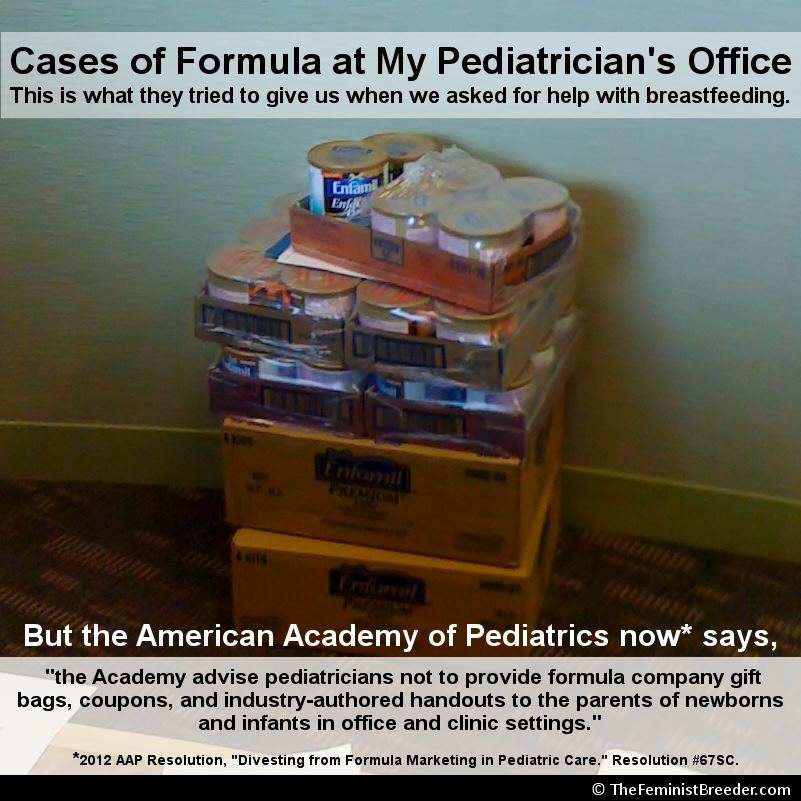
Since her email, a couple of other resources and bits have caught my eye. One is that the AAP has a resolution about the distribution of formula “gift bags” by pediatricians and hospitals. Apparently this came out in 2011, but it only came to my attention when I saw this image on Facebook!

In keeping with the 10 Steps and consistent with the AAP’s resolution, the hospital advocacy project from the Illinois State Breastfeeding Taskforce makes available the following useful documents for mothers to communicate with their hospitals:

The Task Force explains:

We encourage you to make the Breastfeeding Bill of rights and Hospital Experience Letters available to moms in your classes, practices, community events, breastfeeding fairs, “rock & rest” stations, etc.

Encourage moms to fill out the appropriate letter and mail back to the hospital where she delivered her baby.  Or collect the letters and mail them from your agency or task force.  Help moms make their voices heard!

We hope that this will show hospital administrators that lactation consultants, knowledgeable staff and breastfeeding friendly practices are valued by moms and families using their hospital services.

The Missouri Breastfeeding Coalition clued me into this Breastfeeding Plan for Mothers (pdf) from the MO Dept. of Health. The handout may be downloaded and printed as needed and is a, “list of requests that support breastfeeding for the postpartum stay. Similar to a birth plan and based on the 10 Steps for Breastfeeding.”

Also, make sure to check out this awesome resource, the WIC Sharing Gallery—free programs, curricula, brochures, and more from different WIC offices. I found this because I was back at the Illinois Breastfeeding Taskforce’s website downloading their Grandmother’s Tea curriculum for intergenerational support of breastfeeding.

Another great resource is the FREE online Tear-Sheet Toolkit from La Leche League.

And, finally, I already touched on this, but remember there are ample handouts/articles available from the incomparable Diane Wiessinger about birth and breastfeeding.

Building Birth Bridges: Communication

This post is part 5 of my CAPPA re-cap series.

The final day of the CAPPA conference I heard Polly Perez speak about Building Bridges with an emphasis on communication and fear. She described four basic communication and emphasized that communication is a two-way street.

The four styles are:

  • Expressive
  • Sympathetic
  • Direct
  • Systematic

Each style has its strengths and also ways in which it is perceived by others. You should give information in the simplest way to the person you are talking to and adjust your style of communication depending on who you’re talking to, changing communication behavior in order to improve communication. Communication is the lifeblood of all relationships.

She shared this quote:

Luke: I don’t believe it. Yoda: that is why you fail.

And she explained that listening is active, not a passive activity. Listen with empathy, openness, and awareness:“Use language that lets you share your heart openly.”

She also asserted that we must stop letting our practices be fear-based, quoting Connie Pike in saying, “We must give people the opportunity to challenge their fears. Not only will this change each person, it will change the political and medical climate in which they make these choices.”

In communicating within in the medical system, Polly pointed out that a fundamental issue is with the power hierarchy and that we must develop strategies that enhance problem solving, but still retain and support the person in power. (**I’m a little too radical, I guess, for this tip, which is perhaps why I’ve not found a niche working within a medical system and instead work outside of it.) She suggested asking yourself: What does this person you are talking to fear? She also quoted Bethany Hayes “Working in Circle” who said with regard to working in hospital climates, “we found a system that was as sick as the people it was treating.” Changing sick systems is not about subterfuge but bringing light to situations that need to be altered.

Polly then made an observation that I found very powerful and very telling:

We have taken the hearts and minds out of much of our work because we’re frightened of getting too close. But, close is where we need to be.

Yes.

During a different session, but closely related to this topic of communication, I laughed out loud watching this video clip of twin babies communicating with each other. I’m going to use this in future classes.

Controversies in Breastfeeding

20120724-174258.jpg

If you get a chance to attend one of his presentations, don’t miss it! In this slide, Dr. Jack explains that he disagrees strongly with the notion that a baby that has lost 10% of its birthweight needs to be supplemented.

Just in time for the start of World Breastfeeding Week, here is part 4 of my CAPPA re-cap series!

This post is a companion to my CAPPA re-cap post about the impact of birth practices on breastfeeding. Dr. Newman’s keynote session about Controversies in Breastfeeding was actually given before his breakout about birth and breastfeeding, but for the chronological value, it made sense to me to put up the birth post first.

As I already shared, in Newman’s perspective we have a huge problem in that many medical care providers do not recognize the critical importance of breastfeeding. Newman also emphasized that there are many people who don’t know squat about breastfeeding and breastmilk and don’t feel like they need to learn anything before they start doing studies and writing papers about it.

Why is hard to study breastmilk?

Because…there is no such thing as “standard” breastmilk. It is a physiological fluid and varies from person to person. We DO NOT have to prove that breastfeeding is better than formula. Those comparison studies are unnecessary.

Some great stuff from Dr. Newman’s presentation about controversies:

  • The exclusively breastfed, well-gaining 5 month old is getting only, at most, 10-15% more milk than the exclusively breastfeeding, well-gaining 1 month old, even though the 5 month old is twice as heavy. Baby continues to gain weight steadily even though it is not “getting enough” compared to its formula fed counterpart. (put that in your pipe and smoke it–yep, he really then said that ;-D)
  • Colostrum has 100,000-5,000,000 leukocytes per ml–that is more than blood. (i.e. colostrum has more white blood cells in it than your actual blood has in it!)
  • Colostrum and formula are the same in the following ways: both are liquid.
  • Breastmilk does not need to supply vitamin D (makes no sense to describe breastmilk as “deficient in” or “lacking” vitamin D).
  • With regard to the high incidence of reflux being diagnosed in babies—his response to why so high is, “because [most] doctors don’t know anything about breastfeeding.”
  • We learn one thing when we hear that the mother has been told to feed her baby X number of minutes per side—>the person telling her this does not understand breastfeeding.
  • There are no such thing as “flat nipples”–women have normal nipples. We live in a bottle feeding culture that makes us assume that if a mother does not have nipples that stick out like a bottle nipple, the nipples are flat (**Molly’s own note–we also live in a culture where 75-90% of women have epidurals during labor which can contribute to edema in the breast and the accompanying appearance of flat nipples).

 And, there should be no controversy about formula feeding vs. breastfeeding. If you actually look at the biochemistry of breastmilk you would know there is no comparison. No controversy. (with a laugh after this he added, “pediatricians are simple folk” ;-D)

In that plainspoken way I found so refreshing, Dr. Jack also pointed out that formula feeding is missing one more thing: breastfeeding. That’s right. Society thinks that bottle feeding is the “same”–it isn’t. Breastfeeding is an intimate relationship. He also pointed out that, “people will lie, lie, lie to sell products.” (see ad to right)

Finally, he explained that this mechanization of breastfeeding (through things like test weighing and nipple shields and timed feedings) will cause more and more mothers to abandon breastfeeding and then she’ll say, ‘we tried everything and it just didn’t work.’ Yes, we did “try everything,” everything to make her not succeed. (And, then she’ll write an article about it complaining about “what’s wrong with breastfeeding.”)

Handouts from Dr. Newman are available here. One I’ve used recently is How to Know a Health Professional is not Supportive of Breastfeeding.

I address other systemic influences on breastfeeding in Breastfeeding as an Ecofeminist Issue

The Impact of Birth on Breastfeeding

Just in time for the start of World Breastfeeding Week, here is part 3 of my CAPPA re-cap series!

…they want you to believe it’s their power, not yours…They stick needles into you so you won’t hear anything, you might as well be a dead pig, your legs are up in metal frames, they bend over you, technicians, mechanics, butchers, students, clumsy or sniggering, practicing on your body, they take your baby out with a fork like a pickle out of a jar.

–Margaret Atwood in her novel Surfacing (opening quote of Dr. Jack’s presentation at the 2012 CAPPA conference)

As I mentioned, my favorite part of the CAPPA conference was hearing Dr. Jack Newman speak about controversies in breastfeeding (see next post) and then about the impact of birth on breastfeeding (breakout session). He was an amazing speaker. Very straightforward and almost blunt as well as funny and fast-paced. I really feel glad to have had the chance to see him in person after years of being familiar with his materials.

The notion of the birth-breastfeeding continuum isn’t new to me, having actually published articles about it previously, however Dr. Newman’s phrasing, descriptions, and reminders was just so perfect that it left me feeling even more enthused about the inextricable link between birth and breastfeeding. It is a biologic continuum that nature does not see distinct events—baby is born and goes to breast, it is part of the same event. Drawing on Diane Wiessinger’s work, Dr. Newman explained

With animal births: following a normal birth, infant feeding just…happens. Following an interventionist birth, the mother rejects the baby and there is no nursing at all.

In some hospitals, separation of mother and baby is routine as a way to “prevent” postpartum mood disorders. Dr. Jack’s own theory was that perhaps human mothers turn this “rejection” against themselves and it shows up as a postpartum mood disorder.

Babies NEED and expect to be with their mothers after birth. It is of critical importance. As I shared via Facebook, Dr. Jack explained this:

Know how much an incubator costs now? $50,000. Why don’t we just give half of that money to the mother and put the baby skin to skin on mother’s chest?

And, this gem:

Our hospital births break every rule in the mammalian list of mother-baby necessities.” –Dr. Newman

He also noted that if baby is put skin-to-skin on mother immediately after birth regardless of original intention, the pair will breastfeed. It is biologically programmed.

Why do hospital births break the rules?

Because, as Dr. Newman explained we have a big, big problem in that HCPs do not recognize the critical importance of breastfeeding. He also repeatedly emphasized (in a very funny way) that there are many people who don’t know squat about breastfeeding and breastmilk and don’t feel like they need to learn anything before they start doing studies and writing papers about it.

Dr. Newman also emphasized the important point that the burden of proof rests upon those who promote an intervention! He was speaking with regard to recommending formula supplementation, but I strongly believe it applies to any birth practice. So simple and yet so profound. One example that he shared that is familiar to birth advocates is that lying down for electronic fetal monitoring is a position of comfort for the care provider, NOT for the mother.

And, he made this excellent point: “All medical interventions, even when necessary, decrease the mother’s sense of control, and increase her sense of her ‘body not being up to the task.” Again, the burden of proof rests on those who promote the intervention, not vice versa.

As I’ve touched on several times before, IV fluids that are commonly administered during labor may increase the baby’s birth weight, leading the baby to be more likely to experience the dreaded 10% weight loss (“totally bogus, by the way”). Also as I’ve noted before, IV fluids lead to significant maternal fluid retention which contributes to edema in the nipples and areolas and then…the dreaded “flat nipples.” The more fluid a mother gets in labor, the more a baby “loses” after birth!

Including the same picture as in my other post, because it is in this picture that Dr. Jack is specifically talking about his next point:

I disagree strongly with this statement:

‘Typically, loss of = or >10% of birth weight in the first few days suggests dehydration and the need to consider supplementation.’

He goes on to note that what is necessary is NOT supplementation but to help the mother and baby breastfeed well. The real question when it comes to newborn weight loss is, “is the mother-baby breastfeeding well?”

Newman also addressed something birth advocates are familiar with, the fact that epidural anesthesia can cause maternal fever. This leads to an infant sepsis workup and antibiotics and usually means separation of mother and baby. Here we again experience the failure of many medical care providers to recognize the importance of breastfeeding as beyond just a feeding method. Breastfeeding protects the baby–this is what most hospitals do not understand.

Of interventions that undermine breastfeeding, Dr. Jack pointed to Demerol (meperidine) as the “worst of the lot,” with newborns experiencing sedation and many of them not sucking at all. He also pointed out that all interventions increase the risk of cesarean section, which leads to increased discomfort for mothers and less willingness to breastfeed and increased likelihood of mother-baby separation.

The importance of skin-to-skin contact

Babies easily find their way to the unwashed nipple. And, given baby’s inborn feeding behaviors and instincts, it seems clear that, “if the baby expresses his or her choice, the baby would choose the breast.” (with regard to breastfeeding as maternal “choice”)

Not putting baby skin to skin with the mother, “increases the risk of hypoglycaemia significantly…Isn’t skin to skin contact a less invasive preventative measure than giving formula?” Newman then points out that most often we see “skin to blankets” which keeps baby from showing they’re ready to feed, doesn’t stimulate milk supply, and leads to engorgement which is not normal.

And, at the end he emphasized that when it comes to birth and breastfeeding, all too often WE MESS IT UP by meddling with the biological processes and rhythms of the mother-baby relationship.

For more about controversies in breastfeeding, check out my next post.

Handouts from Dr. Newman are available here. One I’ve used recently is How to Know a Health Professional is not Supportive of Breastfeeding.

I’ve written about the birth-breastfeeding continuum and about some other systemic influences on breastfeeding in breastfeeding as an ecofeminist issue.