Archives

DVD Review: Birth as We Know It

Birth as We Know It: Educational Edition. DVD directed and produced by filmmaker Elena Tonetti-Vladimirova. 2006, www.birthintobeing.com (40 minutes), $39.95.

Reviewed by Molly Remer, MSW, ICCE, Talk Birth

As a birth educator, I am always on the lookout for the “perfect” video to show in classes. Though not a film I would show in its entirety to the average class, Birth as We Know It is a gorgeous compilation and I’m delighted to have it amongst my educational resources.

The film is available in two versions—the feature film edition and the “educational edition.” The feature film contains almost 4 hours of total footage (a number of bonus features), including 11 births. The educational edition consists of two condensed versions of the feature film—a 40 minute presentation and a 25 minute version designed to show in groups. I chose to purchase the educational edition and this review is based on that edition. I have not seen the full length feature film.

The forty minute version of the film contains gentle, moving footage of 7 births. All the births occur in water—some in the ocean, but most at home. It also includes footage about birth trauma, cesarean section, and circumcision that is not included in the 25 minute presentation version (which also includes only 6 of the births). The DVD also contains instrumental versions of both.

The births included on this film are all exceptionally peaceful, beautiful, gentle, quiet, and calm births. Some of the birth footage is in slow motion, the sounds are muted, and there is instrumental music as the soundtrack as well as occasional voiceover commentary by the filmmaker. The film alternates between birth footage and spoken descriptions/interviews about conscious birth, emotional presence, limbic imprinting, etc. The voiceover commentary addresses things like toning and healing one’s own birth trauma.

The births are wonderfully undisturbed and unhindered—in most the only hands near mother’s perineum are her own and this is such a profound difference from the usual media representations of birth! A highlight is during “Tanya’s Birth” in which she speaks to her older child, smiles with extreme beauty and peace, then casually glances down again and as the camera follows her glance, we see the baby’s head has emerged between her legs and she is cradling it gently. I love for people to have a chance to see this powerful moment!

Though interesting, I find the voiceover content and non-birth portions of the film to be too abstract or “metaphysical” to appeal to the average birth consumer. It is even a bit too metaphysical for me and I find that the concepts she mentions are not well explained and do not seem immediately reasonable or easy to accept in stride. The instrumental version is one way to gloss over this element, but then you are unable to scene select to specific content the way you are able to do in the regular versions.

So, though I do not show the complete film in classes, there are several birth clips that I do show routinely. I find two of the births in particular to be potent educational tools and they have been very well received in classes and have had a profound impact. The births are so different from general media representations of birth that they leave couples stunned with amazement about what birth can be. Since the births are in water, they are a very gentle, non-messy, not very “graphic” way to expand people’s understanding of normal birth. People in my classes have said things like, “wow! You never see something like that!” or, “that was so beautiful, I’m just in shock.” I find men in particular are more receptive to this footage than to other, more detailed, videos I show and I have had a few request to borrow and view the whole video instead of just the clips I have chosen for class.

In conclusion, this is a lovely film and though I have some reservations about showing the entire educational edition, some of the birth footage has been a powerful addition to my work with birth.

This review was previously published at Citizens for Midwifery.

Conscious Agreement and Informed Consent

This post is part 2 of my CAPPA Re-Cap series.

During their general sessions at the recent CAPPA conference, Laurel Wilson and Tracy Wilson Peters both advocated a process called “Conscious Agreement” in working with pregnant couples. The basic steps are as follows:

  • Separate yourself from external influences
  • Get quiet and pause
  • Listen in (including mentally checking in with your body and how it feels)
  • Choose and commit

I especially appreciated Tracy’s observations that this process of conscious agreement goes beyond informed consent and, as birth educators, we need to make sure to “marry the two every time,” rather than focusing solely on informed consent. Why? Because there are several things wrong with informed consent as it is practiced today:

  • It fails to address the importance of conscious decision-making
  • Informed consent is made with the mind or intellect (and ignores feeling and intuition)

And…

  • You can “consent” all day long and not feel good about it.

The last point is the crux of the issue to me. When I cover informed consent in my non-birth classes, I always emphasize that the corollary is informed refusal. If “consent” as it is practiced by your hospital means saying yes and there is no option of saying no, it does not qualify as consent! A choice without the option to refuse is NOT a choice at all (see The Illusion of Choice). My students have almost never heard of the notion of “informed refusal” and seem shocked to even consider the possibility! Since I’ve had a special interest in this topic for a long time, I really connected with the idea of conscious agreement, especially when paired, as Tracy suggests, with informed consent information.

Another handy tip offered by Tracy during her presentation was to use HALT before entering into any agreement (or confrontation). Check in to see if you are…

  • H–Hungry
  • A–Angry
  • L–Lonely
  • T–Tired

(Also, consider whether the person you are trying to communicate with is any of these things. This is especially good to remember with children.) And, she shared this little poster:

This little sign may have been made especially for me. I have a terrible problem with getting crabby and snappish and plain old hangry (hungry + angry)—and then having to apologize. You’d think I’d have it figured out by now! (though, I do think nursing exacerbates it)

Epigentics, Breastfeeding + Diet, and Prenatal Stress

This post is part one of my CAPPA Re-Cap series.

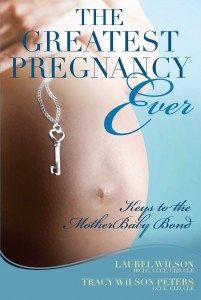
CAPPA linchpins Laurel Wilson and Tracy Wilson Peters are co-authors of a new book, The Greatest Pregnancy Ever, that focuses on the depth, intensity, and value of the MotherBaby bond. As I noted, I listened to Laurel talk about Bridging the Nutrition Gap and to Tracy speak about the “accidental parent.” In both, they addressed the biological wisdom that mothers possess and of the deeply interconnected nature of the maternal relationship.

Laurel reminded us that there is a brain in our gut, essentially. This brain literally tells us how we should be feeling our emotions, based on the nutrition that we’re putting into our bodies. She discussed epigenetics–a term meaning literally “above the gene”—explaining that this is the “translator that ‘reads’ the book of instructions from our genome.” The translator tells the body to turn on or off the genes we’ve inherited from our parents. Epigenetics is essentially the environment–those things in our environment that influence our biology. Laurel pointed out enthusiastically that we want to create an excellent “translator” for our children. She also emphasized repeatedly that one important job of the placenta is to “train” the baby for the environment it will be experiencing. This is why prenatal diet matters, it is helping to prepare the baby to thrive in the environment into which it will be born. So, chronic stress leads to a stressful womb environment, which leads to a baby that is biologically primed to be born into a stressful postnatal environment. Mother’s body primes baby’s body for success in that environment. As I listened to her speak and discuss the things we’ve learned from science about genetics and how our bodies function, I kept thinking: science can do a lot, it can do wonderful things. Mother’s body can do even moreAnd, isn’t that just cool?!

So, what’s going on in the maternal habitat?

One important point Laurel made about prenatal diets was that prenatal diets high in hydrogenated oils predispose mamas to postpartum moods disorders. She said this is because hydrogenated oils essentially “leach” EFA’s out of the mother’s system.

She also noted that mice up to three generations are affected with PCOS by BPA and phthalates (in food packaging. Our food is literally making us sick). These influence change the endocrine system and are connected with reduced sociality and community engagement.

Laurel explained too that no artificial sweeteners are considered safe for pregnant women and that stevia too is linked to epigentic damage. She suggested using honey and molasses as sweeteners if needed.

One tip that I found funny, basic, but so true with regard to choosing healthy foods is to make sure to choose to eat foods that will rot!

In Tracy’s talk she passionately affirmed that we have to eliminate chronic stress from pregnant women’s lives because she is laying an emotional and physical foundation for another person’s life. This matters! Babies are feeling before they are thinking and we are designed to live in the environment we are being born into.

Also remember, babies don’t need to be in nurseries–they need to be with their mothers. This MATTERS!

Book Review: Birthwork

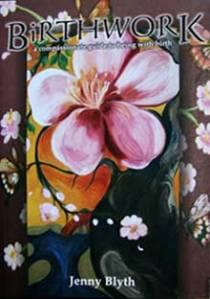
Birthwork
By Jenny Blyth
Reprinted 2007
Softcover, 460 pages
ISBN: 0-9757610-0
www.birthwork.com
Reviewed by Molly Remer, MSW, ICCE, Talk Birth

From Australia, comes a gorgeous and unique book called Birthwork. It is such an amazing and compelling read that it took me a very long time to write my review—it is difficult to describe such a remarkable book. I have never read another book like this. It is truly extraordinary. Subtitled “a compassionate guide to being with birth,” Birthwork was written for all birthworkers–anyone who works directly with birthing women (midwives, doulas, nurses, childbirth educators, physicians…).

This book covers issues of a range and depth I’ve never before seen in a birth text. Subsections include titles like: touching vaginas, respect and relationship, dipping in and out of the birth milieu, group dynamics, conflict, birth culture, loving presence, birth is sacred, trauma release, letting down in the pelvis, and stresses and stretches of childbearing. This is just a sampling of the amazing, comprehensive range of topics explored in Birthwork. I particularly enjoyed sections on directed breathing and “dynamic anatomy in labour.” The book delves into a lot of the emotional and psychological elements of being in a caregiving field and also covers physical components as well.

The book includes lots of questions to ask yourself to increase self-awareness, understanding, and personal development and also exercises to try/explore. Some of the questions are difficult to answer and require you to take a deep look at your motives and ideas about doing birthwork.

The photographs are stunning and there is gorgeous cover art (front, back, and inside). Birthwork has a spiritual component that runs throughout—sort of an Eastern philosophy—that might not appeal to all readers.

The book includes sources and a glossary of fields of care, but no index and no resources sections. It is an expensive book, but so very worth it!

Birthwork is deep and intense. I usually read very quickly and this book took me several weeks to finish because it needs time and space to soak in and be absorbed. Truly a phenomenal read!


Disclosure: I received a complimentary copy of this book for review purposes.

This review was previously published at Citizens for Midwifery.

CAPPA Re-Cap

Yesterday I got home from Kansas City where I’d been attending the annual free birth conference hosted by CAPPA. While there I concluded that Desirre Andrews is officially a superhuman live-tweeter. You can catch up with all of her rapid-fire tweets about the conference at CAPPA’s Twitter account.

I also tried my hand at posting a few things that particularly grabbed my attention to my Talk Birth and Citizens for Midwifery Facebook pages which automatically feed into Twitter. I’m not very good at catching short snippets for live-tweets, but some thoughts that I grabbed to highlight are as follows. If they don’t have quotation marks, they aren’t necessarily direct quotes, just “essence” summaries as I tried to take notes and pay attention!

First I attended Laurel Wilson’s talk about Bridging the Nutrition Gap and next, I listened to Tracy Wilson-Peters speak passionately about the “accidental parent.”

Essence tweets from Laurel and Tracy’s talks:

Babies don’t need to be in nurseries–they need to be with their mothers. This MATTERS!

Science can do a lot, can do wonderful things. Mother’s body can do even more…

Prenatal diets high in hydrogenated oils predispose mamas to postpartum moods disorders.

And, then I attended a breakout session from Darla Burns about postpartum rituals and snagged this interesting tidbit:

In Holland, all pregnant women are required to buy a homebirth kit, “just in case.”

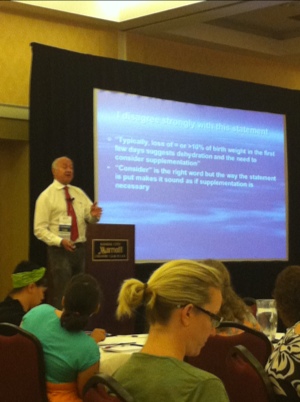
The second day, I found myself entranced by the most awesome Dr. Jack Newman. His presentations were the highlight of the conference for me. I loved him! I attended two–his general session on Controversies in Breastfeeding and then his breakout sessions, Impact of Birth Practice on Breastfeeding:

20120724-174258.jpg

If you ever get a chance to see this man, don’t miss it!

We have a big, big problem in that HCPs do not recognize the critical importance of breastfeeding.

There are many people who don’t know squat about breastfeeding and breastmilk and don’t feel like they need to learn anything before they start doing studies and writing papers about it. –Dr. Jack Newman

There is no such thing as “standard” breastmilk. It is a physiological fluid and varies from person to person. We DO NOT have to prove that breastfeeding is better than formula. Those comparison studies are unnecessary.

The burden of proof rests upon those who promote an intervention! –Dr. Newman

With animal births: following a normal birth, infant feeding just…happens. Following an interventionist birth, the mother rejects the baby and there is no nursing at all.

Our hospital births break every rule in the mammalian list of mother-baby necessities.” –Dr. Newman

Lying down for electronic fetal monitoring is a position of comfort for the care provider, NOT for the mother.

Know how much an incubator costs now? $50,000. Why don’t we just give half of that money to the mother and put the baby skin to skin on mother’s chest? –Dr. Newman

Seriously, Dr. Newman’s talks were amazing. Be prepared to hear more about them soon!

The final day I heard Polly Perez speak about Building Bridges with an emphasis on communication and fear:

Luke: I don’t believe it. Yoda: that is why you fail.

“Use language that lets you share your heart openly.” –Polly Perez

Listening is *active*, not a passive activity. Listen with empathy, openness, and awareness.

We have taken the hearts and minds out of much of our work because we’re frightened of getting too close. But, close is where we need to be.

“We must give people the opportunity to challenge their fears. Not only will this change each person, it will change the political and medical climate in which they make these choices.” –Connie Pike, via Polly Perez

Polly shared the first home birth she attended – made her fear of it “melt away like butter in a pan.”

You do not have to be an OB to be knowledgeable about birth. –doctor working with Polly Perez

Follow up from same doc: “if you tell me a baby is going to come out, I’m a gonna believe you!”

Changing sick systems is not about subterfuge but bringing light to situations that need to be altered.

Since micro-blogging is simply not my gift and is unlikely ever to become so, I am also planning longer posts based on several of the conference sessions. They will be (links will be updated as the posts become live):

At the CAPPA conference I also made a large custom order of great gifts from Joy Belle jewelry.

And, I ate tons of sample honey sticks from Glorybee–yummy! (see prior post: Why Honey Sticks During Labor?)

Other treats involved getting to spend some quality visiting time with a Friends of Missouri Midwives friend from St. Louis. We spent a lot of time talking over the FoMM newsletter (of which I am editor) and I feel very enthused about our ideas for its future.

I also got to meet a Facebook friend who started out originally two years ago as a Talk Birth fan on FB (after finding my site via my all-time most viewed post: In-Utero Practice Breathing). We spent some good time together visiting and laughing and it was fun to make the friendship connection with someone who was previously only an internet friend!

Incorporating Prenatal Yoga into Childbirth Education Classes

Incorporating Prenatal Yoga into Childbirth Education Classes

By Molly Remer, MSW, ICCE, ICPFE

Note: This is a preprint of an article published in the International Journal of Childbirth Education, Volume 27, Number 2 (April 2012)

The essence of yoga can be distilled into four key elements: breath, feeling, listening to the body, and letting go of judgment and expectation (YogaFit, 2010). When considering the essence of yoga, it is easy to see what a natural complement it is to conscious, active preparation for a healthy birth. Most birth educators would agree that paying attention to her breath and to her feelings, listening to her body, and letting go of preconceived expectations of what birth will be like are perhaps the most crucial messages to convey to the pregnant woman and her partner. Additionally, experts widely agree that exercise during pregnancy has beneficial effects for the cardiovascular and musculoskeletal systems and is associated with physical and psychological well-being. There is also some evidence that recreational exercise may reduce the incidence of premature labor and low birthweight babies (Hyatt & Cram, 2003).

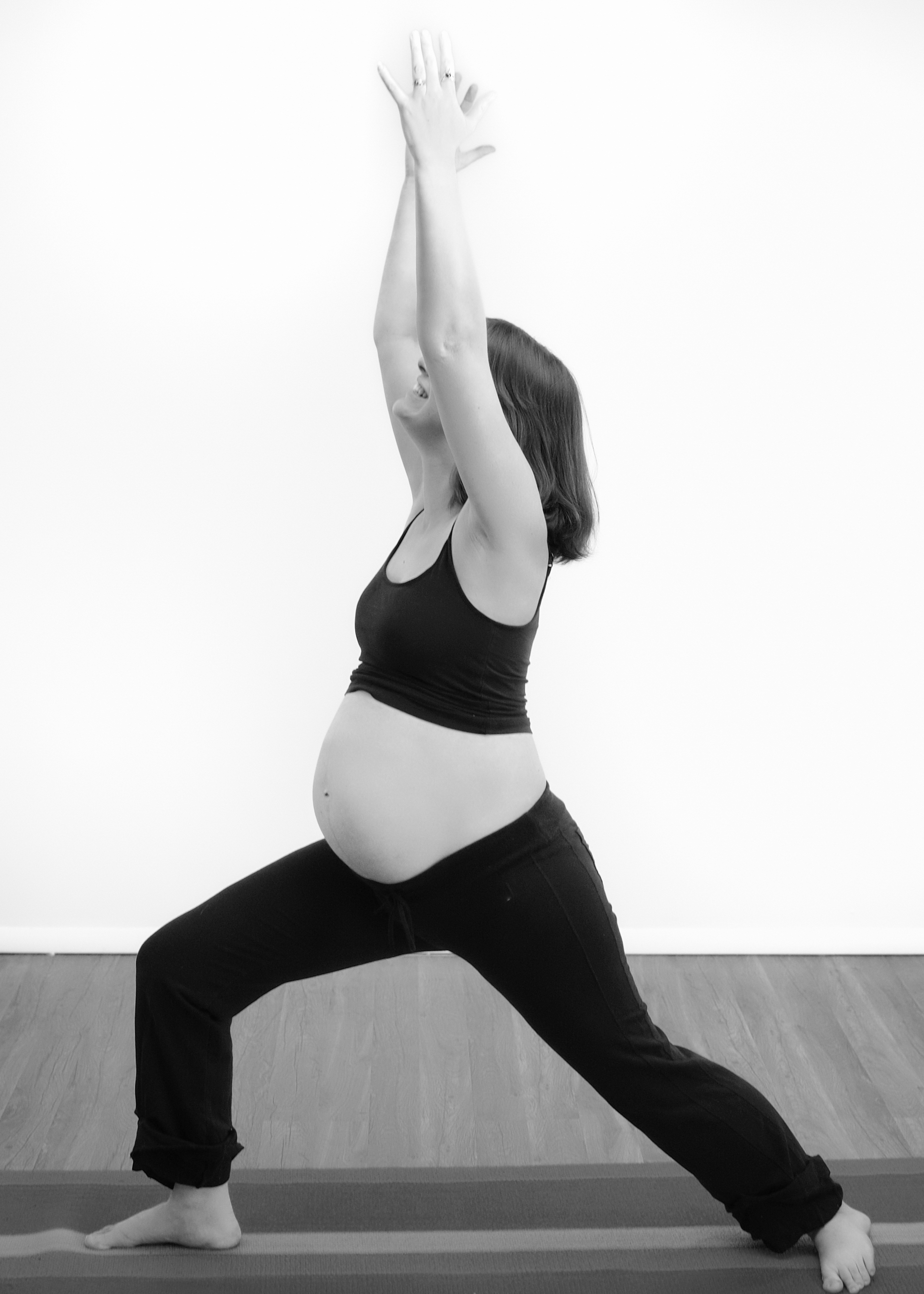
Anyone involved with educating adult learners (in any context) is likely to be familiar with the concept that people are most likely to retain information that they have actually practiced (versus reading about, hearing about or seeing demonstrated). I have found that incorporating a few simple yoga poses into each class session is a beautiful way of illustrating and applying many important elements of childbirth preparation. In approximately 10 minutes of movement, important points can be underscored without having to actually say anything or “lecture” to clients. The hope is that as we move together through a carefully chosen series of poses, subtle emotional development and trust in birth occurs—again, in a more effective manner than by the childbirth educator saying during class: “Trust birth!”

One rationale for incorporating yoga into prenatal classes is as follows: First, people often learn and retain information more effectively by actually doing something. Practicing the yoga poses together allows experiential practice of pelvic floor exercises, pelvic rocks, tailor-sitting, leg cramp alleviation, and back pain coping techniques, to name a few, instead of just hearing me talking!
Second, and most important, Yoga in prenatal classes emphasizes that birth happens in the body. As childbirth educators we spend a significant amount of time talking and sharing information, but birth does not only happen in the mind. Birth happens most profoundly in the body. Not only does birth happen in the woman’s body, but supporting and being with a woman in labor is also an intensely physical process, so it is important for partners to try the yoga series.

People today spend much of their time “living in their heads”, and many of us do not feel comfortable with, or at home in, our bodies. Practicing poses in class helps couples out of their heads and into their bodies and begins a process of feeling comfortable with moving and using their bodies in positive ways. This may help them develop the trust and confidence that will contribute to a smooth and peaceful birth process.

Each pose is followed with a birth affirmation such as, “the magic and mystery of birth delight and amaze me” (Miller, 2003). Positive affirmations help plant positive seeds of confidence and trust in the wisdom of women’s bodies and of the beauty of birth. These cognitive adjustments may also send a welcoming message to the woman’s body and baby as they both prepare for birth.

Opening classes with a series of poses is an effective way to “frame” the class. Class can be opened with a brief check-in period asking how people are feeling, about recent prenatal appointments, and any questions can be addressed. A transition from “regular time” into “class time” occurs with a brief series of simple poses. This routine helps people transition from their normal days into feeling ready and excited for birth class information.

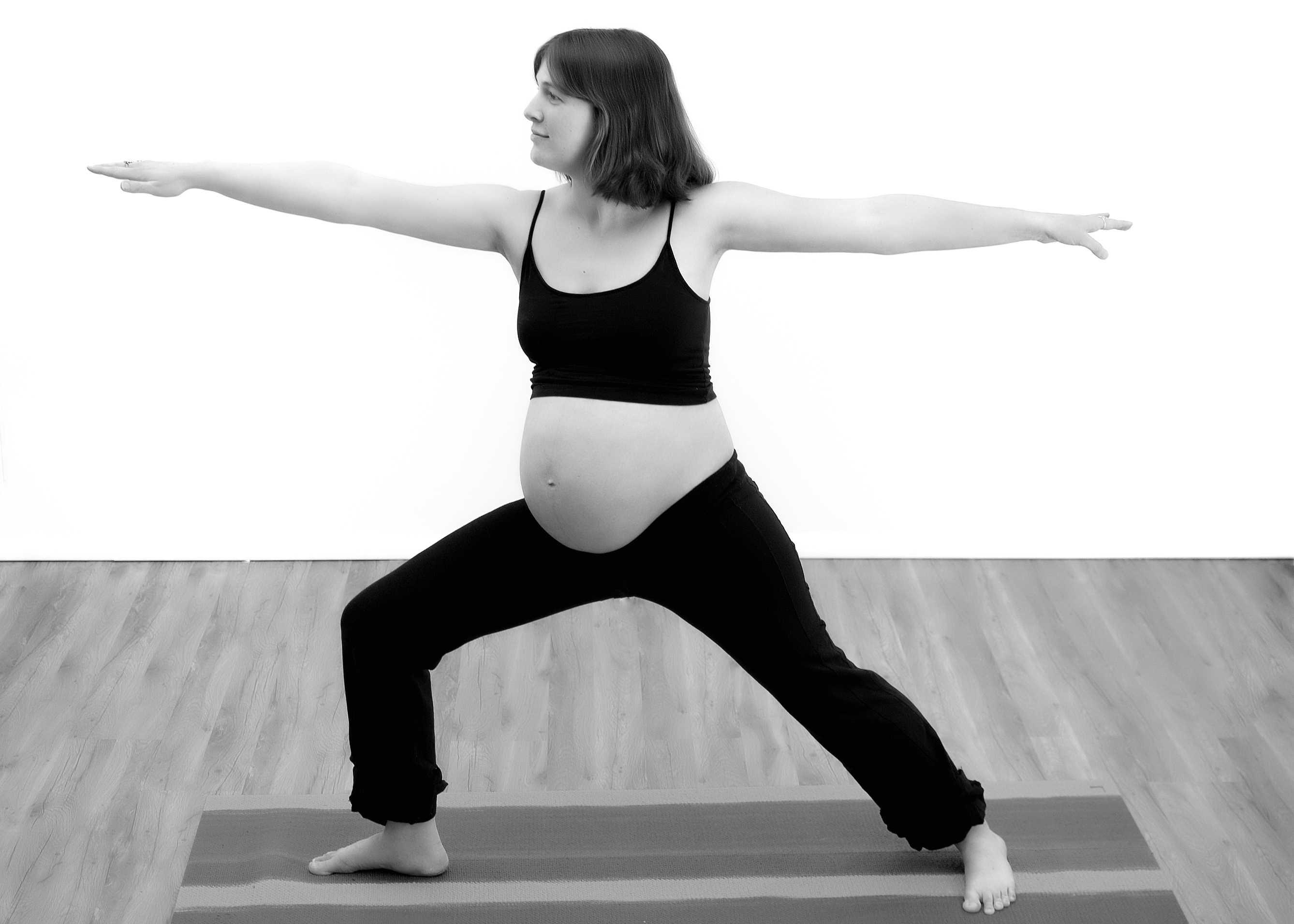
Each pose was chosen because it has specific birth- or pregnancy-related benefits. Begin with healthy sitting—seated crossed legged or tailor-style on the floor with spine straight. Do some neck rolls and shoulder rotations to help release tension. Move into a brief series that includes knee-rocking, leg stretches, Divine Mother Pose, Star Pose, pelvic rock, standing squat, Palm Tree Pose, Half Moon Pose, Triangle Pose and seated Mountain Pose. There is an additional short series of “birthing room yoga” poses described with photographs that is available as a free handout here.

The series is closed with a very brief meditation or visualization exercise. The series of poses and the affirmations are kept the same each week for retention purposes, but the meditation is varied. A quick visualization or relaxation exercise (under two minutes) is often more effective and more readily welcomed by couples than the longer visualization exercises often used in classes (which can seem esoteric to some people). A mindfulness meditation that is effective is:

Inhale and repeat silently: “I exist in the here and now….”

Exhale and repeat silently: “The present moment is all I have to be with…”
Continue inhaling and exhaling as you silently and simply repeat: “Here and now…present moment.”

A favorite resource for easily and smoothly incorporating yoga into classes is The Prenatal Yoga Deck by Olivia Miller, published by Chronicle Books in 2003. The poses listed above were selected from this deck. The deck contains 50 cards, so the educator can easily build a series for use in classes. Each pose card is accompanied by a lovely affirmation. The deck also includes six cards with simple meditations (the meditation above is adapted from one in the deck). The deck format, tidy box for holding the cards and sturdy card for each pose is an ideal format for transport to class as well as serving to provide subtle reminder cards as you lead couples through poses. Each card has a line drawing on the back illustrating the pose, so assessing whether you are doing the pose correctly is easy (sometimes just reading a description of the pose is more complicated than seeing it completed).

Occasionally the childbirth educator may get some eye-rolling or “weird, hippie exercise!” responses from pregnant couples. Regardless of how much or how little they appreciate the practice of yoga in classes, the poses used lay a physical foundation for a positive attitude toward birth and a sense of confidence as a birth-giving woman or supportive partner. Through the simple incorporation of yoga into birth classes, the expectant couple receives an irreplaceable, experiential grounding in the rhythm, focus, release, and conscious awareness so essential to the intensely embodied experience of birthing.

 Molly Remer, MSW, ICCE, ICPFE is a certified birth educator, writer, and activist. She is a professor of Human Services, an LLL Leader, editor of the Friends of Missouri Midwives newsletter, and a doctoral student at Ocean Seminary College. She has two wonderful sons and a toddler daughter and she blogs about birth, motherhood, and women’s issues at Talk Birth (http://talkbirth.me)

Suggested Resources for Birth Educators
The Prenatal Yoga Deck: 50 Poses and Meditations, Olivia H. Miller, ChronicleBooks, (2003)
YogaFit: PreNatal DVD, YogaFit (2009)
Yoga for Your Pregnancy DVD (2004)

All available via Amazon.com

All photos of the author, January 2011, 37 weeks. (c) Karen Orozco, Portraits & Paws Photography

References

Hyatt, G.& Cram, C. (2003). Prenatal & postnatal exercise design. DSW Fitness, Tuscon Arizona (training manual for the ICEA Certified Prenatal Fitness Educator Program)

Miller, O. (2003). The prenatal yoga deck: 50 poses and meditations. Chronicle Books, San Francisco, CA.

Remer, M. (2007). Incorporating prenatal yoga into childbirth educationclasses. Midwifery Today, 4(84), 66.

Talk Birth. (2011). Retrieved from https://talkbirth.me/2010/03/10/birthing-room-yoga-handout/

YogaFit PreNatal/PostpartumSpecialty Program Manual. (2006). YogaFit Training Systems Worldwide, Inc. , www.yogafit.com.

The Gift of Giving Life: Interview with Sheridan Ripley

This interview with Sheridan Ripley is a stop on the Virtual Book Tour for The Gift of Giving Life.

Q1: Many people liken the writing of a book to giving birth to a baby? Did you find this an apt analogy?

YES! We (the co-authors) brought this up a lot. It was like we were gestating together and ideas were growing and growing. The first trimester I actually felt like I missed as I joined the group at the beginning of the 2nd year. It was a 3 year process so the trimester analogy works well.

The 2nd trimester we had plenty of energy and got a lot done and things moved forward quickly. We had that happy, easy 2nd trimester.

That 3rd trimester felt SO SLOW!!! It was the editing, book layout, more editing. Details and more details and felt so long. I know I felt so heavy and weighed down by the process. Luckily we had each other for support and we made a great team.

Finally we were pushing the baby out and while there were little hold ups along the way, it was so exciting. The triumph we felt as we finally held our book in our hands was pretty amazing!

Q2: I’m fascinated by the concept of Heavenly Mother and really enjoyed the sections of The Gift of Giving Life that touched on the relationship with Her. Can you explore more about how LDS women might find strength and connection in this image of the Feminine Divine and how she might aid in giving life?

I believe I am a literal child of a Heavenly Father and knowing that he is a partner with a Heavenly Mother and together they are able to love billions of children, helps me to have faith in my ability to love and raise my boys.

Knowing that our bodies are patterned after their bodies also gives me faith that my body can grow and birth babies! We are mortal and there are instances when medical intervention is needed, but the majority of the time birth is safe. Our bodies are created to create!

As we connect with other women in a supportive loving way we can feel connected to Her because we are each created in Her image. Maybe that is why when women gather around women in childbirth we feel so uplifted, powerful and humbled at the same time.

Some women really feel a need for a connection of a mother figure, especially while pregnant. I have an earthly mom who I am very connected to and she was very helpful during my pregnancy, so I didn’t personally have a desire for a connection with a Feminine Divine at that point.

However there are women who may be missing that mother figure in their life and we all have a deep desire for such a connection. Knowing that there is a Heavenly Mother who stands beside Heavenly Father to help guide us and protect us especially during this time of pregnancy and birth is powerful.

Meditating and pondering on the idea of a Heavenly Mother and how that can help us as we give the gift of life and then raise our children is the best way for me to connect to her. I actually just took time to do this as I hadn’t really thought of this question until you asked it.

That is the great thing about our book and having so many contributors is it will speak to different women, because so many view points are included.

Q3: Do you have any specific tips for women wishing to incorporate more spiritual practices into their pregnancies?

We actually have a newsletter that moms can sign up for where they get a free 20 minute meditation MP3 as well as 5 tips to have a more spiritual pregnancy/birth. I think for each mom it may look different. Prayer and meditation are great places to start, as you will often get inspiration on where to go from there. I also love Mother’s Blessings as a way to have the strength of other women buoy up the pregnant mom. She can benefit from feeling their love and spiritual support

Q4: When women in the birth stories say they asked their husband for a blessing or that their husband gave them a blessing, what does that mean?

A blessing is similar to a prayer. All male members of the Church who are prepared receive the priesthood, which is the authority to act in God’s name. One of the ways they can serve others with the priesthood is by giving blessings by the laying on of hands. They can give blessings of healing or for comfort and guidance. In some cases a wife might ask her husband (or other priesthood holder) for a blessing before or during birth.

I know for me in my first birth, it was so comforting because with my first birth my husband gave me a blessing when I was concerned about the Thing 1’s lack of movement. In the blessing he said he would be born when he was ready. When we discovered that he needed to be born by emergency cesarean immediately even though I was only 34 weeks, I had peace knowing that my husband had just blessed me that “he would be born when he was ready.” I knew everything would be OK.

—-

Thanks for the interesting interview and the review copy of The Gift of Giving Life, Sheridan!

Visit The Gift of Giving Life site to sign up for their newsletter and to receive a free Meditation MP3 as well as tips to help increase spirituality in your pregnancy and birth.

For my readers I have a coupon code for 10% off a copy of The Gift of Giving Life. Click here and after you add the book to your cart use this coupon code. GWFWXR3F This code is good until Father’s Day 2012.

Strong Women

“The vulva is at its most beautiful when transformed by a crowning baby who slides out into her mother’s hands. Women are strong. Women are powerful. Women were made to birth their babies—in their own time, in their own way and with their own innate wisdom. The natural birth community is full of the strongest, most fearless women on the planet—women supporting women.”
–Care Messer (in Midwifery Today, Spring 2012)

20120526-193012.jpg

My 6-year-old son took this picture of part of one of my textbook’s covers as I was typing this post and I thought it seems oddly suited to it!

Sharing Stories

Mother-to-mother birthtelling is easy at blessingways!

In an excellent article by Rachel Reed in the Autumn 2011 issue of Midwifery Today, Sharing Stories, Reclaiming Birth Knowledge, she makes this important point: “Women not only learn practical information about pregnancy, birth, and motherhood through exchanging stories, but also gain emotional and social support…Through sharing stories, women created a sense of connection to other mothers and to the ‘universal nature of birthing’ …”

Despite the everyday miracle of birth and potent role in women’s lives and self-identity, “women’s birth stories are largely ignored in mainstream childbirth education programs. Instead, the approach consists of an ‘expert’ transmitting standardized information sanctioned by the maternity system. This approach does not adequately meet the needs of mothers, nor reinforce mothers’ expertise and knowledge. Building childbirth education around mother-to-mother story sharing would reinforce mothers as the experts in birth.”

What do you know about birth that other people don’t know?

As I read this article, I thought of several experiences in my own childbearing experiences that varied from “standardized information sanctioned by the maternity system” and that includes the alternative care system of which I was a part. Things that, for me, were not available from those systems around me—books, professionals, or media, but that nevertheless came through and are part of my own stories:

  • Being able to feel my babies practice breathing in the last 8-10 weeks of my pregnancies.
  • “Skipping” transition–no “freaking out” required to have a baby after all.
  • Tearing “up” into the labia/clitoral area instead of the more common or expected perineal tearing
  • Experiencing a spontaneous birth reflex
  • No bloody show/mucus/fluid until shortly before pushing
  • Long “strings” of post-birth mucus. So tough and sinuous that they are almost like membrane.
  • Experiencing a second trimester miscarriage clearly and potently as a birth event.

I’m curious to know what other women have experienced like this. What happened to you that you had never heard about before? What is a part of your story that isn’t a part of birth books? What do you know about birth that other people don’t know? How does your story enhance the collective culture of women?

The role of story in midwifery education

Reed goes on to explore the role of story in midwifery care and the education of midwives, explaining, “It is time for midwives, informed by being ‘with woman’ and experiencing birth in all its complexities, to reclaim their own unique birth knowledge. Sharing birth stories represents a rich source of knowledge and develops the ‘collective culture of women.’ Mothers are already doing this well, and childbirth education should reinforce this mother-to-mother expertise. Midwifery education also needs to embrace the power of storytelling as a means of developing woman-centered knowledge and practice.”

One of the most valuable elements of La Leche League for breastfeeding mothers is the mother-to-mother support and information sharing. This is irreplaceable. We need a means of providing this type of mother-to-mother support for birth as well. Not in swapping horror stories or “enlightening” others, but in authentic connection based on our own unique birth wisdom.

Birthtellers

In another article in the same issue of Midwifery Today KaRa Ananda shares the following gem in her article about Birthtellers: “…the stories women tell to each other privately–shape cultures, beliefs, choices and lives. Women used to learn about birth and motherhood through the stories of their mothers, sisters, grandmothers, midwives and friends. Today, that knowledge is transmitted primary through television, movies, peers and the internet. Now is the time for the Birthtellers to arise and once again share our inspirational birth stories–both within our communities and globally through new media technology.”

One of the midwife-authors that makes my heart sing with her lyrical, magical writing, is Sister MorningStar (author of Power of Women). She shared her daughter’s birth story in the autumn 2011 edition of Midwifery Today and it is just beautiful.

My own article on the value of sharing story also appeared in the same issue of Midwifery Today.

Strong Mothers (& Birth Network Resources)

“Birth is not only about making babies. Birth is about making mothers – strong, competent, capable mothers who trust themselves and know their inner strength.” –Barbara Katz Rothman

This classic quote from Barbara Katz Rothman sums up the potent impact of the birth experience on women’s lives and it seemed like  perfect quote to kick off the website of the Rolla Birth Network that I founded with my birth advocate friends and colleagues. We believe that strong, healthy babies, vibrant families and resourceful communities begin with strong mothers. We chose Strong Mothers, Strong Babies, and Strong Community as our tagline because we believe that when women dig deep into their inner strength, everything else follows. We also chose this as our tagline because it reflects the conviction that women have already got it. They have the inner wisdom and the strength they need. While outside professionals and resources can be tremendously helpful, she’s already got what it takes within her, we may just be a part of helping her to access the strength she already possesses.

We agree with doula and birth educator Heather McCue who said: “The whole point of woman-centered birth is the knowledge that a woman is the birth power source. She may need, and deserve, help, but in essence, she always had, currently has, and will have the power.”

On a related note, Holly Kennedy raises this question in her guest editorial in the spring 2011 issue of The Journal of Perinatal Education:

What “matters” in birth is complex, extremely hard to quantify, and will vary from one person to the next…I found myself contemplating what matted most in my ability to support women in birth so they could emerge from the process as strong, healthy mothers. I believe we have collectively lost our way over time about this outcome—the strong mother. The mother’s experience of childbearing, which will affect her forever, can directly influence her future as a mother. How do we address this as a discipline?

Yes, the strong mother. This is what is about. The strong mother who feels capable and competent in the mothering of her newborn and of her infant as it grows.

Another favorite quote about the strength of women:

“Women are strong, strong, terribly strong. We don’t know how strong until we are pushing out our babies. We are too often treated like babies having babies when we should be in training, like acolytes, novices to high priestesshood, like serious applicants for the space program.”

Louise Erdrich, The Blue Jay’s Dance

It is also important to note that we believe that strength is found in all kinds of birth experiences from the triumphantly empowered to the extraordinarily taxing and even traumatic. (Previous post about Birth Strength and the quote above.)

So, speaking of birth networks. One of the things that I’ve been excited about working on now that I am not actively teaching birth classes is on projects for our local Birth Network. I’ve wanted to do something like this for ages, feeling excited about the potential and momentum created by bringing multiple people together to collaborate on projects that make a difference in our community. We have some great ideas planned and I feel rejuvenated and enthusiastic after every meeting.

Here are some resources on forming a birth network in your own community:

Tools, Tips and Resources for Birth Networks

Birth Network National Resources

Programs from Athens Birth Circle

Some time ago a follower of this page, Nora from Happy Within, posted to let me know that she hosts a virtual birth circle for mothers. She describes it thusly: “the birthcircle is a virtual community which is a sacred women´s circle about conscious pregnancy and birth and its free. You can get details here: http://happywithin.wordpress.com/your-birthcircle/.” You can also keep up with her work on Facebook.