Archives

Woman-Centered Collaboration

I’ve posted a couple of times about a collaboration with the Women’s Health in Women’s Hands launch of the feminist women’s health classic Woman-Centered Pregnancy and Childbirth as a pdf version for free online. When I wrote my What to Expect post based on Woman-Centered Childbirth in 2009, I had no idea that one of the authors of the book would later find me on the internet, let alone distribute postcards at the National Rally for Change in Los Angeles containing a quote from me and link to my site. As I’ve said several times lately, I just love the internet. It is amazing to me that these types of connections and collaborations can occur over long distances and without face-to-face contact. Very cool!

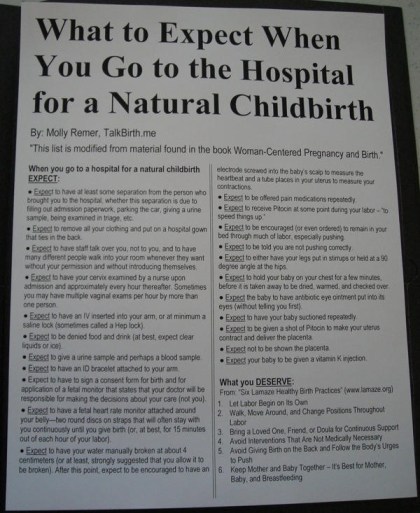
Anyway, this week I received a promo launch packet for the online release of the book. It includes two printouts from my own website and the re-formatted flier based on my blog post, as well as a folder and postcards.
20121008-164805.jpg

And, then I took picture of the packet and included my own vintage copy of the original Woman-Centered Childbirth book 🙂
20121008-164812.jpgThis has been a fun link between past and present activism and between a foremother in birth activism and my current self!

Bits of the (Birth) Net

The following is a collection of the bits and pieces that caught my attention and then were shared via my Talk Birth Facebook page during the last two weeks.

Listening

From a good article by the National Association of Mothers’ Centers in Mother Support: When Words Get in the Way

Words, whether written or voiced, are so very fragile. They can be bent or twisted, even become unrecognizable from their initial intentions. They can have different cultural meanings, regional understandings, and generational perceptions.

There will always be the opportunity for miscommunication…

Such a good reminder. What you say and what people hear are often two different things. What you say and what you mean can be different. How your words are received and interpreted can be very important and intent in many ways doesn’t matter! Communication is transactional process. A two-way process. And, it is symbolic. Meaning can never be fully interpreted and understood completely.

This article also reminded me of one of my own older articles, Listening Well Enough, which came to mind because I’m finishing up with the training of two women. The essay describes my own experience when I was training as a breastfeeding counselor in 2005.

Privacy

The topic of what to risk sharing online came up with friends recently and I enjoyed this article about answering the question of How Much Of Your Private Life Should You Keep Private On Your Blog?

Childbirth Education

Childbirth education is beginning too late in pregnancy; it needs to begin in the first trimester or even before women become pregnant…

The above is one of the concluding points from an interesting article from Birth Works International about supporting women without epidurals.

Good article from Lamaze about your breath and how it can help during pregnancy and birthing!

Virtual labor simulator!

Pushing Positions

Very interesting article on What is the Evidence for Pushing Positions?  Apparently there is more blood loss and second degree tears with upright pushing positions. Personally, I CANNOT imagine giving birth in a supine position. But, I’m also really, really, tired of tearing (tired enough that it is one of the factors in our decision not to have “just one more!” baby). For more thoughts about pushing, see previous post on Following Your Body’s Urges to Push…

And speaking of upright birth, Barbie homebirth photos! 🙂

Informed Consent

Valuable article addressing 10 Responses to Pressure to Consent (remember, it isn’t “informed consent” if you do not have the option of saying NO!)

Posts I’ve written about informed consent:

Prenatal Yoga

Online video prenatal yoga class: Prenatal Yoga – when you feel good, your baby feels good.

And my own prior posts on the subject:

Birthing Room Yoga Handout

Birth, this elegant, simple, yet intricate process has had unnecessary, complex, expensive technology superimposed onto it, creating a dangerous environment for birthing women.” -Alice Bailes

Loved this article on what really matters for midwives!

Epigenetics

NEW STUDY: Epigenetics: Mother’s Nutrition — Before Pregnancy — May Alter Function of Her Children’s Genes. “As parents, we have to understand better that our responsibilities to our children are not only of a social, economical, or educational nature, but that our own biological status can contribute to the fate of our children, and this effect can be long-lasting,” said Mihai Niculescu, M.D., Ph.D., study author from Nutrition Research Institute at the University of North Carolina at Chapel Hill, in Chapel Hill, N.C.–Epigenetics: Mother’s Nutrition — Before Pregnancy — May Alter Function of Her Children’s Genes

After CAPPA this year, I wrote about epigenetics here: Epigentics, Breastfeeding + Diet, and Prenatal Stress

Call the Midwife

Fun! Ms. Magazine linked to one of my blog posts about midwifery in their post about the PBS show Call the Midwife!  And, after posting to the CfM Facebook page about how I didn’t get to watch the show myself because I have no TV channels, CfM fan Jackie clued me in that Call the Midwife is available online (no TV channels required!) Yay! 🙂

Older Posts of My Own

Birth Culture: “Birth is cultural, the way eating is cultural. We don’t just eat what our bodies need to sustain us. If we only did that, there would be no reason for birthday cake. Birthday cake is part of our food culture. The place you are giving birth in has a local culture as well. It also partakes of our national birth culture. Not everything doctors do regarding birth makes the birth faster or physically easier for you or the baby. Some things are just cultural.” -–Jan Mallack & Teresa Bailey

Creating Needle Felted Birth Art Sculptures: My first foray into birth art, before I fell in love with using polymer clay!

Centering for Birth: “Centering is a breath awareness strategy that I’ve adapted for use in birth classes based on the ten second centering process described in the short book Ten Zen Seconds…” Free handout available about centering for birth! (I was reminded of this post by Enjoy Birth!

Breastfeeding as an Ecofeminist Issue:“What happens when society and culture pollute the maternal nest? Is that mother and baby’s problem or is it a political and cultural issue that should be of top priority? Unfortunately, many politicians continue to focus on reproductive control of women, rather than on human and planetary health…”

During a week when I didn’t have time to craft delightful new blog posts, it was fun to have a post from a couple of months ago suddenly getting all kinds of hits and Facebook shares. Thanks, internet! ;-D (Around 150 shares on Facebook apparently. I ♥ Facebook!)

On Parenting Books

Mama Birth: Sadly, Parenting Books CAN’T Actually Raise Your Child: Enjoyed this post! (But I recommend NOT reading the comments on the original article she links to about “detachment parenting.” I lost about 30 minutes of my life, felt my blood pressure rising, and only made it to page three!)

The revolution must have dancing; women know this.
The music will light our hearts with fire,
the stories will bathe our dreams in honey
and fill our bellies
with stars.
-Nina Simons via Rebecca A Wright, Doula

DVD Review: Laboring Under an Illusion


DVD Review: Laboring Under an Illusion: Mass Media Childbirth vs. The Real Thing
Filmmaker: Vicki Elson
50 minutes, $39.99 (personal use­)
www.birth-media.com

Reviewed by Molly Remer, Talk Birth

Laboring under an Illusion is a treasure trove of discussion-provoking material. Filmmaker Vicki Elson is an anthropologist and childbirth educator who has created a striking documentary exploring media-generated myths about childbirth. As a childbirth educator, I often reference in my classes how our attitudes and expectations about birth are shaped by media messages—birth is an emergency, etc. This film eloquently and entertainingly provides 50 minutes of backup material for the idea!

The film blends media messages from comedy shows like Murphy Brown, Mad About You,and I Love Lucy, movie clips such as Juno, Coneheads, and Nine Months, along with “reality” based shows on Discovery Health with the inherently contrasting messages in clips of beautiful births from films like Birth as We Know It, The Business of Being Born, and Orgasmic Birth. It also contains brief voiceover narrations from “regular” women about birth. Occasionally, there is a scene with the filmmaker speaking directly to the viewer about concepts raised in the film. These scenes are less entertaining than the popular media clips and the friends with whom I watched the film wanted to fast-forward these segments—the media clips chosen so clearly speak for themselves that they don’t really need explanation, at least to the already birth-savvy viewer. Because of some strong language in the media clips, I caution parents to preview the film before sharing it with children.

Laboring Under an Illusion is an entertaining and illuminating film for consumers as well as for birth educators, doulas, and midwives. I highly recommend it!

Disclosure: I received a complimentary copy of the DVD for review purposes

Amazon affiliate link included in image.

The dualism of blogging (and life)

Yesterday, I found myself involved in two different conversations about blogging. In the first, I exclaimed to my friend, “do you have any idea how many things I want to blog about that I don’t?! I need a blog for, ‘the things I don’t blog about.'” In the second, some other friends said to me, “you’re just so open on your blog, I don’t think I can be that open.” We then went on to discuss the various crazy people we have known who we do not wish to have access to information about us or to know things about our lives. I’ve been writing this blog since 2007 and had another blog before that. While I have had people read and comment that I sometimes wish were not following my writing and while I’ve had a handful of negative/insulted comments, for all these years I’ve never had an actual bad experience with blogging. Sometimes I think it is the tone I maintain here—I rarely write prescriptively (i.e. here’s what YOU SHOULD DO) and I rarely write inflammatorily (i.e. why are some people such IDIOTS about this?!) and I rarely write controversially (i.e. down with circumcision!). I also consciously choose not to write in what I refer to as a “putting out fires” style. You may notice that when there is some new outrage in the birth or breastfeeding community, I rarely address it here. I’d rather focus on building something new and on what I can offer in terms of information, experience, or idea than to debunk, criticize, or expose. And, I don’t actually have time to keep up with all the drama even if I wanted to. I barely have time to keep up with my own life on my own little patch of the earth! I do occasionally reflect that this probably limits my site traffic in some ways—particularly when I choose to ignore something obnoxious that crosses my email box and later another blogger writes a witty exposé of the same subject and it goes viral throughout Facebookworldland—though I try not to compare myself to other bloggers or to have too much stats envy.

And, periodically, I get lovely emails like one from last week saying, “I love your energy and gentle voice.” 🙂 And, periodically, things happen and I see remarks on twitter referring to something I’ve written as, “I dislike the tone of it and its intention to demonise the health service.” 😦 The latter just happened last night in response to the publication of my What to Expect When You Go to the Hospital for a Natural Childbirth as an informational leaflet in conjunction with Women’s Health in Women’s Hands’ publication of Woman-Centered Childbirth in full text online. Twitter is too character limited for me to respond to the critique in full, so I said I’d write a follow-up blog post to explain. 20120928-141455.jpg A different organization (Women’s Health in Women’s Hands) converted one of my posts into this flier and it does not include my initial disclaimer expressing my trepidation about being perceived as “hospital-bashing” (it shouldn’t include that, because it is flier now, not a rambling blog post!). The article is NOT meant to hospital bash, it is meant to prepare and plan appropriately. I wrote it because I was tired of how betrayed my clients were when they planned beautiful, natural hospital births and then experienced many things on the list in my article. There is also a companion article and series of tips (I think on the back side of the tweeted leaflet as a matter of fact) about how to cope/navigate–the information is not meant to discourage, but to realistically prepare. Have a homebirth is NOT one of the tips, because this isn’t a home vs hospital article! Whew! See…too many words for Twitter, that’s why I rarely use it except FB auto-tweeting stuff.

So, which is it? Am I authentic and open, or keeping my mouth shut all the time?! Maybe both. What I know is there is a lot I don’t write about. I don’t write because I’m too scared, or too sensitive, or too fearful, or too self-righteous, or too busy, or too annoyed, or too scattered, or too embarrassed. I don’t write things because I have relatives who read this or friends who read this and I’d rather not share some things with some people. And, which is it? Do I have nice energy and a gentle voice or am I a strident hospital-basher out to demonize and victimize?!

And, I started to reflect that I guess I am all these things and how people experience me and my writing is in part up to me and in part up to them. Just like in real life. I can be gentle, kind, and nurturing. I can be critical, judgmental, and harsh. I can be helpful and I can be selfish. I can be patient and impatient. I can be friendly, I can be preoccupied. I can be energetic and enthusiastic and upbeat and I can be exhausted and defeated. I can be a fabulous, fun mother and I can be a distracted and grouchy mother. I can be funny and I can take myself too seriously. Different people, relationships, and environments bring out different expressions of who I am. Sometimes I really like myself a lot. I like who I am, I like how I move through the world, and I’m impressed with my own capacities. I have great ideas and solid values and principles and the ability to articulate those in writing. Sometimes I actually hate myself. I see only the bad parts and I wish I could just be better. I feel hypocritical and over aware of inconsistencies in my own thoughts/beliefs and my expression of my values in the world. I often want to be better than I am, but in rare moments of grace and self-compassion, I realize that I’m pretty good already. And, in some moments of self-righteousness and superiority, I actually feel better than some people in some areas/some ways!

There are two things that I know for sure. I never wish to diminish another woman and to make her feel judged as unworthy or “less than” for her birth or mothering choices. And, at the same time, I never wish to lie to another woman either in an effort to prevent her from feeling those things…

Blogging does only convey a slice of the “real me,” but I also find it an authentic slice, an authentic form of expression, and a real experience of who I am, just not all of who I am. Ever. I can be both more and less than what speaks to you from these many, many pages of blog posts. More in that I am more complicated and think deeper and with more intensity than most people will ever know and less in that I’m multidimensional and flawed and real, not just words on a screen from one moment in time.

20120928-150355.jpg

Yesterday..taking my kids to the theater and taking a moment to point out the “hidden” Goddess right in the middle of town. Today, sitting on the bed in the dim light while Alaina naps, typing feverishly and feeling utterly swamped with the one million things I’d like to do with my life…

Domestic Violence During Pregnancy

By Molly Remer, MSW, ICCE, CCCE

Violence during pregnancy is an unfortunately common experience. Between four and eight percent of women experience domestic (intimate partner) violence during their pregnancies. The incidence of violence increases for women with unplanned or unwanted pregnancies with 26% of pregnant teens experiencing intimate partner violence and 15% of all women whose pregnancies are unwanted being in an abusive relationship. Indeed, murder is the second only to car accidents as the most common cause of injury related death for pregnant women.[1] Sadly, these statistics are likely higher in reality due to underreporting or misclassification.

Despite prevalence and severity, domestic violence is not often addressed in the birth community. Books directed at pregnant women rarely even mention violence in pregnancy (and most do not even include it at all), even though the incidence is similar to the rate of premature births and much higher than the incidence of various pregnancy related complications that generally warrant at least a paragraph in birth literature (such as placenta previa). Likewise, books and training programs for doulas, birth educators, and other birth professionals, generally neglect to address intimate partner violence.

An introduction to the issue of domestic violence during pregnancy requires an understanding of the following dynamics:

  • Cycle of Violence—the concept that violent behavior in a relationship tends to occur in three distinct phases. In the tension building phase, the battered partner feels as if she is “walking on eggshells.” The abuser’s temperament and mood becomes increasingly unpredictable and volatile and culminates in the explosion/eruption phase in which an acutely violent incident occurs. Early in a relationship, this phase is often followed by the honeymoon phase during which the batterer is contrite, asks for forgiveness, offers gifts, and assures the woman that, “it will never happen again.” The length of each phase varies by couple and with their relationship. Over time, the tension building or explosion phases may be very prolonged, with little or no time spent in the honeymoon phase.

The cycle of violence continues to repeat and tends to escalate in severity, despite the assurances that the batterer makes during the honeymoon phase.

  • Domestic violence is about power and control. It is NOT about anger management, substance abuse (though substances can increases violent incidents), or “nagging” from a girlfriend or wife.
  • The abusive partner tends to tell the woman that the violence is her fault and that she provokes or deserves the abusive incidents. He often isolates her from people and situations that will help her know otherwise.
  • Abusive relationships may involve physical, emotional, or verbal battering and frequently some combination of the three. Physical abuse includes pushing, choking, kicking, sexual abuse and other means of physical control/harm as well as punching or slapping. Verbal and emotional or psychological abuse involves name calling, insults, berating, shouting/screaming, humiliation, threats, intimidation, destruction of property, isolation, activity restriction, abuse of pets, and withholding of economic, physical, or emotional resources. Women often forget to acknowledge some physical forms of violence like choking or pushing as “real” abuse and will often not consider themselves abused unless they have been punched or slapped by their husband or partner.
  • Women stay in abusive relationships for numerous reasons. Battered women often leave their relationships several times before they end it for good. Reasons are dynamic, complex, and individual. Some very basic reasons include hope, love, and fear. The most dangerous time in the relationship is when she leaves—it is then that she is most likely to be severely injured or killed. As a society, we should NOT be asking why women stay, we should be asking how we can stop domestic violence from happening.

 So, what can you do? If you are a pregnant woman who is being abused, please contact your local domestic violence shelter or hotline. Or, call the National Domestic Violence Hotline at 1-800-799-SAFE. Even if you do not feel ready to leave your relationship, many shelters offer “outpatient” support groups and counseling. If you are a prenatal health care provider (midwife, doctor, nurse, physician assistant), please include domestic violence screening questions during your prenatal visits and be alert and responsive to signs of violence. If you are a doula, birth educator, or other birth professional, include a discussion of domestic violence during your classes or prenatal visits and encourage exploration and acknowledgment of these issues during your networking with other birth workers. You may also wish to download and read the Center for Disease Control’s guide, Intimate Partner Violence during Pregnancy: A Guide for Clinicians. If you are a friend or relative of a pregnant woman experiencing abuse, help her develop a safety plan and encourage her to seek the services of a domestic violence shelter.

Though it can be very awkward to address domestic violence issues with women directly and can feel like an intrusion into private lives, if you choose silence, you contribute to a continued culture of fear, shame, denial, and invisibility for the many women experiencing violence during this time in their lives. Acknowledging the reality and prevalence of violence against women in our culture and encouraging open, respectful, and assertive dialog about it is a powerful tool in reducing the occurrence. Strive to help bring violence against pregnant women into public view instead of considering family violence to be private, family business. Women and babies are too important for us to remain quiet.

Portions of this article are excerpted from the booklet Talking to a Battered Woman: A Guide for the Short Term Helper by Molly Remer, MSW, ICCE. This booklet is available as free pdf file on Molly’s website (http://talkbirth.me). Molly is a certified childbirth educator, the editor of the Friends of Missouri Midwives newsletter, a breastfeeding counselor, and a college professor.


[1] National Coalition Against Domestic Violence Fact Sheet “Reproductive Health & Pregnancy,” http://www.ncadv.org/files/reproductivehealthandpregnancy.pdf

This article was originally published in Citizens for Midwifery News and was later reprinted in International Doula along with a companion sidebar by Susan Hodges.

Related post: Birth Violence

Guest Post: Abuse of pregnant women in the medical setting

This post is a companion piece to my article, Domestic Violence During Pregnancy, and was previously published as a sidebar in Citizens for Midwifery News and later in International Doula.

Abuse of pregnant women in the medical setting

 By Susan Hodges, founder and past President of Citizens for Midwifery

Have you or someone you know experienced rude, abusive or violent treatment at the hands of obstetricians or other hospital staff? Abusive behavior, in or out of the hospital, can include threats, coercion, yelling, belittling, lying, omission of information, lack of informed consent, misrepresentation (of medical situation, of interventions, of reasons they “need” you to do something or not do something), and so on. For example, nurses yelling at a woman to push is abusive, even if the nurses don’t intend to be abusive. An OB lying to a woman that her baby is “too big” (something that neither he/she nor anyone else can predict), telling her she “needs” intervention, and then not providing complete information about the risks and benefits of the intervention, is abusive behavior. Unwanted and unnecessary surgery (such as episiotomy or an avoidable cesarean section) is no less violence against a woman than hitting or strangling – most of us have just not thought about it in that way. The fact that most women are persuaded that they “needed” the intervention, that it was because their body was somehow defective, is another aspect of the abuse (blaming the victim).

While the situation is different from domestic violence in some ways, it is also similar. Abuse in the medical setting is also about power and control, the pregnant or laboring woman is often blamed for her situation, and verbal and emotional abuse can be similar. Because we are taught to “trust your doctor”, and in fact there is an explicit assumption of trust in the “fiduciary relationship” between the woman and her doctor who is an “expert”, most of us do not think about the possibility of abuse, and many of us stay with the OB or feel we have no choice about our health care providers or settings, especially when we are in labor. Also, the doctors and staff generally are not even aware that their behavior or actions are abusive.

Forty years ago, domestic violence happened, but was hidden and accepted. A lot of women had to do a great deal of work to come up with the language and the legal strategies, and to educate women, law enforcement, judges, mental health workers, and many others to get us to the point where we are today, where at least the problem has a name and at least some of the time women can fight back with the law on their side.

It is extremely difficult to deal with an abusive OB (and it might be hidden abuse, manipulation, etc.) in the middle of labor, just as is very difficult to effectively deal with an abusive spouse in the middle of the abuse. The childbirth community is only just now beginning to recognize that women are being abused in many ways in the present system of maternity care.  We don’t really have special words for it yet. We do have some legal underpinnings to fight at least some of it, but we are in the very early stages. It will take recognition of the problem on a larger scale and by women who are not being abused by OBs to bring this issue to public attention, create language for it, and use legal tools to end it. We have a lot of work to do.

Have you experienced abuse? At the least you can file a complaint. See “Unhappy With Your Maternity Care? File a Complaint!” at http://cfmidwifery.org/Resources/item.aspx?ID=1

Related post: Birth Violence

Guest Post: What is a 21st Century Feminist?

Molly’s note: I have a lot of diversity amongst my Facebook friends and amidst the many politically liberal posts I see every day there are also links to anti-feminist articles, written by mothers, that make me incredibly sad. Last month an acquaintance posted one of them and I responded to her: “This article made me sad, because of the writer’s distorted experience of what feminism is (or the distortion she’s experienced of it). I hate it when women perceive feminism as a ‘dirty word’ or incompatible with their lives as homemakers and mothers.” As our conversation continued, I went on to explain: I’ve been a feminist forever–like before I even knew there was an actual word for it. I do understand that there is a tension between feminism and motherhood sometimes (in a negative way). I think because I mostly read or associate with feminist mothers, and feminist attachment-parenting-minded mothers at that, I’ve had less exposure to the “other kind” and I tend to feel like, “I’m not that way, so surely no one else is either!” I guess it might be similar to other large movements and certain representatives of those movements making the whole thing look bad–i.e. if people might say “religion is oppressive!” rather than realizing that it is really how some people USE religion that is oppressive, not necessarily the institution itself.

I am a feminist. I was one long before I had children. It was my first “cause.” I’m also the mother of three. I’m totally into birth and breastfeeding and female-biological-processes. I might be able to be accused of being biologically reductionist in some of my ideas, because of the importance I place on the body, particularly the female body, in how I relate to the world and to my own spirituality. However, to me, feminism feels simple and obvious. I love women. I think they’re awesome. I don’t think they should be exploited, controlled, victimized, or dominated. Boom. I’m a feminist! Duh.

In addition, I don’t consider myself pro-choice OR pro-life. I consider myself pro-woman and for me that means upholding all women’s reproductive rights, regardless of how I feel about making those choices for myself and regardless of how I am personally uncomfortable with some women’s choices. Women MUST be able to control their own bodies and who has access to them. To me it is that simple and that nonnegotiable.

So, I appreciated this guest post that came in today and how it lays out very simply what it means to be a 21st century feminist…


What is a 21st Century Feminist?
Women’s Author Says She (and He) May Look A Lot Like You!

With all the talk of a “war on women” during this explosive election year, the notion of feminism is once again in the news – and open to debate. Especially among women.

Nothing illustrates that better than the rash of commentary following the recent death of sexual-revolution era author Helen Gurley Brown, says Heather Huffman (www.heatherhuffman.net), a 35-year-old author whose newest book, “Devil in Disguise,” continues her tradition of upbeat romances featuring strong female protagonists.

“Some writers took her to task for advocating sexual freedom for women,” Huffman says. “They say she wasn’t a ‘feminist’ because she was all for promiscuity, not women’s rights, and her actions led to an explosion of single moms and STDs.

“Others viewed her as the ultimate ‘feminist,’ a heroine who chopped through a cultural thicket to break down repressive social mores.”

The truth is, Huffman says, that Brown did important work on behalf of women.

“While I don’t advocate promiscuity, I do acknowledge that Gurley Brown’s boundary-pushing stance brought the topic of women’s rights to the forefront, paving the way for change,” she says.

The problem is, she says, that when people hear the word “feminist,” they picture a woman from another time, like Helen Gurley Brown. They don’t see themselves at all.

“I hear some women say, ‘I’m not a feminist!’ They think a feminist is a strident, angry man-hater who gets up in arms over any perceived slight,” Huffman says. “That’s too bad, because the world needs feminists as much as it needs any group that advocates for human rights.”

Feminism changes with the times, she says. So what is a 21st century feminist? Huffman offers her observations:

• She (or he) supports a woman’s right to be a mom – or not.  When women won acceptance and equal rights in the workplace, we were released from one box and plopped right into another one. “We went from raising children to raising children and working. Too often, that’s the expectation now,” Huffman says. Feminists support a woman’s right to choose her life’s direction, whether that’s staying at home and being mothers, choosing never to become mothers, or some hybrid of work and motherhood.   “Having equal rights is having the freedom to choose our life’s direction without being subjected to discrimination because of what other people expect our role to be,” Huffman says.

• Supports removing double standards. “You still see, in the workplace and at home, the tough guy gets praised, and the tough woman, well, she’s a ‘witch’ or worse,” Huffman says. More smart, savvy women have earned respect professionally – Hillary Clinton, Condoleezza Rice, Madeleine Albright – and that’s progress, but we still have work to do. “Professional women still get criticized about their hair style, their fashion choices.  Rarely are professional men snubbed for these things.”

• Understands what rights are being legislated and by whom. We all know the hot-button “values” issues that polarize voters. “The reality is a politician’s party affiliation doesn’t paint an accurate picture of who they are or what they stand for. Voting records, corporate associations, and actions are much more telling. As citizens, as women with a voice, we must do our homework to ensure our values are being reflected in Washington. And, in truth, feminism is more than a political movement – it’s the empowerment of women to live the life they were created for.”

About Heather Huffman

Heather Huffman is a women’s advocate, writer, former human relations specialist and mother of three. She and her family are currently homesteading 10 acres in the Ozarks. Huffman is the author of seven novels, including “Throwaway” and its prequel, “Tumbleweed.” A portion of proceeds from sales of her books benefit groups fighting human trafficking.

New Birth Skills Workshop!

Active Birth and Labor Support

Saturday November 17, 6-9:00

Location: Tara Day Spa in Rolla, Missouri

Cost: $35 for the pregnant woman + one support person (husband, partner, relative, friend…)

Workshop description: First, practice active birth techniques and learn about working with pelvic mobility. Next, spend some time learning labor tips and tricks and practicing comfort measures with doulas! Then, enjoy a friendly Q & A session all about what you most want to know. You will have access to three birth professionals for the price of one! We will close with some relaxation skills practice and a guided visualization.

Interested? Please email me and I’ll send you the registration form!

Where are the women who know?

Ames, Iowa 1960

Pregnant and
no female friend to confide in
Scared and
no woman to tell it to
A male doctor who patronizingly
calls me by my first name
while I’m supposed to
respectfully
call him Dr. So-an-so

A husband so afraid of
his own fear that
He’s unwilling to know it’s there
not the person
to listen to mine

Where are the witches, midwives
and friends
to belly dance and chant
while I deliver
to hold me and breathe with me
as I push
to touch me and comfort me
as I cry?

Where are the womyn who know
what it’s like
to give birth?

–Antiga in The Goddess Celebrates, p. 152

This poignant poem spoke to me from the pages of an anthology of women’s rituals recently. It made me think about my plans and visions for the birthwork I’d like to offer to my community. Some friends/colleagues and I launched a local Birth Network this year and one of my primary hopes for it is that it will provide easy access to the women who know. And, that in simultaneously creating access for pregnant women to each other, the opportunity arises to uncover their own deep knowing, rather than needing expert advice or opinions. To that end, we’re planning a series of birth workshops (more details soon!) and hopefully a birth circle.

In the novel The Heart of the Fire recently I marked these two quotes:

“A woman who has borne children…loses many of her terrors.” The character speaking goes on to explain, “…for a Priestess it is, a path. A path of opening.”

Later the main character is attending the birth of one of her siblings and observes, “[the midwife] says the most important thing is to never bring fear into the room of a laboring woman. ‘A woman must be completely open to birth a child,’ she says, ‘and so she is unable to defend herself from the thoughts of those around her.'”

I’ve written about birth fear several times before. I think many women underestimate the potent impact the emotional condition of birth witnesses of all kinds (including doctors, nurses, grandmothers, doulas, and friends!) can have on their own birthing times. Women in labor enter a timeless, liminal space, and use their right brain–the primitive brain, the “birth brain” as I call it or “their monkey” as Ina May calls it–to dig deep and access the inner resources they need to birth their babies. When other people in the room are fearful or agitated or even just too talkative, the laboring woman has a heightened vulnerability to and awareness of those emotional states. This is what the fictional midwife quoted above means about being “unable to defend herself from the thoughts of those around her.” This is an important understanding. While to the birth attendant, this is just one more birth in a lifetime career, for the mother giving birth this is potentially a peak experience and definitely something she will remember for the rest of her life. This is a sacred moment and one deserving great care, tenderness, and respect.

In my ideal vision of the world, pregnant women would have ample access to other women who know what it is like to give birth under their own power and self-authority. And, these women who know would likely be women who have lost many of their “terrors” in the process. Access to women who know would render most traditional forms of childbirth education unnecessary, offering instead what Michel Odent would deem “new style childbirth education”:

“…for the most part, these are mothers who have no special qualification but, having given birth to their own children, feel the need to help other women who could benefit from their personal experience. They organize meetings, often at their own homes. They do not usually encumber themselves with any particular theoretical basis for their teaching, but may find it useful to give this or that school of thought as a reference. Their aim could most accurately be described as being to provide information and education, rather than specific preparation.” (previously quoted in thoughts on epidurals, risk, and decision making)

So, this is really what I’m hoping to be a part of creating for the women of my own community. I want to help open the door so that the women who know and the women who are preparing themselves to know can meet in safe space and in so doing lose many of their terrors and joyfully uncover their own unique strengths. I believe I’ve already seen it working.

Related posts:

The Value of Sharing Story

Information ≠ Knowledge

How Do Women Really Learn About Birth?

Becoming an Informed Birth Consumer (updated edition)

20120903-135413.jpg

“Birth is life’s central mystery. No one can predict how a birth may manifest…Our dominant culture is anything but ‘natural’ so it is no surprise that childbirth, even with the most natural lifestyle lived by an individual family, sometimes needs intervention and medical assistance. This is not to say that any one mother’s efforts to have a natural childbirth are futile. Just that birth is bigger than one’s personal desires.” –Jeannine Parvati Baker (in The Goddess Celebrates: An Anthology of Women’s Rituals, p. 215)

It’s Labor Day and it is also the start of Empowered Birth Awareness Week! A blog carnival is in full swing at The Guggie Daily and I’ve been having some thoughts about birth as a consumer issue. Very often, it appears to me that responsibility for birth outcomes is placed on the mother—if only she’d “gotten educated” she would have made “better choices.” Many people have a tendency or overlook or minimize the impact of the context in which she makes her choices. In that way, I appreciate Baker’s observation about that birth is bigger than one’s personal desires. That doesn’t mean that we can’t take vital steps to alter the larger culture of birth in which we make our choices, however, and one of those ways is to remember to think about birth as a consumer issue.

Though it may not often seem so, birth is a consumer issue. When speaking about their experiences with labor and birth, it is very common to hear women say, “they won’t let you do that here” (such as regarding active birth–moving during labor). They seem to have forgotten that they are customers receiving a service, hiring a service provider not a “boss.” If you went to a grocery store and were told at the entrance that you couldn’t bring your list in with you, that the expert shopping professional would choose your items for you, would you continue to shop in that store? No! If you hired a plumber to fix your toilet and he refused and said he was just going to work on your shower instead, would you pay him, or hire him to work for you again? No! In birth as in the rest of life, YOU are the expert on your own life. In this case, the expert on your body, your labor, your birth, and your baby. The rest are “paid consultants,” not experts whose opinions, ideas, and preferences override your own.

There are several helpful ways to become an informed birth consumer:

  • Read great books such as Henci Goer and Amy Romano’s new book Optimal Care in Childbirth or Pushed by Jennifer Block.
  • Hire an Independent Childbirth Educator (someone who works independently and is hired by you, not by a hospital). Some organizations that certify childbirth educators are Childbirth and Postpartum Professionals Association (CAPPA), BirthWorks, Birthing From Within, Lamaze, and Childbirth International. Regardless of the certifying organization, it is important to take classes from an independent educator who does not teach in a hospital. (I’m sure there are lots of great educators who work in hospitals, but in order to make sure you are not getting a “co-opted” class that is based on “hospital obedience training” rather than informed choice, an independent educator is a good bet.)
  • Consider hiring a doula—a doula is an experienced non-medical labor support provider who offers her continuous emotional and physical presence during your labor and birth. Organizations that train doulas include CAPPA, DONA, and Birth Arts.
  • Join birth organizations specifically for consumers such as Citizens for Midwifery or Birth Network National or International Cesarean Awareness Network.
  • Check to see if you have a local birth network in your own community or even start your own (I recently co-founded one in my town!)
  • Talk to other women in your community. Ask them what they liked about their births and about their care providers. Ask them what they wish had been different. Pay attention to their experiences and how they feel about their births. If they are dissatisfied, scarred, unhappy, and disappointed, don’t do what they did.
  • Ask your provider questions. Ask lots of questions. Make sure your philosophies align. If it isn’t a match, switch care providers. This is not the time for misplaced loyalty. Your baby will only be born once, don’t dismiss concerns your may have over the care you receive or decide that you can make different choices “next time.”
  • Find a care provider that supports Lamaze’s Six Healthy Birth Practices and is willing to speak with you seriously about them:
  1. Let labor begin on its own
  2. Walk, move around and change positions throughout labor
  3. Bring a loved one, friend or doula for continuous support
  4. Avoid interventions that are not medically necessary
  5. Avoid giving birth on your back and follow your body’s urges to push
  6. Keep mother and baby together – It’s best for mother, baby and breastfeeding

These care practices are evidence-based and form an excellent backbone for a solid, mother and baby friendly birth plan.

Why “evidence-based care” though?

Because maternity care that is based on research and evidence for best practice is not just a nice idea or a bonus. It isn’t just about having a “good birth.” Evidence-based care is what mothers and babies deserve and what all birthing mothers should be able to expect! Here is a great summary of pregnancy and birthing practices that the evidence backs up:

20120903-142510.jpgRemember that birth is YOURS—it is not the exclusive territory of the doctor, the hospital, the nurse, the midwife, the doula, or the childbirth educator. These people are all paid consultants—hired by you to help you (and what helps you, helps your baby!).

“As long as birth- metaphorically or literally-remains an experience of passively handing over our minds and our bodies to male authority and technology, other kinds of social change can only minimally change our relationship to ourselves, to power, and to the world outside our bodies” – Adrienne Rich (Of Woman Born p185)
20120903-135505.jpg

Related posts:

Birth class handouts

Can I really expect to have a great birth? (updated edition)

What to Expect When You Go to the Hospital for a Natural Birth

Active Birth in the Hospital

The Illusion of Choice

Musings on Story, Experience, & Choice

This post is updated from a previous edition.