Archives

Birth Mystery

“Whether a woman knows it or not, she is a vessel of great magnitude born capable of reshaping humanities destiny if she only knew the true depths of her innate gifts. Be prepared now to see the fierce face of the feminine rock as her inner geographies of volcanic strength erupt from a love she has held in her belly for life all of her days. This is not a gasp of her last breath. It is her birthing cry into her wise leadership on our planet.” –ALisa Starkweather

“Birth, like love, is an energy and a process, happening within a relationship. Both unfold with their own timing, with a uniqueness that can never be anticipated, with a power that can never be controlled, but with an exquisite mystery to be appreciated.” –Elizabeth Noble

“Birth is not a cerebral event; it is a visceral-holistic process which requires all of your self–body, heart, emotion, mind, spirit.” –Baraka Bethany Elihu (Birthing Ourselves into Being)

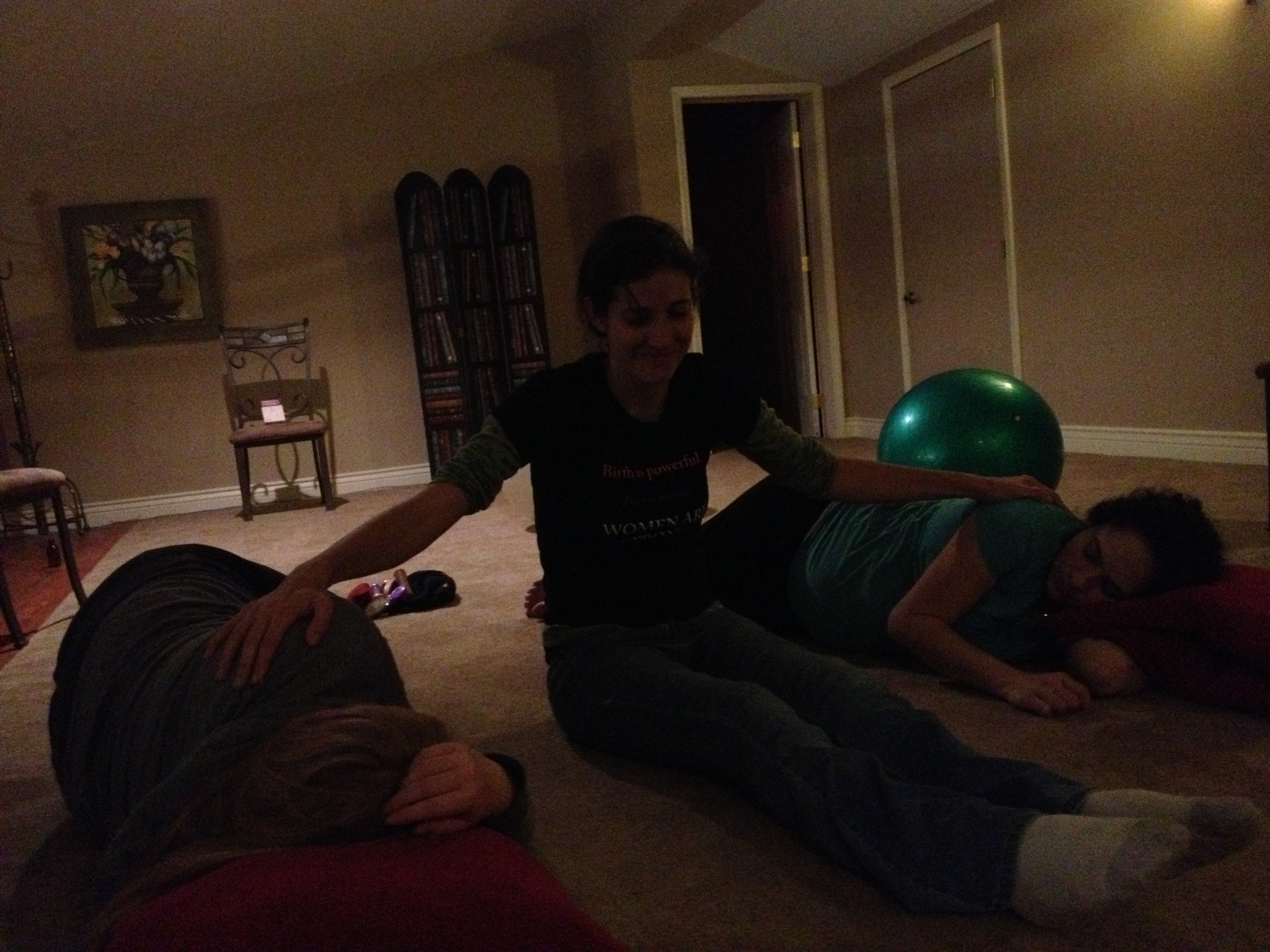
Last weekend, I taught our final Birth Skills Workshop of the year. While I know I have been writing about my sense of separation from birth work or the phase of “moving on,” in which I find myself, this workshop was an excellent experience. The women were so beautiful and interested and anticipatory. The couple working together was so loving. My doula co-presenter was so present and grounding. I came home feeling really positive and enthused and I also found myself considering new birthwork-related ideas and new possibilities, including something that I’m really excited about, but don’t feel like I can share publicly just yet. This work is in my blood, my roots, my heart and my soul, regardless of how direct the services are that I offer or the primacy/priority of face-to-face birthwork in my life. I will never not care about birthing women. They’re too amazing. They’re too important. And, my own sense of being, my spirituality, my thealogy, is too intimately entwined with my own embodied experience of gestating, birthing, lactating, and mothering, to ever make a full separation from it. After I got home and looked at my few pictures from the evening, I realized that in eight years of teaching birth classes, I have exactly zero pictures of me doing so! But, here is one of some of the mamas were enjoying a much deserved relaxation session after a lot of active birth practice. 🙂

October 2013 036This photo reminds me of the amazing benefits of co-teaching a workshop with another birth professional. SO much better than teaching alone ever was! Doula Summer of Peaceful Beginnings Doula Services and I have been friends for a long time (we also co-founded Rolla Birth Network). She has helped me when I’ve needed help and I’ve helped her when she’s needed help, but our helping skills/abilities rest in different areas, which is why we work extremely well together with a workshop like this one. I provide the information and structure, Summer provides the gentle presence and soothing hand. A good workshop needs both!

I also re-discovered how I do enjoy putting together a nice information packet! 🙂

October 2013 023

In addition to my workshop-related epiphany, I had a lightbulb moment with regard to my M.Div thesis. It suddenly seemed clear to me that rather than create a scholarly, academic discourse proving a theory about birth as a spiritual experience, I need to integrate my theories with my birth art sculptures. I need to frame my work within this sculptural context, this personal experience, this lived reality of the might of creation. I have 234 pages of possible content for said thesis, all saved in an intimidating word document waiting to be sorted through and added to. It is overwhelming to even open. With my new idea of framing my thesis through my own art, I feel a pathway emerging through the information, a pathway that integrates the academic and the personal and that results in something uniquely my own…

October 2013 011

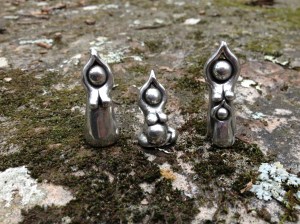
Some of my sculptures-turned-pewter-jewelry.

“Be soft. Think of [labor] as a fine silvery stream, not a raging waterfall. Follow the stream, have faith in its course. It will go its own way, meandering here, trickling there. It will find the grooves, the cracks, the crevices. Just follow it. Never let it out of your sight. It will take you.” -Sheng-yen

“We vibrate to that primordial rhythm even before we have ears to hear…We vibrate to the rhythms of our mother’s blood before she herself is born. And this pulse is the thread of blood that runs all the way back through the grandmothers to the first mother.” – Layne Redmond (August 19, 1952 – October 28, 2013): Drummer/Composer, Author and much more (via The Girl God)

“Within the womb of every woman glows the consciousness of Mother Earth.” –Roslyne Sophia Breillat (via The Girl God)

Guest Post: Squatter’s Rights

October 2013 024

Squatter’s Rights

A couple of posts ago, I mentioned I’d made a new sculpture that I titled after a friend of mine and an article she wrote several years ago. She originally sent me the article to review, because she was thinking of sending it to a magazine. Several years passed, several more babies were born, her computer got fried, and the article was lost. However, it stayed with me anyway. It stayed with me when I prepared for the birth of my rainbow baby girl, it stayed with me as I created birth art to prepare for her birth, and it stayed with me as I reached down to catch my baby’s whole pink wonderful self in my hands as she was born in one smooth reflex almost three years ago. So, I created my figure and I emailed Shauna about it and then I went digging. Deep in the ancient, archived messages in my Outlook Express folder on my old laptop that now belongs to Zander (age 7), I found it. I found Shauna’s squatter’s rights article that had so touched my birth consciousness in such a way that I never forgot—even though babies, computers, friendships, and time have all marched on. I was already a childbirth educator when I read it, had already given birth myself, and was deeply immersed in birth work and childbearing. However, that doesn’t mean that certain descriptions cannot reach us and grab our attention in new ways. I’m delighted that Shauna gave me permission to publish her article here and to share her insights and experiences in this way!

Squatter’s Rights

by Shauna Marie

Would the new child coming from me be slippery like soap? I rubbed my fat belly. I loved each pound I gained, each craving I had, and every trip to the bathroom. Okay, maybe not every trip to the bathroom. But, I loved this growing baby. Tucked away like a pearl in the sea just waiting to be discovered. I was in a constant state of marvel.

Would I be able to physically do this? No, I don’t mean the labor, nor do I mean the birth. I knew I could do that. I got lost in thought as I planned in my head every moment that would come after my body did the work of labor. The moment would come once my body was ready and the crown of a child’s head pushed itself from me, the moment the child would emerge. That’s what I was planning for; I planned to catch my own baby.

I imagined opening my legs and squatting, I even practiced. I wondered where I’d put my hands, how I would have my legs, and if this little wet creature would be so slippery that I’d drop him or her. In December of 1999 this would be my second birth, but my first time catching a baby.

Like many people from a young age I was led to believe that women didn’t and couldn’t birth outside hospitals. The ones who did were radical or even dangerous. I was led to believe that the birth doesn’t matter, the baby matters. For my own personal sanity, due to cultural birth fear, I had to just come to the conclusion that as long as my baby was okay I could endure anything and that it would all be over soon.

Now rewind a little bit here, because there is something to be said about being at the right place at the right time; or knowing the right person. As a person who now tries to make a difference by being a strong home birth and natural family living advocate, I know who you know can sometimes make all the difference. For some people they just need that connection with real birth; they need to know someone who will talk about what birth really is about from a natural and physiological point of view. Above all people need to be exposed to home birth because it normalizes birth.

I was almost connected at one small point during my first pregnancy, just weeks before my first birth a friend of a friend was having a baby. I asked where she was having the baby at and when. My friend said she was in labor now, and having the baby at home. A jolt of sudden uncomfortableness and worry struck me, “At home! Why?” (Thinking oh my gosh there is no epidural at home!) My friend responded with a rather obvious sounding answer, “Well her mom is a midwife.” “Oh,” I said in an understanding tone. Somehow this made total sense now. If her mom is a midwife then it’s okay for her.

Quickly all home birth thoughts were intercepted with other conversations of non-birth related content. To this day I feel that should have been my contact with home birth. Instead I missed my first calling and just two months later I was induced two weeks before my due date against my own wishes (along with two other women from my OB’s office) to fit into the OB’s schedule.

I learned an awful lot that night. I learned I would never give birth to a healthy baby in a hospital again. I learned that in a hospital it is okay for others to look at your body, touch you, reach into you, and deliver your baby; but it’s not okay for you to do so.

I also learned that birth does matter, not just a healthy baby. Healthy empowered moms matter and instincts are stripped away by technology and birth colliding. This often even includes the instinct to breastfeed.

I was shocked at how disconnected I felt from the waist down. These strangers were in charge of me. There is something about being tied to IV’s and monitors, naked from the waist down in a hospital bed, legs in stirrups, that takes your power away. Even though some one at some point said, “Here comes your baby, look at your baby come” I felt like I wanted to reach over my belly and feel, or catch. I’d seen that in a birth video once –a nurse said something like ‘you can touch your baby’s head and feel’ to a mom giving birth flat on her back. I waited for someone to say that to me, but no one did.  Be it because of hospital policy, or be it because of shame, it was a no-no to touch or even catch what was mine. I felt so disconnected as I tried eagerly to see over my belly, knees being held up to my ears by three sets of hands to the chants of, “Push, push, pushhh…. good girl.”

I wondered so much about just staying home. I had what I thought was an unexplainable and unfounded desire to hibernate in a dark corner like an animal.

Around the same time that I got pregnant with baby number two I heard a doctor on television actually say that women are physiologically unable to catch their own babies. Already committed to having a home birth that comment further sealed the deal. I was catching my own baby this time. Not only do I dislike someone telling me that I can’t do something, I didn’t believe a woman would let her baby just fall to the floor (many mammals are born that
way though). Surely even if a woman didn’t squat with intent to catch her baby the child would be born slipping onto bed or floor without assistance or harm. My research lead me to discover that women have given birth effortlessly while in comas, unassisted and unmedicated. We’ve all heard the stories of scared teens giving birth suddenly, alone in a bathroom. The body just gives birth when it’s time. Not to mention National Geographic taught me from a young age more than just that women in tribes go topless; they also sometimes give birth to babies unassisted and catch them.

Shauna’s eighth baby, born into her hands this summer.

I was also somehow sure a woman could give birth in total control; in control of her thoughts, feelings, and use of good judgment. I was no longer buying into the stereotypical out of control agony portrayed in movies. I didn’t know, but I deeply believed a woman giving birth, if allowed, could totally be in control and instinctively know how to give birth.

I figured that squatting would give me the best angle to catch my baby. Being in a squat, on bent knees, or even on all fours is clearly the most natural and easiest way to birth a baby. Squatting has roots in ancient history as far as birth goes back. It is only within the last 100 to 150 years, since physicians took control of birth, that women have been required to have babies laying their backs in the lithotomy position. Lying on the back (or semi lying) has obvious benefits from the doctor’s perspective as it provides a good view and way to manually remove a baby, as well as use a scalpel to cut a wider opening to the vagina. The use of gigantic tongs (forceps), vacuum suction extraction on the baby’s head, and even manually pulling on the baby’s head have all been routinely practiced by physicians.

Elizabeth Noble, author of Childbirth with Insight, states, “Women who squat for birth can generally deliver their babies without any manual assistance at all. Gravity and the free space around the perineum allow the baby’s rotation maneuvers to be accomplished spontaneously.”

There are vast differences in giving birth in a squatting position rather than lying down. Well over half of all the births in this country currently involve some type of surgical or operative procedure such as; cesarean section, episiotomy, vacuum extraction, or the use of forceps. These interventions and their accompanying risks could be avoided if women would just adopt a squatting position for birth. Aside from working with rather than against the body and gravity the birth canal depth is shortened during a squat, and the pelvic diameter is increased. In fact just the simple act of squatting can open a women’s pelvic outlet by up to 28 percent. All of these benefits can shorten the second stage of labor and the need for interventions. Squatting also reduces the risk of tearing. Dr. Michel Odent writes in Birth Reborn that, “This position assures maximum pelvic pressure, optimal muscle relaxation, extensive perineal stretching, and minimal muscular effort. It also provides the best safeguard against serious perineal tears.”

Routinely birthing moms are put on their backs or reclined in beds which center the mother’s weight on her tail bone, narrowing the pelvic outlet and compressing major blood vessels which reduce proper circulatory function. This in turn reduces oxygen to the baby and to the uterus making contractions less productive and more painful. Less oxygen to the baby signals distress in the infant, which if in a hospital could cause a whole round of interventions. Combine an oxygen deprived baby with a mother trying to push uphill with a baby that cannot move into a good birthing position because of restricted pelvic room, and ultimately you have mothers who are very good candidates for a birth that must be forcefully assisted by forceps, vacuum extraction or the ever so common routine C-section. The Centers for Disease control states on their website that cesarean sections are now at 32.8% in North America (2011).

Delivery of the after birth in an upright position also has clear advantages. When the placenta isn’t compressed there is less chance of blood pooling up and creating large clots, and gravity aids in placental expulsion.

When the day finally came for me to catch my baby I talked myself through the contractions. I told myself I could do this. I said over and over I can do this, because as a pregnant mammal it’s what I was put here to do. When I felt it was time I squatted over a mirror and saw the crown. I told myself to enjoy this moment, not everyone gets to catch their own baby, and I didn’t want to miss one second of this experience. I swirled the thick wet black hair that was presenting around in a circle with my fingertips. Any and all pain was gone, it was amazing. I focused on this new life that was unfolding from my body. I waited for contractions and I let my body do the work without forceful pushing or feeling agony. When the baby slid into freedom and the room was engulfed with newborn smells and newborn cries I cried out, “It’s a boy, it’s a baby boy!”

The impact of that birth was powerful and amazing; so much so that I have caught five more children from my body since then. There is a saying about the “thrill of the catch,” and midwives and doctors know this. It’s intoxicating and it’s very powerful to catch a baby.

So much harm has been done to cloud the process of childbirth. Birth isn’t just about babies, it’s about mothers too. It’s about how they work together. Catching your own baby puts you focused on your birth, and without trying you take the control and suddenly you feel and know what you need to do. Focusing on the important task of birth made an impact on me a very positive way as a mother. True freedom over my body gave me independence, confidence, and self-control.

Not every woman may want to catch her own baby, but every woman should be encouraged to do so, or at the very, very least know they can if they do wish to. Most women I have spoken with actually say they have never even thought of it.

The state of birth in this country lies squarely in the hands of birthing women. Until we start demanding more respect and more variation in our birthing options we have no one to blame but ourselves. We must first credit ourselves with being able to birth safely the way nature intended before anyone else will give us that credit. The seeking out of safe and natural birth options will slowly continue to influence and change how birth is perceived.

There are specialized hospital beds that can be converted in a way that women are more upright. If you will be giving birth in a hospital request them, demand them. Hill-Rom makes such a bed; the Affinity Three Birthing Bed aids a woman to side lie, squat, kneel, sit, and lean in various positions. It has a labor bar and position controls that are quite impressive. The bed can be lowered or raised up, down, back, and forth

There are birth balls, birth bars, and birthing stools that can aid in more natural upright positions in whatever birth setting you choose. There are showers and tubs to soothe a mother.

I share my experiences with catching my own babies, and have even shared very private birth photos and even one video with others in the past; because I have been told by so many women it has empowered them. I also hear from lots of women who say how strong both me and my legs must be to squat down like that. I assure that it’s not my legs that are strong; it’s my heart and my passion, and the willingness to open up and catch what is mine.

Shauna Marie is happily married to the man of her dreams. They live in the Midwest where they juggle eight energetic children while homeschooling and developing upon a one acre hobby farm of veggies, fruits, chickens, geese, and the dream of a dairy goat. She blogs about her life at Life with Eight Kids. Shauna is very passionate about family with an emphasis on childbirth and healthy, happy moms and babies.

Postscript: Shauna’s most recent birth story, excerpted below, is an excellent description of a squatting birth!

I was standing there in the still of the labor lull a rush of hormones hit me and the baby’s head slipped fully into the birth canal. I squatted down instinctively. I was then super indecisive: I flip-flopped between on my hands and knees to squatting, then squatting with one leg up and one leg down, then a leg up on the side of the tub, then standing upright, then a squat-stand and finally then back to the other positions all over again. This baby was going to start to seriously crown in a big way and I had no idea where I wanted to be! Having done this so many times I had way too many choices in my head and I knew what they all felt like. Later Ricky told me he got nervous that I was moving around so much in the tub; he was worried I’d slip and fall. I however felt firmly planted like a rock. I told him later I felt like I had sticky gecko pads on my limbs and slipping never crossed my mind.

Our baby was starting to crown as I finally squatted down low with one leg higher than the other (I was out of time to change things up. I’ll just squat and do it the same ‘boring’ highly effective way I always do it I thought lol.) I used some counter pressure on her velvety head to help ease her head out but it wasn’t really needed and a painless contraction inched her head fully out.

via Life With Eight Kids: Beatrice’s Unassisted Birth Story (half hour labor and birth -with extra info on my favorite topics of vernix, cord cutting, and not pushing).

Related Talk Birth resources:

Active Birth in the Hospital

Spontaneous Birth Reflex

How to Use a Hospital Bed without Lying Down

What to Expect When You Go to the Hospital for a Natural Childbirth

References:

(Elizabeth Noble, Childbirth with Insight, 78). See also Golay, J., et al., “The squatting position for the second stage of labor: effects on labor and maternal ad fetal well-being,” Birth 20(2) (June 1993):73-78.

Postpartum outcomes in supine delivery by physicians vs nonsupine delivery by midwives.Terry RR, Westcott J, O’Shea L, Kelly F. J Am Osteopath Assoc. 2006 Apr;106(4):199-202. Conclusion: Nonsupline positions during labor and delivery were found to have clinical advantages without risk to mother or infant. Enhanced maternal outcomes included improved perineal integrity, less vulvar edema, and less blood loss.

Dr. Martha Collins D.C., Pregnancy and Chiropractic Planetciropractic.com

Russell JGB. Moulding of the pelvic outlet. J Obstet Gynaec Brit Cwlth 1969;76:817-20

Squatting can enlarge the pelvic outlet up to 28 percent (Russell, J.G., “The rationale of primitive delivery positions,” Br J Obstet Gynaecol 89 (September 1982):712-715

Paciornik M; Commentary: arguments against episiotomy and in favor of squatting for birth. Birth 1990; 17(2): 104-5.

The total U.S. cesarean delivery rate reached a high of 32.9% of all births in 2009, rising 60% from the most recent low of 20.7 in 1996 Martin JA, Hamilton BE, Ventura SJ, et al. Births: Final data for 2009. National vital statistics reports; vol 60 no 1. Hyattsville, MD: National Center for Health Statistics. 2011.

Marion Sousa writes: “[Squatting shortens and widens the pelvic outlet.” (Childbirth at Home. New York: Bantam, 1976 in Judith Goldsmith, Childbirth Wisdom from the World’s Oldest Societies, 153)

Several studies have reported that in the majority of women delivering in the lithotomy position, there was a 91% decrease in fetal transcutaneous oxygen saturation (Humphrey et al. 1973, 1974)

Robertson, Empowering Women: Teaching Active Birth in the 90s, (105)

Dr. M. Odent Birth Reborn, (101)

Hill-Rom Affinity Three Birthing Bed educational video and website. Online user manual http://www.hill-rom.com/PDFs/manuals/UserManuals/u025_iet.pdf
Thesis Tidbits: The Wise Women Behind, Within, and Around Us

October 2013 130

“The Childbearing Year” sculptures cast in pewter.

When I first described my thesis project about birth as a spiritual experience, I described my use of the word “spiritual” in this way:

When I use the word “spiritual,” I mean a range of experiences from a humanistic sensation of being linked to women around the world from all times and spaces while giving birth, to a “generic” sense of feeling the “might of creation” move through you, to a sense of non-specifically-labeled powers of Life and Universe being spun into being through your body, to feeling like a “birth goddess” as you pushed out your baby, to more traditional religious expressions of praying during labor, or drawing upon scripture as a coping measure, or feeling that giving birth brought you closer to the God of your understanding/religion, or, indeed, meeting God/dess or Divinity during labor and birth).

via Birth as a Spiritual Experience (Thesis Project) | Talk Birth.

Just this week, a mother shared a link to her birth story on my Facebook wall and there, embedded within the body of her narrative, was exactly the kind of thing I’m exploring with my thesis:

The pain was deep and blinding at this point. I was still pacing. I felt out of control, my primal being had been unleashed and it was a spirit I could no longer cage. I yelled that I couldn’t do it, I begged for help. In my mind I was screaming, I wanted to claw at my eyes, rip out my uterus, jump off a cliff and end my pain.

Then something happened… I don’t remember what was said, but the walls around me rung with words of encouragement from my men, and from the wise women.

All of a sudden it didn’t feel like we were just 6 people, but the very ground beneath opened and the walls melted and the ceiling cracked to reveal the sky and what I saw were the souls of billions of women who had come before me, gathered together in support of us. I opened my eyes and suddenly it was as though I was immeshed in a tightly woven tapestry of all the mothers who have ever existed- all my sisters and grandmothers- that had birthed their children before me and they held the space- I found myself surrounded by souls from every time and place. These were women of the cities, of the jungles, the sierras, the ghettos, the caves, the shores… these were mothers from every single culture, every walk of life. Starting deep and low and getting louder and louder was a chanting, and in my mind’s ear I heard some ancient song that these mothers sang to me- and it brought me one message: I can do this. I am doing this. I am safe. I have the power. I am protected by all the mothers who have come before me and I will hold the space for all the mothers who will come after In that moment, I was protected and supported by every mother who had ever existed- they stood around me in a circle and from them, I drew my strength.

No more fear. No more pain. I banished the negative feelings and harnessed all positive energy. I opened my eyes and looked deep into the eyes of my child and I was moved by his wisdom- Joell smiled back at me and a universal truth made itself known to me in that moment: all children are deeply connected to birth. Something in his eyes told me, “You can do it, mommy”. They understand the universe in ways we cannot fathom. They are the wise ones, and from them we have much to learn.

via A Slightly Twisted Fairy Tale » A Perfect Circle: The homebirth story of Carmelo Cypress, pt. 1.

I’ve also been catching up with issues of Midwifery Today and noticed the following quote in the article, “Searching for Ancient Childbirth Secrets” in Midwifery Today Autumn 2013. Tsippy Monat writes:

“Anthropology describes trance as a condition is which the senses are heightened and everyday things take on a different meaning. Communicative competence with other people may increase or may not exist. Facts of time and place are revealed differently than in normal everyday consciousness. This description reminded me of situations encountered at birth because birth is a condition in which the mind is altered. When I accompany births, I experience the flooding of oxytocin and endorphins. In Hebrew, the root of the word birth can also mean ‘next to God'” (p. 49).

And, in an essay based around an article about an old Gemanic/Jewish naming ceremony that I wrote for a different blog, I wrote:

If power does indeed rest in the stories that are told, how would the birth culture in the US change if we did have stories and rituals like the Hollekreisch (with original connection to the Goddess intact, of course)? In their book Milk, Money, and Madness, Michels and Baumslag explain: “In western society, the baby gets attention while the mother is given lectures [emphasis mine]. Pregnancy is considered an illness; once the ‘illness’ is over, interest in her wanes. Mothers in ‘civilized’ countries often have no or very little help with a new baby. Women tend to be home alone to fend for themselves and the children. They are typically isolated socially and expected to complete their usual chores, including keeping the house clean and doing the cooking and shopping, while being the sole person to care for the infant…” (p. 17)

This is in contrast with perhaps the original function of the Hollekreisch ceremony which acknowledged the mother’s vital role:

“The consistent connection of the ritual with the motherʼs rise from childbed, and the home-based nature of the ceremony, seem to indicate that the Hollekreisch ceremony gave the mother an important role. Hayyim Schauss, whose research was based on interviews, eyewitness accounts, and historical writings dating from the seventeenth century, indicates that in some areas of Germany, a synagogue ritual preceded the ceremony. The mother of the child walked to worship with the local rebbetzin and donated a new wrapper (wimple), with the infantʼs name sewn onto it, for the Torah scroll. This allowed the mother and her ability to give birth to be celebrated along with the new child—which may be precisely why the ceremony became associated with, or was originally rooted in, the legend of Frau Holle” (p. 66, emphasis mine).

via Hollekreisch: Honoring Childbirth.

Also in a new family project that actually has deep roots in my personal experiences with birth as a spiritual experience, Mark and I have been working on making pewter versions of some of my birth art sculptures. This one is my pushing-the-baby-out sculpture, the original of which was created to help me prepare for the birth of my last baby:

October 2013 134

I am a wild woman
and the spirit of every wild woman
coalesces in me
for we are each wild women
and we are all the spirit
of the wild woman.
I will follow the voice in my heart.

~ Melissa Clary, quoted by Raising Ecstasy

(via Journey Of Young Women)

Tuesday Tidbits: Birth Power

October 2013 032

“When a woman births without drugs…she learns that she is strong and powerful…She learns to trust herself, even in the face of powerful authority figures. Once she realizes her own strength and power, she will have a different attitude for the rest of her life, about pain, illness, disease, fatigue, and difficult situations.” –Polly Perez

~~

“The way a society views a pregnant and birthing woman, reflects how that society views women as a whole. If women are considered weak in their most powerful moments, what does that mean?” –Marcie Macari

~~

“I think one of the best things we could do would be to help women/parents/families discover their own birth power, from within themselves. And to let them know it’s always been there, they just needed to tap into it.” –John H. Kennell, MD

~~

“As doulas, midwives, nurses, and doctors, it’s important to never underestimate how deeply entrusted we are with someone’s most vulnerable, raw, authentic self. We witness their heroic journeys, see them emerge with their babies, hearts wide open…” –Lesley Everest (MotherWit Doula)

~~

“When you have a baby, your own creative training begins. Because of your child, you are now finding new powers and performing amazing feats.” –Elaine Martin

~~

“Learn to respect this sacred moment of birth, as fragile, as fleeting, as elusive as dawn.” ~ Frederick Leboyer (via From Womb to Cradle Doula Services)

~~

‎”It takes force, mighty force, to restrain an instinctual animal in the moment of performing a bodily function, especially birth. Have we successfully used intellectual fear to overpower the instinctual fear of a birthing human, so she will now submit to actions that otherwise would make her bite and kick and run for the hills?” –Sister Morningstar (in Midwifery Today)

~~

“Birth is women’s business; it is the business of our bodies. And our bodies are indeed wondrous, from our monthly cycles to the awesome power inherent in the act of giving birth.” –Sarah Buckley

~~

“We are volcanoes. When we women offer our experience as our truth, all the maps change. There are new mountains. That’s what I want to hear–to hear you erupting. You Mount St. Helenses who don’t know the power in you–I want to hear you…If we don’t tell our truth, who will?” –Ursula K. Le Guin

~~

“For most people, modern life meanders along a path of ups and downs, by and large devoid of high-voltage experiences that have the power to alter our lives in significant ways…The birth of a child is one of those significant experiences.” –John & Cher Franklin (FatherBirth)

~~

Birth power has been on my mind today after I read my friend’s Shauna’s unassisted birth story of her eighth baby:

Our baby was starting to crown as I finally squatted down low with one leg higher than the other (I was out of time to change things up. I’ll just squat and do it the same ‘boring’ highly effective way I always do it I thought lol.) I used some counter pressure on her velvety head to help ease her head out but it wasn’t really needed and a painless contraction inched her head fully out. I noticed I talked a lot to Ricky about what was happening like I was giving him a play-by-play of a sport. I stood up on two legs again…As I stood up Ricky took a few pictures of me holding her fully birthed head with one hand and I said, “Get a picture of me smiling.” I totally posed for a picture while I cradled her head between the two worlds of womb and Earth…

via Life With Eight Kids: Beatrice’s Unassisted Birth Story (half hour labor and birth -with extra info on my favorite topics of vernix, cord cutting, and not pushing).

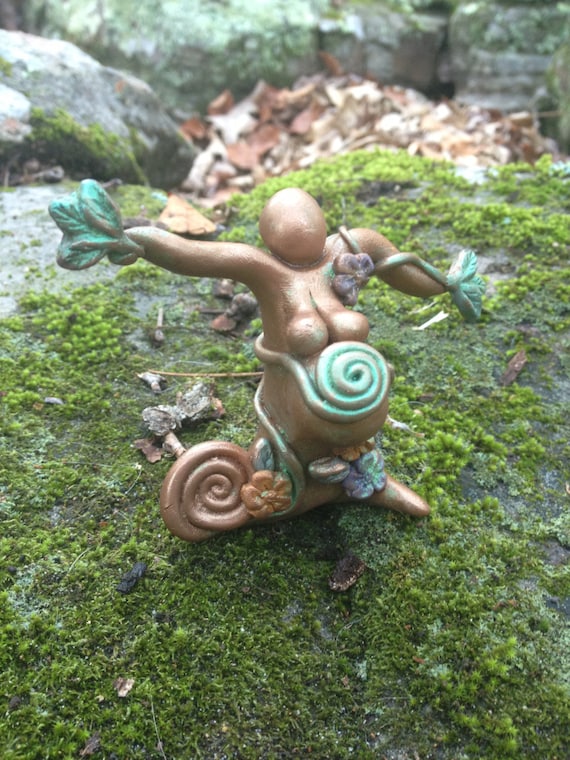
Completely coincidentally, over the weekend I made a new sculpture that I named in honor of Shauna and her past births.

October 2013 024I called this one “Squatter’s Rights,” after an article draft Shauna wrote several years ago that had a potent impact on me, particularly her line, “and then I reach down and catch what’s mine.” (previously written about in this post.) I made the new sculpture because I received a message on etsy asking me about the sculpture shown at the conclusion of another past post:

“I believe with all my heart that women’s birth noises are often the seat of their power. It’s like a primal birth song, meeting the pain with sound, singing their babies forth. I’ve had my eardrums roared out on occasions, but I love it. Every time. Never let anyone tell you not to make noise in labor. Roar your babies out, Mamas. Roar.” –Louisa Wales

via What Does Coping Well Mean? | Talk Birth.

Over the weekend, I also made a batch of new sculptures for a training taking place in Hawaii:

October 2013 020I hope these bring a sense of birth power to the women receiving them 🙂

Tonight I lit a candle as part of the Wave of Light for Pregnancy and Infant Loss Remembrance Day. It is important to acknowledge that power may be found in the full spectrum of experiences of the childbearing year…

October 2013 020

And, in a thematically appropriate connection, a Facebook fan sent me a link today to a powerful video of a woman singing during labor. I’d seen a version on YouTube before, so I went looking for it there and instead I found a short webisode specifically about singing during labor:

In my own first labor, I hummed the blessingway chant Woman Am I over and over again until the baby was born. I find that humming, vocalizing, and talking to/coaching myself is one way that I awaken my own birth power during birthing.

How do you awaken your birth power?

I shared some ideas in another past post, but I’d love to add to it!

Business of Being Born: Classroom Edition

Childbirth is a women’s rights issue and a reproductive justice issue. The United States maternity system is one of the costliest in the developed world, yet our birth outcomes compare poorly to those of other industrialized nations. Among industrialized countries, we consistently rank last or second to last in perinatal and maternal mortality rates. Moreover, birth is depicted in mainstream media with fear, medical intervention, and crisis…

via The Business of Being Born Classroom Edition.

It took me some time to get around to it, but I’ve finally finished exploring The Business of Being Born: Classroom Edition and its associated toolkit of educational materials! As a long-time childbirth educator and birth activist, of course I was interested in this classroom version of the (new) classic birth advocacy film, but I’m also a college professor and therefore was doubly interested—how might this resource be incorporated into one or more of my human services courses? As the BoBB companion site explains…

Childbirth is an issue most people do not engage with until they have experienced the maternal health system. The Business of Being Born: Classroom Edition reaches out to young adults BEFORE they confront their own birth decisions, both placing the issue on the radar and challenging the prevailing assumptions about birth providers and current obstetrical management trends. The goal is for the next generation of policy makers, practitioners, educators, and parents to approach birth decisions with awareness and confidence. Our strategy is to incorporate this evidence-based presentation into classrooms around the country. We envision empowering the next generation of parents to seek out systemic change and new policies supporting domestic maternity care…

via The Business of Being Born Classroom Edition.

The Classroom Edition of the film runs about 25 minutes and comes packaged with one of my all-time favorite resources for birth classes and tabling events: The Guide to a Healthy Birth from Choices in Childbirth. It also comes with two additional celebrity interviews, the short film Birth by the Numbers, and a instructor’s toolkit with classroom activities tying the themes of the film to major subjects such as Women’s Studies, Public Health, and Sociology.

My only critique of the classroom edition of the film is that the assembled quotes at the beginning of the film are put together in a choppy sort of way that makes it difficult to perceive (for the average viewer), which are the “good” (i.e. accurate) quotes and which are popular types of misinformation. There is also an odd, repetitively distracting, monotonal quality to the music that plays through much of the footage. Excerpted from the full-length film, the classroom edition still includes Ricki Lake’s homebirth in her bathtub, which was one of my top favorite moments of the original film. Content from a historical perspective as well as content involving the shadowing of a homebirth midwife and the personal stories from families choosing midwifery care were greatly reduced from the original version and the classroom edition seems to have more of an emphasis on sociocultural analysis. It is noted that 90% of women in many hospitals experience some type of labor augmentation (usually pitocin) and also that hospitals are businesses, businesses that are not really interested in having women hang around in the labor room.

One of the college courses I teach is American Social Policy. I have always been interested in birth change from a systemic (macro) level as a companion to change on the individual (micro) level, so I especially appreciated watching the Birth by the Numbers presentation included with the classroom edition of BoBB. When speaking about the idea that the increase in cesarean rate reflects maternal choice, public health professor Gene Declercq says, “this blaming of women is farcical. It is not about the mothers, it is about the way we treat care in the United States. Nobody ever wants to admit there is a difficult inherent in the system.” Well, I want to admit it and this is the kind of macrosystem-level change we talk about in my Policy course. At the companion Birth by the Numbers website, you can download a powerpoint presentation and other teaching tools, as well as watch the short film, in which public health professor Gene Declercq debunks popular myths about the causes of the United States cesarean rate increase. The film also looks at disparities in maternity mortality rates and tackles questions of systemic influences on maternal health outcomes.

So, are mothers really asking for cesareans?

slide

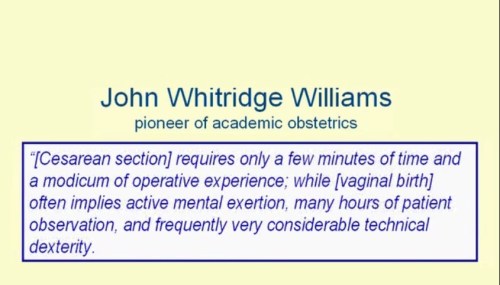
Declercq also draws on writing from the classic obstetrics textbook, Williams Obstetrics, and shares this quote about one of the real reasons that cesarean rates continue to rise:
whycesareanAnd, he makes this important observation:womenhaventchanged
As Nadine Goodman says in The Business of Being Born Classroom Edition, “A woman will always remember how she was made to feel during her birth…if you don’t have the reverence and respect for birth, where do you go from here?”

Prior post about The Business of Being Born: Transformation Through Birth | Talk Birth

Disclosure: I received a complimentary digital package for review purposes.

Tuesday Tidbits: Tree Mother

“Childbirth takes place at the intersection of time; in all cultures it links past, present and future. In traditional cultures birth unites the world of ‘now’ with the world of the ancestors, and is part of the great tree of life extending in time and eternity.” –Sheila Kitzinger

“Just as a tree grows best when anchored firmly in the earth, so can a pregnant mother feel strong and capable when supported by a sisterhood of nurturing friends.” -April Lussier

”And I say the sacred hoop of my people was one of the many hoops that made one circle, wide as daylight and as starlight, and in the center grew one mighty flowering tree to shelter all the children of one mother and one father.” – Black Elk (via Literary Mama)

“Good timber does not grow with ease; the stronger the wind, the stronger the trees.” – J. Willard Marriott

“A pregnant woman is like a beautiful flowering tree, but take care when it comes time for the harvest that you do not shake or bruise the tree, for in doing so, you may harm both the tree and its fruit.” –Peter Jackson

I am at the point in my school session in which I’m barely keeping my head above water! So, since I recently made a tree mama sculpture and because I recently helped do a tree-themed henna design on a pregnant mama, I decided to just go with some quotes today and call it a day!

I’m definitely no Mandala Journey, but my mom and I did a tree mandala attempt with my friend anyway:


And, the next day she had her baby! I think he was waiting for henna… 🙂

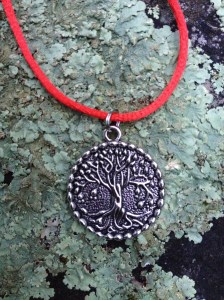
I also added some simple tree of life “birth amulet” pendants to my etsy shop! 🙂
Sept 2013 010

Talk Books: One Recumbent Mommy

Some time ago I received a unique memoir to review along with a companion book for children. The topic of One Recumbent Mommy is bedrest and the book is written in a friendly, conversational, and personal style that has potential to bring an air of sisterhood to women experiencing the same challenge and make them feel less alone. The book is based on the author’s blog and a casual, breezy, lighthearted style comes through strongly. The author writes:

I was on hospital bedrest with incompetent cervix for about 16 weeks and while there, I kept a blog chronicling the ups and down of day to day life in the hospital.  That blog was published and is entitled, One Recumbent Mommy: A Humorous Encounter With Bedrest.  I wrote a children’s companion book as well, entitled Wherever I Am, I Will Love You Still: A Book About An Extended Hospital Stay.  This book was written from my 2 year old son’s point of view.  I was trying to get at a way of explaining the situation in terms that a young child could understand.

The companion children’s book: Where I Am, I Will Love You Still, is friendly and sweet and the illustrations are engaging. This book would be a very useful addition to a family whose mother is experiencing a hospital stay. While the book’s conclusion includes the new baby sister coming home, it definitely has the potential to be applied to non-maternity-related hospital stays as well. Do note that bottle feeding is portrayed in the book.

While I was somewhat disappointed by the very conventional medical model of care in One Recumbent Mommy and the seemingly unquestioning acceptance of it by the author (especially considering that bedrest has come under serious scrutiny as to its actual effectiveness at preventing pregnancy loss), as well as the apparently overlooked irony of the baby’s birth then being induced, I appreciated the reminder that for many women pregnancy is anything but a joyful, flower-strewn walk through a miraculous meadow of belly casts and earth-goddesses. My writing and my posts often trend to a Happy Birth Dance! mode of writing about birth and was beneficial to me to remember that this model can feel very isolating, discouraging, and depressing to women whose experiences of pregnancy and birth are different from my own.

Along this same line of thought, I was reminded of recent writings from beautiful blogger Leonie Dawson about her experiences with severe hyperemesis gravidarum (requiring multiple hospitalizations):

And despite everything – despite it all –

Love is calling me forward.

As ancient as the beginning of time, love calls upon us to do what we could not do without.

Love asks of us great things…

via The Love That Calls Us Forward | Leonie Dawson – Amazing Biz, Amazing Life.

As I read One Recumbent Mommy and my priestess/ceremonialist self came to fore however, I also found myself wishing this mama had had some kind of beautiful hospital blessing ceremony to honor her commitment to her baby or that someone had offered her a nurturing prayer, poem, or blessing for her as a Bedrest Warrior doing what had to be done to protect her baby. Could there be a place for a Happy Bedrest Birth Dance mode of writing and experiencing as well? I gratefully welcome additions to this post of ideas for rituals, poems, prayers, or resources that can be offered to bedrest mamas who are doing their best to welcome a healthy, full-term baby into their lives! 🙂

Tuesday Tidbits: Postpartum Mamas

As Americans, we are under the impression that new moms are ‘Superwomen’ & can return to life as it was before baby. We must remember to celebrate this new mother and emulate the other cultures that honor new mothers by caring for them, supporting them, & placing value on the magnificent transformation she is going through. This is the greatest gift we can give to new mothers & newborns…–Darla Burns (via Tuesday Tidbits: Postpartum Mothering)

“The first few months after a baby comes can be a lot like floating in a jar of honey—very sweet and golden, but very sticky too.” –American College of Nurse-Midwives

The United States are not known for their postpartum care practices. Many women are left caught completely off guard by the postpartum recovery experience and dogged by the nagging self-expectation to do and be it all and that to be a “good mother” means bouncing back, not needing help, and loving every minute of it.

This country is one of the only utterly lacking in a culture of postpartum care. Some version of the lie-in is still prevalent all over Asia, Africa, the Middle East, and particular parts of Europe; in these places, where women have found the postpartum regimens of their own mothers and grandmothers slightly outdated, they’ve revised them. The U.S. seems only to understand pregnancy as a distinct and fragile state. For the expectant, we issue reams of proscriptions—more than can reasonably be followed. We tell them what to eat and what not to eat. We ask that they visit the doctor regularly and that they not do any strenuous activity. We give them our seats on the bus. Finally, once they’ve actually undergone the physical trauma of it, their bodies thoroughly depleted, we beckon them most immediately to rejoin the rest of us. One New York mother summed up her recent postpartum experience this way: “You’re not hemorrhaging? OK, peace, see you later…”

…“A culturally accepted postpartum period sends a powerful message that’s not being sent in this country,” said Dr. Margaret Howard, the director of the Day Hospital for Postpartum Depression in Providence, Rhode Island. “American mothers internalize the prevailing attitude—‘I should be able to handle this myself; women have babies every day’—and if they’re not up and functioning, they feel like there’s something wrong with them.”

via Why Are America’s Postpartum Practices So Rough On New Mothers? – The Daily Beast.

Via First the Egg, I then read this powerful reflection prompted by the article above:

In the piece, one woman mentions that women are literally still bleeding, long after they’re expected to “bounce back” and reclaim their old lives and be totally self-sufficient. Our bodies haven’t finished healing, and we’re supposed to look and act as though nothing even happened here, it’s all good. It’s all just the same as it was.

Secretly, I’ve been the slightest bit ashamed of all the help I’ve needed.

via Eat the Damn Cake » bleeding time.

I also read this raw, honest, and touching look at the “betrayal” experienced by women who enter into the mystery of birth expecting a blissed out, earth mother, orgasmic birth experience:

…But inside my head, I could not believe what was happening. How painful it was. How terrifying. I felt helpless. And degraded and humiliated by there being witnesses. And at the same time, I felt so, so alone. I remember at one point saying, completely out of my mind, “I don’t understand why no one is doing anything to help me! Please help me!” Della reminded me that what I was feeling was the baby coming. That I was doing just what I was supposed to, having the baby, right then….

via Mutha Magazine » S. LYNN ALDERMAN’S Ugliest, Beautiful Moment (Or, Fuck Ina May).

And, that made me think of my own thoughts about birth regret and how we may hide it from the pregnant woman we perceive as vulnerable in her beautiful, fleeting state as Pregnant Woman:

I’ve come to realize that just as each woman has moments of triumph in birth, almost every woman, even those with the most blissful birth stories to share, have birth regrets of some kind of another. And, we may often look at subsequent births as an opportunity to “fix” whatever it was that went “wrong” with the birth that came before it. While it may seem to some that most mother swap “horror stories” more often than tales of exhilaration, I’ve noticed that those who are particularly passionate about birth, may withhold or hurry past their own birth regret moments, perhaps out of a desire not to tarnish the blissful birth image, a desire not to lose crunchy points, or a desire not to contribute to the climate of doubt already potently swirling around pregnant women…

via Birth Regrets? | Talk Birth.

Which then made me think about the women who know...

Where are the witches, midwives

and friends

August 2013 011

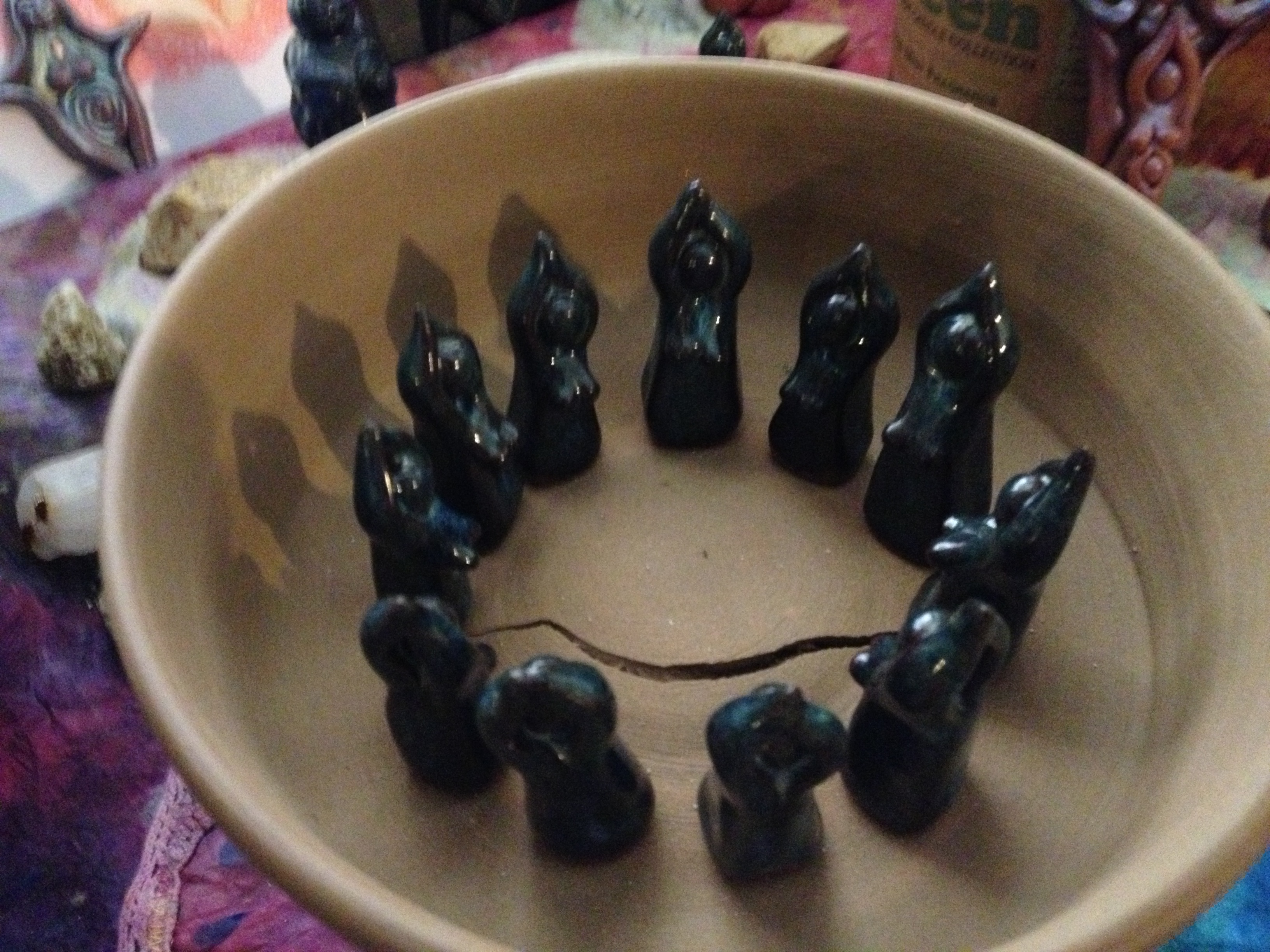
Circle of women sculptures as gifts for my women’s group. Yes, there’s a crack—“the world cracks everyone”—but that is how the light gets in…

to belly dance and chant

while I deliver

to hold me and breathe with me

as I push

to touch me and comfort me

as I cry?

Where are the womyn who know

what it’s like

to give birth?

via Where are the women who know? | Talk Birth.

Thinking about that reminded me of the chant we sang around the fire at the festival I just returned from on Sunday night:

Dance in a circle of women,

Make a web of my life,

Hold me as I spiral and spin,

Make a web of my life…

via Goddess Chants – Dance in a Circle of Women by Marie Summerwood.

May all pregnant women and tender postpartum mamas dance in a circle of women!

I’d hoped to have time to post a festival recap and some lessons learned, but other responsibilities take precedence at least for today, so I’ll leave you with one of the pictures my sister-in-law took on a misty morning, sunrise stroll around the lake and another that I took in the Temple at the festival:

Sept 2013 090

Sept 2013 036

See also:

Postpartum Survival Tips

Timeless Days: More Postpartum Planning

Mothers Matter–Creating a Postpartum Plan

Planning for Postpartum

Some reminders for postpartum mamas & those who love them

Birthing the Mother-Writer (or: Playing My Music, or: Postpartum Feelings, Part 1)

Postpartum Thoughts/Feelings, Part 2

Postpartum Feelings, Part 3

What to tell a mother-to-be about the realities of mothering…

Tuesday Tidbits: Pain, Birth, and Fear

20130903-200523.jpg  “…if you want to know where a woman’s true power lies, look to those primal experiences we’ve been taught to fear…the very same experiences the culture has taught us to distance ourselves from as much as possible, often by medicalizing them so that we are barely conscious of them anymore. Labor and birth rank right up there as experiences that put women in touch with their feminine power…” -Christiane Northrup

During my first pregnancy, I read like crazy. I felt like I was studying for the biggest test of my life, only it was impossible to know what was actually going to be on it. When I actually gave birth, I was delighted to find I was able to get out of my head and trust my body. Quite some time later, I figured out that information about birth does not equal knowledge about birth.

We spend a lot of time informing and educating women about their choices surrounding birth and are often then surprised that this apparent information does not translate into experience once in the birth room. Obviously, this is partially because the birth room is a context impacted by a large number of social, cultural, psychological, and environmental factors, but I believe it is also because with all of our information we still haven’t managed to help parents develop knowledge and the two are not the same. Parents are often not able to recall or to mobilize information resources while actually embroiled in the birth experience. They need an inner knowing and inner resources to draw on for coping.

via Information ≠ Knowledge

I also pondered (and continue to ponder) how women really learn about birth. Like I did, most of them seek out written information and this can lead to information overload…

With the wonderful world wide web available to us 24/7, the deluge of information we encounter (and seek out) during pregnancy can feel a lot like drowning. So many choices, so much to learn, so much to digest. There are times when everything seems to come into question — from what you eat during pregnancy to whether you should create a birth plan…

via Stop Birth Information Overload by Getting Back to Basics — Giving Birth with Confidence.

My all-time favorite article about the notion of this “information feeding frenzy” engaged in by pregnant women is by Pam England who explains the following:

It would seem at first glance that a mother who gathers lots of information during pregnancy is motivated and headed in the “right direction.” However, a more important detail of her preparation is her being aware of what is motivating her to August 2013 041become so well-informed. What does the drive for information feel like in her body? How does she know in her bones and gut how to use the information? And to what degree is she is aware of any of this?

If she is not listening to the subtle messages in her body, in her breath, in her dreams, or in the patterns in her thoughts and emotions, then she is acting from her conditioning and not from awareness. From the outside, no one may be able to tell the difference, but on the inside, she will feel the difference…

via Birthing From Within – Information Frenzy.

Which brings me back to this quote:

“I usually claim that pregnant women should not read books about pregnancy and birth. Their time is too precious. They should, rather, watch the moon and sing to their baby in the womb.” –Michel Odent

via How Do Women Really Learn About Birth?

And also to another of my own articles about information overload during pregnancy:

Many pregnant women have information overload. They are faced with more information than they know what to do with. They are bombarded by it. What they really need is “knowing.” They need to know: “What skills do I possess or can learn that will help me greet my birth with anticipation and confidence? What are my tools? My resources? Can I just let it happen?” As an educator I ask myself, “What will help them feel confident? Feel ready? Trust their bodies and their capacities?”

via Talk Less, Learn More: Evolving as an Educator

A lot of this information feeding frenzy, including that of my own first pregnancy, may be related to fear of labor, pain, and the unknown.

Could it be that human fear of pain is being used to generate financial profit? (the opium-is-the-opiate-of-the-masses model). Perhaps once the notion of palliative care reached a certain level of acceptance for the dying within the medical community, it began to spill over into other human conditions (the slippery-slope model). Or, perhaps we don’t want transparency at all (the denial model)…

…I can think of many questions that fall under this topic…Why do we call the intense phenomenon of birth “painful”? How do our genetics, behavior, training and thought-processes affect our experience of pain? What about the health care culture – has it focused on relieving pain at the expense of what we gain from working with pain short of trauma or imminent death? How do we prepare women for working with sensation without automatically labeling it pain? Is the “empowerment” often attributed to giving birth what is learned by going through the center of the “there is no birth of consciousness without pain” experience? These questions are just a start…

via About Pain and Birth | Dancing Thru Pregnancy® Blog.

Could these fears also be tied to our cultural lack of appropriate vocabulary for pain?

A childbirth educator interviewed during the film briefly discusses pain and says that we need more words for pain, because it is ridiculous that we have only one word that is used to describe a hangnail, a broken leg, being hit by a car, and labor. I had already been musing about pain during labor and how we perceive it, talk about it, and so forth and this comment was additional food for thought for me. I’m thinking that there are many other words used to describe women’s experiences of labor and birth other than pain–a word that is limited in scope and that for some women may well not even apply to the experiences in birth

via Words for Pain

Or, to a fear of “losing control” during labor?

A topic that frequently arises in birth classes is about the fear of “losing control” in labor. Losing control, “losing it,” or “freaking out” are concerns expressed by women preparing to give birth. It is important to acknowledge that this is a common fear. I also like to ask parents to think about what “freaking out” or “losing it” would mean to them? I ask them to consider what benefits there may be to losing control. I also say, “What if you do freak out? Maybe, so what?! Maybe it is okay. Maybe it is good. Maybe it is helpful…”

via Fears About Birth and Losing Control

Or, perhaps more simply, to a lack of trust in our care providers?

I was interested to read a short segment in the book Labor Pain about studies on fear about birth. A Swedish study indicated that it was not pain that caused women the most anxiety about labor (44% of women had fear of pain). It also wasn’t fear of death of the mother or baby (55% worried about this). It wasn’t fear of their physical or mental capacity to give birth (65% feared this), but it was “lack of trust of obstetric staff during delivery” (73%).

via Fear & Birth

Men may also feel a lot of fear surrounding birth and have few ways to express it:

Although a man cannot feel the same pain as a laboring woman, I believe that many men experience a similar cycle of emotions in the birthing space to that which Dick-Read described, with a slightly different end product, namely: Fear > Tension > Panic. A man who is not confident in his partner’s birthing abilities, who is poorly informed, and/or who is poorly supported, becomes increasingly tense; and if this tension is not eased, then he spirals into an irreversible state of panic. This panic manifests differently in different men: some men become paralyzed by their fear (the familiar specter of the terrified dad sitting stock-still at the foot of the bed), while others spring into hyperactivity, bringing endless cups of water or becoming obsessively concerned with the temperature of the birth pool.

via Fathers, Fear, and Birth

I think it is also important to recognize the deep gifts to be found in facing our fears and doing it anyway:

We may feel guilty, ashamed, negative, and apologetic about our deepest “what ifs.” We worry that if we speak of them, they might come true. We worry that in voicing them, we might make homebirth or midwifery or whatever look bad. We don’t want to add any fuel to the fire of terror that already dominates the “mainstream” birth climate. And, we don’t want to lose “crunchy points.” We want to be blissfully empowered, confident, and courageous. And, guess what? We are. Sometimes that courage comes from looking the “what ifs” right in the eye. Sometimes it comes from living through them. My most powerful gift from my pregnancy with my daughter, my pregnancy-after-loss baby, was to watch myself feel the fear and do it anyway. I was brave. And, it changed me to learn that.

What if we can learn more from our shadows than we ever thought possible? There is power in thinking what if I can’t do this and then discovering that you CAN…

via What If…She’s Stronger than She Knows… | Talk Birth.

20130903-200533.jpg

Guest Post: Paid Menstrual Leave?

Paid Menstrual Leave – it’s time!  

by DeAnna L’am. Reprinted with permission.

A Russian lawmaker has asked parliament to give women two days paid leave a month when they menstruate… Mikhail Degtyaryov, a member of the nationalist LDPR party, wrote on his website “During that period (of menstruation), most women experience psychological and physiological discomfort. The pain for the fair sex is often so intense that it is necessary to call an ambulance”… Scientists and gynecologists look on difficult menstruation not only as a medical, but also a social problem…” ~ Standard Digital, August 2013

Fascinating! Lets look at how good things are turned on their heads, yet again, to result (unsurprisingly) in women’s dis-empowerment.

Indeed, a paid monthly Menstrual Leave would be an honoring, empowering option for women worldwide. Yet proposing it for all the wrong reasons diminishes us, and our cyclicity, to “a social problem.”

Campaigns have been initiated over the years under the guise of empowering women, which ended up diminishing, dis-empowering, and ultimately killing us! Marketing guru Edward Bernays was hired in 1928 by an American Tobacco Company president to increase sales of Lucky Strike cigarettes. Sigmond Freud’s work was utilized to expand understanding of ‘What Women Want’ and capitalize on it for marketing purposes.

Realizing that women were motivated and empowered by the suffrage movement, Bernays manipulated a real need – into a persuasive sales tactic. He hired women to march in the Easted Sunday parade smoking what he cleverly named their “Torches of Freedom.” Bernays succeeded overnight: he persuaded women to pick up an unhealthy habit, and commit to spending their hard earned money for years, by equating cigarettes with personal freedom and equality to men. Smoking among women exploded into unparalleled heights. Their personal freedom and equality to men continued to suffer…

Similarly, women were encouraged by manipulative campaigns to start giving birth in hospitals after countless generations of home births. Many new hospitals were built as a result of Second World War, to accommodate the staggering number of injured soldiers returning from battle. It took a few years for most hospitals to empty, as wounded soldiers either recovered or died. Faced with many large vacant hospital buildings and idle staff, administrators procured and released ad campaigns, which sinisterly manipulated women to believe that giving birth at home was ‘primitive’ and unsafe, while birthing at the hospital was promoted as safer, ‘modern’, and a highly intelligent choice.

Women bought into these campaigns, and many others like them, all over the world. They started smoking and felt ‘glamorous’. They started giving birth in hospitals and felt ‘modern’. They started using disposable menstrual products and felt ‘progressive’ and ‘in control.’ All along they have also been developing an array of respiratory diseases and dying of lung cancer; They have been cut open in cesarean sections (1 in 4, to accommodate doctor’s convenience); They have reached an all-time-high maternal and infant mortality rates following hospital birth; And they have been contributing to our planetary ecological crisis by damping 12 billion “feminine hygiene” products into landfills every year, in the U.S.A. Alone!

And here we are: In the midst of a pioneering worldwide movement of women reclaiming menstruation as the heightened state of awareness for which it was recognized in all indigenous cultures; In the process of inspiring women to honor their menstrual blood and their body’s needs, by taking time off to rest and renew themselves on the first day of their period — we are faced with a legal initiative which is both revolutionary and reactionary at the same time!

Wouldn’t it be revolutionary for the workplace to grant Paid Menstrual Leave to women? Wouldn’t we feel validated in our need for rejuvenation, honored for our body’s monthly regeneration, and empowered by the cultural acknowledgment of our rhythm?

We certainly would, if it weren’t billed as a response to “a social problem” of the “fair sex” who suffers “psychological and physiological discomfort.” Our menstrual cycle is neither a social problem nor a mere discomfort. Our menstrual flow is profound and life affirming work performed monthly by our bodies. We need to rest and renew in response to it, or we develop symptoms labled “psychological and physiological discomfort” by our culture (and frequently by us, too…)

Cigarettes, hospital births, and disposable menstrual products were sold to us through clever manipulative tactics, yet we never needed them… We DO NEED Paid Menstrual Leave!

We have stopped smoking in drovers. We have been reclaiming home births, and have started using sustainable menstrual products (such as cloth pads, sea sponges, and menstrual cups). It is time to claim for ourselves, and demand from our culture, a monthly PML to replace PMS!

PML (Paid Menstrual Leave) is the deeply deserved rest our body, mind, and spirit need monthly. In its absence, our body screams in PMS pain, and will continue to do so until we listen to its needs and honor them.

This is a call for action! Lets unite in demanding legaly-bound Paid Menstrual Leave — not as a patronizing gesture designed to send us home for being a “social problem.” But rather as the honoring of a deep need, which springs from our depth, to renew our body, our emotions, and our spirit – monthly – while preparing for another cycle in the ever turning wheel of our lives.  


© 2013, DeAnna L’am, Red Moon – Cycles of Women’s Wisdom™

DeAnna L’am, (B.A.) speaker, coach, and trainer, is author of ‘Becoming Peers – Mentoring Girls Into Womanhood’ and ‘A Diva’s guide to Getting Your Period’. She is founder of Red Moon School of Empowerment for Women & Girls™ and of Red Tents In Every Neighborhood – Global Network. Her pioneering work has been transforming women’s & girls’ lives around the world, for over 20 years.

DeAnna helps women & girls love themselves unconditionally! She specializes in helping women make peace with their cycle; Instructs Moms in the art of welcoming girls to empowered womanhood, and trains women to hold RED TENTS in their communities. Visit her at: www.deannalam.com

Disclaimer: I am a Red Moon program affiliate. However, the only affiliate link in this post is the one included here!