Archives

Rites of Passage Resources for Daughters & Sons

Childbirth is a rite of passage so intense physically, psychologically, emotionally, spiritually, that most other events in a woman’s life pale next to it. In our modern lives, there are few remaining rituals of initiation, few events that challenge a person’s mettle down to the very core. Childbirth remains a primary initiatory rite for a woman.” –from the book MotherMysteries

“One of the greatest failings of our society
is that we do not have a ceremony to mark
the passage from childhood to adulthood.”

~Dr. Michael Thompson, author of Raising Cain~

As a culture, we have very few recognized rites of passage.  I would suggest that perhaps marriage is the only remaining rite of passage that is acknowledged in the mainstream with celebration and ritual. We also have 18th and 21st birthdays recognized as transitional, but unfortunately only through celebrations that involve a lot of drinking. We also recognize the birth of a new baby, but the focus is on the baby and not on the transitional rite of passage for the woman and very often her needs, wishes, and feelings about the experience are trivialized, minimized, or even discouraged (i.e. a healthy baby is ALL that matters…). This summer when a friend’s son turned 13, I was looking up rites of passage for boys, and was frustrated to find the most common definition or experience of a “rite of passage” for a teenage boy was having sex for the first time or getting drunk for the first time. 😦 I would actually venture to conclude that some of the nationwide problems we experience with birth and maternity care stem from this basic lack of acknowledgement of significant rites of passage in our lives.

So, I’ve very much been enjoying my participation in a free telesummit on Rites of Passage for boys and girls, planned by DeAnna L’am of Red Moon and Janet Allison of Boys Alive (there are a variety of guest speakers from a variety of other organizations and backgrounds as well, both men and women).

The event goes on through next week, so check it out if you get a chance! Good stuff!

Rites of Passage: Skillfully Guiding Girls into Womanhood and Boys into Manhood

This same week a student asked me for resources for a mother-daughter group. I had some suggestions for her and figured I’d include them here!

The Thundering Years: Rituals and Sacred Wisdom for Teens
Amazon affiliate link included in image.

In the past, I’ve facilitated a mother-daughter group using a curriculum called Meetings at the Moon that was published by the Unitarian Universalist Association. I’m not sure if it is available any longer though because I no longer see it available on their website. I really love it. Some other resources I like are: Wild Girls which is a book by Patrician Mongahan and includes ideas for facilitating a girls’ circle; the curriculum/program Women’s Rites of Passage by Hermitra Crecraft; and the book Becoming Peers: Mentoring Girls into Womanhood by DeAnna L’am.

I’ve previously referenced some material on rites of passage and rituals from the book The Thundering Years also, which is an excellent book about creating rituals and sacred ceremonies for teenagers. The other books I mentioned are specifically for girls, but The Thundering Years is for both boys and girls.

I’d love to hear additional suggestions from readers if you have favorite resources on rites of passage celebrations or initiations for our adolescents!

And, speaking of telesummits and also my own need for self-care and rest, I also decided to treat myself to the “upgraded” version of an upcoming telesummit for women called Wild Free Beautiful You. (The basic event is free, so check it out!) More about this soon!

Amazon affiliate links included in book images and Wild Free Beautiful You affiliate link included in telesummit image.

(and, this was another “short post”—I’m doing pretty good, aren’t I?! ;-D)

Invisible Nets

I have several friends and acquaintances preparing for the births of their babies at the end of this month and into November. This weekend, when I found out one of them was in labor, I peeked in at her Facebook page and saw her profile picture, so strong and beautiful and solitary and I remembered with such poignancy that liminal point between pregnant woman and mother of a newborn. The tenderness and triumph of standing up with your new baby for the first time. The marveling at the fact that, I did it. The sweet, fresh, beautiful irreplaceable sensations of your fresh new baby lying upon your chest. The worry of how to do this mothering thing “right.” All of those vibrant and deep first moments and trying to sink into them. The stark sensation of having crossed into completely new territory and having left your old self behind forever. The moments of marveling at your own strength and courage and reveling in your own power. The moments of feeling bitterly lost and confused.

I wrote this on my Facebook page as I thought of her and of the other Oct/Nov mothers about to step across the birth threshold:

Holding in my heart all the special mothers taking their birth journeys tonight–stepping across that pivotal threshold and into the unknown. May they discover they are stronger than they knew, may they marvel at their own courage, may they dig deep, and may they know joy beyond measure.

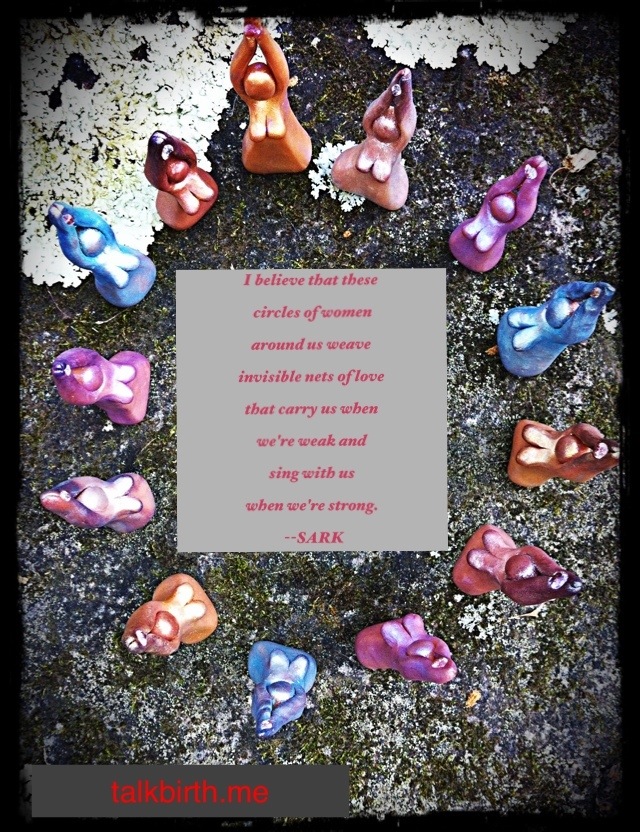
I also finally used one of my favorite quotes for women’s circles and a picture of a set of new sculptures that I made this weekend and turned it into a little shareable image. I’ve wanted to do this for a long time, but had trouble finding anything that would let me edit a picture on my phone to include words. It isn’t perfect, but it is my first attempt!
20121023-152429.jpg
And, I thought of my own past posts…

Thoughts about a birth blessing and more

“…May we see and hear women. May we witness them in the act of living, of birthing, of struggling, of triumphing. In surrender and in self-doubt. In exultation and joy. May we hold that space for her story. May we listen well and wisely.” (Molly Remer)

Thoughts about being a “birth warrior“…

“I was surprised to find myself connect with the birth warrior metaphor in labor. Shortly after my first baby was born, I turned to my dear friend who had been present and said, “I feel like I’ve been in a war…”

Thoughts about those sweet, delicate, precious moments of waiting to inhale

Thoughts of the sweet, sticky, beautiful, and simultaneously soul-crushing and soul-expanding experiences of early postpartum

I hope all of the women I know who are giving birth in the upcoming season discover that, as Sheila Kitzinger said, “Birth isn’t something we suffer, but something we actively do and exult in.” (from promo for One World Birth)

And, that while, “Women are as nervous and unsure of themselves as ever, and they need to learn to trust their bodies. Birthing is much more that eliminating pain. It is one of life’s peak experiences.” (Elisabeth Bing)

Happy Birthing Days, Mamas!

(P.S. This is an experiment with writing a short post! How’d I do?!)

What If? Shifting the Dialogue of Birth

Sometimes at mother blessing ceremonies I share a modified version of a piece of writing by Leilah McCracken called, “Shifting the Paradigm of ‘What if?'” (I forget where I originally read it, perhaps in Hypnobabies?).

This is my re-working of McCracken’s words, with the addition of my own thoughts at the end:

Many of us think “What if?!” in fearful ways before giving birth: What if I need to transfer? What if the pain is awful? What if my uterus ruptures? What if the baby won’t come out? What if I lose control? and so on.

Let’s shift the internal dialogue and think “what if?!” in powerful ways: “What if I have the most beautiful experience of my life? What if I could actually feel a wet, moving baby on my belly—just after birth—and fall in love with that feeling forever? What if I give birth and feel pure exhilaration? What will happen if I give birth as a powerful, free woman—what will happen if I claim my right to give birth as my biology impels me to? What if I emerge victorious, free, and powerful? What if—what if my baby never feels anything in her first moments other than my body and my love? What if I push my baby out into my own hands, and pull her up, and kiss her wet head, and cry and moan and weep my joy in private, darkness and love—what if… what if this birth is the most loving, sweet and gentle moment of my life? What if I give birth with wild joy and courageous abandon? What if…

If I read this out loud to a woman, I substitute “you” for “I”—the “you” message puts her directly into that new framework of what if!

What if we become as powerful and wise as we are meant to be? What if we share our wisdom and our strength with other women? What if we act with courage and in solidarity with other women? What if we believe unshakably in the power of women to triumph and to act with courage? What if we expect birth to be beautiful? What if we trust that we can learn so much from each other? What if we trust women’s bodies and the wisdom of babies? What if we listen, really listen? What if we remember that she always has the right to define her own experience? What if we know in our hearts that all mothers love their babies? What if we act as though other women don’t need to be enlightened or “educated”? What if we believe she has the keys within herself to unlock her own steady power? We will change the way the world spins…

What if… the very future rests on our ability to engage with these what if’s?


Note: I then wrote a companion post about the flip side—the going ahead and thinking the “bad” what if’s—because I want to also acknowledge that there is power and value in experiencing and working through the so-called “negative” what if’s as well.

What if…she knows exactly what to do…

Woman-Centered Collaboration

I’ve posted a couple of times about a collaboration with the Women’s Health in Women’s Hands launch of the feminist women’s health classic Woman-Centered Pregnancy and Childbirth as a pdf version for free online. When I wrote my What to Expect post based on Woman-Centered Childbirth in 2009, I had no idea that one of the authors of the book would later find me on the internet, let alone distribute postcards at the National Rally for Change in Los Angeles containing a quote from me and link to my site. As I’ve said several times lately, I just love the internet. It is amazing to me that these types of connections and collaborations can occur over long distances and without face-to-face contact. Very cool!

Anyway, this week I received a promo launch packet for the online release of the book. It includes two printouts from my own website and the re-formatted flier based on my blog post, as well as a folder and postcards.
20121008-164805.jpg

And, then I took picture of the packet and included my own vintage copy of the original Woman-Centered Childbirth book 🙂
20121008-164812.jpgThis has been a fun link between past and present activism and between a foremother in birth activism and my current self!

Bits of the (Birth) Net

The following is a collection of the bits and pieces that caught my attention and then were shared via my Talk Birth Facebook page during the last two weeks.

Listening

From a good article by the National Association of Mothers’ Centers in Mother Support: When Words Get in the Way

Words, whether written or voiced, are so very fragile. They can be bent or twisted, even become unrecognizable from their initial intentions. They can have different cultural meanings, regional understandings, and generational perceptions.

There will always be the opportunity for miscommunication…

Such a good reminder. What you say and what people hear are often two different things. What you say and what you mean can be different. How your words are received and interpreted can be very important and intent in many ways doesn’t matter! Communication is transactional process. A two-way process. And, it is symbolic. Meaning can never be fully interpreted and understood completely.

This article also reminded me of one of my own older articles, Listening Well Enough, which came to mind because I’m finishing up with the training of two women. The essay describes my own experience when I was training as a breastfeeding counselor in 2005.

Privacy

The topic of what to risk sharing online came up with friends recently and I enjoyed this article about answering the question of How Much Of Your Private Life Should You Keep Private On Your Blog?

Childbirth Education

Childbirth education is beginning too late in pregnancy; it needs to begin in the first trimester or even before women become pregnant…

The above is one of the concluding points from an interesting article from Birth Works International about supporting women without epidurals.

Good article from Lamaze about your breath and how it can help during pregnancy and birthing!

Virtual labor simulator!

Pushing Positions

Very interesting article on What is the Evidence for Pushing Positions?  Apparently there is more blood loss and second degree tears with upright pushing positions. Personally, I CANNOT imagine giving birth in a supine position. But, I’m also really, really, tired of tearing (tired enough that it is one of the factors in our decision not to have “just one more!” baby). For more thoughts about pushing, see previous post on Following Your Body’s Urges to Push…

And speaking of upright birth, Barbie homebirth photos! 🙂

Informed Consent

Valuable article addressing 10 Responses to Pressure to Consent (remember, it isn’t “informed consent” if you do not have the option of saying NO!)

Posts I’ve written about informed consent:

Prenatal Yoga

Online video prenatal yoga class: Prenatal Yoga – when you feel good, your baby feels good.

And my own prior posts on the subject:

Birthing Room Yoga Handout

Birth, this elegant, simple, yet intricate process has had unnecessary, complex, expensive technology superimposed onto it, creating a dangerous environment for birthing women.” -Alice Bailes

Loved this article on what really matters for midwives!

Epigenetics

NEW STUDY: Epigenetics: Mother’s Nutrition — Before Pregnancy — May Alter Function of Her Children’s Genes. “As parents, we have to understand better that our responsibilities to our children are not only of a social, economical, or educational nature, but that our own biological status can contribute to the fate of our children, and this effect can be long-lasting,” said Mihai Niculescu, M.D., Ph.D., study author from Nutrition Research Institute at the University of North Carolina at Chapel Hill, in Chapel Hill, N.C.–Epigenetics: Mother’s Nutrition — Before Pregnancy — May Alter Function of Her Children’s Genes

After CAPPA this year, I wrote about epigenetics here: Epigentics, Breastfeeding + Diet, and Prenatal Stress

Call the Midwife

Fun! Ms. Magazine linked to one of my blog posts about midwifery in their post about the PBS show Call the Midwife!  And, after posting to the CfM Facebook page about how I didn’t get to watch the show myself because I have no TV channels, CfM fan Jackie clued me in that Call the Midwife is available online (no TV channels required!) Yay! 🙂

Older Posts of My Own

Birth Culture: “Birth is cultural, the way eating is cultural. We don’t just eat what our bodies need to sustain us. If we only did that, there would be no reason for birthday cake. Birthday cake is part of our food culture. The place you are giving birth in has a local culture as well. It also partakes of our national birth culture. Not everything doctors do regarding birth makes the birth faster or physically easier for you or the baby. Some things are just cultural.” -–Jan Mallack & Teresa Bailey

Creating Needle Felted Birth Art Sculptures: My first foray into birth art, before I fell in love with using polymer clay!

Centering for Birth: “Centering is a breath awareness strategy that I’ve adapted for use in birth classes based on the ten second centering process described in the short book Ten Zen Seconds…” Free handout available about centering for birth! (I was reminded of this post by Enjoy Birth!

Breastfeeding as an Ecofeminist Issue:“What happens when society and culture pollute the maternal nest? Is that mother and baby’s problem or is it a political and cultural issue that should be of top priority? Unfortunately, many politicians continue to focus on reproductive control of women, rather than on human and planetary health…”

During a week when I didn’t have time to craft delightful new blog posts, it was fun to have a post from a couple of months ago suddenly getting all kinds of hits and Facebook shares. Thanks, internet! ;-D (Around 150 shares on Facebook apparently. I ♥ Facebook!)

On Parenting Books

Mama Birth: Sadly, Parenting Books CAN’T Actually Raise Your Child: Enjoyed this post! (But I recommend NOT reading the comments on the original article she links to about “detachment parenting.” I lost about 30 minutes of my life, felt my blood pressure rising, and only made it to page three!)

The revolution must have dancing; women know this.
The music will light our hearts with fire,
the stories will bathe our dreams in honey
and fill our bellies
with stars.
-Nina Simons via Rebecca A Wright, Doula

DVD Review: Laboring Under an Illusion


DVD Review: Laboring Under an Illusion: Mass Media Childbirth vs. The Real Thing
Filmmaker: Vicki Elson
50 minutes, $39.99 (personal use­)
www.birth-media.com

Reviewed by Molly Remer, Talk Birth

Laboring under an Illusion is a treasure trove of discussion-provoking material. Filmmaker Vicki Elson is an anthropologist and childbirth educator who has created a striking documentary exploring media-generated myths about childbirth. As a childbirth educator, I often reference in my classes how our attitudes and expectations about birth are shaped by media messages—birth is an emergency, etc. This film eloquently and entertainingly provides 50 minutes of backup material for the idea!

The film blends media messages from comedy shows like Murphy Brown, Mad About You,and I Love Lucy, movie clips such as Juno, Coneheads, and Nine Months, along with “reality” based shows on Discovery Health with the inherently contrasting messages in clips of beautiful births from films like Birth as We Know It, The Business of Being Born, and Orgasmic Birth. It also contains brief voiceover narrations from “regular” women about birth. Occasionally, there is a scene with the filmmaker speaking directly to the viewer about concepts raised in the film. These scenes are less entertaining than the popular media clips and the friends with whom I watched the film wanted to fast-forward these segments—the media clips chosen so clearly speak for themselves that they don’t really need explanation, at least to the already birth-savvy viewer. Because of some strong language in the media clips, I caution parents to preview the film before sharing it with children.

Laboring Under an Illusion is an entertaining and illuminating film for consumers as well as for birth educators, doulas, and midwives. I highly recommend it!

Disclosure: I received a complimentary copy of the DVD for review purposes

Amazon affiliate link included in image.

The dualism of blogging (and life)

Yesterday, I found myself involved in two different conversations about blogging. In the first, I exclaimed to my friend, “do you have any idea how many things I want to blog about that I don’t?! I need a blog for, ‘the things I don’t blog about.'” In the second, some other friends said to me, “you’re just so open on your blog, I don’t think I can be that open.” We then went on to discuss the various crazy people we have known who we do not wish to have access to information about us or to know things about our lives. I’ve been writing this blog since 2007 and had another blog before that. While I have had people read and comment that I sometimes wish were not following my writing and while I’ve had a handful of negative/insulted comments, for all these years I’ve never had an actual bad experience with blogging. Sometimes I think it is the tone I maintain here—I rarely write prescriptively (i.e. here’s what YOU SHOULD DO) and I rarely write inflammatorily (i.e. why are some people such IDIOTS about this?!) and I rarely write controversially (i.e. down with circumcision!). I also consciously choose not to write in what I refer to as a “putting out fires” style. You may notice that when there is some new outrage in the birth or breastfeeding community, I rarely address it here. I’d rather focus on building something new and on what I can offer in terms of information, experience, or idea than to debunk, criticize, or expose. And, I don’t actually have time to keep up with all the drama even if I wanted to. I barely have time to keep up with my own life on my own little patch of the earth! I do occasionally reflect that this probably limits my site traffic in some ways—particularly when I choose to ignore something obnoxious that crosses my email box and later another blogger writes a witty exposé of the same subject and it goes viral throughout Facebookworldland—though I try not to compare myself to other bloggers or to have too much stats envy.

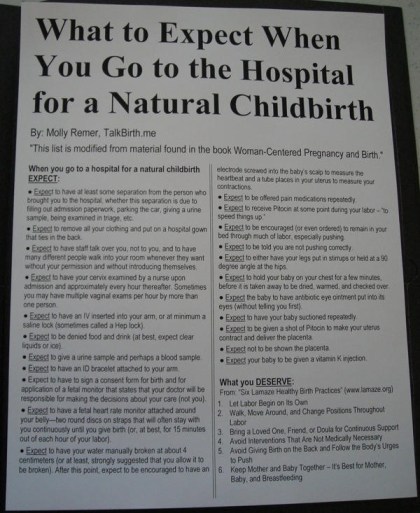
And, periodically, I get lovely emails like one from last week saying, “I love your energy and gentle voice.” 🙂 And, periodically, things happen and I see remarks on twitter referring to something I’ve written as, “I dislike the tone of it and its intention to demonise the health service.” 😦 The latter just happened last night in response to the publication of my What to Expect When You Go to the Hospital for a Natural Childbirth as an informational leaflet in conjunction with Women’s Health in Women’s Hands’ publication of Woman-Centered Childbirth in full text online. Twitter is too character limited for me to respond to the critique in full, so I said I’d write a follow-up blog post to explain. 20120928-141455.jpg A different organization (Women’s Health in Women’s Hands) converted one of my posts into this flier and it does not include my initial disclaimer expressing my trepidation about being perceived as “hospital-bashing” (it shouldn’t include that, because it is flier now, not a rambling blog post!). The article is NOT meant to hospital bash, it is meant to prepare and plan appropriately. I wrote it because I was tired of how betrayed my clients were when they planned beautiful, natural hospital births and then experienced many things on the list in my article. There is also a companion article and series of tips (I think on the back side of the tweeted leaflet as a matter of fact) about how to cope/navigate–the information is not meant to discourage, but to realistically prepare. Have a homebirth is NOT one of the tips, because this isn’t a home vs hospital article! Whew! See…too many words for Twitter, that’s why I rarely use it except FB auto-tweeting stuff.

So, which is it? Am I authentic and open, or keeping my mouth shut all the time?! Maybe both. What I know is there is a lot I don’t write about. I don’t write because I’m too scared, or too sensitive, or too fearful, or too self-righteous, or too busy, or too annoyed, or too scattered, or too embarrassed. I don’t write things because I have relatives who read this or friends who read this and I’d rather not share some things with some people. And, which is it? Do I have nice energy and a gentle voice or am I a strident hospital-basher out to demonize and victimize?!

And, I started to reflect that I guess I am all these things and how people experience me and my writing is in part up to me and in part up to them. Just like in real life. I can be gentle, kind, and nurturing. I can be critical, judgmental, and harsh. I can be helpful and I can be selfish. I can be patient and impatient. I can be friendly, I can be preoccupied. I can be energetic and enthusiastic and upbeat and I can be exhausted and defeated. I can be a fabulous, fun mother and I can be a distracted and grouchy mother. I can be funny and I can take myself too seriously. Different people, relationships, and environments bring out different expressions of who I am. Sometimes I really like myself a lot. I like who I am, I like how I move through the world, and I’m impressed with my own capacities. I have great ideas and solid values and principles and the ability to articulate those in writing. Sometimes I actually hate myself. I see only the bad parts and I wish I could just be better. I feel hypocritical and over aware of inconsistencies in my own thoughts/beliefs and my expression of my values in the world. I often want to be better than I am, but in rare moments of grace and self-compassion, I realize that I’m pretty good already. And, in some moments of self-righteousness and superiority, I actually feel better than some people in some areas/some ways!

There are two things that I know for sure. I never wish to diminish another woman and to make her feel judged as unworthy or “less than” for her birth or mothering choices. And, at the same time, I never wish to lie to another woman either in an effort to prevent her from feeling those things…

Blogging does only convey a slice of the “real me,” but I also find it an authentic slice, an authentic form of expression, and a real experience of who I am, just not all of who I am. Ever. I can be both more and less than what speaks to you from these many, many pages of blog posts. More in that I am more complicated and think deeper and with more intensity than most people will ever know and less in that I’m multidimensional and flawed and real, not just words on a screen from one moment in time.

20120928-150355.jpg

Yesterday..taking my kids to the theater and taking a moment to point out the “hidden” Goddess right in the middle of town. Today, sitting on the bed in the dim light while Alaina naps, typing feverishly and feeling utterly swamped with the one million things I’d like to do with my life…

Domestic Violence During Pregnancy

By Molly Remer, MSW, ICCE, CCCE

Violence during pregnancy is an unfortunately common experience. Between four and eight percent of women experience domestic (intimate partner) violence during their pregnancies. The incidence of violence increases for women with unplanned or unwanted pregnancies with 26% of pregnant teens experiencing intimate partner violence and 15% of all women whose pregnancies are unwanted being in an abusive relationship. Indeed, murder is the second only to car accidents as the most common cause of injury related death for pregnant women.[1] Sadly, these statistics are likely higher in reality due to underreporting or misclassification.

Despite prevalence and severity, domestic violence is not often addressed in the birth community. Books directed at pregnant women rarely even mention violence in pregnancy (and most do not even include it at all), even though the incidence is similar to the rate of premature births and much higher than the incidence of various pregnancy related complications that generally warrant at least a paragraph in birth literature (such as placenta previa). Likewise, books and training programs for doulas, birth educators, and other birth professionals, generally neglect to address intimate partner violence.

An introduction to the issue of domestic violence during pregnancy requires an understanding of the following dynamics:

  • Cycle of Violence—the concept that violent behavior in a relationship tends to occur in three distinct phases. In the tension building phase, the battered partner feels as if she is “walking on eggshells.” The abuser’s temperament and mood becomes increasingly unpredictable and volatile and culminates in the explosion/eruption phase in which an acutely violent incident occurs. Early in a relationship, this phase is often followed by the honeymoon phase during which the batterer is contrite, asks for forgiveness, offers gifts, and assures the woman that, “it will never happen again.” The length of each phase varies by couple and with their relationship. Over time, the tension building or explosion phases may be very prolonged, with little or no time spent in the honeymoon phase.

The cycle of violence continues to repeat and tends to escalate in severity, despite the assurances that the batterer makes during the honeymoon phase.

  • Domestic violence is about power and control. It is NOT about anger management, substance abuse (though substances can increases violent incidents), or “nagging” from a girlfriend or wife.
  • The abusive partner tends to tell the woman that the violence is her fault and that she provokes or deserves the abusive incidents. He often isolates her from people and situations that will help her know otherwise.
  • Abusive relationships may involve physical, emotional, or verbal battering and frequently some combination of the three. Physical abuse includes pushing, choking, kicking, sexual abuse and other means of physical control/harm as well as punching or slapping. Verbal and emotional or psychological abuse involves name calling, insults, berating, shouting/screaming, humiliation, threats, intimidation, destruction of property, isolation, activity restriction, abuse of pets, and withholding of economic, physical, or emotional resources. Women often forget to acknowledge some physical forms of violence like choking or pushing as “real” abuse and will often not consider themselves abused unless they have been punched or slapped by their husband or partner.
  • Women stay in abusive relationships for numerous reasons. Battered women often leave their relationships several times before they end it for good. Reasons are dynamic, complex, and individual. Some very basic reasons include hope, love, and fear. The most dangerous time in the relationship is when she leaves—it is then that she is most likely to be severely injured or killed. As a society, we should NOT be asking why women stay, we should be asking how we can stop domestic violence from happening.

 So, what can you do? If you are a pregnant woman who is being abused, please contact your local domestic violence shelter or hotline. Or, call the National Domestic Violence Hotline at 1-800-799-SAFE. Even if you do not feel ready to leave your relationship, many shelters offer “outpatient” support groups and counseling. If you are a prenatal health care provider (midwife, doctor, nurse, physician assistant), please include domestic violence screening questions during your prenatal visits and be alert and responsive to signs of violence. If you are a doula, birth educator, or other birth professional, include a discussion of domestic violence during your classes or prenatal visits and encourage exploration and acknowledgment of these issues during your networking with other birth workers. You may also wish to download and read the Center for Disease Control’s guide, Intimate Partner Violence during Pregnancy: A Guide for Clinicians. If you are a friend or relative of a pregnant woman experiencing abuse, help her develop a safety plan and encourage her to seek the services of a domestic violence shelter.

Though it can be very awkward to address domestic violence issues with women directly and can feel like an intrusion into private lives, if you choose silence, you contribute to a continued culture of fear, shame, denial, and invisibility for the many women experiencing violence during this time in their lives. Acknowledging the reality and prevalence of violence against women in our culture and encouraging open, respectful, and assertive dialog about it is a powerful tool in reducing the occurrence. Strive to help bring violence against pregnant women into public view instead of considering family violence to be private, family business. Women and babies are too important for us to remain quiet.

Portions of this article are excerpted from the booklet Talking to a Battered Woman: A Guide for the Short Term Helper by Molly Remer, MSW, ICCE. This booklet is available as free pdf file on Molly’s website (http://talkbirth.me). Molly is a certified childbirth educator, the editor of the Friends of Missouri Midwives newsletter, a breastfeeding counselor, and a college professor.


[1] National Coalition Against Domestic Violence Fact Sheet “Reproductive Health & Pregnancy,” http://www.ncadv.org/files/reproductivehealthandpregnancy.pdf

This article was originally published in Citizens for Midwifery News and was later reprinted in International Doula along with a companion sidebar by Susan Hodges.

Related post: Birth Violence

Guest Post: Abuse of pregnant women in the medical setting

This post is a companion piece to my article, Domestic Violence During Pregnancy, and was previously published as a sidebar in Citizens for Midwifery News and later in International Doula.

Abuse of pregnant women in the medical setting

 By Susan Hodges, founder and past President of Citizens for Midwifery

Have you or someone you know experienced rude, abusive or violent treatment at the hands of obstetricians or other hospital staff? Abusive behavior, in or out of the hospital, can include threats, coercion, yelling, belittling, lying, omission of information, lack of informed consent, misrepresentation (of medical situation, of interventions, of reasons they “need” you to do something or not do something), and so on. For example, nurses yelling at a woman to push is abusive, even if the nurses don’t intend to be abusive. An OB lying to a woman that her baby is “too big” (something that neither he/she nor anyone else can predict), telling her she “needs” intervention, and then not providing complete information about the risks and benefits of the intervention, is abusive behavior. Unwanted and unnecessary surgery (such as episiotomy or an avoidable cesarean section) is no less violence against a woman than hitting or strangling – most of us have just not thought about it in that way. The fact that most women are persuaded that they “needed” the intervention, that it was because their body was somehow defective, is another aspect of the abuse (blaming the victim).

While the situation is different from domestic violence in some ways, it is also similar. Abuse in the medical setting is also about power and control, the pregnant or laboring woman is often blamed for her situation, and verbal and emotional abuse can be similar. Because we are taught to “trust your doctor”, and in fact there is an explicit assumption of trust in the “fiduciary relationship” between the woman and her doctor who is an “expert”, most of us do not think about the possibility of abuse, and many of us stay with the OB or feel we have no choice about our health care providers or settings, especially when we are in labor. Also, the doctors and staff generally are not even aware that their behavior or actions are abusive.

Forty years ago, domestic violence happened, but was hidden and accepted. A lot of women had to do a great deal of work to come up with the language and the legal strategies, and to educate women, law enforcement, judges, mental health workers, and many others to get us to the point where we are today, where at least the problem has a name and at least some of the time women can fight back with the law on their side.

It is extremely difficult to deal with an abusive OB (and it might be hidden abuse, manipulation, etc.) in the middle of labor, just as is very difficult to effectively deal with an abusive spouse in the middle of the abuse. The childbirth community is only just now beginning to recognize that women are being abused in many ways in the present system of maternity care.  We don’t really have special words for it yet. We do have some legal underpinnings to fight at least some of it, but we are in the very early stages. It will take recognition of the problem on a larger scale and by women who are not being abused by OBs to bring this issue to public attention, create language for it, and use legal tools to end it. We have a lot of work to do.

Have you experienced abuse? At the least you can file a complaint. See “Unhappy With Your Maternity Care? File a Complaint!” at http://cfmidwifery.org/Resources/item.aspx?ID=1

Related post: Birth Violence

Lann’s Birth Story–Baba Style!

Today my firstborn son turns NINE! I can hardly believe it. I mean, I remember being nine. What happened?! And, as I thought about his birth and planned to share his birth story link as I always do, I suddenly remembered…I have his birth story from my mom’s perspective too! And, I’ve never shared it here (I also have my friend’s version and my doula’s version—this could keep me going for a while!). In our family, we call my mom Baba as her grandma name, so here is the tale of Lann’s birth, Baba Style:

The time for Lann’s birth was rapidly approaching, and I felt like I was fairly well prepared. My bag was packed, and I had been studying my labor support information. I needed to honor my commitment to demonstrate lace making at the Potosi Bisonfest, so I had driven a separate car, and had my newly purchased cell phone handy – I even made a test call to Molly and Mark to be sure it would work from that location. It was a long day – up at 5:45 a.m., drive 2 hours to Potosi, demonstrate for 6 hours, drive 2 hours home. I made it through without receiving “The Call”, and thought I’d go ahead and check in with them to see if the watched pot had begun to boil before falling, exhausted, into bed.

What a surprise it was to have Mark answer at about 7:30, and tell me that they thought something was happening. I couldn’t believe it, even though this was the moment we’d all been waiting for! Molly got on the phone, and expressed her concern that perhaps this was false labor. I tried to reassure her that it didn’t matter to me if I had to make 10 false trips, as long as I didn’t miss it. Her contractions were coming regularly and close together, but even so, she seemed reluctant to call in her support team without feeling more confident about what was happening. We decided to wait a little while, and see what developed. I used that time to change out of my demonstration costume, and begin gathering supplies I thought I might need (book, project, birth art, extra clothing, etc.). The phone rang within 45 minutes, and this time Molly said she wanted me to come. She told me that during contractions, she kept thinking it was time for me to come, but that between them she felt she was doing fine. I took that to mean it was time for me to get to Jefferson City!

I listened to soothing music in the car as I tried not to speed on my trip. I repeatedly visualized how the evening would progress, even though I knew that anything could happen, and that I needed to be open to whatever occurred. No amount of imagination could prepare me for I was about to experience.

I arrived at the Remer home at about 10 p.m., where Mark let me in and told me Molly was in the shower. When I got upstairs, and unloaded my belongings, I could hear Molly humming “Woman am I” from behind the bathroom door. When she came out, wrapped in a green towel, she was so adorable that I had to take a couple of pictures. She said she’d had 7 contractions while in the shower, and was glad I was there.
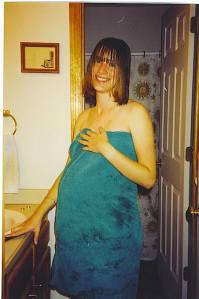
It’s hard to remember the exact chronology of events. After a while, we called the doula – but when she wanted to know the timing of the contractions, both Mark and I were vague. It was never clear to us if we were timing things correctly. What was clear was that the contractions were coming close together, and seemed intense to me. We called the birth center to give them a head’s up, but had to leave a message, and realized that we weren’t sure what the after hours procedure was supposed to do. We called S again to ask her how to contact the doctor, L, directly. It seems like around that time, L returned the call from Molly’s message, so apparently that’s their procedure – just leave a message and someone calls you back!

Meanwhile, Molly continued to have regular, intense contractions that barely ended before the next one began. She commented that she never seemed to get a break, and was a little fretful about things getting worse. I tried to let her know that she only needed to deal with each contraction as it came, and not to “suffer what she feared”, because maybe this was as heavy as they would ever get. I felt like I should be the voice of wisdom, even though I couldn’t really tell what was going on with her. My job was to soothe and support, and I had schooled myself carefully to remain cool and calm!

Throughout the contractions, Molly continued to hum “Woman am I”, and sometimes, as the humming began to speed up and get louder, I would hum along with her, hoping this would help to center her. We had various tricks that we had planned, like a foot massage, counter pressure, squeezing combs (hah!), but none of them seemed desirable or necessary. Occasionally, she would begin to question her ability to continue if it became more difficult, so I brought in her list of affirmations and read them to her between contractions – they were all familiar to her and seemed marginally helpful. Watching a woman labor makes the support people feel rather helpless, so it was good to find something that she could focus on, if only for a while. We also offered frequent drinks and food. Mark was extraordinarily in tune with her.

We tried various positions to ease her comfort. One mistake was suggesting that she lie down on the bed for a while. She said it made her feel terrible and trapped. She was amazingly calm and serene, otherwise. I had expected her to be irritable with me, or Mark, but she was very internal and focused. I had also expected to feel more protective than I did. I thought I’d want to take away her pain, and be the “mom” who fixes the hurts, but she was so in control the entire time that I didn’t feel the need to go into mom mode. Her strength was inspiring.

Around 2 a.m., we decided it was time to call S, who arrived in record time. It was a relief to have a more professional opinion available. Molly was in the bathroom at this time, and had quite a bit of pre-birth matter (to put it politely) that had been discharged into the toilet. To me, this looked like far more than the mucus plug and seemed to indicate that birth was imminent, but S didn’t seem to think so. I still don’t know, but it was definitely an indicator of big progress being made! Also, the contractions were very heavy and close together. S took us aside, and said that first-time moms take a really long time, and that we shouldn’t be jumping the gun – hindsight reveals that Molly was further along than any of us realized.

S altered the room lighting with little gentle lamps that gave off a dim blue light, very much like candles. She whipped out rice socks, and offered various suggestions for position changes. It was good to have someone else to offer support, although we were doing pretty well without her. Molly kept saying that she felt different inside, like something was happening, but she wasn’t too clear on what it was. She said that during contractions, she wanted to race to the birth center, but between them she didn’t. I remembered her saying something similar about my arrival, earlier, and wondered if maybe we should heed this and get straight in the car……

S suggested another shower, but Molly was quite resistant to this, and then announced that we should go to the birth center. I was glad to be at this point – in the hands of professionals! The original plan had been to transport in 3 cars – Molly and Mark in theirs with the carseat, me, and then S. It became obvious that Molly would be much more secure if she could have Mark’s attention during this 40 minute drive, so we switched the carseat to my vehicle, got everyone loaded, and sped away. It must have been at about 3:15, because we got to the birth center at 4. By this time, I was running on adrenaline, having had no sleep, and having already driven nearly 6 hours, but I felt charged and clear. My grandson was on his way, and I was the driver. This was an important task! I tend to drive a tad fast in ordinary circumstances, but this event led me to be a regular lead-foot. I kept it at about 75 mph, although S says I went faster. The road between JC and Columbia is very “swoopy” – there are lots of dips, and then bumps that the car sort of chunks over. Molly was moaning, and seemed especially agitated as we bumped and swooped. I don’t think slowing down would have helped, so I just kept the pedal to the metal and got her there as fast as I could.  I couldn’t tell what was happening in the back seat at all, and just concentrated on my driving.

We pulled into the parking lot of the center, and there was nobody there! As I began to question this, a car pulled in, and out stepped V [midwife], very calmly, carrying a cup of coffee. She opened the door, asked a few quiet questions, and then casually went off to brew more coffee. We unloaded some things, including Molly, who seemed a little confused and tired. Mark called friend Kate, who we had called before, leaving a message. Little did we know that she was standing by waiting for the follow-up call for hours! She arrived about a half hour later, beaming and fresh. It was good to see another caring face. We all wanted to do something – anything – for Molly. However, Molly was in complete command of herself, so it was left to us to stand quietly by.

We were placed in the room Molly had hoped to have, and I came in, no doubt thinking we had plenty of time. She checked Molly and said that she couldn’t find a cervix. I found this unnerving. Did she mean no progress had been made? How could that be?!? Did Molly have some bizarre disorder that caused her cervix to disappear? I was working hard on being quietly serene, so I finally just asked what she meant. V said Molly was fully dilated, and could begin pushing whenever she felt the urge. I’ll never forget Molly’s face, disheveled hair, and wide eyes as she looked questioningly at V and said, “Are you telling me the truth?” Well, she was telling the truth, and Molly soon began to push. At this point, I remembered the car ride, and realized that Molly had gone through transition while swooping along the highway.

At one point during the pushing, Molly was standing by the bed with her arms and elbows supporting her. She gave a tremendous grunt, and her water broke with an audible report, splashing Kate and lots of the floor. It seemed like a lot of fluid! At this juncture, V said she’d better call the doctor, so we helped Molly into the bathroom.

Molly was concerned about making huge messes, so she was fairly comfortable in the bathroom – that way, everything just dropped handily into the toilet. The age-old concern about excreting a wee amount of feces was there, so being on the toilet alleviated that problem. Mark was with her all the time. I should take a moment to mention how wonderful Mark was throughout this entire event. He never left her side, and was completely attentive to every move she made or word she spoke. He never lost his calm demeanor for a moment, and was a pillar of strength and support.

Dr. L was now present, and she added to the overall feeling of having a competent team in place. It also helped to know that things were moving right along, and Molly would soon have her tiny son.

I had made sure to bring along Molly’s birth necklace from the Blessingway, as well as her needle felted birth art. I took a moment to hang the necklace at the foot of the bed where she could see it, and I place her felted ladies on the table where they could look on. Molly was wearing a cotton-knit nightgown, and had on an amulet bag with the fused glass touchstone a friend had given her. We all knew that things were happening, and became very energized by the birthing energy.

While in the bathroom, as we stood outside the door, I could hear Molly humming her song – I hummed along with her so that she would know that I was still with her, even if I wasn’t in the same room. I didn’t know if she could hear me (she could), but I thought it might help.

Molly and Mark were still in the bathroom when L came out and told us that they wanted some privacy, and ushered us all out into the lobby. Before I left, I told everyone that Molly didn’t want to give birth on a toilet, and they seemed to hear me. We sat there – V, Kate, S and I – chatting a bit, and wondering what was going on in there. I voiced my trepidation that maybe I wouldn’t get to see the birth after all, but that I also realized that I wanted it to happen the way they wanted it. That meant they might not want me (or anyone) there, and I knew I needed to be at ease with that. V had some stories to tell of her own children not needing her. I wasn’t comforted, but was fully aware I needed to get over it! I later discussed this with Molly, who told me that L had asked if they wanted privacy, and when they said yes, she took it upon herself to move us out.

Not too much time elapsed (maybe 30 minutes), and L came out to invite us back into the birthing room, but that no talking was allowed. It was really hard to not utter any words of encouragement to Molly, who was now lying on her side on the bed. It was very dimly lit, so L shined a flashlight to show us the tiny tuft of hair emerging as the baby began to crown. Once again, I later found out that Molly had not requested complete silence – but at the time, I was afraid to make a peep for fear they’d kick me out and I’m miss everything. They had us place a mirror so that Molly could see the baby, and shifted her position so that she was sideways on the bed. If I’d been allowed to speak, I would have suggested placing something under her heels to give her purchase for pushing. Instead, I moved around a bit, and put my leg under her foot to try to help. Then, I had to move to allow room for L and V to get ready for the Lannbaby.

Molly expressed amazement that she was “really doing this” and repeated that it didn’t feel real. She kept saying things like, “This is really me! I’m really doing this!” She was astoundingly together the entire time.

Molly pushed and pushed, still serene and still in command. There was a great deal of stretching discomfort that alarmed her, but L put her mind at rest by telling her that her body was made to stretch like that. After a few more pushes, and Lann’s head emerged, crying loudly, and spluttering. Before this, I was recalling a birth support video that I’d watched, in which the baby wasn’t breathing and was shockingly limp and white. I was girding my loins to be calm and supportive if this happened – but no need! A very vibrant and squalling head greeted us! His body slithered out directly afterward, and we had a whole, crying baby boy in the room with us. What a miracle! The joy was intense. Kate and I burst into tears.

Just born!

L handed the baby to Molly, who immediately, with Mark behind her throughout, began crooning and talking to her tiny son. She instinctively put him to her breast, and he calmed as he began nursing. They cut the cord, and then needed to take him from her for checking, and diapering – it was time for the placenta, which slid out as nice as you please. They told Molly that she had a small tear, and didn’t recommend stitching it.

There was an uncomfortable follow-up moment, when some blood clots needed to be manually removed to that the uterus could properly contract. Mark had the baby, and it was hurting Molly, so she called to me. S got there first, but I soon took her place, and we went through a few more rounds of “Woman am I”.

We also joked with Molly about getting an A+++ on labor and birthing. I’m not sure what the staff made of that. They probably thought I was some pushy, overachieving home school mom that insisted on academic excellence. It was definitely an A+++ event!

This is about when I got a chance to hold my peacefully sleeping grandson – what a perfect little guy! It was such a wonder and an honor to be present at his birth. I’ll forever be grateful to Molly and Mark for allowing me to share this experience with them. It forged a new bond between us, and made me understand the reality of life everlasting. Little Lann is my immortality.

Baby Lann with his Baba!
(I couldn’t find a newborn one with Baba. Surely I have one?!)

With Baba nine years later! (and Aunt Nancy too!)

Thanks for being there, Mom! 🙂

Related posts:

My First Birth

Alaina’s Birth Story–Baba Style!