“Her courage is written on her body.” –Molly(Talk Birth)
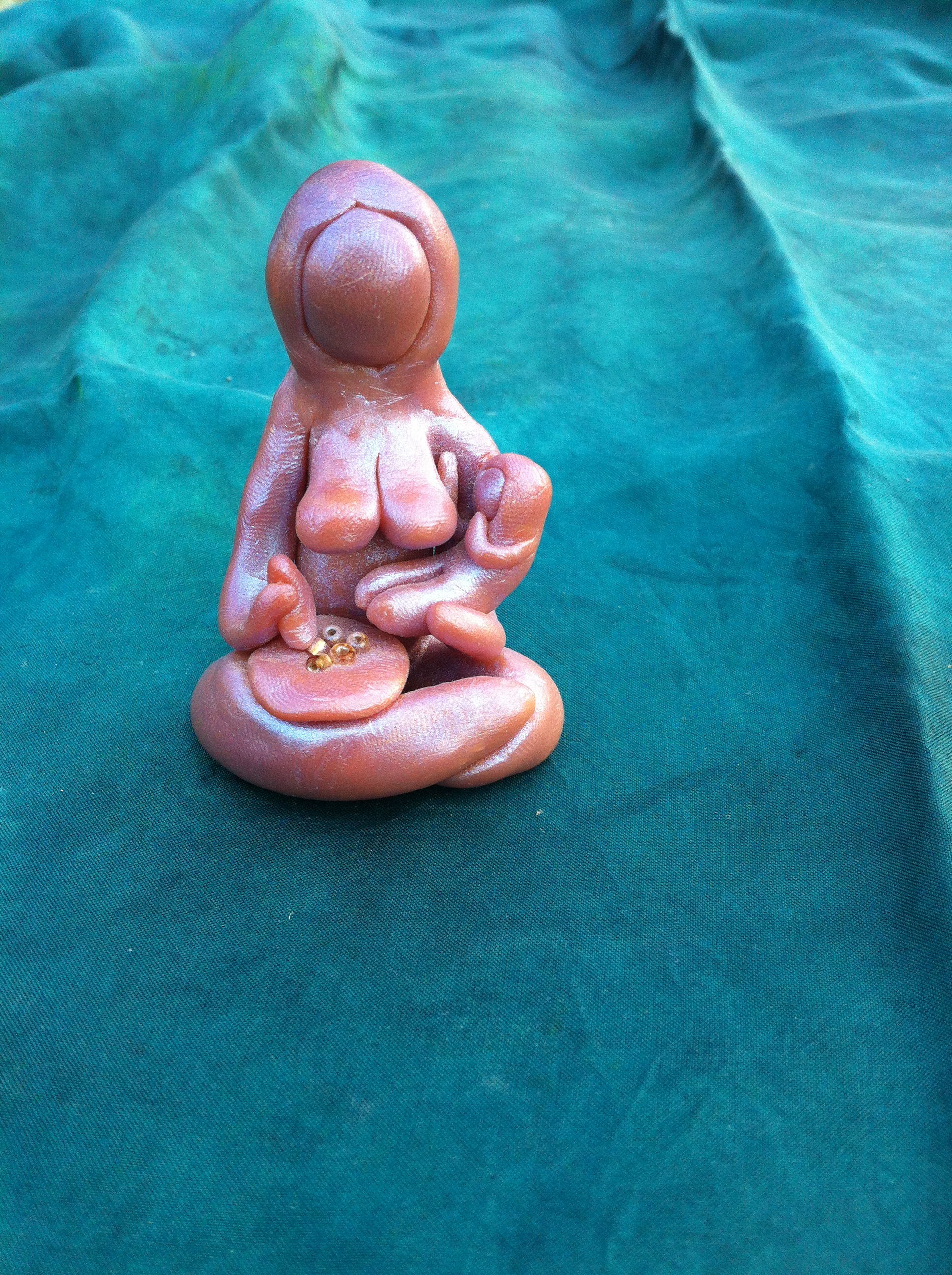
Last year I made several cesarean birth art sculptures by request. It felt like a “risk” of sorts to make them, like I was trying to interpret another woman’s experience artistically, but I did it and they were well-received. I chose to imprint words in the figure’s cesarean scar because I kept thinking about how that mother’s love and hope and courage are all permanently written on her body. Recently, I had a request to make another and so I re-visited my Cesarean Courage idea and made some new figures. She is wearing her baby and her scar with pride and strength. These sculptures are not supposed to send an “at least you have a healthy baby” message, they are communicating that her birth journey with her baby is seen and acknowledged and validated.
“I became a mama goddess, too. I became a wonder of fertility, of softness, of late nights and warm beds; a body capable of unimaginable things. I labored and tore open, too.”
When I shared the cesarean courage mama picture on Facebook, someone responded: Usually I look at the scar as a forever reminder of my failure. The idea my courage and love is forever written on my body in the marks of a surgeon’s knife is so transforming. I am humbled and amazed and inspired and encouraged by the ways in which birth art “speaks” to other women. It is a powerful experience and I feel so honored to communicate and share in this way. When I stopped teaching birth classes, I worried about no longer being “of service” to birthing women, but through my sculptures, jewelry, and writing, I still am doing this work and I am grateful.
Thinking about it reminded me of this wonderfully powerful photo of a mother-assisted cesarean birth in which the mother (a midwife, IIRC) caught her own baby…
WHEN a baby is born by caesarean, the hands that lift it from the womb to the world usually belong to an obstetrician. But now, there’s someone else who can help deliver the baby: the mother.
This picture and article were published several years ago and also covered in a Radical Doula post.
There are lovely photos from an online doula friend at Plenitud of a family-centered cesarean birth as well. And, two more recent posts with family-centered cesarean births here and here.
This week I was also touched to read a mother’s story of homebirth plans turned hospital birth plans turned cesarean birth after the baby developed an atrial flutter and was risked out of homebirth:
This has been a big week, with deep shifts that I’m sure will keep happening as we go through the coming days. Sometime in the next three weeks, I will subdivide into two women — one a mother, and one a fresh newborn infant, each with our own developing story and life path. I will find that I care more deeply about some things than I ever thought possible, and other things that were important markers of my life and identity are no longer significant. I’ll celebrate and I’ll mourn…
I knew I was going to be a mother very soon. I focused on not freaking out, and on enjoying my last moments of being so intertwined with my baby. I sent her telepathic messages of love and reassurance. I knew I wouldn’t be seeing her right after the surgery and that likely she would have to go through some trials before I could be with her again.
The operation itself was not as bad as I expected. One critical piece of my experience was having the accompaniment of a labor and delivery nurse friend, who served as a kind of impromptu doula, helping me to hold my ground when treatments being offered were inappropriate or unnecessary, and to fully embrace with less fear and more trust the life-saving help that hospital staff had to offer…
These mamas have taken powerful birth journeys. They have laid down their bodies for their babies. They hold their experiences, they wear them, their courage, love, and hope, upon their skin. The birth experience is there, loud and clear, and yet new experiences and joys are too. She is whole.
I’ve recently had several requests from friends asking about the best birth books to give as gifts to pregnant relatives. After sending my third response, I realized that there’s a blog post in here somewhere!
Giving Birth with Confidence—this is the well-known childbirth education organization Lamaze International’s guide to pregnancy and birth and it is one of my favorites. My review of a past edition is here.
The Birth Partner—this guide by Penny Simkin is a classic for helping fathers or other birth partners serve during labor
The Greatest Pregnancy Ever—focused on positive mental attitude during pregnancy and cultivating a mother-baby bond prenatally (caveat: I’ve not actually finished reading this one, so I’m not sure if I have any reservations about it or not. I bought it at the last CAPPA conference)
Birthing from Within—the original birth art resource and a fabulous “out-of-the-box” handbook for preparing for birth. It is not attached to a particular outcome and can help mothers dig deep whether experiencing a home birth or a cesarean. This book is my all-time favorite, but my recommendation comes with a caveat that the short breastfeeding section is terrible.
The Baby Book—-a comprehensive, reassuring look at baby’s first year by Dr. and Martha Sears.
I used to recommend The Thinking Woman’s Guide to a Better Birth, but is has been replaced by an updated version calledOptimal Care in Childbirth and I’ve not yet read that one. My educated guess is that it is still an excellent recommendation! 🙂 I also used to recommend The Birth Book by Dr. Sears. It is still a good suggestion, but it is now an “older” book and so I don’t put it at the top of my list any longer.
Also, make sure you grab a copy of the free Guide to a Healthy Birth from Choices in Childbirth. I love this little booklet so much! It is my top favorite resource for tabling at community events. Another free educational resource that I recommend (particularly for women planning natural births in hospital settings) is Mother’s Advocate. There is a free booklet and a series of videos that explore Lamaze’s Six Healthy Birth Practices (which all mothers deserve as part of evidence-based care during birth, regardless of birth location).
In addition, all the books I’ve reviewed in the past are available on my website from this link, so make sure to browse and see if anything else jumps out at you as a good match.
“Everyone who interacts with a pregnant woman is, in some way, her ‘teacher.’ Telling birth stories, sharing resources, imparting obstetrical information, giving advice or warnings—these are all direct or indirect ways of teaching about birth and parenting. Whether you currently identify yourself as a ‘childbirth teacher,’ or you are a midwife, doctor, doula, yoga teacher, nurse, therapist, breastfeeding counselor, or you are simply a woman or man who cares about the power of the childbearing year, you already hold the power of mentoring within you.”
Because books are my first and longest-lasting love, I began my blogging career with a book blog. I eventually gave it up when I felt I no longer had time for it and turned my attention of other blog work. However, I occasionally mine the old blog for content here and I’ve realized that rather than doing traditional reviews, I really, really like doing my somewhat-new “talk books” posts on this blog. I’ve mentioned before that one of my reasons for blogging is simply to store information in one place that I want to remember or come back to later. If I’ve typed up everything I like from a book, I don’t really need to hang onto the book and the “essence” of many books (or at least what I got from them) is all compiled in one place. So, what follows is one of those mined posts (though at the end, I got caught up in the topic and went off into some related thoughts).
Laughter and Tears: The Emotional Life of New Mothers was written in 1997 by Lamaze co-founder Elisabeth Bing. I found myself with a dearth of postpartum resource books after giving birth to my first child and desperately hungered for them. I went on a dogged mission to locate them, finding them somewhat difficult to unearth, and eventually I think I read basically every book ever written on the postpartum period. I started out enjoying Laughter and Tears, but found it less and less engaging as it went on. I think there is such a great need for books about postpartum out there—ideally, for women to read before their babies are born. I wish I would have had one already on my shelf when my first baby was born, instead of having to discover the niche later. However, part of why the book was not engaging by the time I actually read it was simply because it is geared toward women in the immediate postpartum (and also first time mothers primarily)—when I read it, I was no longer there and so my interest in the book waned fairly quickly. I also found a the heavy emphasis on “reclaiming your body” off-putting—there was even a comment like, “now that your baby is a robust two month old, you can begin to reclaim your body by reducing or eliminating feedings at night.” Excuse me? “Robust” TWO MONTH OLD? That is practically still a fetus as far as I’m concerned!
Several quotes I marked to share:
“Our society is profoundly ambivalent about children. On one hand, we praise family values, but on the other, we emphasize individual liberty and the rights of women to have as many freedoms as men. We encourage mothers to desire to have it all, but do not guarantee maternity leave, health insurance, or day care. We use babies to sell products, from laundry detergent to automobile tires, but we don’t want a mother with a toddler in the seat next to us on an airplane. We question the legality of abortion but threaten to withdraw welfare benefits from disadvantaged children. We celebrate children and praise parents for having them, but we do not provide structures or systems to help nurture them.”
And, one I still find extremely relevant:
“The degree of pleasure you take in your mothering is not the same thing as loving the baby or being an effective parent. Keep in mind there is a distinction between mother love and maternal satisfaction. You may love your baby very much but be dissatisfied with your life circumstances.”
There was also a quote that I find a new relevance in today now that our household structure has changed to both parents being home nearly full-time. I’ve been confronted over and over again in the last several months with how many “keys” to the household and family life that I’ve held over my ten years as the primary parent in the home and that, at some level, there is a power in being the one who knows (even if it just where the mustard is, for example) and that switching over to sharing those household details doesn’t actually come easily for either parent, no matter how we’ve said we wish to share them. I’m also noticing how very, very many details of the somewhat invisible work of parenting are still very much my responsibility—such as planning birthday parties or taking kids to playgroup or making dentist appointments or making sure Christmas presents are purchased and equal—and apparently, I do not know how to let those go or start transferring some of the responsibility without feeling put-upon, annoyed, demanding or like, I’ll just do it myself, since I’m the expert anyway. And, as this quote below references, I also have enjoyed being the primary emotional parent as well and still hold on to that terrain—essentially, what I want to share is the cooking and towel-folding responsibilities, while still getting to be the one run to for security and snuggles.
“Men are challenged by their attempts to be more involved and more nuturant than the ‘traditional’ father. Women are challenged not only by developing an identity in the world outside the home, but also by opening up and truly incorporating men into the intimate life of the family. You may have a concept of what a more involved father should be like, but if you are honest with yourself, is your image truly about sharing the love and nurturance? Or is it actually about wanting your partner to help with domestic chores? Are you really imagining a co-parent, or are you thinking of something more like a regular baby-sitter and handyman?”
Whatever it’s shortcomings, this book again reminded me of how vital postpartum support is for families in our society and reminded me of why I originally wanted to be a postpartum doula and how called I felt to that work. In 2004, I trained with DONA as a postpartum doula and felt 100% certain that I had found where I belonged (indeed, I still get Christmas cards and updates from one of my first postpartum doula clients—I was good at the work and they liked me a lot!). I stopped working as a postpartum doula in 2006 though. My biggest reason for discontinuing postpartum work was because at this point in my life I couldn’t reconcile taking care of someone else’s family while my own needed me so much. There I would be washing my client’s dishes and thinking that I have a huge pile unwashed at my own house (that my husband then did at night when he got home) and/or folding their laundry and thinking of the two full baskets at my own house in my own living room as yet not put away. Also, I recognized that I felt more comfortable with and am temperamentally more suited for educational/”academic” types of support rather than the “intimate” hands-on support that postpartum or labor support requires. For a time after quitting, I really felt embarrassed about it because I was SO sure it was my “calling” and because I spent so much money on training, books, supplies, certification packet, etc. (Luckily, I totaled it up when I was preparing to quit and I made enough money from my clients to at least more than pay myself back for the training!)
I feel fervently that women/families need postpartum doula support (sometimes desperately) and I felt depressed to realize that I wasn’t the person for the role after all. I didn’t understand at the time, but I quickly figured out why the majority of the women in the postpartum doula training with me were middle-aged. They had the energy to “mother-the-mother” and “nurture the family” at that season in their lives, whereas I am still in a season in which I need to nurture my own family before I have the energy to spare to nurture someone else’s. There were also a handful of women in the training, like me, who had very young children. There were no in-betweeners, like where I am right now. I’ve begun to notice this in birth activism work (and to a lesser, but still noticeable extent, in breastfeeding support work) as well—passionate mothers-of-infants or toddlers and gray-haired sage-women are the ones who come together for the bulk of the birth activist workload in various organizations.
I’m also reminded again, however, of why breastfeeding support holds such a lasting pull for me and that is because postpartum is where it is at, that is where we are so very, very deeply needed as support people. Birth is amazing and exhilarating and women most definitely need us there too, but in the nitty-gritty, day-to-day, unglamorous, nipples and breast infections, teething, crying, dirty-haired, exhausted, wrung-out maternal web of daily being is a very tender and delicate beauty that becomes visible only when we’re willing to spend months and months, or even years, serving as a listening ear, a medication lookup, and someone to trust with both her laughter and her tears.
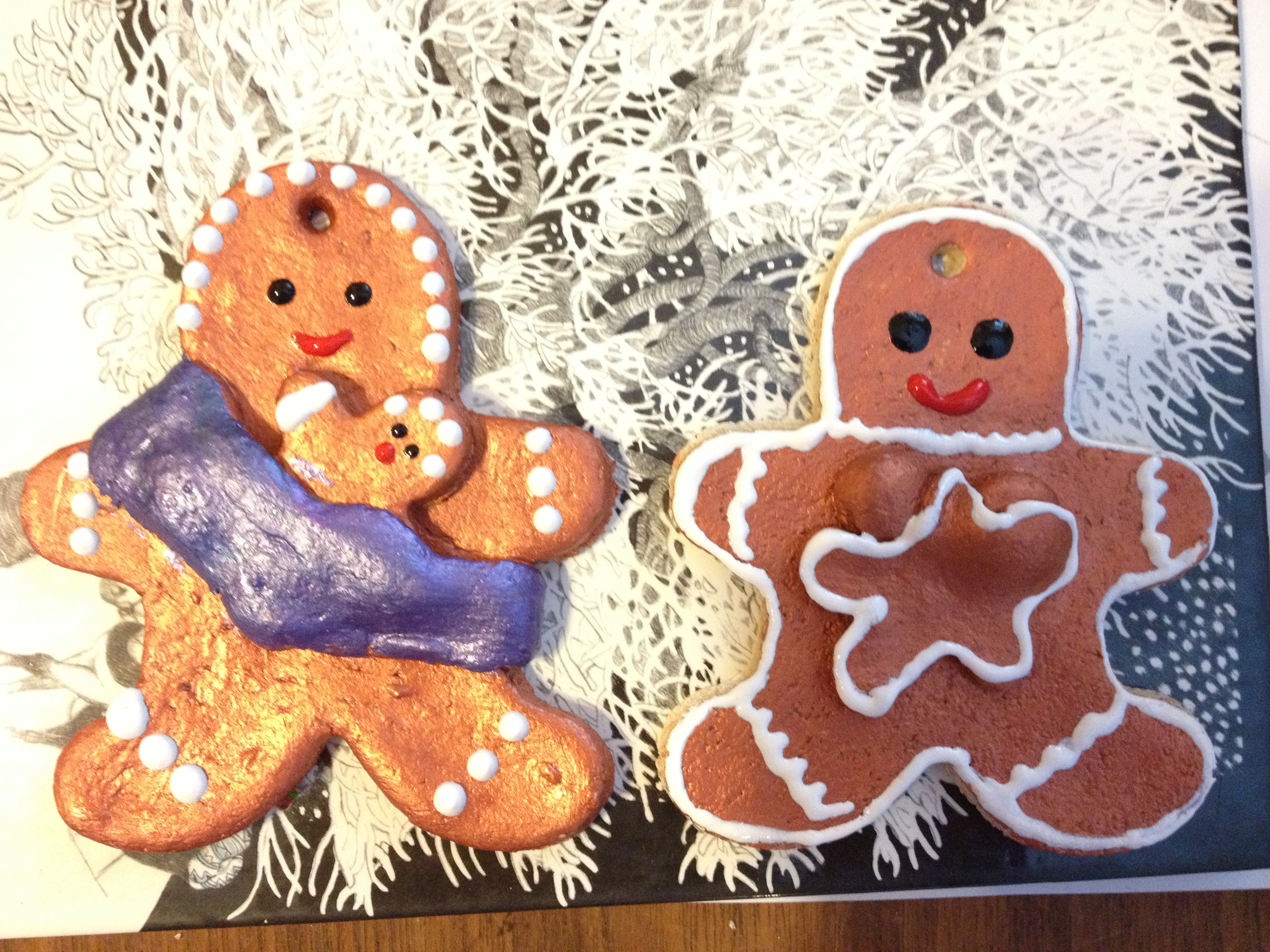
I’m either officially a creative genius, or have officially gone off the deep end. On our family fun snow day, we made salt dough ornaments and these were mine:
Pretty sweet, eh? After making them, I shared them on Facebook where they received a favorable reception. So, today…I thought, why not go for polymer clay and make some holiday pins? I spent WAY too long working on these and I also had a ton of fun (near catastrophe with falling objects in the closet notwithstanding as I frantically searched for my pasta roller to get the thickness right!). Behold, Gingerbirth Mama:
And her friends:
Large and small:
And, the manic crafter demo’ing the pin-possibilities:
“Whether a woman knows it or not, she is a vessel of great magnitude born capable of reshaping humanities destiny if she only knew the true depths of her innate gifts. Be prepared now to see the fierce face of the feminine rock as her inner geographies of volcanic strength erupt from a love she has held in her belly for life all of her days. This is not a gasp of her last breath. It is her birthing cry into her wise leadership on our planet.” –ALisa Starkweather
“Birth, like love, is an energy and a process, happening within a relationship. Both unfold with their own timing, with a uniqueness that can never be anticipated, with a power that can never be controlled, but with an exquisite mystery to be appreciated.” –Elizabeth Noble
“Birth is not a cerebral event; it is a visceral-holistic process which requires all of your self–body, heart, emotion, mind, spirit.” –Baraka Bethany Elihu (Birthing Ourselves into Being)
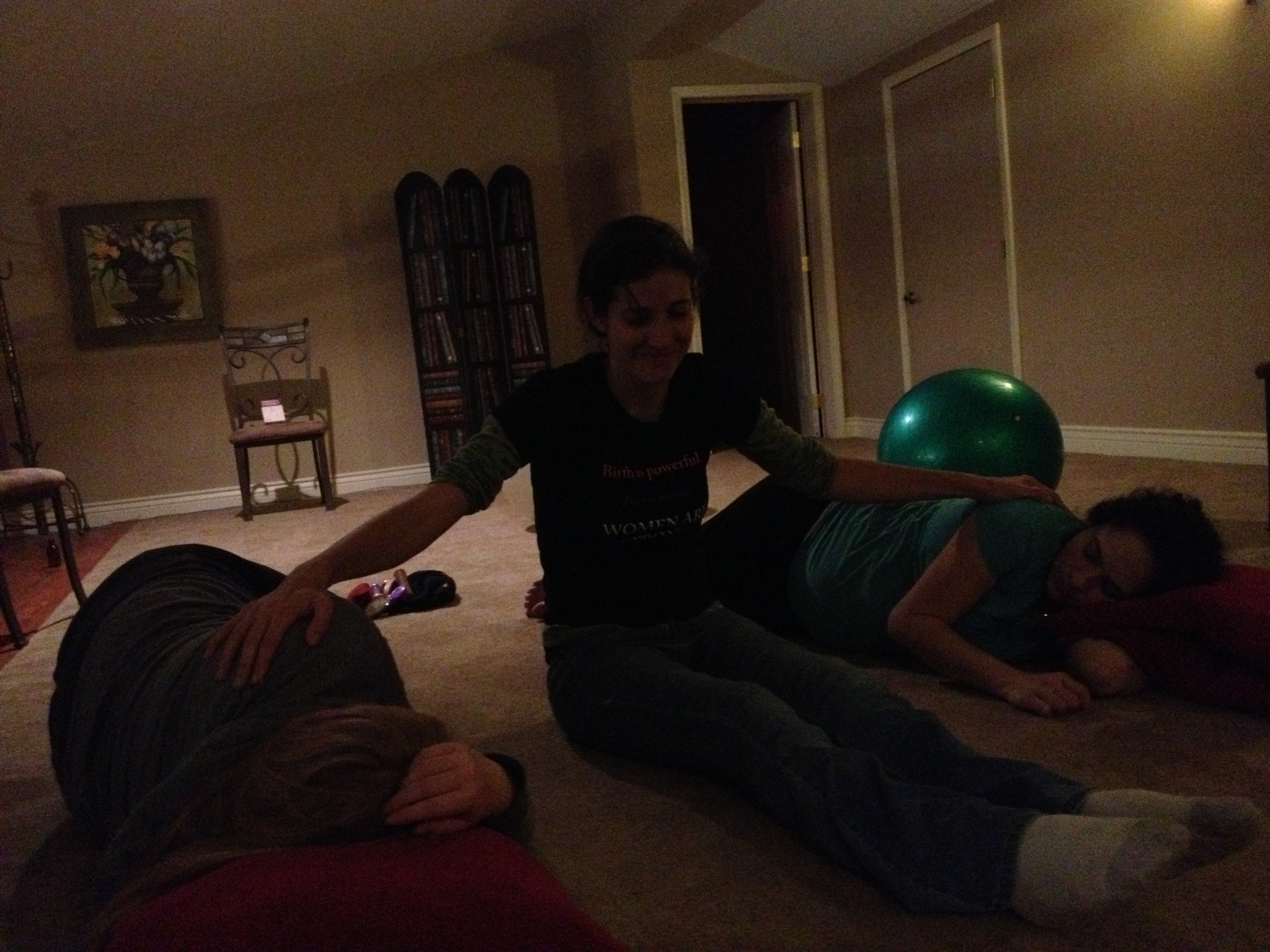
Last weekend, I taught our final Birth Skills Workshop of the year. While I know I have been writing about my sense of separation from birth work or the phase of “moving on,” in which I find myself, this workshop was an excellent experience. The women were so beautiful and interested and anticipatory. The couple working together was so loving. My doula co-presenter was so present and grounding. I came home feeling really positive and enthused and I also found myself considering new birthwork-related ideas and new possibilities, including something that I’m really excited about, but don’t feel like I can share publicly just yet. This work is in my blood, my roots, my heart and my soul, regardless of how direct the services are that I offer or the primacy/priority of face-to-face birthwork in my life. I will never not care about birthing women. They’re too amazing. They’re too important. And, my own sense of being, my spirituality, my thealogy, is too intimately entwined with my own embodied experience of gestating, birthing, lactating, and mothering, to ever make a full separation from it. After I got home and looked at my few pictures from the evening, I realized that in eight years of teaching birth classes, I have exactly zero pictures of me doing so! But, here is one of some of the mamas were enjoying a much deserved relaxation session after a lot of active birth practice. 🙂
This photo reminds me of the amazing benefits of co-teaching a workshop with another birth professional. SO much better than teaching alone ever was! Doula Summer of Peaceful Beginnings Doula Services and I have been friends for a long time (we also co-founded Rolla Birth Network). She has helped me when I’ve needed help and I’ve helped her when she’s needed help, but our helping skills/abilities rest in different areas, which is why we work extremely well together with a workshop like this one. I provide the information and structure, Summer provides the gentle presence and soothing hand. A good workshop needs both!
I also re-discovered how I do enjoy putting together a nice information packet! 🙂
In addition to my workshop-related epiphany, I had a lightbulb moment with regard to my M.Div thesis. It suddenly seemed clear to me that rather than create a scholarly, academic discourse proving a theory about birth as a spiritual experience, I need to integrate my theories with my birth art sculptures. I need to frame my work within this sculptural context, this personal experience, this lived reality of the might of creation. I have 234 pages of possible content for said thesis, all saved in an intimidating word document waiting to be sorted through and added to. It is overwhelming to even open. With my new idea of framing my thesis through my own art, I feel a pathway emerging through the information, a pathway that integrates the academic and the personal and that results in something uniquely my own…
Some of my sculptures-turned-pewter-jewelry.
“Be soft. Think of [labor] as a fine silvery stream, not a raging waterfall. Follow the stream, have faith in its course. It will go its own way, meandering here, trickling there. It will find the grooves, the cracks, the crevices. Just follow it. Never let it out of your sight. It will take you.” -Sheng-yen
“We vibrate to that primordial rhythm even before we have ears to hear…We vibrate to the rhythms of our mother’s blood before she herself is born. And this pulse is the thread of blood that runs all the way back through the grandmothers to the first mother.” – Layne Redmond (August 19, 1952 – October 28, 2013): Drummer/Composer, Author and much more (via The Girl God)
“Within the womb of every woman glows the consciousness of Mother Earth.” –Roslyne Sophia Breillat (via The Girl God)
Childbirth is a women’s rights issue and a reproductive justice issue. The United States maternity system is one of the costliest in the developed world, yet our birth outcomes compare poorly to those of other industrialized nations. Among industrialized countries, we consistently rank last or second to last in perinatal and maternal mortality rates. Moreover, birth is depicted in mainstream media with fear, medical intervention, and crisis…
It took me some time to get around to it, but I’ve finally finished exploring The Business of Being Born: Classroom Edition and its associated toolkit of educational materials! As a long-time childbirth educator and birth activist, of course I was interested in this classroom version of the (new) classic birth advocacy film, but I’m also a college professor and therefore was doubly interested—how might this resource be incorporated into one or more of my human services courses? As the BoBB companion site explains…
Childbirth is an issue most people do not engage with until they have experienced the maternal health system. The Business of Being Born: Classroom Edition reaches out to young adults BEFORE they confront their own birth decisions, both placing the issue on the radar and challenging the prevailing assumptions about birth providers and current obstetrical management trends. The goal is for the next generation of policy makers, practitioners, educators, and parents to approach birth decisions with awareness and confidence. Our strategy is to incorporate this evidence-based presentation into classrooms around the country. We envision empowering the next generation of parents to seek out systemic change and new policies supporting domestic maternity care…
The Classroom Edition of the film runs about 25 minutes and comes packaged with one of my all-time favorite resources for birth classes and tabling events: The Guide to a Healthy Birth from Choices in Childbirth. It also comes with two additional celebrity interviews, the short film Birth by the Numbers, and a instructor’s toolkit with classroom activities tying the themes of the film to major subjects such as Women’s Studies, Public Health, and Sociology.
My only critique of the classroom edition of the film is that the assembled quotes at the beginning of the film are put together in a choppy sort of way that makes it difficult to perceive (for the average viewer), which are the “good” (i.e. accurate) quotes and which are popular types of misinformation. There is also an odd, repetitively distracting, monotonal quality to the music that plays through much of the footage. Excerpted from the full-length film, the classroom edition still includes Ricki Lake’s homebirth in her bathtub, which was one of my top favorite moments of the original film. Content from a historical perspective as well as content involving the shadowing of a homebirth midwife and the personal stories from families choosing midwifery care were greatly reduced from the original version and the classroom edition seems to have more of an emphasis on sociocultural analysis. It is noted that 90% of women in many hospitals experience some type of labor augmentation (usually pitocin) and also that hospitals are businesses, businesses that are not really interested in having women hang around in the labor room.
One of the college courses I teach is American Social Policy. I have always been interested in birth change from a systemic (macro) level as a companion to change on the individual (micro) level, so I especially appreciated watching the Birth by the Numbers presentation included with the classroom edition of BoBB. When speaking about the idea that the increase in cesarean rate reflects maternal choice, public health professor Gene Declercq says, “this blaming of women is farcical. It is not about the mothers, it is about the way we treat care in the United States. Nobody ever wants to admit there is a difficult inherent in the system.” Well, I want to admit it and this is the kind of macrosystem-level change we talk about in my Policy course. At the companion Birth by the Numbers website, you can download a powerpoint presentation and other teaching tools, as well as watch the short film, in which public health professor Gene Declercq debunks popular myths about the causes of the United States cesarean rate increase. The film also looks at disparities in maternity mortality rates and tackles questions of systemic influences on maternal health outcomes.
So, are mothers really asking for cesareans?
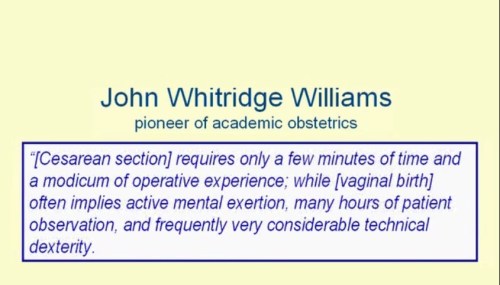
Declercq also draws on writing from the classic obstetrics textbook, Williams Obstetrics, and shares this quote about one of the real reasons that cesarean rates continue to rise: And, he makes this important observation:
As Nadine Goodman says in The Business of Being Born Classroom Edition, “A woman will always remember how she was made to feel during her birth…if you don’t have the reverence and respect for birth, where do you go from here?”
Lots of birth stuff to share this week! I may be slowly transitioning away from face-to-face birth work, but reading and writing about birth definitely remain on my agenda. First, this post about pivotal moments in one birth professional’s journey:
Thanks to a powerful recent blog by a doula in England about her experience in a Birthing from Within workshop, I have found myself reflecting on my own path as a doula and childbirth educator. Over the years I’ve done ICEA training, DONA Birth Doula Certification, and Birthing from Within Mentor Certification, along with apprenticing as a midwife and a Masters of Science in Parent-Child Nursing – more than my fair share of learning. Through the past twenty + years of practice I can identify the 7 core experiences that have shaped who I am as a birth professional.
Reading her list brought back some of my own pivotal moments and also helped me see how those moments relate to my current priestess/women’s mysteries path. I think I’ve already mentioned that I renewed my ICEA CBE certification this year, but I let my CAPPA certification lapse. I will let my prenatal fitness educator certification lapse as well and I did not renew my membership in several birth-related organizations. And, in a complicated decision related to a variety of factors, I withdrew my registration for a Birthing from Within mentor training this fall. I’ve wanted to train with BfW for ages, but I realized after we got home from California that I just can’t picture myself doing birth classes any more. Single day workshops or presentations, yes, but teaching (or mentoring) series of birth classes is just not on my radar any longer. I feel removed from or distant from it and I also feel okay with that. It is taking me quite some time to realize that birth writing is still a legitimate form of birthwork/birth advocacy/activism and I don’t need to feel like I “should” be doing something else in order to be valuable.
And, I’m so thankful that Missouri midwives have now known the freedom to practice for five years! I meant to post this link in an earlier Tuesday Tidbits post:
There is something so genuine, so deep, so…right about women serving women. Midwifery and midwives are intricately woven into the fabric of my life.
Don’t forget to watch the lovely Ballad of the Midwife video that goes with it! Both the video and the post were created by a talented friend of mine 🙂
Speaking of friends, check out these large family blogs and vote for my friend Shauna’s blog Life with 7 Kids! (she just welcomed a new baby, so it is 8 kids now! :))
And, speaking of videos, after seeing a pretty hands-on, baby-twisting sort of breech birth in Birth Story, I found this pictorial article to be a good reminder with lots of useful pictures:
Most important rule is HANDS OFF THE BREECH no matter how tempting it is just to pull on that leg DON’T. It’s the easiest way to create nuchal arms and a completely deflexed head. When you pull on the leg you create a morro reflex in the baby.
“Remember this, for it is as true as true gets: Your body is not a lemon. You are not a machine. The Creator is not a careless mechanic. Human female bodies have the same potential to give birth well as aardvarks, lions, rhinoceri, elephants, moose, and water buffalo. Even if it has not been your habit throughout your life so far, I recommend that you learn to think positively about your body.”
― Ina May Gaskin, Ina May’s Guide to Childbirth
I know the traditional root of the word midwife is “with woman” (some sources say “wise woman”), but I’d like to offer another. When I was pregnant with my second son, I had a wonderful midwife and we spent many hours together talking about birth and midwifery. During one conversation she said to me, “you can’t be a midwife unless you love women.” This struck me profoundly—a midwife must love women.
Oh, and speaking of this loving women and this not being a lemon stuff…
Respect for our bodies, our babies, and our rights is never too much to expect.
That’s why I’m joining forces with the folks I thought were nuts. Remember the ones waving the signs? The ones I thought were nosy, yoga-ball bouncing doctor-haters? Turns out, they are none of those things. They are a smart, growing global coalition of people who recognize that we have a problem with the way many women are treated while giving birth. Nine out of 10 women give birth in a hospital in the United States. Through rallies and advocacy, ImprovingBirth.org is making sure everyone knows that all those women do not check their human rights at the door.
But, what happens after the birth? I’ve often thought that my role in breastfeeding support, while less “glamorous” or exciting than birth work, has had more lasting value to the women I serve. Breastfeeding is the day in, day out, nitty-gritty reality of daily mothering, rather than a single event and it matters (so does birth, of course, it matters a lot, but birth is a rite of passage, liminal event and breastfeeding is a process and a relationship that goes on and on for every. single. day. for sometimes years). Anyway, sorry for the brief side note, but I enjoyed reading this article about the celebrity culture surrounding pregnancy and birth with its obsession with who has a “bump” and then how after the birth the main deal is losing that weight and having a fabulous bod again! Woot!
And that’s it. There’s no talk of the hard decisions and challenges that arise when bringing another human in the world: coping emotionally, miscarriages and health risks throughout the pregnancy, emotions that range from excitement to loss, how the partner is coping, decisions surrounding the birth, doulas, home birth, hospital birth, breastfeeding, milk supply, c-section recovery, vaginal recovery, colic, sleep, schedules, being tired all the time, depression, regret, fear, hiding in the bathroom crying. Agonizing decisions about work, caregivers and new priorities. Maternity leave. Paid time off. Unpaid time off. Pumping at work. Making time for your partner. Making time for yourself. A body that has changed but can also do incredible things.
Instead it’s mostly about getting skinny again after the baby is born, which we’re told over and over again is the MOST IMPORTANT THING. And it’s not. I know it’s not, and yet I have a constant dialogue in my head about how I have thirty pounds to lose and my thighs rub together and my stomach is bloated and has the texture of a grape that’s not quite a raisin and my face is fat and I’ll never fit into my old clothes again. I say this to friends (who haven’t had kids) and the response is: “Focus on the amazing thing your body just did, girl! A baby came out of you! You’re being too hard on yourself!” And they are right. I know this. But I can’t shake the feeling that I’m a failure because I’m not the size and shape I once was. And then I feel dumb and embarrassed for focusing on my looks when I should be celebrating how awesome it is that I’m a mom to two healthy, wonderful kids. It’s an exhausting, stupid cycle.
There is an important conversation to have about motherhood that we’re not having on a larger level. I know this because I talk to moms all the time. None of us are talking about maxi dresses or nursery colors or how we worked out for 90 minutes a day with our trainers while wearing a corset. We’re talking about how our maternity leaves don’t feel long enough. How often there’s nowhere to pump at work so we do it in our cars. How frustrating it is to be making too much milk/too little milk. How some days we can’t stand our partners, and on other days they totally save us.
Reading all that and thinking about my own “grape” stomach that just isn’t quite making it back to “normal” after having my last baby, I was reminded of a quote from a very recent post:
“…we all need the renewing powers of ‘rhythm, ritual, and rest.’ This phrase reminds doulas of three helpful labor techniques outlined by legendary doula trainer, Penny Simkin. Rhythm, ritual, and rest not only aid birthing women, but they support all of us to move skillfully through our life’s labors. The power of rhythm restores vibrancy through dance, music, and motion. The power of ritual opens the way to direct encounter with the mysterious wonder of life. Rest renews and restores the very cells of our often tired and over-stimulated bodies and minds…” –Amy Wright Glenn
One of the best pictures I have of the “mothering” while “personing” experience!
“I’m winging it every day, praying, surrendering, steeping myself in grace by any means necessary. I grapple with finding my own integrity, to trust the path that I have chosen, to believe that I am mothering well, that I can claim for myself a belief in my own goodness.” – Elizabeth at Mothering with Soul
“Giving birth to a new life is about so much more than just the moment itself. The power of finding your strength as a woman through birth resonates for the rest of your life. It shapes you as a person, and as a parent.” ~ Gina Sewell
I want to say first that I believe, as the organization Mothers and More does, that all work that women do, whether paid or unpaid has social, political, and economic value. In my own life I don’t distinguish between what I do for money and what I do as a volunteer, but that is partially a function of privilege, because I loveall of my work and choose freely to do it. I recently finished reading the book The Art of Family and in it the author makes a point that I’ve made in various posts as well, mothers have always “worked,” it does no good to try to distinguish between “working mothers” and “stay-at-home mothers,” because the difference is much more fluid and alive than a category can hold.
FOUNDATIONAL TO A LASTING FAMILY is acknowledging that we will be many things to each other for our whole lives, even past death. We can abandon the old fears that family life will smother us and instead go after fully practicing ourselves in the presence of partner and children. In short, making a family is the best way to present ourselves, to stake our claim to a spot on earth. But “practicing ourselves’’ in front of our family, what does that mean? To give the essence of ourselves to our children is not necessarily dependent on the amount of time you spend with your children. Here, we must recast the debate over moms who work and those who stay at home with children. This is one of those divisions that turn up damned if you do, damned if you don’t, because it is a false one from the start. First, mothers have always been “at work,’’ whether farming, spinning, pioneering, running cottage industries, or investment banking. In history, women have always, of necessity, worked for the welfare of their families, some even forced to leave their children behind to find ways to sustain them. Imagine that pain, next time you come home late from the office.
The real issue with at-home moms and working moms is the struggle for identity. Having children is the most identity-challenging and identity-changing thing women do—starting with pregnancy, when even your body gets an identity change. That should be our first big clue. But we are terrified to face it. Who wants to watch your identity evaporate, which is what having children often feels like? Identity isn’t about societal roles, either, though the ones we get stuck with can be more burden than help to us. In fact, if we allow societal roles to determine our identity, we are not really in control, we are accepting a series of masks. We have to ask ourselves the hard questions: Who would I be without this job, without this kid, without this income, without this education?—getting at the core of who we are. This is a work we must do solely on our own, and it is excruciating work. But no human gets out of it, not even mothers. Babies make you ask, “Well, who am I now?’’ Though it is currently hot in intellectual theory to say we are nothing but social and cultural constructions, this is not a spiritual truth. Identity is something you build relationship by relationship, not role by role. Families, especially at the young-children stage, are not the pause button pressed down on who you are and what you want to pursue. Yes, we may have to put off finishing that degree, taking the promotion that requires weekly travel, writing that screenplay, or finally learning French, but those things weren’t going to make you you anyway. Your relationships make you who you are, because they give you a chance to actually manifest yourself, which is what you really believe in. We fill up what we do with who we are. What we do can never fill us up.
Gina Bria (2011-11-28). The Art of Family : Rituals, Imagination, and Everyday Spirituality (pp. 8-9). iUniverse. Kindle Edition.
This notion is also explored in an article I enjoyed from Mothering:
“…Women a few hundred years ago worked their butts off every day helping their family survive. They planted and harvested, killed and prepared their own food. The children either watched younger children, played (often unsupervised) or worked right along side them. Women who had to work outside of their home had other people or family members care for their children while they cared for others. The wealthiest women probably had other paid servants care for their children much of the time. Children played with other children. Children worked. Children solved some of their own problems and they found things to do…”
Personally, I refer to this as “grinding my corn”:
Grinding my corn sculpture from several years ago.
I want to be with my children, but I wish to be engaged in my own pursuits at the same time. When our lives feel happiest and most harmonious is when exactly this is occurring—when we are all together, but each working on our own projects and “doing our own thing.” I envision a life of seamless integration, where there need not even be a notion of “life/work” balance, because it is all just life and living. A life in which children are welcome in workplaces and in which work can be accomplished while in childspaces. A life in which I can grind my corn with my children nearby and not feel I need apologize for doing so or explain myself to anyone…
You were twenty, twenty-three, thirty, thirty-five. You were free and young and somebody else.
We were free and young and somebody else.
But now, we’re mothers.
At some point the reality will hit us: We are never alone again, no matter where we are, and we are the only ones in the world who have become this person toward this child.
…
I’ve been the same woman my whole life. What about her? Where is she? Is she just dead?
Yes, she is just dead.
Does that seem harsh? Well, it is. So is motherhood.
Perhaps we can soften this whole thing by saying our identities are “transformed,” or we are “forever changed,” but the fact of the matter is that the woman you once were is gone, and she will never come back.
Period.
I also recently finished reading the anthology The Maternal is Political and in it Jennifer Margulis (later birth writer of the new book Business of Baby) says:
Jame’s working full time and my staying home wasn’t working. My working full-time and James’s staying home hadn’t worked either. We both wanted to be with our children. And we both wanted to work (something I was only able to admit once I tried being a full-time mom). But neither of us wanted to do one or the other exclusively.
–Jennifer Margulis
This is what we are working towards for my husband and me, hopefully this year. I think we both deserve to be home with the kids, I think we both also have other work that is valuable to pursue. I envision a life of seamless integration of our various roles and passions–all of us. We have a family mantra: “our family works in harmony to meet each member’s needs.” 🙂
“Is there one single aspect of motherhood that isn’t political? From conception to graduation, from your kid’s first apartment until you die, it is basically one political decision after another…” –Rebecca Walker
Also in The Maternal is Political, Beth Osnes writes about Performing Mother Activism (she has a one woman show) and I love her analogy of care being like a loaf of bread…
I go on with scenes that tackle the onslaught of societal expectations and repressive forces that creep into a woman’s life once she becomes a mother: “it happens one day. You find a large parcel on your front porch. You open it to find the status quo being delivered to you…well, actually, the status quo manual…” I go on with scenes that lambaste the fearmongering that goes on in our government and media: “The status quo wants you to dumb down, mother. It will tell you who to trust and who to fear.” I remind mothers that we must think for ourselves: “I say rage, mother. Do not go gently into that good night. Rage, rage, against the dying of your light.”
I have also stopped expecting that caring needs to be a whole and perfect project, like an unsliced loaf of homemade bread. I am coming to accept that, at least for me, caring about the world is more fragmented, much more like a store-bought loaf that splays open as soon as you open the bag. Here’s a slice of caring about antipoverty legislation, here’s one of caring for my three-year-old with the flue, here’s a slice of caring for victims of our country’s warring and, whoops, here’s even a slice of caring about my curtains. I have stopped imagining that caring is pure and unselfish; many people, including me, fashion their identities out of caring, whether for kids or for the world. Still: Bread is bread, and caring is caring. Whole or broken. Homemade or purchased. Consumed or given away.
I’m also learning that social movements will go on, even if nursing mothers or parents of toddlers have to drop out for a while. We will be back,someday, maybe when the youngest turns two or whenever we can again afford to dream like activists, rather than work like dogs. We may be more distracted than before, less available…But when we return, we will give a break to someone else who needs it—like those erstwhile college students who may be finding that carting babies to marches is harder than they anticipated.
And when we do rejoin the movement, it is possible that we will agitate and march and advocate from a deeper place within ourselves than we had known existed. It is possible that we will act from that cavity our children have hollowed out of us, that place where breath begins.
–Valerie Weaver-Zercher
And, as a lovely closing tribute to all women and all their work, remember this…
Mothers — you are powerful. Stand tall. You are full of grace. Stand tall. Join together and stand tall. Be as a Redwood tree. Stand tall. If you have stood next to a Redwood tree or seen photos of one, you will notice that they do not grow alone. They grow in groves with all of the trees connected together, even if they appear to be separate. Their shallow roots form a web that holds these big trees up in the wind. Redwoods do not fall very often. We can emulate those trees, mothers. We can hold each other up.
We may feel alone at times, but believe me and remember: You are being supported underneath the surface of where you live. Right beside you there is somebody thinking about you and supporting you whether you know it or not. Think of all the mothering that goes on in life. I have found in my life that it comes sometimes when you do not expect it and from someone you do not realize has your back. Someone in your root system seems to know that you need something. Women have a natural mothering instinct if they just listen to it.
As an African American Lamaze Certified Childbirth Educator, I have observed over my 18 years of teaching that childbirth education class participants are less likely to be women of color. My desire for more women of color to attend childbirth education classes is rooted deeper than just their presence in a classroom – it is rooted in my desire for more women of color to understand the disparities that exist in maternal and birth outcomes.
In a recent Science and Sensibility blog post by Christine Morton on maternal health disparities, she reviewed the work of several well-known public health researchers – Dr. Eugene Declercq, Dr. Mary Barger and Dr. Judith Weiss. Their findings point to the fact that African American women have higher rates of cesarean births at nearly every age group and across every level of education.
In addition, the U.S. Department of Health and Human Services reports that one of every five non-Hispanic,black births are pre-term, African American mothers experience an infant mortality rate twice that of non-Hispanic, white mothers, and breastfeeding rates among African American mothers are 16 percent lower than white mothers.
Given the disparities that exist in maternal and birth outcomes for women of color, I think April as Minority Health Awareness Month is a great opportunity to talk about a few other factors that minority moms or mothers-to-be can control or influence. It’s a hard reality that mothers face real challenges in getting the childbirth care they want and deserve. Even though medical evidence may tell us certain practices are good for mothers and babies, the “system” is not always geared to deliver that care. Health care providers are rushed, spread thin, or incentivized for practices that are not most beneficial to the mother.
Let’s go back to the fact that African American women have higher rates of cesarean births than non-Hispanic,white women. Is it because African American women are sicker and need to have a cesarean birth? Researchers report that this is untrue. They conclude that higher rates of cesarean births among African American women are a result of a shift in obstetric practices to focus more heavily on use of childbirth interventions. And, when we bring in an induction to the equation, there is a correlation between the increased rates of induction to the increased rates of cesarean births!
Research shows that babies pay a steep price for these early births caused by inductions or a failed induction, which led to a cesarean. Babies have greater difficulties breathing, breastfeeding, and maintaining their temperature, which usually means being separated from moms and spending time in the Intensive Care Unit. While an increasing number of hospitals and health care professionals are shying away from unnecessary cesarean birth and induction, it’s one of many care practices that just aren’t supported by good medical evidence.
So how can women of color push for better care?
Become an active partner with your care provider. While doctors or midwives have professional knowledge and skills, they may not know everything about your personal background and preferences. Finding a provider who will also act as your partner can help you push for the care that’s best for you and your baby.
Ask questions – lots of them! Labor and birth in particular can be unpredictable. That’s why it’s a smart idea to prepare a list of rolling questions throughout your pregnancy to help you determine if the right care is being recommended during labor, birth and after birth.
Do your research. Understand your available care options before, during and after labor at the hospital or birth center. If you know that during labor you’d like the ability to walk around, eat and drink – choose a birth facility that will be more aligned with your birth preferences or wishes.
Participate in a childbirth education class. Taking a Lamaze class will help you understand maternity care best practices and be better prepared to navigate your labor and birth. A childbirth educator will help you identify the right questions to ask when making decisions about your care.
I encourage all women – particularly African American women – to learn more about getting the right care in pregnancy and childbirth by attending a childbirth education class. Skipping out on childbirth education is a lost opportunity to stack the deck in your favor and become a well-informed consumer of evidence-based practices! As a consumer, it is your right to be a partner in your health care decisions.
—
Tara Owens Shuler, MEd, LCCE, FACCE is the president of Lamaze International. She has practiced as a childbirth educator since 1995. In 2005, she became the Director of the Duke AHEC Lamaze Childbirth Educator Program. In addition to training individuals to become childbirth educators and preparing expectant women and their partners for a safe and healthy birth experience, Tara provides labor support services. Along with coordinating the Lamaze program in the Duke AHEC office, Tara works with her statewide AHEC partners in developing continuing education programs and/or resources for healthcare providers in North Carolina and assists with the Duke AHEC PATHWAYS Health Careers program for K-12 students. When not working, Tara and her husband enjoy playing with their dog, Gramps, and traveling.
Visit Lamaze International for great resources to help mothers and mothers-to-be learn their options.
“With a new awareness, both painful and humorous, I begin to understand why the saints were rarely married women. I am convinced it has nothing inherently to do, as I once supposed, with chastity or children. It has to do primarily with distractions. The bearing, rearing, feeding and educating of children; the running of a house with its thousand details; human relationships with their myriad pulls–woman’s normal occupations in general run counter to creative life, or contemplative life, or saintly life. The problem is not merely one of Woman and Career, Woman and the Home, Woman and Independence. It is more basically: how to remain whole in the midst of the distractions of life; how to remain balanced, no matter what centrifugal forces tend to pull one off center; how to remain strong, no matter what shocks come in at the periphery and tend to crack the hub of the wheel.”
― Anne Morrow Lindbergh, Gift from the Sea
Lindbergh’s notion of mother as the axis of the household wheel really resonated with me, as did her descriptions of being pulled off center and distracted by a million aspects of the “wheel” of life. Her comment that saints were rarely married women made me smile, because it makes me think of Wayne’s Dyer’s comments that gurus rarely have eight kids, because there is nothing like the experience of parenting to shake your sense of yourself as someone who has it all together, spiritually or otherwise. And, it makes me think about how after some reading about Zen philosophy, I decided that Buddhism and Zen were not for me, because attachment is at the core of a mothering life. I got super irritated with old Buddha and his remarks about being “non-attached” and I thought, “easy for you to say, Mr. Go Sit Under a Tree and Wait for Enlightenment while your wife stays home and takes care of your kid—I guess she was too unenlightened and ‘attached’ to let go.” Being a mother has taught me a lot about relationship as the ground of being and relatedness, not non-attachment, as the core of a rich human experience. As I described in a prior post:
I have learned a lot about the fundamental truth of relatedness through my own experiences as a mother. Relationship is our first and deepest urge. The infant’s first instinct is to connect with others. Before an infant can verbalize or mobilize, she reaches out a hand to her mother. I have seen this with my own babies. Mothering is a profoundly physical experience. The mother’s body is the baby’s “habitat” in pregnancy and for many months following birth. Through the mother’s body the baby learns to interpret and to relate to the rest of the world and it is to mother’s body that she returns for safety, nurturance, and peace. Birth and breastfeeding exist on a continuum as well, with mother’s chest becoming baby’s new “home” after having lived in her womb for nine months. These thoroughly embodied experiences of the act of giving life and in creating someone else’s life and relationship to the world are profoundly meaningful.
…to be a woman is to have interests and duties raying out in all directions from the central mother-core, like spokes from the hub of a wheel. The pattern of our lives is essential circular. We must be open to all points of the compass; husband, children, friends, home, community; stretched out, exposed, sensitive like a spider’s web to each breeze that blows, to each call that comes…
How difficult for us, then, to achieve a balance in the midst of these contradictory tensions, and yet how necessary for the proper functioning of our lives. How much we need and how arduous of attainment is that steadiness preached in all rules for holy living…
She also acknowledges the essential, and yet often difficult to find, need for solitude to find stillness as the axis of the revolving wheel of life:
…Women need solitude in order to find again the true essence of themselves; that firm strand which will be the indispensible center of the whole web of human relationships. She must find that inner stillness which Charles Morgan describes as ‘the stilling of the soul within the activities of the mind and body so that it might be still as the axis of a revolving wheel is still…
This beautiful image is to my mind the one that women could hold before their eyes. This is an end toward which we could strive–to be the still axis within the revolving wheel of relationships, obligations and activities…
… she must consciously encourage those pursuits which oppose the centrifugal forces of today. Quiet time alone, contemplation, prayer, music, a centering line of thought or reading, of study or work. It can be physical or intellectual or artistic, any creative life proceeding from oneself…
…It need not be an enormous project or great work. But it should be something of one’s own. Arranging a bowl of flowers in the morning can give a sense of quiet in a crowded day—like writing a poem, or saying a prayer. What matters most is that one be for a time inwardly attentive…
I recall feeling this way about my own mother—that she was the center of our family, the anchoring space, the core to return to.
Other thoughts from Lindbergh that I related to after finding them online when reading reviews of her book and stories about her life include:
“I cannot see what I have gone through until I write it down. I am blind without a pencil…I am convinced that you must write as if no one were ever going to see it. Write it all, as personally and specifically as you can, as deeply and honestly as you can. … In fact, I think it is the only true way to reach the universal, through the knot-hole of the personal. So do, do go ahead and write it as it boils up: the hot lava from the unconscious. Don’t stop to observe, criticize, or be ‘ironic.’ Just write it, like a letter, without rereading. Later, one can decide what to do.”
And that made me think about story and being a story woman and I also saved this quote (not from Lindbergh):
We constantly weave life events into narrative and interpret everything that happens through the veil of story. From our smallest, most personal challenges to global issues that affect nations and generations, we make the world fit into the story we are already carrying. This unceasing interplay between experience and narrative is a uniquely human attribute. We are the storytellers, the ones who put life into words. – Christina Baldwin, Storycatcher (via The Circle)
How funny that we had to wait for spring before being able to actually make a snowman this year! (*note bat posed for imminent destruction too!)
Last week, Lann had his first test (yellow stripe) in taekwondo. He did a good job!
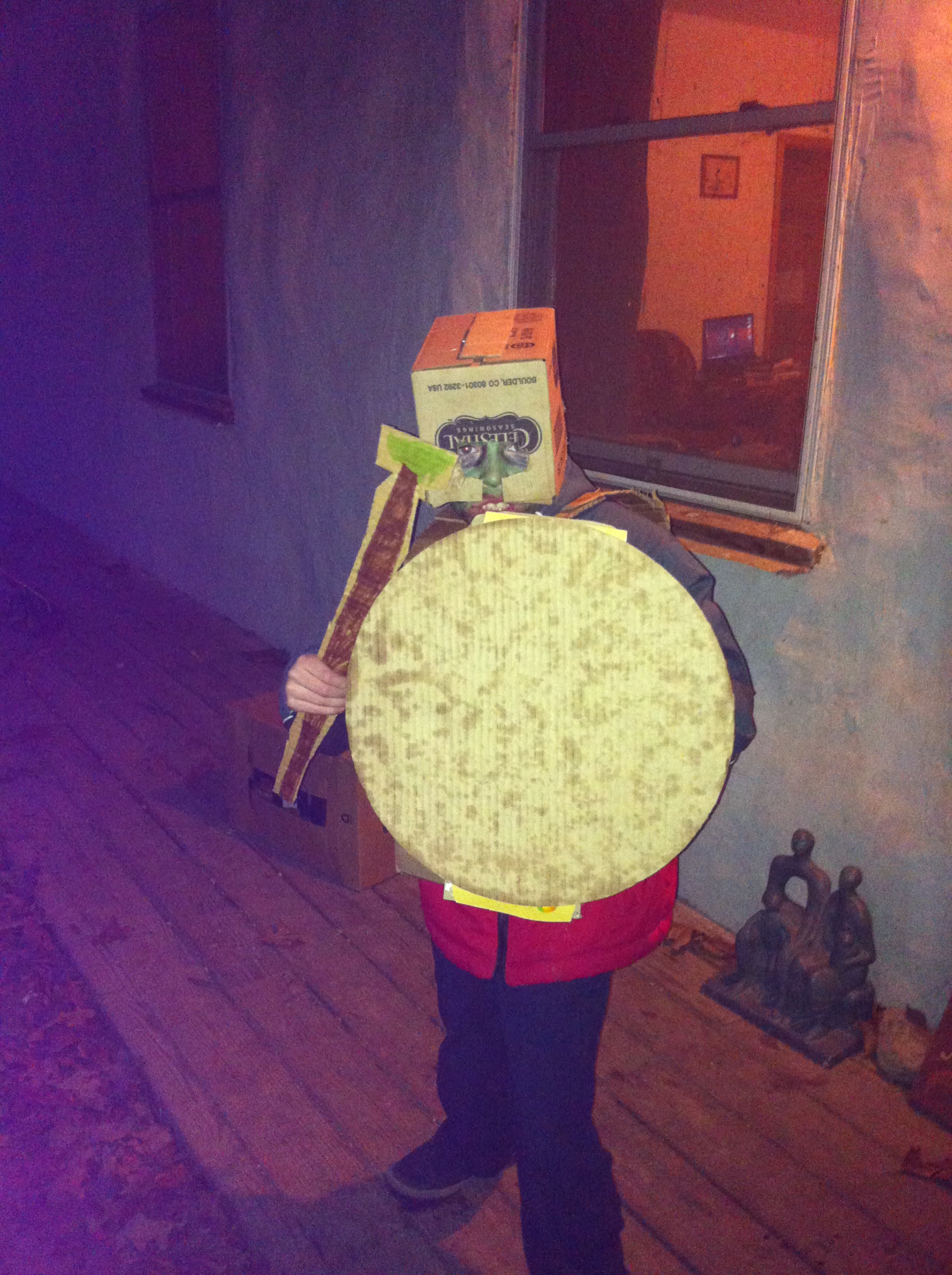
Future plans involve moving on from cardboard armor, to real movie stuff…
In the car on the way home from a different class, Lann was planning his birthday party (Sept). He wants to learn how to make silicone movie masks. He said: “I’ll do the sculpting and art part, you do the reading and talking about it part, Dad can do the sitting around with his mouth open part, Zander can do the running around and squealing part, and Alaina can do the napping.” I said: “does Dad really only sit around with his mouth open?!” And Lann said, “Mom, in AWE!” He also said they’re going to go to the Drury Inn and dress up in Lord the Rings costumes, “and, we’ll have to hang up a sign that says Nerdfest.”
That same week we were briefly discussing the massive scale of the universe and the fact that the Earth is hanging around out there in space, spinning, and Lann said, “sometimes my brain hurts when thinking about a selection of topics.” 😉 And, that reminded me of a long ago Lann story when he was about four. We were doing the whole, “I love you as big as the sky” type of thing, and I said, “I love you as much as the universe–and guess what, the universe has no end, it keeps getting bigger, and goes on forever!” And Lann said, “oh mom, that’s so beautiful I don’t know what to say.”
The week before, Lann hitched a ride to taekwondo with Baba and since I was on break from class, I was home with Zander and Alaina (usually they go grocery shopping with Mark while I’m in class). Zander came running in to get my iphone so he could take a movie of something and I heard him their room taking a movie and narrating to Lann as he does so, so that he can give him the movies when he gets home and catch him up on what Z’s been up to while they’re separated! Good buddies!
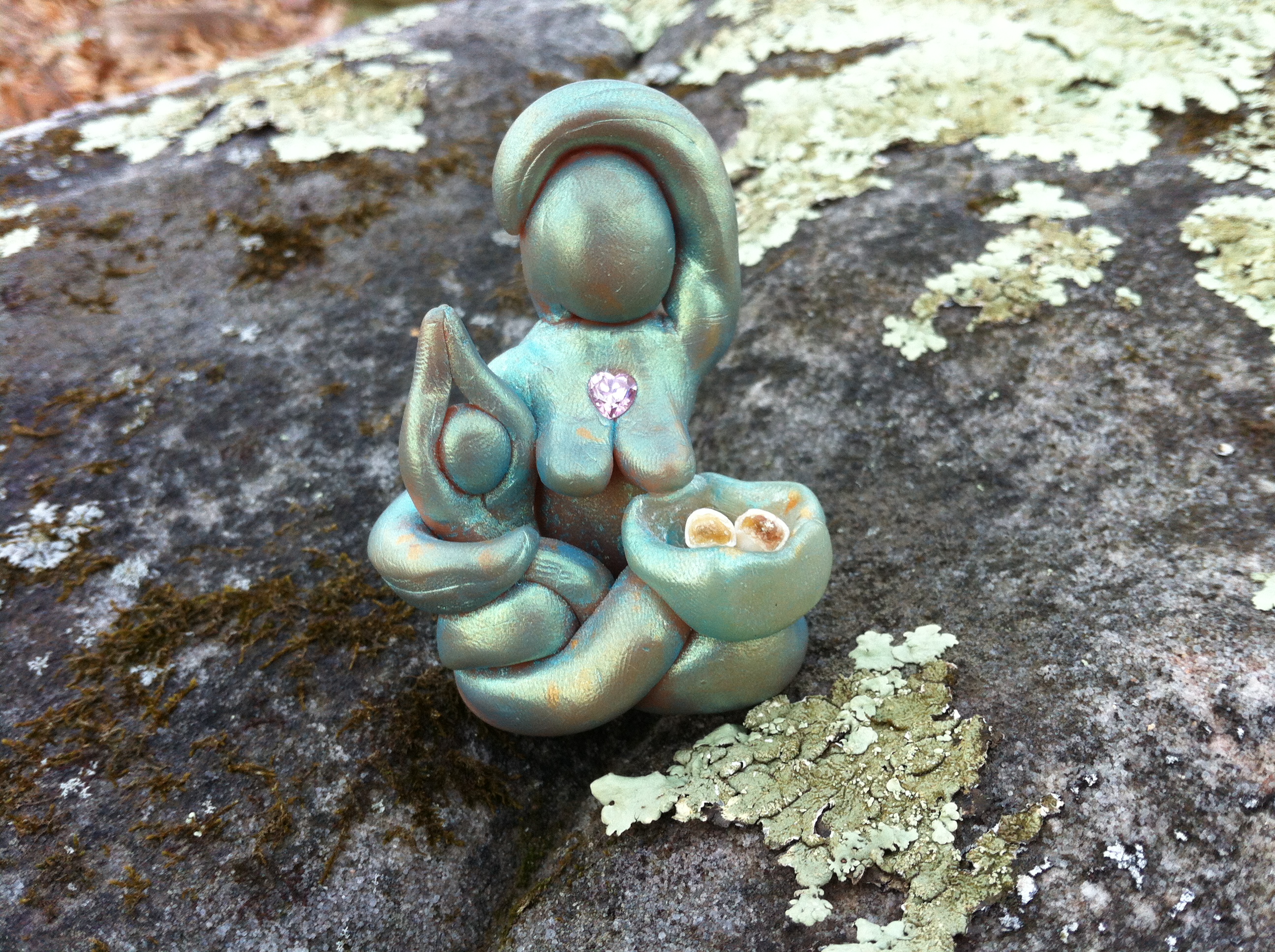
Heartbreak of tooth decay sculpture from fall of last year–mama covers head, not wanting to know and yet holding both baby and the extracted teeth. At her heart is a jewel, because she acts with deep love.
We’re dealing with ongoing dental issues with Alaina. Despite our heroic efforts, she’s ended up with the most severe problems of any of our children. Last week I took her to the local pediatric dentist. He was really nice and informative and Alaina did really great with him. However, she needs a LOT of work, more than I thought, and it is going to be really expensive. She needs the crowns she already has replaced because they were not fitted correctly by the first dentist and there is decay around/behind them, plus she needs four other crowns and also two regular fillings. :*(
We’re definitely going to have to go through the general anesthesia route. The local pediatric dentist only does this work in the hospital and we got the estimate from the surgery center for the hospital portion only and it was $8900. Our insurance will cover part of it (we’ll still have to cover about $4500), but that doesn’t matter. What matters is that that is absurd.What a broken system. Taking your kid to the hospital for two hours to get their teeth worked on just should NOT cost $9000, no matter who pays for it, that is patently ridiculous. So, I’m going ahead with the consultation I made for her in Springfield on Wednesday. I called in advance to double-check and they do their oral surgery work in an outpatient surgery center rather than in a hospital and their estimate for the clinic part is $2000, total. That is more like it and is worth the two-hour drive (one way). I wish I hadn’t bothered taking her locally, because now we just have to do the exact same thing on Wednesday and then still go back. She has to have a physical first, before she can have anesthesia, so I also made an appointment for her first-ever visit to the doctor. What I really, really wish is that I’d just taken her to Springfield in the first place, last year, when we first started to get her teeth taken care of. I am so angry with the dentist we took her to in St. Louis. I was happy with the same office for Lann (different dentist, 8 years ago), but I have HATED everything that happened there with Alaina and I wish I’d never taken her there. I feel like they actually caused the problems she has now by not acting to treat the teeth I first brought her in about and then doing an absolutely CRAPPY job on everything they did after that. I don’t actually feel like I really have energy to really be angry though, my primary feeling is sadness and anxiety about what is to come.
In a cuter Alaina story, I made myself a little sculpture to use as a pendant, but Alaina appropriated it. When I finally put it on her, she said…”dooool.” I said, “did you just say ‘cool’!?” And she said, yes!
She also “knits” and likes tiny dogs…
We get a lot of use out of the Ergo still too!
And, I guess our kids should be in a band:
Alaina sings!
Zander drums!
Lann drums too!
We went to my sister’s house a couple of weeks ago and the kids immediately took to my brother-in-law’s drums. Neither had ever drummed before and Zander really rocked it! Alaina singing was a moment I captured last week when I was printing invoices and she was sitting behind me putting on a show.
In my own news, I finally renewed my ICEA childbirth educator certification after dawdling on it for a long time, but I let my CAPPA certification lapse. It was a hard decision, but made the most sense. I’ve been moving on from birth education for quite some time, and continuing to shell out money for something I’m not using often doesn’t make a lot of sense.
My new classes begin today! After the hectic disequilibrium that comes with the final week of a school session, the following week feels a lot like coming home from being out-of-town—excited to see your familiar life, yet also slightly panicky about needing to “catch up.” Plus, there is so much to be unpacked…and then, BOOM, two weeks off is SHORT. My online class is full and my two in-seat classes have 12 students each. There was a lot of prep to do get ready for them–I always forget that these “breaks” aren’t about having a vacation, they are about preparing for next session.
I’m not sure how good I do about being the “axis,” but my wheel is a pretty fulfilling one 🙂
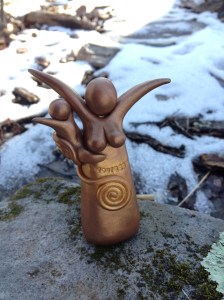 Last year I made several cesarean birth art sculptures by request. It felt like a “risk” of sorts to make them, like I was trying to interpret another woman’s experience artistically, but I did it and they were well-received. I chose to imprint words in the figure’s cesarean scar because I kept thinking about how that mother’s love and hope and courage are all permanently written on her body. Recently, I had a request to make another and so I re-visited my Cesarean Courage idea and made some new figures. She is wearing her baby and her scar with pride and strength. These sculptures are not supposed to send an “at least you have a healthy baby” message, they are communicating that her birth journey with her baby is seen and acknowledged and validated.
Sometime in the next three weeks, I will subdivide into two women — one a mother, and one a fresh newborn infant, each with our own developing story and life path. I will find that I care more deeply about some things than I ever thought possible, and other things that were important markers of my life and identity are no longer significant. I’ll celebrate and I’ll mourn…
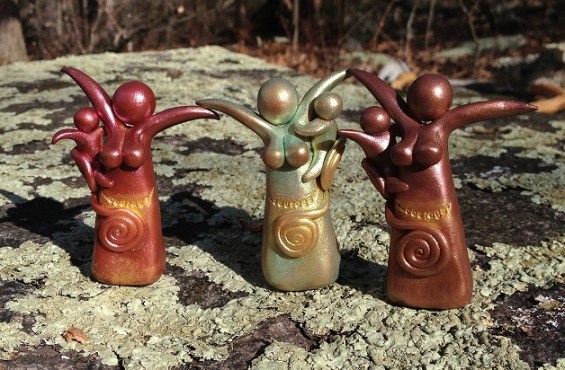 These mamas have taken powerful birth journeys. They have laid down their bodies for their babies. They hold their experiences, they wear them, their courage, love, and hope, upon their skin. The birth experience is there, loud and clear, and yet new experiences and joys are too. She is whole.
 Because books are my first and longest-lasting love, I began my blogging career with a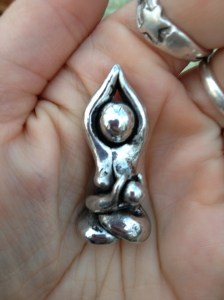














 Talk Birth