Archives

Guest Post: Abuse of pregnant women in the medical setting

This post is a companion piece to my article, Domestic Violence During Pregnancy, and was previously published as a sidebar in Citizens for Midwifery News and later in International Doula.

Abuse of pregnant women in the medical setting

 By Susan Hodges, founder and past President of Citizens for Midwifery

Have you or someone you know experienced rude, abusive or violent treatment at the hands of obstetricians or other hospital staff? Abusive behavior, in or out of the hospital, can include threats, coercion, yelling, belittling, lying, omission of information, lack of informed consent, misrepresentation (of medical situation, of interventions, of reasons they “need” you to do something or not do something), and so on. For example, nurses yelling at a woman to push is abusive, even if the nurses don’t intend to be abusive. An OB lying to a woman that her baby is “too big” (something that neither he/she nor anyone else can predict), telling her she “needs” intervention, and then not providing complete information about the risks and benefits of the intervention, is abusive behavior. Unwanted and unnecessary surgery (such as episiotomy or an avoidable cesarean section) is no less violence against a woman than hitting or strangling – most of us have just not thought about it in that way. The fact that most women are persuaded that they “needed” the intervention, that it was because their body was somehow defective, is another aspect of the abuse (blaming the victim).

While the situation is different from domestic violence in some ways, it is also similar. Abuse in the medical setting is also about power and control, the pregnant or laboring woman is often blamed for her situation, and verbal and emotional abuse can be similar. Because we are taught to “trust your doctor”, and in fact there is an explicit assumption of trust in the “fiduciary relationship” between the woman and her doctor who is an “expert”, most of us do not think about the possibility of abuse, and many of us stay with the OB or feel we have no choice about our health care providers or settings, especially when we are in labor. Also, the doctors and staff generally are not even aware that their behavior or actions are abusive.

Forty years ago, domestic violence happened, but was hidden and accepted. A lot of women had to do a great deal of work to come up with the language and the legal strategies, and to educate women, law enforcement, judges, mental health workers, and many others to get us to the point where we are today, where at least the problem has a name and at least some of the time women can fight back with the law on their side.

It is extremely difficult to deal with an abusive OB (and it might be hidden abuse, manipulation, etc.) in the middle of labor, just as is very difficult to effectively deal with an abusive spouse in the middle of the abuse. The childbirth community is only just now beginning to recognize that women are being abused in many ways in the present system of maternity care.  We don’t really have special words for it yet. We do have some legal underpinnings to fight at least some of it, but we are in the very early stages. It will take recognition of the problem on a larger scale and by women who are not being abused by OBs to bring this issue to public attention, create language for it, and use legal tools to end it. We have a lot of work to do.

Have you experienced abuse? At the least you can file a complaint. See “Unhappy With Your Maternity Care? File a Complaint!” at http://cfmidwifery.org/Resources/item.aspx?ID=1

Related post: Birth Violence

New Birth Skills Workshop!

Active Birth and Labor Support

Saturday November 17, 6-9:00

Location: Tara Day Spa in Rolla, Missouri

Cost: $35 for the pregnant woman + one support person (husband, partner, relative, friend…)

Workshop description: First, practice active birth techniques and learn about working with pelvic mobility. Next, spend some time learning labor tips and tricks and practicing comfort measures with doulas! Then, enjoy a friendly Q & A session all about what you most want to know. You will have access to three birth professionals for the price of one! We will close with some relaxation skills practice and a guided visualization.

Interested? Please email me and I’ll send you the registration form!

Can I really expect to have a great birth? (updated edition)

Given my limited situation, can I really expect to have a great birth today?” For the woman who asked me this question a homebirth, a birth center, a midwife, and a doula were all not remotely feasible options. My answer to her question is a qualified “yes!” and it really got me thinking about ways to help yourself have a great birth when your overall choices are limited. In fact, there is a long list of ideas of things that may help contribute to a great birth!

  • Choose your doctor carefully—don’t wait for “the next birth” to find a compatible caregiver. Don’t dismiss uneasiness with your present care provider. As Pam England says, “ask questions before your chile is roasted.” A key point is to pick a provider whose words and actions match (i.e. You ask, “how often do you do episiotomies?” The response, “only when necessary”—if “necessary” actually means 90% of the time, it is time to find a different doctor!). Also, if you don’t want surgery, don’t go to a surgeon (that perhaps means finding a family physician who attends births, rather than an OB, or, an OB with a low cesarean rate).
  • If there are multiple hospitals in your area, choose the one with the lowest cesarean rate (not the one with the nicest wallpaper or nicest postpartum meal). Hospitals—even those in the same town—vary widely on their policies and the things they “allow” (i.e. amount of separation of mother and baby following birth, guidelines on eating during labor, etc.) Try checking with Cesareanrates.com for local information!
  • When you get the hospital, ask to have a nurse who likes natural birth couples. My experience is that there are some nurses like this in every hospital—she’ll want you for a patient and you’ll want her, ask who she is! If possible, ask your doctor, hospital staff, or office staff who the nurses are who like natural birth—then you’ll have names to ask for in advance.
  • Put a sign at eye level on the outside of your door that reads, “I would like a natural birth. Please do not offer pain medications.” (It is much easier to get on with your birth if you don’t have someone popping in to ask when you’re “ready for your epidural!” every 20 minutes.)
  • You might want to check out either or both of these two books: Homebirth in the Hospital and/or Natural Hospital Birth
  • Work on clear and assertive communication with your doctor and reinforce your preferences often—don’t just mention something once and assume s/he will remember. If you create a birth plan, have the doctor sign it and put it in your chart (then it is more like “doctor’s orders” than “wishes”). Do be aware that needing to do this indicates a certain lack of trust that may mean you are birthing in the wrong setting for you! Birth is not a time in a woman’s life when she should have to fight for anything! You deserve quality care that is based on your unique needs, your unique birthing, and your unique baby! Do not let a birth plan be a substitute for good communication.
  • Two resources I particularly enjoy that shake up the notion of a birth plan are, 1. the birth as a labyrinth metaphor from Birthing from Within and 2. this article about how does one really PLAN for birth.
  • When making a birth plan, use the Six Healthy Birth Practices as a good, solid foundation.
  • Cultivate a climate of confidence in your life.
  • Once in labor, stay home for a long time. Do not go to the hospital too early—the more labor you work through at home, the less interference you are likely to run into. When I say “a long time,” I mean that you’ve been having contractions for several hours, that they require your full attention, that you are no longer talking and laughing in between them, that you are using “coping measures” to work with them (like rocking, or swaying, or moaning, or humming), and that you feel like “it’s time” to go in. If you’re worried about knowing when you’re really in labor, check out this post: how do I know if I’m really in labor?
  • Ask for the blanket consent forms in advance and modify/initial them as needed—this way you are truly giving “informed consent,” not hurriedly signing anything and everything that is put in front of you because you are focused on birthing instead of signing.
  • Have your partner read a book like The Birth Partner, or Fathers at Birth, and practice the things in the book together. I frequently remind couples in my classes that “coping skills work best when they are integrated into your daily lives, not ‘dusted off’ for use during labor.”
  • Practice prenatal yoga—I love the Lamaze “Yoga for Your Pregnancy” DVD—specifically the short, 5-minute, “Birthing Room Yoga” segment. I teach it to all of my birth class participants.
  • Use the hospital bed as a tool, not as a place to lie down (see my How to Use a Hospital Bed without Lying Down handout)
  • If you feel like you “need a break” in the hospital, retreat to the bathroom. People tend to leave us alone in the bathroom and if you feel like you need some time to focus and regroup, you may find it there. Also, we know how to relax our muscles when sitting on the toilet, so spending some time there can actually help baby descend.
  • Use the “broken record” technique—if asked to lie down for monitoring, say “I prefer to remain sitting” and continue to reinforce that preference without elaborating or “arguing.”
  • During monitoring DO NOT lie down! Sit on the edge of the bed, sit on a birth ball near the bed, sit in a rocking chair or regular chair near the bed, kneel on the bed and rotate your hip during the monitoring—you can still be monitored while in an upright position (as long as you are located very close to the bed). Check out the post Active Birth in the Hospital for some additional ideas.
  • Bring a birth ball with you and use it—sit near the bed if you need to (can have an IV, be monitored, etc. while still sitting upright on the ball). Birth balls have many great uses for an active, comfortable birth!
  • Learn relaxation techniques that you can use no matter what. I have a preference for active birth and movement based coping strategies, but relaxation and breath-based strategies cannot be taken away from you no matters what happens. The book Birthing from Within has lots of great breath-awareness strategies. I also have several good relaxation handouts and practice exercises that I am happy to email to people who would like them. One of my favorites is: Centering for Birth.
  • Use affirmations to help cultivate a positive, joyful, welcoming attitude.
  • Read good books and cultivate confidence and trust in your body, your baby, your inherent birth wisdom.
  • Take a good independent birth class (not a hospital based class).
  • Before birth, research and ask questions when things are suggested to you (an example, having an NST [non-stress test] or gestational diabetes testing). A good place to review the evidence behind common forms of care during pregnancy, labor, and birth is at Childbirth Connection, where they have the full text of the book A Guide to Effective Care in Pregnancy and Childbirth available for free download (this contains a summary of all the research behind common forms of care during pregnancy, labor, and birth and whether the evidence supports or does not support those forms of care).
  • When any type of routine intervention is suggested (or assumed) during pregnancy or labor, remember to use your “BRAIN”—ask about the Benefits, the Risks, the Alternatives, check in with your Intuition, what would happen if you did Nothing/or Now Decide.
  • Along those same lines, if an intervention is aggressively promoted while in the birth room, but it is not an emergency (let’s say a “long labor” and augmentation with Pitocin is suggested, you and baby are fine and you feel okay with labor proceeding as it is, knowing that use of Pitocin raises your chances of having further interventions, more painful contractions, or a cesarean), you can ask “Can you guarantee that this will not harm my baby? Can I have in writing that this intervention will not hurt my baby? Please show me the evidence behind this recommendation.
  • If all your friends have to share is horror stories about how terrible birth was, don’t do what they did.
  • Look at ways in which you might be sabotaging yourself—ask yourself hard and honest questions (i.e. if you greatest fear is having a cesarean, why are you going to a doctor with a 50% cesarean rate? “Can’t switch doctors, etc.” are often excuses or easy ways out if you start to dig below the surface of your own beliefs. A great book to help you explore these kinds of beliefs and questions is Mother’s Intention: How Belief Shapes Birth by Kim Wildner. You might not always want to hear the answers, but it is a good idea to ask yourself difficult questions!
  • Believe you can do it and believe that you and your baby both deserve a beautiful, empowering, positive birth!

I realize that some of these strategies may seem unnecessarily defensive and even possibly antagonistic—I wanted to offer a “buffet” of possibilities. Take what works for you and leave the rest!

I posted on my Facebook page asking for additional thoughts and suggestions and I appreciated this one from doula and educator, Rebecca:

“I think I’d tell people to stop closing doors on themselves you know? Stop making assumptions about what is possible and be open to creating new possibilities – maybe not perfect and exact but inviting in opportunity. No money doesn’t mean no doula in most cases.”

She’s right! A lot of doulas-in-training will offer free birth services, many doulas and midwives do barter arrangements or other trades, and many non-traditional birth professionals also have sliding scale rates.

Great births are definitely possible, in any setting, and there are lots of things you can do to help make a great birth a reality!

This post was revised (from this one) to participate in… And the Empowered Birth Awareness Blog Carnival!

Building Birth Bridges: Communication

This post is part 5 of my CAPPA re-cap series.

The final day of the CAPPA conference I heard Polly Perez speak about Building Bridges with an emphasis on communication and fear. She described four basic communication and emphasized that communication is a two-way street.

The four styles are:

  • Expressive
  • Sympathetic
  • Direct
  • Systematic

Each style has its strengths and also ways in which it is perceived by others. You should give information in the simplest way to the person you are talking to and adjust your style of communication depending on who you’re talking to, changing communication behavior in order to improve communication. Communication is the lifeblood of all relationships.

She shared this quote:

Luke: I don’t believe it. Yoda: that is why you fail.

And she explained that listening is active, not a passive activity. Listen with empathy, openness, and awareness:“Use language that lets you share your heart openly.”

She also asserted that we must stop letting our practices be fear-based, quoting Connie Pike in saying, “We must give people the opportunity to challenge their fears. Not only will this change each person, it will change the political and medical climate in which they make these choices.”

In communicating within in the medical system, Polly pointed out that a fundamental issue is with the power hierarchy and that we must develop strategies that enhance problem solving, but still retain and support the person in power. (**I’m a little too radical, I guess, for this tip, which is perhaps why I’ve not found a niche working within a medical system and instead work outside of it.) She suggested asking yourself: What does this person you are talking to fear? She also quoted Bethany Hayes “Working in Circle” who said with regard to working in hospital climates, “we found a system that was as sick as the people it was treating.” Changing sick systems is not about subterfuge but bringing light to situations that need to be altered.

Polly then made an observation that I found very powerful and very telling:

We have taken the hearts and minds out of much of our work because we’re frightened of getting too close. But, close is where we need to be.

Yes.

During a different session, but closely related to this topic of communication, I laughed out loud watching this video clip of twin babies communicating with each other. I’m going to use this in future classes.

Book Review: Birthwork

Birthwork
By Jenny Blyth
Reprinted 2007
Softcover, 460 pages
ISBN: 0-9757610-0
www.birthwork.com
Reviewed by Molly Remer, MSW, ICCE, Talk Birth

From Australia, comes a gorgeous and unique book called Birthwork. It is such an amazing and compelling read that it took me a very long time to write my review—it is difficult to describe such a remarkable book. I have never read another book like this. It is truly extraordinary. Subtitled “a compassionate guide to being with birth,” Birthwork was written for all birthworkers–anyone who works directly with birthing women (midwives, doulas, nurses, childbirth educators, physicians…).

This book covers issues of a range and depth I’ve never before seen in a birth text. Subsections include titles like: touching vaginas, respect and relationship, dipping in and out of the birth milieu, group dynamics, conflict, birth culture, loving presence, birth is sacred, trauma release, letting down in the pelvis, and stresses and stretches of childbearing. This is just a sampling of the amazing, comprehensive range of topics explored in Birthwork. I particularly enjoyed sections on directed breathing and “dynamic anatomy in labour.” The book delves into a lot of the emotional and psychological elements of being in a caregiving field and also covers physical components as well.

The book includes lots of questions to ask yourself to increase self-awareness, understanding, and personal development and also exercises to try/explore. Some of the questions are difficult to answer and require you to take a deep look at your motives and ideas about doing birthwork.

The photographs are stunning and there is gorgeous cover art (front, back, and inside). Birthwork has a spiritual component that runs throughout—sort of an Eastern philosophy—that might not appeal to all readers.

The book includes sources and a glossary of fields of care, but no index and no resources sections. It is an expensive book, but so very worth it!

Birthwork is deep and intense. I usually read very quickly and this book took me several weeks to finish because it needs time and space to soak in and be absorbed. Truly a phenomenal read!


Disclosure: I received a complimentary copy of this book for review purposes.

This review was previously published at Citizens for Midwifery.

CAPPA Re-Cap

Yesterday I got home from Kansas City where I’d been attending the annual free birth conference hosted by CAPPA. While there I concluded that Desirre Andrews is officially a superhuman live-tweeter. You can catch up with all of her rapid-fire tweets about the conference at CAPPA’s Twitter account.

I also tried my hand at posting a few things that particularly grabbed my attention to my Talk Birth and Citizens for Midwifery Facebook pages which automatically feed into Twitter. I’m not very good at catching short snippets for live-tweets, but some thoughts that I grabbed to highlight are as follows. If they don’t have quotation marks, they aren’t necessarily direct quotes, just “essence” summaries as I tried to take notes and pay attention!

First I attended Laurel Wilson’s talk about Bridging the Nutrition Gap and next, I listened to Tracy Wilson-Peters speak passionately about the “accidental parent.”

Essence tweets from Laurel and Tracy’s talks:

Babies don’t need to be in nurseries–they need to be with their mothers. This MATTERS!

Science can do a lot, can do wonderful things. Mother’s body can do even more…

Prenatal diets high in hydrogenated oils predispose mamas to postpartum moods disorders.

And, then I attended a breakout session from Darla Burns about postpartum rituals and snagged this interesting tidbit:

In Holland, all pregnant women are required to buy a homebirth kit, “just in case.”

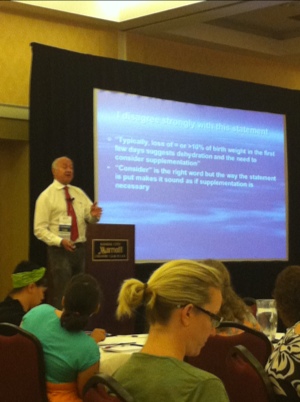
The second day, I found myself entranced by the most awesome Dr. Jack Newman. His presentations were the highlight of the conference for me. I loved him! I attended two–his general session on Controversies in Breastfeeding and then his breakout sessions, Impact of Birth Practice on Breastfeeding:

20120724-174258.jpg

If you ever get a chance to see this man, don’t miss it!

We have a big, big problem in that HCPs do not recognize the critical importance of breastfeeding.

There are many people who don’t know squat about breastfeeding and breastmilk and don’t feel like they need to learn anything before they start doing studies and writing papers about it. –Dr. Jack Newman

There is no such thing as “standard” breastmilk. It is a physiological fluid and varies from person to person. We DO NOT have to prove that breastfeeding is better than formula. Those comparison studies are unnecessary.

The burden of proof rests upon those who promote an intervention! –Dr. Newman

With animal births: following a normal birth, infant feeding just…happens. Following an interventionist birth, the mother rejects the baby and there is no nursing at all.

Our hospital births break every rule in the mammalian list of mother-baby necessities.” –Dr. Newman

Lying down for electronic fetal monitoring is a position of comfort for the care provider, NOT for the mother.

Know how much an incubator costs now? $50,000. Why don’t we just give half of that money to the mother and put the baby skin to skin on mother’s chest? –Dr. Newman

Seriously, Dr. Newman’s talks were amazing. Be prepared to hear more about them soon!

The final day I heard Polly Perez speak about Building Bridges with an emphasis on communication and fear:

Luke: I don’t believe it. Yoda: that is why you fail.

“Use language that lets you share your heart openly.” –Polly Perez

Listening is *active*, not a passive activity. Listen with empathy, openness, and awareness.

We have taken the hearts and minds out of much of our work because we’re frightened of getting too close. But, close is where we need to be.

“We must give people the opportunity to challenge their fears. Not only will this change each person, it will change the political and medical climate in which they make these choices.” –Connie Pike, via Polly Perez

Polly shared the first home birth she attended – made her fear of it “melt away like butter in a pan.”

You do not have to be an OB to be knowledgeable about birth. –doctor working with Polly Perez

Follow up from same doc: “if you tell me a baby is going to come out, I’m a gonna believe you!”

Changing sick systems is not about subterfuge but bringing light to situations that need to be altered.

Since micro-blogging is simply not my gift and is unlikely ever to become so, I am also planning longer posts based on several of the conference sessions. They will be (links will be updated as the posts become live):

At the CAPPA conference I also made a large custom order of great gifts from Joy Belle jewelry.

And, I ate tons of sample honey sticks from Glorybee–yummy! (see prior post: Why Honey Sticks During Labor?)

Other treats involved getting to spend some quality visiting time with a Friends of Missouri Midwives friend from St. Louis. We spent a lot of time talking over the FoMM newsletter (of which I am editor) and I feel very enthused about our ideas for its future.

I also got to meet a Facebook friend who started out originally two years ago as a Talk Birth fan on FB (after finding my site via my all-time most viewed post: In-Utero Practice Breathing). We spent some good time together visiting and laughing and it was fun to make the friendship connection with someone who was previously only an internet friend!

Doulas at Homebirths?

What is a doula?

A doula provides non-medical labor support—all the good stuff like back rubs and encouraging words and suggestions for different positions to help with labor. She does not replace the father’s role, but “holds the space” for both mother and father as they take their own journeys/come into their new roles as parents. In my birth classes, I explain that I think one of the benefits of a doula is that it frees the dad up to JUST be the dad and to live his own experience/journey and not have the pressure of trying to remember all the birth “tricks” and book information.

But, why have a doula at a homebirth?

A lot of women planning homebirths do not feel as much of a need for a doula as do women in the hospital. The midwife is capable of providing many of the same functions as a doula, but she also has the monitoring tasks and baby tasks to take care of, while a doula is just there for YOU. Other things to consider when thinking about a doula for a homebirth are whether or not the midwife will be bringing an assistant and what her role will be if there is one–sometimes the assistant is available to fulfill some aspects of the doula role, other times she is observing or otherwise in training for other tasks. And, also consider how many people who want present at the birth–if you’re already having a midwife, an assistant, and say a mother or sister or friend there, adding a doula too may mean too much crowding.

A couple of months ago, I solicited feedback about doulas and homebirth for an article I was compiling for the Friends of Missouri Midwives newsletter. The full article is available here: Doulas and Homebirth. I had anticipated receiving a number of responses suggesting that doulas at homebirth are unnecessary, or redundant. After all, an emotional connection and secure trust is often the hallmark of what differentiates the midwifery model from the medical model. However, the responses I received were overwhelmingly in favor of hiring a doula for a homebirth. Personally, I very much valued the specific and customized postpartum care my doula provided to me after my last homebirth and I’ve concluded that a doula has the potential to offer something unique and precious to families, in whatever setting the birth takes place. I also think that the doula is the most likely member of the birth team to remain in contact with the family in the future. Perhaps it is because, even given the friendliness of the midwifery model, there is less of a “power differential” between mother and doula.

Personal experiences

The decision to hire a doula is a personal one, regardless of in which setting you give birth. My first baby was born at a birth center with the presence of a midwife, a doctor, my doula, a friend, my mother, and my husband. In hindsight, I felt like it had been too many people and that the doula hadn’t really been needed. For my second birth, at home, it was extremely important to me to have as few people present as possible. My husband, my mom, and my son greeted the arrival of my second son. My midwife arrived five minutes before his birth—just in time to catch! My midwife for his birth was so amazing, that I didn’t feel the need for any other professional care. I still miss her! My third baby was a second trimester miscarriage and he was born at home unassisted and just my husband present. Later, a friend who is a doula was very, very helpful to me with postpartum care/doula stuff. I really wished I had a doula there during his birth for emotional support and supportive physical care tasks (not medical support, but tea bringing and towel washing).

It is the little things that matter--here my doula puts warm socks on me following my baby's January birth (baby and I had special matching birth socks knitted by my mom)

And, finally, with my last baby, while I liked and respected my midwife I didn’t have the same warm bond with her and really wanted to hire a doula again, precisely because I was missing some of the emotional component I value so highly in midwifery care. It is really the little things that make doula care so special (see included photo!). When planning my last birth, I chose to hire the same doula as with my third birth, with the primary purpose being immediate postpartum help (“washing the bloody towels and bringing me tea” is how I define it).

Talk Birth in Labor…

And, speaking of my doula, I’ve been meaning to share this photo for a long time. When my doula had her own baby last April, amongst the wonderful photos that our mutual friend took at the birth, I was tickled to see this picture of my doula looking at my website while in labor:
I think this could be an advertisement for my blog 😉

You can read Summer’s intense birth story here and also be moved to tears by the stunning birth awesomeness of her video slideshow here:

Small Stone Birth Activism

As someone who feels deeply, passionately, and intensely about the need to transform the birth culture in the US, I have often experienced an immobilizing feeling of not doing enough. Of not helping enough. Of not being enough to affect the kind of social change I want to see happen in the world. As a mother of small children, I often feel limited with regard to the kind of large-scale changes I’d like to make in the birth world. I have been a childbirth educator since 2005 and I’m also trained as a birth doula, a postpartum doula, a prenatal fitness education, a prenatal yoga teacher, a birth art facilitator, and a breastfeeding educator. I’ve accepted that birth doula work doesn’t fit into my life right now (and even without young children, I do not know that I actually possess the strength to lend witness to the hospital birth machine). I’ve happily taught independent birth classes, usually privately in homes one-on-one, for quite a few years which feels like smaller scale change than I envision. It is also becoming less easy to integrate into the rest of my life’s responsibilities. Rather than relying only on teaching independent classes as my primary outlet for change, I enjoy discovering alternate ways of educating others about birth.

While reading the book The Mother Trip by Ariel Gore, I came across this quote from civil rights activist Alice Walker: “It has become a common feeling, I believe, as we have watched our heroes failing over the years, that our own small stone of activism, which might not seem to measure up to the rugged boulders of heroism we have so admired, is a paltry offering toward the building of an edifice of hope. Many who believe this choose to withhold their offerings out of shame. This is the tragedy of our world.” Ariel adds her own thoughts to this: “Remember: as women, as mothers, we cannot not work. Put aside your ideas that your work should be something different or grander than it is. In each area of your life—in work, art, child-rearing, gardening, friendships, politics, love, and spirituality—do what you can do. That’s enough. Your small stone is enough.”

These quotes caused me to reflect on the myriad methods of “small stone” birth activism that can be engaged in as a passionate birth activist mother embroiled in a season of her life in which the needs of her own young family take precedence over “changing the world.” We can offer the small stones of:

  • Speaking positively about normal, natural birth, to whomever we are speaking with whenever the topic arises.
  • Birth advocacy bumper stickers.
  • Sharing our birth stories.
  • Creating little informational cards (inspired by Carla Hartley’s Trust Birth Initiative cards) to seed around our communities in creative locations. I am fond of using Vistaprint and ordering their horizontal premium cards for just the cost of shipping.
  • Creating bookmarks with inspiring information about birth and giving them to pregnant women, handing them out at health fairs, etc.
  • Buying subscriptions to enlightening magazines for doctors’ offices.
  • Buying gift subscriptions to enlightening magazines for our public libraries.
  • Talking to pregnant women—my most recent approach is simply to say, “I wish you a wonderful birth!”
  • Responding to “action alerts” from the organizations in our states promoting healthy, normal birth and midwifery.
  • Supporting healthy birth related organizations with your membership. I am a member of 11 birth-related organizations. I also maintain subscriptions to a variety of magazines and journals.
  • Volunteering—either for advocacy organizations or directly with pregnant women.
  • Showing up at events, fundraisers, and rallies. Maybe we are not able to plan these events by ourselves at this point in our lives (or maybe we can!), but we can certainly show up and be counted!
  • Talking to non-pregnant women and girls about birth.
  • Giving empowering books to pregnant friends (or to not pregnant friends!).
  • Buying memberships to supportive organizations for friends and family members.
  • Give back issues of inspiring, positive magazines to people as part of your baby shower gifts.
  • Making donations as you are able to local chapters, statewide organizations, or national organizations promoting birth, breastfeeding, doulas, midwives, etc.
  • Making your birth stories available online.
  • Blogging about birth and about issues in the birth world (in addition to writing my Talk Birth blog since 2007, I’ve also blogged for ICEA and maintained the CfM blog).
  • Being an online childbirth educator—visit message boards (especially “mainstream” message boards) and give accurate, evidence based information. This has the potential to reach many people, but also can be very time-consuming (and addictive in a way) and can replace the face- to-face good you could do, so be careful with this one.
  • Participating in online research (such as the Birth Survey transparency in maternity care project).
  • Writing letters to the editor of your local newspaper educating the public about birth options and midwifery care.

Despite my persistent feelings of wishing to do more, when I examine each of my offerings, I begin to acknowledge that maybe my own small stones of effort are enough after all…

What stones do you add to the pile?

—-

Molly Remer, MSW, ICCE, CCCE is a certified birth educator, writer, and activist who lives with her husband and children in central Missouri. She is the editor of the Friends of Missouri Midwives newsletter, a breastfeeding counselor, a professor of human services, and doctoral student in women’s spirituality. She blogs about birth, motherhood, and women’s issues at http://talkbirth.me.posts.

The first version of this article was published in Citizens for Midwifery News, March 2008. Revised version published in the Fall 2009 edition of the International Journal of Childbirth Education (ICEA’s publication).

Guest Post: More Business of Being Born Mini-Review

In conjunction with the More Business of Being Born giveaway I’m currently hosting, I’m also pleased to share this mini-review of the first installment (Down on the Farm) guest posted by my friend and colleague, doula Summer:

More Business of Being Born

Down on the Farm: Conversations with Legendary Midwife Ina May

Reviewed by Summer Thorp-Lancaster

http://peacefulbeginnings.wordpress.com
http://summerdoula.wordpress.com

The first installation of More Business of Being Born, Down on the Farm: Conversations with Legendary Midwife Ina May, is infused with loving scenes of midwifery care, loads of vital information and even a few jokes (such as a gift referencing Ina May’s infamous “sphincter law”).  We are given an up close view of the well-known Farm in Tennessee, whose Midwives boast an exemplary track record of Midwife attended, out-of-hospital births. This record includes a less than 2% cesarean section rate in over 2500 births. Throughout the interviews, Ina May’s (and the other Midwives featured) reverence and respect for the Midwifery Model of Care is ever-present. Her passion for the safety and overall well-being of the motherbaby is palpable and stirring.

It would be impossible to cover the many aspects of birth, or even just Midwife attended out-of-hospital birth, in a full length film, let alone an episode, but this piece successfully touches on many topics and will (hopefully) lead to further discussion amongst viewers. As an activist, I found myself left with a renewed sense of action or purpose, a desire to do more and help more so that all mamas and babies have the opportunity to experience birth as the positive, loving and intimate experience it was meant to be as well as a deeper understanding of the crisis surrounding our medical model of birth. I would recommend this film to everyone, as the state of maternity care affects us all.

The Value of Sharing Story

“..no matter what her experience in birth was, every mother knows something other people don’t know.”—Pam England


“Stories are medicine…They have such power; they do not require that we do, be, act anything—we need only listen. The remedies for repair or reclamation of any lost psychic drive are contained in stories.” –Clarissa Pinkola Estes


Every woman who has given birth knows something about birth that other people don’t know. She has something unique and powerful to offer.

As birth professionals, we are often cautioned against sharing our personal stories. We must remember that it is her birth and her story, not ours. In doula and childbirth educator trainings, trainees are taught to keep their own stories to themselves and to present evidence-based information so that women can make their own informed choices. As a breastfeeding counselor too, I must remind myself to keep my own personal experiences out of the helping relationship. My formal education is in clinical social work and in that field as well we are indoctrinated to guard against inappropriate self-disclosure in a client-helper setting. In each environment, we are taught how to be good listeners without clouding the exchange with our own “baggage.” The messages are powerful—keep your own stories out of it. Recently, I have been wondering how this caution might impact our real-life connections with women?

Nine months after I experienced a powerful miscarriage at home at 15 weeks, a good friend found out at 13 weeks that her baby died. As I had, she decided to let nature take its course and to let her body let go of the pregnancy on its own timetable, rather than a medical timetable. When she emailed me for support, it was extremely difficult to separate our experiences. I kept sharing bits and pieces of my own loss experiences and then apologizing and feeling guilty for having violated the “no stories” rule. I kept telling her, “I know this isn’t about me, but I felt this way…” I told her about choosing to take pictures of the baby and to have a ceremony for him at home. That I wished I had gotten his footprints and handprints. The kinds of personal sharing that may have been frowned upon in my varied collection of professional trainings. After several apologies of this sort, I began to reflect and remembered that what I hungered for most in the aftermath of my own miscarriage was other women’s voices and stories. Real stories. The nitty gritty, how-much-blood-is-normal and did-you-feel-like-you-were-going-to-die, type of stories. Just as many women enjoy and benefit from reading other women’s birth stories, I craved real, deep, miscarriage-birth stories. These stories told me the most about what I needed to know and more than organization websites or “coping with loss” books ever could.

I had a similar realization the following month when considering the effectiveness of childbirth classes and trying to pin down what truly had reached me as a first time mother. The question I was trying to answer as I considered my own childbirth education practice was how do women really learn about birth? What did I, personally, retain and carry with me into my own birth journey? The answer, for me, was again, story.

On this blog, I have a narrative about my experiences during my first pregnancy with being able to feel my baby practicing breathing while in-utero. More than any other post on the site, this post receives more comments on an ongoing basis from women saying, “thank you for sharing”–that the story has validated their own current experience. In this example, rather than getting what they need from books, experts, or classes, women have found what they needed from story and, indeed, most of them reference that it was the only place they were able to find the information they were seeking.

And finally, as breastfeeding counselor, during monthly support meetings, I cannot count the number of times I’ve seen mothers’ faces fill with relief when another mother validates her story with a similar one.

So, what is special about story as a medium and what can it offer to women that traditional forms of education cannot? Stories are validating. They can communicate that you are not alone, not crazy, and not weird. Stories are instructive without being directive or prescriptive. It is very easy to take what works from stories and leave the rest because stories communicate personal experiences and lessons learned, rather than expert direction, recommendations, or advice. Stories can also provide a point of identification and clarification as a way of sharing information that is open to possibility, rather than advice-giving.

Cautions in sharing stories while also listening to another’s experience include:

  • Are you so busy in your own story that you can’t see the person in front of you?
  • Does the story contain bad, inaccurate, or misleading information?
  • Is the story so long and involved that it is distracting from the other person’s point?
  • Does the story communicate that you are the only right person and that everyone else should do things exactly like you?
  • Is the story really advice or a “to do” disguised as a story?
  • Does the story redirect attention to you and away from the person in need of help/listening?
  • Does the story keep the focus in the past and not in the here and now present moment?
  • Is there a subtext of, “you should…”?

Several of these self-awareness questions are much bigger concerns during a person-to-person direct dialogue rather than in written form such as blog. In reading stories, the reader has the power to engage or disengage with the story, while in person there is a possibility of becoming stuck in an unwelcome story. Some things to keep in mind while sharing stories in person are:

  • Sensitivity to whether your story is welcome, helpful, or contributing to the other person’s process.
  • Being mindful of personal motives—are you telling a story to bolster your own self-image, as a means of pointing out others’ flaws and failings, or to secretly give advice?
  • Asking yourself whether the story is one that will move us forward (returning to the here and now question above).

While my training and professional background might suggest otherwise, my personal lived experience is that stories have had more power in my own childbearing life than most other single influences. The sharing of story in an appropriate way is, indeed, intimately intertwined with good listening and warm connection. As the authors of the book, Sacred Circles, remind us “…in listening you become an opening for that other person…Indeed, nothing comes close to an evening spent spellbound by the stories of women’s inner lives.”

Molly Remer, MSW, ICCE, CCCE is a certified birth educator, writer, and activist who lives in central Missouri with her husband and children. She is an LLL Leader, a professor of Human Services, and the editor of the Friends of Missouri Midwives newsletter. She blogs about birth, women, and motherhood at https://talkbirth.wordpress.com.

This is a preprint of The Value of Sharing Story, an article by Molly Remer, MSW, ICCE, published in Midwifery Today, Issue 99, Autumn 2011. Copyright © 2011 Midwifery Today. Midwifery Today’s website is located at: http://www.midwiferytoday.com/