Archives

Circles Writing

each time we pose pen or pencil to paper

we connect with who we are         who we were       who we want to be

we are circles of women

writing together     apart    in dialogue     alone

we write: wherever we are     when we’re overwhelmed

to clear our minds

to express our anger, to clarify our thoughts

when we’re too tired to talk, to capture that exact feeling

to release our pain, to honour our truths

we write

to connect ourselves

to this circle

these circles

of women writing

each time we pose

pen or pencil

to paper.

–Wendy Judith Cutler, 1992 (in We’Moon datebook, 2011)

This time last year, I was writing about the circle of women that gathered in my living room for my blessingway. This photo was a beautiful gift from my friend Karen.

I am so amazed and pleased and surprised and blessed by the connections that have come into my life (or that have been made stronger) due to women writing. I love how the perfect “message” springs off the page (or computer screen) at me from another woman’s life, musings, words, and experiences. It is incredible.

I’ve been working on a happy birthday post about my baby girl (who is sick and crabby right now—and, now I’m sick and crabby too, which makes it hard to find the glowing words I want to share). One of the things I wish to express is about having come full circle—we’ve made our first trip around the sun together. I feel like I’ve closed out something by having made this journey with her in my arms. In the book Sisters Singing, I read this quote this morning:

There is an open, flexible, compassionate way of relating to everything we experience, including natural disasters and sudden death. It is not so much a process of learning how to ‘get over’ a profound loss, but rather how to allow it to be there, lightly, gently, like a fine thread woven forever into the tapestry of who we are.” –Nancy J. Rigg

And, then, on FB, I spied this beautiful quote as well: “Rejoicing in ordinary things is not sentimental or trite. It actually takes guts. Each time we drop our complaints and allow everyday good fortune to inspire us, we enter the warrior’s world.”
― Pema Chödrön, The Places That Scare You: A Guide to Fearlessness in Difficult Times

2011 Blog Year in Review

The dawn of 2011 saw me preparing to meet my new baby girl. I was given a beautiful blessingway (and attended several others during the year). Then, I gave birth to her magical, tiny self on January 19. As the year passed, she got bigger and bigger and bigger:

Three Month a-Baby!
Six Months
Eightmonthababy!
Nine Months
Ten Months Old!
Elevenmonthababy!

We took lots of pictures to try to chronicle the sweet, perfect texture of our lives with her in it. I continued to make lots of birth art. I also published several of my originally-in-print articles in blog post format:

Birth Lessons from a Chicken
Nursing Johnny Depp
The Rhythm of Our Lives
The Value of Sharing Story
Listening Well Enough
Mindful Mama: Presence and Perfectionism in Parenting
Listening to my baby…even when we disagreed!
Planning for Postpartum
The Spot

I made slight revisions to the two posts that consistently get a high number of hits each week and didn’t make any changes to the post about good foods to eat during labor that continues to top my blog’s personal charts:

How do I know I’m really in labor?
In-Utero Practice Breathing
Good Foods to Eat in Labor

In addition to some of my articles-turned-posts, several new posts that I wrote in 2011 received a lot of attention, thanks to Facebook shares, and a guest post about alcohol and breastfeeding was enormously popular for the two weeks between Christmas and New Year’s Day.

I just want to grind my corn!
Affordable Fetal Model
Active Birth in the Hospital
Guest Post: Alcohol and Breastmilk

My final post of 2011 also received quite a few hits via Facebook in the last few days, but has not received any comments on the post itself (only FB!):

The Illusion of Choice

I spoke my truth in several other posts that I felt pleased with, but that did not get a lot of airtime via other sites:

What Really Scares Me: Social Attitudes Towards Women
Asking the right questions…
“You’ll Miss This…”
Surrender?
Birthing the Mother-Writer (or: Playing My Music, or: Postpartum Feelings, Part 1)
Milk, Money, & Madness
The “Almost Died…” Remark
Fatherbaby
The Ragged Self

I also started to write a little about homeschooling.

I feel like I spent a lot of 2011 in a writer’s prayer—trying to tell about it—trying to preserve in time these high, sweet, clear, delicious, beautiful notes that composed my year with my new baby.

Embodied Prayer

Sister, before you get all busy and serious about your new year resolutions,
take a moment to tune into that force which beats your heart,
which grows the leaves on the trees, which creates and tears down,
everything.
Tune into the captivating rhythm of evolution,
and dance your way into your holy calling.
The whole universe is dancing with you.

–Awakening Women Institute

This was Alaina and me in January 2011!

This year, I’d like to let go of shoulding myself. If I don’t truly have to do something, I’m only going to do it if I want to do it. If the word “should” enters the picture about anything, I’m going to use that as my cue to NOT do whatever it is I’m letting should me. Sound like a plan?

I enjoyed reading this post from Dreaming Aloud recently and the writer observes that she is only going to be able to be her for the new year: “I might even let myself mother to my own standards too! Wouldn’t that be nice, rather than failing every day because I don’t do everything the way the books say.” She also included this interesting idea about 3/4 baked: “Another influential book in my life…Zugunruhe… talks about the 3/4 baked philosophy, where the author urges us to do our work the best we can, but rather than spending all our energy in refining it ad infinitum, put it out to the world 3/4 baked and let the feedback and the inspiration it creates, and your own distance, do the final honing, because really there is no such thing as perfect.”

Embodied Prayer

My next intention for 2012 is a very personal one that I feel hesitant to write about. As soon as I read the gorgeous quote above, I knew I wanted to share something about it though. When I applied to graduate school in thealogy (not spelled wrong!) last year, I wrote in my application that I wanted my life to be a living prayer for social justice and women’s empowerment. Recently, based on my work in my graduate classes, I have been asked to write several articles for academic journals focused on women and religion. I have always felt very cautious and wary of sharing any of my ideas about spirituality or religion publicly and so this makes me nervous for a variety of reasons. However, if I’m actually going to be writing these articles, it is probably time to shed discomfort and speak my truth! I think my primary concept of living prayer is really about mindfulness. Being here and being aware. In September, the Awakening Women Institute offered via Twitter to give people “temple names”—you were asked to respond to the question about “your edge right now in your life. What is calling you, what is challenging, what is opening?” I was instantly intrigued and responded to the offer with the following: “I have multiple edges–I feel at the edge of being able to truly live my faith, having my life be a living prayer. I also constantly teeter on the edge between meeting my children’s needs and meeting my own needs–and trying to find the harmony in that; trying to find the place in which our family works in harmony to meet each member’s needs (not requiring ‘sacrifice,’ because we have a seamless integration!).” The temple name I received was: Embodied Prayer. At first I felt slightly disappointed, like, yeah, I said that already. But, as I “rested” with the name and stated it aloud—i.e. “I am Embodied Prayer”—it has become a very powerful daily practice for me. I have long sought strategies to integrate a sense of the sacred in daily life and have also known that at the root, what I’m really wanting is daily mindfulness. My “temple name” is serving as that mindfulness touchstone for me—as I go about my life, I ask myself what kind of “prayer” I’m offering in this moment. And, is this the kind of prayer I want to embody right now? (i.e. the other day I was stressed out and driving too fast and feeling annoyed with my kids and I stepped back slightly and looked at my “prayer” and realized that I wanted to embody a much different sort of offering to the divine, to the web of life, than a stressed out cranky prayer. This step back and self-reminder, immediately calmed my mood and allowed me to breathe more deeply and kindly.) That said, I also have a pretty deep-seated tendency to be extremely harsh with myself (see first New Year’s intention!) and I must also be mindful of not using this name in a self-flagellating way—i.e. what kind of prayer is THAT, you loser!—or to become angry at myself when I forget to use it, forget to be mindful.

To what/why is this prayer offered anyway?

Something that made me feel as if I belonged to our tiny little Unitarian Universalist church and like there was indeed a spiritual niche I fit into, was a hymn we sang during one of my first visits with a line of, “some call it evolution, and others call it God.” That notion that there is something widely felt by many, but called by different names and within vastly different systems of belief and understanding, is why I continue to identify as a UU. This force, this connecting “glue” that holds the universe together might be named by others “God” or “the Universe” or “Nature” or “Life Force” or “the Sacred” or “Divinity” or “the Tao”—I feel most satisfied when I personalize it as Goddess. I do also feel Her presence directly in my life—call it an energy, call it the sacred feminine, call it the divine, call it source, call it soul, call it spirit, call it the great mystery…I perceive a web of relatedness and love within the world and I choose to put a feminine form to that energy—to name it and know it as “Goddess.” When I am embodied prayer, it is mindfulness of this connection and relatedness of which I speak.

The Illusion of Choice

A choice is not a choice if it is made in the context of fear.

Informed choice is a popular phrase with birth professionals and healthy birth activists. I’ve read impassioned blog posts from doulas and birth activists claiming that if we support women’s right to homebirth, we must also support her “choice” to have an elective cesarean. But, I believe we have constructed a collaborative mythos within the birth activist community that an informed choice is possible for most women. The statistics tell us a different story. I do not believe that women with full ability to exercise their choices would choose many of the things that are typically on the “menu” for birth in mainstream culture.

What’s on the menu?

Women give their blanket “informed consent” to all manner of hospital procedures without the corollary of informed refusal–is a choice a choice when you don’t have the option of saying no?

In many hospitals, women are STILL not allowed to eat during labor despite ample evidence that this practice is harmful–is a choice a real choice if made in the context of hospital “policies” that are not evidence-based?

Women are told that their babies are “too big” and then “choose” a cesarean. Is a choice a choice when it is made in the context of coercion and deception?

Women choose hospitals and obstetricians that are covered by their insurance companies. Is a choice a real choice when it is made by your HMO?

Women choose hospital birth because they cannot find a local midwife. Is a choice a real choice when it is made in the context of restrictive laws and hostile political climates?

Women often state they are seeking “balanced” birth classes that aren’t “biased” towards natural birth (or towards hospital birth), but is a choice a choice when it is made in the context of misrepresented information? Because, as Kim Wildner notes, balance means “to make two parts equal”–what if the two parts aren’t equal? What is the value of information that appears balanced, but is not factually accurate? Pointing out inequalities and giving evidence-based information does not make an educator “biased” or judgmental–it makes her honest! (though honesty can be “heard” as judgment when it does not reflect one’s own opinions or experiences).

On a somewhat related note, recently, the subject of “quiverfull” families came up amongst my friends and comments were made about feminists needing to support those women’s “choice” to have so many children. However, I worry about women who are making reproductive “choices” in the context of what can be a very repressive religious tradition. Women’s choices about their lives are not always made with free agency. And, that is where some feminist critiques of other women’s choices come from–a critique of the larger context (patriarchy) rather than the woman herself. Is a choice a choice when it is made in the context of oppression?

Where do women get information to make their choices?

In his 2010 presentation, Birthing Ethics: What You Should Know About the Ethics of Childbirth, Raymond DeVries uses data from the Listening to Mother’s studies to help us understand where women are getting their information about birth—this is the context in which their “informed choices” are being made and this is the context we need to consider.

Our choices in birth and life are profoundly influenced by the systems in which we participate…

Some choices shaped by the system
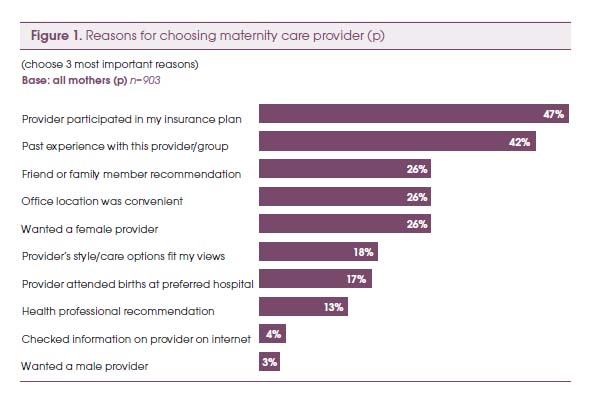

Women learn from books and experiences of others (and self):
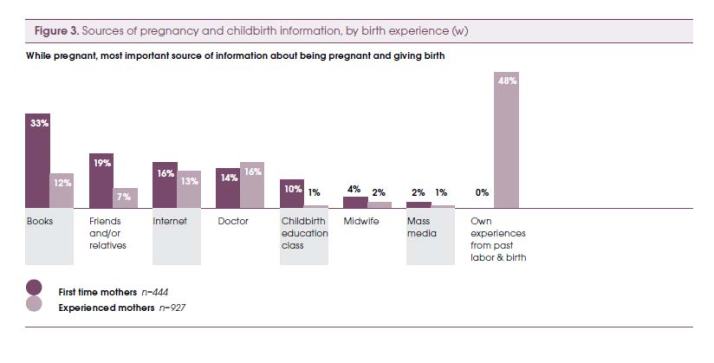
The number one book women learn from is What to Expect When You’re Expecting, which has been number four on NY Times Bestsellers list for over 500 weeks and counting.

According to De Vries, via the Listening to Mothers data, this is what women tell us about how they learn, what they learn, and upon what their choices are based:

Television explains birth
Pain is not your friend
But technology is
Mothers are listening to doctors (and nurses)
Medicalized birth allows mothers to feel capable and confident
Interfering with birth is mostly okay
Our health system works (mostly)
We like choice
We want to be “informed”

He also explains polarization: “We seek information to confirm our opinion. Contrary information does not convince, it polarizes.” How do we share information so that women can make truly informed choices without polarizing?

As advocates, I think we sometimes fall back on the phrase “informed choice” as an excuse not to be outraged, not to despair, and not to give up, because it promises that change is possible if only women change and most of us have access to change at that level.

Birthing room ethics

In another presentation, U.S. Maternity Care: Understanding the Exception That Proves the Rule, DeVries explores the ethical issues surrounding choices in birth, noting that “choice is central at all levels – but can choice do all the moral work?” We wish to respect parental choice, but information does not equal knowledge and we often err on the side of treating them as one and the same. In maternity care, often there is no choice. Tests become routine or practices become policy, and “information [is] given with no effort to understand parental values (the ritual of informed consent).”

Is choice possible while in active labor?
De Vries also raises a really critical question with no clear answers—is choice really possible during active labor? He also asks, “should a healthy pregnant woman be allowed to choose a surgical birth? But is it safe? The problem with data…Interestingly, those who think it should be allowed find it safe, and those who oppose it, find it to be unsafe.” When considering where this “choice” of surgical birth comes from, he identifies the following factors:

The desires of women
• Preserve sexual function
• Preserve ideal body
• The need to fit birth into employment
• Options offered by health care system

The desires of physicians
• Manage an unpredictable process
• The limits of obstetric education

Why should we care, anyway?

Another popular phrase is, “it’s not my birth.” I agree with the opinion of Desirre Andrews on this one:

“I do not believe in the saying ‘Not my birth.’ Women are connected together through the fabric of daily life including birth. What occurs in birth influences local culture, reshapes beliefs, weaves into how we see ourselves as wives, mothers, sisters, & women in our community. Your birth is my birth. My birth is your birth. This is why no matter my age or the age of my children it matters to me.”

Victims of circumstance?

While it may sound as if I am saying women are powerlessly buffeted about by circumstance and environment, I’m not. Theoretically, we always have the power to choose for ourselves, but by ignoring, denying, or minimizing the multiplicity of contexts in which women make “informed choices” about their births and their lives, we oversimplify the issue and turn it into a hollow catchphrase rather than a meaningful concept.

Women’s lives and their choices are deeply embedded in a complex, multifaceted, practically infinite web of social, political, cultural, socioeconomic, religious, historical, and environmental relationships.

And, I maintain that a choice is not a choice if it is made in a context of fear.

But, what do we know?

I read an interesting article by anthropologist and birth activist, Robbie Davis-Floyd, in the summer issue of Pathways Magazine. It was an excerpt from a longer article that appeared in Anthropology News, titled “Anthropology and Birth Activism: What Do We Know?” In the conclusion, Davis-Floyd states the following:

“Doctors ‘know’ they are giving women ‘the best care,’ and ‘what they really want.’ Birth activists…know that this ‘best care’ is too often a travesty of what birth can be. And yet on that existential brink, I tremble at the birth activist’s coding of women as ‘not knowing.’ So, here’s to women educating themselves on healthy, safe birth practices–to women knowing what is best for themselves and their babies, and to women rising above everything else.”

I believe that every woman who has given birth knows something about birth that other people don’t know. I also believe that women know what is right for their bodies and that mothers know what is right for their babies. I’m also pretty certain that these “knowings” are often crowded out or obliterated or rendered useless by the large sociocultural context in which women live their lives, birth their babies, and mother their young. So, how do we celebrate and honor the knowings and help women tease out and identify what they know compared to what they may believe or accept to be true while still respecting their autonomy and not denigrating them by characterizing them as “not knowing” or as needing to “be educated”? As I’ve written previously, with regard to education as a strategy for change: People often suggest “education” as a change strategy with the assumption that education is all that is needed. But, truly, do we want people to know more or do we want them to act differently? There is a LOT of information available to women about birth choices and healthy birth options. What we really want is not actually more education, we want them to act, or to choose, differently. Education in and of itself is not sufficient, it must be complemented by other methods that motivate people to act. As the textbook I use in class states, “a simple lack of information is rarely the major stumbling block.” You have to show them why it matters and the steps they can take to get there…

And, as the wise Pam England points out: “A knowledgeable childbirth teacher can inform mothers about birth, physiology, hospital policies and technology. But that kind of information doesn’t touch what a mother actually experiences IN labor, or what she needs to know as a mother (not a patient) in this rite of passage.”

The systemic context…

We MUST look at the larger system when we ask our questions and when we consider women’s choices. The fact that we even have to teach birth classes and to help women learn how to navigate the hospital system and to assert their rights to evidence-based care, indicates serious issues that go way beyond the individual. When we talk about women making informed choices or make statements like, “well, it’s her birth” or “it’s not my birth, it’s not my birth,” or wonder why she went to “that doctor” or “that hospital,” we are becoming blind to the sociocultural context in which those birth “choices” are embedded. When we teach women to ask their doctors about maintaining freedom of movement in labor or when we tell them to stay home as long as possible, we are, in a very real sense, endorsing, or at least acquiescing to these conditions in the first place. This isn’t changing the world for women, it is only softening the impact of a broken and oftentimes abusive system.

And, then I read an amazing story like this grandmother’s story of supporting her non-breastfeeding daughter-in-law and I don’t know WHAT to do in the end. Can we just trust that women will find their own right ways, define their own experiences, and access their own knowings in the context of all the impediments to free choice that I’ve already explored? What if she says, “why didn’t you TELL me?” But, if we share our information we risk polarization. If we keep silent and just offer neutral “support,” regardless of the choice made, then doesn’t it eventually become that the only voice available for her as she strives to make her own best choices is the voice of What to Expect and of hospital policy?

“Our lives are lived in story. When the stories offered us are limited, our lives are limited as well. Few have the courage, drive and imagination to invent life-narratives drastically different from those they’ve been told are possible. And unfortunately, some self-invented narratives are really just reversals of the limiting stereotype…” –Patricia Monaghan (New Book of Goddesses and Heroines, p. xii)

—-
Related posts:

What to Expect When You Go to the Hospital for a Natural Childbirth
Birth & Culture & Pregnant Feelings
Asking the right questions…
Active Birth in the Hospital
Why do I care?

References:

De Vries, Raymond. May 20, 2010. Birthing Ethics: What You Should Know About the Ethics of Childbirth, Webinar presented by Lamaze International.

De Vries, Raymond. Feb. 26-27. U.S. Maternity Care: Understanding the Exception That Proves the Rule. Coalition for Improving Maternity Services (CIMS). 2010 Mother-Friendly Childbirth Forum
Imaginary Future Children

My brother graduated from college earlier this year and recently got his ultimate dream job in a nearby state. This is the realization of a plan and vision he’s held for himself since he was a very small child. It is pretty exciting for the whole family! Anyway, a couple of weeks ago I was talking to my husband about it and we were reminiscing about when we were young and launching our lives. Thinking about my brother, I was feeling a little wistful and a little tied down, thinking about how we’re never planning to move anywhere else and so forth and musing about whether we’ve made a mistake by settling so permanently in one home and location, are we missing out on “adventure,” etc. I also said, “remember what it was like to make decisions without having to think about our kids?” After a pause, we realized that we did not remember and that was because, while our children at one point didn’t physically exist, making decisions about our lives as adults has still always included them. And, then I was struck with a wave of memories of how the choices we made as a very young couple were based on the then-hypothetical nature of our future children and what we wanted for them. When I was finishing my BA in psychology, one of the top issues on my mind was where to go to graduate school. I felt a pull towards PhD programs in psychology and I felt like that is what many people were expecting of me, but I also knew in my heart that there was no way I could manage a practice as a psychologist while also having children. I didn’t want to spend that much time in school and then feel torn being pursuing my career and taking care of my children. So, I decided to work on my MSW, theorizing that the more flexible nature of the work and the less expensive nature of the degree would be more compatible with family life. (I was 18 while making this decision.)

Then, when I was getting ready to graduate from graduate school and Mark was finishing his bachelor’s degree we had a conversation about how it was “now or never” in terms of what we were going to do—I told him that now was the time when we had the MOST freedom and flexibility with our choices and if we felt like we wanted to live in a different part of the country, etc., NOW was the time to do it, before we had a family to uproot. We talked at length and looked for jobs and apartments in a variety of different states. Finally, we concluded that we wanted our children to be raised near their grandparents and not in a different state where they would see them once or twice a year. (I was now 21 and would not actually have any children for three more years.)

No way could I keep these people apart!

We realized that many towns and places are much the same as any other and why not settle where we were certain the grandparents would remain. I also knew that I wanted to be close to my own mom so she could help me with my babies! So, we bought land one mile from where my parents live before I even got pregnant with our first baby. Post-graduate school I was offered a full-time job at an organization that I adored the year before I planned to get pregnant and I turned it down, knowing that I wouldn’t want to be working full-time while having a baby.
Any more future babies out there?

Yesterday, I was sitting in the living room playing with Alaina and waxing eloquent about her fundamental awesomeness. The boys were playing in the living room too and I said, “I think I HAVE to have one more baby so Alaina has someone to play with! She’s going to really want me to have a friend for her.” Lann said, “But mom, what if you have a…” and I said, “it won’t matter if the baby is a boy. Boys and girls can play together just fine! It is great to have two boys and it would be fun to have two girls, but the other baby doesn’t have to be a girl. Alaina will be happy to have a boy to play with too.” He started to say something again and I went on and on about why do people think children have to be segregated by gender, blah, blah and then he said, “MOM! I’m not talking about what if the baby is a BOY, I was trying to say, what if it is a MISCARRIAGE!” And, I was quiet for a moment before saying, “I know. I worry about that too.” It was a sobering moment. I’ve talked and thought at length about how I’d like to end my childbearing years on this high, happy note, rather than possibly begin a new loss journey. (I do recognize that it is bizarre to make decisions about our family’s future based on fear, rather than love.) Just as when I was a teenager and twenty-something, today I continue to make decisions based on my present-day children and my hypothetical future children, including the possibility of experiencing further pregnancy losses.

Today as I was snuggling Alaina in the morning—she was popping up and staring at me and then flopping on top of me and snuggling her head into my shoulder over and over—and I was smelling her and feeling her strong, wiggly, vibrant little form and I thought, “you healed me.” If I hadn’t had her, I know I would have carried a permanent wound and a permanent place of sadness in my soul surrounding my childbearing years. She fixed it.

Thankful for place

Returning to my notion of being “permanent, this is an excerpt from one of my essays for my Ecology and the Sacred course.

I was interested by the explanation [in our class text] about how we typically, “tell the story of our cultural lives and our interactions with other people…” While I definitely share this tendency, I do also feel deeply rooted to my natural place—the land on which I live and on which I grew up. My parents homesteaded their property in the 1970’s and I was born at home and spent my entire childhood on the same piece of land on which I was born, playing in the woods. They are very connected to their land and literally their blood, sweat, and tears have gone into their “place” in the natural world.

Eight years ago, my husband and I bought a parcel of my parents’ property and built our own home there. We live on a different road than my parents, but are still only one mile from where I was born, and our property is bordered by theirs on two sides. My husband and I have now invested a lot of time and energy into this piece of land, now our blood, and sweat, and tears are part of this piece of land and we feel permanent in this location. We do not—indeed, cannot—envision ever moving and living anywhere else. Sometimes my husband and I talk about whether this sense of permanence is binding or restrictive—i.e. what about the sense of possibility, about being able to “start over” anywhere—but we’ve concluded that rootedness has a great deal of personal value to us and we wouldn’t want to trade our roots for “wings.” While this isn’t quite the same as a natural history of place, I do feel that my own identity and social story includes an interwoven, personally important element of natural place. This part of the country is where I belong and I am invested in it…

While some people lament the “foolishness” of their youth, looking back at my own young adult years, I’m surprised at my own youthful perceptiveness and foresight about what choices would best suit the needs of my then-imaginary children and family. I’m curious to know what life choices did you make as an inexperienced young adult that have continued to serve you well?

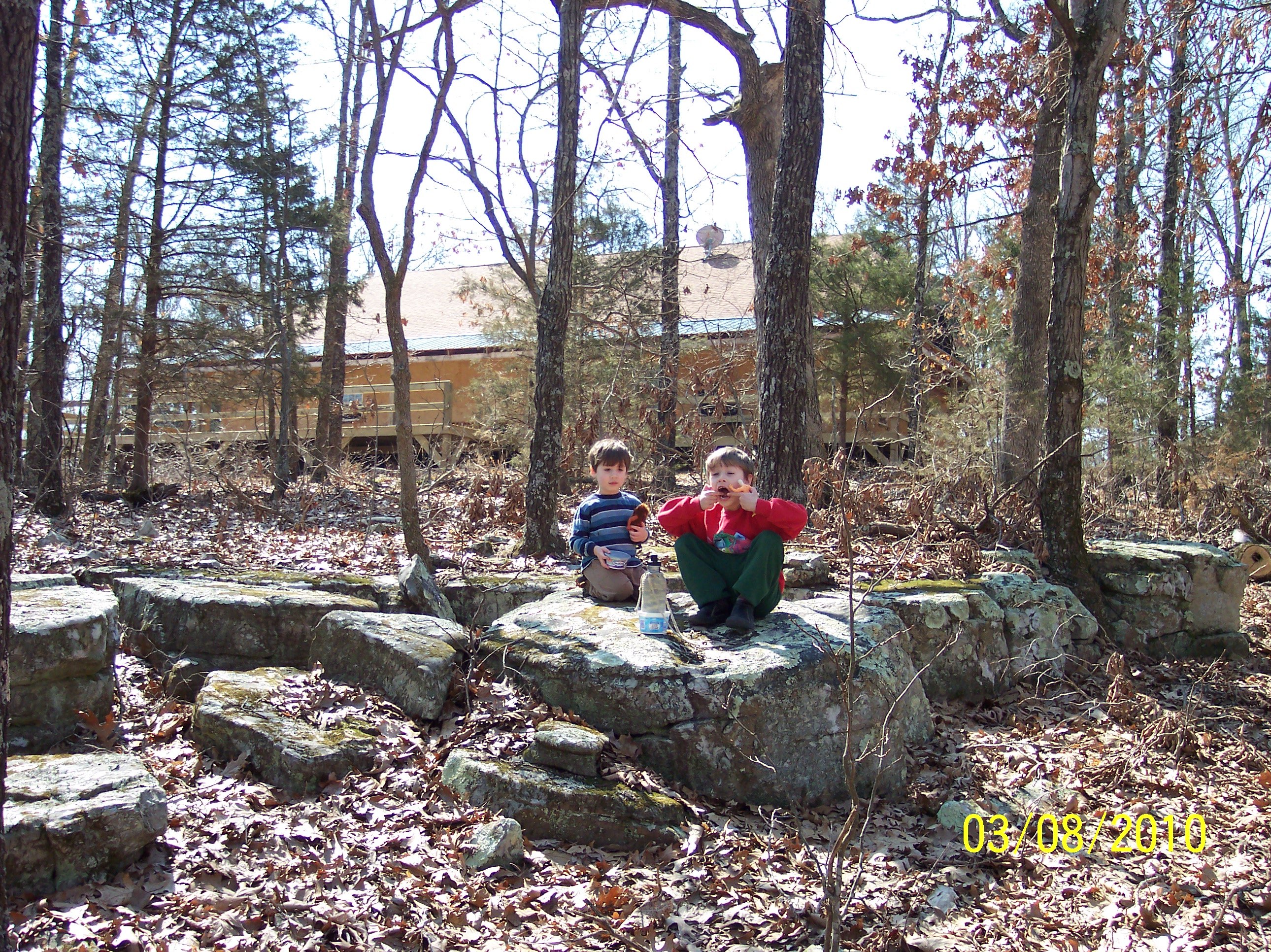
The boys playing in our place last year–not hypothetical children anymore!

Front of house

Back deck. See why I love it here?

Guest Post: Alcohol and Breastmilk

Just in time for the holiday season, a note to clarify the issue of nursing moms drinking alcohol. (c) Karen Orozco

Your milk alcohol level will be exactly the same as your blood alcohol level. So if you’ve had a couple of drinks and hit the legal limit, your milk has about the same alcohol content as fresh fruit juice or a non-alcoholic beer–.08%ish. Alcohol does not concentrate in the milk, and as your liver clears it from your blood, the milk alcohol level will also drop. There is no need to pump and dump for a healthy baby! If you are concerned about even very minimal amounts of alcohol in the baby’s system, nurse before you go out, and time your drinking so that you give your liver time to metabolize it before the baby would want to nurse again.

The takeaway message: Long before you have enough alcohol in your milk for your baby to even notice, you would be so hammered that you would hardly remember you even had a baby. The concern for occasional drinkers is not really alcohol being passed to the baby, but mom and dad remaining sober enough to care for the baby–and that’s a really big deal where co-sleeping is concerned! Safely sleeping with a baby means being stone cold sober. Period.

Merry Christmas, Happy Holidays, and a great New Year to everyone!

Please note that I’m really only talking about moms who have a drink now and then, not habitual heavy drinkers. We just don’t know what effect continuous long-term exposure to alcohol might have on a baby.

Lynn Carter is an IBCLC in Kirksville, Missouri.

Busy is Boring!

Another tidbit for my personal “remember this” files…

Stop Describing Yourself as Busy
When you’re swamped, it’s easy to tell anyone who will listen that you are very, very busy. As I describe in Hidden Feelings of Motherhood, your thoughts are powerful. Viewing a situation as negative releases the stress hormone cortisol. This is not good for you! Mentally rehearsing your busyness accomplishes nothing positive and is most likely harmful. So stop describing yourself that way.

This is something you can do for yourself now. Besides, everyone is busy these days. It’s actually kind of boring to hear about the busyness of others. And telling others about our busyness fuels the peer pressure you might feel when talking with other mothers—a rather bizarre competition to see who is the busiest of all.
–Kathleen Kendall-Tackett: Practical Steps Toward Achieving More Balance in Your Life

I read this several years ago and it comes to mind whenever I’m tempted to describe myself as “busy.” She’s right. It is boring to hear about how busy other people are and to essentially compare lists of busyness. I’d rather talk about the things we’re doing that fuel us and excite us, rather than review a litany of to-dos.

Polymer Clay Goddess Pendants

So many blog topics and ideas and yet so many papers to grade! (Expect a flurry of extremely awesome posts from me during my break that starts Sunday.)

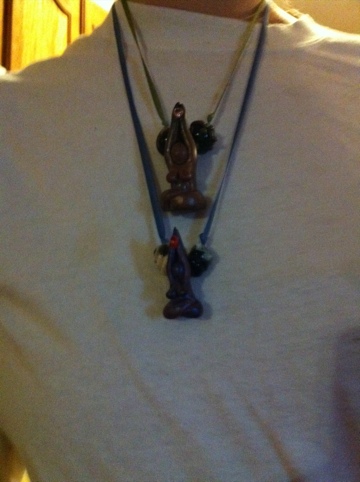
Just a picture post then to show my two most recent experiments in polymer clay birth goddess pendant making.

This little one is my tiniest effort. She doesn’t have a belly stone, just the jewel in her hands:
20111128-144746.jpg

The larger one is my favorite so far. She has a moonstone belly and is holding a heart shaped crystal.

20111205-143346.jpg

Tried to get a picture of me wearing them, but it didn’t really turn out (and, my, what an attractive shirt I wearing in which to model them. Love the flattering neckline with the pendants).
20111205-143408.jpg

I really love making these sculptures and have plans for more on that aforementioned break as well!

The Ongoing Crisis of Abundance

In March, I lamented to my husband, “you can’t imagine the amount of things I think of doing each day and then have to let go of.” What is weird—and that I also told him then—is that many of those ideas only occur to me on that day and are not really that important. Very often, these are not life priorities—they are just things that pop up and catch my attention and I think, “I could do that!” So, things like blog carnivals at interesting and popular blogs (I could write an entry–I have tons of ideas regarding that theme!), legislative alerts from worthy causes (I should write a letter and help with this!), interesting articles and posts (I could read that, it would only take a minute!), contests to enter (I’d like to win that, I should enter!), volunteer roles (wow! Sounds so interesting, I’d love to do it!), trainings or conferences to attend (I should register!), neat homeschooling projects (hey, maybe next time the baby sleeps, I can start this with the kids!), a new book that catches my eye (I should order that!), great recipes (I could make that for dinner!) good quotes to share on Facebook, I could write an article about this!, or about that!, someone has a question I could answer, here’s a neat article (I want to share this with others!), ooh! More free books to put onto my Kindle, art ideas, journal entries, etc., etc. It never stops! And, these are usually in addition to my ongoing projects, ideas, commitments, responsibilities, laundry, meal preparation, things other people want from me and so forth. Oh, and did anyone comment on my Facebook status? ;-D

Too much?

Sometimes I think I just like and care about TOO MANY things. All of these things splinter my attention in a million ways however, and also leave me with a persistent sensation of, “well, I didn’t get everything done today.” I continue to try to make sure to unsubscribe from email lists and blog subscriptions to cut down on this immediacy sensation that a constant influx of new information and ideas promotes. As I told my husband, “if I didn’t get that newsletter, or click on that article, or open that email, I would never have known about all those things I could have gotten done today.” Plus, there is always a new batch tomorrow! And, then I get a little depressed thinking why the rush to get things done and to finish? So I can die with a clear to-do list?! Come on!

Though actually, this is different than having “too many things to do”—because many of the things are new each day—it is part of managing the information flow into my life, I think. Some time ago I read this free book from Zen Habits and it was very helpful in its recommendations of how to sort through all of the clamor and focusing, but I think I’ve let go of those zen habits again in the last couple of months and need to try to re-read the book (but, OOPS, I’ve just turned that into another to-do!). I worked very hard before Alaina was born to trim away the extraneous so that I could focus intensively on her, but new and interesting things, ideas, and opportunities continue to emerge to take the place of what I trimmed away.

I want to remember my conditions of enoughness and to also make a new priorities/goals sheet so that when the baby naps, I know what’s at the top, rather than getting distracted. When each day ends, I continue to find I feel as if I have somehow failed. And, that I have let someone, some thing, or myself down.

When I was originally planning to share these thoughts so many months ago, I also remembered a poem I wrote when my first son was a toddler. I don’t have a toddler now…two kids and a baby instead…but the feeling of ideas building, cresting, and falling away is still familiar and my closing thought still a good reminder!

Vision

I cannot shake the feeling
That my life does not look
The way I want it to.
Each day, new big ideas build in me
And crest in a wave of vision
That finally breaks upon the shore
Of daily life with a toddler.

Reality.
Bound by the demands of everyday
Instead of grand and bold.

You’ll See It When You Believe It
Do I believe it?
Is this my journey?
Humbling
To watch the death of ego.

Be here now.
Am I?
Is it possible that where I am
And what I’m doing
Is exactly where I’m supposed to be?

And, then I remembered this quote from The Life Organizer by Jennifer Louden:

Would a weight lift off my shoulders if I realized that it’s normal to feel pulled between choices, that it’s normal to want to do more than I have time or energy for, and that it’s normal to have to choose between two equally wonderful things, that it’s actually a sign I’m a fascinating, amazing person?

That’s right. I’m a fascinating and amazing person. And, so are these three:

Choose wisely, Molly dear. Choose wisely!

I always say that I want to live well and wisely my one wild and precious life and to me that means making conscious decisions every day to pull my actions into alignment with my values. It is an ongoing process. I live in a rich and fascinating world. I can do it!

Mindful Mama: Presence and Perfectionism in Parenting

Being a mindful mama can be painful.

I am acutely aware of how often I fail, mess up, and let myself down in this work of conscious mothering. When I decide to go through a drive-through after a long day in town, I am very aware of each preservative laden, saturated fat heavy, factory-farmed, non-fair trade bite that crosses our lips. When I’m tired and have low energy for responsive parenting and I say “yes” my boys can watch a DVD, I know I am using it as a “babysitter” and as a “plug-in drug.” I cringe to hear myself say at times, “you guys are driving me crazy!” It is painful to know better and to watch myself do it anyway.

Listening to my Inner Critic

Instead of an inner guide, I too often listen to my inner critic. My judge. The perfect mama that sits on my shoulder and lets me know how often I screw it all up. I laugh sometimes as I reference the invisible panel of “good parents” that sits in my head judging me and finding me lacking.

For me, being a mindful mama is bound up in complicated ways with being a perfect mama; a “good mother.” In this way, it is NOT true mindfulness—I respond to my children based on how I think I should respond, how a “good mindful mama” would respond, not necessarily based on what is actually happening. Too often, I respond as I believe Dr. Sears, Jon Kabat-Zinn, or Marie Winn (The Plug in Drug) thinks I should respond, not based on reality or how we feel in the moment. This is the antithesis of true mindfulness. Mindfulness means an awareness of what is, it does not mean a constant monitoring of how I have failed. If I cannot be flexible and compassionate with myself, how do I expect to be a flexible and compassionate mother?

I am harsh and relentless in my own assessment of myself. Listening to the inner clamor of how to “be good” and “do it right,” prevents me from tuning in to what my children are really doing and really need in the moment. It is difficult to hear my own authentic voice, the still, small voice within, amidst the shouting in my head produced by all my reading and ideas.

This realization also forces me to acknowledge how often my mothering is about ME and not about my children. Too often my mothering springs from a preoccupation with being a “good mother”—i.e. making this all about me, me, ME—rather than about my children in the moment.

Meet Perfect Mama

I’m sure many of you know Perfect Mama—she gives birth with joy and ease, preferably at home and possibly unassisted. She breastfeeds responsively and for as long as her child needs—even through subsequent pregnancies and babies. She uses cloth diapers, or even better, no diapers at all because she practices elimination communication. She eats only organic foods and is perhaps vegetarian or vegan. She is always happy and creative and ready to play. She homeschools. She stays home, or, she effortlessly balances fulfilling work with a baby on her hip. She babywears and co-sleeps and grows her own food. She is “green” in her life and buying habits. She does not circumcise and she never forgets to boycott Nestle. Her family does not watch TV. She uses gentle, patient, loving discipline—no snapping or snarling. She never yells or gets angry and she never, never feels resentful or irritable.

I see in myself, in my friends, and in online communities, a ready tendency to judge or evaluate other mothers based on this inner checklist of good, “natural mothering” behaviors/practices, rather than seeing her as who and how she really is. There is also the tendency to hide the “ugly” parts ourselves or the parts that don’t conform to the checklist.

I actually meet many of the criteria on this checklist and in many ways (at least on paper!) I am “Perfect Mama.” Except, I do not always do it all with a smile on my face. That is my major failure. I am painfully aware—mindful—that, though I always love my children, I do not love every single moment I spend with them. It hurts to recognize and confess that I do not always cherish and adore being a mother. When I look past all the “right answers” on the checklist, guess what is left? Just me. For better or for worse.

I’m afraid that many of us trade the rigidity and prescribed values and ideals of the dominant culture, for a new set of natural family living values that we cling to with just as much rigidity and dogma.

If I look at being a mindful mama as an entity, a goal, an ideal to achieve, an assignment on which to get an A, then I’ve missed much of the point. Being a mindful mama isn’t about a rigid constellation of proper behaviors and ideas. It isn’t about struggling to conform to a mold. It is about being there, showing up, being present for life as it unfolds, and offering myself to my children fully, imperfectly, and whole. Cultivating self-acceptance alongside the “witness.” And, picking up the pieces when I fall, and trying again.

Finding My Authentic Mothering Wisdom

I continue to discover how I might clear our mental space to find my own authentic mothering wisdom. I am learning that being a mindful mama isn’t truly about a specific collection of beliefs and behaviors—the checklist—but is about responsiveness and presence.

I open my heart and vow to be here now. To tune in—to really look and breathe and smell and hear. Perhaps if I throw out the checklist, it is enough to look daily upon my life and my children with gratitude and love. To pause in the moment and drink it in. To really see my little ones before me. To stretch my arms wide to embrace them and to embrace the flow of life. To hold myself in the inner light of love and compassion. To try to do better—but in moving forward, rather than looking back with harshness and self-criticism. Perhaps I can love and accept right here, right now, even if that nowness sometimes involves a Happy Meal, or a raised voice, or red food coloring, or an Elmo movie.

Perhaps parenting authentically, from the heart, can’t be learned in a book or through application of a theory, but only through being there and being aware—of both the beauty and the messiness. Perhaps it means a loosening of attachment to attachment parenting as a prescribed set of practices and beliefs. Perhaps it means being a more loving friend to my own imperfect self.

Molly Remer, MSW, ICCE is a certified birth educator, writer, and activist. She is a breastfeeding counselor, editor of the Friends of Missouri Midwives newsletter, and a professor of Human Services. She has two wonderful sons, Lann and Zander, and one delightful infant daughter, Alaina and lives in central Missouri. She blogs about birth at https://talkbirth.wordpress.com, midwifery at http://cfmidwifery.blogspot.com, and miscarriage at http://tinyfootprintsonmyheart.wordpress.com.

Mindful Mama: Presence & Perfectionism in Parenting by Molly Remer, was published in Natural Life, July/August, 2011,