DVD Review: Birth as We Know It

Birth as We Know It: Educational Edition. DVD directed and produced by filmmaker Elena Tonetti-Vladimirova. 2006, www.birthintobeing.com (40 minutes), $39.95.

Reviewed by Molly Remer, MSW, ICCE, Talk Birth

As a birth educator, I am always on the lookout for the “perfect” video to show in classes. Though not a film I would show in its entirety to the average class, Birth as We Know It is a gorgeous compilation and I’m delighted to have it amongst my educational resources.

The film is available in two versions—the feature film edition and the “educational edition.” The feature film contains almost 4 hours of total footage (a number of bonus features), including 11 births. The educational edition consists of two condensed versions of the feature film—a 40 minute presentation and a 25 minute version designed to show in groups. I chose to purchase the educational edition and this review is based on that edition. I have not seen the full length feature film.

The forty minute version of the film contains gentle, moving footage of 7 births. All the births occur in water—some in the ocean, but most at home. It also includes footage about birth trauma, cesarean section, and circumcision that is not included in the 25 minute presentation version (which also includes only 6 of the births). The DVD also contains instrumental versions of both.

The births included on this film are all exceptionally peaceful, beautiful, gentle, quiet, and calm births. Some of the birth footage is in slow motion, the sounds are muted, and there is instrumental music as the soundtrack as well as occasional voiceover commentary by the filmmaker. The film alternates between birth footage and spoken descriptions/interviews about conscious birth, emotional presence, limbic imprinting, etc. The voiceover commentary addresses things like toning and healing one’s own birth trauma.

The births are wonderfully undisturbed and unhindered—in most the only hands near mother’s perineum are her own and this is such a profound difference from the usual media representations of birth! A highlight is during “Tanya’s Birth” in which she speaks to her older child, smiles with extreme beauty and peace, then casually glances down again and as the camera follows her glance, we see the baby’s head has emerged between her legs and she is cradling it gently. I love for people to have a chance to see this powerful moment!

Though interesting, I find the voiceover content and non-birth portions of the film to be too abstract or “metaphysical” to appeal to the average birth consumer. It is even a bit too metaphysical for me and I find that the concepts she mentions are not well explained and do not seem immediately reasonable or easy to accept in stride. The instrumental version is one way to gloss over this element, but then you are unable to scene select to specific content the way you are able to do in the regular versions.

So, though I do not show the complete film in classes, there are several birth clips that I do show routinely. I find two of the births in particular to be potent educational tools and they have been very well received in classes and have had a profound impact. The births are so different from general media representations of birth that they leave couples stunned with amazement about what birth can be. Since the births are in water, they are a very gentle, non-messy, not very “graphic” way to expand people’s understanding of normal birth. People in my classes have said things like, “wow! You never see something like that!” or, “that was so beautiful, I’m just in shock.” I find men in particular are more receptive to this footage than to other, more detailed, videos I show and I have had a few request to borrow and view the whole video instead of just the clips I have chosen for class.

In conclusion, this is a lovely film and though I have some reservations about showing the entire educational edition, some of the birth footage has been a powerful addition to my work with birth.

This review was previously published at Citizens for Midwifery.

Book Review: The Blue Cotton Gown


Book Review: The Blue Cotton Gown: A Midwife’s Memoir
By Patricia Harman
Beacon Press, 2008
Hardcover, 290 pages
ISBN: 978-0807072899

Reviewed by Molly Remer, Talk Birth

Patsy Harman is a CNM in West Virginia. She runs a busy women’s health practice with her husband Tom, an OB-GYN. Though obstetrics was once a rewarding part of their practice, they’ve stopped attending births due to unaffordable malpractice insurance rates. In addition to tales from the office, this compelling narrative follows Patsy through struggles with the IRS, fears over potential lawsuits, family complications, and uterine cancer. Since I usually come from a consumer advocate’s perspective, it was very interesting to have this intensely personal look at the other side of the coin—the deep fear obstetric professionals have of lawsuit.

The author told me in advance that this is not a book of birth stories, “it is about women giving birth to themselves.” This is true—there are almost no birth stories in the book (and in one of the few there is, I was surprised to read that the mother was induced with misoprostol!). However, this is actually what gives the book its absorbing edge. In it, you get to see another side of midwifery—the “with woman” side that extends before and after pregnancy and childbirth. This is a side of midwifery that I haven’t yet seen explored in memoir format and it was incredibly engaging. Patsy’s clientele are women who have STDs or yeast infections, who need pap smears or well-woman exams, or who need a pregnancy diagnosed, but her care for them goes beyond the physical. The women’s lives are complicated, as is her own. Some of the stories are very sad and others are uplifting. If you are looking for birth stories, look elsewhere, if you are looking for a skillfully written and emotional look at the practice of nurse-midwifery and its dominating role in a woman’s multifaceted life, you will find a treasure in The Blue Cotton Gown. As it came to an end, I found myself wishing for Part Two.

Read my review of Patsy’s other memoir here:

Book Review: Arms Wide Open: A Midwife’s Journey

Disclosures:

I received a complimentary copy of this book for review purposes.

Amazon affiliate link included above (in title and image)

This review was previously published at Citizens for Midwifery.

Conscious Agreement and Informed Consent

This post is part 2 of my CAPPA Re-Cap series.

During their general sessions at the recent CAPPA conference, Laurel Wilson and Tracy Wilson Peters both advocated a process called “Conscious Agreement” in working with pregnant couples. The basic steps are as follows:

  • Separate yourself from external influences
  • Get quiet and pause
  • Listen in (including mentally checking in with your body and how it feels)
  • Choose and commit

I especially appreciated Tracy’s observations that this process of conscious agreement goes beyond informed consent and, as birth educators, we need to make sure to “marry the two every time,” rather than focusing solely on informed consent. Why? Because there are several things wrong with informed consent as it is practiced today:

  • It fails to address the importance of conscious decision-making
  • Informed consent is made with the mind or intellect (and ignores feeling and intuition)

And…

  • You can “consent” all day long and not feel good about it.

The last point is the crux of the issue to me. When I cover informed consent in my non-birth classes, I always emphasize that the corollary is informed refusal. If “consent” as it is practiced by your hospital means saying yes and there is no option of saying no, it does not qualify as consent! A choice without the option to refuse is NOT a choice at all (see The Illusion of Choice). My students have almost never heard of the notion of “informed refusal” and seem shocked to even consider the possibility! Since I’ve had a special interest in this topic for a long time, I really connected with the idea of conscious agreement, especially when paired, as Tracy suggests, with informed consent information.

Another handy tip offered by Tracy during her presentation was to use HALT before entering into any agreement (or confrontation). Check in to see if you are…

  • H–Hungry
  • A–Angry
  • L–Lonely
  • T–Tired

(Also, consider whether the person you are trying to communicate with is any of these things. This is especially good to remember with children.) And, she shared this little poster:

This little sign may have been made especially for me. I have a terrible problem with getting crabby and snappish and plain old hangry (hungry + angry)—and then having to apologize. You’d think I’d have it figured out by now! (though, I do think nursing exacerbates it)

Epigentics, Breastfeeding + Diet, and Prenatal Stress

This post is part one of my CAPPA Re-Cap series.

CAPPA linchpins Laurel Wilson and Tracy Wilson Peters are co-authors of a new book, The Greatest Pregnancy Ever, that focuses on the depth, intensity, and value of the MotherBaby bond. As I noted, I listened to Laurel talk about Bridging the Nutrition Gap and to Tracy speak about the “accidental parent.” In both, they addressed the biological wisdom that mothers possess and of the deeply interconnected nature of the maternal relationship.

Laurel reminded us that there is a brain in our gut, essentially. This brain literally tells us how we should be feeling our emotions, based on the nutrition that we’re putting into our bodies. She discussed epigenetics–a term meaning literally “above the gene”—explaining that this is the “translator that ‘reads’ the book of instructions from our genome.” The translator tells the body to turn on or off the genes we’ve inherited from our parents. Epigenetics is essentially the environment–those things in our environment that influence our biology. Laurel pointed out enthusiastically that we want to create an excellent “translator” for our children. She also emphasized repeatedly that one important job of the placenta is to “train” the baby for the environment it will be experiencing. This is why prenatal diet matters, it is helping to prepare the baby to thrive in the environment into which it will be born. So, chronic stress leads to a stressful womb environment, which leads to a baby that is biologically primed to be born into a stressful postnatal environment. Mother’s body primes baby’s body for success in that environment. As I listened to her speak and discuss the things we’ve learned from science about genetics and how our bodies function, I kept thinking: science can do a lot, it can do wonderful things. Mother’s body can do even moreAnd, isn’t that just cool?!

So, what’s going on in the maternal habitat?

One important point Laurel made about prenatal diets was that prenatal diets high in hydrogenated oils predispose mamas to postpartum moods disorders. She said this is because hydrogenated oils essentially “leach” EFA’s out of the mother’s system.

She also noted that mice up to three generations are affected with PCOS by BPA and phthalates (in food packaging. Our food is literally making us sick). These influence change the endocrine system and are connected with reduced sociality and community engagement.

Laurel explained too that no artificial sweeteners are considered safe for pregnant women and that stevia too is linked to epigentic damage. She suggested using honey and molasses as sweeteners if needed.

One tip that I found funny, basic, but so true with regard to choosing healthy foods is to make sure to choose to eat foods that will rot!

In Tracy’s talk she passionately affirmed that we have to eliminate chronic stress from pregnant women’s lives because she is laying an emotional and physical foundation for another person’s life. This matters! Babies are feeling before they are thinking and we are designed to live in the environment we are being born into.

Also remember, babies don’t need to be in nurseries–they need to be with their mothers. This MATTERS!

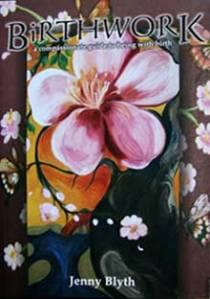
Book Review: Birthwork

Birthwork
By Jenny Blyth
Reprinted 2007
Softcover, 460 pages
ISBN: 0-9757610-0
www.birthwork.com
Reviewed by Molly Remer, MSW, ICCE, Talk Birth

From Australia, comes a gorgeous and unique book called Birthwork. It is such an amazing and compelling read that it took me a very long time to write my review—it is difficult to describe such a remarkable book. I have never read another book like this. It is truly extraordinary. Subtitled “a compassionate guide to being with birth,” Birthwork was written for all birthworkers–anyone who works directly with birthing women (midwives, doulas, nurses, childbirth educators, physicians…).

This book covers issues of a range and depth I’ve never before seen in a birth text. Subsections include titles like: touching vaginas, respect and relationship, dipping in and out of the birth milieu, group dynamics, conflict, birth culture, loving presence, birth is sacred, trauma release, letting down in the pelvis, and stresses and stretches of childbearing. This is just a sampling of the amazing, comprehensive range of topics explored in Birthwork. I particularly enjoyed sections on directed breathing and “dynamic anatomy in labour.” The book delves into a lot of the emotional and psychological elements of being in a caregiving field and also covers physical components as well.

The book includes lots of questions to ask yourself to increase self-awareness, understanding, and personal development and also exercises to try/explore. Some of the questions are difficult to answer and require you to take a deep look at your motives and ideas about doing birthwork.

The photographs are stunning and there is gorgeous cover art (front, back, and inside). Birthwork has a spiritual component that runs throughout—sort of an Eastern philosophy—that might not appeal to all readers.

The book includes sources and a glossary of fields of care, but no index and no resources sections. It is an expensive book, but so very worth it!

Birthwork is deep and intense. I usually read very quickly and this book took me several weeks to finish because it needs time and space to soak in and be absorbed. Truly a phenomenal read!


Disclosure: I received a complimentary copy of this book for review purposes.

This review was previously published at Citizens for Midwifery.
Marriage thoughts

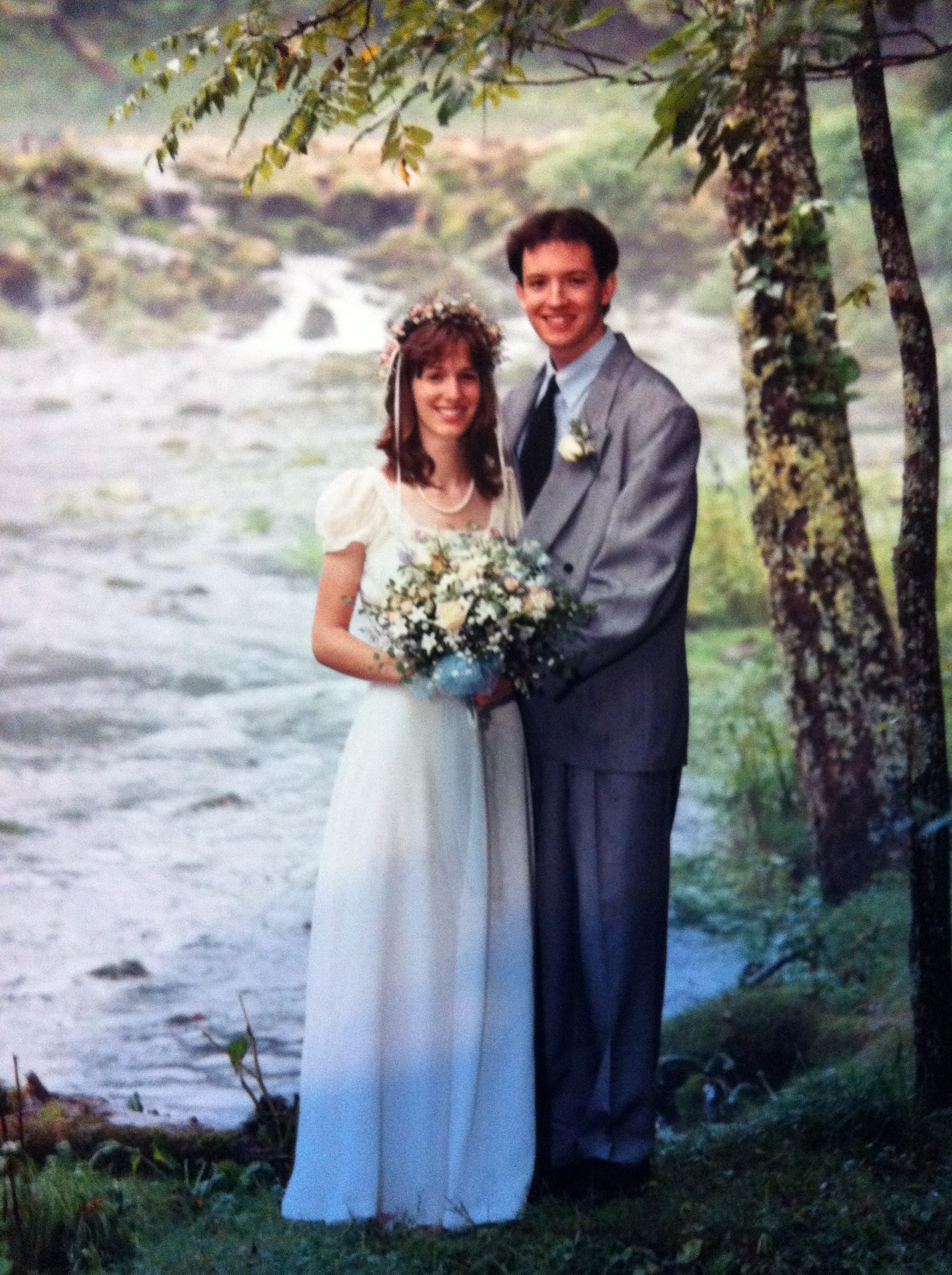
Today is our fourteenth wedding anniversary. Last year I shared some married musings in my rainy wedding post and I have a couple of related thoughts to share this year too. As I noted last year, I personally don’t experience my marriage as being hard work or difficult. Though I do understand that this is not everyone’s experience, I have a lot of difficulty understanding or appreciating comments that I see repeated in various Facebook-type locations that come from the, “love is a choice that you make every day” angle. Really?!?! I have trouble getting on board with that, because it sounds like if you don’t make the “love” choice, the alternative is just naturally disliking or not enjoying your spouse? My love for my husband feels similar to the love I feel for my children—it is a constant, it is not choice based. It is deep, abiding, and embedded. It doesn’t feel optional, which is what the word “choice” makes it sound like to me. If you choose to love your family, you can also choose not to love them on a daily basis. This doesn’t reflect my own experience in my relationship or my mothering.

At the beginning of this month, a Facebook friend shared a long quote about marriage from a Christian relationship book that seemed to come from this love is a choice philosophy. I did like this part of what she shared: “There are no lessons to be learned when a husband dominates his wife. There are no inspiring examples to emulate when a wife manipulates a husband. But love unlocks the spiritual secrets of the universe. Love blows open eternity and showers its raindrops on us.” (Perhaps I identify because of that rainy wedding of ours!) When I read this book excerpt and the subsequent comments about marriage being the “hardest work of your life” or a “constant challenge” or about how spouses and ourselves can be so “hard to love,” I shared this with her: today [July 1] is my husband’s 35th birthday, the 18th I’ve spent with him. I’ve never found him hard to love and I’ve never found our marriage to be hard work or our relationship a challenge. Quite the contrary in fact—he’s my safe haven and my soft place to land. Now, parenting I find to be a challenge! And, parenting compatibly together is also sometimes hard. But marriage. Marriage is sweet, comfortable, and home.

I then added: not to say that I don’t understand or appreciate that marriage is a struggle/hard/challenge for some couples. I know that it is and I admire the effort and commitment they put into a strong relationship. I just wanted to offer a different experience 🙂 I wish the same for you one day!

And, then when my parents’ celebrated their 38th anniversary two weeks ago, I thought it was high time I asked my mom about this whole “hard work” angle. This is what she said: “Not at all! It’s a union of like-minded, harmonious people. It has always felt absolutely right to me. I’m where I’m supposed to be, with a man I love completely! He’s my best friend. It’s not effortless, but it comes naturally to us!”

I do feel like I had an excellent relationship model. My parents are super cute and they like each other a lot and always have. They argue about things sometimes and have the occasional bump, but I’ve never seen them working hard at being married, only delighting in it. Maybe I’m just getting hung up on semantics, but I just have a personal pet peeve about that descriptor and I don’t know that it is the best message to give to people approaching their own marriages. I think about birth, of course: yes, sometimes we give the, “it is hard work, but you can do it and it is SO worth it” message about giving birth and maybe it is the same with the marriage message, but I like to share a, “birth is an awesome, empowering miracle and I hope you love it” opinion and I like to offer other couples the same sentiment about marriage.

And, because I can’t think of anywhere else to put it and yet I want to share, here is a picture of the totally awesome, totally homemade German chocolate cake I made for Mark for his birthday this month. In 14 years of marriage and 18 birthdays with him, I’ve never made him a real one before. I’ve done mixes and canned frosting, but I don’t like coconut. This year I decided to make a homemade one (with add-your-own-coconut-to-the-icing-if-that’s-your-thing) and it was unbelievable. It had 7 eggs in it, weirdly–4 in the icing and 3 in the cake. Who knew?!
20120704-204435.jpg

CAPPA Re-Cap

Yesterday I got home from Kansas City where I’d been attending the annual free birth conference hosted by CAPPA. While there I concluded that Desirre Andrews is officially a superhuman live-tweeter. You can catch up with all of her rapid-fire tweets about the conference at CAPPA’s Twitter account.

I also tried my hand at posting a few things that particularly grabbed my attention to my Talk Birth and Citizens for Midwifery Facebook pages which automatically feed into Twitter. I’m not very good at catching short snippets for live-tweets, but some thoughts that I grabbed to highlight are as follows. If they don’t have quotation marks, they aren’t necessarily direct quotes, just “essence” summaries as I tried to take notes and pay attention!

First I attended Laurel Wilson’s talk about Bridging the Nutrition Gap and next, I listened to Tracy Wilson-Peters speak passionately about the “accidental parent.”

Essence tweets from Laurel and Tracy’s talks:

Babies don’t need to be in nurseries–they need to be with their mothers. This MATTERS!

Science can do a lot, can do wonderful things. Mother’s body can do even more…

Prenatal diets high in hydrogenated oils predispose mamas to postpartum moods disorders.

And, then I attended a breakout session from Darla Burns about postpartum rituals and snagged this interesting tidbit:

In Holland, all pregnant women are required to buy a homebirth kit, “just in case.”

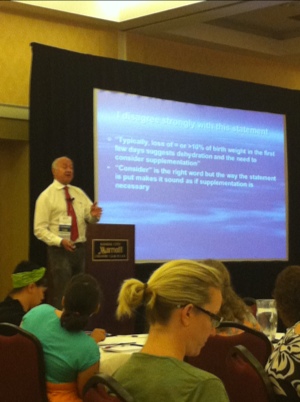
The second day, I found myself entranced by the most awesome Dr. Jack Newman. His presentations were the highlight of the conference for me. I loved him! I attended two–his general session on Controversies in Breastfeeding and then his breakout sessions, Impact of Birth Practice on Breastfeeding:

20120724-174258.jpg

If you ever get a chance to see this man, don’t miss it!

We have a big, big problem in that HCPs do not recognize the critical importance of breastfeeding.

There are many people who don’t know squat about breastfeeding and breastmilk and don’t feel like they need to learn anything before they start doing studies and writing papers about it. –Dr. Jack Newman

There is no such thing as “standard” breastmilk. It is a physiological fluid and varies from person to person. We DO NOT have to prove that breastfeeding is better than formula. Those comparison studies are unnecessary.

The burden of proof rests upon those who promote an intervention! –Dr. Newman

With animal births: following a normal birth, infant feeding just…happens. Following an interventionist birth, the mother rejects the baby and there is no nursing at all.

Our hospital births break every rule in the mammalian list of mother-baby necessities.” –Dr. Newman

Lying down for electronic fetal monitoring is a position of comfort for the care provider, NOT for the mother.

Know how much an incubator costs now? $50,000. Why don’t we just give half of that money to the mother and put the baby skin to skin on mother’s chest? –Dr. Newman

Seriously, Dr. Newman’s talks were amazing. Be prepared to hear more about them soon!

The final day I heard Polly Perez speak about Building Bridges with an emphasis on communication and fear:

Luke: I don’t believe it. Yoda: that is why you fail.

“Use language that lets you share your heart openly.” –Polly Perez

Listening is *active*, not a passive activity. Listen with empathy, openness, and awareness.

We have taken the hearts and minds out of much of our work because we’re frightened of getting too close. But, close is where we need to be.

“We must give people the opportunity to challenge their fears. Not only will this change each person, it will change the political and medical climate in which they make these choices.” –Connie Pike, via Polly Perez

Polly shared the first home birth she attended – made her fear of it “melt away like butter in a pan.”

You do not have to be an OB to be knowledgeable about birth. –doctor working with Polly Perez

Follow up from same doc: “if you tell me a baby is going to come out, I’m a gonna believe you!”

Changing sick systems is not about subterfuge but bringing light to situations that need to be altered.

Since micro-blogging is simply not my gift and is unlikely ever to become so, I am also planning longer posts based on several of the conference sessions. They will be (links will be updated as the posts become live):

At the CAPPA conference I also made a large custom order of great gifts from Joy Belle jewelry.

And, I ate tons of sample honey sticks from Glorybee–yummy! (see prior post: Why Honey Sticks During Labor?)

Other treats involved getting to spend some quality visiting time with a Friends of Missouri Midwives friend from St. Louis. We spent a lot of time talking over the FoMM newsletter (of which I am editor) and I feel very enthused about our ideas for its future.

I also got to meet a Facebook friend who started out originally two years ago as a Talk Birth fan on FB (after finding my site via my all-time most viewed post: In-Utero Practice Breathing). We spent some good time together visiting and laughing and it was fun to make the friendship connection with someone who was previously only an internet friend!

Big Girl!

This started as a quick, primarily photo update of my now 18 month old little big girl, but has grown to include more thoughts and a lot more length! I’ve been writing it for probably a month, adding bits and pieces of things I want to remember. Probably time to actually post it…

I can’t believe she is big enough to hold on to the chains and swing on the swing like a big girl:

20120627-114133.jpgAnd, speaking of big girls, she has her first pair of big girl shoes. She picked them out herself and it was really hard to get her to stand still enough to actually take a picture of them!
20120627-114147.jpgIt is also hard to get a picture of her smiling–and not moving–but catching on ride on Daddy’s shoulders worked!
20120627-114154.jpg
Strolling with big brothers.
20120627-114138.jpg
At the park
20120721-144103.jpg

Other things I’ve jotted down to remember:

  • Seems to say I love you—usually after picking her up, snugs down head on shoulder, pats back, and says in small, sweet, sing-songy tone “I yuh ya!”
  • Puts own feet into shorts when you hold them up for her–totally cute.
  • Rides bikes–perches on big bro’s bike while pushed, toes tightly gripping like small monkey.
  • Rides in stroller to help with watering the vineyard
  • Screams/squeals to communicate most opinions
  • Points to eyes and quite a few other body parts accurately–says “eye” clearly.
  • Loves her na-nas (see pix at end).
  • Pats your back softly and sweetly when you pick her up–love this
  • Kisses her dolls’ heads when she picks them up–how does she know to do this?! Love this too.
  • Loves dolls and looking at baby chicks
  • Says yeah and shakes head for no–helps a lot with communication (and is a new skill learned in last two months or so–see note below written before this sentence about my being concerned slightly with her verbal development or lack thereof)
  • We think she has a strawberry allergy, but not positive.
  • Starting to wear undies. Also, wipes self after going pee and it is ridiculously adorable
  • Fascinated by comparing undies to others who wear undies. And, seems to say, “undies.”
  • I posted a quick story on Facebook last month about how she fell backwards off a stool in the living room and smacked the back of her head. She cried and nursed and recovered. Then, at bedtime she did some “play therapy” with two dolls–she held them up and then laid them back like they’d fallen, then scooped them up and held them to her chest to have na-nas (we could tell because she held them face in and made smacking noises with her lips). Sad that she fell, but really sweet that she knew how to take care of her “hurt” babies too!

    And, more pictures!

    Snuggling with her beloved grandpa Tom.
    20120704-203210.jpg
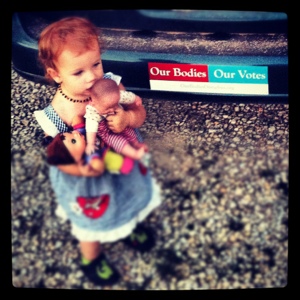
    Engaging in women’s health activism already:
    20120704-203354.jpg
    Big enough to ride on a real big kid ride at the fourth of July carnival. I love the way she is looking at Lann here.

    Drinking from the hose.
    20120712-164553.jpg

    I continue to marvel at her every day, and sniff her wonderful head, and think she’s adorable many times a day, AND she is also still exhausting me. Whew. She was a super easy baby and she is a hard toddler. She makes this one sound for almost everything and it is this plaintive sort of whine/grunt and it gets SO OLD. I feel like I spend much more time than I’d like to whining, stop it at her–not about anything she is physically doing, but about that flipping awful sound. I am sound sensitive and always have been and I feel like this noise of hers actually causes me physical pain. She needs to learn to talk and soon. She is my least verbal baby and it is much harder to have a nonverbal toddler than it was to have verbal ones. Sometimes I wonder if we should feel concerned about her linguistic development–it doesn’t seem to be developing much and in some ways she seems like she is going backwards (as in, I worry that she might say less words now than she did on her birthday. I know that is a warning sign and I have other friends who take their kids to speech therapy and other early intervention programs for things like this). While she was my happiest baby, she is a pretty complaining toddler age person! She is also into everything and a total destructomatic. The boys and I are occasionally known to call her, “The Destroyer of Worlds.” And, I’m known to sing a little rhyme sometimes that goes: “Laina, Laina is causing paina in mama’s braina.” Uh oh! Am I horrible?! Or, just keeping it real? I do try to strike a balance in blogging with transparency/honesty and not being a whiny, “bad mom” who doesn’t cherish her darlings enough!

    As long as I’m in a confessional mood about my cherishment failings, I also want to mention that trying to leave the house with my kids is pretty much a hideous nightmare every time. Once we’re gone, it’s good, but the process of leaving feels like torture! It is just insane. And, then I leave all crabby and tight chested and frazzled and feeling like my kids may secretly be trying to kill me or something. I hate it. When we went bowling last week, I said that in a “bad mom” moment—“ugh, it is so awful to try to go anywhere with you guys!!!!” and Zander said sensibly, “but everything is always fine after we leave.” And, I was like, oh, yeah.

    And, speaking of bowling, look who bowled like a big girl?! I swear, it actually hurt my heart to see her sturdy little body staggering up there holding that big ball.

    20120712-164442.jpg

    And, in moments of sheer maternal awesomeness, I bowled two games myself and did score over 100 each time even though I bowled while babywearing, while nursing and babywearing, and with one hand while holding her on my hip (got a strike that time, actually).

    We continue to nurse, a lot. Sometimes, I feel like this about it:
    20120717-100021.jpg
    I swear we both make these exact faces. I feel such maternal kinship with mothers of all species.

    Very often she nurses like this (she’s always favored being a vertical, upright nurser):
    20120704-203306.jpg

    And, often nursing her is like this too:
    20120704-203152.jpg

    I am at a birth conference right now and feel surprised that people have been surprised that she needs to be brought to me to nurse. She nurses probably three times a night and at least seven times during the day. Totally okay with me and feels/seems normal.

Fetal Model Update

Some time ago I wrote a popular post about a newborn doll I bought at Kmart that is a perfect and affordable fetal model to use for childbirth classes. Unfortunately, Baby Sasha had a horrible run-in with mice in the closet and is now permanently disfigured 😦

20120714-091530.jpg

We tried everything to remove these stains and nothing worked at all. Not even one bit. While I suppose I could still use her with her new “birthmark,” I’ve read that educators need to be very careful with the unintentional messages sent by their birthing class props—i.e. never jerk the placenta out of the knitted uterus, don’t hold the fetal model between your knees or drop it on the floor, and don’t throw the uterus down when you’re done with it. If you’ve done your job properly and used your props effectively, they’ve become associated in the clients’ minds with the “real thing” and the manner in which you handle these props sends unconscious signals to the clients about these items in their own lives. So, I don’t want their “baby” to emerge from the uterus “flawed” in this striking way.

I did discover that her little hat still tidily covers the mark on her head and she is restored to looking cute again:

20120714-091538.jpg

I have ridiculous affection for this little face.

I sent my husband on a mission to Kmart to replace my beloved baby and alas, there were none to be found. Luckily, Kmart.com came to the rescue and I was able to order not one, but two, new little cuties!

20120714-091545.jpg

This baby needs a name!

The replacement newborn isn’t quite as cute as my original and doesn’t look quite as realistic (Mark says they’re identical and the old doll is just dirtier). Close comparison did reveal that their eyes are different colors, original Sasha’s being a better, darker newborn blue and new baby’s being lighter and more gray.

20120714-091552.jpg

Almost as big as a real newborn!

20120714-091604.jpg

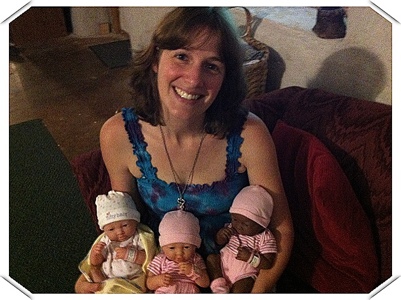
Now, I have triplet demo-babies!

20120714-091612.jpg

Alaina has an obsession with dolls and she wants to take all of these babies from me. She also gets very stressed by trying to carry all three at once and keeps dropping at least one. She staggers around making kind of a panting sound and sort of whine-moaning for aid. The night the new dolls arrived she insisted on falling asleep with all of them, but the stress of trying to hold them all at once while also nursing, kept her awake for over an hour. She kept wanting them to get to nurse on the other side and actually acting a little panicky that they couldn’t all nurse on the same side.
20120714-091624.jpg

20120715-003603.jpg
Sorry, Alaina! Mine!

Another Pinterest Day!

Yesterday we had another Pinterest Day. It was so exhausting that I’m going to not do another one for a couple of weeks! Alaina has been incredibly whiny and demanding and getting into everything all the time, often destroying things—so, it is really difficult to do fun stuff with the other kids, when someone else is complaining on my hip and sticking her hand down my shirt to twist my nipples half the time. So, our Pinterest projects of awesomeness were shaded by an overlay of intense crabbiness on my part. Boo! 😦 We expanded the definition to include “stuff we want to make” too. So, for lunch we had the best ever grilled cheese sandwiches that we just created, not from Pinterest. Mine had sautéed organic spinach and mushrooms added to the top of organic mozzarella and provolone all on (totally non-organic) french bread. Yummy, yum, yum!20120714-091343.jpg

Also, from our own heads we decided to make caramel apples using super delightful little Kraft caramel bits and organic apples from the food co-op:

20120714-091349.jpg

Can you tell which one we made last?

After lunch the boys were excited to try these microwave chocolate chip cookies that looked super simple and easy. However, results were poor and I didn’t even both trying to make the pictures look better using Instagram. We made Zander’s first and since it still look squishy after the allotted time, we roasted the heck out of it and it was crunchy and burned on the bottom. The choco chips turned into powdery relics (that were kind of tasty). Lann deemed his a, “mega sugar bomb” and left it abandoned on the table. We didn’t put enough butter in his, I guess, because it was just loose crumbles.

20120714-091404.jpg

We tried again with mine and it was no better.

20120714-091412.jpg

My assessment is that this was about as tasty and texturally appealing as leaving a small bowl of egg, flour, and sugar on your dashboard on a hot day. Epic fail all around!

Pinterest Day dinner was vastly more successful: a cheesy, wild rice and spinach casserole and “crispy roast potatoes.” The potatoes called for “duck fat,” which is not one of my personal kitchen staples, so I used olive oil. I also sliced them in the food processor rather than into chunks.

20120714-091427.jpg

Verdict: totally delicious.

The casserole was a modified version of this recipe. I added spinach and didn’t use chicken (or any of the veggies called for, other than dried, minced onion and garlic). Mark and I enjoyed it, the kids didn’t really.

20120714-091434.jpg

20120714-091441.jpg

Nice glass of strawberry wine to help me recover from Pinterest Day adventures with Alaina!

We’ve actually had other Pinterest Days in between the first one and this one. On the fourth of July I made several things, including homemade Payday bars that I was absurdly pleased with:

20120714-154247.jpg

Definite win with these! Next time I’ll just stir the peanuts in though rather than layering them on the bottom on the top, where they had a tendency to pop out and roll away.