Inseparable

Notice how she is holding my finger?

The cutting of the umbilical cord tends to herald the arrival of a new and unique life. Though this tiny being began its existence many months before, growing nestled and protected within the womb, the just-born infant is seen as an individual apart from his or her mother. There is, however, a significant error in this thinking, for baby and mother are one, so to speak, and severing this unit denies an empirical truth. Birth should not be a celebration of separation, but rather a reuniting of mother and baby, who joins her for an external connection. –Barbara Latterner, in the book New Lives [emphasis mine]

I felt like this was a completely relevant quote for our Independence Day weekend. A baby has no concept of the notion of independence. Even though we live in a culture that pushes for independence at young ages, all babies are born hard-wired for connection. For dependence. It is completely biologically appropriate and is the baby’s first and most potent instinct. I remind mothers that after birth your chest literally becomes your new baby’s habitat. Mother’s body is baby’s home—the maternal nest. If the baby cries when you put her down, that means you have a smart baby! Not a “dependent” or “manipulative” one. People are fond of making comments about babies being “spoiled” if they are held often. It is impossible to spoil a baby by responding to her needs (why do people have such an issue with other people holding babies anyway?). I am 100% certain that it is impossible to “spoil” any baby under the age of one by answering her when she cries and giving her what she needs (which at this point is food, warmth, safety, love, and physical closeness). One of LLL’s  pearls of wisdom is, “a baby’s wants are a baby’s needs”—-there is no difference between them at this age. A baby is not “manipulating” you by crying for you to come to her and then stopping when you pick her up—-that is a perfect example of skillful mother-baby communication (if someone says, “she is only crying to get you to pick her up” the answer is “yes! She is! Isn’t she smart!”) .

New Lives is a compilation of essays by NICU nurses and it is no surprise to me that the essay from which the above quote comes was written by a former LLL Leader 🙂

Speaking of LLL, at the last international conference in 2007 I was fortunate enough to hear Dr. Nils Bergman speak about skin-to-skin contact, breastfeeding, and perinatal neuroscience. In super short summary: babies NEED to be with their mothers following birth in order to develop proper neural connections and ensure healthy brain development and proper brain “organization”; Mother’s chest is baby’s natural post-birth “habitat” and is of vital developmental and survival significance; Breastfeeding = Brain wiring.

And, as long as I’m reminiscing about the conference and Dr. Bergman, in fact I actually ended up “performing” on stage with him in a mimed play put on immediately prior to his presentation! He is a dynamic and engaging speaker (with a great accent!) and has so much of value to share. I will never forget hearing his duet with an LLL Leader of the song, “Anything Tech Can Do, Mum Can Do Better.”

Yes she can, yes she can, yes she CAAAANNNNNN!!

Today, let’s celebrate being in dependence with our babies 🙂

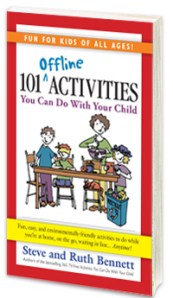
Book Review: 101 Offline Activities You Can Do With Your Child

101 Offline Activities You Can Do With Your Child
Steve Bennett,  Ruth Bennett
Paperback: 134 pages
Publisher: BPT Press (June 14, 2011)
ISBN-13: 978-0984228522

Reviewed by Molly Remer

Just in time for summer amusement comes the new book 101 Offline Activities You Can Do With Your Child. Written by the authors of the classic 365 TV-Free Activities You Can Do With Your Child (a book I’ve used a resource for about 6 years), this concise little book offers a wide variety of fun activities. Coded at the bottom of the page with a sketch, the activities are either designed to be used at home, on the road, in the kitchen, or anytime, anyplace. A nice feature is the picture index for kids who are not yet reading to choose their own activities.

Single page explanations/descriptions mean all of the activities are fairly simple to implement and enjoy—offering a brief time-out for anytime fun. Many of the craft ideas seem most appropriate for children under age 10 and plenty of the other games and other activities are enjoyable for any age group.

My kids have come up with quite a few of the suggested ideas using their own imaginations and some of the ideas are classic car games (or variations thereof), but there is enough fresh, unique content to make this book a worthwhile resource for our family.

Disclosure: I received a complimentary copy of this book for review purposes.

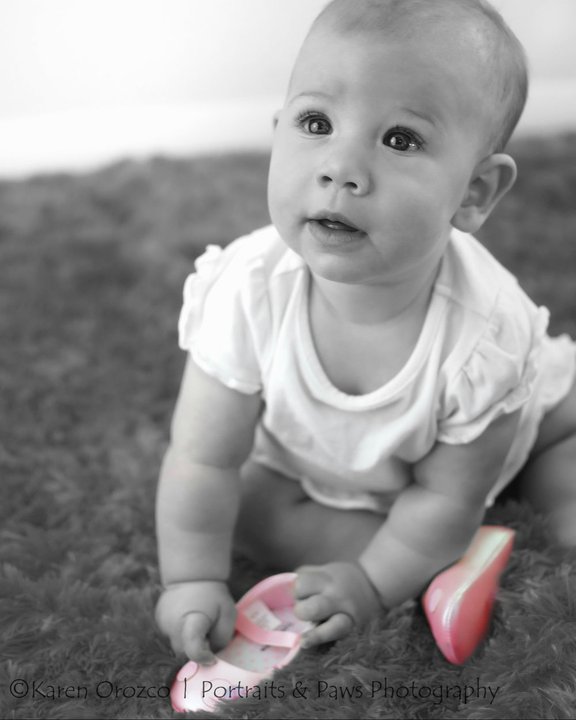
Remember those pink shoes?

When I found out that Alaina was probably a girl, I went to the store and bought a pair of shiny pink shoes. (I wrote about this here.) When I got my first set of maternity pictures taken, we included those shoes in a couple of the pictures:

Last week, I took Alaina for a photo shoot with my same photographer friend and look at the shoes now!

One of my good friends is nearing the end of her own pregnancy after loss journey and she just had a maternity photo shoot with the fabulous Karen as well. She had a similar belly picture taken with a little pair of pink socks. When I looked at her photo, I remembered so vividly my own feelings while getting the one taken of me—that almost panicky combination of hope and fear and just trying to trust that I would NOT have to look back at that picture and be filled with grief that I had no one to fill the shoes after all. And, once again, I felt grateful and relieved to be on this other side of the PAL journey. It is a very, very good place to be. I look forward to my friend welcoming her own “rainbow baby” next month and getting to feel that sense of pure relief at putting those pink socks on her happy, beautiful, healthy new daughter!

Asking the right questions…

A couple of weeks ago a list of sexual assault prevention tips made the rounds on Facebook. Containing reminders such as, “When you see someone walking by themselves, leave them alone” and “Carry a whistle! If you are worried you might assault someone ‘on accident’ you can hand it to the person you are with, so they can blow it if you do,” these tips are absolutely perfect and so very appropriate. I spent several years working in domestic violence shelters answering the hotline. The number one question/comment I used to get from people about this work was, “why doesn’t she just leave?” And, we always used to reply that that is the wrong question, “the question isn’t, ‘why does she stay?’ but ‘Why does HE do it?!'” And, why, as a society, do we accept it? The same website that created the SA Prevention Tips poster, also noted this:

When we talk about rape as something that happens to 1 in 6 women, it is something that happens to women. Oh no, women! You have a problem! A women’s problem! That has to do with women! What are women going to do to solve this problem? Perhaps if we rephrased that as ‘one in…however many…men will commit rape in his lifetime,’ the problem might start to look a little different to certain people.

The wrong questions

Quite a while before this, an article made the rounds about women in another country ironing their pubescent daughters’ breasts flat to try to make them less appealing as rape targets. Many comments on the article were to the effect of, “ugh! What horrible mothers.” Again, entirely the wrong lens with which to be looking. Why is it okay to rape little girls?! Ditto for the news reports of a reporter being sexually harassed by the football team when she went to  interview them—people responded with things like, “she should try dressing professionally.” Um, excuse me? How about the football players—adult, capable men—try acting like professionals? Wrong questions, wrong lens, wrong direction to point the fingers. And, it is because I respect men as people that I give them more credit than this—I believe men are rational and fully capable people who are responsible for their own behavior, not out of control pigs who women are responsible for “taming” and/or not “provoking” (sexually or otherwise). Men are smart, let’s treat them like it by remembering to ask the right questions and to give the right sets of tips.

Of cannibalism & implied social acceptance

These topics remind me of an example I use in the college classes I teach and the questions I encourage my students to ask about all kinds of social services: If we respond to the presence of disturbing social conditions by working primarily to soften the pain they cause, does this imply tolerance for their existence? Our actions do help, but we need to be sensitive to the fact that our limited actions indicate endorsement of, or at least acquiescence to, these conditions that call for all our hurry and scramble. Under the guise of caring we may have reached a point of acceptance of conditions that produce the pain we try to ease…Why are we accepting that children go hungry, that people are homeless, and that women are beaten and raped? Are these conditions that you find acceptable? Are these things just part of the “normal” course of life? I then ask my students to consider cannibalism—what would it be like if rape was as unheard of in our culture as cannibalism? We don’t have “cannibalism survivors support groups” and cannibal hotlines and shelters, because as a whole, our culture does NOT accept cannibalism as a remotely acceptable activity. All of our “services” for sexual assault and domestic violence tell a different story—while these things are “too bad” and “shouldn’t happen,” we’ve accepted that they do and in a way tolerate their existence. I believe we can and should create a world where DV and SA are as unheard of as cannibalism! Usually this example gives students pause. We need to ask bigger social questions that go beyond the individual cases right in front of us.

But what about pregnancy and birth, anyway?

Okay, what does any of this have to do with pregnancy or birth?! Well, in the most recent issue of Brain, Child magazine, I was reading an essay called “Play Parallels” by Dorothy Fortenberry, exploring parallels between her play, Good Egg, and reading What to Expect during her own pregnancy. In it, she makes this fabulous observation:

“I also left my obstetrician. The more I saw him, the less I wanted to talk to him—and if you don’t like chatting with someone, I’ve usually found you also don’t want to have his face in your crotch.”

And how! She then comments on reading an article about how the environment in the womb sets the stage for the baby’s entire life and that mothers are responsible for making this environment as pure as possible–it is in your hands! She also is thinking about the dangers of eating coldcuts during pregnancy, frequently warned about in popular pregnancy books and media: “Hold on, I thought, deep breath. Stop hating yourself and start asking questions. Like: Where was an article about why cities have air pollution in the first place? What about an article about what to do if you want to leave your ob/gyn? Or the headline I would have written: ‘Pregnant Women Routinely Denied Health Insurance, Perhaps a Bigger Deal for Babies Than Tuna‘?…I’d be damned if I paid someone else to make me feel bad about myself. The next time I started to panic, I vowed to put my time and money to helping women with real challenges in pregnancy, and more worrisome things on their plate than sliced turkey.” [emphases mine]

Finally, she describes the book as, “a long, depressing catalogue of all the ways I had already failed my baby” and then concludes, “I saw it as one more way our society puts all of the blame and credit on individual mothers, casually omitting any larger forces like politics, or fate.”

Motherblame

I truly think this is a chronic social issue—motherblame. We MUST look at the larger system when we ask our questions. The fact that we even have to teach birth classes and to help women learn how to navigate the hospital system and to assert their rights to evidence-based care, indicates serious issues that go way beyond the individual. When we say things about women making informed choices or make statements like, “well, it’s her birth” or “it’s not my birth, it’s not my birth,” or wonder why she went to “that doctor” or “that hospital,” we are becoming blind to the sociocultural context in which those birth “choices” are embedded. When we teach women to ask their doctors about maintaining freedom of movement in labor or when we tell them to stay home as long as possible, we are, in a very real sense, endorsing, or at least acquiescing to these conditions in the first place. This isn’t changing the world for women, it is only softening the impact of a broken and oftentimes abusive system.

Poem: Woman & Nature

Woman and Nature

By Susan Griffin

 The earth is my sister;

I love her daily grace,

her silent daring,

and how loved I am

how we admire this strength in each other,

all that we have lost

all that we have lived

all that we know:

we are stunned by this beauty,

and I do not forget;

what she is to me,

what I am to her.

——-

My friends and I had our quarterly women’s retreat today and I used the above poem as our closing reading (I did alter it slightly from the original in the middle). To read it, have each participant read one line and the rest of the group repeat it after her. The italicized section is then read by the group in unison.

I also used the following as our opening reading:


Opening Words/Chalice Lighting

May we be reminded here of our highest aspirations,

and inspired to bring our gifts of love and service to the altar of humanity.

May we know once again that we are not isolated beings

but connected, in mystery and miracle, to the universe,

to this community and to each other.

-Anonymous (Reading #434 in Singing The Living Tradition)

—————–

I like to share these things I’ve collected here as well in case other women are googling for readings for women’s programs, retreats, or mother blessing ceremonies 🙂

Postpartum Feelings, Part 3

When I published my article about my postpartum feelings with my first son, I envisioned it as the first part of a series of three posts comparing/contrasting my postpartum feelings and experiences following each child. Here’s what happened—I wrote part two in which I shared some of the recurrent thoughts I had in the year following my second son’s birth and decided that I just don’t feel like publishing it. Reading it back over makes me feel like I probably could have been considered mentally ill and I don’t really feel like sharing that right now. I started to analyze why I feel like sharing any kinds of feelings via blog anyway—really, what is this about? Why “expose” myself? In part, because that is what helped, and still helps, me the most; knowing that I’m not alone in my feelings and that other women have “been there.” So, I feel I have a responsibility of sorts to share my own “been theres.” When I began this website/blog, it was primarily about gathering and sharing information with others, not about telling my own story or sharing my personal experiences. I didn’t start it intending to have any element of a, “personal journal published online” feeling. After the birth-miscarriage of my third son and then my pregnancy-after-loss journey, it took on more of the personal journal flavor. And, I’ve liked that. I’ve enjoyed sharing my feelings and experiences and learning from the comments other people leave that I’ve “spoken” to something in them, and/or helped someone to understand their own experiences (or me) better. That said, I don’t have to share everything I write just because I’ve bothered typing it and I just don’t feel like sharing my second post about weirdo, “crazy” postpartum thoughts right now. So there! Maybe someday I’ll hit “publish” on it.

Of course I know (and firmly believe!), that you’re “postpartum for the rest of your life” (Robin Lim), but I feel like this current postpartum experience is different than my others in some qualitatively different ways. I first credited it to having taken placenta pills this time around. My doula encapsulated my placenta for me and I took all 95 capsules during the first 6 weeks postpartum. It was amazing! I have become a total “convert” to the benefits of placenta encapsulation. I felt GREAT and I had tons and tons of energy, instead of being wiped out and weak and exhausted feeling. I’ve only taken about two naps in Alaina’s life (this may come back to bite me with regard to lactational amenorrhea , we’ll see…) and that ISN’T because I’m crazy and was pushing myself too hard, it is because I haven’t felt like I needed to take any naps. I highly recommend placenta encapsulation. Amazingly powerful!

Another thing that is different about this experience is that I don’t feel “restricted” after having her—I don’t feel like I’ve had to sacrifice or let anything go, I feel like she has integrated smoothly into our lives. I had a phone counseling session with an intuitive healer the afternoon before Alaina was born and one of the new “neural pathways” I set was, “the new baby seamlessly integrates into our lives.” I think it worked! 🙂 What is interesting, is that I have put quite a lot on hold lately, but it doesn’t feel like she MADE me, it feels like what I want to do (or not do, as the case may be). When my first son was born, I had to let go of most of my old life and work and it was very painful. With my second son. I felt like I had a lot of energy to give to the “world” that was being blocked/couldn’t find expression. This time, there is more balance. I’m continuing to teach college classes in-seat and online and that feels really good to me. I’m homeschooling the boys and doing well with that (we actually “do school” almost every day!). I read all of the time (55 books so far this year!). I’ve started a doctoral program. And, I make time for a variety of other smallish projects like facilitating quarterly women’s retreats, editing the FoMM newsletter, and answering breastfeeding help calls/emails.  Oh, and making birth art sculptures (new pictures to follow soon!) And, here’s what I’m not doing: writing new articles, working on my books (I have three in progress), doing much birth work, staying caught up on articles/news/research, teaching prenatal yoga or prenatal fitness classes or leading birth art sessions (all of which I trained to do last year), creating (or teaching) any new craft classes for our annual craft camp, writing the dozens of blog posts that come to mind (or even pulling old material into this blog the way I’d like to do), staying caught up with book reviews, keeping up with the garden, etc., etc. More about balancing mothering and personing will follow someday. I promise!

With previous babies, I’ve felt very haunted by the “list” of all I’m not doing. While I still feel this way sometimes, I more often have a less familiar feeling—that of amazement at my own capacity for adaptation and change. I regularly feel kind of proud of myself—like, look how I can expand and enfold and how I can create a life that works and is satisfying as it continually evolves and changes.

This time with my baby has been the sweetest and most delicious time in my life. Yes, I’m still busy and overextended and hard on myself about a lot of things, but there is a different clarity to the experience. I feel like every moment with her is so vivid, clear, and memorable and like each one is being etched into me. It is just so real this life we have together now and it is weird for me to realize how quickly things change and how pretty soon, this life that I’m living in this moment, will just be our past. I do feel like I savored my boys’ infancies as well, but I don’t remember this sharpness of feeling and observation.  I feel like I will never forget what it is like to be this mother of my baby girl. However, I also know that the reality is that the growing baby and then toddler, and then child replaces the one who came before (even though it is the same person—those other versions of them are replaced by the vivid reality of the now). So, while I retain distinct mental snapshots of my life with the boys as babies, their current, vibrant, and ever-growing selves are much more intense and real (obviously), and I know it will be the same with her. And, it makes my eyes well up to know that this sharp sweetness will float away on the rivers of time and that before I know it, I will be the mother of two men and a woman. It is hard to explain what I mean in writing—what I want to say is, “but this is SO REAL now.” Well, duh. It IS real now. And, later will be real as well. That is just the flow of life, Molly dear ;-P However, one of the main reasons I wanted to get her pictures taken yesterday is to try to capture what it is like to be her mother NOW:

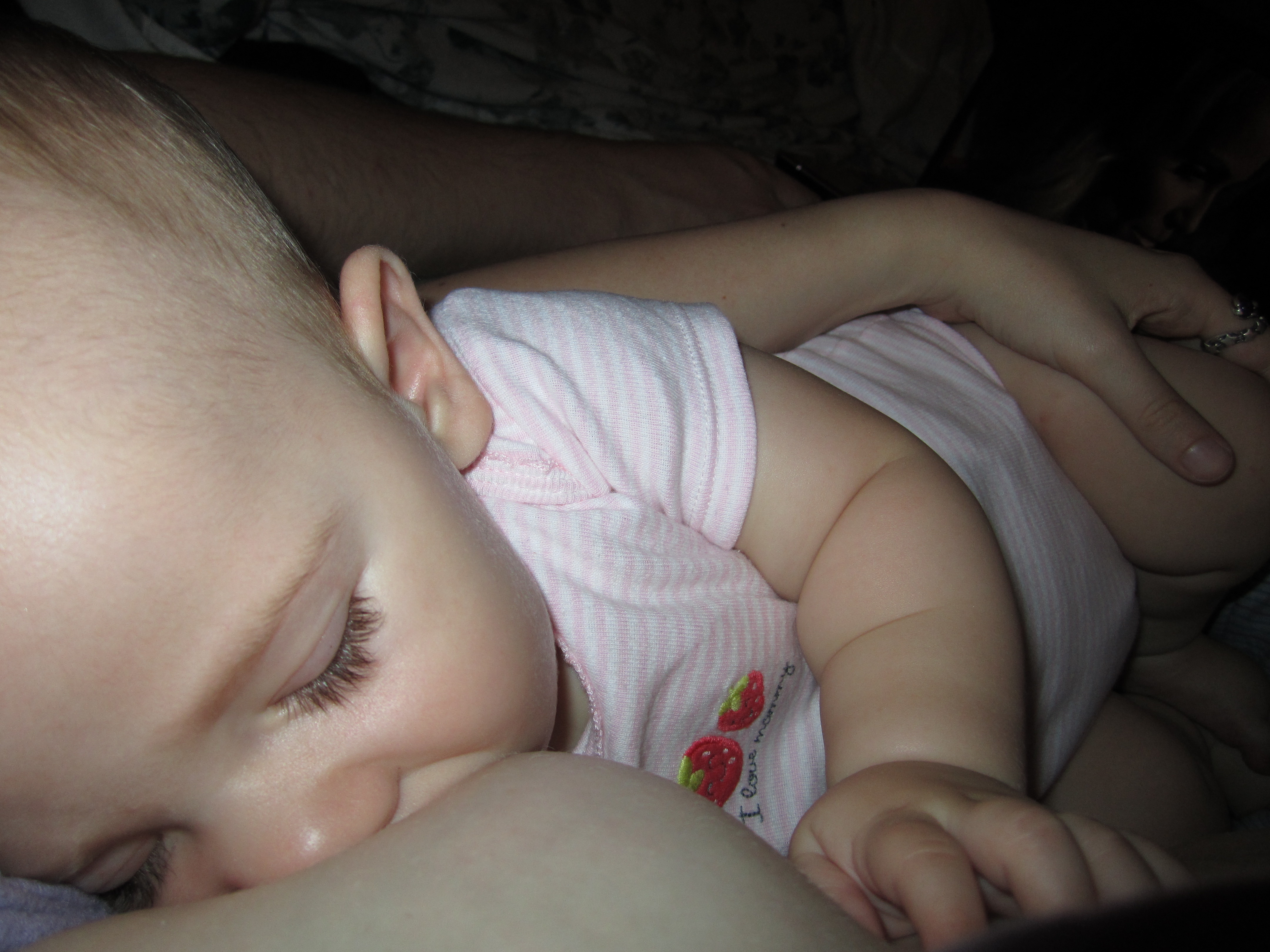
Then, last night while I was nursing her to sleep in my arms as I have done every night for five months, I took this picture myself to capture how well we fit together. I wanted to get how her little feet are nestled into my legs so perfectly and how her hands rests on me and how her head cradles in my arm:

I know this one isn’t a pro picture, but this is what it is like to be her mama 🙂

Poem: Sons

Every so often I wake up in the morning with a fully-formed poem in my mind. In 2006, five days after composing the poem below, I gave birth to my second son, Zander (just as seven dreams told me prenatally). Fantastic two-hour homebirth of a 9lbs 2oz baby!

Sons

I sense a future for myself as a mother of sons.

Curious, vibrant, full of life energy.

Will I be able to nurture them into

Good men?

Warm hearts, strong hands.

Compassionate, responsive, confident.

Happy and balanced in their lives.

For now, one son.

Not yet three.

Bright eyes, big smile

Wonderful way with words.

Generous with hugs and kisses and

“I so love you mommy!”

Loves slides at parks

And painting

And dictating sculptures.

Bursting with life and

Shining with possibility.

Full of ideas, words, and vigor.

The prospect of another waits

Close beneath my skin.

Thirty-nine weeks of mystery.

My sense of the future unfolding.

 ~~~~~

Molly Remer

5/24/06

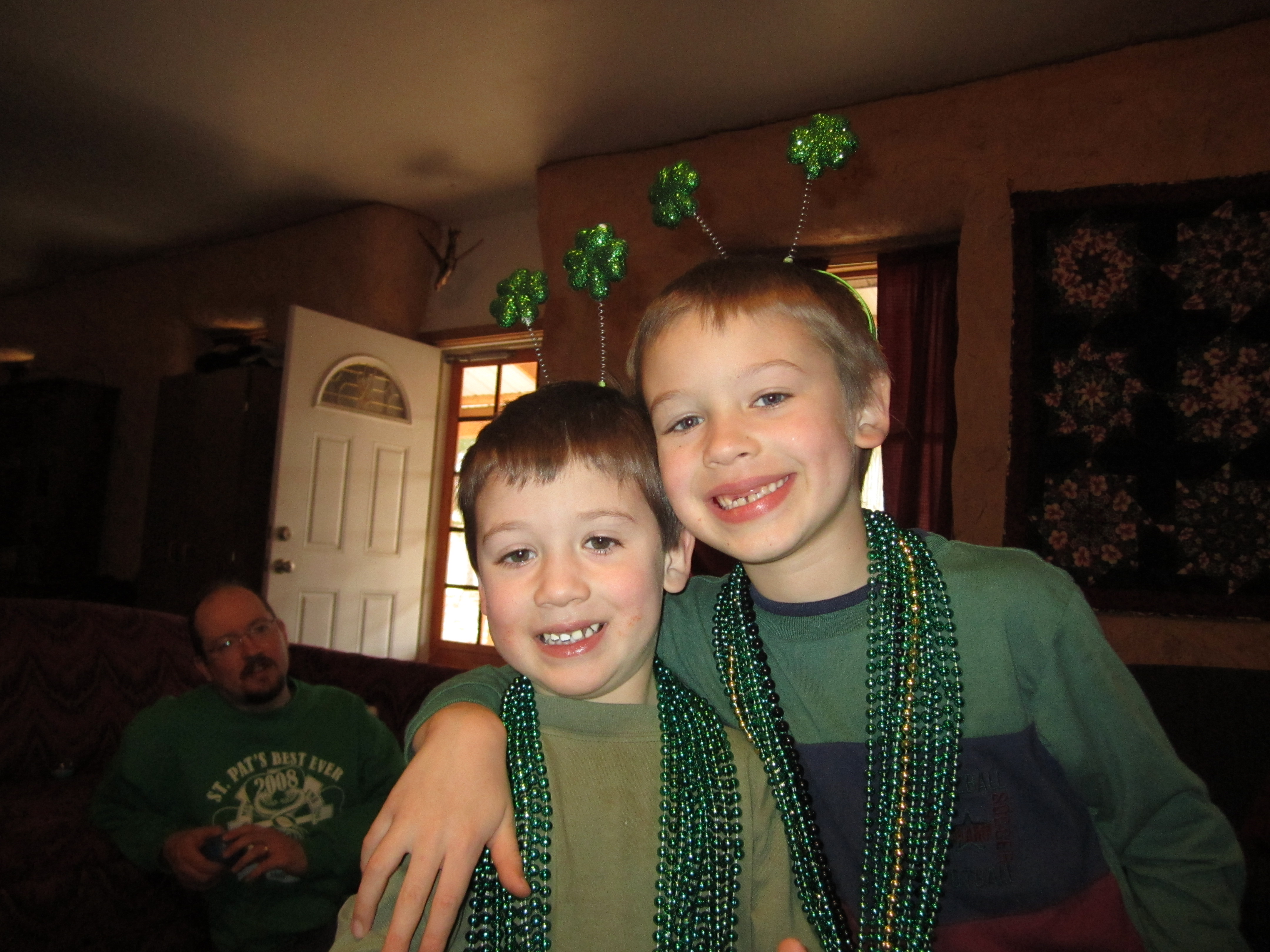
My sons: St. Pat's 2011

Abusive or Honest?

I recently finished reading the book, Breakthrough: How the 10 Greatest Discoveries in Medicine Saved Millions and Saved the World, which I got for free on my Kindle. The section about germ theory talked about Ignaz Semmelweis, of course, and his conviction that it was an “invisible particle” carried by physician to woman that was causing “childbed fever” to be a rampant problem in hospitals. (I appreciated that the book noted that mortality rates for women attended by midwives or giving birth in their own homes were very low compared to hospital-based physicians.) During the latter part of his life, Semmelweis became very agitated by the failure of his colleagues to recognize the validity of his theory of the cause of childbed fever and began sending them, “vicious letters.” An example included in the book was the following:

Your teaching, Herr Hofrath, is based on the dead bodies of women slaughtered through ignorance…If, sir, you continue to teach your students and midwives that puerperal fever is an ordinary disease, I proclaim you before God and the world to be an assassin…

The author goes on to explain that Semmelweis later died in a mental institution and that, “Ironically, some contend that Semmelweis’ final vitriolic attacks against his colleagues constituted a third key milestone: His abusive letters may have helped raise awareness years later, as other evidence for germ theory began to accumulate.”

I find it fascinating that his frustration and anger towards his colleagues is described as “abusive” and “vitriolic,” when Semmelweis wrote a book, presented papers, and spoke with other professionals at length about the issue and was dismissed and even mocked for his ideas. When his (correct!) theory continued to be ignored and women continued to die, isn’t he a little entitled to be angry and express that?! I think he was being honest in his letters, not abusive. It made me think of how women are dismissed as being “drama queens” for being upset about unnecessary cesareans and that the terms “birthrape” or “birth trauma” are viewed by some as too “extreme” and how the medical profession all too often continues to NOT practice evidence based maternity care with regard to a variety of issues from restrictions on freedom of movement, to continuous fetal monitoring without indication, to risky induction of labor procedures, to cesareans for “failure to progress.” In the future, these experiences and women’s and birth advocates’ “vitriolic” reactions to them may be viewed through the same lens in which I view Semmelweis’ attempts to share his findings—they were trying to tell people something really important after all.

In another section of the book, the author says, “Scientific medicine has never been shy to dismiss if not denigrate any perceived threat to its values or power.” We continue to regularly see this in maternity care today!

The Rhythm of Our Lives

This article was originally published in New Beginnings magazine (publication of La Leche League International) in 2007. As I’ve noted, I’m making an effort to “centralize” my written pieces into one location—bringing things here that I’ve written for other blogs or for other publications.

The Rhythm of Our Lives

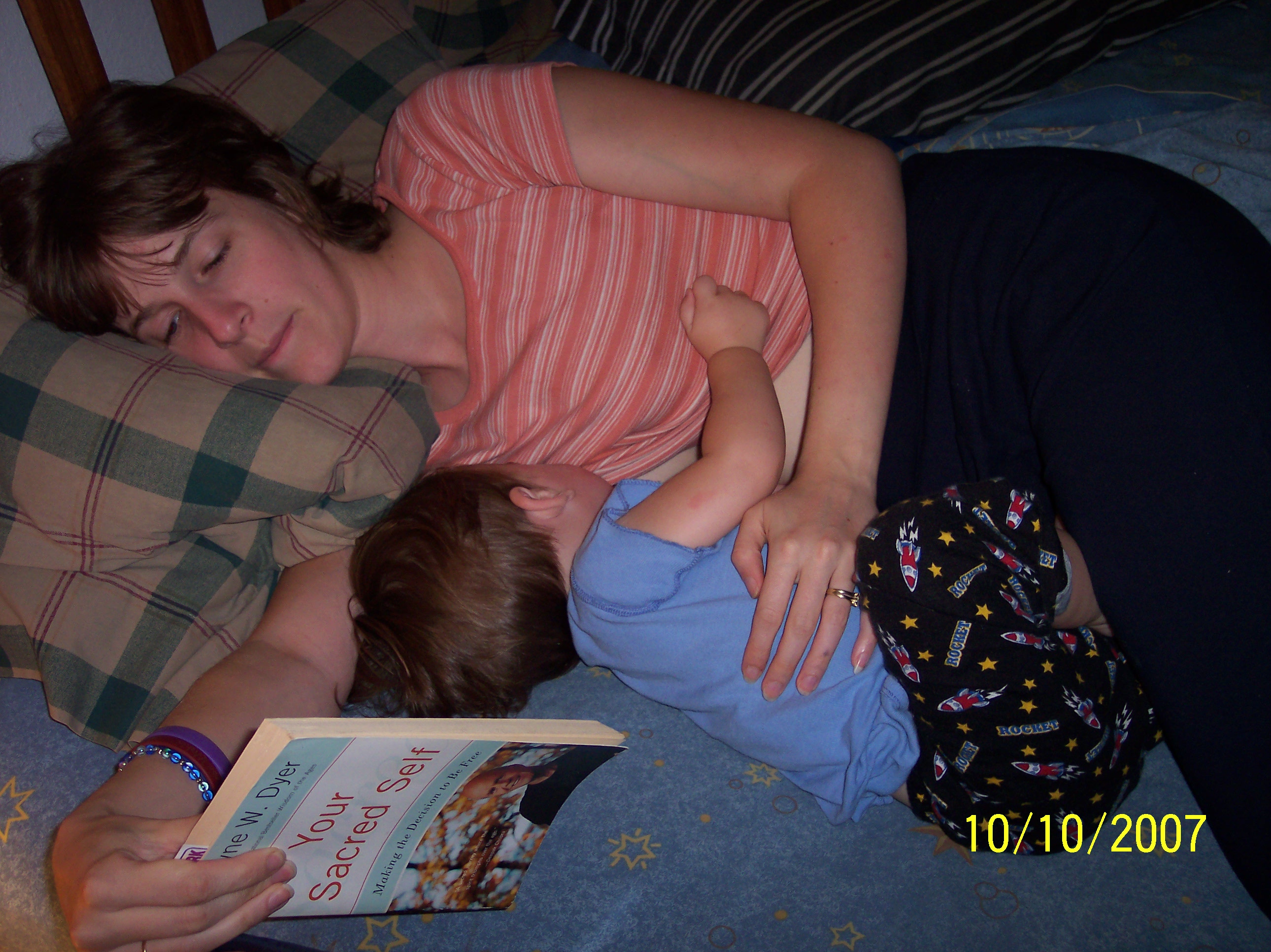
Nursing & Reading, 2007

by Molly Remer

2007

When I became a mother, many things in my life changed. I was startled and dismayed by the magnitude in which my free time diminished and one by one many of my leisure pursuits and hobbies were discarded. The time for one of my favorite hobbies increased exponentially, however, and this was a very pleasant surprise. That hobby is reading. As a child I was a voracious reader—my mother had to set a limit for me of “only two books a day.” In college and graduate school, reading for fun fell away and I spent six years reading primarily textbooks and journal articles. In the years following, I began to read for pleasure again and when my first baby was born in 2003, I once again became a truly avid reader. Why? Because of breastfeeding. As I nursed my little son, I read and read and read. I devoured mostly nonfiction with occasional fiction as “dessert.”

At first I scoured The Womanly Art of Breastfeeding and the Sears’ The Baby Book to try to make sense of my new life and then began to gobble up books about motherhood and women’s experiences of mothering. Reading did actually help me adjust to motherhood. Subtitled “Breastfeeding as a Spiritual Practice,” an article published in the fall 2003 issue of Mothering magazine was immensely meaningful to me. My baby was about two weeks old when the magazine arrived—the first issue I had received after his birth. This article was in it and it was exactly what I needed to read. Breastfeeding can be a meditative and spiritual act–it is actually a “practice” a “discipline” of sorts. The author, Leslie Davis, explains it better:

I realized I’d never before devoted myself to something so entirely. Of course I’ve devoted myself to my husband, to my family, to friends, to my writing, to mothering, and even to God and other spiritual endeavors at various points in my life…I’d completely given myself to this act of nursing in a way that I never had before. Nothing was more important than nursing my son. Nothing was put before it. There was no procrastination as with exercise, no excuses as with trying to stop eating sugar, no laziness as with housecleaning and other chores. Nursing had to be done, and I did it, over and over again, multiple times a day, for more than 800 days in a row. It was the closest thing to a spiritual practice that I’d ever experienced.

Viewing the act of breastfeeding through a spiritual lens like this was a lifeline to me as a vulnerable, sensitive, and bruised postpartum woman trying desperately to adjust my pace as an overachieving “successful” independent person to one spending hours in my nursing chair attached to a tiny mouth. I marvel at the uncountable number of times I spent nursing Lann and that I now spend nursing my second son, Zander. I calculate that I’ve probably nursed Zander about 3,000 times just lying down to go to sleep (nap or bedtime, plus waking up times too). That is just the lying down times, not the sitting in the chair or standing in the Ergo baby carrier times. This is the key to my reading success–I’ve had over 3,000 opportunities during the last year to pick up a book or other reading materials!

In 2007, I read approximately 150 books. I lie in my “nest” with my baby nursing and my older son resting near my back. The baby is nourished by me and in this pause in the busyness of life I am in turn nourished by the access he allows me to the printed word. As he grows bigger with my milk, I also “grow” intellectually and in the opportunity for spiritual and emotional renewal. As the baby drifts off I read to myself and when he is asleep I read stories to my four year old. This is the rhythm of our lives—suck, swallow, read, and consider.

——-

With my current baby, my reading “landscape” has changed again, since I now have a Kindle! 🙂

Happy Father’s Day!

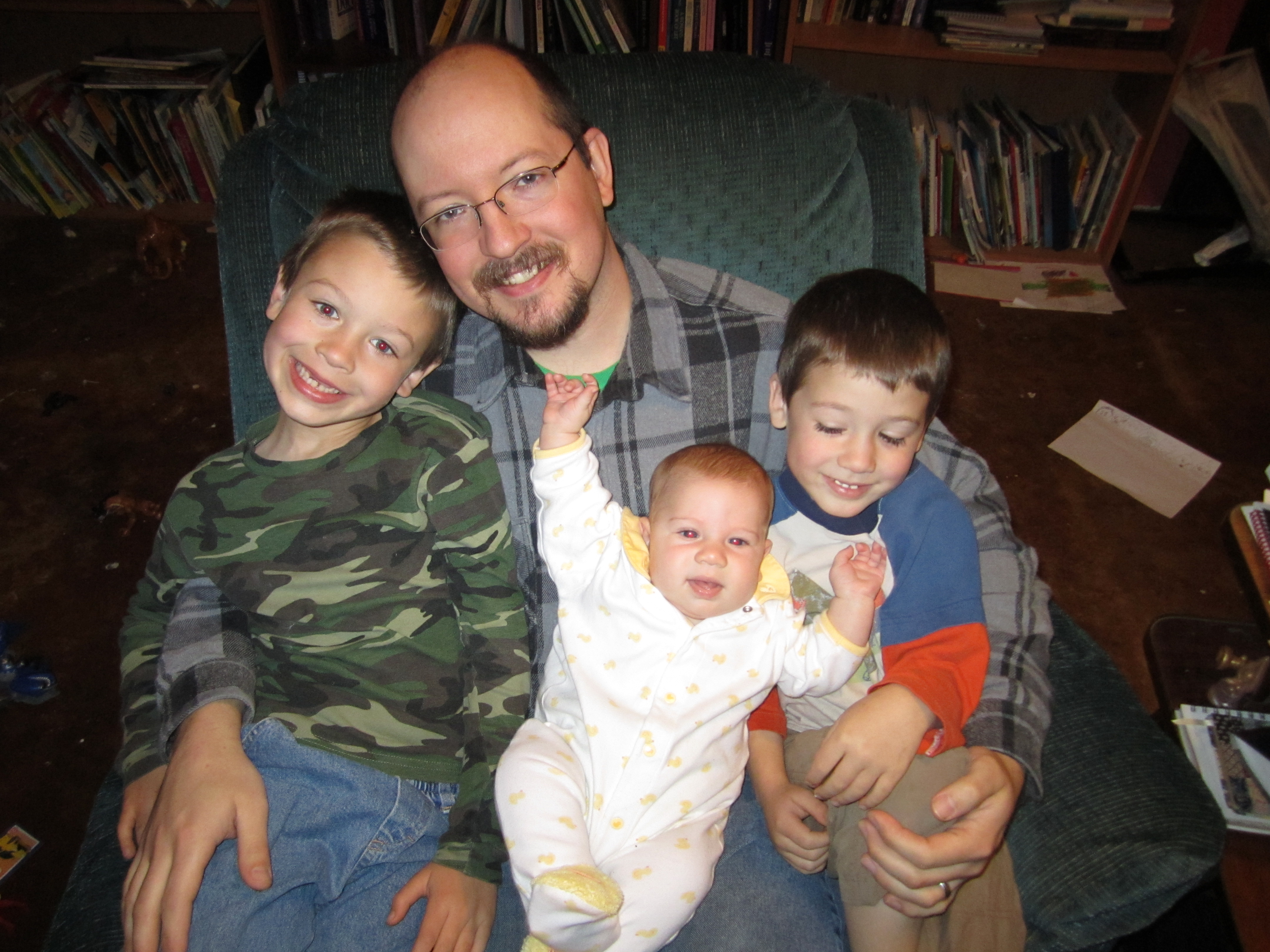
My man and his kids!

“No one can describe to a man what having his own child will mean to him. Words simply cannot do justice; each man needs to discover it for himself.”

“Fatherhood challenges us, but it also enlarges us and reshapes our perception of what is important in the world around us. As we take stock of this new world, we find that doing our job as a dad is inherently honorable and respectful, and brings to us the dignity that goes with the territory. Far from being emasculating, being a dad makes us men in the finest sense of the term.” —Dads Adventure

Both of the above quotes come from a wonderful article from Dads Adventure about The Dignity of Being a Dad. Make sure to check out the associated Father’s Day Flashmob in Denver and keep watching until the 3.5 minute point—loved this part especially and it made me cry! I really appreciate this new “brotherhood of dads” movement and hope it becomes widely known! I have used materials from Dads Adventure in my birth classes for quite some time. More often than not, the wife comments to me privately about how her husband appreciated receiving materials that were specifically for him.

Here are some links to past posts I’ve made about fatherhood:

And, from Mother’s Advocate, here is a great article with some specifics for new(ish) fathers:

Sex After Baby: A How-To Guide for Partners (an associated post called Sex, Lies, & the Postpartum Year is also very good)