The Tentative Pregnancy

I am going to try to switch much of my writing about my current pregnancy here, rather than keeping it on my miscarriage blog as I have been. My pregnancy experience is so entertwined with my loss experiences that I’ve been having trouble identifying the proper “home” for my posts on the subject. Barbara Katz Rothman used the phrase “the tentative pregnancy” when referring to the impact of amniocnetisis on pregnancy. I feel like I am experiencing that phenomenon with regard to pregnancy after loss (PAL). I just wrote about some of these feelings in depth on my other blog in this post: No “Safe” Point. I feel like I am constantly aware of being pregnant and yet somehow disconnected from it—like one level (body, mind, or emotions) is very aware and another level (mind, or is it emotions?) hasn’t taken on the pregnant identity. I guess I am experiencing the embodied experience of being pregnant—so, physical awareness—and yet psychologically and emotionally I have not taken “pregnant woman” into my identity again yet. Not sure if this is making sense, but it kind of does to me…

For someone who places such high value on pregnancy and birth as well as for someone whose professional work is centered around, “encouraging joy and confidence in childbearing,” this is an odd as well as kind of sad place to be in. We do not plan to have any more children and I really hope to find plenty of moments to celebrate and revel in this pregnancy—I told my friends already that I’m expecting to have the biggest blessingway EVER this time around! I really enjoy being pregnant. Feels like a state of health to me and I feel physically good while pregnant—strong, pretty, etc. This pregnancy has been a very physically smooth one just like my first two were—no nausea, no troublesome or painful pregnancy complications/symptoms, just feeling like I’m getting rounder and full of life and promise. However, there is a component of personal identification missing for me this time that I can’t quite pin down. Maybe it will

come with time. I think I’m going to do some more birth art and see what happens!

I am 18 weeks pregnant now and I haven’t shared any pictures in a while! The first of these was taken at 16 weeks (at a craft workshop we attended. The attentive among you will notice my lovely Cherokee basket in the background—I am inordinately proud of making this basket!) and the second was taken yesterday at 17w5d.

We had another ultrasound today (another changed feature of the pregnant landscape for me is that this is my most ultrasound-exposed baby EVER. I feel like I benefit more from the reassurance, than I fear risk from the u/s itself). We hoped to find out the baby’s gender—it is very important for me to know in advance this time around. The doctor first said boy, which is what I was feeling in my gut, but then he looked around some more and said he was definitely “flipping” his opinion to “girl.” So, essentially, I know as much as I did yesterday ;-D I really want to name this baby and to have a non “it” identity for it. I do not feel like trying to analyze or explain or justify this feeling. I just feel it.

So, this post is my first effort at bringing the “pregnant woman” identity back into my life. I haven’t started a baby book/pregnancy journal for this pregnancy yet and may not do so this time around. I then worry about the baby feeling unequally treated, etc., so I figure that this can be the baby I blog about. That will be its special something different—I’ve never blogged during a pregnancy before. With my first pregnancy, I participated extensively in a newsgroup and kept all of my postings from that in a big binder for my pregnancy memoir. I also had a specific pregnancy journal and a prenatal/baby book. With my second pregnancy, we did special things we hadn’t before like make a belly cast and have professional pregnancy pictures taken. And, I kept a special pregnancy journal and a prenatal/baby book (same exact one as with my first to be equal! I also did baby calendars for the first year of each of their lives—I wrote something in the calendar blank every single day for each of them! Yay me! No “maternal failure alert” light flashing here!). With my third pregnancy, I had started a special pregnancy journal and also a prenatal/baby book (again, the same one as with the previous children to be equal!). Then, when that pregnancy ended at 14w5d, I had to put those journals away and it hurt so much that I can’t quite manage to start one this time. I just write in my regular journal about it and I do have one of those same identical prenatal/baby books (I’m so equal!)  waiting. I think I will use it to write in after the baby is born (more than half of it is a baby book, the first section is the prenatal care record, which perhaps I will fill in retroactively). I also have one of those exact same baby calendars in my drawer (obtained when my first baby was still a baby—I plan ahead!) so that I can do the one-entry-every-day-of-first-year thing for this baby too. While I have blogged extensively about my loss experiences, I have not yet ever blogged during a pregnancy. So, maybe this can be this new baby’s special thing. 🙂
Honesty in Birth Preparation

Some time ago I came to the disheartening conclusion that what many independent birth educators like myself teach women in birth classes isn’t actually what they can expect, it is what they deserve. And, in our birth culture there can be a dramatic difference between the two. I then wrote an article exploring what many women can expect from a traditional hospital-based “natural” birth—it was published in Pathways magazine and has also made the rounds multiple times as a blog post. So, what then do women deserve? In my mind, they deserve: humane care; respectful, individualized treatment; freedom of movement and choice in a woman-honoring environment; informed consent; the Six Healthy Birth Practices; and the recognition that birth is a significant rite of passage and transformative life event. With this conviction, I therefore refuse to start teaching only what can be expected, because women deserve so very much more than that—but, how to professionally handle the dichotomy in class?

Published in the 80’s, the book Childbirth with Insight by Elizabeth Noble has some thoughts on the subject offer the birth educators of today. In the section addressing the issue of being honest with childbirth education clients about common obstetric practices, she says:

“…instructors in the community cannot afford to discuss obstetric practices in ways that will aggravate local hospitals and obstetricians if they wish to fill their classes. One childbirth educator comments, ‘Imagine if we told couples how it really was…perhaps we’d lose fewer teachers from our group.’ No wonder many of these dedicated and enthusiastic teachers suffer ‘childbirth preparation burnout.’ They are caught in a triple bind. If they describe accurately how birth is managed in some hospitals, couples would become very fearful. If expectant parents anticipate a warm and flexible birth environment and find that such is not the case in the hospital they use, their disappointment is inevitable and bitter. If the instructors advocate childbirth without drugs or anesthesia and these are needed, parents may harbor feelings of guilt and failure.”

The author concludes this segment of the discussion with a very potent and powerful message to birth educators:

“Each instructor must teach what she knows in her bones to be true. A dynamic teacher is constantly changing, becoming more self-aware. At the same time, couples must be warned that almost all hospitals and doctors have expectations based on the mechanical model of birth.” [emphasis mine]

This is such a difficult line to walk—to encourage confidence, trust, and joy in childbearing, while being straightforward about the challenges couples may face when seeking a natural birth experience in a hospital. I always encourage couples to “assume good intent” from hospital staff—they offer medication because they feel like they are helping and also simply because it is the primary “tool” in their medical-model oriented helping toolbox. I also remind them that routines are powerful and if the majority of births occurring at a specific hospital are induced, medicated, heavily intervened with, etc. it can be difficult to buck the trend. Again, not out of some sketchy motive from hospital staff, but simply because of routine or “this is what we always do” or “this is what mothers want from us.”

The very firey, bold, honest, and passionate 1990’s manifesto on VBAC, Open Season even more bluntly addresses the issue of transparency in maternity care and also the effectiveness of childbirth education in this quote:

“If childbirth classes really ‘worked,’ more women would be having babies without interference. More women would be recognizing the complete naturalness of birth and would remain at home, delivering their infants with feelings of confidence and trust. More and more, midwives would be demanded. The names of those hospitals and doctors who treated women and babies with anything less than absolute respect would be public knowledge, and childbirth classes would be the first place these names would be discussed. ‘You’re seeing What’s-His-Face? He’s a pig! In my opinion, of course,’ I tell people who come to my classes. I then proceed to give them the names of people who have used Pig-face. They can always ask Dr. P. for the names of people who have used him and been satisfied with their births, for balance.”

While I’m not personally to the point of taking the “Dr. Pig-face” approach from Open Season, I’ve decided that honesty is the best policy and I’ve started to be very upfront about my challenge with the couples in my classes. Lately, I say, “here’s where I’m wrestling with something. I’m teaching you what you deserve, but it isn’t necessarily what you can expect…” and we proceed to explore choices, talk about communication skills, talk about evidence-based care, making sure the care provider’s words and actions thus far are matching, etc. However, my basic dilemma remains—I am not changing a broken system by teaching individual couples how to navigate it more satisfactorily, I’m actually supporting the broken system (right?!). While one-on-one change efforts have value and are personally rewarding, what I know in my bones to be true is that what we actually need is widespread maternity care reform and systemic change on a global level…

(I originally posted some content from this post on the ICEA blog.)

Childbirth Educator as Midwife…

“Expectant mothers need to be mothered; their hearts need to be infused with love, confidence, and determination. I now see myself as ‘midwife’ to the gestation and birth of women as mothers.”

–Pam England

This is a beautiful quote that really speaks to how I wish to work with women and what I would like to accomplish.

As I’ve noted before, I have a big binder of back issues of  the International Journal of Childbirth Education and they are a real treasure. Here are several quotes that relate to the sentiment above:

From the Sept. 1999 issue in an article called The Challenge of Change: Making Mother-Friendly Care a Reality in Childbirth Education by Mayri Sagady comes a discussion of educator as “banker” or “midwife”:

[the concept of]..traditional education as ‘banking.’ This is where the role of the teacher is to ‘make deposits of information’ into the student’s mind. The student’s job is simply to ‘store the deposits’…the teacher as midwife [is explained as] ‘Midwife-teachers are the opposite of banker teachers. While the bankers deposit knowledge in the learner’s head, the midwives draw it out. They assist the students in giving birth to their own ideas, in making their own tacit knowledge explicit and elaborating it’…Within the field of childbirth education today, there are surely both ‘bankers’ and ‘midwife-teachers’

Then in the December 1999 issue in an article by Celeste Phillips called Family-Centered Maternity Care: Past, Present, & Future, she offers three challenges for 21st century birthing educators:

+”Help men and women understand that birth itself has the potential to change lives for the better.”

+”Give women a sense of fulfillment and tremendous accomplishment.”

+”Give new parents a strong connection to the very essence of life.”

These are formidable—and exciting—tasks! I think it is important to examine our own birth education programs to see how well we are meeting these challenges and also to strive to serve our clients as midwife-teachers rather than as of bankers of information.

And circling back around to my opening quote,  I am reminded of another good one, this one from Midwifery Today’s founder/editor, Jan Tritten:

“You will have ideas, options and paths to ponder, but you will also have a sense of possible directions to take as you consider midwifery, childbirth education, or being a doula or an activist. Your path may be circular or straight, but meanwhile you can serve motherbaby while on the path, with a destination clearly in mind.” She also says, “I use the word midwife to refer to all birth practitioners. Whether you are a mother, doula, educator, or understanding doctor or nurse you are doing midwifery when you care for motherbaby.” (emphasis mine)

Ecstatic Birth

The beautifully organized hormonal symphony of labor was mentioned by several speakers at the CAPPA conference in North Carolina.

Here are two lovely quotes from Sarah Buckley about ecstatic birth and the role of birthing hormones:

“Giving birth in ecstasy: This is our birthright and our body’s intent. Mother Nature, in her wisdom, prescribes birthing hormones that take us outside (ec) our usual state (stasis), so that we can be transformed on every level as we enter motherhood.” –Sarah Buckley

“This exquisite hormonal orchestration unfolds optimally when birth is undisturbed, enhancing safety for both mother and baby. Science is also increasingly discovering what we realise as mothers – that our way of birth affects us life-long, both mother and baby, and that an ecstatic birth —
a birth that takes us beyond our self — is the gift of a life-time.” –Sarah Buckle

While I definitely do not feel like “orgasmic” is an accurate descriptor of my own birth experiences, I really like the term “ecstatic birth.” According to Sarah’s descriptions/definitions of ecstatic birth, I feel like I’ve had three ecstatic births (including a second-tri miscarriage-birth—the hormonal “symphony” was the same as with full-term labor and my sense of exhilaration and accomplishment and almost “pride” was the same as with my other babies, except then I also had the accompanying overwhelming grief at not having a living baby to exalt over).

When I think about the term “ecstatic birth” and recall my own feelings and experiences, I think I’m thinking of the immediate post-birth ecstasy/euphoria I experienced and still remember so profoundly. The I DID IT moments. And too, the other-plane-of-existence feelings/consciousness of being in labor and working in harmony with my body. The Laborland stuff—which is that indescribable, surrendered, sort of “hypnotized” state of truly embodied experience.

Self-Renewal Tips for Mothers

Based on responses to the now-closed giveaway I hosted for the book The Mother’s Guide to Self-Renewal, here are some great self-renewal tips from readers:

  1. My favorite self-renewal tip is to get some sea salt (fine ground), safflower oil and your favorite essential oil (I use lavender) and make some homeade salt scrub (you could use sugar of course). I take it in the bathroom and give myself a foot massage with it. Ahhhh. It might not be life changing, but it sure rejuvenates.

  2. Okay, here’s my tip – it’s hard, but oh so worth it – COLD shower. Nicest way: warm up the bathroom, and massage yourself all over with almond oil (can scent with a few drops of essential oil of your choice), then when you are read, step in and out of the cold water about three times til it doesn’t feel cold anymore – it will knock the breath out of you and leave you feeling amazing, awake and re-energized.

    If you can’t quite manage the whole thing, doing your face, hands and feet isn’t bad either.

    Don’t do it in pregnancy or in the first three days of your period.

  3. I sleep in!  When I can, that is! When I can’t I bake. Baking is therapeutic to me, and it’s an “unnecessary” bit of cooking that smells divine and is often something sweet. 
  4. Reading a good book is a great way I love to self-renew.

  5. I knit and have been using lavender to help me sleep when I get pregnancy insomnia at 3 in the morning.
  6. I love a hot bath (BY MYSELF). I don’t get to do it often as my boys love bathing with mummy. But a good soak and dimmed lights often leave me feeling new again. Especially if you have special bubble bath or salts that only get used by you.
  7. My favorite tip for self-renewal is making time for yoga. Yoga is a tremendous physical and spiritual practice for me, and when nothing else is right, it usually is.

  8. Self-renewel tip: I love music. Pop in my favorite cd. Turn it up and dance and sing until everything else fades away

    • I drive around aimlessly in my car and listen to my music as loud as I can! This dissipates my moodiness in just minutes. Another favorite renewal activity is hiking by myself as often as I can.
    • Tip: I love to take time out for coffee with friends or a birth movie night with my doula sisters!

    • My favorite tip is getting a pedicure and reading a magazine. It makes me feel better.

    • Yoga, baths, and footbaths are my favorite recharges. Thanks!

    • My favorite way to recharge is to take foot bath. Boil some hot water, find a nice quiet location, put on some soft music, or just listen to the birds outside your window. Pick some fresh herbs, (or use essential oils) like lavender, lemon, mint, cinnamon and just put your feet in and relax. If you have some river rocks you can put those in the bottom of your pan and roll your feet over them, and you get a massage and a foot bath!
    • I love to renew by reading a good book and holding my son…who is 4

    Childbirth Education Curriculum Preparation Resources

    Recently, I received a question from a new childbirth educator seeking resources for developing her class curriculum. I emailed her back with a couple of ideas and thought I would also share them here. Here are several of the most useful tools I’ve discovered for birth class curriculum development:

    • Prepared Childbirth, The Family Way: Educator’s Guide (from www.thefamilyway.com)
    • The teaching manuals sold (very affordably) by ICEA are EXTREMELY useful: Family-Centered Education: The Process of Teaching Birth is one of my favorites as is Teaching Pregnancy, Birth and Parenting. If you can get the ICEA Educator’s Guide, it is quite useful too (they used to sell it for around $7, but I don’t see it on their site right now).
    • Empowering Women: Teaching Active Birth, by Andrea Robertson is a class resource for developing birth classes—can be hard to find lately though.
    • I love The Pink Kit for all kinds of strategies and information about the pelvis and working with pelvic mobility.
    • Transition to Parenthood has a full curriculum outline available online as well as several great handouts and activities.

    The ICEA resources have been my overall favorite, though I’ve added things from all kinds of other sources, as no single resource everything I want to share in a class-—I add information from all kinds of books, videos, reading, journal articles, etc. Every class I teach is a little bit different because I add and subtract things all the time! I only have one page outline for each week of class and it is PLENTY. I do not use power points or anything like that. Just me, lots of hands-on activities, a few visual aids, and the rapport established with my clients.

    Good luck with your journey and enjoy making these classes your own!

    And What’s This? More Birth Quotes!

    I decided to split my most recent Facebook quote sharing into two posts, because it was becoming overwhelmingly long. These are the quotes I’ve shared on the Citizens for Midwifery Facebook page since April. While I realize that I don’t “own” these quotes—other people said them, not me!—I do have quite a bit of legwork invested in seeking and sharing these quotes (I mostly get them from my own reading) and if you re-post one or more of them on your own Facebook page, blog post, or book, I really appreciate acknowledgement and/or link back to this site or to my FB page, that this is where you originally got the quote!

    ‎”When a woman births without drugs…she learns that she is strong and powerful…She learns to trust herself, even in the face of powerful authority figures. Once she realizes her own strength and power, she will have a different attitude for the rest of her life, about pain, illness, disease, fatigue, and difficult situations.” –Polly Perez

    “It is a curious commentary on our society that we tolerate all degrees of explicitness in our literature and mass media as regards sex and violence, but the normal act of breastfeeding is taboo.” – American Academy of Pediatrics (via Baby Bloom Doula Service)

    “The way a society views a pregnant and birthing woman, reflects how that society views women as a whole. If women are considered weak in their most powerful moments, what does that mean?” –Marcie Macari

    “Attempting to fulfill an idea of the ‘perfect’ mother can only prove soul-destroying, as no such person exists.” –Adela Stockton

    “In the sheltered simplicity of the first days after a baby is born, one sees again the magical closed circle, the miraculous sense of two people existing only for each other.” –Anne Morrow Lindbergh

    Giving birth is an experience carried not only into the first days of motherhood but also throughout life, having far-reaching effects on the mother’s self-esteem and confidence.” –Gayle Peterson

    ‎”I think one of the best things we could do would be to help women/parents/families discover their own birth power, from within themselves. And to let them know it’s always been there, they just needed to tap into it.” –John H. Kennell, MD

    “As doulas, midwives, nurses, and doctors, it’s important to never underestimate how deeply entrusted we are with someone’s most vulnerable, raw, authentic self. We witness their heroic journeys, see them emerge with their babies, hearts wide open…” –Lesley Everest (MotherWit Doula)

    “…advocates of home birth have never suggested that *all* women should give birth at home, only that it is a reasonable choice for some women. Given that rather modest claim, the force and vehemence with which home birth is opposed by ACOG seems out of all proportion.” –Elizabeth Armstrong (Princeton University)

    “Few healthy, low-risk mothers require technology-intensive care…Yet…the typical childbirth experience has been transformed into a morass of wires, tubes, machines and medications that leave healthy women immobilized, vulnerable to high levels of surgery and burdened with physical and emotional health concerns…” –Maureen Corry (quoted in Lamaze International‘s journal)

    “At a time when Mother Nature prescribes awe and ecstasy, we have injections, examinations, and [cord] clamping… Instead of body heat and skin to skin contact, we have separation…Where time should stand still for those eternal moments of first contact as mother and baby fall deeply in love, we have haste to deliver  the placenta and clean up for the next ‘case.'” –Sarah Buckley

    “Who am I to be brilliant, gorgeous, talented, fabulous? Actually, who are you not to be?” – Marianne Williamson

    “…celebrate ourselves for our courage to birth. The real question becomes not, ‘Have you done your breathing exercises?’ but rather, ‘Can you love yourself no matter how you birth, where you birth, or what the outcome?'” –Claudia Panuthos

    “Whenever a woman has a problem, I believe that she herself can find the answer, provided she is given adequate information and support. I firmly believe in women’s strength and resourcefulness; I’ve witnessed these time and again. Women care about the continuation and continuity of life; they are intrigued by relationships, how things fit together.” –Elizabeth Davis

    “Deep relaxation, surrender, letting go: when midwives are asked to disclose the secret of giving birth with relative ease, these are the words we choose. More than metaphors for coping, these responses are based on physiological imperatives…” –Elizabeth Davis

    “The greatest joy is to become a mother; the second greatest is to be a midwife.” –Norwegian Proverb

    ‎”Brick walls eventually crumble precisely because people keep busting their heads against them.” –Barbara Wilson-Clay (IBCLC)

    “Some midwives pull women up the hill and say I will get you through this. Other midwives walk behind quietly and gently say, ‘I believe in you.'” -Patricia M. Couch (via Wellpregnancy Childbirth Educator Trainings and Childbirth Classes)

    ‎”In our own world today, motherhood is rarely sufficiently honored. One day each year, there are brunches and corsages and little gifts of love. But the rest of the time? As a culture, we do not respect the great gift of mothering. Women’s work in raising the next generation is taken for granted. Yet it is a vital service to humanity, one that deserves to be acknowledged continually.” –Patricia Monaghan

    ‎”Becoming a mother does not need to rob you of your selfhood. Stay away from martyrdom. Martyrs never make good mothers; what is gained in giving is taken away in guilt.” –Gayle Peterson

    “The midwife cannot be skilled without being caring. She cannot be truly caring without being skilled.” –Sheila Kitzinger

    “The two most beautiful sights I have witnessed in my life are a full blown ship at sail and the round-bellied pregnant female.” –Benjamin Franklin

    “When you have a baby, your own creative training begins. Because of your child, you are now finding new powers and performing amazing feats.” –Elaine Martin

    “…in a time lacking in truth and uncertainty and filled with anguish and despair, no woman should be shamefaced in attempting to give back to the world, through her work, a portion of its lost heart.” –Louise Bogan

    “If the baby’s body is a joy and a delight in the mother’s arms, that same body will become a joy and a delight to its owner later on.” –English & Pearson

    “Even if I am simply one more woman laying one more brick in the foundation of a new and more humane world, it is enough to make me rise eagerly from my bed each morning and face the challenge of breaking the historic silence that has held women captive for so long.” –Judy Chicago

    “Children are the power and the beauty of the future. Like tiny falcons we can release their hearts and minds, and send them soaring, gathering the air to their wings…” –Skip Berry

    “Mama exhorted her children at every opportunity to ‘jump at de sun.’ We might  not land on the sun, but at least we would get off the ground.”- Zora  Neale Hurston (via Literary Mama)

    “That they can strengthen through the empowerment of others is essential wisdom often gathered by women. “—Mary Field Belenky (via Applaud Women)

    “Since beliefs affect physiologic functions, how women and men discuss the process of pregnancy and birth can have a negative or positive effect on the women that are involved in the discussion. Our words are powerful and either reinforce or undermine the power of women and their bodies.” –Debra Bingham (I was inspired to share this quote today by a conversation with Kerry Tuschhoff 🙂

    “Learn to respect this sacred moment of birth, as fragile, as fleeting, as elusive as dawn.” ~ Frederick Leboyer (via From Womb to Cradle Doula Services)

    ‎”It takes force, mighty force, to restrain an instinctual animal in the moment of performing a bodily function, especially birth. Have we successfully used intellectual fear to overpower the instinctual fear of a birthing human, so she will now submit to actions that otherwise would make her bite and kick and run for the hills?” –Sister Morningstar (in Midwifery Today)

    “Birth is women’s business; it is the business of our bodies. And our bodies are indeed wondrous, from our monthly cycles to the awesome power inherent in the act of giving birth.” –Sarah Buckley

    “When a man is truly ‘present’ for the birth of his child and allows himself to be touched by the mystery unfolding before his eyes, he will have an unquestionable experience that can catapult him into the next phase of his development as a mature human being. His encounter with the power of birth…can connect him to his partner and his child in ways that sustain him for the rest of his life.” –John Franklin

    “When he becomes a father, a man leaves behind his life as a single individual and expands into a more inclusive role. He becomes a link in an unbroken chain. And in doing so, he himself undergoes a birth process–the birth of himself as a father.” –John Franklin (FatherBirth)

    ‎”We are volcanoes. When we women offer our experience as our truth, all the maps change. There are new mountains. That’s what I want to hear–to hear you erupting. You Mount St. Helenses who don’t know the power in you–I want to hear you…If we don’t tell our truth, who will?” –Ursula K. Le Guin

    “For most people, modern life meanders along a path of ups and downs, by and large devoid of high-voltage experiences that have the power to alter our lives in significant ways…The birth of a child is one of those significant experiences.” –John & Cher Franklin (FatherBirth)

    “Pregnancy and labor are periods of vulnerability. This vulnerability is not weakness, but softness, which later contributes to adjustment to motherhood. Feeling dependent may open you to your need for help, and the ability to accept help from others can increase your strength and endurance for labor. Each of us must come to terms with our own feminine strength and our need for protection.” –Gayle Peterson (An Easier Childbirth)

    “Labor is also teamwork. It is a mother and baby learning together how to push and how to be born, how to yield and separate from the union of pregnancy. You are not in control nor are you out of control during labor. The best way to approach labor is with an attitude of learning rather than controlling.” –Gayle Peterson (An Easier Childbirth)

    “Midwifery calls upon you to be the best you can be: the best advocate, guide, healer, counselor, mother, comrade, and confidant of the women seeking your care.”— Anne Frye

    “The birth of a baby is the birth of family. Myriad births take place at once: Women become mothers, husbands become fathers, daughters become sisters, and sons become brothers. One birth ripples through generations, creating subtle shifts and rearrangements in the family web.” –Gayle Peterson

    “The family’s trust in the midwife and the midwife’s trust in the competence of the family members are the basis of caring that has the power of magic.” ~ Mary C. Howell (from Midwifery Today e-news)

    “Birth is not a cerebral event; it is a visceral-holistic process which requires all of your self–body, heart, emotion, mind, spirit.” –Baraka Bethany Elihu (Birthing Ourselves into Being)

    “Fear is completely intertwined with what we experience as labor pain…And it is the fear in our physicians and nurses as much as the fear within ourselves.” –Suzanne Arms (Immaculate Deception II)

    “There is no place for ideology in birthing. Each birth has its own story and we must respond to what the baby tells us.” –Spinning Babies.com (via Kelly Caldwell)

    I do think there is a place for ideologies/philosophies about birth and as guides for humane care/practice and as guides for making prenatal care and birth care decisions (before the birth), but in the actual moment, release of attachment is often necessary.

    “To be pregnant is to be vitally alive, thoroughly woman, and undoubtedly inhabited.” ~Anne Buchanan (via CAPPA)

    “Your doc/friend/mother-in-law may be saying, ‘Don’t be a hero, get the epidural!’ But this isn’t about heroics, this is about protecting your body…” –Jennifer Block (via @Spirited Doula Services)

    “Giving birth in ecstasy: This is our birthright and our body’s intent. Mother Nature, in her wisdom, prescribes birthing hormones that take us outside (ec) our usual state (stasis), so that we can be transformed on every level as we enter motherhood.” –Sarah Buckley

    “The mystery of life and birth is a profound invitation to be authentic as you trust and tremble your way through labor’s Gates of doubt and fear. It is possible that you will become more intuitive during labor than at any other time…Allow your body to guide you in your breathing, in your unique movement, in knowing …what to do…even when you don’t know what to do.” –Pam England (The Labyrinth of Birth)

    “Every great dream begins with a dreamer. Always remember, you have within you the strength, the patience and the passion to reach for the stars to change the world.” ~ Harriet Tubman (via Midwifery Today e-news)

    “Midwives can create a spirit of beauty at a birth or they can desecrate it. They can create a sacred space around a birthing woman that drives out fear & inspires the mother’s belief in herself, which ultimately determines the outcome of the birth. Midwives can be a channel of Grace in ways they never imagined & in doing so they create a spirit of reverence. Reverence in these days and times is not a common thing.” Caroline Wise, Birthing with Reverence (Midwifery Today)

    Re: “advice” for someone who is pregnant: “…if you know that you are pregnant and if you know when you conceived your baby and you think that everything’s okay, doctors can probably do nothing for you. Women need to realize that the role of medicine in pregnancy is very limited…What’s important is for a mom-to-be to be happy, to eat well, to adapt her lifestyle to her pregnancy, to do whatever she likes to do…I think that’s what we have to explain to women. They have to realize that doctors have very limited power.” –Michel Odent (in Optimal Birth)

    Birth Quotes Update

    Time for my semi-regular re-sharing of birth quotes I’ve shared on my Talk Birth Facebook page in the last several months (there are also a few grief/miscarriage quotes mixed in as well as some activism quotes too). While I realize that I don’t “own” these quotes—other people said them, not me!—I do have quite a bit of legwork invested in seeking and sharing these quotes (I mostly get them from my own reading) and if you re-post one or more of them on your own Facebook page, blog post, or book, I really appreciate acknowledgement and/or link back to this site or to my FB page, that this is where you originally got the quote!

    “…in not disturbing the laboring woman you’re not handing over all control to her…it’s not a question of handing control to the laboring woman, it’s a question of *not controlling* her…while she’s in labor and giving birth physiologically, she’s going to seem well and truly out of control–totally wild!–so the issue of control seems a pretty irrelevant one really.” –Sylvie Donna (Optimal Birth)

    “I see my body as an instrument, rather than an ornament.” ~Alanis Morissette, quoted in Reader’s Digest, March 2000 via Denver Doula

    ‎”Expectant mothers need to be mothered; their hearts need to be infused with love, confidence, and determination. I now see myself as ‘midwife’ to the gestation and birth of women as mothers.” –Pam England (Birthing from Within)

    ‎[re: “surrender” during labor] “…She may refer to this as the feeling of surrender; but this kind of surrender is a gift, not something she herself did with her mind. At this point the body truly takes over and the thinking mind recedes into the background. This may be how women historically and presently, are able to labor without mental suffering and without pain medication.” –Pam England (Labyrinth of Birth)

    This feels true from my personal experiences–I feel like the most important thing anyone can know about birth is to welcome that surrender (to let go of control) and also about the value of *freedom* in enabling the surrender to happen (freedom in the physical space–i.e. no one “letting” you drink or not drink or labor in bed or out of bed).

    “[re: ecstatic birth] This exquisite hormonal orchestration unfolds optimally when birth is undisturbed, enhancing safety for both mother and baby. Science is also increasingly discovering what we realise as mothers – that our way of birth affects us life-long, both mother and baby, and that an ecstatic birth —
    a birth that takes us beyond our self — is the gift of a life-time.” –Sarah Buckley

    “When you don’t follow your nature there is a hole in the universe where you were supposed to be.” –Dane Rudhyar (via Marian Thompson, LLL Founder)

    ‎”Birth is what women do. Women are privileged to stand in such power! Birth stretches a woman’s limits in every sense. To allow such stretching of one’s limits is the challenge of pregnancy, birth, and parenting. The challenge is to be fully present and to allow the process because of inner trust. How can women find their power, claim it, and stand firm in it throughout?” –Elizabeth Noble

    (Her answer: “vertical birth”–thus, to quite literally STAND in one’s birth power!)

    ‎”…it is not easy for women to lay claim to our life-giving power. How are we to reclaim that which has been declared fearful, polluting and yet unimportant? How are women to name as sacred the actual physical birth, which comes with no sacred ritual…?” –Elizabeth Dodson Gray

    ‎”A woman’s path to power is more like engaging life’s energies in a swirling movement filling us up, out, into wholeness.” –Lois Stovall

    “The body has its own way of knowing, a knowing that has little to do with logic, and much to do with truth, little to do with control, and much to do with acceptance…” –Marilyn Sewell (via Mothering Magazine‘s pregnancy e-newsletters)

    “…much of what passes for childbirth education and preparation today actually increases women’s fears by giving them too much concrete information to hang their anxiety on, and too many names for all the bad things they already fear will happen. In the course of trying to calm the higher brain by giving it lots of data, we can end up defeating our purpose by feeding our fears.” –Suzanne Arms (Immaculate Deception II)

    “We take for granted in the United States that childbirth is a multi-million dollar industry. It’s as simple as that–women’s bodies and the act of creation are intertwined with the economy. What if our relationship with body and womb and birth was in every sense of the word FREE? What if we didn’t need managed care? Literally or figuratively?” –Baraka Bethany Elihu (Birthing Ourselves into Being)

    Reader responded with a question about, “how do we teach our children about birth?” and this was my short answer:

    I think by talking about is as something that is a “normal” as can be–i.e. not scary and dangerous–and by not “hiding” birth from them like it is a secret. My kids have seen all kinds of natural birth videos, pictures in books, etc. When …my older son was only 3 1/2 he drew me a picture with the baby attached to the mom with an umbilical cord (both with big smiles on their faces) and the placenta in bowl next to them (which of course couldn’t actually be there unless the baby was not still attached to the mom with the cord). 🙂

    “I am starting to see that a woman’s strength in birth is also in the letting go and allowing herself to tumble fearlessly with the current, never losing sight of the belief that, when the energy of the tide is through, she will find herself upright again on the shore.” –Maria (at the blog A Mom is Born)

    “Because parents are transients in the maternity care system, there is little cumulative birth experience over successive generations of mothers. Women giving birth don’t make the same mistakes as their mothers or grandmothers–they make new ones.” –Elizabeth Noble (Childbirth with Insight)

    ‎”Those who push themselves to climb the last hill, cross the finish line, or conquer a challenging dance routine often report feelings of euphoria and increased self-esteem…women who experience natural birth often describe similar feelings of exaltation and increased self-esteem. These feelings of accomplishment, confidence, and strength have the potential to transform women’s lives…In many cultures, the runner who completes the long race is admired, but it is not acknowledged that the laboring woman may experience the same life-altering feelings…” -Giving Birth with Confidence (Lamaze International)

    “Fathers’ sharing in the birth experience can be a stimulus for men’s freedom to nurture, and a sign of changing relationships between men and women. In the same way, women’s freedom to give birth at home is a political decision, an assertion of determination to reclaim the experience of birth. Birth at home is about changing society.” –Sheila Kitzinger

    (Emphasis mine.) Posted in honor of Independence Day!

    I’ve noted that many women (including myself) cite “freedom” as one of the main reasons they choose out-of-hospital birth…

    ‎”Labor is not a time to judge ourselves but a period for reflecting on our movement through life at a given moment. It is not possible to control labor, it is only possible to follow the process and to meet whatever it may offer.” –Gayle Peterson (An Easier Childbirth)

    “There is an urgent need for childbirth education for doctors and nurses so that, instead of superimposing a medical perception of birth, professional helpers listen to, learn from, and respect women’s experiences. Only in this way shall we be able to humanize the culture of birth.” –Sheila Kitzinger (forward in An …Easier Childbirth by Gayle Peterson)

    The book was written in 1993 and I think we still haven’t figured that out yet…:(

    ‎”The absolute miracle of a birth and the emergence of a new human being into the world catapults both mother and father into the realm of awe and wonder. They are flooded with non-ordinary feelings and energies that support a deep connection not only with the newborn and each other, but also with the mystery and power of life itself.” –John & Cher Franklin

    ‎”A strong woman knows she has strength enough for the journey, but a woman of strength knows it is in the journey where she will become strong.”

    “A strong woman isn’t afraid of anything, but a woman of strength shows courage in the midst of her fear.” (from the same “Woman of Strength” poem as above quote, author unknown, many internet versions floating around)

    “When I dare to be powerful–to use my strength in the service of my vision–then it becomes less and less important whether I am afraid.” –Audre Lorde

    “Despite hundreds of years of negative programming, labor and birth can be a soul-stirring experience!” —Christiane Northrup, MD

    “The labor and birth experience itself is a microcosmic slice of what fathering asks of a man.” –John Franklin (FatherBirth)

    ‎”…an experience of the phenomenal capacity of our birthing body can give us an enduring sense of our own power as women. Birth is the beginning of life; the beginning of mothering, and of fathering. We all deserve a good beginning.” –Sarah J. Buckley

    “Birth privacy is important because it fosters FREEDOM and that sense of freedom is fundamental to birthing unhindered and with joy.” –Molly Remer (my contribution to the book/DVD giveaway on Orgasmic Birth: The Best Kept Secret (fan page))

    “Cautious, careful people, always casting about to preserve their reputation and social standing, never can bring about a reform.” Susan B. Anthony

    “When I say painless, please understand, I don’t mean you will not feel anything. What you will feel is a lot of pressure; you will feel the might of creation move through you. Pain, however, is associated with something gone wrong. Childbirth is a lot of hard work, and the sensations that accompany it are very strong, but there is nothing wrong with labor.” –Giuditta Tornetta

    Love this –the “might of creation.” How true!

    “Day by day, month by month, year by year we are confronted with all that we do not know, that we do not understand, that we do not grasp. Sometimes we are humbled by this knowledge and say: God, it is too wonderful for me to comprehend but I know this universe is more grand and more beautiful than I ever could have imagined and I give thanks for the blessing of being here and seeing, hearing, experiencing, and sensing all that is so wonderful around and in me…” –Susan L. Suchocki

    “Life is full and overflowing with the new. But it is necessary to empty out the old to make room for the new to enter.” —Eileen Caddy

    “Once the baby is born, your life will change forever. It will change in so many ways, and until you get there you simply can’t be told. The joys, the sorrows, the excitement, the fear, the frustrations–in fact, I think all the adjectives in the world couldn’t describe what is in store for you.” –Giuditta Tornetta

    ‎”I love to think that the day you’re born, you’re given to the world as a birthday present.” –Leo Buscaglia (shared on my second son’s fourth birthday)

    “Wherever women gather together failure is impossible.” –Susan B. Anthony

    “I believe with all my heart that women’s birth noises are often the seat of their power. It’s like a primal birth song, meeting the pain with sound, singing their babies forth. I’ve had my eardrums roared out on
    occasions, but I love it. Every time. Never let anyone tell you not to make noise in labor. Roar your babies out, Mamas. Roar.” –Louisa Wales

    “…The motherhood mosaic has pieces that are dark and dull, but it’s a work that shines.” –Carol Weston

    “Women’s bodies have near-perfect knowledge of childbirth; it’s when their brains get involved that things can go wrong.” –Peggy Vincent (via Sweet Miracles

    “A child strips away our illusions that we are perfect, that we have it all figured out, that we are all grown up. In fact, we grow up with our children if we are willing to remain open to their innate goodness as well as our own.” –Peggy O’Mara

    “The suckling relationship is one of the sources of real sweetness that we have in human existence…The suckling baby can teach adults about the expression of sweet love and gratitude in a way no words can.”
    –Ina May Gaskin

    “Unfortunately, birthing woman has not only lost touch with her body and with her ancient female lineage. She has also lost her voice to speak up, to question intervention, to ask for support, to demand respect for the work of giving birth and caring for her infant. When she finds that voice, she will regain a vital part of her creativity and power as a woman.” –Suzanne Arms (Immaculate Deception II)

    “Pregnancy is a time of being in touch with the power of creation itself.” –Rahima Baldwin & Terra Richardson

    “We ourselves feel that what we are doing is just a drop in the ocean. But the ocean would be less because of that missing drop.” –Mother Teresa

    ‎”Childbirth calls into question our very existence, requiring an expectant couple to confront not only new life but death, pain, fear, and, most of all, change.” –Elizabeth Noble (quoting a new mother)

    “Hope is the thing with feathers, That perches in the soul, And sings the tune without the words, And never stops at all…” –Emily Dickinson

    ‎”We may tell ourselves that birth is a natural and safe process and recall our childbirth teacher’s emphasis that a woman’s body is designed for giving birth, but our own bodies may hold a different truth. It is essential to honor body memory, as it wields far more influence than the intellect during labor.” –Gayle Peterson (in An Easier Childbirth re: working through birth memories in preparation for future births)

    “If a community values its children, it must cherish its mothers.” -John Bowlby

    “Just as a tree grows best when anchored firmly in the earth, so can a pregnant mother feel strong and capable when supported by a sisterhood of nurturing friends.” -April Lussier

    “Planning for birth is like getting ready for an athletic event…You can’t predict exactly what is going to happen; the events of the game will unfold according to their own particular logic, and not necessarily
    according to your plan.” –Adrienne Lieberman

    “If we don’t take care of mothers, they can’t take care of their babies.” –Jeanne Driscoll

    “And I also know how important it is in life not necessarily to be strong but to feel strong, to measure yourself at least once, to find yourself at least once in the most ancient of human conditions, facing blind, deaf stone alone, with nothing to help you but your own hands and your own head…” –Christopher McCandless

    ‎”When you are drawing up your list of life’s miracles, you might place near the top the first moment your baby smiles at you.” –Bob Greene

    I have crystal clear memories of my second baby’s first smile (the day of birth–looking into my eyes) and of my first baby’s first laugh. Less clear memories of the FIRST smile for my firstborn and first laugh for my second. I guess it is good that they each get one of the special, miracle moments!

    “Midwives do NOT empower women. Only women can empower themselves. If you’ve been empowered through birth, thank your midwife for holding the space – but know that it was surely YOU that created and walked the journey” -Pamela Hines (via Barbara Herrera)

    “Though we have lost a petal, we are still flowers, lush and full together in a garden of hope.” -Angie M. Yingst

    ‎”Once her endorphins have kicked in, a woman may actually enjoy labor or may even find it an ecstatic experience. I have many times told the story of one of my clients who was crying and desperate in early labor, only to be smiling and dancing around the room at nine centimeters’ dilation.”–Elizabeth Davis

    “Life shrinks or expands in proportion to one’s courage.” –Anais Nin

    “Giving birth requires an honest surrendering of your body and soul. You need to be in a relaxed state of love. Love has a way of overpowering fear. The more energy-draining feelings you can unload, the more room you will have for bliss and simplicity. Birth can be an unfolding and emergence like something you’ve never experienced before.” –Lynn Griesemer

    “Labor is like mothering: you prepare and do the best you can, but finally, most of it is out of your hands. Birth is a great mystery. Yet we live in a rational, scientific world that doesn’t allow for mystery…” –Jennifer Louden

    ‎”Although the popularly desired outcome is ‘Healthy mother, healthy baby,’ I think there is room in that equation for ‘Happy, non-traumatized, empowered and elated mother and baby.’” –Ashley Booth Youn

    [in reference to before she had her baby] “…I thought the only thing that was important…was to have a healthy baby. Now I recognize that while this is the primary goal, it is not the only goal. Birth is such an emotional experience; it can give or take away so much more than I ever realized…it will change you in such a wonderful and powerful way. It gave me more strength than I ever imagined. Since then, whenever I become overwhelmed, all I have do to is say, ‘I had a baby in my home!’ I am instantly empowered.”–Jody Niekamp (in Journey into Motherhood)

    ‎”10% of births needfully culminate in intervention. Self-esteem depends on salvaging the most important truth from your experience: Birth cannot be controlled. It is a mystery.” –Karen Fisk

    “As doulas, midwives, nurses, and doctors, it’s important to never underestimate how deeply entrusted we are with someone’s most vulnerable, raw, authentic self. We witness their heroic journeys, see them emerge with their babies, hearts wide open…” –Lesley Everest (MotherWit Doula)

    “Not every woman experiences unaided, natural childbirth, yet many women hope for it. To strive for birth as a peak experience—to withstand this ‘trial by fire’–a woman must learn what labor pain is and be prepared to accept and work with it. And she must also prepare for the unexpected.” –Karen Fisk

    ‎”It is so easy to close down to risk, to protect ourselves against change and growth. But no baby bird emerges without first destroying the perfect egg sheltering it. We must risk being raw and fresh and awkward. For without such openness, life will not penetrate us anew. Unless we are open, we will not be filled.” –Patricia Monaghan

    “A Life may last for just a moment…. but a memory can make that moment last forever…” (Unknown)

    “Birth is an experience that demonstrates that life is not merely function and utility, but form and beauty.” –Christopher Largen

    “Birth matters. It brings us into being, on many levels.” –Ananda Lowe

    ‎”The way a society views a pregnant and birthing woman, reflects how that society views women as a whole. If women are considered weak in their most powerful moments, what does that mean?” –Marcie Macari

    “Shrouding information about birth in silence hides the fact that labor and birthing pain is a positive key to transformation. Preparation for and expectation of that pain leads to self-awareness. Thus, birth becomes not only a passage for your child, but a passage for you into instinctual and effective parenting.” –Karen Fisk

    Of Dolls and Breasts

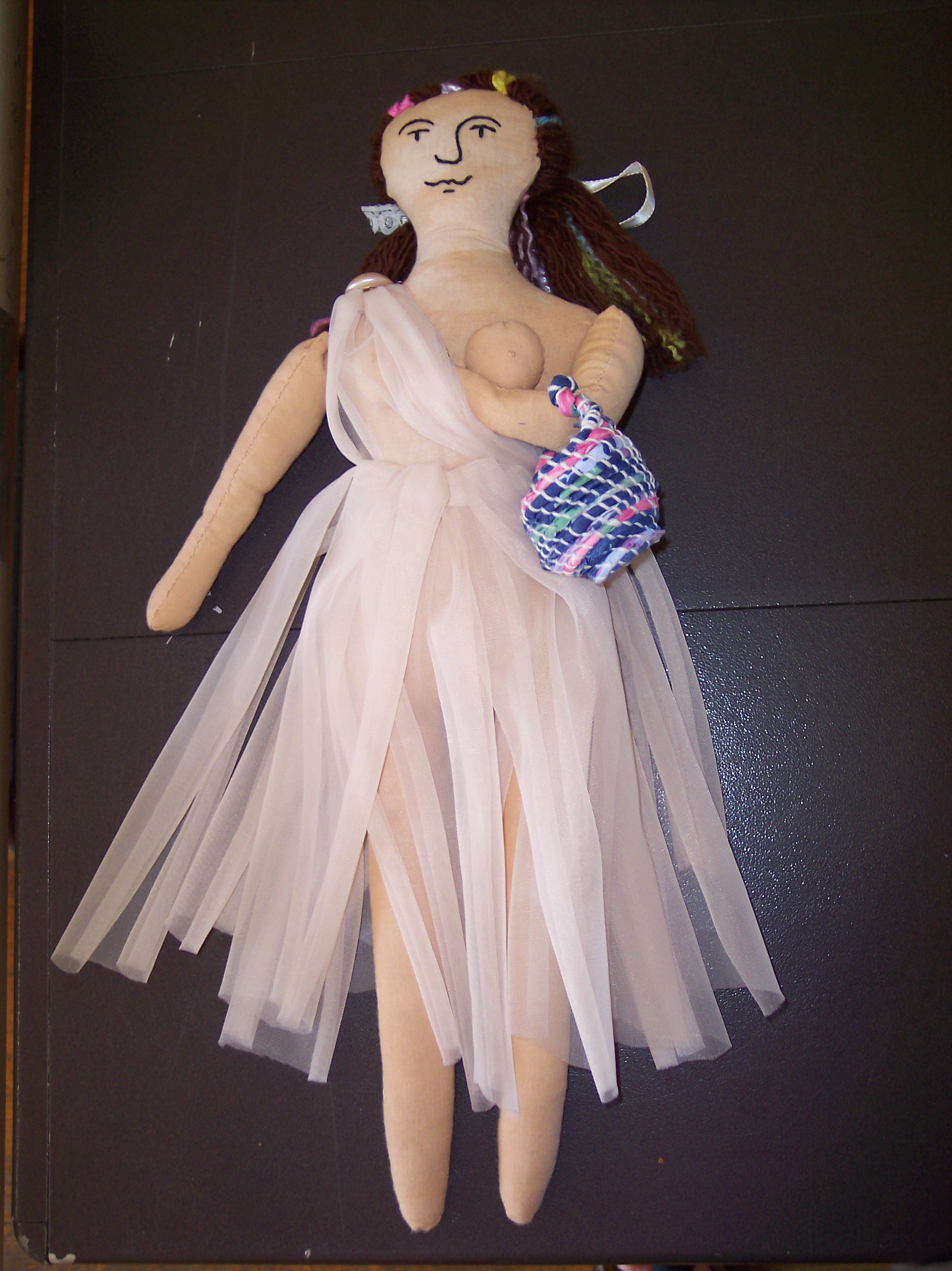
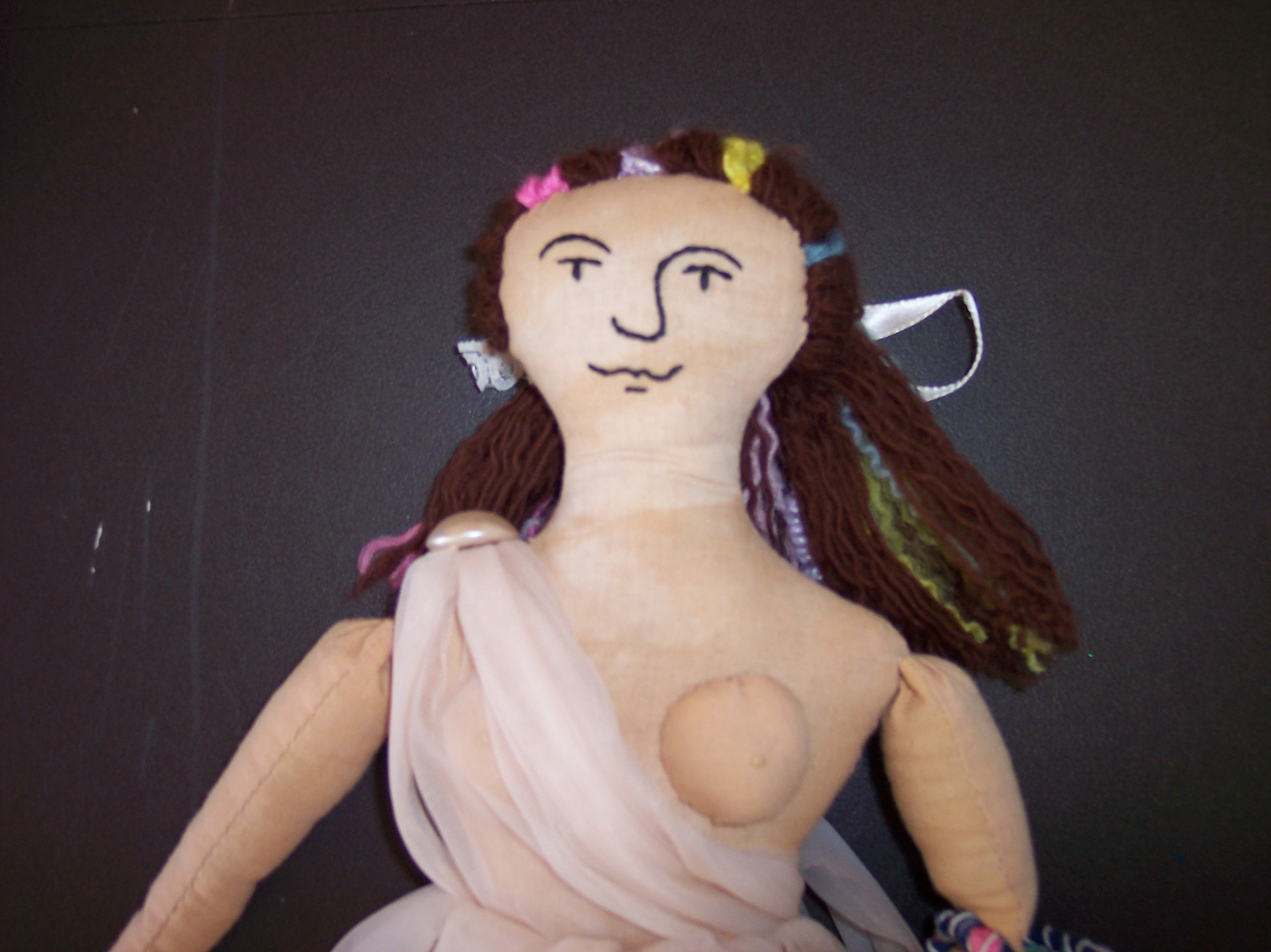
    Since it is still World Breastfeeding Week, I have another breast-related post for today! I just returned from an annual craft workshop that I attend with my family. One of the workshop teachers and her daughter made this doll—named Pandora—for the “director’s challenge” (make a project using these random items from a bag). I loved her and tried very hard to win her in the silent auction, but her creator outbid me on her at the very last minute! The exposed breast with nipple was apparently very disturbing to some other workshop attendees, because someone anonymously kept pulling the gauze over to cover up the other breast. And, then someone else would uncover it (sometimes this someone was me). Finally, someone actually wrapped a paper towel all across her upper body, so no breasts were visible!

    While I do understand this somewhat from a “modesty” perspective, or “there are kids here!” I think it is symptomatic of a real issue with breasts in our wider culture and the very real implications for breastfeeding. What if breasts were just normal? How would our world look? What would happen to breastfeeding rates? Not just breastfeeding initiation rates—which are high, but then fall alarmingly once women leave the hospital and have to face breastfeeding in the real world where many, many people, think a tiny little doll breast needs to be covered with paper towels [what on earth do they think of a real, human-sized breast with a baby attached to it?! Horrors!]—but breastfeeding rates at 6, 12, and 18 months?

    I think breasts are cool, so I was kind of annoyed by this little back and forthing with the covering of the doll breast during the workshop. However, it also reminded me WHY (when removed from my personal little breastfeeding/woman-celebrating subculture), people get hung up on breastfeeding in public, etc. Because a large majority of people think breasts should be hidden tidily away (unless selling beer or music or any number of things—then it is okay to show quite a lot of breast—but, no nipples please!). It was then that my attention was drawn to my large collection of pregnancy/birth/breastfeeding/goddess pendants and I realized how very many of my pieces of jewelry have breasts (many with nipples). Sorry to offend, Mainstream Culture, but I still think breasts are cool and worthy of jewelry-celebration (both as fabulous baby-feeders as well as just respecting/honoring women’s wonderful bodies—not as sex-objects, but as life giving, miraculous creations! How would our whole world change if everyone viewed women this way?) and I’m sorry that so many people oversexualize them to the extent that a nifty little doll like this has to be covered up with paper towels! I still wish I would have won her, but photos will have to do!

    Nighttime Breastfeeding and Depression?

    Since it is World Breastfeeding Week this week, it seems fitting to have a post about breastfeeding! I just read a guest post by Kathleen Kendall-Tackett at Science and Sensibility about the (flawed) recommendation that mothers avoid breastfeeding at night as a depression-reduction strategy. The conclusion of the post referenced above was: “The results of these previous studies are remarkably consistent. Breastfeeding mothers are less tired and get more sleep than their formula- or mixed-feeding counterparts. And this lowers their risk for depression.”

    I, too, have noticed the advice often in popular culture to, “let dad take a night feeding so mom can get more sleep.” It doesn’t seem to really hold up in practice (or in research).

    My personal experiences as a breastfeeding mother–-even of a newborn—was that I most often felt, “surprisingly well-rested.” I experienced little to no of the classic sleep-deprived mother signs and I attributed this to breastfeeding. I marveled at the sense of perfect nighttime harmony that I experienced with my babies–-I remember saying, “during the day, he confuses me, but at night it is like we are in perfect harmony.” The symbiosis of waking seconds before baby needed to nurse amazed me. And, since they slept right next to me it was extremely easy to not completely waken. As they got older, I would often wake in the morning not able to clearly recall whether I had woken during the night at all–-and if so, how many times-–though, baby would be on a different side, so I knew I must have!

    As toddlers, both my boys went through a period of extra-night nursing and being very rough while nursing at night and I remember saying–-“hey, I’m more sleep-disrupted now with a two year old than with a two month old! What’s up?!” (and this was my cue that night weaning was a good idea).

    Though, I feel it is also important to say that I have seen some pretty serious sleep deprivation cases as a breastfeeding counselor that have made me realize that breastfeeding on demand all night CAN, individually speaking, be a link to depression in some mothers. However, I think various practitioners take anecdotal experiences too seriously in making blanket recommendations-–either anecdotal from personal experience or from very serious client cases. On the flip-side, this can also include me! I recognize in myself that my positive night-nursing experiences and sense of nighttime harmony and symbiosis, etc. skew my own approaches to working with breastfeeding mothers on sleep issues–-I feel that in a few cases, I have failed to take seriously several mothers’ concerns about night nursing, because I had personal blinders on about my own harmonious experiences and thought they must certainly be exaggerating (and/or culturally conditioned to see a “problem,” where none really existed other than popular opinion about babies being able to “sleep through the night”).