Tag Archive | childbirth education

Lamaze: Pregnancy, Birth, & Beyond

In addition to the Healthy Birth guides I posted about in my last post, I also received my first shipment of Lamaze’s new publication, Lamaze: Pregnancy, Birth & Beyond. This magazine is excellent! I was very favorably impressed. It is brief, but provides an excellent, positive, overall overview of pregnancy, birth, and early parenting. I found myself thinking that if I could give only ONE handout in class, this would probably be the one to choose, since it neatly touches all the important bases and in the tone of confidence, trust, and respect that Lamaze does so well. There is a particularly good article called “Position Statement” that reviews the pros and cons of 11 different positions for labor. It has great photo illustrations as well as clear, accurate information.

I was really pleased with this magazine. The articles are clearly written and easy to understand and takes a clear position on the normal, healthy nature of birth. I also appreciated the articles for new parents about taking care of yourself after the baby’s birth, safe sleeping, and breastfeeding. It is important to remember the continuum extends from pregnancy, through birth, and on to breastfeeding and newborn care! Childbirth educators can sign up to receive their own free shipments of these magazines here. It is published once a year, but shipped quarterly.

There is advertising for disposable diapers as Huggies is a sponsor of the magazine, but absolutely NO formula or bottle advertising, which, of course, is no less than I’d expect from Lamaze and their philosophy.

Speaking of Lamaze, I also really enjoy their basic guide, Giving Birth with Confidence.
Do Epidurals Impact Breastfeeding?

There was a question recently on a list I belong to about the impact of epidurals on breastfeeding. The person asking the question had been told by several hospital based childbirth educators that epidurals do not “cross the placenta’ and thus do not have an impact on the baby. Since this is an issue of concern, I thought I’d share some of my response/thoughts regarding this question here. I was happy to hear Linda J. Smith speak at the LLLI conference luncheon session about this very issue–the impact of birth practices on breastfeeding–and she covered a ton of material about the impact of epidurals on breastfeeding (she also wrote a book on the same topic with the late Mary Kroeger). There is some good information, though much less complete, on her site. The biggest problems with epidurals are the impact on the mother rather than the baby, though the medications used in epidurals DO cross the placenta and get to the baby, they are much less seriously impactful than IV or IM narcotics. An epidural refers to the means of medication delivery not what is actually being delivered into the body, so it is hard to say definitively that one has no effect, because different anesthesiologists use different “cocktails” of drugs in their epidurals. They usually use bupivacaine as the anesthetic, but there are opoids included as well, such as *morphine* or other related opoids like that.

All the books I have as a CBE say that medications used in epidurals do make it to the baby, but effects vary. Most effects are connected to what is happening to mom—i.e. mother gets a fever as a side effect of the meds and that stresses baby. Fluid overloading leads to more fluid in baby’s lungs, etc. The main breastfeeding impact on the mother’s side is excess fluid retention in the breasts due to the fluid “bolus” administered prior to an epidural. Baby is a little sleepy following birth and then can’t latch to severely swollen breasts (which are not “normally” engorged, but excessively so due to excess fluid), and so it goes. You often hear from mothers that their nipples are “too flat” for the baby to latch on to and as you probe further you find that the flatness has NOTHING to do with the mother’s true anatomy, but has to do with that excess fluid. Women are so programmed to look inward and blame themselves for problems that it is really unfortunate (like mothers who “aren’t making enough milk” when it is really a pump with bad suction).

Basically most breastfeeding problems that have to do with birth practices are not correctly attributed to the source—the birth practices—and are instead blamed on the mother (“flat nipples”), the baby (“lazy suck”), or breastfeeding (“sometimes it just doesn’t work out”).


How to Use a Hospital Bed Without Lying Down

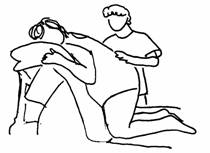
In classes, I often suggest that when couples enter their hospital room in labor they pile all of their belongings onto the bed rather than the laboring woman hopping into it. I encourage people to start seeing the bed as a tool they can actively use during labor, rather than a place for labor and birth to passively happen to you. To that end, I’ve made a little handout called “helpful ways to use a hospital bed without lying down.” I’m uploading it here in hopes that others may find it useful as well.

Kneeling & leaning on back of hospital bedFor more about the importance of freedom of movement during labor, make sure to check out Lamaze’s Healthy Birth Practice paper: Walk, Move Around, and Change Positions Throughout Labor or this video clip from Mother’s Advocate.

Top Five Birth Plan…

Birth plans are a topic often discussed in birth classes. There are SO many things that could be put onto a birth plan that sometimes it is difficult to sort out the most important. I encourage couples in my classes to complete two different “values clarification” exercises to help them include those things on their plan that are MOST important to them, rather than trying to cover everything on a one page birth plan. They often ask what I think is important to include. So, recently I started thinking that if I needed to create a birth plan for a birth in hospital that was as normal and natural as possible and could only include five elements, what would be most important to me, my baby, and a normal birth?

These are my top five after first going into the hospital as late in labor as possible (this isn’t included on my birth plan and doesn’t need to be on anyone’s birth plan–“I plan to labor at home as long as possible”–because it isn’t relevant by the time you get there and people are reading your plan. It belongs on your own personal plan, but not in your “official” plan):

  1. No pitocin.
  2. Minimal fetal monitoring and preferably with a Doppler only.
  3. Freedom of movement throughout labor (stay out of bed, use it as an active tool rather than as a place to lie down. Stay upright during any necessary monitoring.)
  4. Push with the urge in whatever position works best for me (NO coached, directed, or “cheerleader” style pushing).
  5. Baby immediately to me. NO separation.

House of Babies

During my classes, we talk about how media portrayals of birth impact our perceptions and expectations as well as contribute to our fears about birth. Often media portrayals of birth have a tense, “emergency” atmosphere, with lots of rushing around and communicate that birth is a dangerous, medical event requiring rescuing by medical teams. Usually, when I bring this up, people in my classes nod in agreement and have lots of examples to share. However, in the last two classes, women have responded, “well, on House of Babies, I saw…” or “in House of Babies…” or “House of Babies isn’t like that.” Well, cool! I think I need to see House of Babies! (I don’t get any TV channels though, so alas, I can’t see it. Someone in my current class offered to show me a recording of it though, so I’m excited to see it).

I’m encouraged to know that there are shows like this with positive, affirming messages reaching women and showing them what birth can be like in a supportive, midwifery model of care atmosphere.

“Balanced” Information?

Occasionally I read that someone is planning to take a hospital sponsored birth class because they feel they will get more “balanced” information. This usually seems to be said with regard to medications “versus” natural birth. There is an excellent discussion about this issue in the book Mother’s Intention: How Belief Shapes Birth.

“Let us look at [the word] ‘balanced’ first…’to make two parts exactly equal.’ What if the two parts are not equal? What if a parent will be making decisions that will affect her and her baby with both short and long term consequences? Is it fair to distort reality so that the information she has to choose from seems ‘equal,’ even though it really isn’t? Why would a parent want information that appears balanced, but isn’t factual?”

From my perspective, independent classes are better able to provide you with truly helpful, accurate, and factual information (even though they might not feel “balanced” towards all interventions/options), because the educator is working for you and not for an institution.

Climate of Confidence, Climate of Doubt

Recently I finished reading (and reviewing) the new book Our Bodies, Ourselves: Pregnancy & Birth. In the opening chapter, they identify a concept that I have *felt* for some time, but hadn’t really put a finger on. The authors refer to it as a “climate of confidence” and a “climate of doubt.” I love this way of articulating the messages swirling around pregnant women in our society.

A Climate of Doubt comes from “The media’s preference for portraying emergency situations, and doctors saving babies, sends a message that birth is fraught with danger. Other factors, including the way doctors are trained, financial incentives in the health care system, and a rushed, risk-averse society, also contribute to the popular perception that childbirth is an unbearably painful, risky process to be ‘managed’ in a hospital with the use of many tests, drugs, and procedures. In such an environment, the high-tech medical care that is essential for a small proportion of mothers and babies has become the norm for almost everyone…[a] ‘climate of doubt’ that increases women’s anxiety and fear.”

A Climate of Confidence “reinforces women’s strengths and abilities and minimizes fear. Some of the factors that nourish a climate of confidence include high-quality prenatal care; healthy food and time to rest and exercise; a safe work and home environment; childbearing leave; clear, accurate information about pregnancy and birth; encouragement, love and support from those close to you; and skilled and compassionate health care providers.”

——-
I encourage my birth class clients to consider ways in which they can create a climate of confidence in their lives as they prepare for their births and their babies.

New, Free Breastfeeding Guide from LLLI!

La Leche League International has completely redone their catalog–the layout and appearance have received a stunning makeover and the result is a beautiful new “pocket guide” called “Breastfeeding Guide: tips & products.” So, instead of being a catalog, it is actually a helpful little booklet first and a catalog second (the products come in the second half of the booklet, after the tips. 26 pages of questions answered and then 25 pages of catalog–pocket sized though, so maybe 3 x 5?). For being so small, it covers a remarkable amount of territory and gives lots of good information–from “How often will my baby nurse?” to “When will baby sleep all night?” to “Is it possible to breastfeed twins?” It is a great little *book* not just a catalog. I love it and think it was a stroke of genius to reach out this way! The format is inspired (and inspiring!)

Childbirth educators, doulas, and lactation consultants wishing to acquire many of these Guides in bulk to distribute to their clients can do so for only the cost of shipping! ($5.41 for 50 little books!) Go to the LLLI online store to order some. They really are a lovely and useful resource!

Evidence Based Care Fact Sheet (& Mother Friendly Care)

In Sept. 2007, Citizens for Midwifery published a useful new fact sheet summarizing the evidence basis for the 10 Steps for Mother-Friendly Care. The fact sheet is two sided and packed with information. The Coalition for Improving Maternity Services (CIMS) has a mission “to promote a wellness model of maternity care that will improve birth outcomes and substantially reduce costs.” To this end, they created the evidence based
Mother-Friendly Childbirth Initiative (MFCI). This Initiative “provides guidelines for identifying and designating “mother-friendly” birth sites including hospitals, birth centers and home-birth services.” There are ten steps for mother-friendly care and ample evidence supporting each step.

CIMS also has a very useful consumer handout–“Having a Baby: 10 Questions to Ask“–that helps expectant couples ask questions of their health care providers to determine if the care they are receiving is the evidence based, mother friendly care all pregnant women deserve.

The 10 Steps are:

“A mother-friendly hospital, birth center, or home birth service:

  1. Offers all birthing mothers:
    • Unrestricted access to the birth companions of her choice, including fathers, partners, children, family members, and friends;
    • Unrestricted access to continuous emotional and physical support from a skilled woman-for example, a doula or labor-support professional:
    • Access to professional midwifery care.
  2. Provides accurate descriptive and statistical information to the public about its practices and procedures for birth care, including measures of interventions and outcomes.
  3. Provides culturally competent care — that is, care that is sensitive and responsive to the specific beliefs, values, and customs of the mother’s ethnicity and religion.
  4. Provides the birthing woman with the freedom to walk, move about, and assume the positions of her choice during labor and birth (unless restriction is specifically required to correct a complication), and discourages the use of the lithotomy (flat on back with legs elevated) position.
  5. Has clearly defined policies and procedures for:
    • collaborating and consulting throughout the perinatal period with other maternity services, including communicating with the original caregiver when transfer from one birth site to another is necessary;
    • linking the mother and baby to appropriate community resources, including prenatal and post-discharge follow-up and breastfeeding support.
  6. Does not routinely employ practices and procedures that are unsupported by scientific evidence, including but not limited to the following:
    • shaving;
    • enemas;
    • IVs (intravenous drip);
    • withholding nourishment;
    • early rupture of membranes;
    • electronic fetal monitoring;

    Other interventions are limited as follows:

    • Has an induction rate of 10% or less;
    • Has an episiotomy rate of 20% or less, with a goal of 5% or less;
    • Has a total cesarean rate of 10% or less in community hospitals, and 15% or less in tertiary care (high-risk) hospitals;
    • Has a VBAC (vaginal birth after cesarean) rate of 60% or more with a goal of 75% or more.
  7. Educates staff in non-drug methods of pain relief and does not promote the use of analgesic or anesthetic drugs not specifically required to correct a complication.
  8. Encourages all mothers and families, including those with sick or premature newborns or infants with congenital problems, to touch, hold, breastfeed, and care for their babies to the extent compatible with their conditions.
  9. Discourages non-religious circumcision of the newborn.
  10. Strives to achieve the WHO-UNICEF “Ten Steps of the Baby-Friendly Hospital Initiative” to promote successful breastfeeding…”

Why “Woman-Centered” Childbirth?

I refer to my approach to childbirth education as “woman-centered.” Why? I believe woman-centered birth supports normal birth. The two are inextricably linked. According to the Association of Labor Assistants and Childbirth Educators, “woman-centered childbirth recognizes the primary role of the mother, and allows labor to progress according to the mother’s natural rhythms.” As an ALACE trained educator, I stress the importance of respecting the mother’s instincts and choices about how to give birth, including positions for labor and birth,  comfort measures, and choice of caregivers and support. My goal is to help women reclaim trust in their bodies inherent abilities to give birth in a safe and unhindered manner.

This does not mean there is not a role for the father in birth or that I do not value the role of fathers. A father most definitely goes through a “birth” of his own–into fatherhood–and the psychological growth he experiences is significant. He also experiences fears and changes as he prepares to meet his baby and is of significant importance during labor and birth in his irreplaceable role of loving and supporting the mother of his baby. My beliefs about birth are underscored by the feeling that the mother is of central importance in the process of birth and that respecting birth as a woman-centered and woman-directed passage is the healthiest, safest, and best way for babies (and therefore, families!) to be born.