Archives

Wednesday Tidbits: Activism!

vdayutvs_webRolla Birth Network is pleased to be one of the co-sponsors of the upcoming production of The Vagina Monlogues, Eve Ensler’s classic feminist empowerment play.

The local production of The Vagina Monologues will benefit the Russell House, a shelter for battered women and their children. The event is specifically planned as part of V-Day:

“V-Day is a global activist movement to end violence against women and girls. V-Day is a catalyst that promotes creative events to increase awareness, raise money, and revitalize the spirit of existing anti-violence organizations. V-Day generates broader attention for the fight to stop violence against women and girls, including rape, battery, incest, female genital mutilation (FGM), and sex slavery.”

Last year we had a candlelight vigil on Valentine’s Day in honor of One Billion Rising. While that was a wonderful project too, this play production is much more ambitious and is very exciting! Here are some more details:

1506285_10201181030470858_1053739884_o

Local cast members (including my very own talented and awesome doula! 🙂 )

Rolla Area Citizens for Women 2014
Presents a Benefit Production of

Eve Ensler’s
THE VAGINA MONOLOGUES

FEBRUARY 21, 2014 at 7:00 PM

Venue:
Cedar Street Playhouse
701 North Cedar Street
Rolla, Missouri 65401

$5.00 Minimum Donation per person CASH ONLY
Benefits The Russell House

I’m really looking forward to going!

Another Missouri-local opportunity specific to birth advocacy and midwifery activism is the annual Friends of Missouri Midwives Cookie Day at the Capitol coming up next week:

1524390_680284898676217_1590110806_oYes, it is true, Barbara Harper will be there! Isn’t that cool?! I heard her speak at the CAPPA conference in 2010 and very much enjoyed her presence and devotion. I hope the weather cooperates so I can see her grace our Capitol building with her poise and information!

“Let us initiate our daughters into the beauty and mystery of being strong and confident women who claim their right to give birth and raise their children with dignity, power, love, and joy.” –Barbara Harper

One of the opportunities that is also going on this month that is not local, but virtual instead, is DeAnna L’am’s Red Tent Summit. It is free to register and participate. I have not yet carved out the space I need to actually tune in, but the lineup of speakers and wealth of topics is amazing!

Also, while all of these particular events are offered with a wonderfully upbeat spirit of intent and energy, I also feel like sharing an activism-related quote that I’ve had saved in my drafts folder for a long time that acknowledges the important role of anger and activism:

I’m not afraid to say it. Hell, isn’t anger kind of a prerequisite for activism work? As a birth worker I get to watch abuse after abuse, injustice after injustice – over and over again. I mean, really, what spurs the need for activism work if not injustice? And injustice stirs up indignant anger.

We have this huge deficit with the word, “anger.” Somehow, whenever it is said, we cling to this connotation that it – the word, the feeling – is inherently BAD. It took me a lot of years to come to the understanding that there are no “bad” or “good” feelings – that emotions just are. They are states of being which reflect either met or unmet needs.

Anger is usually a catalyst emotion…

via I am an Angry Activist.

I’ve self-identified as an activist since at least 1996 (when I first began working at the same battered women’s shelter for which the Vagina Monologues production is benefiting, actually!) I do find that some anger (or sheer disbelief!) at injustice is part of the fuel that drives my present-day activism. In fact, social justice was at the heart of my response several years ago when asked why I became a childbirth educator:

…the question was posed, “why did you become a childbirth educator?” I responded with the following: because I care deeply about women’s issues, social justice and social change and I feel like women’s choices in childbirth are intimately entwined with this. Because I believe peace on earth begins with birth. Because the births of my own sons were the most powerful and transformative events of my life. And, because I believe every woman should have the opportunity to feel and know her own power and to blossom into motherhood with strength, confidence, and joy. ♥

…On a discussion board once, someone asked the question “what’s at the root of your love of birth?” I was still for a moment and let my intuitive, heart-felt, gut level response come to me and it was this:

Women.

Women’s health, women’s issues, women’s empowerment, women’s rights.

Social justice….

via Why, indeed? | Talk Birth.

I’m currently finishing a book about women’s rituals and this paragraph caught my eye last night in relationship to my own experience of birth activism (and other activist work):

“One of the other problems in areas of small population is the relationship between local and regional leadership. Often, people who are competent local leaders are recruited to work regionally or nationally in their organizations. This policy frequently leaves a vacuum at the local level because leadership is not broadly enough based in those communities.”

I’ve seen this happen with myself, noticing that as I became involved with birth activism on a national level, my time for local birth activism was necessarily reduced. (And, then as my interests and commitments broadened beyond birth, the time for birth activism of any kind reduced.) I also see it happening with digital commitments—basically, the more I do for people on a virtual level over the internet, the less I have to give on a face-to-face local level. I’m still sitting with this realization and wondering what to do with it. The organizers of the One Billion Rising event in Denver this year recently contacted me to ask permission to read one of my poems aloud during their event. I was thrilled to say yes, but then I also thought about my local community and how most people here would not be familiar with my poem at all. So, Denver hears it, but my own local area does not. Interesting. I also found out this week that one of my essays about my grandma was translated into French and published in a French magazine. Cool, yes, but again gave me pause…

January 2014 063Related past posts:

Birth Violence

Tuesday Tidbits: Domestic Violence

Domestic Violence During Pregnancy

Guest Post: Abuse of pregnant women in the medical setting

Business of Being Born: Classroom Edition

Tuesday Tidbits: The Role of Doulas…

Community Organizing

Birth Matters!

Taking it to the Body, Part 4: Women’s Bodies and Self-Authority

Birthrites: Meditation Before a Cesarean

You say you honor choices. May 2015 164

Can you really honor mine?

I will always honor the process which

brought forth flesh of my flesh.

I honor your births too.

Can you ever honor my experience, or will I

forever be a part of your statistics on

the way things shouldn’t be?

via When birth doesn’t go as planned… | Talk Birth

I have sometimes felt at a loss in how to help women cope with their feelings about their cesarean birth experiences. Jackie Singer, the author of Birthrites, writes about her own preparation for a cesarean (after a previous vaginal birth) and includes this “meditation” suggestion (to use at any time—while walking, sitting, preparing for sleep, stuck in traffic):

The practice is simply to nod the head, and say inwardly, ‘Yes.’ Whatever is going on, whether it be delightful, or thoroughly unpleasant, breathe into it and think, ‘OK, this is what is happening now.’ Pay attention to each sense in turn: what can you see? Hear? Smell? Taste? Feel? Notice your thoughts, and remember that they are not you, they are just thoughts. It becomes quite a liberation not to hold on to your judgements about things, but to witness instead how sensations arise and then pass away.

When you find yourself feeling anxious about the coming operation, just remind yourself to nod and say, ‘Yes.’ When you are putting on the ridiculous surgical stockings, think, ‘Yes,’ and allow yourself to smile. When the epidural needle is going in, breathe deeply and think ‘Yes, this pain is like a contraction and will pass.’ When you are numb from the chest down, being lifted onto the trolley and wheeled into the operating theatre, just think, ‘yes, yes, yes.’

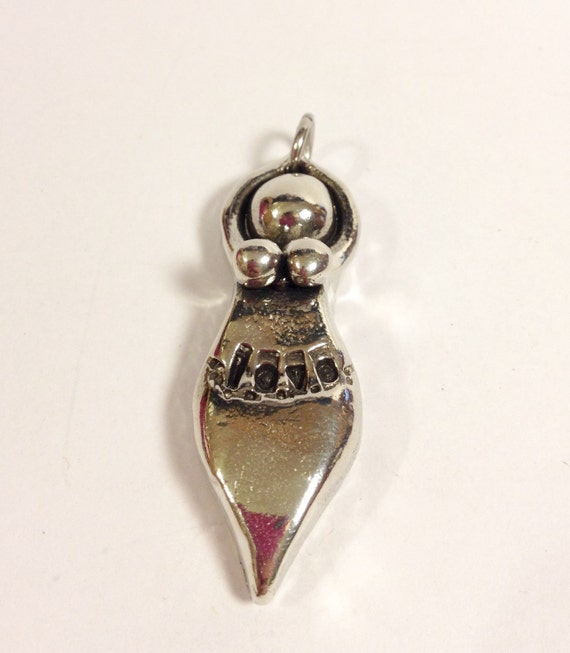
Because I had made a birthing necklace in advance of my first baby’s birth…I brought this to the hospital and Cesarean birth goddess pendant, necklace original sculpture (birth art, c-section, doula, midwife, mother)hung it on my wall. Even though I couldn’t see it during the operation, it helped me to remember that this would still be a birth: a challenging and yet joyous event, and one for which the qualities of love, going with the flow, majesty and a sense of humour would be just as important as during a natural labour…

She goes on to describe how she visited with a friend who is a hospital chaplain and they did a little ceremony:

…it was a relief to feel a hand on my belly that spoke of love and wonder and beauty, rather than the functionality of the body. Tess rubbed my forehead and belly with scented oil and laid flowers from her garden on my bump. We shut our eyes and she asked Mother Spirit to surround the baby and me, to keep us safe through the operation, to bring blessings on the hands of the surgeon and the skill of the midwives. This brought me peace in the hours leading up to the operation, and helped me to face it with quiet confidence, feeling protected.

11150546_1614074768804739_5920468981887497904_nThis post is part of a short series of posts from the book Birthrites by Jackie Singer. The first was about ritual and the second about birth as a rite of passage.

Past posts related to cesarean birth:

Cesarean Awareness Month

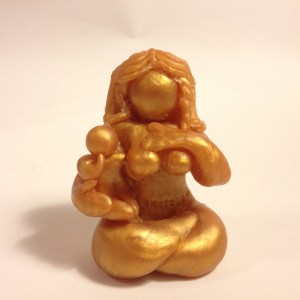
Cesarean Birth Art Sculptures

Cesarean Trivia

Cesarean Birth in a Culture of Fear Handout

Becoming an Informed Birth Consumer (updated edition)

The Illusion of Choice

ICAN Conference Thoughts

Helping a Woman Give Birth?

Tuesday Tidbits: Cesarean Awareness Month Round-Up

Sign up for my Brigid’s Grove Newsletter for resources, monthly freebies, and art announcements.

Good Birth Books to Gift to Others

I’ve recently had several requests from friends asking about the best birth books to give as gifts to pregnant relatives. After sending my third response, I realized that there’s a blog post in here somewhere!December 2013 010

Here are my current recommendations:

Sacred Pregnancythis book is simply beautiful. My past review is here.

Giving Birth with Confidence—this is the well-known childbirth education organization Lamaze International’s guide to pregnancy and birth and it is one of my favorites. My review of a past edition is here.

The Birth Partnerthis guide by Penny Simkin is a classic for helping fathers or other birth partners serve during labor

The Greatest Pregnancy Everfocused on positive mental attitude during pregnancy and cultivating a mother-baby bond prenatally (caveat: I’ve not actually finished reading this one, so I’m not sure if I have any reservations about it or not. I bought it at the last CAPPA conference)

Birthing from Within—the original birth art resource and a fabulous “out-of-the-box” handbook for preparing for birth. It is not attached to a particular outcome and can help mothers dig deep whether experiencing a home birth or a cesarean. This book is my all-time favorite, but my recommendation comes with a caveat that the short breastfeeding section is terrible.

The Baby Book-a comprehensive, reassuring look at baby’s first year by Dr. and Martha Sears.

For birth stories, I love and adore Simply Give Birth (past mini-review is here). I also like Journey Into Motherhood (available as a free digital copy here) and Adventures in Natural Childbirth.

I used to recommend The Thinking Woman’s Guide to a Better Birth, but is has been replaced by an updated version called Optimal Care in Childbirth and I’ve not yet read that one. My educated guess is that it is still an excellent recommendation! 🙂 I also used to recommend The Birth Book by Dr. Sears. It is still a good suggestion, but it is now an “older” book and so I don’t put it at the top of my list any longer.

Also, make sure you grab a copy of the free Guide to a Healthy Birth from Choices in Childbirth. I love this little booklet so much! It is my top favorite resource for tabling at community events. Another free educational resource that I recommend (particularly for women planning natural births in hospital settings) is Mother’s Advocate. There is a free booklet and a series of videos that explore Lamaze’s Six Healthy Birth Practices (which all mothers deserve as part of evidence-based care during birth, regardless of birth location).

Past book lists and related suggestions:

What To Do When Newly Pregnant and Wanting a Natural Birth…

Suggested Reading

Postpartum Reading List

Book list: Preparing Children for Homebirth

Non-Advice Books for Mothers

2012 Book List (all kinds of stuff, not just birth)

In addition, all the books I’ve reviewed in the past are available on my website from this link, so make sure to browse and see if anything else jumps out at you as a good match.

“Everyone who interacts with a pregnant woman is, in some way, her ‘teacher.’ Telling birth stories, sharing resources, imparting obstetrical information, giving advice or warnings—these are all direct or indirect ways of teaching about birth and parenting. Whether you currently identify yourself as a ‘childbirth teacher,’ or you are a midwife, doctor, doula, yoga teacher, nurse, therapist, breastfeeding counselor, or you are simply a woman or man who cares about the power of the childbearing year, you already hold the power of mentoring within you.”

–Pam England

Guest Post: Infertility Doula

Infertility Doula:  Infertility and the Natural Birth Community

by Kristen Hurst

Okay, so you’ve wanted to have kids since you emerged from the womb. You had your dolls enact your birth plan before you could write it down. At some point, you adopted the title birth junkie, no shame attached. You studied to become a midwife or a doula. You finally get to the age at which you could conceivably conceive…and then you can’t. November 2013 019

For some women suffering from infertility, waiting the year before they can have access to IVF and other medical interventions isn’t the answer. It’s not that they don’t want to wait that long, it’s just that some women don’t feel comfortable with pumping your body full of hormones in order to conceive when you have made an effort to rid your home of hormone-altering plastics and chemicals. Yet when it comes to natural “solutions” it can be just as frustrating to be handed a garden full of herbs and told to wait. You’ve been waiting your whole life—the wait was supposed to be over.

In my experience, natural birth communities tend to do an excellent job supporting mothers who have experienced miscarriages, but are less certain about the role of would-be mothers who can’t conceive. It’s not that we don’t welcome them, especially if they are midwives and doulas, but we assume that they have another place to go: there are a significant number of infertility support groups in the world that even have their own lingo! Nevertheless, midwives and doulas that have experienced infertility are an integral part of our community, and their needs—and perspectives— shouldn’t be ignored.

For women who have only recently discovered their infertility, we can support them through natural treatments and even more conventional fertility treatments. We can offer acupuncture, fertility massage, and a variety of herbs and dietary changes.  We can accompany these women to difficult appointments. We can offer to be an infertility doula, a concept that, as far as I can tell, was coined by Ebru B. Halper to describe the profession she created as a result of her struggles with infertility. Halper guides women through the overwhelming maze of fertility treatments, providing whatever kind of support they may need. I’m not sure why this concept hasn’t caught on, but I think it’s a helpful frame for how we can approach infertility in our communities.

Since training to become a doula, I’ve often thought about how we can be doulas for the women in our communities no matter what they’re experiencing. I often feel as though I am a doula to my children, helping them birth their best selves. But that process has to extend beyond the treatment process into whatever grief or celebration might follow. Ultimately, there is no one “right” thing to say to a birth worker who cannot have her own babies. What we need to do is to listen and be present because we know that birth is a gift. I can’t know what it feels like to be denied that gift, but there are many women who can share their perspective.

The point of this conversation isn’t to make me feel grateful for the fact that I have been able to give birth—it is to celebrate grief as an end in itself. “Grief is neither a disorder nor a healing process: it is a sign of health itself, a whole and natural gesture of love,” says Dr. Gerald May. He continues, “[n]or must we see grief as a step towards something better. No matter how much it hurts–and it may be the greatest pain in life–grief can be an end in itself, a pure expression of love–“  As a birthing community, we must bear witness to this painful love rather than assure the woman that it’s “meant to be.” We can’t stop being infertility doulas once the treatment is over. Making space for both the love within birth and the love within grief can only make our lives richer.

Kristen Hurst is a mother, a writer, a yogi, and a doula. She received her bachelor’s degree in fashion marketing, and writes often about pregnancy and maternity fashion for Seraphine Maternity.   When she’s not trying to juggle the lives of  her sons, she enjoys painting and catching up with a great Jane Austen novel.

Birth Mystery

“Whether a woman knows it or not, she is a vessel of great magnitude born capable of reshaping humanities destiny if she only knew the true depths of her innate gifts. Be prepared now to see the fierce face of the feminine rock as her inner geographies of volcanic strength erupt from a love she has held in her belly for life all of her days. This is not a gasp of her last breath. It is her birthing cry into her wise leadership on our planet.” –ALisa Starkweather

“Birth, like love, is an energy and a process, happening within a relationship. Both unfold with their own timing, with a uniqueness that can never be anticipated, with a power that can never be controlled, but with an exquisite mystery to be appreciated.” –Elizabeth Noble

“Birth is not a cerebral event; it is a visceral-holistic process which requires all of your self–body, heart, emotion, mind, spirit.” –Baraka Bethany Elihu (Birthing Ourselves into Being)

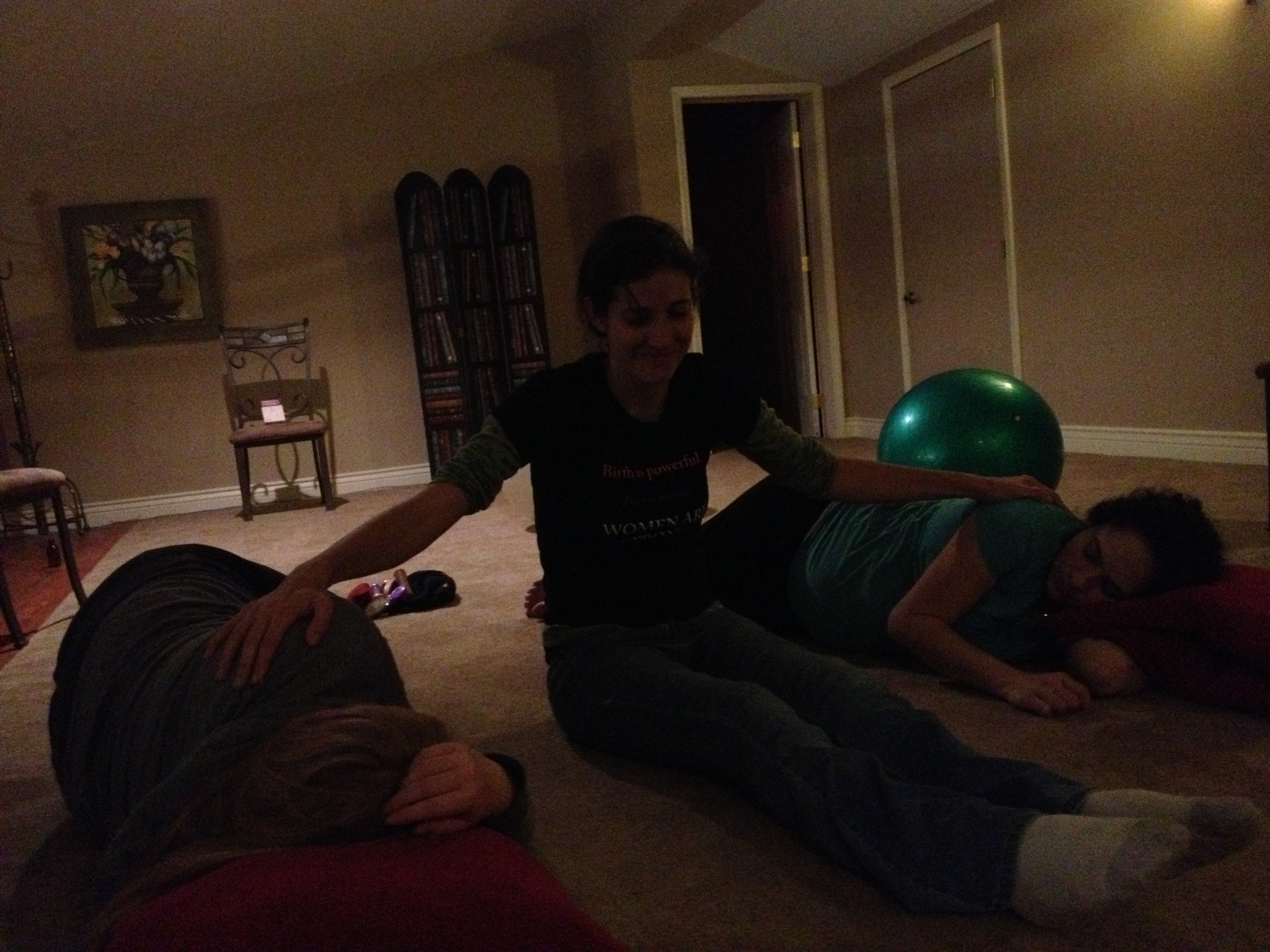
Last weekend, I taught our final Birth Skills Workshop of the year. While I know I have been writing about my sense of separation from birth work or the phase of “moving on,” in which I find myself, this workshop was an excellent experience. The women were so beautiful and interested and anticipatory. The couple working together was so loving. My doula co-presenter was so present and grounding. I came home feeling really positive and enthused and I also found myself considering new birthwork-related ideas and new possibilities, including something that I’m really excited about, but don’t feel like I can share publicly just yet. This work is in my blood, my roots, my heart and my soul, regardless of how direct the services are that I offer or the primacy/priority of face-to-face birthwork in my life. I will never not care about birthing women. They’re too amazing. They’re too important. And, my own sense of being, my spirituality, my thealogy, is too intimately entwined with my own embodied experience of gestating, birthing, lactating, and mothering, to ever make a full separation from it. After I got home and looked at my few pictures from the evening, I realized that in eight years of teaching birth classes, I have exactly zero pictures of me doing so! But, here is one of some of the mamas were enjoying a much deserved relaxation session after a lot of active birth practice. 🙂

October 2013 036This photo reminds me of the amazing benefits of co-teaching a workshop with another birth professional. SO much better than teaching alone ever was! Doula Summer of Peaceful Beginnings Doula Services and I have been friends for a long time (we also co-founded Rolla Birth Network). She has helped me when I’ve needed help and I’ve helped her when she’s needed help, but our helping skills/abilities rest in different areas, which is why we work extremely well together with a workshop like this one. I provide the information and structure, Summer provides the gentle presence and soothing hand. A good workshop needs both!

I also re-discovered how I do enjoy putting together a nice information packet! 🙂

October 2013 023

In addition to my workshop-related epiphany, I had a lightbulb moment with regard to my M.Div thesis. It suddenly seemed clear to me that rather than create a scholarly, academic discourse proving a theory about birth as a spiritual experience, I need to integrate my theories with my birth art sculptures. I need to frame my work within this sculptural context, this personal experience, this lived reality of the might of creation. I have 234 pages of possible content for said thesis, all saved in an intimidating word document waiting to be sorted through and added to. It is overwhelming to even open. With my new idea of framing my thesis through my own art, I feel a pathway emerging through the information, a pathway that integrates the academic and the personal and that results in something uniquely my own…

October 2013 011

Some of my sculptures-turned-pewter-jewelry.

“Be soft. Think of [labor] as a fine silvery stream, not a raging waterfall. Follow the stream, have faith in its course. It will go its own way, meandering here, trickling there. It will find the grooves, the cracks, the crevices. Just follow it. Never let it out of your sight. It will take you.” -Sheng-yen

“We vibrate to that primordial rhythm even before we have ears to hear…We vibrate to the rhythms of our mother’s blood before she herself is born. And this pulse is the thread of blood that runs all the way back through the grandmothers to the first mother.” – Layne Redmond (August 19, 1952 – October 28, 2013): Drummer/Composer, Author and much more (via The Girl God)

“Within the womb of every woman glows the consciousness of Mother Earth.” –Roslyne Sophia Breillat (via The Girl God)

Guest Post: Squatter’s Rights

October 2013 024

Squatter’s Rights

A couple of posts ago, I mentioned I’d made a new sculpture that I titled after a friend of mine and an article she wrote several years ago. She originally sent me the article to review, because she was thinking of sending it to a magazine. Several years passed, several more babies were born, her computer got fried, and the article was lost. However, it stayed with me anyway. It stayed with me when I prepared for the birth of my rainbow baby girl, it stayed with me as I created birth art to prepare for her birth, and it stayed with me as I reached down to catch my baby’s whole pink wonderful self in my hands as she was born in one smooth reflex almost three years ago. So, I created my figure and I emailed Shauna about it and then I went digging. Deep in the ancient, archived messages in my Outlook Express folder on my old laptop that now belongs to Zander (age 7), I found it. I found Shauna’s squatter’s rights article that had so touched my birth consciousness in such a way that I never forgot—even though babies, computers, friendships, and time have all marched on. I was already a childbirth educator when I read it, had already given birth myself, and was deeply immersed in birth work and childbearing. However, that doesn’t mean that certain descriptions cannot reach us and grab our attention in new ways. I’m delighted that Shauna gave me permission to publish her article here and to share her insights and experiences in this way!

Squatter’s Rights

by Shauna Marie

Would the new child coming from me be slippery like soap? I rubbed my fat belly. I loved each pound I gained, each craving I had, and every trip to the bathroom. Okay, maybe not every trip to the bathroom. But, I loved this growing baby. Tucked away like a pearl in the sea just waiting to be discovered. I was in a constant state of marvel.

Would I be able to physically do this? No, I don’t mean the labor, nor do I mean the birth. I knew I could do that. I got lost in thought as I planned in my head every moment that would come after my body did the work of labor. The moment would come once my body was ready and the crown of a child’s head pushed itself from me, the moment the child would emerge. That’s what I was planning for; I planned to catch my own baby.

I imagined opening my legs and squatting, I even practiced. I wondered where I’d put my hands, how I would have my legs, and if this little wet creature would be so slippery that I’d drop him or her. In December of 1999 this would be my second birth, but my first time catching a baby.

Like many people from a young age I was led to believe that women didn’t and couldn’t birth outside hospitals. The ones who did were radical or even dangerous. I was led to believe that the birth doesn’t matter, the baby matters. For my own personal sanity, due to cultural birth fear, I had to just come to the conclusion that as long as my baby was okay I could endure anything and that it would all be over soon.

Now rewind a little bit here, because there is something to be said about being at the right place at the right time; or knowing the right person. As a person who now tries to make a difference by being a strong home birth and natural family living advocate, I know who you know can sometimes make all the difference. For some people they just need that connection with real birth; they need to know someone who will talk about what birth really is about from a natural and physiological point of view. Above all people need to be exposed to home birth because it normalizes birth.

I was almost connected at one small point during my first pregnancy, just weeks before my first birth a friend of a friend was having a baby. I asked where she was having the baby at and when. My friend said she was in labor now, and having the baby at home. A jolt of sudden uncomfortableness and worry struck me, “At home! Why?” (Thinking oh my gosh there is no epidural at home!) My friend responded with a rather obvious sounding answer, “Well her mom is a midwife.” “Oh,” I said in an understanding tone. Somehow this made total sense now. If her mom is a midwife then it’s okay for her.

Quickly all home birth thoughts were intercepted with other conversations of non-birth related content. To this day I feel that should have been my contact with home birth. Instead I missed my first calling and just two months later I was induced two weeks before my due date against my own wishes (along with two other women from my OB’s office) to fit into the OB’s schedule.

I learned an awful lot that night. I learned I would never give birth to a healthy baby in a hospital again. I learned that in a hospital it is okay for others to look at your body, touch you, reach into you, and deliver your baby; but it’s not okay for you to do so.

I also learned that birth does matter, not just a healthy baby. Healthy empowered moms matter and instincts are stripped away by technology and birth colliding. This often even includes the instinct to breastfeed.

I was shocked at how disconnected I felt from the waist down. These strangers were in charge of me. There is something about being tied to IV’s and monitors, naked from the waist down in a hospital bed, legs in stirrups, that takes your power away. Even though some one at some point said, “Here comes your baby, look at your baby come” I felt like I wanted to reach over my belly and feel, or catch. I’d seen that in a birth video once –a nurse said something like ‘you can touch your baby’s head and feel’ to a mom giving birth flat on her back. I waited for someone to say that to me, but no one did.  Be it because of hospital policy, or be it because of shame, it was a no-no to touch or even catch what was mine. I felt so disconnected as I tried eagerly to see over my belly, knees being held up to my ears by three sets of hands to the chants of, “Push, push, pushhh…. good girl.”

I wondered so much about just staying home. I had what I thought was an unexplainable and unfounded desire to hibernate in a dark corner like an animal.

Around the same time that I got pregnant with baby number two I heard a doctor on television actually say that women are physiologically unable to catch their own babies. Already committed to having a home birth that comment further sealed the deal. I was catching my own baby this time. Not only do I dislike someone telling me that I can’t do something, I didn’t believe a woman would let her baby just fall to the floor (many mammals are born that
way though). Surely even if a woman didn’t squat with intent to catch her baby the child would be born slipping onto bed or floor without assistance or harm. My research lead me to discover that women have given birth effortlessly while in comas, unassisted and unmedicated. We’ve all heard the stories of scared teens giving birth suddenly, alone in a bathroom. The body just gives birth when it’s time. Not to mention National Geographic taught me from a young age more than just that women in tribes go topless; they also sometimes give birth to babies unassisted and catch them.

Shauna’s eighth baby, born into her hands this summer.

I was also somehow sure a woman could give birth in total control; in control of her thoughts, feelings, and use of good judgment. I was no longer buying into the stereotypical out of control agony portrayed in movies. I didn’t know, but I deeply believed a woman giving birth, if allowed, could totally be in control and instinctively know how to give birth.

I figured that squatting would give me the best angle to catch my baby. Being in a squat, on bent knees, or even on all fours is clearly the most natural and easiest way to birth a baby. Squatting has roots in ancient history as far as birth goes back. It is only within the last 100 to 150 years, since physicians took control of birth, that women have been required to have babies laying their backs in the lithotomy position. Lying on the back (or semi lying) has obvious benefits from the doctor’s perspective as it provides a good view and way to manually remove a baby, as well as use a scalpel to cut a wider opening to the vagina. The use of gigantic tongs (forceps), vacuum suction extraction on the baby’s head, and even manually pulling on the baby’s head have all been routinely practiced by physicians.

Elizabeth Noble, author of Childbirth with Insight, states, “Women who squat for birth can generally deliver their babies without any manual assistance at all. Gravity and the free space around the perineum allow the baby’s rotation maneuvers to be accomplished spontaneously.”

There are vast differences in giving birth in a squatting position rather than lying down. Well over half of all the births in this country currently involve some type of surgical or operative procedure such as; cesarean section, episiotomy, vacuum extraction, or the use of forceps. These interventions and their accompanying risks could be avoided if women would just adopt a squatting position for birth. Aside from working with rather than against the body and gravity the birth canal depth is shortened during a squat, and the pelvic diameter is increased. In fact just the simple act of squatting can open a women’s pelvic outlet by up to 28 percent. All of these benefits can shorten the second stage of labor and the need for interventions. Squatting also reduces the risk of tearing. Dr. Michel Odent writes in Birth Reborn that, “This position assures maximum pelvic pressure, optimal muscle relaxation, extensive perineal stretching, and minimal muscular effort. It also provides the best safeguard against serious perineal tears.”

Routinely birthing moms are put on their backs or reclined in beds which center the mother’s weight on her tail bone, narrowing the pelvic outlet and compressing major blood vessels which reduce proper circulatory function. This in turn reduces oxygen to the baby and to the uterus making contractions less productive and more painful. Less oxygen to the baby signals distress in the infant, which if in a hospital could cause a whole round of interventions. Combine an oxygen deprived baby with a mother trying to push uphill with a baby that cannot move into a good birthing position because of restricted pelvic room, and ultimately you have mothers who are very good candidates for a birth that must be forcefully assisted by forceps, vacuum extraction or the ever so common routine C-section. The Centers for Disease control states on their website that cesarean sections are now at 32.8% in North America (2011).

Delivery of the after birth in an upright position also has clear advantages. When the placenta isn’t compressed there is less chance of blood pooling up and creating large clots, and gravity aids in placental expulsion.

When the day finally came for me to catch my baby I talked myself through the contractions. I told myself I could do this. I said over and over I can do this, because as a pregnant mammal it’s what I was put here to do. When I felt it was time I squatted over a mirror and saw the crown. I told myself to enjoy this moment, not everyone gets to catch their own baby, and I didn’t want to miss one second of this experience. I swirled the thick wet black hair that was presenting around in a circle with my fingertips. Any and all pain was gone, it was amazing. I focused on this new life that was unfolding from my body. I waited for contractions and I let my body do the work without forceful pushing or feeling agony. When the baby slid into freedom and the room was engulfed with newborn smells and newborn cries I cried out, “It’s a boy, it’s a baby boy!”

The impact of that birth was powerful and amazing; so much so that I have caught five more children from my body since then. There is a saying about the “thrill of the catch,” and midwives and doctors know this. It’s intoxicating and it’s very powerful to catch a baby.

So much harm has been done to cloud the process of childbirth. Birth isn’t just about babies, it’s about mothers too. It’s about how they work together. Catching your own baby puts you focused on your birth, and without trying you take the control and suddenly you feel and know what you need to do. Focusing on the important task of birth made an impact on me a very positive way as a mother. True freedom over my body gave me independence, confidence, and self-control.

Not every woman may want to catch her own baby, but every woman should be encouraged to do so, or at the very, very least know they can if they do wish to. Most women I have spoken with actually say they have never even thought of it.

The state of birth in this country lies squarely in the hands of birthing women. Until we start demanding more respect and more variation in our birthing options we have no one to blame but ourselves. We must first credit ourselves with being able to birth safely the way nature intended before anyone else will give us that credit. The seeking out of safe and natural birth options will slowly continue to influence and change how birth is perceived.

There are specialized hospital beds that can be converted in a way that women are more upright. If you will be giving birth in a hospital request them, demand them. Hill-Rom makes such a bed; the Affinity Three Birthing Bed aids a woman to side lie, squat, kneel, sit, and lean in various positions. It has a labor bar and position controls that are quite impressive. The bed can be lowered or raised up, down, back, and forth

There are birth balls, birth bars, and birthing stools that can aid in more natural upright positions in whatever birth setting you choose. There are showers and tubs to soothe a mother.

I share my experiences with catching my own babies, and have even shared very private birth photos and even one video with others in the past; because I have been told by so many women it has empowered them. I also hear from lots of women who say how strong both me and my legs must be to squat down like that. I assure that it’s not my legs that are strong; it’s my heart and my passion, and the willingness to open up and catch what is mine.

Shauna Marie is happily married to the man of her dreams. They live in the Midwest where they juggle eight energetic children while homeschooling and developing upon a one acre hobby farm of veggies, fruits, chickens, geese, and the dream of a dairy goat. She blogs about her life at Life with Eight Kids. Shauna is very passionate about family with an emphasis on childbirth and healthy, happy moms and babies.

Postscript: Shauna’s most recent birth story, excerpted below, is an excellent description of a squatting birth!

I was standing there in the still of the labor lull a rush of hormones hit me and the baby’s head slipped fully into the birth canal. I squatted down instinctively. I was then super indecisive: I flip-flopped between on my hands and knees to squatting, then squatting with one leg up and one leg down, then a leg up on the side of the tub, then standing upright, then a squat-stand and finally then back to the other positions all over again. This baby was going to start to seriously crown in a big way and I had no idea where I wanted to be! Having done this so many times I had way too many choices in my head and I knew what they all felt like. Later Ricky told me he got nervous that I was moving around so much in the tub; he was worried I’d slip and fall. I however felt firmly planted like a rock. I told him later I felt like I had sticky gecko pads on my limbs and slipping never crossed my mind.

Our baby was starting to crown as I finally squatted down low with one leg higher than the other (I was out of time to change things up. I’ll just squat and do it the same ‘boring’ highly effective way I always do it I thought lol.) I used some counter pressure on her velvety head to help ease her head out but it wasn’t really needed and a painless contraction inched her head fully out.

via Life With Eight Kids: Beatrice’s Unassisted Birth Story (half hour labor and birth -with extra info on my favorite topics of vernix, cord cutting, and not pushing).

Related Talk Birth resources:

Active Birth in the Hospital

Spontaneous Birth Reflex

How to Use a Hospital Bed without Lying Down

What to Expect When You Go to the Hospital for a Natural Childbirth

References:

(Elizabeth Noble, Childbirth with Insight, 78). See also Golay, J., et al., “The squatting position for the second stage of labor: effects on labor and maternal ad fetal well-being,” Birth 20(2) (June 1993):73-78.

Postpartum outcomes in supine delivery by physicians vs nonsupine delivery by midwives.Terry RR, Westcott J, O’Shea L, Kelly F. J Am Osteopath Assoc. 2006 Apr;106(4):199-202. Conclusion: Nonsupline positions during labor and delivery were found to have clinical advantages without risk to mother or infant. Enhanced maternal outcomes included improved perineal integrity, less vulvar edema, and less blood loss.

Dr. Martha Collins D.C., Pregnancy and Chiropractic Planetciropractic.com

Russell JGB. Moulding of the pelvic outlet. J Obstet Gynaec Brit Cwlth 1969;76:817-20

Squatting can enlarge the pelvic outlet up to 28 percent (Russell, J.G., “The rationale of primitive delivery positions,” Br J Obstet Gynaecol 89 (September 1982):712-715

Paciornik M; Commentary: arguments against episiotomy and in favor of squatting for birth. Birth 1990; 17(2): 104-5.

The total U.S. cesarean delivery rate reached a high of 32.9% of all births in 2009, rising 60% from the most recent low of 20.7 in 1996 Martin JA, Hamilton BE, Ventura SJ, et al. Births: Final data for 2009. National vital statistics reports; vol 60 no 1. Hyattsville, MD: National Center for Health Statistics. 2011.

Marion Sousa writes: “[Squatting shortens and widens the pelvic outlet.” (Childbirth at Home. New York: Bantam, 1976 in Judith Goldsmith, Childbirth Wisdom from the World’s Oldest Societies, 153)

Several studies have reported that in the majority of women delivering in the lithotomy position, there was a 91% decrease in fetal transcutaneous oxygen saturation (Humphrey et al. 1973, 1974)

Robertson, Empowering Women: Teaching Active Birth in the 90s, (105)

Dr. M. Odent Birth Reborn, (101)

Hill-Rom Affinity Three Birthing Bed educational video and website. Online user manual http://www.hill-rom.com/PDFs/manuals/UserManuals/u025_iet.pdf

Business of Being Born: Classroom Edition

Childbirth is a women’s rights issue and a reproductive justice issue. The United States maternity system is one of the costliest in the developed world, yet our birth outcomes compare poorly to those of other industrialized nations. Among industrialized countries, we consistently rank last or second to last in perinatal and maternal mortality rates. Moreover, birth is depicted in mainstream media with fear, medical intervention, and crisis…

via The Business of Being Born Classroom Edition.

It took me some time to get around to it, but I’ve finally finished exploring The Business of Being Born: Classroom Edition and its associated toolkit of educational materials! As a long-time childbirth educator and birth activist, of course I was interested in this classroom version of the (new) classic birth advocacy film, but I’m also a college professor and therefore was doubly interested—how might this resource be incorporated into one or more of my human services courses? As the BoBB companion site explains…

Childbirth is an issue most people do not engage with until they have experienced the maternal health system. The Business of Being Born: Classroom Edition reaches out to young adults BEFORE they confront their own birth decisions, both placing the issue on the radar and challenging the prevailing assumptions about birth providers and current obstetrical management trends. The goal is for the next generation of policy makers, practitioners, educators, and parents to approach birth decisions with awareness and confidence. Our strategy is to incorporate this evidence-based presentation into classrooms around the country. We envision empowering the next generation of parents to seek out systemic change and new policies supporting domestic maternity care…

via The Business of Being Born Classroom Edition.

The Classroom Edition of the film runs about 25 minutes and comes packaged with one of my all-time favorite resources for birth classes and tabling events: The Guide to a Healthy Birth from Choices in Childbirth. It also comes with two additional celebrity interviews, the short film Birth by the Numbers, and a instructor’s toolkit with classroom activities tying the themes of the film to major subjects such as Women’s Studies, Public Health, and Sociology.

My only critique of the classroom edition of the film is that the assembled quotes at the beginning of the film are put together in a choppy sort of way that makes it difficult to perceive (for the average viewer), which are the “good” (i.e. accurate) quotes and which are popular types of misinformation. There is also an odd, repetitively distracting, monotonal quality to the music that plays through much of the footage. Excerpted from the full-length film, the classroom edition still includes Ricki Lake’s homebirth in her bathtub, which was one of my top favorite moments of the original film. Content from a historical perspective as well as content involving the shadowing of a homebirth midwife and the personal stories from families choosing midwifery care were greatly reduced from the original version and the classroom edition seems to have more of an emphasis on sociocultural analysis. It is noted that 90% of women in many hospitals experience some type of labor augmentation (usually pitocin) and also that hospitals are businesses, businesses that are not really interested in having women hang around in the labor room.

One of the college courses I teach is American Social Policy. I have always been interested in birth change from a systemic (macro) level as a companion to change on the individual (micro) level, so I especially appreciated watching the Birth by the Numbers presentation included with the classroom edition of BoBB. When speaking about the idea that the increase in cesarean rate reflects maternal choice, public health professor Gene Declercq says, “this blaming of women is farcical. It is not about the mothers, it is about the way we treat care in the United States. Nobody ever wants to admit there is a difficult inherent in the system.” Well, I want to admit it and this is the kind of macrosystem-level change we talk about in my Policy course. At the companion Birth by the Numbers website, you can download a powerpoint presentation and other teaching tools, as well as watch the short film, in which public health professor Gene Declercq debunks popular myths about the causes of the United States cesarean rate increase. The film also looks at disparities in maternity mortality rates and tackles questions of systemic influences on maternal health outcomes.

So, are mothers really asking for cesareans?

slide

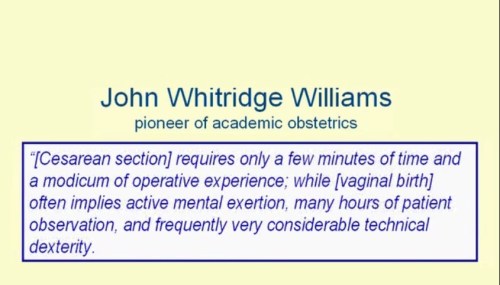
Declercq also draws on writing from the classic obstetrics textbook, Williams Obstetrics, and shares this quote about one of the real reasons that cesarean rates continue to rise:
whycesareanAnd, he makes this important observation:womenhaventchanged
As Nadine Goodman says in The Business of Being Born Classroom Edition, “A woman will always remember how she was made to feel during her birth…if you don’t have the reverence and respect for birth, where do you go from here?”

Prior post about The Business of Being Born: Transformation Through Birth | Talk Birth

Disclosure: I received a complimentary digital package for review purposes.

MamaFest!

Last summer, my Rolla Birth Network friends and I conceived of a local event to be held celebrating mothers. We made a couple of August 2013 020decisions in planning our event that were really smart: we decided to focus on celebration rather than education (or even activism), we decided not to involve any money (either for the attendees or the hosts [aside from tabling materials/supplies]), and…this is key…we also decided to only do that which was within our own personal resources to provide. It worked! We pulled off a lovely MamaFest event at Tara Day Spa in Rolla. It was well-attended and fun and involved very little expense for anyone. It was work, of course, but it was within our resources/capacities. Community organizations were welcome to have a table at the event for free with the only stipulations being no formula/bottle materials (this event is co-sponsored by La Leche League of Rolla in conjunction with World Breastfeeding Week) and that they had to provide something to do at their table. Our vision was that this event would not involve simply walking around picking up flyers and leaving, but instead would provide an opportunity to hang out with friends, see cool things, learn some stuff, and make some projects. I had a birth art booth that was a delight for me to offer to the women.

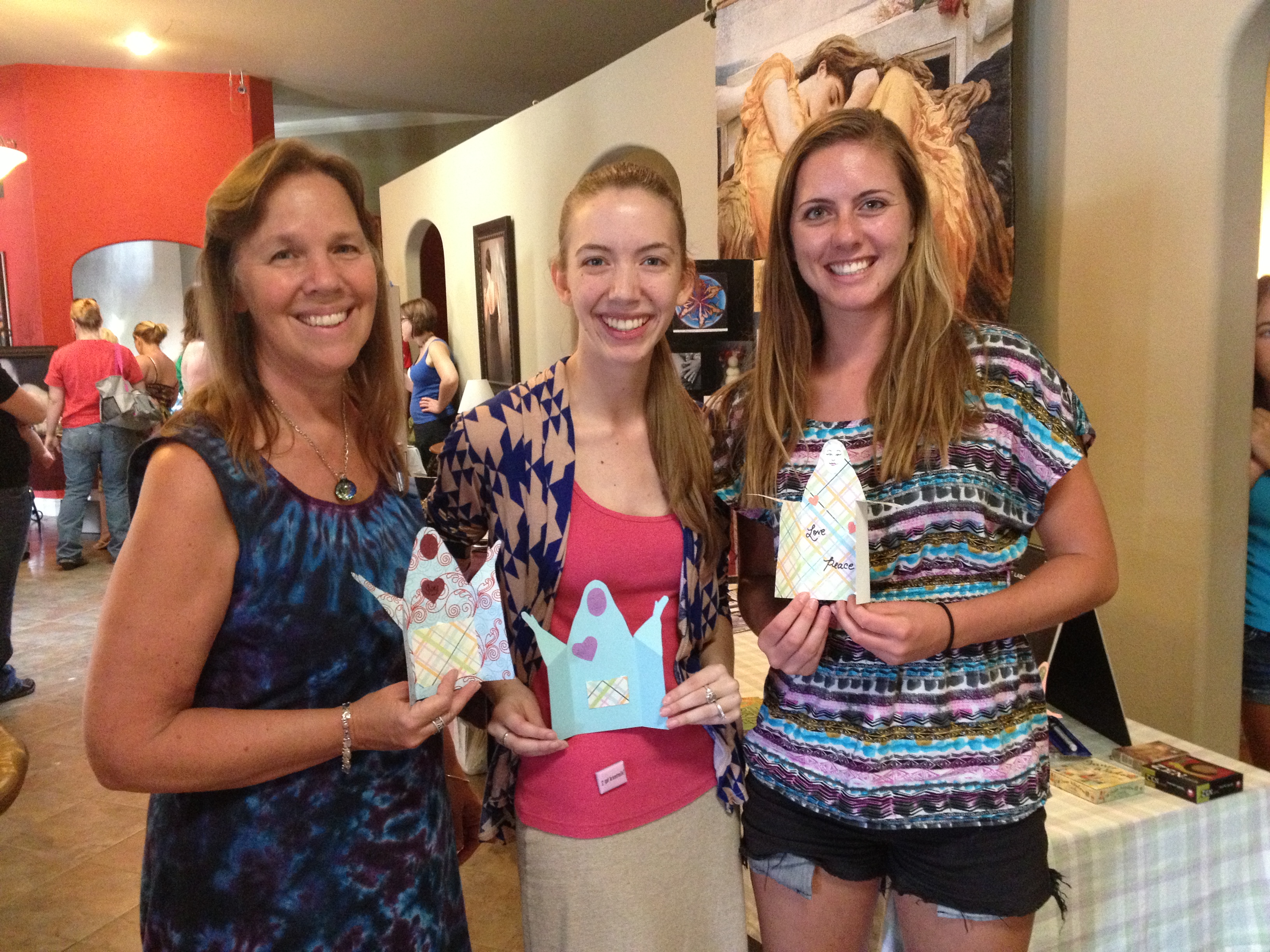
This year in August, we hosted our second annual MamaFest event, again with a similar vision. Our resources/time were a little slimmer August 2013 017this year due to peoples’ schedules (particularly my own, leaving my co-founder shouldering most of the organizing effort), new babies, etc. We had fewer exhibits and fewer attendees and slipped more into the boothy-vibe that we hoped to avoid, and learned some things to try next year. I still consider the event a success, especially considering the fairly minimal womanpower with which we had to work. It was an especially good outreach opportunity for LLL and I said at the end that even if I hadn’t been involved at all with the planning of it, I would definitely have considered it a worthwhile event to continue attending with my LLL booth. I was super excited about my simple, but pretty (and free!) offering for the birth art booth this year: mother affirmation/blessing cards. Unfortunately, very few people took me up on my offer and I was a little sad about that, but my LLL booth with its breastfeeding trivia game and got breastmilk ™ pins was pretty popular. We have lots of ideas for next year and the possibility of experimenting with new directions, such as doing away with the booths altogether and having more retreat-like experience stations (i.e. yoga). What we know we want to keep is our commitment to celebrating women and their capacities, because they’re just super awesome and worth celebrating!

Here are some pictures of my booth and some projects from the event:

August 2013 016

Birth art booth!

August 2013 031

Loved this thumbprint necklace project offered at the booth of a local doula/photographer. Alaina appropriated it immediately because, “me like hearts!”

August 2013 028

Babyloss memorial charms offered by the Rainbow Group (local pregnancy/infant loss support)

August 2013 015

Emergency back up project that I scrambled for when I realized people weren’t making my cards–affirmation “stones” (glass pebbles written or drawn on with glass paint markers).

August 2013 013

At least my own loyal family members showed up and made my project! (mom, sister, and visiting cousin)

What I learned from this event again this year was that you do not have to live in a city to be able to offer something like this in your community, all you need is a small handful of women who care and who can use their skills and resources to make it happen! 🙂

Tuesday Tidbits: Miscarriage Care

66112_618725968151055_156983473_nFor ages, I’ve had the following quote about miscarriage and doctors saved in my drafts folder:

“The only person who can really tell you what is happening to you is your own doctor, who peers into you with a light and a speculum, who samples your blood or urine, or who presses a sonogram paddle into your belly. If you are in trouble, bleeding, scared, or more depressed than you think you can handle on your own, you must find help. Read and research all you can, but remember that the one-on-one assistance of a real doctor is the only thing that will give you answers that count. If you don’t like or trust your doctor, then find one you can…”

I Will Carry You

I saved it because it bothered me so much to read. One-on-one assistance of a real doctor is the ONLY thing that will give you answers that count?! I disagree so much with this and it saddens me to know that women turn to doctors for support that they are unlikely to be able to provide, particularly if women are looking for compassion. My own ER doctor experience was horrendous and involved quotes like: “this is very common, it is just natural selection” and, “this wouldn’t hurt so much if you would just stay still,” as well as leaving bloody handprints streaked across the bed and blood on the floor (specifically after being told how very disturbed I was by all the blood). In contrast, I was treated with beautiful compassion (and actual, genuine, useful help) by every midwife I talked to. In defense of doctors though, I also went to my own family practice doctor for a follow-up visit and she said one of the best things I heard from anyone, doctor or not: “some women find comfort in knowing that love was all their babies ever knew.” And, before I left, she asked if she could give me a hug. That mattered more and lasted longer than any “advice” that she gave me about possible causes, trying, again, etc.

So, this week, related miscarriage articles and stories started catching my eye, such as this one that touches on the various dehumanizing ways many women are treated in medical care environments:

Rush of blood to my brain. Pounding in my ears. Breathing comes in short bursts. And I’m ushered out into the waiting area where I’m told to go home to wait for it to ‘come away’. And there I find myself, blinking in the sun, shaking like a leaf. So I waited. And waited. One week later the tiny form within still clung on. I saw it in my minds eye, not wanting to let go of me, its mother. Perish the thought. Instead I spent the week overly busy whilst somehow trying to recalibrate a defeated dream and birth date that would never occur. Finally, I just booked in for the D&C, and signed for an “excavation of contents.”

I am a psychotherapist and counsellor. I focus mainly on fertility in all its guises. From pre pregnancy to birth and beyond I am struck as women and their partners endure dehumanising experience after dehumanising experience, just like this one…

via The heartbreak of miscarriage

And, that reminds me of what Ina May said in her Birth Story documentary that the number one rule of maternity care should be Be Nice and she asks us to consider how just those two words could change maternity wards. While not miscarriage-specific, of course The Neighborhood Doula’s status on Facebook tonight jumped out at me:

“We need to treat women tenderly in labor. This may be the first time she has ever been treated that way. She will pass that on to her baby. If mom has a traumatic birth, filled with interventions she may be afraid of her baby. Fear of baby = disempowerment. A new mother should never feel that way. We need to treat dad with tenderness during labor too. If we treat him well, he will treat mom and baby well.”

Wise words from Ina May Gaskin at the 2012 Joyful Birth and Breastfeeding expo, Asheville, NC

Over the weekend, I was touched to see a photo from Stillbirthday on Facebook with a caption that almost made me cry because I think this perspective is SO important:

Supporting Birth Diversity means…

…Honoring that birth can occur, at any point in pregnancy.

The word “birth” is not reserved for full term, neither is it exclusively for live babies.

(Share your photo and what Supporting Birth Diversity means to you.)

And, of course I’ve already shared my thoughts on miscarriage as a birth event: 421806_605009189522733_1988490402_n

“Miscarriages are labor, miscarriages are birth. To consider them less dishonors the woman whose womb has held life, however briefly.” –Kathryn Miller Ridiman

via Miscarriage and Birth | Talk Birth.

I also read several articles about other women’s experiences with miscarriage as a birth event such as this moving exploration of “missing” when your expectation was of carrying:

Instead I was overwhelmed by pain that felt like the worst wrenching of labor, contractions that came so fast I could barely breathe, shaking and numbness in my limbs that finally made me crawl to the phone and call the nurse who told me to get to the ER as fast as we could. I’d never heard stories of the real, raw truth of what it means to miscarry, so I had no idea what to expect.

But just because a death comes early does not mean it is lighter to bear or let go…

on carrying and missing | mothering spirit.

And this article that touches on the birth event concept, as well as issues of guilt and blame, as well as the idea of miscarriage as a rite of passage:

That is why there is no doubt in my mind that any woman – and indeed any family – who goes through a miscarriage should see it as a rite of passage. The more that miscarriage is seen as horrific, as something which somehow could have been preventable, and is therefore blamed on the woman’s health, fitness or diet, the more we are denying ourselves as fallible animals. We are making women responsible somehow for these acts of nature. We are instilling guilt and fear, layer upon layer. The result is a woman, and by extension her family, who no longer trusts her body to do what is right. It must be faulty – it miscarried. Her body was not healthy enough, not experienced enough or somehow not adequately formed to be able to carry the pregnancy to full term.

This is not a healthy attitude to have, and can only result in more negative birth outcomes. One of the reasons I do not have a black tinge around my memories of my son’s birth is that, through it all, I trusted in my body. I did what I could, and although I couldn’t understand WHY it had happened, I came to accept that this time was just not meant to be. I am an animal, and I am fallible. This time I fell into the statistics of 1 in 7 pregnancies failing. There’s really no more to it – no guilt, no shame, no fear for future pregnancies; it’s just not appropriate.

Having gone through this whole process I now feel more of a woman. Yes, really. Not only have I experienced the horror myself, but I have had countless other women suddenly willing to share their own story with me. In a sad way I feel as if I have entered a secret club, something taboo and a bit shameful. I’m not really sure why nobody wants to discuss miscarriage, when it affects so many of us. If it were accepted as a rite of passage for any woman, as much as childbirth itself, I feel we’d all have a more positive outlook on all births, whatever the outcome.

via Guest Post: Miscarriage as a Rite of Passage | The Happy Womb.

I also finished reading a quick book that was offered free on Kindle last week (now back to a regular, reasonable price) and saved these two quotes:

In the days that followed, the bleeding continued. Every time I would see the blood, I couldn’t help but think I was losing my child slowly bit by bit. It wasn’t just ordinary bleeding; it was the end of my baby’s life. It was the end of my dream to become a mom. I was devastated. I felt so lost and alone. Unfortunately, my husband didn’t seem to understand or be able to comfort me. To him, the baby was not even real yet. And since he was actually afraid of becoming a dad, I think in some ways he was relieved that it didn’t work out. In my mind, I had lost a child. Someone important to me had died, and I was grieving. The hard part is that I was grieving alone with no one to share my sorrow. This is often a problem for women who miscarry. You feel so sad and devastated, but many times your friends and family don’t get it. They don’t realize how much love you can feel for a baby you never saw, met or held. You try to turn to those you love for comfort and support, but they have little to offer you during the time when you need someone to lean on the most. It’s not that they don’t want to help or that they don’t care. No one wants to see you sad or hurting. They just don’t understand what you are feeling and the intensity of your emotions. Even the words they say to you can come across as insensitive or hurtful. They often dismiss your grief and trivialize your pain, all the while thinking they are being encouraging and supportive.

(Amazon.com: From Pain to Parenthood: A Journey Through Miscarriage to Adoption eBook: Deanna Kahler: Kindle Store)

The author also touches on the depth of the grief following miscarriage and how very, very real it is (I’ve written before that one of the things I kept saying to my parents when they came to my house following Noah’s miscarriage-birth was, “this was real. I want you to know it was real.” (I honestly think I didn’t think miscarriages were “real” before, in the sense that I categorized them as something other than birth or death.)

According to The Women’s Encyclopedia of Health and Emotional Healing, “the length of the pregnancy is not as significant as how emotionally linked a woman feels to her baby.” The book goes on to say that if you felt your child was real very early in the pregnancy, then you may experience as much grief as someone who has lost a newborn. If the love for your unborn child was already there, you will be heart-broken and devastated. Your loss can affect you in many different ways, some emotional and some physical. You may notice muscle tension, have trouble sleeping, have difficulty concentrating, suffer from frequent headaches, cry a lot or even notice unusual sensations in your body.

(Amazon.com: From Pain to Parenthood: A Journey Through Miscarriage to Adoption eBook: Deanna Kahler: Kindle Store)

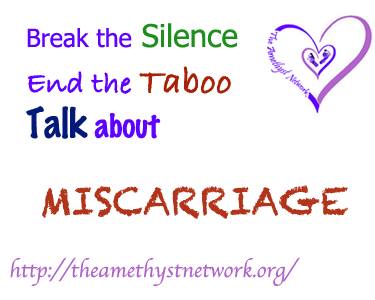
And, these quotes made me remember a brief post from The Amethyst Network regarding early losses and the validity of feelings:

I felt very conflicted over this. I HAD grieved before, but if I was grieving over not-an-actual-miscarriage then did it count? If my loss wasn’t actually a loss, then was my grief valid?

I was talking with a friend (who happens to also be involved with TAN) and explained to her how I was feeling confused and upset over this. She taught me something important.
“You grieved” she said. “It doesn’t matter whether the physical experience was a miscarriage or not, because the grief was real, you experienced the emotional process, and that is valid.”

And so I would say to all mothers who have had an early loss, or a loss that they felt in their gut even though there was no proof. Your feelings–no matter what they are–are valid feelings. We each have different experiences, and we each have different feelings. But what you feel is legitimate, regardless of the circumstances.

Did It Count?

995401_615271668496485_1504558296_n

(and, really, there is no “shame” in not acknowledging how it changes us either, the shame rests in the lack of acknowledgment from so many around us)

This last photo (for some reason it refuses to let me caption it?!) is of some “hope” baubles created by members of the Rainbow Group (local loss support group) at our recent MamaFest event (more about this soon, I hope!).

August 2013 028