Earlier this year I mentioned that I’d used BlogBlooker to convert my blog into a book so that I could copy the text into a year-end Wordle. Anyway, I decided I might as well make the finished blogbook available for download here as an ebook of sorts. It is pretty rough, since it includes comment text as well as “footnotes” of any websites I linked to. And, the formatting of pictures and other elements is a little funky, plus it includes any reviews or giveaways or quotes posts that I did during 2011. But, for anyone who wants it, here is a year of Talk Birth in pdf ebook format. I sent it to myself to read on my iPad and it was really pretty fun! It is a long document—410 page pdf. Enjoy!
Archives
2011 Blog Year in Review
The dawn of 2011 saw me preparing to meet my new baby girl. I was given a beautiful blessingway (and attended several others during the year). Then, I gave birth to her magical, tiny self on January 19. As the year passed, she got bigger and bigger and bigger:
Three Month a-Baby!
Six Months
Eightmonthababy!
Nine Months
Ten Months Old!
Elevenmonthababy!
We took lots of pictures to try to chronicle the sweet, perfect texture of our lives with her in it. I continued to make lots of birth art. I also published several of my originally-in-print articles in blog post format:
Birth Lessons from a Chicken
Nursing Johnny Depp
The Rhythm of Our Lives
The Value of Sharing Story
Listening Well Enough
Mindful Mama: Presence and Perfectionism in Parenting
Listening to my baby…even when we disagreed!
Planning for Postpartum
The Spot
I made slight revisions to the two posts that consistently get a high number of hits each week and didn’t make any changes to the post about good foods to eat during labor that continues to top my blog’s personal charts:
How do I know I’m really in labor?
In-Utero Practice Breathing
Good Foods to Eat in Labor
In addition to some of my articles-turned-posts, several new posts that I wrote in 2011 received a lot of attention, thanks to Facebook shares, and a guest post about alcohol and breastfeeding was enormously popular for the two weeks between Christmas and New Year’s Day.
I just want to grind my corn!
Affordable Fetal Model
Active Birth in the Hospital
Guest Post: Alcohol and Breastmilk
My final post of 2011 also received quite a few hits via Facebook in the last few days, but has not received any comments on the post itself (only FB!):
I spoke my truth in several other posts that I felt pleased with, but that did not get a lot of airtime via other sites:
What Really Scares Me: Social Attitudes Towards Women
Asking the right questions…
“You’ll Miss This…”
Surrender?
Birthing the Mother-Writer (or: Playing My Music, or: Postpartum Feelings, Part 1)
Milk, Money, & Madness
The “Almost Died…” Remark
Fatherbaby
The Ragged Self
I also started to write a little about homeschooling.
I feel like I spent a lot of 2011 in a writer’s prayer—trying to tell about it—trying to preserve in time these high, sweet, clear, delicious, beautiful notes that composed my year with my new baby.
Year End Wordle
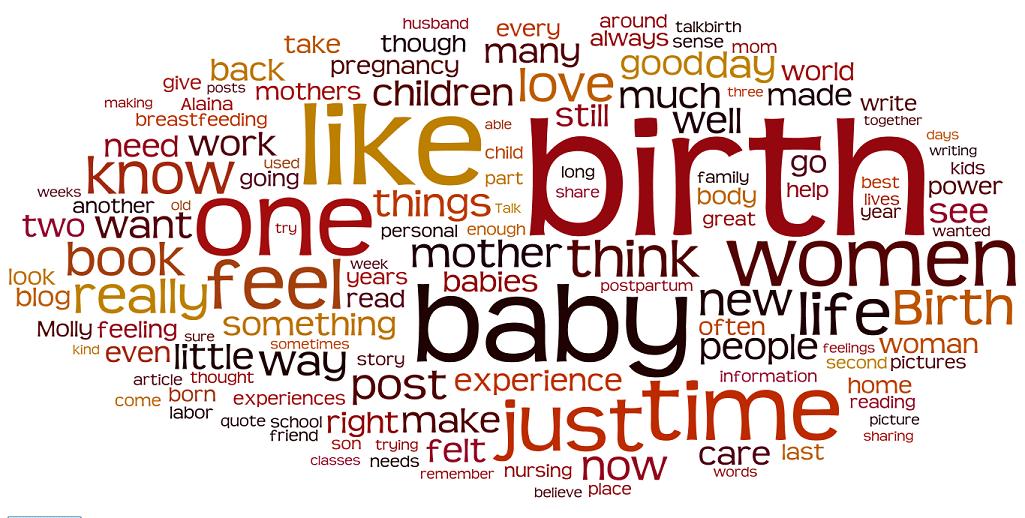
I’m working on a 2011 year-end summary post and it is taking me longer to do than I anticipated. So, for now, a delightful year-end Wordle image instead. I just love these! So much fun to see what you’ve been talking about for a year. It was important to me that the Wordle represent my whole year’s worth of blog posts, rather than just the most recent page which is how it automatically works. So, I used the wonders of BlogBooker to turn the last year’s worth of posts into a book and then copied and pasted that text into Wordle for a full-year’s image. (Side note: Guess how many pages the blogbook was…409. Whoa. No wonder I’m having trouble choosing what to put into a year in review post ;-D)
The Illusion of Choice
A choice is not a choice if it is made in the context of fear.
Informed choice is a popular phrase with birth professionals and healthy birth activists. I’ve read impassioned blog posts from doulas and birth activists claiming that if we support women’s right to homebirth, we must also support her “choice” to have an elective cesarean. But, I believe we have constructed a collaborative mythos within the birth activist community that an informed choice is possible for most women. The statistics tell us a different story. I do not believe that women with full ability to exercise their choices would choose many of the things that are typically on the “menu” for birth in mainstream culture.
What’s on the menu?
Women give their blanket “informed consent” to all manner of hospital procedures without the corollary of informed refusal–is a choice a choice when you don’t have the option of saying no?
In many hospitals, women are STILL not allowed to eat during labor despite ample evidence that this practice is harmful–is a choice a real choice if made in the context of hospital “policies” that are not evidence-based?
Women are told that their babies are “too big” and then “choose” a cesarean. Is a choice a choice when it is made in the context of coercion and deception?
Women choose hospitals and obstetricians that are covered by their insurance companies. Is a choice a real choice when it is made by your HMO?
Women choose hospital birth because they cannot find a local midwife. Is a choice a real choice when it is made in the context of restrictive laws and hostile political climates?
Women often state they are seeking “balanced” birth classes that aren’t “biased” towards natural birth (or towards hospital birth), but is a choice a choice when it is made in the context of misrepresented information? Because, as Kim Wildner notes, balance means “to make two parts equal”–what if the two parts aren’t equal? What is the value of information that appears balanced, but is not factually accurate? Pointing out inequalities and giving evidence-based information does not make an educator “biased” or judgmental–it makes her honest! (though honesty can be “heard” as judgment when it does not reflect one’s own opinions or experiences).
On a somewhat related note, recently, the subject of “quiverfull” families came up amongst my friends and comments were made about feminists needing to support those women’s “choice” to have so many children. However, I worry about women who are making reproductive “choices” in the context of what can be a very repressive religious tradition. Women’s choices about their lives are not always made with free agency. And, that is where some feminist critiques of other women’s choices come from–a critique of the larger context (patriarchy) rather than the woman herself. Is a choice a choice when it is made in the context of oppression?
Where do women get information to make their choices?
In his 2010 presentation, Birthing Ethics: What You Should Know About the Ethics of Childbirth, Raymond DeVries uses data from the Listening to Mother’s studies to help us understand where women are getting their information about birth—this is the context in which their “informed choices” are being made and this is the context we need to consider.
Our choices in birth and life are profoundly influenced by the systems in which we participate…
Some choices shaped by the system
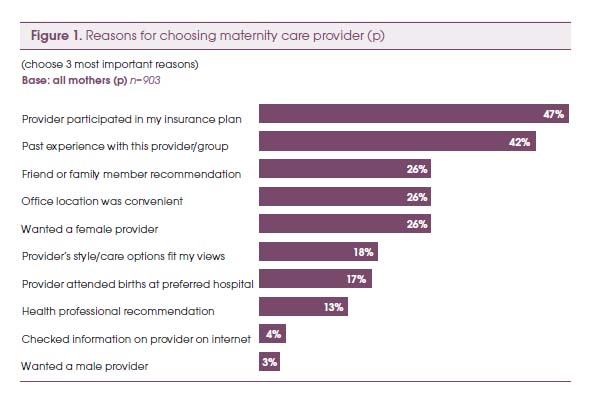
Women learn from books and experiences of others (and self):
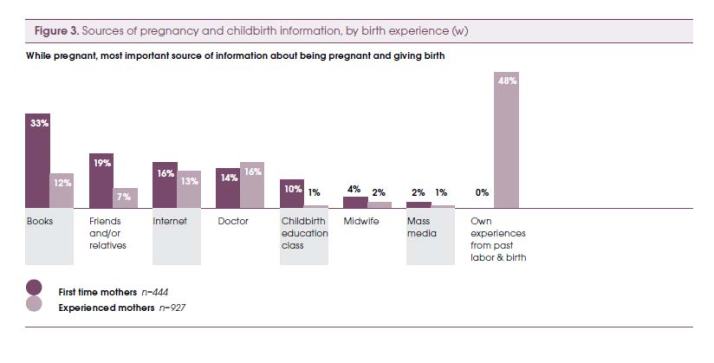
The number one book women learn from is What to Expect When You’re Expecting, which has been number four on NY Times Bestsellers list for over 500 weeks and counting.
According to De Vries, via the Listening to Mothers data, this is what women tell us about how they learn, what they learn, and upon what their choices are based:
Television explains birth
Pain is not your friend
But technology is
Mothers are listening to doctors (and nurses)
Medicalized birth allows mothers to feel capable and confident
Interfering with birth is mostly okay
Our health system works (mostly)
We like choice
We want to be “informed”
He also explains polarization: “We seek information to confirm our opinion. Contrary information does not convince, it polarizes.” How do we share information so that women can make truly informed choices without polarizing?
As advocates, I think we sometimes fall back on the phrase “informed choice” as an excuse not to be outraged, not to despair, and not to give up, because it promises that change is possible if only women change and most of us have access to change at that level.
Birthing room ethics
In another presentation, U.S. Maternity Care: Understanding the Exception That Proves the Rule, DeVries explores the ethical issues surrounding choices in birth, noting that “choice is central at all levels – but can choice do all the moral work?” We wish to respect parental choice, but information does not equal knowledge and we often err on the side of treating them as one and the same. In maternity care, often there is no choice. Tests become routine or practices become policy, and “information [is] given with no effort to understand parental values (the ritual of informed consent).”
Is choice possible while in active labor?
De Vries also raises a really critical question with no clear answers—is choice really possible during active labor? He also asks, “should a healthy pregnant woman be allowed to choose a surgical birth? But is it safe? The problem with data…Interestingly, those who think it should be allowed find it safe, and those who oppose it, find it to be unsafe.” When considering where this “choice” of surgical birth comes from, he identifies the following factors:
The desires of women
• Preserve sexual function
• Preserve ideal body
• The need to fit birth into employment
• Options offered by health care systemThe desires of physicians
• Manage an unpredictable process
• The limits of obstetric education
Why should we care, anyway?
Another popular phrase is, “it’s not my birth.” I agree with the opinion of Desirre Andrews on this one:
“I do not believe in the saying ‘Not my birth.’ Women are connected together through the fabric of daily life including birth. What occurs in birth influences local culture, reshapes beliefs, weaves into how we see ourselves as wives, mothers, sisters, & women in our community. Your birth is my birth. My birth is your birth. This is why no matter my age or the age of my children it matters to me.”
Victims of circumstance?
While it may sound as if I am saying women are powerlessly buffeted about by circumstance and environment, I’m not. Theoretically, we always have the power to choose for ourselves, but by ignoring, denying, or minimizing the multiplicity of contexts in which women make “informed choices” about their births and their lives, we oversimplify the issue and turn it into a hollow catchphrase rather than a meaningful concept.
Women’s lives and their choices are deeply embedded in a complex, multifaceted, practically infinite web of social, political, cultural, socioeconomic, religious, historical, and environmental relationships.
And, I maintain that a choice is not a choice if it is made in a context of fear.
But, what do we know?
I read an interesting article by anthropologist and birth activist, Robbie Davis-Floyd, in the summer issue of Pathways Magazine. It was an excerpt from a longer article that appeared in Anthropology News, titled “Anthropology and Birth Activism: What Do We Know?” In the conclusion, Davis-Floyd states the following:
“Doctors ‘know’ they are giving women ‘the best care,’ and ‘what they really want.’ Birth activists…know that this ‘best care’ is too often a travesty of what birth can be. And yet on that existential brink, I tremble at the birth activist’s coding of women as ‘not knowing.’ So, here’s to women educating themselves on healthy, safe birth practices–to women knowing what is best for themselves and their babies, and to women rising above everything else.”
I believe that every woman who has given birth knows something about birth that other people don’t know. I also believe that women know what is right for their bodies and that mothers know what is right for their babies. I’m also pretty certain that these “knowings” are often crowded out or obliterated or rendered useless by the large sociocultural context in which women live their lives, birth their babies, and mother their young. So, how do we celebrate and honor the knowings and help women tease out and identify what they know compared to what they may believe or accept to be true while still respecting their autonomy and not denigrating them by characterizing them as “not knowing” or as needing to “be educated”? As I’ve written previously, with regard to education as a strategy for change: People often suggest “education” as a change strategy with the assumption that education is all that is needed. But, truly, do we want people to know more or do we want them to act differently? There is a LOT of information available to women about birth choices and healthy birth options. What we really want is not actually more education, we want them to act, or to choose, differently. Education in and of itself is not sufficient, it must be complemented by other methods that motivate people to act. As the textbook I use in class states, “a simple lack of information is rarely the major stumbling block.” You have to show them why it matters and the steps they can take to get there…
And, as the wise Pam England points out: “A knowledgeable childbirth teacher can inform mothers about birth, physiology, hospital policies and technology. But that kind of information doesn’t touch what a mother actually experiences IN labor, or what she needs to know as a mother (not a patient) in this rite of passage.”
The systemic context…
We MUST look at the larger system when we ask our questions and when we consider women’s choices. The fact that we even have to teach birth classes and to help women learn how to navigate the hospital system and to assert their rights to evidence-based care, indicates serious issues that go way beyond the individual. When we talk about women making informed choices or make statements like, “well, it’s her birth” or “it’s not my birth, it’s not my birth,” or wonder why she went to “that doctor” or “that hospital,” we are becoming blind to the sociocultural context in which those birth “choices” are embedded. When we teach women to ask their doctors about maintaining freedom of movement in labor or when we tell them to stay home as long as possible, we are, in a very real sense, endorsing, or at least acquiescing to these conditions in the first place. This isn’t changing the world for women, it is only softening the impact of a broken and oftentimes abusive system.
And, then I read an amazing story like this grandmother’s story of supporting her non-breastfeeding daughter-in-law and I don’t know WHAT to do in the end. Can we just trust that women will find their own right ways, define their own experiences, and access their own knowings in the context of all the impediments to free choice that I’ve already explored? What if she says, “why didn’t you TELL me?” But, if we share our information we risk polarization. If we keep silent and just offer neutral “support,” regardless of the choice made, then doesn’t it eventually become that the only voice available for her as she strives to make her own best choices is the voice of What to Expect and of hospital policy?
“Our lives are lived in story. When the stories offered us are limited, our lives are limited as well. Few have the courage, drive and imagination to invent life-narratives drastically different from those they’ve been told are possible. And unfortunately, some self-invented narratives are really just reversals of the limiting stereotype…” –Patricia Monaghan (New Book of Goddesses and Heroines, p. xii)
—-
Related posts:
What to Expect When You Go to the Hospital for a Natural Childbirth
Birth & Culture & Pregnant Feelings
Asking the right questions…
Active Birth in the Hospital
Why do I care?
References:
De Vries, Raymond. May 20, 2010. Birthing Ethics: What You Should Know About the Ethics of Childbirth, Webinar presented by Lamaze International.
De Vries, Raymond. Feb. 26-27. U.S. Maternity Care: Understanding the Exception That Proves the Rule. Coalition for Improving Maternity Services (CIMS). 2010 Mother-Friendly Childbirth Forum
Magic of Mothering
(The first part of this post is an excerpt from an assignment in one of the classes I’m taking)
“Remember, when Keplet postulated that the moon effected the tides on earth, Galileo dismissed the hypothesis as ‘occult fancy.’ It involved action at a distance, and, therefore, violated the ‘solid laws of nature’ of that time. Now these laws of nature (as they were understood by classical physics only a century ago) have already been transcended; this progression should gently hint to us that many of the solid laws of our day are beliefs that obscure the otherwise obvious” (Passmore, 168).
I have long been wary of the phrase, “we used to think, but now we know…” usually stated with great conviction and little room for debate.
Body Wisdom
As Passmore goes on to note, “It is important to make a distinction between ‘progress in science’ and its explanatory power. This power for explanation depends upon the kind of question being asked. History shows that the questions change with changing beliefs/values in both time and space, periods and cultures.” It is exciting to me to consider how much we just don’t know and yet, the world keeps on spinning along, with or without our “knowing” all the facts. I think about this with regard to birth and breastfeeding. How many generations of women have pushed out their babies and fed them at the breast without knowing the exact mechanics of reproduction even, let alone milk production. There are all kinds of historical myths and “rules” about breastmilk and breastfeeding and even ten years ago we used to think the inner structure of the breast was completely different than what we think it is like now. Guess what? Our breasts still made milk and we still fed our babies, whether or not we knew exactly how the milk was being produced and delivered. Body knowledge, in this case, definitely still trumped scientific knowledge. I love that feeling when I snuggle down to nurse my own baby—my body is producing milk for her regardless of my conscious knowledge of the patterns or processes. And, guess what, humans cannot improve upon it. The body continues to do what the human mind and hand cannot replicate in a lab. And, has done so for millennia. I couldn’t make this milk myself using my brain and hands and yet day in and day out I do make it for her, using the literal blood and breath of my body, approximately 32 ounces of milk every single day for the last eleven months. That is beautiful.
The protective impact of a mama
And, on a somewhat related note, several years ago when I read Birth Book, I marked a section about “imprinting” in it (I think it has been fairly well established that there isn’t really human “imprinting” after birth, but when this book was written it was still one of the ideas). Anyway, there was a section about research done with baby goats done to look at the ability of a mother to protect her offspring from environmental stress. They separated twin goats and put some in rooms alone and the others in rooms with their mothers. The only difference in the room was the presence of the mother. An artificial stress environment was created involving turning off the lights every two minutes and shocking the baby goats on the legs. After the babies were conditioned like this, they were tested again two years later. This time all the babies (now adult goats) were in rooms alone and were again “treated” to the lights off and shock routine. The goats who had been with their mothers during the early experience showed no evidence of abnormal behavior in the stressful environment. The ones who had not been with their mothers did show “definite neurotic behavior.” Somehow, the presence of the mother alone served to protect the baby goats from the traumatic influences and keep them from being “psychologically” disturbed in adulthood.
Except for feeling sorry for the baby goats, I thought this information was SO COOL. How magic are mothers that just by being there we can help our babies–even if there is still something stressful going on, our simple presence helps our babies not be stressed by it and continue to feel safe. Magic!
Birth stress?
The goat research was included in the book because of the idea that birth may be a stressful environment for a baby and if the continuity of motherbaby is maintained after birth (immediate skin-to-skin contact and opportunity for breastfeeding), the baby does not become stressed or “neurotic.” But…if the continuity for mother and baby is broken by separation (baby whisked away for weighing or whatever), both mother and baby are stressed by this and it may have an impact on their future relationship and behavior. The book also talks about how the sound of the baby’s first cry has a sort of “imprinting” effect on the mother in that her uterus immediately begins to contract and involute after hearing her baby’s first cry, whereas mothers who are immediately separated from their babies and do not make contact with them have a higher likelihood of postpartum hemorrhage (I have no idea if this has been debunked or not since the book was written in 1972, but it was an interesting idea to read about).
Mothering is magic. Seriously.
Last Minute Gift Idea: Rescue Gifts
I received a press release recently with a neat last-minute gift idea that has relevance to birth activism—a symbolic gift of a safe birth kit for a mother in the developing world (I investigated a little and the organization is a legitimate humanitarian organization.) Here is the information:
Rescue Gifts help refugees and others who have been impacted by war and natural disaster. Holiday shoppers can choose a gift that
inspires them and dedicate it in honor of a special person in their lives. The International Rescue Committee will send gift recipients a beautiful acknowledgement card with the gift giver’s personalized message.
There’s a perfect gift for everyone:
- For a mom: A Safe Delivery ($24) can ensure critical supplies for the safe birth of a child in a crisis zone.
- For a spouse: Emergency Food ($68) can deliver a month’s supply of vitamin-rich therapeutic food for at least 50 malnourished children in places wracked by food shortages or famine.
- For the foodie or friend with a green thumb: A Community Garden ($60) can provide tools and seeds to refugees who have been resettled in the United States, so that they can grow their own fresh, healthy food in an IRC community garden.
- For a teacher: A Year of School ($52) can supply the tuition, books and other materials for one year of a child’s schooling in a country recovering from war.
Shoppers who spend $75 or more will receive a fashionable organic cotton “Rescue” T-shirt designed and donated by Threads for Thought, or they can opt to have it sent as a gift.
Rashida Jones, IRC Voice and star of NBC’s “Parks and Recreation,” is promoting the Clean Water Rescue Gift and giving it to her friends this year. She says, “At an IRC refugee camp in Thailand, I saw that the ready availability of water transforms lives. I am buying this gift for my friends this holiday season.”
Parks & Recreation is one of my favorites TV shows, so it is fun to have that connection too. Of course, I inquired as to what exactly a “safe delivery kit” entails, because I do not want to inadvertently be promoting non-evidence based Western medical care practices in countries relying heavily on traditional midwives. I was told that, “as such, the Safe Delivery Rescue Gift represents the typical amount of money needed for the IRC to provide supplies and assistance necessary for a safe delivery. However, Safe Delivery Rescue Gift donations will be used where and when most needed in our wide-ranging humanitarian work in more than 40 countries and 22 U.S. cities. The IRC does provide and support pre and post natal care for new and expectant mothers and their babies. This includes training and equipping midwives like the ones in Tham Hin refugee camp in Thailand, although midwifery is not the only childbirth model that the IRC supports.”
If you’re looking for a last-minute stocking stuffer for a humanitarian minded friend or family member, or for a birth activist buddy, you might find the right gift at Rescue Gifts!
Giveaway: Arms Wide Open: A Midwife’s Journey
Giveaway is now closed! Jen Chendea is the winner!
I’m happy to host a holiday giveaway of Patsy Harman’s book, Arms Wide Open. To enter, just leave a comment sharing what giving birth taught you about yourself! I will draw the winner randomly on January 1.
An excerpt from my review of the book:
Harman’s writing style is lyrical and engaging as well as candid. The book is based on personal journals and reading it feels like eavesdropping on someone’s very private thoughts and feelings. The book is much more of a look at a woman’s feelings about her life, than it is a “manifesto” about birth or about the practice of midwifery. In this manner, I feel like you receive a much more complete picture of a midwife’s life and journey, rather than reading a sequence of birth stories. Patsy has a lot of life in addition to birth. While definitely not a “feel good” book, Arms Wide Open is a deeply touching and very honest exploration of one woman’s personal journey in life, love, motherhood, and midwifery.
via Book Review: Arms Wide Open: A Midwife’s Journey « Talk Birth.
Blessingway Poem: A Prayer for One Who Comes to Choose This Life
A Prayer for One Who Comes to Choose This Life
By Danelia Wild
May she know the welcome
of open arms and hearts
May she know she is loved
by many and by one
May she know the circle of friendship that gives
and receives love in all its forms
May she know and be known
in the heart of another
May she know the heart
that is this earth
reach for the stars and
call it home
And in the end
may she find everything
in her heart
and her heart
in everything
Last week I attended a blessingway for a friend who moved away last year. We didn’t know each other very well when she lived here, but thanks to Facebook, we’ve kept in touch and have bonded this year due to some personal experiences and commonalities. The poem above from the book Sisters Singing felt perfect to me to share with her. She has waited with such hope and love to meet her new daughter.
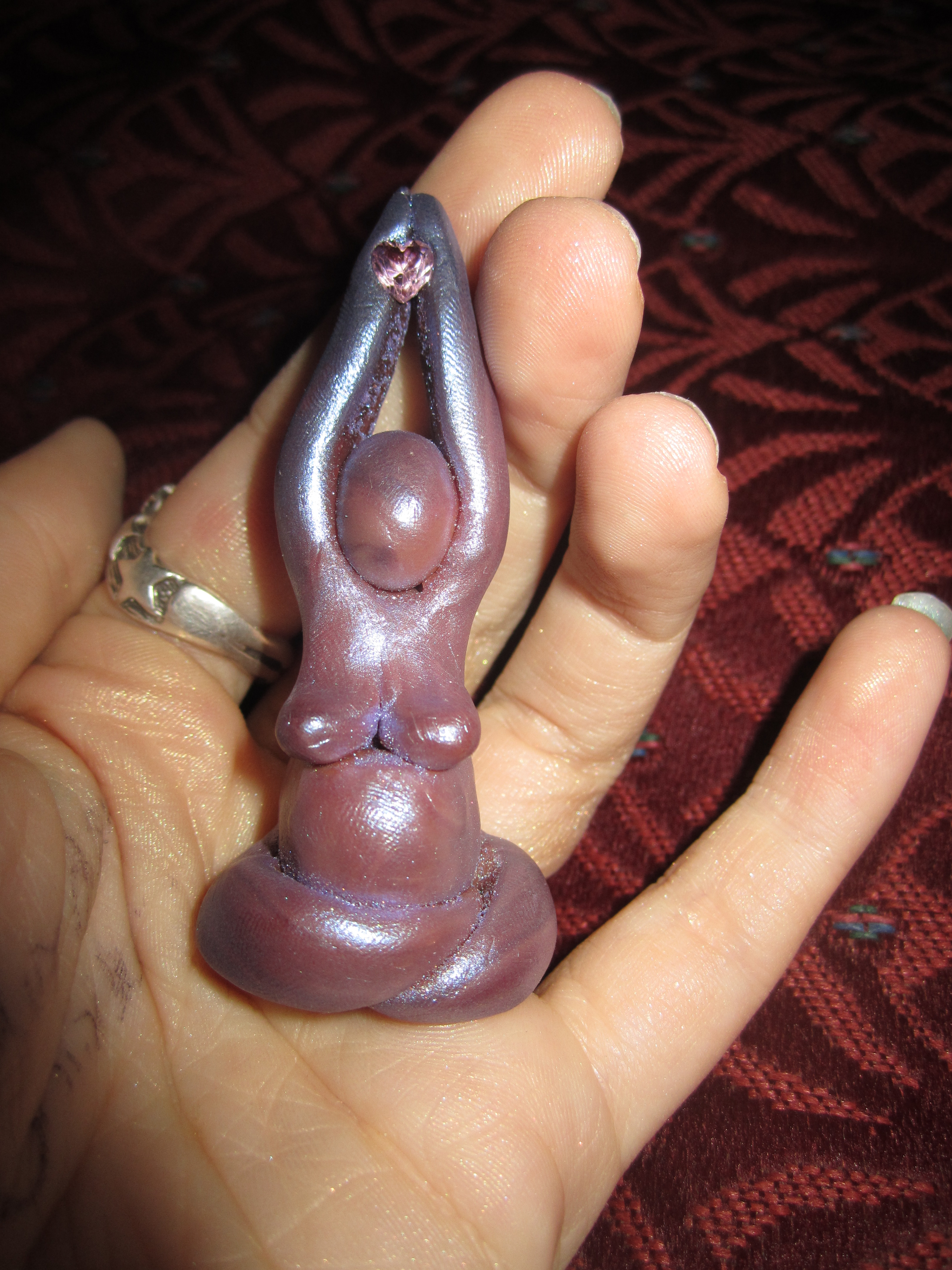
I also made her one of my polymer clay birth goddess sculptures. I purposely overbaked it to make the pigment more deeply colored. This goddess is holding a heart-shaped gem for love. 
Birth Quotes of the Month
As always, while these quotes are obviously not my own words, I do appreciate a link back to my site if you re-post them because I have a significant amount of legwork invested in finding and typing the quotes. Most are not recycled from other pages (I give credit if they are), but are typed up when they catch my eye in the books/magazines/journals I’m reading.
“The first few months after a baby comes can be a lot like floating in a jar of honey—very sweet and golden, but very sticky too.” –American College of Nurse-Midwives
“Your children love you. Be the trampoline for their rocketing and the cupped palms for their returning.” –Shae Savoy (in We’Moon 2011 datebook)
“There is nobody, out the other side of that sort of strong birth, who is not better prepared to meet the absolutely remarkable challenges of parenthood. When the power and trust is transferred to the mother, when she delivers her child, rather than ‘is delivered’ when she chooses, rather than ‘is allowed’, no matter what sort of technical birth she has, she is stronger, fiercer, and better. After a trip like that, you would kill for that child, and you know you can.” —The Yarn Harlot
Why do birth work? “I do it, because nothing else… nothing else, compares to watching a woman move mountains with her own self, to watching her rise to a challenge and meet the moment with all she has, and that experience is only enhanced when she is supported by those who care for her, respect her, and want her to be empowered by the journey.” –The Yarn Harlot
“We must act to keep the knowledge and the powers of women alive.” – Lynn Andrews 
“Birth Freedom is inevitable. The natural progression is for people to move from tyranny to liberty. The agents of the status quo, however, rarely yield power without a fight.” –Senator John Loudon (ret.) in Midwifery Today e-news
“If I didn’t define myself for myself, I would be crunched into other people’s fantasies for me and eaten alive.” – Audre Lorde
“We have barely tapped the power that is ours. We are more than we know.” –Charlene Spretnak
“Woman is a glorious possibility; the future of the world is hers.” – Matilda Gage
“In everyone’s life, at some time, our inner fire goes out. It is then burst into flame by an encounter with another human being. We should all be thankful for those people who rekindle the inner spirit.” ~Albert Schweitzer
“There is a sacredness in tears. They are messengers of overwhelming grief…and unspeakable love.” –Washington Irving
“Don’t you dare, for one more second, surround yourself with people who are not aware of the greatness that you are.” (Roots of She by Amanda Oaks, via @ROAR! Empowering Women to Give Voice to Their Truth)
“We all start out knowing magic. We are born with whirlwinds, forest fires, and comets inside us. We are born able to sing to birds and read the clouds and see our destiny in grains of sand. But then we get the magic educated right out of our souls.” -Robert R. McGammon
“It’s hard to describe if you’ve never been there, but to watch a woman access her full power as a woman to give birth is awe-inspiring, and I never get tired of being witness to it. It’s an honor to watch that transformation take place.” ~ Julie Bates, CNM
“The emerging woman..will be strong-minded, strong-hearted, strong-souled, and strong-bodied…strength and beauty must go together.” ~Louisa May Alcott
“We must relearn to trust the feminine, to trust women and their bodies as authoritative regarding the children they carry and the way they must birth them.” –Elizabeth Davis, CPM
“The women in labor must have NO STRESS placed upon her. She must be free to move about, walk, rock, go to the bathroom by herself, lie on her side or back, squat or kneel, or anything she finds comfortable, without fear of being scolded or embarrassed. Nor is there any need for her to be either ‘quiet’ or ‘good.’ What is a ‘good’ patient? One who does whatever she is told—who masks all the stresses she is feeling? Why can she not cry, or laugh, or complain?” –Grantly Dick Read, Childbirth without Fear
“The purpose of life is not to maintain personal comfort; it’s to grow the soul.” –Christina Baldwin
“Everyone who interacts with a pregnant woman is, in some way, her ‘teacher.’ Telling birth stories, sharing resources, imparting obstetrical information, giving advice or warnings—these are all direct or indirect ways of teaching about birth and parenting. Whether you currently identify yourself as a ‘childbirth teacher,’ or you are a midwife, doctor, doula, yoga teacher, nurse, therapist, breastfeeding counselor, or you are simply a woman or man who cares about the power of the childbearing year, you already hold the power of mentoring within you.” –Pam England
“The purpose of our lives is to give birth to the best which is within us.” –Marianne Williamson
“There is no single formula for motherhood and writing that suits us all. Instead, there are many paths on this literary journey, all leading to the same destination, each equally valuable.” – Elif Shafak
“Remember our heritage is our power; we can know ourselves and our capacities by seeing that other women have been strong.” – Judy Chicago
“Scientific medicine has never been shy to dismiss if not denigrate any perceived threat to its values or power.” –from the book Breakthrough: How the 10 Greatest Discoveries in Medicine Saved Millions and Saved the World
“Midwives often forget that our beliefs in [mom’s] abilities can alter her accomplishments. It is important to check our hearts and push through any lack of belief that may inhibit her strengths. This may sound silly or ethereal, but I guarantee it can make a difference for a laboring mom and family.” ~ Carol Gautschi (Midwifery Today)
“Hormones have a kind of crazy rhythm that you can trust. Behind them is internal intelligence; try listening instead of controlling. When hormones are ‘raging,’ they exaggerate what’s already going on internally as a signal for us to pay attention and learn from it.” –Camille Maurine (Meditation Secrets for Women)
“Since the release of adrenaline is highly contagious, the main preoccupation of an authentic midwife, after the paradigm shift, will be to maintain her own level of adrenaline as low as possible when she is close to a labouring woman. Midwives of the future will also need to train themselves to remain silent, since language is the most powerful stimulant of the neocortex. The silent knitting session will be a necessary step towards an understanding of what authentic midwifery is. We present it as the symbol of a vital new phase in the history of childbirth and midwifery.” –Michel Odent (in Midwifery Today)
“Sons branch out, but one woman leads to another.” –Margaret Atwood (quoted in Sacred Circles)
“We can no longer sit back and debate whether maternity care is evidence-based. We have seen that over and over again, in most cases, it is not…” –Connie Livingston
“If the first woman God ever made was strong enough to turn the world upside down all alone, together women ought to be able to turn it rightside up again.” –Sojourner Truth
“The intrinsic intelligence of women’s bodies can be sabotaged when they’re put into clinical settings, surrounded by strangers, and attached to machines that limit their freedom to move. They then risk falling victim to the powerful forces of fear, loneliness, doubt , and distrust, all of which increase pain. Their hopes for a normal birth disappear as quickly as the fluid in an IV bottle.” ~Peggy Vincent
“The problem is not that obstetricians are surgeons. They are. The problem is that society has invested surgeons with control over normal childbirth.” –Michael Klein, MD (in The Journal of Perinatal Education)
“Perhaps the greatest gift that women can give their daughters is to take precious care of their own lives—to develop their natural talents and to honor the opportunities that come their way. By so doing, they become vital models for their children as well as full women in their own right.” ~ Evelyn Bassoff
“When one woman puts her experiences into words, another woman who has kept silent, afraid of what others will think, can find validation. And when the second woman says aloud, ‘yes, that was my experience too,’ the first woman loses some of her fear.” –Carol Christ
“Befriend fear, embrace struggle, trust nature, the process, and a baby’s wisdom.” –WYSH (Wear Your Spirit for Humanity see also https://talkbirth.wordpress.com/2011/05/25/birth-altar-wisdom/)
“Thousands of women today have had their babies born under modern humanitarian conditions–they are the first to disclaim any knowledge of the beauties of childbirth…” –Grantly Dick Read, Childbirth without Fear
“I am not free while any woman is unfree, even when her shackles are very different from my own.” –Audre Lorde
“Not only do I trust my body, I am in awe of all it can do. I don’t know if I will ever be able to accomplish anything as marvelous as birthing and nursing two babies. That is more amazing to me than running a marathon or climbing a mountain. I have created and nurtured life; nothing tops that. ” ~ Corbin Lewars (via Midwifery Today)
“Humanizing birth means understanding that the woman giving birth is a human being, not a machine and not just a container for making babies. Showing women—half of all people—that they are inferior and inadequate by taking away their power to give birth is a tragedy for all society.” –Marsden Wagner
“I am sure that if the mothers of various nations could meet, there would be no more wars.” – E. M. Forster
“The strength that is displayed in labor and birth is something that no one can EVER take from you in your life. Elixir of courage.” –Desirre Andrews
What Am I Thankful For?
Many people have been participating in the Facebook tradition of posting something they’re thankful for as their status throughout November. A friend of mine collected all of hers into a Thanksgiving blog post, noting that they seem more powerful when all collected into one place. I thought that was a great idea and so I’m following suit! I’ve written recently about how blogging counts as valuable writing and I also think that the seeds of many a good blog post can be found in Facebook statuses and comments. While usually written in a different, very casual manner, I often save things I’ve posted to Facebook to use as “kernels” from which to germinate new blog posts.
So, during November, I have been thankful for:
- Bedtime. On a day, “where my kids were manic, wild little beasts and I was a frazzle-haired crabatron.”
- a class full of (mostly) interested and engaged students who seem to really be *clicking* with the material. I really got a great group at FLW this session. I’m having lots of fun with them!
- safe travels and for Kindle
- when I got rear-ended this afternoon, it was just a little bump and nothing more serious!
- well water–I always feel confused when people say they “don’t like water” or that they have to force themselves to drink water. Water is my favorite drink! But, then I go somewhere with city water and suddenly I understand!
- On the second anniversary of the miscarriage-birth of my tiny son Noah. I’ve been thankful today for Alaina who fills our lives with such joy and I’m thankful that I got to spend his birthday on the “other side” of the pregnancy after loss journey with her, and I’m thankful for Noah and the gifts he brought to our lives–I feel like he made it possible for us to have her and I’m so thankful for that. We remembered him tonight with a candle by his tree and moonlit labyrinth walk while we listened to a special song.
- smooth, safe travels and home sweet home.
- that I had a flat tire at the geology museum parking lot today rather than at FLW last night! And, I’m thankful for my wonderful husband who dropped everything to come to the rescue (not only did he put on the spare, he traded cars with me so I took the kids home in his car, while he kept mine in town and is going to take it to get a new tire).
- the military service of Mark’s late dad, LaRoy, who was disabled in Vietnam. He made many personal sacrifices in his service, but one of the gifts of that service was that Mark’s college education was paid for–meaning our family continues to benefit today by having no student loans. I often feel thankful for LaRoy for that!
- an active, engaged online class this session.
- quiet time alone to write!(and for a normal nap from baby girl today–I’m also thankful that she remains a precious, good-spirited treasure even on days when she doesn’t nap very well)
- my mom, who keeps trekking to the Fort with me each week so that Alaina doesn’t have to be separated. I really appreciate it! (and her only reward, aside from spending time with the greatness that is A and me, is a salad from Panera)
- pictures from our family photo shoot today! Feeling thankful for Karen today (see photo below).
- my husband, who takes care of so many things each morning that I often overlook or take for granted (maybe because I’m busy still snoozing and snuggling in bed with the baby when he’s getting ready for work!) He takes care of the animals, makes me tea, does the dishes, etc. (Today got all of the towering mounds of recycling packed up to take to the recycling center.)
- the past TEN months of baby girlness in our house!
- my Kindle. I love being able to carry 600 or so books around with me wherever I go! It is like magic.
- that I get to say things in my home like, “Lann! Those birth goddesses aren’t baked! Did you hear me? The goddesses aren’t baked!!” ♥ my boys and my life!
- that the busyness of the day involves finally getting to meet an out-of-town friend’s new baby, celebrating a beautiful mama at a blessingway, and teaching a class tonight that I enjoy!
- a great class tonight–I have some really fun students!
- courageous birthing women, for midwives of all varieties, for magnificent babies, for loving fathers, for dedicated doulas, for committed birth activists, for inspirational childbirth educators, and for the everyday, transformative miracle of birth.
And, heck, I should add that I’m thankful for Facebook, because of how it allows me to maintain connections with friends who have moved away as well as for daily check ins with local friends and with family near and far. Also, for the idea-sharing, thought-provoking discussions, points of connection and inspiration, and being able to reach out to the broad birth activism world and to pregnant mamas through my business pages. That thankfulness makes me remember that I am thankful for this blog as well, which gives me the opportunity and avenue to reach out to touch the lives of many women and people around the world, rather than simply in my own little corner.
Some are mundane and some are more profound and there is some repetition, but all make up the texture of daily life.
Happy Thanksgiving!