Archives

Tuesday Tidbits: National Breastfeeding Month

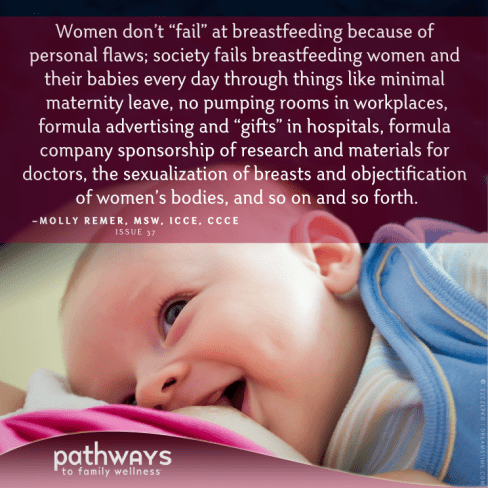
10556374_10152170229481290_105195906968994596_n(1)I was feeling kind of bad during the first week of August about having not gotten around to making any World Breastfeeding Week posts this year (I was still coming down from Mamafest on August 2nd, plus in “second stage” on birthing a really huge project, to be revealed soon!). Anyway, Pathways to Family Wellness Magazine took care of it for me with the image above! The referenced article is on the Pathways site here: Breastfeeding As an Ecofeminist Issue | The Outer Womb and on my own site is here: Breastfeeding as an Ecofeminist Issue | Talk Birth. I noticed it was shared 3,552 times on Facebook, which seems “viral” in terms of breastfeeding memes! (I confess I wish it would have directed back to my own site or page with that number of shares though!) And, no, I didn’t read the comments on it except for a handful, because I am not really interested in any criticism right now. BUT, the one critical comment I did see was about “society” having nothing to do with it is up to women to take care of themselves/assert their “natural rights” which “no one can take away from them,”  and so I have to repeat: breastfeeding is a sociopolitical and sociocultural issue. It does not occur in a vacuum and in the privacy of our own homes, it is intimately and inextricably linked to the health of society as a whole and inevitably impacted by the circles of support, broken or healthy, that surround each and every breastfeeding dyad. Breastfeeding is a systemic issue. Women, families, babies, men, children…we are all embedded in an expanding network of social, political, and cultural systems every, single, day. It is inescapable, for better or for worse.

As a related image of the embedded, interdependent nature of reality, including breastfeeding, I really appreciated the graphic in this post by Science and Sensibility.
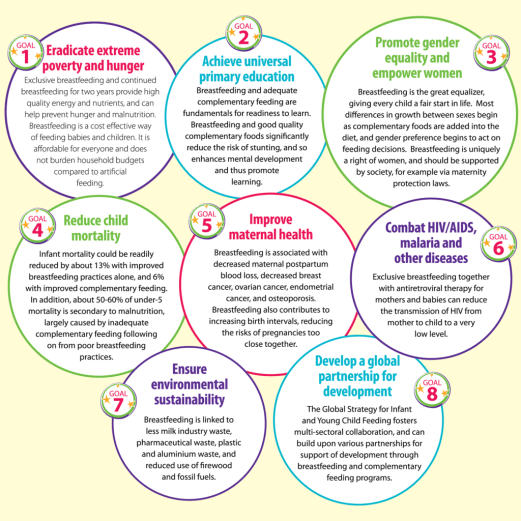
wbw2014-goals-1024x1024Breastfeeding is a women’s health issue, a reproductive rights issue, and promotes gender equality and empowers women! It both systemic and personal. Neither context can be ignored.

I was very pleased to get an email from Routledge publishing at the beginning of August promoting World Breastfeeding Week and offering a compilation of related free resources through the end of the month. Routledge is a textbook publishing company and I use some of their textbooks in my Human Services classes: World Breastfeeding Week – Routledge.

In addition to breastfeeding-specific textbooks, they also are offering free online access to related interesting textbooks like The Politics of Maternity and Social History of Maternity and Childbirth. This tells me they recognize the birth-breastfeeding continuum!

Live Love Latch logoSince our Mamafest event was coordinated by two LLL Leaders and our other local Leader helped with it as well, it made since to me to register it as an official Live, Love, Latch event. Live, Love, Latch is an initiative launched by La Leche League USA this year in honor of National Breastfeeding Month in August. The point of these events is celebration of breastfeeding and breastfeeding support.

The purpose of the celebration is, of course, to celebrate breastfeeding, but also to highlight support. All in attendance will be counted as participants, with the goal being to break the previous year’s record for breastfeeding supporters attending. Leaders have autonomy to decide on the details of each celebration.

This celebration theme provides an opportunity to educate family, friends, healthcare providers and other community members about how breastfeeding can be supported, and also emphasizes the value of the support network behind every nursing dyad.

via About – Live, Love, Latch!

I will write more about Mamafest in another post this week (I hope!), but if you’re curious, the photo album is available on the Rolla Birth Network Facebook page. We had 84 people sign in on our Live, Love, Latch sign-in form and about 100-120 people in attendance overall. It was really a successful, fun, exciting event.

After sharing these other images and thoughts, I couldn’t resist making another image of my own:
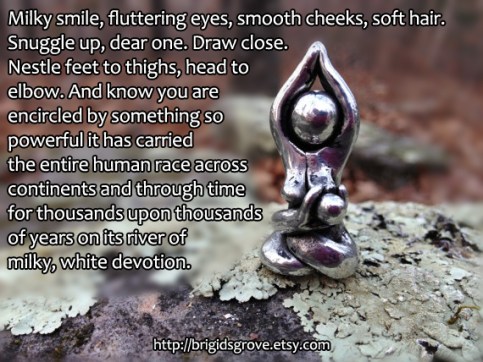
meme1And, we set up a new coupon code at Brigid’s Grove in honor of National Breastfeeding Month! Use WBW10OFF for a 10% discount on any item through the end of the month. 🙂
Tuesday Tidbits: Human Rights and Birth

“It takes force, mighty force, to restrain an instinctual animal in the moment of performing a bodily function, especially birth. Have we successfully used intellectual fear to overpower the instinctual fear of a birthing human, so she will now submit to actions that otherwise would make her bite and kick and run for the hills?”

–Sister Morningstar (in Midwifery Today)

486253_470181139659475_1370955888_nWhen I end my introduction to human services class and then again when I begin my social policy class, I ask my students to consider the above: What would happen if everyone cared? What would happen if our first reaction was compassion? What would happen if we focused on what matters? What would happen if we assumed everyone had inherent worth and value and deserves humane care and compassion?

I have said for a long time that women’s rights in birth represent a human rights issue, so I was very interested to receive word of a Human 10360685_10152979214427627_4161278366266845515_nRights in Childbirth campaign:

Women do not lose their basic human rights once they become pregnant. And yet, across the globe, women’s human rights are compromised and violated around childbirth. Examinations, interventions and procedures that pose risks to both mothers and their babies are routinely performed without informed consent, or through coerced compliance via threats or fear. When women come out of childbirth with post-partum PTSD from disrespect, abuse, or obstetric violence, the goal of a “healthy mother and healthy baby” has not been met.

via Home | Human Rights in Childbirth.

Childbirth IS a women’s rights issue and a reproductive issue:

Childbirth is a women’s rights issue and a reproductive justice issue. The United States maternity system is one of the costliest in the developed world, yet our birth outcomes compare poorly to those of other industrialized nations. Among industrialized countries, we consistently rank last or second to last in perinatal and maternal mortality rates. Moreover, birth is depicted in mainstream media with fear, medical intervention, and crisis…

via Business of Being Born: Classroom Edition | Talk Birth.

But, childbirth is also, quite simply, a human issue:

This is the whole point—women’s rights aren’t about “taking” rights from anyone else OR about demanding “special treatment,” they are important for a HUMANE WORLD for all people. I think it is hilariously awful that “women’s rights” are considered a political issue and that there is a section about “women’s rights” in the “opposing viewpoints” database for my social policy class. As long as women’s rights are considered a political issue or as something about which an opposing viewpoint can be held, rather than as self-evident, we are in continued, desperate need of revolution.

via Women’s Power & Self-Authority | Talk Birth.

Human rights in childbirth include access to the provider of one’s own free choice, so on a related note check out this set of consumer-oriented materials about the midwives model of care offered by collaborative effort of several midwifery organizations and endorsed by several others:

“Normal Healthy Childbirth for Women & Families: What You Need to Know” clearly explains and advocates the benefits of normal, physiologic birth for the average health care consumer. This helpful tool was created from a 2012 consensus statement developed by ACNM, the Midwives Alliance of North America, and the National Association of Certified Professional Midwives.

via OMOT Normal Birth Document Feature Page.

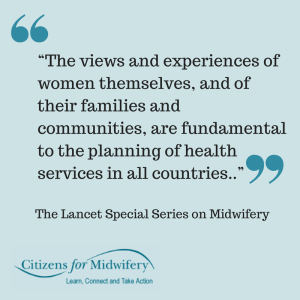
The below quote may seem obvious to birth advocates, but it is revolutionary in terms of health care. When Citizens for Midwifery shared this quote, they noted that, “One the KEY findings of the Lancet Special Series on Midwifery affirms the importance of women and their families participating in planning of health care.” For more from this special series on midwifery, go here: TheLancet.com.

10455322_10152508291549483_5155910343021300458_n(1)

And, in case we get so caught up in theorizing about appropriate care that we forget the lived experiences of the women who need it, read this tough, sobering article about why “going in pushing” does not a VBAC birth plan make:

Karen’s story is not uncommon and nor is the advice she was given about “going in pushing” but when we tell women they can not be cut unless they consent are we telling the truth? Whilst it’s true that legally the hospital can not physically force you into an operating theatre without your consent, they are not afraid to gain consent using underhand methods…

via Go In Pushing – It’s not a VBAC Birth Plan – Whole Woman.

And, of course, some relevant quotes to remember:

“If women lose the right to say where and how they birth their children, then they will have lost something that is as dear to life as breathing.” –Ami McKay

“Mothers need to know that their care and their choices won’t be compromised by birth politics.” – Jennifer Rosenberg

via As dear as breathing… | Talk Birth.

Is there anything that can be done, or are we facing an insurmountable struggle? I think we can remember that our “small stone” birth activism does matter:

While reading the book The Mother Trip by Ariel Gore, I came across this quote from civil rights activist Alice Walker: “It has become a common feeling, I believe, as we have watched our heroes failing over the years, that our own small stone of activism, which might not seem to measure up to the rugged boulders of heroism we have so admired, is a paltry offering toward the building of an edifice of hope. Many who believe this choose to withhold their offerings out of shame. This is the tragedy of our world.” Ariel adds her own thoughts to this: “Remember: as women, as mothers, we cannot not work. Put aside your ideas that your work should be something different or grander than it is. In each area of your life—in work, art, child-rearing, gardening, friendships, politics, love, and spirituality—do what you can do. That’s enough. Your small stone is enough.”

These quotes caused me to reflect on the myriad methods of “small stone” birth activism that can be engaged in as a passionate birth activist mother embroiled in a season of her life in which the needs of her own young family take precedence over “changing the world”…

via Small Stone Birth Activism | Talk Birth.

And, on a fun note, you might enjoy this lovely homebirth treasury on etsy: Home Birth by Kayleigh on Etsy. 🙂

“Thousands of women today have had their babies born under modern humanitarian conditions–they are the first to disclaim any knowledge of the beauties of childbirth…” –Grantly Dick Read, Childbirth without Fear

“I am not free while any woman is unfree, even when her shackles are very different from my own.” –Audre Lorde

“Humanizing birth means understanding that the woman giving birth is a human being, not a machine and not just a container for making babies. Showing women—half of all people—that they are inferior and inadequate by taking away their power to give birth is a tragedy for all society.” –Marsden Wagner

IMG_6046

Tuesday Tidbits: Story Power (again!)

“One of the most important things I have learned about birthing babies is that the process is more of an unfolding marvel than a routine progression of events.” –Tori Kropp

May 2014 031Lots and lots of tidbits on my mind this week! It has been a while since I’ve done a proper Tuesday Tidbits post and it has caught up with me. To avoid making this too loooong, I’ve split it up into a series of loosely connected thematic posts to release over the next couple of days/weeks.

First, a beautifully touching story about a family’s decision to have another child after parenting a child with very serious special needs (for which they have no diagnosis).

“…I, alone, would have to make the decision whether or not to have another baby. If we did, I would be like any pregnant woman–following doctor’s orders, cutting out questionable foods and praying for a healthy baby; everything I had done with Joy. This this time, though, I would have an intimate knowledge of what most moms-to-be only fear in the ‘what-if’ scenarios they play out in their heads. Eric had made his decision. Was I willing to jump into the darkness with him? Would my marriage survive if I didn’t? Would it survive if I did?…”

The Family Bed | Brain, Child Magazine.

Then, some thoughts about birth and pain and sensation:

“You may be able to feel baby pressing on your cervix. You have never felt anything like this. You may be able to feel your pelvis flexing and be acutely aware of where your thighs join your hips. You may be able to feel your uterus flex in a way that feels exactly like a really tough workout. But the bottom line:

You have never felt anything like this…”

Meditation for Birth | Mothering.

While there is a simplistic understanding reflected in this post that doesn’t seem to accurately embrace or even grasp the wide, staggering array of women’s experiences during the childbearing year, I do totally agree with this premise: labor is like nothing you’ve ever felt before (or will since). That is why people use the frustrating term, “birth mystery” to describe it, because it is full, total, complex, complete, and all-encompassing, and you may never, ever be so fully present in your body during the rest of your life. And, it is different every time (though more “familiar” the more babies you have, there are always surprises in birth).

Some past posts from me about birth and pain:

Tuesday Tidbits: Pain, Birth, and Fear

Tuesday Tidbits: Pain, Power, and Lasting Memory

Pain with a Purpose?

Perceptions of Pain

And a gritty, real (and painful) postpartum story from a real-life friend:

My vagina winced. She had been through so much. Held together by medical stitches, she felt so fragile, vulnerable, broken. Like Humpty Dumpty post-fall. (How embarrassing. Could she go lower? She had been so glorious). The king’s horses and men failed to reconstruct Humpty, and I wondered, despite my OB’s expertise, if I too would never be put back together again. Humpty Dumpty was just an egg. Who gives a rip about an egg? My lady parts were much more important…

via Milk, Pain, & Fear | Peace, Love, & Spit Up.

A short, funny story from the news about a student getting trapped in giant vagina, “Gateway to the World” sculpture.

“…Police confirmed that the firefighters turned midwives delivered the student ‘by hand and without the application of tools’…”

US student is rescued from giant vagina sculpture in Germany | World news | The Guardian.

There is a neat article about Mother Blessing ceremonies in Breastfeeding Today magazine (LLLI’s publication).

And, speaking of honoring mothers, my sweet sister-in-law has a blog post up about her belly cast experience following the mother blessing we had for her in June: The Mossy Stone: My Belly Cast.

Returning to difficult stories though, here is one with a  **trigger warning for child loss**. This is a beautiful, touching story about the death of a son and the decision to have a second child.

I know lots of women avoid loss stories while pregnant. I can’t avoid them, even though I think about it and maybe it is mentally better for me not to read them. I have to hold/honor/hear these stories too—they don’t need to be hidden away.

“The pregnancy progressed smoothly, as my first pregnancy had. When I began to show and people began asking me if I was pregnant with my first child, I was determined to remember Ronan in my response, no matter how uncomfortable it made the asker. “No,” I replied. “I had a son and he died.” The conversation often stopped here, the narrative halted. When the questions first began I scrambled to make the awkward exchange a bit easier for the other person. “Sorry to throw that on you,” I’d say, smiling. But now I don’t. My new policy is: asked and answered. Or, as a relative of mine used to say, if you don’t want the answer, don’t ask the question. I don’t elaborate on how or why my first child died when some people go on to ask those questions (and they occasionally do); at that point I tell them that I prefer not to say any more. I don’t want to offer up the details of Ronan’s illness like the pieces of a tragic tale. But I want it to be known—to strangers, to everyone—that he was in the world, that he was fully loved, and that he was my first baby…”

What The Living Do | Brain, Child Magazine.

Why is this? Because stories hold power! I saw this quote this week on The Mother-Daughter Nest:

Telling our stories- while being witnessed with loving attention by others who care- may be the most powerful medicine on earth.

Some of the stories that want to be told are joyful.
Some are sad.
Some are painful and make us feel vulnerable and afraid.
Some are full of hope and inspiration.
Some of our “story doors” take courage to open.
Some we may not be ready to open and that is okay.

But the telling? The telling brings healing, understanding, and connection.

(This is also why Red Tents are powerful)

May 2014 085

The WHO Code: Why Should We Care?

“Knowledge serves no purpose if it is not spread around. As the poor get poorer and the rich get richer, an entrenched ignorance is kept in place through a culture created and maintained by commercial interests.” – Gabrielle Palmer, The Politics of Breastfeeding

The international WHO Code of marketing breastmilk substitutes reached its 33rd anniversary this week. This means that for 33 years the United States has failed to live up to international standards AND for 33 years infant formula corporations have successfully ignored the WHO Code. In addition, they have convinced over half of U.S. hospitals to serve as marketing shills for their products—distributing their marketing materials—-samples, coupons, booklets, and other ads-—in health care settings in a manner that is well-established to undermine women’s breastfeeding success and to have a negative impact on infant health. Quite simply, getting breastfeeding “advice” from a formula company in a form of a cute little booklet with a happy baby on the front is like getting nutrition “advice” from McDonald’s. It is not neutral or benign and it does not have the interests of mom and baby at heart, it is a skillful marketing tactic, nothing else. I have long repeated the Ban the Bags catchphrase: Doctors’ offices and hospitals should market health and nothing else. To be clear, I would consider all medication-sponsored posters, etc. to fall in same category, not just formula. Refusing to honor the WHO Code isn’t actually illegal, however. The US voted against the proposal in the first place—on the original signing of the Code there were 118 votes for the Code, one against (the United States!), and 3 abstentions. Eventually more than 160 countries participated in the WHO Code. When the United States did accept it, they adopted it as guidelines to distribute to large manufacturers. Providers should follow it, but they can actually can do what they want. UNICEF has a state of the code chart that breaks down which country does what with the Code. US is under the no action category along with a small handful of other countries that includes Somalia and Kazakhstan.

This issue is a systemic problem and it goes WAY beyond just the individual mom and her baby!  Breastfeeding or not breastfeeding is actually a political and public health issue in the US, not simply a “personal choice.” Personal choice is the language American people and formula manufacturers love to use and it is a very, very successful manner of appealing the individualist nature of our culture, but in this case it is actually code for, “let huge multibillion dollar corporations exploit women at will and our health care providers will even help them do it!

While the WHO code has no legal teeth in the US (it IS law in some other countries, but it was written in terms that allow national governments to make their own decisions about how/if to enforce or participate in it). It is still VERY important for health care providers and US distributors and marketers to be aware that their actions are out of sync with international guidelines and that they are in violation of international standards.

…breastfeeding, like all aspects of women’s lives, occurs in a context, a context that involves a variety of “circles of support” or lack thereof. Women don’t “fail” at breastfeeding because of personal flaws, society fails breastfeeding women and their babies every day through things like minimal maternity leave, no pumping rooms in workplaces, formula advertising and “gifts” in hospitals, formula company sponsorship of research and materials for doctors, the sexualization of breasts and objectification of women’s bodies, and so on and so forth. According to Milk, Money, and Madness (1995), “…infant formula sales comprise up to 50% of the total profits of Abbott Labs, an enormous pharmaceutical concern.” (p. 164) And the US government is the largest buyer of formula, paying for approximately 50% of all formula sold in the nation…

via Breastfeeding as an Ecofeminist Issue | Talk Birth.

These past posts take a look at the systemic context surrounding breastfeeding women and how it impacts their “personal choices.” January 2014 041

Breastfeeding as an Ecofeminist Issue

Preventing Culturally Induced Lactation Failure

A Bias Toward Breastfeeding?

Tuesday Tidbits: Breastfeeding Research

Wednesday Tidbits: World Breastfeeding Week!

Controversies in Breastfeeding

The Impact of Birth on Breastfeeding


International Day of the Midwife!

cropMay 2014 073

International Day of the Midwife is today and Virtual International Day of the Midwife has a free online conference! The lineup of presentations is really rich. Check it out here

In celebration of this day, we’re offering a 10% off code good for use on any of the items in our etsy shop! Use 2014SPRING10OFF. 🙂

“It’s hard to describe if you’ve never been there, but to watch a woman access her full power as a woman to give birth is awe-inspiring, and I never get tired of being witness to it. It’s an honor to watch that transformation take place.” ~ Julie Bates, CNM

I’ve been blessed with care, love, and attention from midwives for many years. They’re irreplaceable and the model of care cannot be beat.

Here is a quote I shared on Facebook yesterday from midwifery legend, Ina May Gaskin:

10150680_850255348324885_8097255052427107934_nAt the end of April, Marsden Wagner passed away. An OB and outspoken birth rights activist as well as author of Born in the USA and participant in many documentary films about maternity care, Wagner was an incredible asset to birthing women and midwifery in the U.S. He will be missed.

“Humanizing birth means understanding that the woman giving birth is a human being, not a machine and not just a container for making babies. Showing women—half of all people—that they are inferior and inadequate by taking away their power to give birth is a tragedy for all society.” –Marsden Wagner, MD

10150734_10152385011414483_5563219813214176884_n


Thesis Tidbits: Feminism, Midwifery, and Motherhood

“Feminism catches fire when it draws upon its inherent spirituality. When it does not, it is just one more form of politics, and politics never fed our deepest hungers.” –Carol Lee Flinders (in The Millionth Circle)

Yesterday, I spent several hours finishing a blog post for Feminism and Religion regarding empowered self-care (it won’t run until next  week). It is a primarily a personal narrative, rather than a political commentary, but as I was writing it, I learned about new legislation introduced in Missouri in an effort to effectively destroy the practice of independent midwifery here. I also have a friend whose family March 2014 082 member just experienced terribly abusive treatment during the immediate postpartum period. I typed feverishly away with an absolutely excruciating headache and a million things on my mind, primarily the very many injustices experienced by women during the childbearing year. I was also left wondering HOW we can truly take care of ourselves when legislators and health care workers actively take dramatic and even cruel steps to prevent us from doing so?

Another friend wrote a comprehensive blog post about this malpractice insurance legislation and the issues involved with it. Midwifery advocacy organizations have already introduced a perfectly appropriate piece of legislation this session and do not need the proposed bogus piece of legislation that offers nothing in the way of protection for Missouri midwifery consumers and instead simply serves to drive midwives out of practice:

…Fortunately, midwives in Missouri do offer a grievance process and adhere to the practice standards set by the certifying agency NARM (North American Registry of Midwives). While there is already a high degree of professional accountability practiced in Missouri, this is because the state professional organization (Missouri Midwives Association) believes it is important and necessary for the professional practice of midwifery and not because the state has directed midwives to do so.

The state of Missouri has continued to be uninterested in working with midwives and home birth families to improve and safeguard the practice of midwifery.

Is there a better option? YES! HB 1363

Instead of HB 2189, we would like to suggest directing legislators to support HB 1363. This is a comprehensive midwifery licensing bill which does provide a mechanism for oversight and responsible, regulated practice. It also addresses the issue of malpractice insurance by requiring midwives to have coverage under the same conditions as physicians. It would also require Medicaid reimbursement for families desiring the care of Certified Professional Midwives and home birth.

via Missouri Legislature Works Against Women, Families and Midwives….AGAIN. | Midwives, Doulas, Home Birth, OH MY!.

I also recently finished a class on ritual theory for my doctoral degree program. The text for the class was To Make and Make Again: Feminist Ritual Thealogy by Charlotte Caron. In it, I was repeatedly reminded that gathering with other women in a circle for ritual and ceremony is deeply important even though it might just look like people having fun or even being frivolous, it is actually a microcosm of the macrocosm—a miniature version of the world we’d like to see and that we want to make possible. Returning to Caron, she explains something similar: “Ritual change is symbolic change, but it can lead to direct action or to ideological change, so it can be an important element in strategizing for change. One way of causing change is to re-form or alter the system. This involves recognizing that we are part of the system and that the system is dependent on feedback from its parts to keep it in balance, which means that we have the capacity to change” (p. 209).

Ritual experience can lead to practical action: spiritual praxis. But, this action does not need to look the same for all women, nor does it always have to involve large structures of society or even sweeping societal change.

“It is important to recognize that not all women will choose to act in the large structures of society. While it is hoped that all women will act toward justice, still electoral politics, lobbying, and revising the economic system may not be the spheres in which some women exert their energy. Ritual actions, raising children to be just and caring people, living in just ways in intimate and community relationships, and modeling different patterns and values are political actions to change patriarchal ideology. The choices of what spheres to devote energy to are important to honor. The constraints of women’s lives—when they are disabled, when they are dealing with past traumas, when they are raising young children, and when they are doing the many other things expected of women in our society—mean that women need to make choices that will allow them to live with integrity and well-being.” (p. 211)

A number of options of action are possible. “What is important are women’s choices to act in concrete ways in every circumstance, to know our neighbors, to raise children to be caring people, to live as if justice exists, to be just in personal relationships, and to live in the community in ways that model the values of justice and well-being for women and all of creation.” (p. 211)

As a mother who works extensively with other mothers, I appreciated Caron’s acknowledgement that raising children is a feminist act with potential to create change as well. “Another strategy for change is through raising children to be just and caring people. A media image portrays feminists as being against motherhood—but in fact, feminists make the best mothers. They raise children aware of themselves and the world, of options and values, of what justice means and how to work toward it, and how to be self-critical and self-respecting” (p. 203-204). Caron also explains that “in a just society, women would be free to make whatever decisions they needed to, for however long they needed to, in relation to political action in the public and the private sphere. All people would participate in the decision-making, and women would be supported in their decisions rather than, as sometimes happens, made to feel guilty for not doing enough or not valued for what they do.”

In connection with women being valued for what they actually do, Caron makes an interesting note about the visions women in her research hold for the future, for the possible:

“Interestingly, none of the visions described by women was based in self-fulfillment, in gaining personal power, or in one’s group having power and the expense of others. Instead, the interviewees talked about the elimination of social, economic, military, and other patriarchal problems, and about living in a world of valued individuals, healthy and diverse relationships, economic and environmental sustainability, equality for all, and shared decision-making and power” (p. 220).

Connected to these themes, one of my classic favorite quotes about women’s spirituality groups is this one:

“…Women’s spirituality groups can become birth centers for social change”

–Anne Rush in The Politics of Women’s Spirituality (p. 384)

March 2014 127

Wednesday Tidbits: Activism!

vdayutvs_webRolla Birth Network is pleased to be one of the co-sponsors of the upcoming production of The Vagina Monlogues, Eve Ensler’s classic feminist empowerment play.

The local production of The Vagina Monologues will benefit the Russell House, a shelter for battered women and their children. The event is specifically planned as part of V-Day:

“V-Day is a global activist movement to end violence against women and girls. V-Day is a catalyst that promotes creative events to increase awareness, raise money, and revitalize the spirit of existing anti-violence organizations. V-Day generates broader attention for the fight to stop violence against women and girls, including rape, battery, incest, female genital mutilation (FGM), and sex slavery.”

Last year we had a candlelight vigil on Valentine’s Day in honor of One Billion Rising. While that was a wonderful project too, this play production is much more ambitious and is very exciting! Here are some more details:

1506285_10201181030470858_1053739884_o

Local cast members (including my very own talented and awesome doula! 🙂 )

Rolla Area Citizens for Women 2014
Presents a Benefit Production of

Eve Ensler’s
THE VAGINA MONOLOGUES

FEBRUARY 21, 2014 at 7:00 PM

Venue:
Cedar Street Playhouse
701 North Cedar Street
Rolla, Missouri 65401

$5.00 Minimum Donation per person CASH ONLY
Benefits The Russell House

I’m really looking forward to going!

Another Missouri-local opportunity specific to birth advocacy and midwifery activism is the annual Friends of Missouri Midwives Cookie Day at the Capitol coming up next week:

1524390_680284898676217_1590110806_oYes, it is true, Barbara Harper will be there! Isn’t that cool?! I heard her speak at the CAPPA conference in 2010 and very much enjoyed her presence and devotion. I hope the weather cooperates so I can see her grace our Capitol building with her poise and information!

“Let us initiate our daughters into the beauty and mystery of being strong and confident women who claim their right to give birth and raise their children with dignity, power, love, and joy.” –Barbara Harper

One of the opportunities that is also going on this month that is not local, but virtual instead, is DeAnna L’am’s Red Tent Summit. It is free to register and participate. I have not yet carved out the space I need to actually tune in, but the lineup of speakers and wealth of topics is amazing!

Also, while all of these particular events are offered with a wonderfully upbeat spirit of intent and energy, I also feel like sharing an activism-related quote that I’ve had saved in my drafts folder for a long time that acknowledges the important role of anger and activism:

I’m not afraid to say it. Hell, isn’t anger kind of a prerequisite for activism work? As a birth worker I get to watch abuse after abuse, injustice after injustice – over and over again. I mean, really, what spurs the need for activism work if not injustice? And injustice stirs up indignant anger.

We have this huge deficit with the word, “anger.” Somehow, whenever it is said, we cling to this connotation that it – the word, the feeling – is inherently BAD. It took me a lot of years to come to the understanding that there are no “bad” or “good” feelings – that emotions just are. They are states of being which reflect either met or unmet needs.

Anger is usually a catalyst emotion…

via I am an Angry Activist.

I’ve self-identified as an activist since at least 1996 (when I first began working at the same battered women’s shelter for which the Vagina Monologues production is benefiting, actually!) I do find that some anger (or sheer disbelief!) at injustice is part of the fuel that drives my present-day activism. In fact, social justice was at the heart of my response several years ago when asked why I became a childbirth educator:

…the question was posed, “why did you become a childbirth educator?” I responded with the following: because I care deeply about women’s issues, social justice and social change and I feel like women’s choices in childbirth are intimately entwined with this. Because I believe peace on earth begins with birth. Because the births of my own sons were the most powerful and transformative events of my life. And, because I believe every woman should have the opportunity to feel and know her own power and to blossom into motherhood with strength, confidence, and joy. ♥

…On a discussion board once, someone asked the question “what’s at the root of your love of birth?” I was still for a moment and let my intuitive, heart-felt, gut level response come to me and it was this:

Women.

Women’s health, women’s issues, women’s empowerment, women’s rights.

Social justice….

via Why, indeed? | Talk Birth.

I’m currently finishing a book about women’s rituals and this paragraph caught my eye last night in relationship to my own experience of birth activism (and other activist work):

“One of the other problems in areas of small population is the relationship between local and regional leadership. Often, people who are competent local leaders are recruited to work regionally or nationally in their organizations. This policy frequently leaves a vacuum at the local level because leadership is not broadly enough based in those communities.”

I’ve seen this happen with myself, noticing that as I became involved with birth activism on a national level, my time for local birth activism was necessarily reduced. (And, then as my interests and commitments broadened beyond birth, the time for birth activism of any kind reduced.) I also see it happening with digital commitments—basically, the more I do for people on a virtual level over the internet, the less I have to give on a face-to-face local level. I’m still sitting with this realization and wondering what to do with it. The organizers of the One Billion Rising event in Denver this year recently contacted me to ask permission to read one of my poems aloud during their event. I was thrilled to say yes, but then I also thought about my local community and how most people here would not be familiar with my poem at all. So, Denver hears it, but my own local area does not. Interesting. I also found out this week that one of my essays about my grandma was translated into French and published in a French magazine. Cool, yes, but again gave me pause…

January 2014 063Related past posts:

Birth Violence

Tuesday Tidbits: Domestic Violence

Domestic Violence During Pregnancy

Guest Post: Abuse of pregnant women in the medical setting

Business of Being Born: Classroom Edition

Tuesday Tidbits: The Role of Doulas…

Community Organizing

Birth Matters!

Taking it to the Body, Part 4: Women’s Bodies and Self-Authority

Good Birth Books to Gift to Others

I’ve recently had several requests from friends asking about the best birth books to give as gifts to pregnant relatives. After sending my third response, I realized that there’s a blog post in here somewhere!December 2013 010

Here are my current recommendations:

Sacred Pregnancythis book is simply beautiful. My past review is here.

Giving Birth with Confidence—this is the well-known childbirth education organization Lamaze International’s guide to pregnancy and birth and it is one of my favorites. My review of a past edition is here.

The Birth Partnerthis guide by Penny Simkin is a classic for helping fathers or other birth partners serve during labor

The Greatest Pregnancy Everfocused on positive mental attitude during pregnancy and cultivating a mother-baby bond prenatally (caveat: I’ve not actually finished reading this one, so I’m not sure if I have any reservations about it or not. I bought it at the last CAPPA conference)

Birthing from Within—the original birth art resource and a fabulous “out-of-the-box” handbook for preparing for birth. It is not attached to a particular outcome and can help mothers dig deep whether experiencing a home birth or a cesarean. This book is my all-time favorite, but my recommendation comes with a caveat that the short breastfeeding section is terrible.

The Baby Book-a comprehensive, reassuring look at baby’s first year by Dr. and Martha Sears.

For birth stories, I love and adore Simply Give Birth (past mini-review is here). I also like Journey Into Motherhood (available as a free digital copy here) and Adventures in Natural Childbirth.

I used to recommend The Thinking Woman’s Guide to a Better Birth, but is has been replaced by an updated version called Optimal Care in Childbirth and I’ve not yet read that one. My educated guess is that it is still an excellent recommendation! 🙂 I also used to recommend The Birth Book by Dr. Sears. It is still a good suggestion, but it is now an “older” book and so I don’t put it at the top of my list any longer.

Also, make sure you grab a copy of the free Guide to a Healthy Birth from Choices in Childbirth. I love this little booklet so much! It is my top favorite resource for tabling at community events. Another free educational resource that I recommend (particularly for women planning natural births in hospital settings) is Mother’s Advocate. There is a free booklet and a series of videos that explore Lamaze’s Six Healthy Birth Practices (which all mothers deserve as part of evidence-based care during birth, regardless of birth location).

Past book lists and related suggestions:

What To Do When Newly Pregnant and Wanting a Natural Birth…

Suggested Reading

Postpartum Reading List

Book list: Preparing Children for Homebirth

Non-Advice Books for Mothers

2012 Book List (all kinds of stuff, not just birth)

In addition, all the books I’ve reviewed in the past are available on my website from this link, so make sure to browse and see if anything else jumps out at you as a good match.

“Everyone who interacts with a pregnant woman is, in some way, her ‘teacher.’ Telling birth stories, sharing resources, imparting obstetrical information, giving advice or warnings—these are all direct or indirect ways of teaching about birth and parenting. Whether you currently identify yourself as a ‘childbirth teacher,’ or you are a midwife, doctor, doula, yoga teacher, nurse, therapist, breastfeeding counselor, or you are simply a woman or man who cares about the power of the childbearing year, you already hold the power of mentoring within you.”

–Pam England

Talk Books: Laughter & Tears: The Emotional Life of New Mothers

Laughter and Tears: The Emotional Life of New MothersBecause books are my first and longest-lasting love, I began my blogging career with a book blog. I eventually gave it up when I felt I no longer had time for it and turned my attention of other blog work. However, I occasionally mine the old blog for content here and I’ve realized that rather than doing traditional reviews, I really, really like doing my somewhat-new “talk books” posts on this blog. I’ve mentioned before that one of my reasons for blogging is simply to store information in one place that I want to remember or come back to later. If I’ve typed up everything I like from a book, I don’t really need to hang onto the book and the “essence” of many books (or at least what I got from them) is all compiled in one place. So, what follows is one of those mined posts (though at the end, I got caught up in the topic and went off into some related thoughts).
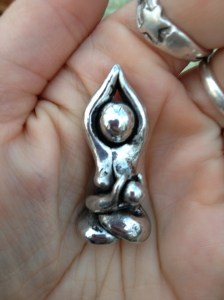
Laughter and Tears: The Emotional Life of New Mothers was written in 1997 by Lamaze co-founder Elisabeth Bing. I found myself with a dearth of postpartum resource books after giving birth to my first child and desperately hungered for them. I went on a dogged mission to locate them, finding them somewhat difficult to unearth, and eventually I think I read basically every book ever written on the postpartum period.  I started out enjoying Laughter and Tears, but found it less and less engaging as it went on. I think there is such a great need for books about postpartum out there—ideally, for women to read before their babies are born. I wish I would have had one already on my shelf when my first baby was born, instead of having to discover the niche later. However, part of why the book was not engaging by the time I actually read it was simply because it is geared toward women in the immediate postpartum (and also first time mothers primarily)—when I read it, I was no longer there and so my interest in the book waned fairly quickly. I also found a the heavy emphasis on “reclaiming your body” off-putting—there was even a comment like, “now that your baby is a robust two month old, you can begin to reclaim your body by reducing or eliminating feedings at night.” Excuse me? “Robust” TWO MONTH OLD? That is practically still a fetus as far as I’m concerned!

Several quotes I marked to share:

“Our society is profoundly ambivalent about children. On one hand, we praise family values, but on the other, we emphasize individual liberty and the rights of women to have as many freedoms as men. We encourage mothers to desire to have it all, but do not guarantee maternity leave, health insurance, or day care. We use babies to sell products, from laundry detergent to automobile tires, but we don’t want a mother with a toddler in the seat next to us on an airplane. We question the legality of abortion but threaten to withdraw welfare benefits from disadvantaged children. We celebrate children and praise parents for having them, but we do not provide structures or systems to help nurture them.”

And, one I still find extremely relevant:

“The degree of pleasure you take in your mothering is not the same thing as loving the baby or being an effective parent. Keep in mind there is a distinction between mother love and maternal satisfaction. You may love your baby very much but be dissatisfied with your life circumstances.”

There was also a quote that I find a new relevance in today now that our household structure has changed to both parents being home nearly full-time. I’ve been confronted over and over again in the last several months with how many “keys” to the household and family life that I’ve held over my ten years as the primary parent in the home and that, at some level, there is a power in being the one who knows (even if it just where the mustard is, for example) and that switching over to sharing those household details doesn’t actually come easily for either parent, no matter how we’ve said we wish to share them. I’m also noticing how very, very many details of the somewhat invisible work of parenting are still very much my responsibility—such as planning birthday parties or taking kids to playgroup or making dentist appointments or making sure Christmas presents are purchased and equal—and apparently, I do not know how to let those go or start transferring some of the responsibility without feeling put-upon, annoyed, demanding or like, I’ll just do it myself, since I’m the expert anyway. And, as this quote below references, I also have enjoyed being the primary emotional parent as well and still hold on to that terrain—essentially, what I want to share is the cooking and towel-folding responsibilities, while still getting to be the one run to for security and snuggles.

“Men are challenged by their attempts to be more involved and more nuturant than the ‘traditional’ father. Women are challenged not only by developing an identity in the world outside the home, but also by opening up and truly incorporating men into the intimate life of the family. You may have a concept of what a more involved father should be like, but if you are honest with yourself, is your image truly about sharing the love and nurturance? Or is it actually about wanting your partner to help with domestic chores? Are you really imagining a co-parent, or are you thinking of something more like a regular baby-sitter and handyman?”

Whatever it’s shortcomings, this book again reminded me of how vital postpartum support is for families in our society and reminded me of why I originally wanted to be a postpartum doula and how called I felt to that work. In 2004, I trained with DONA as a postpartum doula and felt 100% certain that I had found where I belonged (indeed, I still get Christmas cards and updates from one of my first postpartum doula clients—I was good at the work and they liked me a lot!). I stopped working as a postpartum doula in 2006 though. My biggest reason for discontinuing postpartum work was because at this point in my life I couldn’t reconcile taking care of someone else’s family while my own needed me so much. There I would be washing my client’s dishes and thinking that I have a huge pile unwashed at my own house (that my husband then did at night when he got home) and/or folding their laundry and thinking of the two full baskets at my own house in my own living room as yet not put away. Also, I recognized that I felt more comfortable with and am temperamentally more suited for educational/”academic” types of support  rather than the “intimate” hands-on support that postpartum or labor support requires. For a time after quitting, I really felt embarrassed about it because I was SO sure it was my “calling” and because I spent so much money on training, books, supplies, certification packet, etc. (Luckily, I totaled it up when I was preparing to quit and I made enough money from my clients to at least more than pay myself back for the training!)

I feel fervently that women/families need postpartum doula support (sometimes desperately) and I felt depressed to realize that I wasn’t the person for the role after all. I didn’t understand at the time, but I quickly figured out why the majority of the women in the postpartum doula training with me were middle-aged. They had the energy to “mother-the-mother” and “nurture the family” at that season in their lives, whereas I am still in a season in which I need to nurture my own family before I have the energy to spare to nurture someone else’s. There were also a handful of women in the training, like me, who had very young children. There were no in-betweeners, like where I am right now. I’ve begun to notice this in birth activism work (and to a lesser, but still noticeable extent, in breastfeeding support work) as well—passionate mothers-of-infants or toddlers and gray-haired sage-women are the ones who come together for the bulk of the birth activist workload in various organizations.

I’m also reminded again, however, of why breastfeeding support holds such a lasting pull for me and that is because postpartum is where it is at, that is where we are so very, very deeply needed as support people. Birth is amazing and exhilarating and women most definitely need us there too, but in the nitty-gritty, day-to-day, unglamorous, nipples and breast infections, teething, crying, dirty-haired, exhausted, wrung-out maternal web of daily being is a very tender and delicate beauty that becomes visible only when we’re willing to spend months and months, or even years, serving as a listening ear, a medication lookup, and someone to trust with both her laughter and her tears.

December 2013 018Additional resource: Non-Advice Books for Mothers

Business of Being Born: Classroom Edition

Childbirth is a women’s rights issue and a reproductive justice issue. The United States maternity system is one of the costliest in the developed world, yet our birth outcomes compare poorly to those of other industrialized nations. Among industrialized countries, we consistently rank last or second to last in perinatal and maternal mortality rates. Moreover, birth is depicted in mainstream media with fear, medical intervention, and crisis…

via The Business of Being Born Classroom Edition.

It took me some time to get around to it, but I’ve finally finished exploring The Business of Being Born: Classroom Edition and its associated toolkit of educational materials! As a long-time childbirth educator and birth activist, of course I was interested in this classroom version of the (new) classic birth advocacy film, but I’m also a college professor and therefore was doubly interested—how might this resource be incorporated into one or more of my human services courses? As the BoBB companion site explains…

Childbirth is an issue most people do not engage with until they have experienced the maternal health system. The Business of Being Born: Classroom Edition reaches out to young adults BEFORE they confront their own birth decisions, both placing the issue on the radar and challenging the prevailing assumptions about birth providers and current obstetrical management trends. The goal is for the next generation of policy makers, practitioners, educators, and parents to approach birth decisions with awareness and confidence. Our strategy is to incorporate this evidence-based presentation into classrooms around the country. We envision empowering the next generation of parents to seek out systemic change and new policies supporting domestic maternity care…

via The Business of Being Born Classroom Edition.

The Classroom Edition of the film runs about 25 minutes and comes packaged with one of my all-time favorite resources for birth classes and tabling events: The Guide to a Healthy Birth from Choices in Childbirth. It also comes with two additional celebrity interviews, the short film Birth by the Numbers, and a instructor’s toolkit with classroom activities tying the themes of the film to major subjects such as Women’s Studies, Public Health, and Sociology.

My only critique of the classroom edition of the film is that the assembled quotes at the beginning of the film are put together in a choppy sort of way that makes it difficult to perceive (for the average viewer), which are the “good” (i.e. accurate) quotes and which are popular types of misinformation. There is also an odd, repetitively distracting, monotonal quality to the music that plays through much of the footage. Excerpted from the full-length film, the classroom edition still includes Ricki Lake’s homebirth in her bathtub, which was one of my top favorite moments of the original film. Content from a historical perspective as well as content involving the shadowing of a homebirth midwife and the personal stories from families choosing midwifery care were greatly reduced from the original version and the classroom edition seems to have more of an emphasis on sociocultural analysis. It is noted that 90% of women in many hospitals experience some type of labor augmentation (usually pitocin) and also that hospitals are businesses, businesses that are not really interested in having women hang around in the labor room.

One of the college courses I teach is American Social Policy. I have always been interested in birth change from a systemic (macro) level as a companion to change on the individual (micro) level, so I especially appreciated watching the Birth by the Numbers presentation included with the classroom edition of BoBB. When speaking about the idea that the increase in cesarean rate reflects maternal choice, public health professor Gene Declercq says, “this blaming of women is farcical. It is not about the mothers, it is about the way we treat care in the United States. Nobody ever wants to admit there is a difficult inherent in the system.” Well, I want to admit it and this is the kind of macrosystem-level change we talk about in my Policy course. At the companion Birth by the Numbers website, you can download a powerpoint presentation and other teaching tools, as well as watch the short film, in which public health professor Gene Declercq debunks popular myths about the causes of the United States cesarean rate increase. The film also looks at disparities in maternity mortality rates and tackles questions of systemic influences on maternal health outcomes.

So, are mothers really asking for cesareans?

slide

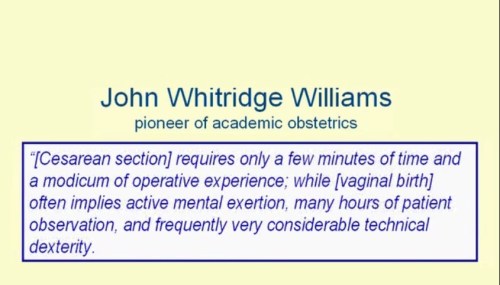
Declercq also draws on writing from the classic obstetrics textbook, Williams Obstetrics, and shares this quote about one of the real reasons that cesarean rates continue to rise:
whycesareanAnd, he makes this important observation:womenhaventchanged
As Nadine Goodman says in The Business of Being Born Classroom Edition, “A woman will always remember how she was made to feel during her birth…if you don’t have the reverence and respect for birth, where do you go from here?”

Prior post about The Business of Being Born: Transformation Through Birth | Talk Birth

Disclosure: I received a complimentary digital package for review purposes.