Archives

Strong, Strong…

20121121-212301.jpg

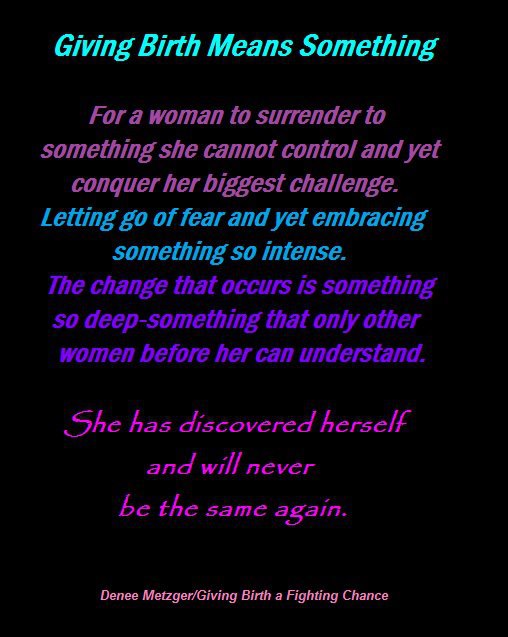
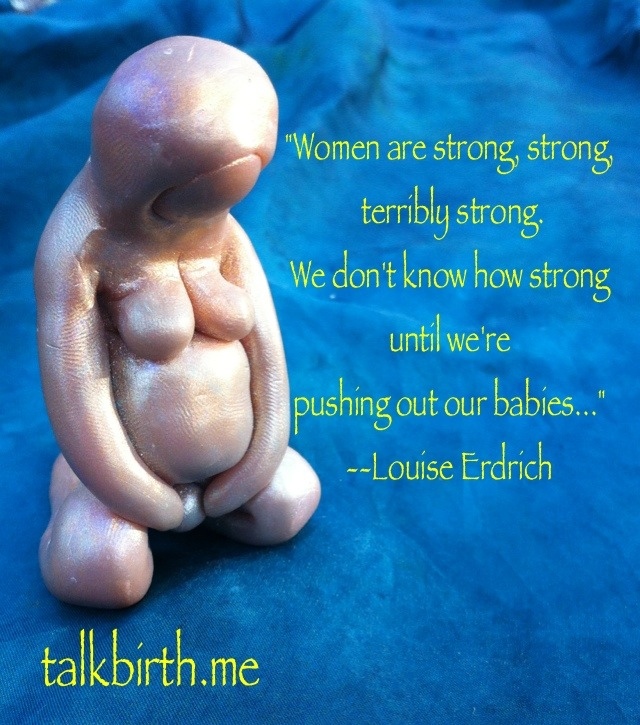
I woke up this morning with this quote running through my head and thinking of a pregnant friend of mine. Since her story is not mine to tell, suffice to say, she had a long and winding road to reach this point and this evening she gave birth at home after having had a cesarean with her first baby! Yay! I’m so excited for her and for their whole family. One part of me just knew she could do it and the other part of me still worried that I was being falsely optimistic. It has happened to me before—that I supported and encouraged and hoped with the mother and despite all those hopes and dreams and wonderful, careful, thoughtful plans, the birth still didn’t go as planned. I also believe that all births are acts of courage and that mothers, whether they push out their babies or not, have the capacity to dig deep and discover strength beyond anything they previously knew. However, just, yay. I’m so happy and excited and relieved for this friend of mine 🙂 The sculpture in the picture is the birth art piece I made after I actually gave birth to my last baby. She captures the pose in which I caught my daughter. My previous photo with this quote was of the pre-birth sculpture I’d made to address my pushing-the-baby-out fears:

Still figuring out the pictures with words app that I got. I love my nature spots in the woods as backgrounds, but they’re too busy and make choosing a text color that actually works almost impossible!

Childbirth is power in its purest and most natural form–it is wild and uncontrollable and takes us on a journey of surrender. Birth is about so much more than babies being born. It is about a mother finding her inner strength at her most vulnerable and powerful moment, which begins her unique and lifelong journey of mothering that child.”

–Brianna Kauer (in Midwifery Today, issue 103)

And, speaking of thankful birthy goodness, Thanksgiving is tomorrow and that reminded me of an earlier post about the rest and be thankful stage!

I also would like to mention that I have a Talk Birth topic on ScoopIt now. I primarily started it so that it could handily feed into my Talk Birth Facebook, while still leaving a more useable record for me to go back to/repost (things just kind of disappear off the page on Facebook and it can be hard to remember what the heck I’ve shared there if I then want to do a blog post about it). I was introduced to ScoopIt via LinkedIn when I started following a really well-curated topic about E-Learning and Online Teaching. There are very, very few birth-related topics on ScoopIt, so start curating one! It is fun and easy and, as I said, really handy for feeding content into your Facebook page or other media (I experimented yesterday with sending a post directly to WordPress and that worked too!)

I’m also thankful for several days at home to spend with my family and without a long to-do list. I have one final paper to grade tonight and then my calendar is pretty deliciously blank for the next four days! We can really use this. I need a stillpoint, a rest, and some time to spend on the fun things I want to do like wallow in piles of books and make fabulous new sculptures and go sit out in the woods and…and…and…

Thankful for all these people too! And, also thankful for fab new pictures from recent photo session with my friend 🙂

What If? Shifting the Dialogue of Birth

Sometimes at mother blessing ceremonies I share a modified version of a piece of writing by Leilah McCracken called, “Shifting the Paradigm of ‘What if?'” (I forget where I originally read it, perhaps in Hypnobabies?).

This is my re-working of McCracken’s words, with the addition of my own thoughts at the end:

Many of us think “What if?!” in fearful ways before giving birth: What if I need to transfer? What if the pain is awful? What if my uterus ruptures? What if the baby won’t come out? What if I lose control? and so on.

Let’s shift the internal dialogue and think “what if?!” in powerful ways: “What if I have the most beautiful experience of my life? What if I could actually feel a wet, moving baby on my belly—just after birth—and fall in love with that feeling forever? What if I give birth and feel pure exhilaration? What will happen if I give birth as a powerful, free woman—what will happen if I claim my right to give birth as my biology impels me to? What if I emerge victorious, free, and powerful? What if—what if my baby never feels anything in her first moments other than my body and my love? What if I push my baby out into my own hands, and pull her up, and kiss her wet head, and cry and moan and weep my joy in private, darkness and love—what if… what if this birth is the most loving, sweet and gentle moment of my life? What if I give birth with wild joy and courageous abandon? What if…

If I read this out loud to a woman, I substitute “you” for “I”—the “you” message puts her directly into that new framework of what if!

What if we become as powerful and wise as we are meant to be? What if we share our wisdom and our strength with other women? What if we act with courage and in solidarity with other women? What if we believe unshakably in the power of women to triumph and to act with courage? What if we expect birth to be beautiful? What if we trust that we can learn so much from each other? What if we trust women’s bodies and the wisdom of babies? What if we listen, really listen? What if we remember that she always has the right to define her own experience? What if we know in our hearts that all mothers love their babies? What if we act as though other women don’t need to be enlightened or “educated”? What if we believe she has the keys within herself to unlock her own steady power? We will change the way the world spins…

What if… the very future rests on our ability to engage with these what if’s?


Note: I then wrote a companion post about the flip side—the going ahead and thinking the “bad” what if’s—because I want to also acknowledge that there is power and value in experiencing and working through the so-called “negative” what if’s as well.

What if…she knows exactly what to do…

Bits of the (Birth) Net

The following is a collection of the bits and pieces that caught my attention and then were shared via my Talk Birth Facebook page during the last two weeks.

Listening

From a good article by the National Association of Mothers’ Centers in Mother Support: When Words Get in the Way

Words, whether written or voiced, are so very fragile. They can be bent or twisted, even become unrecognizable from their initial intentions. They can have different cultural meanings, regional understandings, and generational perceptions.

There will always be the opportunity for miscommunication…

Such a good reminder. What you say and what people hear are often two different things. What you say and what you mean can be different. How your words are received and interpreted can be very important and intent in many ways doesn’t matter! Communication is transactional process. A two-way process. And, it is symbolic. Meaning can never be fully interpreted and understood completely.

This article also reminded me of one of my own older articles, Listening Well Enough, which came to mind because I’m finishing up with the training of two women. The essay describes my own experience when I was training as a breastfeeding counselor in 2005.

Privacy

The topic of what to risk sharing online came up with friends recently and I enjoyed this article about answering the question of How Much Of Your Private Life Should You Keep Private On Your Blog?

Childbirth Education

Childbirth education is beginning too late in pregnancy; it needs to begin in the first trimester or even before women become pregnant…

The above is one of the concluding points from an interesting article from Birth Works International about supporting women without epidurals.

Good article from Lamaze about your breath and how it can help during pregnancy and birthing!

Virtual labor simulator!

Pushing Positions

Very interesting article on What is the Evidence for Pushing Positions?  Apparently there is more blood loss and second degree tears with upright pushing positions. Personally, I CANNOT imagine giving birth in a supine position. But, I’m also really, really, tired of tearing (tired enough that it is one of the factors in our decision not to have “just one more!” baby). For more thoughts about pushing, see previous post on Following Your Body’s Urges to Push…

And speaking of upright birth, Barbie homebirth photos! 🙂

Informed Consent

Valuable article addressing 10 Responses to Pressure to Consent (remember, it isn’t “informed consent” if you do not have the option of saying NO!)

Posts I’ve written about informed consent:

Prenatal Yoga

Online video prenatal yoga class: Prenatal Yoga – when you feel good, your baby feels good.

And my own prior posts on the subject:

Birthing Room Yoga Handout

Birth, this elegant, simple, yet intricate process has had unnecessary, complex, expensive technology superimposed onto it, creating a dangerous environment for birthing women.” -Alice Bailes

Loved this article on what really matters for midwives!

Epigenetics

NEW STUDY: Epigenetics: Mother’s Nutrition — Before Pregnancy — May Alter Function of Her Children’s Genes. “As parents, we have to understand better that our responsibilities to our children are not only of a social, economical, or educational nature, but that our own biological status can contribute to the fate of our children, and this effect can be long-lasting,” said Mihai Niculescu, M.D., Ph.D., study author from Nutrition Research Institute at the University of North Carolina at Chapel Hill, in Chapel Hill, N.C.–Epigenetics: Mother’s Nutrition — Before Pregnancy — May Alter Function of Her Children’s Genes

After CAPPA this year, I wrote about epigenetics here: Epigentics, Breastfeeding + Diet, and Prenatal Stress

Call the Midwife

Fun! Ms. Magazine linked to one of my blog posts about midwifery in their post about the PBS show Call the Midwife!  And, after posting to the CfM Facebook page about how I didn’t get to watch the show myself because I have no TV channels, CfM fan Jackie clued me in that Call the Midwife is available online (no TV channels required!) Yay! 🙂

Older Posts of My Own

Birth Culture: “Birth is cultural, the way eating is cultural. We don’t just eat what our bodies need to sustain us. If we only did that, there would be no reason for birthday cake. Birthday cake is part of our food culture. The place you are giving birth in has a local culture as well. It also partakes of our national birth culture. Not everything doctors do regarding birth makes the birth faster or physically easier for you or the baby. Some things are just cultural.” -–Jan Mallack & Teresa Bailey

Creating Needle Felted Birth Art Sculptures: My first foray into birth art, before I fell in love with using polymer clay!

Centering for Birth: “Centering is a breath awareness strategy that I’ve adapted for use in birth classes based on the ten second centering process described in the short book Ten Zen Seconds…” Free handout available about centering for birth! (I was reminded of this post by Enjoy Birth!

Breastfeeding as an Ecofeminist Issue:“What happens when society and culture pollute the maternal nest? Is that mother and baby’s problem or is it a political and cultural issue that should be of top priority? Unfortunately, many politicians continue to focus on reproductive control of women, rather than on human and planetary health…”

During a week when I didn’t have time to craft delightful new blog posts, it was fun to have a post from a couple of months ago suddenly getting all kinds of hits and Facebook shares. Thanks, internet! ;-D (Around 150 shares on Facebook apparently. I ♥ Facebook!)

On Parenting Books

Mama Birth: Sadly, Parenting Books CAN’T Actually Raise Your Child: Enjoyed this post! (But I recommend NOT reading the comments on the original article she links to about “detachment parenting.” I lost about 30 minutes of my life, felt my blood pressure rising, and only made it to page three!)

The revolution must have dancing; women know this.
The music will light our hearts with fire,
the stories will bathe our dreams in honey
and fill our bellies
with stars.
-Nina Simons via Rebecca A Wright, Doula

Lann’s Birth Story–Baba Style!

Today my firstborn son turns NINE! I can hardly believe it. I mean, I remember being nine. What happened?! And, as I thought about his birth and planned to share his birth story link as I always do, I suddenly remembered…I have his birth story from my mom’s perspective too! And, I’ve never shared it here (I also have my friend’s version and my doula’s version—this could keep me going for a while!). In our family, we call my mom Baba as her grandma name, so here is the tale of Lann’s birth, Baba Style:

The time for Lann’s birth was rapidly approaching, and I felt like I was fairly well prepared. My bag was packed, and I had been studying my labor support information. I needed to honor my commitment to demonstrate lace making at the Potosi Bisonfest, so I had driven a separate car, and had my newly purchased cell phone handy – I even made a test call to Molly and Mark to be sure it would work from that location. It was a long day – up at 5:45 a.m., drive 2 hours to Potosi, demonstrate for 6 hours, drive 2 hours home. I made it through without receiving “The Call”, and thought I’d go ahead and check in with them to see if the watched pot had begun to boil before falling, exhausted, into bed.

What a surprise it was to have Mark answer at about 7:30, and tell me that they thought something was happening. I couldn’t believe it, even though this was the moment we’d all been waiting for! Molly got on the phone, and expressed her concern that perhaps this was false labor. I tried to reassure her that it didn’t matter to me if I had to make 10 false trips, as long as I didn’t miss it. Her contractions were coming regularly and close together, but even so, she seemed reluctant to call in her support team without feeling more confident about what was happening. We decided to wait a little while, and see what developed. I used that time to change out of my demonstration costume, and begin gathering supplies I thought I might need (book, project, birth art, extra clothing, etc.). The phone rang within 45 minutes, and this time Molly said she wanted me to come. She told me that during contractions, she kept thinking it was time for me to come, but that between them she felt she was doing fine. I took that to mean it was time for me to get to Jefferson City!

I listened to soothing music in the car as I tried not to speed on my trip. I repeatedly visualized how the evening would progress, even though I knew that anything could happen, and that I needed to be open to whatever occurred. No amount of imagination could prepare me for I was about to experience.

I arrived at the Remer home at about 10 p.m., where Mark let me in and told me Molly was in the shower. When I got upstairs, and unloaded my belongings, I could hear Molly humming “Woman am I” from behind the bathroom door. When she came out, wrapped in a green towel, she was so adorable that I had to take a couple of pictures. She said she’d had 7 contractions while in the shower, and was glad I was there.
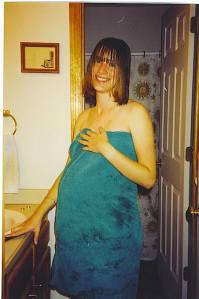
It’s hard to remember the exact chronology of events. After a while, we called the doula – but when she wanted to know the timing of the contractions, both Mark and I were vague. It was never clear to us if we were timing things correctly. What was clear was that the contractions were coming close together, and seemed intense to me. We called the birth center to give them a head’s up, but had to leave a message, and realized that we weren’t sure what the after hours procedure was supposed to do. We called S again to ask her how to contact the doctor, L, directly. It seems like around that time, L returned the call from Molly’s message, so apparently that’s their procedure – just leave a message and someone calls you back!

Meanwhile, Molly continued to have regular, intense contractions that barely ended before the next one began. She commented that she never seemed to get a break, and was a little fretful about things getting worse. I tried to let her know that she only needed to deal with each contraction as it came, and not to “suffer what she feared”, because maybe this was as heavy as they would ever get. I felt like I should be the voice of wisdom, even though I couldn’t really tell what was going on with her. My job was to soothe and support, and I had schooled myself carefully to remain cool and calm!

Throughout the contractions, Molly continued to hum “Woman am I”, and sometimes, as the humming began to speed up and get louder, I would hum along with her, hoping this would help to center her. We had various tricks that we had planned, like a foot massage, counter pressure, squeezing combs (hah!), but none of them seemed desirable or necessary. Occasionally, she would begin to question her ability to continue if it became more difficult, so I brought in her list of affirmations and read them to her between contractions – they were all familiar to her and seemed marginally helpful. Watching a woman labor makes the support people feel rather helpless, so it was good to find something that she could focus on, if only for a while. We also offered frequent drinks and food. Mark was extraordinarily in tune with her.

We tried various positions to ease her comfort. One mistake was suggesting that she lie down on the bed for a while. She said it made her feel terrible and trapped. She was amazingly calm and serene, otherwise. I had expected her to be irritable with me, or Mark, but she was very internal and focused. I had also expected to feel more protective than I did. I thought I’d want to take away her pain, and be the “mom” who fixes the hurts, but she was so in control the entire time that I didn’t feel the need to go into mom mode. Her strength was inspiring.

Around 2 a.m., we decided it was time to call S, who arrived in record time. It was a relief to have a more professional opinion available. Molly was in the bathroom at this time, and had quite a bit of pre-birth matter (to put it politely) that had been discharged into the toilet. To me, this looked like far more than the mucus plug and seemed to indicate that birth was imminent, but S didn’t seem to think so. I still don’t know, but it was definitely an indicator of big progress being made! Also, the contractions were very heavy and close together. S took us aside, and said that first-time moms take a really long time, and that we shouldn’t be jumping the gun – hindsight reveals that Molly was further along than any of us realized.

S altered the room lighting with little gentle lamps that gave off a dim blue light, very much like candles. She whipped out rice socks, and offered various suggestions for position changes. It was good to have someone else to offer support, although we were doing pretty well without her. Molly kept saying that she felt different inside, like something was happening, but she wasn’t too clear on what it was. She said that during contractions, she wanted to race to the birth center, but between them she didn’t. I remembered her saying something similar about my arrival, earlier, and wondered if maybe we should heed this and get straight in the car……

S suggested another shower, but Molly was quite resistant to this, and then announced that we should go to the birth center. I was glad to be at this point – in the hands of professionals! The original plan had been to transport in 3 cars – Molly and Mark in theirs with the carseat, me, and then S. It became obvious that Molly would be much more secure if she could have Mark’s attention during this 40 minute drive, so we switched the carseat to my vehicle, got everyone loaded, and sped away. It must have been at about 3:15, because we got to the birth center at 4. By this time, I was running on adrenaline, having had no sleep, and having already driven nearly 6 hours, but I felt charged and clear. My grandson was on his way, and I was the driver. This was an important task! I tend to drive a tad fast in ordinary circumstances, but this event led me to be a regular lead-foot. I kept it at about 75 mph, although S says I went faster. The road between JC and Columbia is very “swoopy” – there are lots of dips, and then bumps that the car sort of chunks over. Molly was moaning, and seemed especially agitated as we bumped and swooped. I don’t think slowing down would have helped, so I just kept the pedal to the metal and got her there as fast as I could.  I couldn’t tell what was happening in the back seat at all, and just concentrated on my driving.

We pulled into the parking lot of the center, and there was nobody there! As I began to question this, a car pulled in, and out stepped V [midwife], very calmly, carrying a cup of coffee. She opened the door, asked a few quiet questions, and then casually went off to brew more coffee. We unloaded some things, including Molly, who seemed a little confused and tired. Mark called friend Kate, who we had called before, leaving a message. Little did we know that she was standing by waiting for the follow-up call for hours! She arrived about a half hour later, beaming and fresh. It was good to see another caring face. We all wanted to do something – anything – for Molly. However, Molly was in complete command of herself, so it was left to us to stand quietly by.

We were placed in the room Molly had hoped to have, and I came in, no doubt thinking we had plenty of time. She checked Molly and said that she couldn’t find a cervix. I found this unnerving. Did she mean no progress had been made? How could that be?!? Did Molly have some bizarre disorder that caused her cervix to disappear? I was working hard on being quietly serene, so I finally just asked what she meant. V said Molly was fully dilated, and could begin pushing whenever she felt the urge. I’ll never forget Molly’s face, disheveled hair, and wide eyes as she looked questioningly at V and said, “Are you telling me the truth?” Well, she was telling the truth, and Molly soon began to push. At this point, I remembered the car ride, and realized that Molly had gone through transition while swooping along the highway.

At one point during the pushing, Molly was standing by the bed with her arms and elbows supporting her. She gave a tremendous grunt, and her water broke with an audible report, splashing Kate and lots of the floor. It seemed like a lot of fluid! At this juncture, V said she’d better call the doctor, so we helped Molly into the bathroom.

Molly was concerned about making huge messes, so she was fairly comfortable in the bathroom – that way, everything just dropped handily into the toilet. The age-old concern about excreting a wee amount of feces was there, so being on the toilet alleviated that problem. Mark was with her all the time. I should take a moment to mention how wonderful Mark was throughout this entire event. He never left her side, and was completely attentive to every move she made or word she spoke. He never lost his calm demeanor for a moment, and was a pillar of strength and support.

Dr. L was now present, and she added to the overall feeling of having a competent team in place. It also helped to know that things were moving right along, and Molly would soon have her tiny son.

I had made sure to bring along Molly’s birth necklace from the Blessingway, as well as her needle felted birth art. I took a moment to hang the necklace at the foot of the bed where she could see it, and I place her felted ladies on the table where they could look on. Molly was wearing a cotton-knit nightgown, and had on an amulet bag with the fused glass touchstone a friend had given her. We all knew that things were happening, and became very energized by the birthing energy.

While in the bathroom, as we stood outside the door, I could hear Molly humming her song – I hummed along with her so that she would know that I was still with her, even if I wasn’t in the same room. I didn’t know if she could hear me (she could), but I thought it might help.

Molly and Mark were still in the bathroom when L came out and told us that they wanted some privacy, and ushered us all out into the lobby. Before I left, I told everyone that Molly didn’t want to give birth on a toilet, and they seemed to hear me. We sat there – V, Kate, S and I – chatting a bit, and wondering what was going on in there. I voiced my trepidation that maybe I wouldn’t get to see the birth after all, but that I also realized that I wanted it to happen the way they wanted it. That meant they might not want me (or anyone) there, and I knew I needed to be at ease with that. V had some stories to tell of her own children not needing her. I wasn’t comforted, but was fully aware I needed to get over it! I later discussed this with Molly, who told me that L had asked if they wanted privacy, and when they said yes, she took it upon herself to move us out.

Not too much time elapsed (maybe 30 minutes), and L came out to invite us back into the birthing room, but that no talking was allowed. It was really hard to not utter any words of encouragement to Molly, who was now lying on her side on the bed. It was very dimly lit, so L shined a flashlight to show us the tiny tuft of hair emerging as the baby began to crown. Once again, I later found out that Molly had not requested complete silence – but at the time, I was afraid to make a peep for fear they’d kick me out and I’m miss everything. They had us place a mirror so that Molly could see the baby, and shifted her position so that she was sideways on the bed. If I’d been allowed to speak, I would have suggested placing something under her heels to give her purchase for pushing. Instead, I moved around a bit, and put my leg under her foot to try to help. Then, I had to move to allow room for L and V to get ready for the Lannbaby.

Molly expressed amazement that she was “really doing this” and repeated that it didn’t feel real. She kept saying things like, “This is really me! I’m really doing this!” She was astoundingly together the entire time.

Molly pushed and pushed, still serene and still in command. There was a great deal of stretching discomfort that alarmed her, but L put her mind at rest by telling her that her body was made to stretch like that. After a few more pushes, and Lann’s head emerged, crying loudly, and spluttering. Before this, I was recalling a birth support video that I’d watched, in which the baby wasn’t breathing and was shockingly limp and white. I was girding my loins to be calm and supportive if this happened – but no need! A very vibrant and squalling head greeted us! His body slithered out directly afterward, and we had a whole, crying baby boy in the room with us. What a miracle! The joy was intense. Kate and I burst into tears.

Just born!

L handed the baby to Molly, who immediately, with Mark behind her throughout, began crooning and talking to her tiny son. She instinctively put him to her breast, and he calmed as he began nursing. They cut the cord, and then needed to take him from her for checking, and diapering – it was time for the placenta, which slid out as nice as you please. They told Molly that she had a small tear, and didn’t recommend stitching it.

There was an uncomfortable follow-up moment, when some blood clots needed to be manually removed to that the uterus could properly contract. Mark had the baby, and it was hurting Molly, so she called to me. S got there first, but I soon took her place, and we went through a few more rounds of “Woman am I”.

We also joked with Molly about getting an A+++ on labor and birthing. I’m not sure what the staff made of that. They probably thought I was some pushy, overachieving home school mom that insisted on academic excellence. It was definitely an A+++ event!

This is about when I got a chance to hold my peacefully sleeping grandson – what a perfect little guy! It was such a wonder and an honor to be present at his birth. I’ll forever be grateful to Molly and Mark for allowing me to share this experience with them. It forged a new bond between us, and made me understand the reality of life everlasting. Little Lann is my immortality.

Baby Lann with his Baba!
(I couldn’t find a newborn one with Baba. Surely I have one?!)

With Baba nine years later! (and Aunt Nancy too!)

Thanks for being there, Mom! 🙂

Related posts:

My First Birth

Alaina’s Birth Story–Baba Style!
New Birth Skills Workshop!

Active Birth and Labor Support

Saturday November 17, 6-9:00

Location: Tara Day Spa in Rolla, Missouri

Cost: $35 for the pregnant woman + one support person (husband, partner, relative, friend…)

Workshop description: First, practice active birth techniques and learn about working with pelvic mobility. Next, spend some time learning labor tips and tricks and practicing comfort measures with doulas! Then, enjoy a friendly Q & A session all about what you most want to know. You will have access to three birth professionals for the price of one! We will close with some relaxation skills practice and a guided visualization.

Interested? Please email me and I’ll send you the registration form!

DVD Review: The Big Stretch

DVD Review: The Big Stretch

By Alieta Belle & Jenny Blyth

60 Minutes, includes 20 page booklet

www.birthwork.com

Reviewed by Molly Remer, Talk Birth

Jenny Blyth the author of the book Birthwork, is also a filmmaker who co-created the film The Big Stretch with another mother. The particularly special thing about this film is that it is all about women sharing their own experiences and feelings–unlike many current birth movies there are no “experts” present in the film (other than the true experts–women themselves!), the focus is on the families preparing for birth or reflecting on their past birth experiences. The many topics addressed are insightful.

The film’s emphasis is on, “Women in different stages of pregnancy and preparing for a natural birth reflect on how they and ‘stretched’ in everyway – emotionally, physically and spiritually” and I enjoyed this “stretch” theme that ran throughout.

Introducing new scenes/topic is neat artwork and the images in this film in general are particularly gorgeous. In one exception, I was taken aback by footage at the close of the film of a totally naked man riding a bicycle and feel I should warn other viewers to be prepared for that!

The DVD is accompanied by a 20 page booklet full of questions that carries the themes from the film into personal questions to increase self-awareness during pregnancy.

The Big Stretch is a unique and beautiful film in which women’s voices are clearly represented. There are no titles, no degrees, no qualifications listed. This film is a perceptive “motherful” look at the many stretches of birthing: physical, emotional, mental, and cultural.

Disclosure: I received a complimentary copy of the DVD for review purposes.

Review previously published at Citizens for Midwifery.

Children’s Book Review: We’re Having a Homebirth

We’re Having a Homebirth

by Kelly Mochel

Softcover, Stapled, 16 pages

www.homebirthchildrensbook.com

Reviewed by Molly Remer, Talk Birth

We’re Having a Homebirth is a delightful new children’s book with a contemporary feel. The illustrations have a very modern, almost “manga” type appeal.

The book is a nice, positive, simple account of birth at home—it addresses each key issue children may be concerned with in very basic, friendly terms.

My boys, ages 6 and 3 at the time, cuddled up as I read it aloud and both enjoyed it very much. They especially liked the part about the placenta and cord-cutting.

The book is very colorful and half of the pages each have a different, eye-catching background color as well (the other half have white backgrounds).

I recommend this little gem to families planning homebirths and also for midwives to have available in their offices or lending libraries.

Small in size and fairly brief at 16 pages, We’re Having a Homebirth is reasonably priced at $6.50 or at only $2.99 for the Kindle version.

Disclosure: I received a complimentary copy of this book for review purposes.

Becoming an Informed Birth Consumer (updated edition)

20120903-135413.jpg

“Birth is life’s central mystery. No one can predict how a birth may manifest…Our dominant culture is anything but ‘natural’ so it is no surprise that childbirth, even with the most natural lifestyle lived by an individual family, sometimes needs intervention and medical assistance. This is not to say that any one mother’s efforts to have a natural childbirth are futile. Just that birth is bigger than one’s personal desires.” –Jeannine Parvati Baker (in The Goddess Celebrates: An Anthology of Women’s Rituals, p. 215)

It’s Labor Day and it is also the start of Empowered Birth Awareness Week! A blog carnival is in full swing at The Guggie Daily and I’ve been having some thoughts about birth as a consumer issue. Very often, it appears to me that responsibility for birth outcomes is placed on the mother—if only she’d “gotten educated” she would have made “better choices.” Many people have a tendency or overlook or minimize the impact of the context in which she makes her choices. In that way, I appreciate Baker’s observation about that birth is bigger than one’s personal desires. That doesn’t mean that we can’t take vital steps to alter the larger culture of birth in which we make our choices, however, and one of those ways is to remember to think about birth as a consumer issue.

Though it may not often seem so, birth is a consumer issue. When speaking about their experiences with labor and birth, it is very common to hear women say, “they won’t let you do that here” (such as regarding active birth–moving during labor). They seem to have forgotten that they are customers receiving a service, hiring a service provider not a “boss.” If you went to a grocery store and were told at the entrance that you couldn’t bring your list in with you, that the expert shopping professional would choose your items for you, would you continue to shop in that store? No! If you hired a plumber to fix your toilet and he refused and said he was just going to work on your shower instead, would you pay him, or hire him to work for you again? No! In birth as in the rest of life, YOU are the expert on your own life. In this case, the expert on your body, your labor, your birth, and your baby. The rest are “paid consultants,” not experts whose opinions, ideas, and preferences override your own.

There are several helpful ways to become an informed birth consumer:

  • Read great books such as Henci Goer and Amy Romano’s new book Optimal Care in Childbirth or Pushed by Jennifer Block.
  • Hire an Independent Childbirth Educator (someone who works independently and is hired by you, not by a hospital). Some organizations that certify childbirth educators are Childbirth and Postpartum Professionals Association (CAPPA), BirthWorks, Birthing From Within, Lamaze, and Childbirth International. Regardless of the certifying organization, it is important to take classes from an independent educator who does not teach in a hospital. (I’m sure there are lots of great educators who work in hospitals, but in order to make sure you are not getting a “co-opted” class that is based on “hospital obedience training” rather than informed choice, an independent educator is a good bet.)
  • Consider hiring a doula—a doula is an experienced non-medical labor support provider who offers her continuous emotional and physical presence during your labor and birth. Organizations that train doulas include CAPPA, DONA, and Birth Arts.
  • Join birth organizations specifically for consumers such as Citizens for Midwifery or Birth Network National or International Cesarean Awareness Network.
  • Check to see if you have a local birth network in your own community or even start your own (I recently co-founded one in my town!)
  • Talk to other women in your community. Ask them what they liked about their births and about their care providers. Ask them what they wish had been different. Pay attention to their experiences and how they feel about their births. If they are dissatisfied, scarred, unhappy, and disappointed, don’t do what they did.
  • Ask your provider questions. Ask lots of questions. Make sure your philosophies align. If it isn’t a match, switch care providers. This is not the time for misplaced loyalty. Your baby will only be born once, don’t dismiss concerns your may have over the care you receive or decide that you can make different choices “next time.”
  • Find a care provider that supports Lamaze’s Six Healthy Birth Practices and is willing to speak with you seriously about them:
  1. Let labor begin on its own
  2. Walk, move around and change positions throughout labor
  3. Bring a loved one, friend or doula for continuous support
  4. Avoid interventions that are not medically necessary
  5. Avoid giving birth on your back and follow your body’s urges to push
  6. Keep mother and baby together – It’s best for mother, baby and breastfeeding

These care practices are evidence-based and form an excellent backbone for a solid, mother and baby friendly birth plan.

Why “evidence-based care” though?

Because maternity care that is based on research and evidence for best practice is not just a nice idea or a bonus. It isn’t just about having a “good birth.” Evidence-based care is what mothers and babies deserve and what all birthing mothers should be able to expect! Here is a great summary of pregnancy and birthing practices that the evidence backs up:

20120903-142510.jpgRemember that birth is YOURS—it is not the exclusive territory of the doctor, the hospital, the nurse, the midwife, the doula, or the childbirth educator. These people are all paid consultants—hired by you to help you (and what helps you, helps your baby!).

“As long as birth- metaphorically or literally-remains an experience of passively handing over our minds and our bodies to male authority and technology, other kinds of social change can only minimally change our relationship to ourselves, to power, and to the world outside our bodies” – Adrienne Rich (Of Woman Born p185)
20120903-135505.jpg

Related posts:

Birth class handouts

Can I really expect to have a great birth? (updated edition)

What to Expect When You Go to the Hospital for a Natural Birth

Active Birth in the Hospital

The Illusion of Choice

Musings on Story, Experience, & Choice

This post is updated from a previous edition.

Can I really expect to have a great birth? (updated edition)

Given my limited situation, can I really expect to have a great birth today?” For the woman who asked me this question a homebirth, a birth center, a midwife, and a doula were all not remotely feasible options. My answer to her question is a qualified “yes!” and it really got me thinking about ways to help yourself have a great birth when your overall choices are limited. In fact, there is a long list of ideas of things that may help contribute to a great birth!

  • Choose your doctor carefully—don’t wait for “the next birth” to find a compatible caregiver. Don’t dismiss uneasiness with your present care provider. As Pam England says, “ask questions before your chile is roasted.” A key point is to pick a provider whose words and actions match (i.e. You ask, “how often do you do episiotomies?” The response, “only when necessary”—if “necessary” actually means 90% of the time, it is time to find a different doctor!). Also, if you don’t want surgery, don’t go to a surgeon (that perhaps means finding a family physician who attends births, rather than an OB, or, an OB with a low cesarean rate).
  • If there are multiple hospitals in your area, choose the one with the lowest cesarean rate (not the one with the nicest wallpaper or nicest postpartum meal). Hospitals—even those in the same town—vary widely on their policies and the things they “allow” (i.e. amount of separation of mother and baby following birth, guidelines on eating during labor, etc.) Try checking with Cesareanrates.com for local information!
  • When you get the hospital, ask to have a nurse who likes natural birth couples. My experience is that there are some nurses like this in every hospital—she’ll want you for a patient and you’ll want her, ask who she is! If possible, ask your doctor, hospital staff, or office staff who the nurses are who like natural birth—then you’ll have names to ask for in advance.
  • Put a sign at eye level on the outside of your door that reads, “I would like a natural birth. Please do not offer pain medications.” (It is much easier to get on with your birth if you don’t have someone popping in to ask when you’re “ready for your epidural!” every 20 minutes.)
  • You might want to check out either or both of these two books: Homebirth in the Hospital and/or Natural Hospital Birth
  • Work on clear and assertive communication with your doctor and reinforce your preferences often—don’t just mention something once and assume s/he will remember. If you create a birth plan, have the doctor sign it and put it in your chart (then it is more like “doctor’s orders” than “wishes”). Do be aware that needing to do this indicates a certain lack of trust that may mean you are birthing in the wrong setting for you! Birth is not a time in a woman’s life when she should have to fight for anything! You deserve quality care that is based on your unique needs, your unique birthing, and your unique baby! Do not let a birth plan be a substitute for good communication.
  • Two resources I particularly enjoy that shake up the notion of a birth plan are, 1. the birth as a labyrinth metaphor from Birthing from Within and 2. this article about how does one really PLAN for birth.
  • When making a birth plan, use the Six Healthy Birth Practices as a good, solid foundation.
  • Cultivate a climate of confidence in your life.
  • Once in labor, stay home for a long time. Do not go to the hospital too early—the more labor you work through at home, the less interference you are likely to run into. When I say “a long time,” I mean that you’ve been having contractions for several hours, that they require your full attention, that you are no longer talking and laughing in between them, that you are using “coping measures” to work with them (like rocking, or swaying, or moaning, or humming), and that you feel like “it’s time” to go in. If you’re worried about knowing when you’re really in labor, check out this post: how do I know if I’m really in labor?
  • Ask for the blanket consent forms in advance and modify/initial them as needed—this way you are truly giving “informed consent,” not hurriedly signing anything and everything that is put in front of you because you are focused on birthing instead of signing.
  • Have your partner read a book like The Birth Partner, or Fathers at Birth, and practice the things in the book together. I frequently remind couples in my classes that “coping skills work best when they are integrated into your daily lives, not ‘dusted off’ for use during labor.”
  • Practice prenatal yoga—I love the Lamaze “Yoga for Your Pregnancy” DVD—specifically the short, 5-minute, “Birthing Room Yoga” segment. I teach it to all of my birth class participants.
  • Use the hospital bed as a tool, not as a place to lie down (see my How to Use a Hospital Bed without Lying Down handout)
  • If you feel like you “need a break” in the hospital, retreat to the bathroom. People tend to leave us alone in the bathroom and if you feel like you need some time to focus and regroup, you may find it there. Also, we know how to relax our muscles when sitting on the toilet, so spending some time there can actually help baby descend.
  • Use the “broken record” technique—if asked to lie down for monitoring, say “I prefer to remain sitting” and continue to reinforce that preference without elaborating or “arguing.”
  • During monitoring DO NOT lie down! Sit on the edge of the bed, sit on a birth ball near the bed, sit in a rocking chair or regular chair near the bed, kneel on the bed and rotate your hip during the monitoring—you can still be monitored while in an upright position (as long as you are located very close to the bed). Check out the post Active Birth in the Hospital for some additional ideas.
  • Bring a birth ball with you and use it—sit near the bed if you need to (can have an IV, be monitored, etc. while still sitting upright on the ball). Birth balls have many great uses for an active, comfortable birth!
  • Learn relaxation techniques that you can use no matter what. I have a preference for active birth and movement based coping strategies, but relaxation and breath-based strategies cannot be taken away from you no matters what happens. The book Birthing from Within has lots of great breath-awareness strategies. I also have several good relaxation handouts and practice exercises that I am happy to email to people who would like them. One of my favorites is: Centering for Birth.
  • Use affirmations to help cultivate a positive, joyful, welcoming attitude.
  • Read good books and cultivate confidence and trust in your body, your baby, your inherent birth wisdom.
  • Take a good independent birth class (not a hospital based class).
  • Before birth, research and ask questions when things are suggested to you (an example, having an NST [non-stress test] or gestational diabetes testing). A good place to review the evidence behind common forms of care during pregnancy, labor, and birth is at Childbirth Connection, where they have the full text of the book A Guide to Effective Care in Pregnancy and Childbirth available for free download (this contains a summary of all the research behind common forms of care during pregnancy, labor, and birth and whether the evidence supports or does not support those forms of care).
  • When any type of routine intervention is suggested (or assumed) during pregnancy or labor, remember to use your “BRAIN”—ask about the Benefits, the Risks, the Alternatives, check in with your Intuition, what would happen if you did Nothing/or Now Decide.
  • Along those same lines, if an intervention is aggressively promoted while in the birth room, but it is not an emergency (let’s say a “long labor” and augmentation with Pitocin is suggested, you and baby are fine and you feel okay with labor proceeding as it is, knowing that use of Pitocin raises your chances of having further interventions, more painful contractions, or a cesarean), you can ask “Can you guarantee that this will not harm my baby? Can I have in writing that this intervention will not hurt my baby? Please show me the evidence behind this recommendation.
  • If all your friends have to share is horror stories about how terrible birth was, don’t do what they did.
  • Look at ways in which you might be sabotaging yourself—ask yourself hard and honest questions (i.e. if you greatest fear is having a cesarean, why are you going to a doctor with a 50% cesarean rate? “Can’t switch doctors, etc.” are often excuses or easy ways out if you start to dig below the surface of your own beliefs. A great book to help you explore these kinds of beliefs and questions is Mother’s Intention: How Belief Shapes Birth by Kim Wildner. You might not always want to hear the answers, but it is a good idea to ask yourself difficult questions!
  • Believe you can do it and believe that you and your baby both deserve a beautiful, empowering, positive birth!

I realize that some of these strategies may seem unnecessarily defensive and even possibly antagonistic—I wanted to offer a “buffet” of possibilities. Take what works for you and leave the rest!

I posted on my Facebook page asking for additional thoughts and suggestions and I appreciated this one from doula and educator, Rebecca:

“I think I’d tell people to stop closing doors on themselves you know? Stop making assumptions about what is possible and be open to creating new possibilities – maybe not perfect and exact but inviting in opportunity. No money doesn’t mean no doula in most cases.”

She’s right! A lot of doulas-in-training will offer free birth services, many doulas and midwives do barter arrangements or other trades, and many non-traditional birth professionals also have sliding scale rates.

Great births are definitely possible, in any setting, and there are lots of things you can do to help make a great birth a reality!

This post was revised (from this one) to participate in… And the Empowered Birth Awareness Blog Carnival!

Woman Centered Pregnancy and Birth

“Woman-centered childbirth recognizes the primary role of the mother, and allows labor to progress according to the mother’s natural rhythms.” —ALACE CBE training manual

Several years ago I wrote a popular and somewhat controversial post called What to Expect When You Go to the Hospital for a Natural Childbirth. The article took a look at what women can realistically expect from a “standard” hospital birth and included some thoughts on what they deserve, my conclusion being that what women can expect and what they deserve are often, sadly, very different things. The article was one of my widest-reaching pieces and it was republished on both the Unncesarean and on Navelgazing Midwife. I also converted it into an article that was published in Pathways magazine, laid out so beautifully and professionally I practically cried.

However, my idea for the post didn’t come from me alone, it was sparked by reading a similar list in the 1970’s book Woman-Centered Pregnancy and Birth, co-authored by Carol Downer. So, imagine my delight when I was contacted last month by her assistant, letting me know that they’d read and enjoyed my post and telling me this awesome news:

We recently published the book in its entirety online at: www.womenshealthinwomenshands.org/BirthingOurBabies.html.

That’s right, free online! Check it out!

For my conservative readers, do be aware that the book and website both come from a solidly feminist and pro-choice perspective!

“The whole point of woman-centered birth is the knowledge that a woman is the birth power source. She may need, and deserve, help, but in essence, she always had, currently has, and will have the power.” –Heather McCue

Previous thoughts on Why “Woman-Centered” Childbirth?