Archives

Giveaway: Aloe Cadabra

This giveaway is now closed. Kelly D. was the winner!

As a breastfeeding counselor and a childbirth educator, I get occasional questions from new mothers about what to use as an “all natural” personal lubricant. So, my attention was caught when I received an email from the company, Aloe Cadabra. They note the following:

New moms have a lot of things to juggle – care for a newborn, altered sleep patterns, returning to work, etc.  As women navigate their new routines and new “normal” life, many struggle with one piece of this pie – resuming sexual intimacy with their partners.  With pregnancy and childbirth affecting the hormonal balance of a woman’s body, many new moms face challenges in their postnatal sexual health.  A pilot study carried out by St George’s Hospital Medical School in London reports that 3 months after delivery, 39% of women experience vaginal dryness.

As a result, many women turn to mainstream personal lubricant products found at a local drugstore to help bring the spark back to the post-baby bedroom.  If these personal products are on the shelves, then they must be safe to use, right?  Wrong – these readily available products contain the same ingredients found in antifreeze, food preservatives and cleaning solutions – obviously bad for both your body and the environment.

Aloe Cadabra has developed an all-natural, certified organic product made from 95% organic aloe and enriched with Vitamin E.  This first and only plant-based intimate moisturizer is pH balanced for a women’s body, anti-bacterial, anti-microbial and anti-fungal.  Aloe Cadabra is fully absorbed into the skin as it is used, so there is no gooey, sticky mess, and it’s compatible with condoms.

Parents are wisely cautious and educate themselves on products that come in contact with their baby’s body…Doesn’t a mom deserve the same caution?

One reader can win a bottle of Aloe Cadabra simply by leaving a comment on this giveaway! I will close the giveaway next Tuesday at 6:00 p.m.

Happy Birth Dance

“Birth is a creative process, not a surgical procedure. I picture dancers on a stage. Once, doing a pirouette, a woman sustained a cervical fracture as result of a fall; she is not paralyzed. We try to make the stage safer, to have the dancers better prepared. But can a dancer wear a collar around her neck, just in case she falls? The presence of the collar will inhibit her free motion. We cannot say to her, ‘this will be entirely natural except for the brace on your neck, just in case.’ It cannot be ‘as if’ it is not there because we know that creative movement and creative expression cannot exist with those constraints. The dancer cannot dance with the brace on. In the same way the birthing woman cannot ‘dance’ with a brace on. The straps around her abdomen, the wires coming from her vagina, change her birth.” –Dr. Michelle Harrison

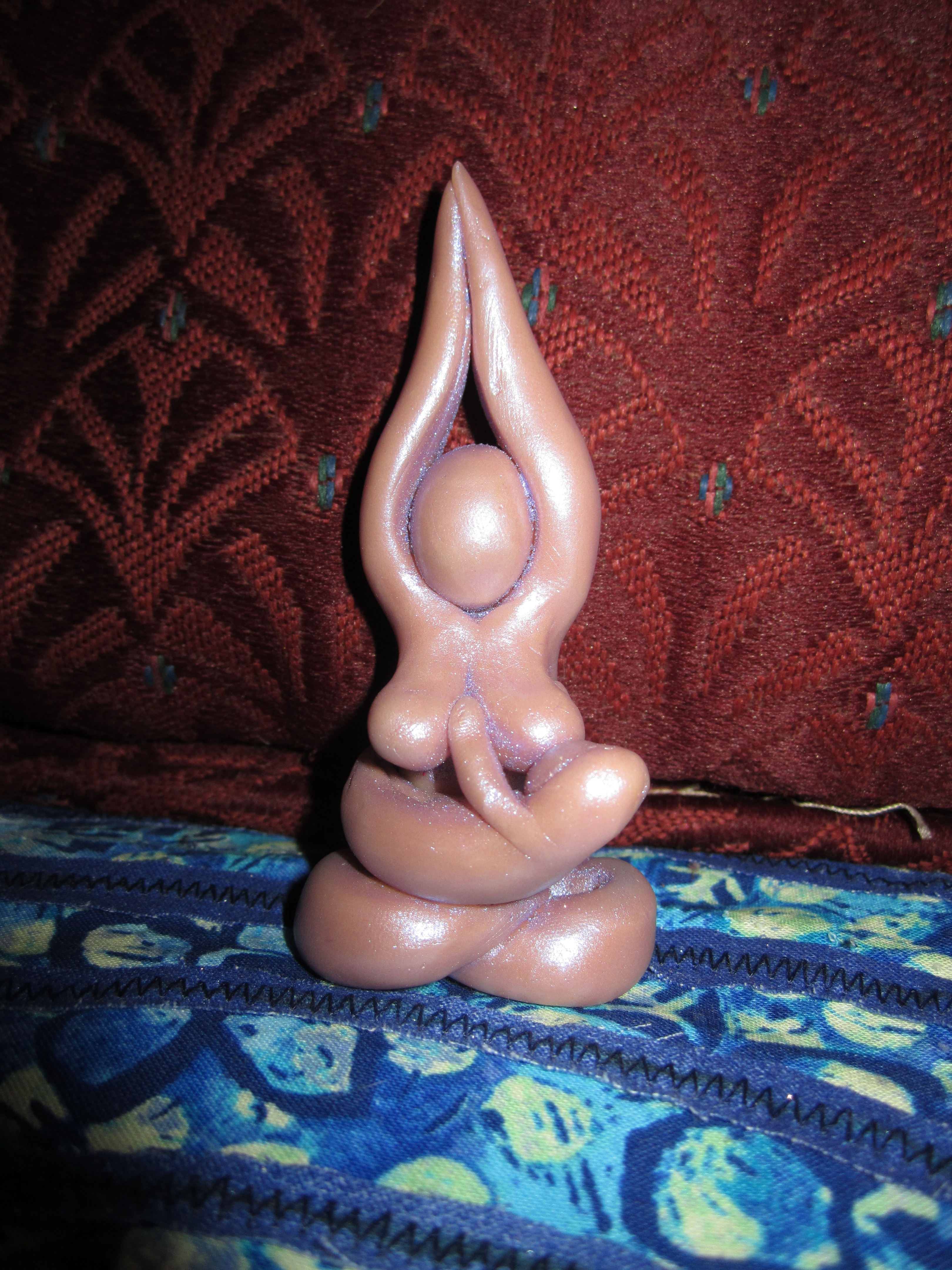
Present from my husband after my daughter's birth

I woke up this morning thinking about this quote. I’ve shared it on my blog before, but that was in 2008 and so it has been lost in the shuffle of other posts (and many, many quotes!) since then. My ongoing thought process actually didn’t have much to do with the quote, though my recent labor pictures post illustrates the idea of freedom of movement throughout labor according to my own body’s messages, rather than assisted with anything else.  However, thinking of dancing and birth made me think of the pendant my husband gave me following the birth of our daughter. He actually gave it to me for Christmas first, but since he gave me four other pendants for presents, I gave this one back to him and told him to save it for a post-baby present! Given how I then felt after birthing her, it felt like a perfect present. I love how this exuberant goddess is dancing for joy. And, how her upswept arms form a heart-like shape. I was so happy to have MY BABY. When I wear this pendant, I remember that feeling of relief and happiness after giving birth to her. Every night when I look down and see her there in my arms I feel lucky and also this continued sense of surprise, almost, to have her here with me. It all seems so magic.

I was talking to my husband about this last night (well, quietly croaking, since I’ve had laryngitis for several days) while on our nightly walk. We’d noticed that Noah’s tulip tree actually bloomed! I told him I hadn’t been sure it would actually survive (clear parallels here), but look, now here we are and look at this baby who is here with us while the flowers bloom. We looked quietly for a minute and then I said, “remember how we almost decided not to try again?” I feel like it was brave to try again. I was brave.


Noah's tree bloomed!


Rapturous Acts

I had included this quote in my recent update post, but decided it edit that one for length and give this its own post.  From the book, The Blue Jay’s Dance: Growing, bearing, mothering, or fathering, supporting, and at last letting go…are powerful and mundane creative acts that rapturously suck up whole chunks of life. –Louise Erdrich

I went to a retreat yesterday and one of my friends said of her own baby that, “I am his everything.” That is an excellent description of that mother-baby unity that I touched on in my last post. With Alaina right now, I am everything she needs. I am her habitat. I am her gauge for the world around her and also for her own self—I’ve pointed out to the boys before how if she gets startled and her arms go out, she immediately searches for my eyes, looking for my signal (calmness) that everything is fine and the startle is unnecessary. She uses me and my responses to her to understand the world (and herself). If she gets fussy when someone else is holding her, as soon as I take her back, she rides along happily peeking over my shoulder—balance of her world restored. Her eyes follow me when I am walking around. I feel like I have savored all of my babies, but I feel more intensely aware this time around how short this time period is—this time of complete symbiosis and dependence. I also remember feeling more confused by my first baby and I remember worrying and worrying about, “what if he cries?” I think I thought he might cry and I’d never be able to calm him back down or something? I’m not really sure what that was about, but I remember feeling like crying = bad mother. With Alaina, I am 100% confident that she will not keep crying (duh). I mentioned before that she doesn’t cry much, but last night she had a fussy spell after our second day in a row being away from home all day, and I had no doubt at all that her trust in me to care for her would calm the fussy (and it did). Oh, and, she also laughed at me for the first time last night! It is amazing to be someone’s whole world and it just feels extra special this time around. This morning when I was playing with her and she was smiling with her whole body (love that), I felt like our connection is so pure and basic that it feels almost holy. I have to confess that she makes me feel like having another baby—how can I not do this again?! I’m still pretty certain we won’t have any more children, but I surprise myself by frequent thoughts about maybe ONE more…

My boys still think I’m pretty awesome and prefer being with me to pretty much anything else (they do adore their grandpa and he is their most fun person to hang out with), but they really like me a whole bunch and I still have the power to make their worlds “right” as well. I enjoy their company and their wild, funny, enthusiastic, creative, complicated personalities and I feel like they are the treasures of my heart. I also feel like my love for them is deeper in a way (or more developed, maybe?) than it was when they were babies, because we are so invested in each other. I know them so well and we’ve had so much life together, I can’t imagine not having them. I can still remember not having Alaina and I can remember how I thought I may never get to have another baby ever again and I’m really enjoying this very uncomplicated, unconditional, sweet, sacred love of and for a little baby again.

I am currently reading and very much enjoying a book called She Changes: Re-imagining the Divine in the World and the author critiques the foundations of modern philosophy as being based on independence from others as the goal/highest state  as well as critiquing spiritual traditions that see attachment as a flaw and a state to be transcended (the book is based on process philosophy instead). She describes an anecdote how a fellow student wrote a paper making a case for “the existence of other minds” and no one else in her class other than her seemed to find it bizarre. She discusses Descartes and his “I think, therefore I am” conclusion as inherently flawed saying that before Descartes could articulate this thought, “he reached out his hand for his mother.” It is relationship, not thought that forms our basis for life and our experience of reality.

In her habitat ("the maternal nest")


I’m getting ready to start teaching in-seat again at the end of this week. I’m getting nervous about it, because we’re not really ready for separation yet, even for short times. The class is 5 hours and since I’m the teacher, I can give breaks when I need to. My husband is going to stay in town with all the kids—I know this sounds slightly crazy, but I have to know she can get to me if she needs me AND we also always have a Wal-Mart list, so he’s going to do that each week (the boys love to go to WM with him, because he has a tendency to say yes to new toys, candy, and weird food for dinner). The class only lasts 8 weeks and one week is a midterm and one a final, which usually means dismissal a bit early those nights. I guess it is a little strange to be worried about it, because many mothers go back to work when their babies are 6 weeks old and for 40 hours at a time. I’m getting all concerned about only working 5 hours once a week! (with a baby lurking in the parking lot with my husband!) But, still, it is on my mind…a LOT.

I’m going to remain on leave from teaching birth classes and I’m also strongly considering not resuming breastfeeding support group meetings—just stick with phone/email help and no in-person group for a while. I do have another project brewing, but I’m not going to write about it until I know if it is going to work out or not!

DVD Review: The HUG: Understanding the Secret Language of the Newborn

DVD Review: The HUG: Understanding the Secret Language of the Newborn
Created by Jan Tedder, 2010
21 minutes, $25
http://www.hugyourbaby.org/

Reviewed by Molly Remer, MSW, ICCE
https://talkbirth.wordpress.com

Developed by a nurse-practitioner to help educate new parents,  HUG stands for “help, understanding, guidance for young families.” In this short, informative DVD, parents learn about the baby’s ability to use distinct body language to communicate its needs and emotional states. Short sections showing real newborns with their parents address calming a crying baby, helping baby eat and sleep well, and playing with baby. It is helpful to see footage of real babies that illustrate a baby’s “Zones” and SOS cues (“Sign of Overstimulation”). The families shown are ethnically diverse.

The information provided on The HUG is very simple and basic. It is nurturing, empowering, and clearly presented. Mentions of breastfeeding communicate that it is the normal and expected way to feed babies. The HUG is a good resource for people who have little previous experiences with newborns or for birth/postpartum professionals looking for ideas about communicating newborn behavior to new parents.

Most new parents are eager to learn about more than just the “baby basics” newborn care such as diapering and bathing. The HUG takes parents into more meaningful territory and helps them learn about their baby’s special communication abilities.

Disclosure: I received a complimentary copy of this DVD for review purposes.

Time Round

I connect to the circle now

and see my life and death

in the child before me–

the glorious whole that spins so fast

it seems not to move

as the sun stands still in the heavens

until we glance again at dusk.

Where did it go and when

did we forget to look?


No matter, just turn.

The circle: our map

The heart: our book.

–Karen Engelmann

I copied this poem onto the first page of my journal when my second son was a newborn. I’m not totally sure what the meaning is intended to be, but I take it as a reminder to slow down and remember to look 🙂 My new baby is already one month old (tomorrow). How is that possible? I still look at her with surprise and amazement almost daily—sort of a, “where did you come from?!” feeling. There is something magic about her.

I have surprised myself by not having much urge to write in the last couple of weeks—usually I am consumed with blog post and article ideas. Something switched this week and the topics are flooding in again, as well as the sense of frustration of not having “enough time” to write them all. It may be because of Mark going back to work and now I feel like I am no longer “off” either and have to get caught back up with real life again. So, I remembered that poem and got it back out again. I also want to remember that my conditions of enoughness for the foreseeable future are:

1. take care of my baby.

2. take care of the boys–including doing some school every day.

3. eat enough food.

3. teach my online class.

That’s it. Write scintillating blog posts is not on the list. Nor is write books, which has suddenly popped back into my consciousness as a “want to do RIGHT NOW!” Nor is laundry really, though it has been haunting me this week. Even birth activism efforts are not really on my list, though there is a lot going on right now that I could/should contribute to. I’ve had a familiar sort of pressure this week to get back to “normal” and to prove to myself that I can handle everything I need to handle (without help).

But look…

This is where my heart is right now.

Fatherbaby

“Nurturing is not a genetically feminine attribute. Tears and laughter are not the province of women only. The last time I looked, men had tear ducts. They had arms for holding babies. They cared about their children. And they cried at births…let the shared experience of childbirth reclaim the human soul.” –-Ariska Razak (midwife and healer)

Daddy and his two week old baby girl!

Yesterday, my husband went back to work for the first time since our new baby was born last month. He was off for slightly under 4 weeks. I strongly encourage all of the fathers who take my classes to take off as much time as possible after their babies are born. Many of them seem surprised by the suggestion, a few of them seem disinterested (like, “but isn’t that her job?”), but most of them express sadness and regret at their workplaces’ unsupportive attitude towards (or flat-out refusal to grant) paternity leave. Many of them are only able (or only feel able) to take the day of the birth off and perhaps one to two more days. I meet many who will only be able to be at home with their new families if the birth straddles a weekend. I could almost cry at the social attitudes this reflects—a complete devaluation of the father’s role, his birth as a father, and his baby and family’s need for his presence. Fathers as well as mothers absolutely need this time to “cocoon” with their new babies. To absorb the magnitude of the changes in their lives, to have time to consider the meaning of their new roles, and to re-integrate into the “normal” rhythms of home life after having experienced the rite of passage and labyrinth of birth.

When our first baby was born in 2003, my husband took one week off and then followed it with a week of half days. He was crushed to leave us—describing it as feeling like we were his “wolf pack” and he was having to leave his pack when he really belonged with us. When our second son was born in 2006, we’d wised up somewhat and he took off 4 weeks. It still didn’t feel like enough for any of us, but it seemed to be viewed by his workplace/co-workers as an unusually long length of time to take off. This time he again took 4 weeks and it hasn’t felt like enough for any of us. I’m interested by how his time off seems to be viewed by most as him needing to be home in order to “help” me, not as a time with inherent value to him. While I certainly do need his “help” while postpartum, I view our relationship as a partnership and our family as just that, our family, not as an exclusive maternal domain with occasional visits from the “daddysitter.” No thanks. Is spending time with his new baby, taking care of his other children, and taking care of household tasks in the home we share, “helping” me, or is it being a complete part of our real lives?! A part that is completely ignored/denied by the modern workplace culture and social attitudes. Spending time with Alaina is of value and importance to both of them, as people who will have a lifelong relationship with each other. Also, somewhat ironically, I am the one who took no time off this time around. I teach online and I had no leave from doing so—it was my own choice to sign a contract for this session and the online staff doesn’t even know I was pregnant or that I had a baby. I took 5 hours off and then posted in my class again. I obviously wouldn’t be doing it if it wasn’t compatible with having a newborn—it is excellently compatible—and I prepared those around me for weeks before her birth that the only things I planned to be responsible for for the first two months or so, were my baby and my class (and, obviously, taking care of my other kids too—but, not even them in the early days postpartum!).

We have discussed how each of our babies has been a catalyst for big changes in our home situation. Our first baby was the catalyst we needed to move away from our by-the-highway-no-yard townhouse in a city and onto our own land in the country near my parents. Our second baby was the catalyst we needed to finish building our real house and to move out of our temporary house and into our permanent home. So, we are now wondering what kind of catalyst our baby girl will be? We have spent our entire married life (13 years!) saying that we want to live a “home based life.” I truly do not think it is (biologically) normal, desirable, or healthy for anyone to spend 40+ hours a week out of their home, regardless of whether or not they have children or who the primary caregiver is. I don’t think fathers belong at work that much time, I don’t think mothers do either, and I don’t think children belong at school every day. The home-based life idea came to us long before we had kids and it came from all the reading and thinking I did about the simple living movement. So, I wonder—and hope—that maybe our new baby will be the catalyst we need to finally face the fear of possible failure (and/or no money!) that accompanies jettisoning his full-time job and building our other “multiple streams of income.” Maybe we will, maybe we’ll keep talking ourselves out of it, but that is what our baby girl makes us feel like doing!

So, here’s to Papatoto! May the fatherbaby unit be recognized as having inherent worth and value.

“When he becomes a father, a man leaves behind his life as a single individual and expands into a more inclusive role. He becomes a link in an unbroken chain. And in doing so, he himself undergoes a birth process–the birth of himself as a father.” –John Franklin (FatherBirth)

”The absolute miracle of a birth and the emergence of a new human being into the world catapults both mother and father into the realm of awe and wonder. They are flooded with non-ordinary feelings and energies that support a deep connection not only with the newborn and each other, but also with the mystery and power of life itself.” –John & Cher Franklin


Birth Art: Final Chapter

As I have noted before, this was my most art-making pregnancy. Rather than make birth art just because I like it (I do!), during my most recent pregnancy I used it as a way to work on—or through—various things. I wrote more about this in this post. So, now that my pregnancy has been completed with the powerful birth of my magical tiny daughter, I felt an intense urge to make two final pieces of birth art (that are directly related to my own current experiences, rather than just birth art for birth art’s sake!). Since I pushed her out on my knees and caught her myself and had worked on my pushing fears with birth art previously, I felt like making a new type of crowning mama sculpture. (Yes, her arms are raised and not doing the catching—because it just works better for me to make them with raised arms!)  I have also written previously about the labyrinth metaphor for pregnancy and birth and so it seemed fitting to put this mama in the center of the finger labyrinth that my friend made for me as a blessingway gift 🙂 She’s taken her journey and she is birthing her baby!

Crowning mama in the center of the fabric labyrinth that my friend Denise made me for a blessingway gift

And, the logical final sculpture in my “series” is a mama WITH her baby!

This mama is happy to finally have her baby to hold and nurse!

I wish I had put the baby in a sling, so it doesn’t look so much like it is desperately clinging on with no support! I didn’t think of it until today though (I made these last night).

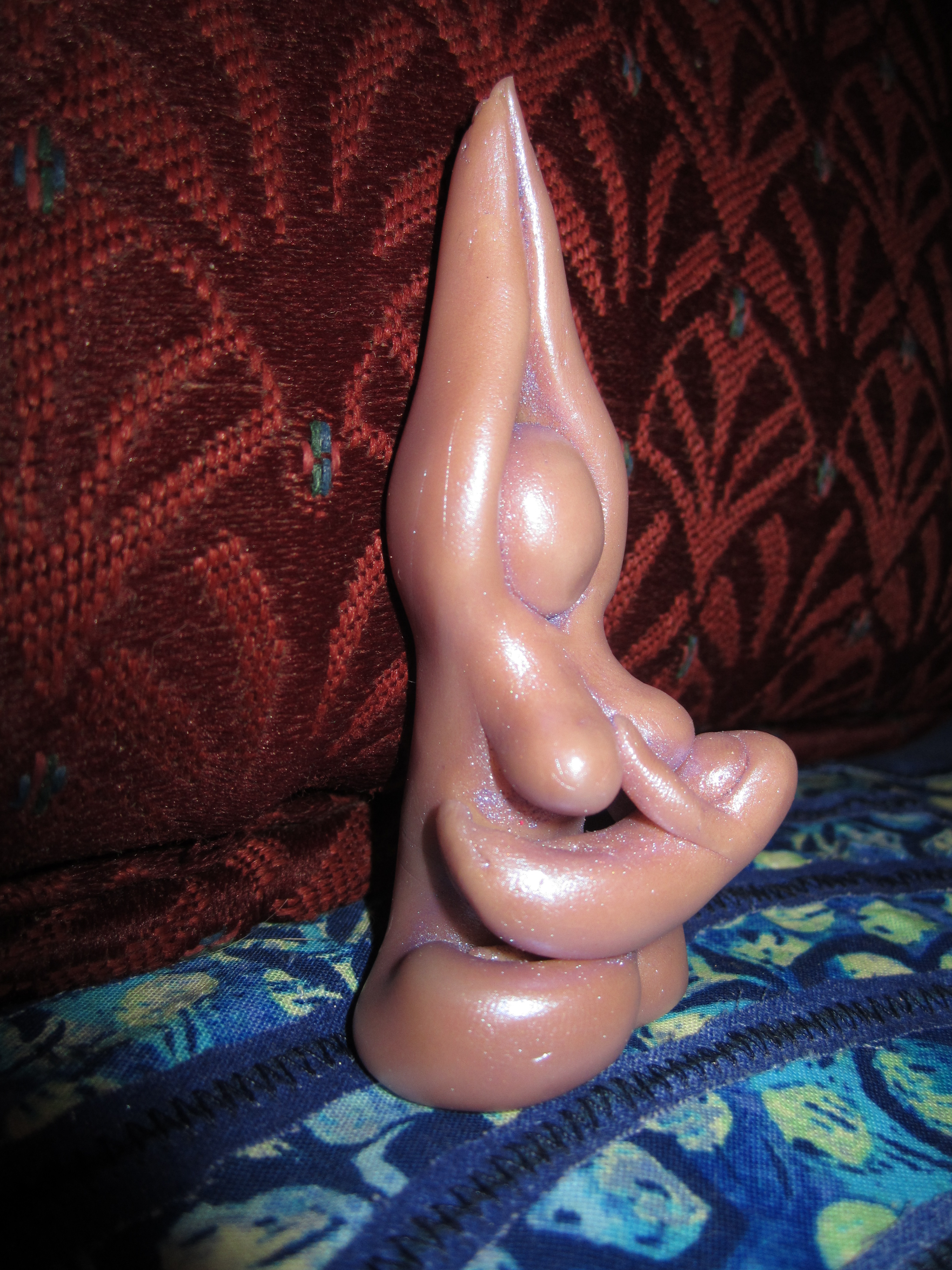
Side view

I actually made this one while nursing my own baby 🙂

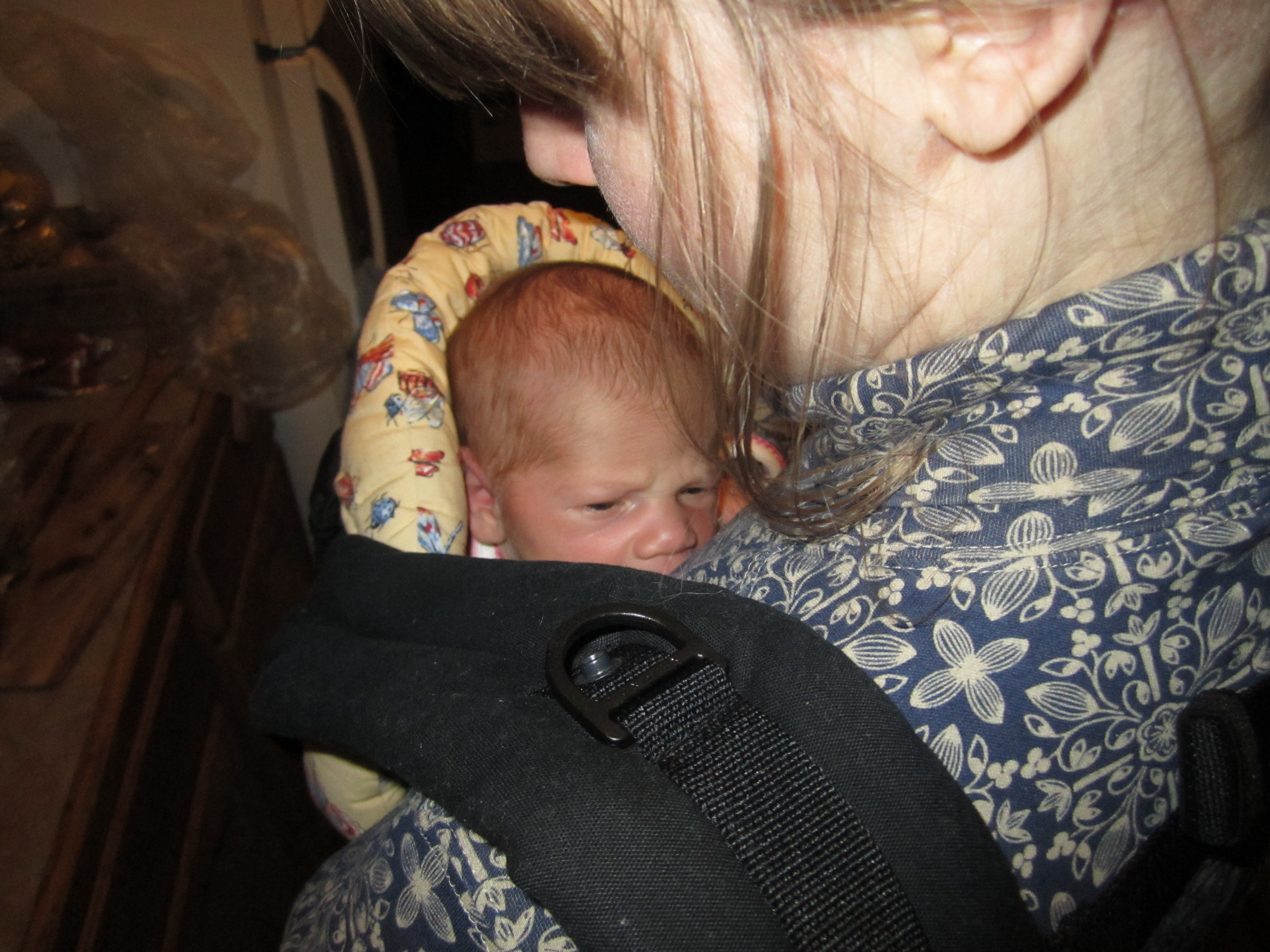
And finally, here is a picture of my little treasure trying out the Ergo for the second time today. She looks a little skeptical!

Close enough to kiss!

Planning for Postpartum

I have been meaning to share this article on my blog for a long time. Now that I’m rapidly approaching another “babymoon,” it feels like a most excellent time to review my own reminders about planning for postpartum!

—-

Planning for Postpartum

By Molly Remer, MSW, ICCE, CCCE

Originally published in The Journal of Attachment Parenting, 2008.

When my first baby was born in 2003, I had a made a classic new mother error—I spent a lot of time preparing for the birth, but not much time truly preparing for life with a new baby.

I had regularly attended La Leche League (LLL) meetings since halfway through my pregnancy and thought I was prepared for “nursing all the time” and having my life focus around my baby’s needs. However, the actual experience of postpartum slapped me in the face and brought me to my knees.

My son’s birth was a joyous, empowering, triumphant experience, but postpartum was one of the most challenging and painful times in my life. I had not given myself permission to rest, heal, and discover. Instead, I felt intense internal pressure to “perform.” I wondered where my old life had gone and I no longer felt like a “real person.” A painful postpartum infection and a difficult healing process with a tear in an unusual location, left me feeling like an invalid—I had imagined caring for my new baby with my normal (high) energy level, not feeling wounded, weak, and depleted. And yet, at five days postpartum I was at the grocery store, at seven days at the post office resuming shipments for my small online business, at two weeks attending meetings and fulfilling responsibilities with an organization (though I still had difficulty walking normally due to pain), at six weeks hostessing at a fundraising ball, and at eight weeks teaching a volunteer training workshop. In retrospect, I have no regrets about how I cared for my baby. He was always with me and I was sensitive to and responsive to his needs. What I regret is how I cared for myself, what I expected from myself, the demands I placed upon myself, and how I treated myself.

I actually slightly delayed having a second child, not for fear of mothering two, but for fear of experiencing the overwhelm of postpartum again.

In 2006, I gave birth to my second son at home. This time I had planned realistically and specifically for a “babymoon.” My husband took four weeks off of work and I stayed at home for the majority of the first month of life with my new baby. Though I again experienced an unfortunate tear and a painful recovery from it (which was still much quicker and less traumatic than the first time) and also some rapidly shifting mood changes along with some tears and anxiety, I look back on this time with my second son with fondness instead of regret. Instead of rushing to rejoin the world, I allowed myself the time, space, and permission to rest and cocoon, knowing that I would be “real” again soon enough.

Reflecting on my two postpartum experiences leads me to offer the following suggestions for postpartum planning:

  • Try to minimize your out of home commitments in advance. Put a hold on projects and “retire” from committees and responsibilities. I joke that with my first baby I thought I needed to get my responsibilities squared away for six weeks and with my second I realized I needed to try to get them squared away for two years.
  • Have a good book on hand about postpartum. When my first baby was born, I was well stocked with baby care and breastfeeding books, but none about the transition into motherhood. My favorite postpartum book is After the Baby’s Birth by Robin Lim. It offers such gems as, “you’re postpartum for the rest of your life” and “when the tears flow, the milk will flow” (with regard to the third day postpartum). Other good postpartum readings are The Post Pregnancy Handbook by Sylvia Brown and The Year After Childbirth by Sheila Kitzinger. A classic for support people is Mothering the New Mother by Sally Placksin.
  • Prepare and freeze a lot of food in advance. Batches of nutritious muffins are a favorite of mine—freeze them and the reheat one as needed for a quick breakfast or snack. These are great for nursing mothers!
  • Plans to spend three to seven days just in bed with your baby. Skin-to-skin is even better.
  • Everyone is familiar with the “sleep when the baby sleeps” advice, but even if you don’t feel the need to sleep, stay in bed and use the quiet time for reflection or to read or write in your journal. Rest is definitely essential every day, but it doesn’t have to be actual sleep to be restorative.
  • If you have other children, arrange for plenty of help caring for them. Do not feel like you “should” be able to handle them all right away. Of course, you could do it if you had to, but you and your new baby will benefit from an extended period of cocooning together. Plan quiet projects that you can do in bed with your older child while the new baby sleeps (a favorite with my older son was making puppets and masks out of felt. I cut them out while still lying down. He actually started calling our bed the “party deck” because we did lots of fun projects there while I was resting with the new baby. I have no idea where he got the phrase!).
  • Give yourself permission to rest and be off duty.
  • When people ask what they can do to help, give them a specific task (go grocery shopping, pick up pictures, bring me dinner, etc.).
  • Ease back into “real life.” Resist the temptation to catch up with email and so forth. Respond to email or phone requests for time or help with a firm, “I just had a baby and I’m not available right now.”
  • Become comfortable asking for help (I vastly prefer being the helper to being the helped and this is particularly hard for me).
  • Similar to a birth plan, make a written postpartum plan that includes a list of the people in your support network, arrangements for help with household duties (or a plan for what can be left undone), people to call for meals, and so forth. List what each person is willing to do—laundry, grocery shopping, cleaning, childcare, meal preparation (notice that “holding the baby so you can work” isn’t on the list!). An example postpartum plan is available on DONA International’s website.
  • If you have relatives coming to help after the baby is born, make sure they know that their job is to take care of you and the house while you take care of the baby. It is not acceptable for you to be fixing meals and sweeping floors while grandma “helpfully” rocks the baby—it needs to be vice versa!
  • Prepare your partner and anyone else in your support network that you will be Queen for a Month and let them know what you will need from them (also, get it fixed in your mind that being Queen is okay!).
  • Expect to be “nursing all day long.” It is okay and good for you both (10-14 nursings in 24 hours is perfectly normal and acceptable!).
  • Encourage your partner to take as much time off as possible—either saved up vacation time or unpaid FMLA time. He can benefit from an extended period of cocooning with his newborn too!
  • Explore the idea that postpartum can be a time of postpartum expression rather than postpartum depression—letting all of your emotions flow, expressing your needs clearly and assertively, and being aware of and accepting of your continuum of feelings are ways to be expressive. (This concept comes from the excellent, but little known book Transformation Through Birth by Claudia Panuthos.)
  • Plan a few special things for yourself—have a little present for yourself to enjoy during postpartum (a new book, good magazine, postnatal massage, whatever is self-nurturing and brings you pleasure. Personally, I do not encourage TV or movie watching because it can become a passive time filler that distracts you from enjoying your babymoon. Some people may include favorite films as their enjoyable postpartum activities though).
  • As postpartum stretches on, if you experience decreased libido, it is okay to honor and accept that.

Planning for a restful, nurturing, “time out” with your new baby is way to honor this new stage in your family’s life cycle and a way to honor yourself as a woman and mother. I hope you will create space in your life for a time in which vulnerability is accepted. Postpartum is a time of openness—heart, body, and mind. I hope your experience is one of tenderness and joy.

Molly Remer, MSW, ICCE, CCCE is a certified birth educator and activist. She is editor of the Friends of Missouri Midwives newsletter, a breastfeeding counselor, and the mother of two young sons and a baby girl on the way. She loves to write and blogs about birth at http://talkbirth.me, midwifery at http://cfmidwifery.blogspot.com, and miscarriage at http://tinyfootprintsonmyheart.wordpress.com.

This is a preprint of Planning for the Postpartum Period an article published in The Journal of Attachment Parenting Volume 11, Issue 1, pp 28-29. Copyright © 2008 Attachment Parenting International. API’s website is located at: http://www.attachmentparenting.org.

Pregnant Friends

Yesterday, I went with my mom and two friends to visit another friend who welcomed her second baby boy into the world in late October. None of us had been to see her since her Mother Blessing ceremony and it was very good to see her baby, to catch up, and to listen to her story. We also brought some food, even though it probably would have been more useful in Nov. rather than Dec.! (Who am I kidding though, don’t all mothers of small children still need postpartum doula and meal assistance even if they’re three YEARS postpartum rather than 6 weeks?! Speaking of which, make sure to read my friend Summer’s recent post on the value of postpartum support.) Anyway, my two friends are pregnant also and so we couldn’t resist the opportunity for some group belly pictures 🙂 My friend S on the left is due in April and then my friend L on the right is due 2 weeks before me (and I’m 33 weeks today!)

Then, of course we had to lift up the shirts for a real belly view 🙂

And, then we bumped bumps 🙂

Speaking of pictures, today I had an official maternity photo shoot with another friend. She took TONS of pictures and I’m really excited to see the finished results! We have family pix, couple pictures, and then me alone as well. It took several hours and we didn’t even take all the pictures we planned for. So, stay tuned for those pictures—they should keep me in posts for quite some time to come!


Guest Book Review: The First 8 Days of Being a Mom

The First 8 Days of Being a Mom

By Gea Meijering

iCare Press, 2008/2009

Softcover, 77 pages, $14.95

ISBN: 978-0-692-00009-0

http://www.thefirst8days.com/

Reviewed by Summer Thorp-Lancaster, http://peacefulbeginnings.wordpress.com

The First 8 Days of Being a Mom is an English language translation of a manual given to new moms in the Netherlands, the Kraamwijzer.

For many moms, the initial magic of new baby is quickly overshadowed by the realization that this tiny person is entirely dependent upon them for everything.  This is can be especially true for women who give birth in the hospital, where the sense of being totally alone and responsible hits hard upon returning home.

This book is intended to help moms know what to expect in those first chaotic days after baby’s arrival.  It includes space for journaling/record keeping each day.  At only 77 pages, it is an easy carry along for those birthing in the hospital.

I liked the inclusion of midwives (they are the main care provider for pregnant women in the Netherlands) doulas and home births, which are still scarce in “mainstream” publications here. The author has carefully mentioned both vaginal and cesarean births, which makes this book appropriate for anyone.  It concisely and clearly covers such basics as bathing and feeding, including both breast and bottle, with pictures to help further understanding.  There is also a strong emphasis on asking for help when needed, which is essential in the first few weeks and months.

Some of the downfalls of the book include the choppiness that comes from translated texts, no bed sharing information and somewhat inaccurate sleeping information, as well as a strong reliance on “call the professional” instead of self-knowledge.  I found this last bit extremely difficult to swallow as I feel it is important for new mothers to trust their knowledge as primary with a “professional” as the secondary opinion.  In my opinion, no one knows baby better than mama (except maybe daddy!).

Overall, this book would make a nice quick-reference guide for first time moms or refresher for veteran moms.  The inclusion of the journaling pages moves it into keepsake material, which balances out the somewhat hefty $20 price tag. [editor’s note: special price currently on website is $14.95]

Disclosure: a complimentary copy of this book was received for review purposes.