Archives

Birthrites: Meditation Before a Cesarean

You say you honor choices. May 2015 164

Can you really honor mine?

I will always honor the process which

brought forth flesh of my flesh.

I honor your births too.

Can you ever honor my experience, or will I

forever be a part of your statistics on

the way things shouldn’t be?

via When birth doesn’t go as planned… | Talk Birth

I have sometimes felt at a loss in how to help women cope with their feelings about their cesarean birth experiences. Jackie Singer, the author of Birthrites, writes about her own preparation for a cesarean (after a previous vaginal birth) and includes this “meditation” suggestion (to use at any time—while walking, sitting, preparing for sleep, stuck in traffic):

The practice is simply to nod the head, and say inwardly, ‘Yes.’ Whatever is going on, whether it be delightful, or thoroughly unpleasant, breathe into it and think, ‘OK, this is what is happening now.’ Pay attention to each sense in turn: what can you see? Hear? Smell? Taste? Feel? Notice your thoughts, and remember that they are not you, they are just thoughts. It becomes quite a liberation not to hold on to your judgements about things, but to witness instead how sensations arise and then pass away.

When you find yourself feeling anxious about the coming operation, just remind yourself to nod and say, ‘Yes.’ When you are putting on the ridiculous surgical stockings, think, ‘Yes,’ and allow yourself to smile. When the epidural needle is going in, breathe deeply and think ‘Yes, this pain is like a contraction and will pass.’ When you are numb from the chest down, being lifted onto the trolley and wheeled into the operating theatre, just think, ‘yes, yes, yes.’

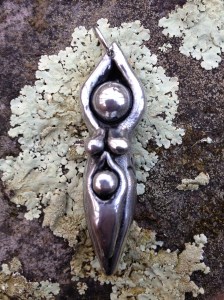
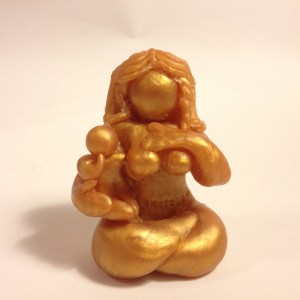
Because I had made a birthing necklace in advance of my first baby’s birth…I brought this to the hospital and Cesarean birth goddess pendant, necklace original sculpture (birth art, c-section, doula, midwife, mother)hung it on my wall. Even though I couldn’t see it during the operation, it helped me to remember that this would still be a birth: a challenging and yet joyous event, and one for which the qualities of love, going with the flow, majesty and a sense of humour would be just as important as during a natural labour…

She goes on to describe how she visited with a friend who is a hospital chaplain and they did a little ceremony:

…it was a relief to feel a hand on my belly that spoke of love and wonder and beauty, rather than the functionality of the body. Tess rubbed my forehead and belly with scented oil and laid flowers from her garden on my bump. We shut our eyes and she asked Mother Spirit to surround the baby and me, to keep us safe through the operation, to bring blessings on the hands of the surgeon and the skill of the midwives. This brought me peace in the hours leading up to the operation, and helped me to face it with quiet confidence, feeling protected.

11150546_1614074768804739_5920468981887497904_nThis post is part of a short series of posts from the book Birthrites by Jackie Singer. The first was about ritual and the second about birth as a rite of passage.

Past posts related to cesarean birth:

Cesarean Awareness Month

Cesarean Birth Art Sculptures

Cesarean Trivia

Cesarean Birth in a Culture of Fear Handout

Becoming an Informed Birth Consumer (updated edition)

The Illusion of Choice

ICAN Conference Thoughts

Helping a Woman Give Birth?

Tuesday Tidbits: Cesarean Awareness Month Round-Up

Sign up for my Brigid’s Grove Newsletter for resources, monthly freebies, and art announcements.

Birthrites: Birth as a Rite of Passage

“Woman-to-woman help through the rites of passage that are important in every birth has significance not only for the individuals directly bellypictureinvolved, but for the whole community. The task in which the women are engaged is political. It forms the warp and weft of society.” –Sheila Kitzinger (Rediscovering Birth)

“I love and respect birth. The body is a temple, it creates its own rites, its own prayers…all we must do is listen. With the labor and birth of my daughter I went so deep down, so far into the underworld that I had to crawl my way out. I did this only by surrendering. I did this by trusting the goddess in my bones. She moved through me and has left her power in me.” ~Lea B., Fairfax, CA (via Mama Birth)

I have long held that birth is a rite of passage worthy of acknowledgement, care, and deep respect.  This post is second in a series of short posts from the book Birthrites by Jackie Singer (the first was about ritual). Singer writes powerful about birth as a rite of passage here:

Birth is the archetypal rite of passage for a woman, containing the essential elements of any ritual: separation from normal life, a profound transition during which the participants occupy a timeless time, followed by re-entry into society in a changed state. It can also be seen as a holy sacrament; the entry of a soul from another plan into this earthly dimension. Birth has always been, and still is, a momentous event, attended by great hopes as well as genuine risks, and one in which people call on a variety of powers for support and protection…

…such a calling in of the spirit is still possible today, whether the birth is at home in a candle-lit pool, or by Caesarean in a brightly lit hospital…

Some collected quotes from past posts on this theme…

‘All cultures believe that women become better and more generous through the process of giving birth. That is why some cultures use words such as ‘sacrifice,’ ‘suffering’ and ‘labour.’ These terms can seem overwhelming and to be avoided’ however, seen from a different viewpoint, childbirth helps us to become strong, resourceful and determined.’ (The Pink Kit)

via Birth as a Rite of Passage & ‘Digging Deeper’ | Talk Birth.

‘Birthing is also a rite of passage–into parenthood–and like any other passage, it comes upon us and we just have to deal with it. It’s an awe-inspiring experience, and it would be perfectly natural to want to prepare in some way. And you can do that. But to some extent the experience is still out of your control.’ (The Pink Kit)

via Birth as a Rite of Passage | Talk Birth.

“Childbirth is a rite of passage so intense physically, psychologically, emotionally, spiritually, that most other events in a woman’s life pale next to it. In our modern lives, there are few remaining rituals of initiation, few events that challenge a person’s mettle down to the very core. Childbirth remains a primary initiatory rite for a woman.” –from the book MotherMysteries

via Thesis Tidbits: Birth as a Shamanic Experience | Talk Birth.

‘So how can today’s modern goddesses, and in particular mammas-to-be, prepare themselves for life’s many transitions? A good starting point is to create your own rite of passage for whatever transition you may be going through. Pregnant women could change their planned baby shower to a Mother Shower (also known as a Blessingway). Mother Showers celebrate and nurture the mother rather than focusing exclusively on the child and are a growing trend amongst women. They offer pregnant women a chance to honour their pregnancy journey, to enjoy symbolic rituals of preparation for the labour and birthing ahead and indulge in an afternoon of loving, nourishing attention from their closest friends and family. And yes, there are still cupcakes!’ –Kat Skarbek

via Rites of Passage… Celebrating Real Women’s Wisdom | Talk Birth.

December 2013 009

Birthrites: Ritual

October 2013 021“This is my body; this is the temple of light. This is my heart; this is the altar of love.”

–Sufi song (quoted in Birthrites)

I received a lot of wonderful books for Christmas this year. One that particularly caught my attention was Birthrites: Ceremonies and Rituals for the Child-bearing Years by Jackie Singer. While it doesn’t contain any ritual outlines, per se (which I had been hoping for), it does contain a lot of thoughtful information. I especially appreciated that it includes information about creating ceremonies to acknowledge a variety of outcomes during the childbearing year, including infertility, abortion, and miscarriage, as well as full-term birth. Two quotes from Birthrites about the value and purpose of rituals in general:

Making ritual diverts our attention from the everyday tasks of survival, and for a brief time allows us to notice and comment on where we are. Faced with the awesome experience of findings ourselves conscious in an unpredictable universe, making ritual is a noble attempt to confer rhythm and coherence to our lives…

…there is a paradox inherent in the whole concept of new ceremony, because part of the power of ceremony is that it has the weight of tradition behind it. In times of continuity, ritual would be something handed down by the elders. Perhaps this is an ideal, but we do not live in times of continuity. Rather than abandoning the whole idea of ritual as irrelevant, we need to respond to the challenges of our fast-changing age by renewing ritual practise in a way that honours the past but makes sense to us now.

This reminded me of my own previous post about blessingways and the role of ritual:

…We’re blessing each other. When we “call down a blessing” we’re invoking the connection of the women around us, the women of all past times and places, and of the beautiful world that surrounds us. We might each personally add something more to that calling down, but at the root, to me, it is an affirmation of connection to the rhythms and cycles of relationship, time, and place. Blessings come from within and around us all the time, there’s nothing supernatural about it.

I also think, though I could be wrong, that it is possible to plan and facilitate women’s rituals that speak to the “womanspirit” in all of us and do not require a specifically shared spiritual framework or belief system in order to gain something special from the connection with other women.

In another book I finished recently, The Power of Ritual, the author explains:

“Ritual opens a doorway in the invisible wall that seems to separate the spiritual and the physical. The formal quality of ritual allows us to move into the space between the worlds, experience what we need, and then step back and once more close the doorway so we can return to our lives enriched.”

via Blessingways and the role of ritual | Talk Birth.

This post is part of a four-part series of short posts from Birthrites.

Talk Books: Laughter & Tears: The Emotional Life of New Mothers

Laughter and Tears: The Emotional Life of New MothersBecause books are my first and longest-lasting love, I began my blogging career with a book blog. I eventually gave it up when I felt I no longer had time for it and turned my attention of other blog work. However, I occasionally mine the old blog for content here and I’ve realized that rather than doing traditional reviews, I really, really like doing my somewhat-new “talk books” posts on this blog. I’ve mentioned before that one of my reasons for blogging is simply to store information in one place that I want to remember or come back to later. If I’ve typed up everything I like from a book, I don’t really need to hang onto the book and the “essence” of many books (or at least what I got from them) is all compiled in one place. So, what follows is one of those mined posts (though at the end, I got caught up in the topic and went off into some related thoughts).

Laughter and Tears: The Emotional Life of New Mothers was written in 1997 by Lamaze co-founder Elisabeth Bing. I found myself with a dearth of postpartum resource books after giving birth to my first child and desperately hungered for them. I went on a dogged mission to locate them, finding them somewhat difficult to unearth, and eventually I think I read basically every book ever written on the postpartum period.  I started out enjoying Laughter and Tears, but found it less and less engaging as it went on. I think there is such a great need for books about postpartum out there—ideally, for women to read before their babies are born. I wish I would have had one already on my shelf when my first baby was born, instead of having to discover the niche later. However, part of why the book was not engaging by the time I actually read it was simply because it is geared toward women in the immediate postpartum (and also first time mothers primarily)—when I read it, I was no longer there and so my interest in the book waned fairly quickly. I also found a the heavy emphasis on “reclaiming your body” off-putting—there was even a comment like, “now that your baby is a robust two month old, you can begin to reclaim your body by reducing or eliminating feedings at night.” Excuse me? “Robust” TWO MONTH OLD? That is practically still a fetus as far as I’m concerned!

Several quotes I marked to share:

“Our society is profoundly ambivalent about children. On one hand, we praise family values, but on the other, we emphasize individual liberty and the rights of women to have as many freedoms as men. We encourage mothers to desire to have it all, but do not guarantee maternity leave, health insurance, or day care. We use babies to sell products, from laundry detergent to automobile tires, but we don’t want a mother with a toddler in the seat next to us on an airplane. We question the legality of abortion but threaten to withdraw welfare benefits from disadvantaged children. We celebrate children and praise parents for having them, but we do not provide structures or systems to help nurture them.”

And, one I still find extremely relevant:

“The degree of pleasure you take in your mothering is not the same thing as loving the baby or being an effective parent. Keep in mind there is a distinction between mother love and maternal satisfaction. You may love your baby very much but be dissatisfied with your life circumstances.”

There was also a quote that I find a new relevance in today now that our household structure has changed to both parents being home nearly full-time. I’ve been confronted over and over again in the last several months with how many “keys” to the household and family life that I’ve held over my ten years as the primary parent in the home and that, at some level, there is a power in being the one who knows (even if it just where the mustard is, for example) and that switching over to sharing those household details doesn’t actually come easily for either parent, no matter how we’ve said we wish to share them. I’m also noticing how very, very many details of the somewhat invisible work of parenting are still very much my responsibility—such as planning birthday parties or taking kids to playgroup or making dentist appointments or making sure Christmas presents are purchased and equal—and apparently, I do not know how to let those go or start transferring some of the responsibility without feeling put-upon, annoyed, demanding or like, I’ll just do it myself, since I’m the expert anyway. And, as this quote below references, I also have enjoyed being the primary emotional parent as well and still hold on to that terrain—essentially, what I want to share is the cooking and towel-folding responsibilities, while still getting to be the one run to for security and snuggles.

“Men are challenged by their attempts to be more involved and more nuturant than the ‘traditional’ father. Women are challenged not only by developing an identity in the world outside the home, but also by opening up and truly incorporating men into the intimate life of the family. You may have a concept of what a more involved father should be like, but if you are honest with yourself, is your image truly about sharing the love and nurturance? Or is it actually about wanting your partner to help with domestic chores? Are you really imagining a co-parent, or are you thinking of something more like a regular baby-sitter and handyman?”

Whatever it’s shortcomings, this book again reminded me of how vital postpartum support is for families in our society and reminded me of why I originally wanted to be a postpartum doula and how called I felt to that work. In 2004, I trained with DONA as a postpartum doula and felt 100% certain that I had found where I belonged (indeed, I still get Christmas cards and updates from one of my first postpartum doula clients—I was good at the work and they liked me a lot!). I stopped working as a postpartum doula in 2006 though. My biggest reason for discontinuing postpartum work was because at this point in my life I couldn’t reconcile taking care of someone else’s family while my own needed me so much. There I would be washing my client’s dishes and thinking that I have a huge pile unwashed at my own house (that my husband then did at night when he got home) and/or folding their laundry and thinking of the two full baskets at my own house in my own living room as yet not put away. Also, I recognized that I felt more comfortable with and am temperamentally more suited for educational/”academic” types of support  rather than the “intimate” hands-on support that postpartum or labor support requires. For a time after quitting, I really felt embarrassed about it because I was SO sure it was my “calling” and because I spent so much money on training, books, supplies, certification packet, etc. (Luckily, I totaled it up when I was preparing to quit and I made enough money from my clients to at least more than pay myself back for the training!)

I feel fervently that women/families need postpartum doula support (sometimes desperately) and I felt depressed to realize that I wasn’t the person for the role after all. I didn’t understand at the time, but I quickly figured out why the majority of the women in the postpartum doula training with me were middle-aged. They had the energy to “mother-the-mother” and “nurture the family” at that season in their lives, whereas I am still in a season in which I need to nurture my own family before I have the energy to spare to nurture someone else’s. There were also a handful of women in the training, like me, who had very young children. There were no in-betweeners, like where I am right now. I’ve begun to notice this in birth activism work (and to a lesser, but still noticeable extent, in breastfeeding support work) as well—passionate mothers-of-infants or toddlers and gray-haired sage-women are the ones who come together for the bulk of the birth activist workload in various organizations.

I’m also reminded again, however, of why breastfeeding support holds such a lasting pull for me and that is because postpartum is where it is at, that is where we are so very, very deeply needed as support people. Birth is amazing and exhilarating and women most definitely need us there too, but in the nitty-gritty, day-to-day, unglamorous, nipples and breast infections, teething, crying, dirty-haired, exhausted, wrung-out maternal web of daily being is a very tender and delicate beauty that becomes visible only when we’re willing to spend months and months, or even years, serving as a listening ear, a medication lookup, and someone to trust with both her laughter and her tears.
December 2013 018Additional resource: Non-Advice Books for Mothers
Talk Books: Cut, Stapled, and Mended

To be honest, I wasn’t sure what to expect from Roanna Rosewood’s memoir, Cut, Stapled, and Mended. After it arrived I actually wondered if I should have agreed to review it, because I have so many things to read, things to think about, and interests that are calling me—do I really need to read a memoir about someone’s cesareans? I’ve already read so many books about birth, do I really want to read another one? Well…the answer was YES, I did need to read it. After I finished the book, I felt almost speechless at how deeply it had touched me. This book was a surprise all the way through, from the opening Orgasmic Amazon Queen sex scene, to a session with a psychic healer who tapped in to Roanna’s past life abdominal wound, to her dogged quest to open herself to her own feminine wisdom, to her birth experiences—all soul-shattering in their own way—this book touched me profoundly. I was shocked to find myself with tears in my eyes at many different points and eventually truly unable to put it down.

Orgasmic Amazon Queen notwithstanding, Roanna comes across as a practical and down-to-earth narrator, who in her quest to understand herself, her body, her inner wisdom, and her birth experiences, makes a decidedly not down-to-earth personal journey through a variety of healing modalities and nontraditional experiences and perspectives. I really loved the balance she struck between the spiritual and metaphysical experiences she describes and the nitty-gritty reality of doing this thing, giving birth. In a perfect example of what I mean, she writes:

You think I would run out of poop but I don’t. It’s endless poop.

My ego, having (literally) had enough of this shit, quits. It gets up and walks right out the door. What is left of me poops in the tub. Looking down, I say, ‘ewwwww.’ I say it as if it wasn’t me who just shat in the tub. I say it as if I just happened to come across poop in my bath one day. ‘Ewwww’ or not, I’m never getting out of the tub ever again. If this tub were full of nothing but shit mud, I would still stay right here (p. 144).

And, just a few pages later, the experience I already quoted in my earlier post:

Only then does the Divine come, taking my body as her own. I am no longer alone. There is no fear…I experience completeness. I find religion. Infinity is tangible. Generations of children, their dreams, passions, defeats and glories—they all pass through me, converging here, between my thighs… (p. 146-147).

via Thesis Tidbits: Cut, Stapled, and Mended | Talk Birth

Despite planning homebirths, Roanna experiences two cesareans and her journey towards VBAC is an arduous one:

Deep inside, I feel the screams of birth echoing off the sides of my skull. Softer and softer they fade, becoming a faint whisper, then disappearing completely.

I open my mouth. ‘Please,’ I whisper-scream-beg-cry, ‘please come back.’

She does not.

I am, once again, mortal. (p. 155)

While I would likely proceed with some degree of caution if reading this memoir as a pregnant first-time mom, there is much to be learned from Roanna’s experiences. Her narrative is rich, deep, compelling, scary, dramatic, poignant, and powerful. I highly recommend it!

Disclosure: I received a complimentary copy of this book for review purposes.

Crossposted at Citizens for Midwifery.

Talk Books: Blessed by Less

“In a way Winter is the real Spring – the time when the inner things happen, the resurgence of nature.”
  ~ Edna O’Brien

As I’ve referenced several times recently, each November for at least the last four years, I’ve felt a deep call to retreat and to re-evaluate my life, my priorities, and my goals. This year, I’ve been struck with a Blessed By Less  profound sense of “fall cleaning.” I’m in the mood to declutter, pare down, reduce, and subtract. I’ve been dragging out my big paper and diagramming out my responsibilities and commitments as well as the ideas I’d like to bring to fruition in 2014. So, when the opportunity arose to review Blessed by Less for the Patheos book club for December, it felt like a perfect synchronicity. Befitting its purpose, this slim little book is the perfect length. It is succinct, direct, and focused. It can be quickly read in just one evening. But, this doesn’t mean that it doesn’t contain practical advice–quite the contrary, each chapter has “first steps” and “big steps” to implement the simple living strategies suggested. I also appreciate that it has different tips based on stage of life–so, there are suggestions for younger people or people with children as well as suggestions for people in the “second half of life,” all tidily contained in inset, targeted boxes.

Blessed by Less offers encouragement and inspiration for all who are burdened down by “things” in their homes and hearts but don’t quite know how to begin the process of letting go. Susan includes tips for beginners and challenges for those who’ve been simplifying for years. Rather than making readers feel guilty for all the stuff they’ve accumulated, Susan gently nudges them to see all that they have to gain—physically, emotionally, and most of all spiritually—by living lightly.

Written by the experienced Catholic careworker, Susan Vogt, I very much appreciated the environmentally friendly message and social justice oriented perspective of Blessed by Less. I admit to sometimes overlooking progressive Christians and lumping all Christian-identified people into a mental box labeled “fundamentalist,” and so it was excellent for me to read Vogt’s perspective on simplifying one’s life. The book is most definitely oriented towards Christian readers, but readers from other faith backgrounds will find many points of overlap in the outlook and perspectives expressed. Vogt was inspired by the approach of the season of Lent to embark on a project in which she gave away an item every day for 40 days. After this time period, she continued her project and followed it up by participating in the Food Stamp Challenge (to live on the average food stamp budget for six weeks). She writes of her foray into uncluttering her life as an opportunity to grow spiritually and points out that this practice can contribute to, “The practiced ability to find God’s presence ‘in all things’—in our ordinary situations.” She writes with compassion about people living in poverty, includes acknowledgement of privilege, and issues a call to action in terms of “what’s fair,” as well as the conviction that making environmentally sustainable choices is essential. An example:

Pay taxes with gratitude that I have an income to tax…

Look upon opportunities to fund worthy causes not as charity but as justice, a way of giving back.

Evaluate the impact that the things I own and my lifestyle have on planet earth. Am I using more than my fair share of energy resources? Is my transportation environmentally friendly?

Stay in solidarity with people who are marginalized by staying informed, praying, fasting, and participating in social justice endeavors.

Vogt also touches on the impact of “TMI: Too Much Information” syndrome and how digital clutter can impact us as well (I’m working on this one!). And, she brings up the central value of human relationships, a section in which she offers a quote that I found to be very freeing advice to parents: “Parents are responsible for the process of bringing up children; parents are not responsible for the outcome.” While this book isn’t specifically geared towards parents, this tip was a refreshing counterpoint to the many parenting books I’ve read that seem to, implicitly or explicitly, promise a specific outcome.

From Blessed by Less I also learned about the Pachamama Alliance, an environmental activism organization seeking to preserve indigenous wisdom for a sustainable world.

And, I was inspired to make some additional microloans via Kiva International! 🙂

Disclosure: I received a complimentary copy of this book for review purposes. This is a crosspost.

Talk Books: My Kitchen Cure

“If it comes from a plant, EAT It. If t is made in one, DON’T.” –Mee Tracy McCormick

How interesting can a book about cooking natural foods be? Very, if written by Mee Tracy McCormick! I have several autoimmune disorders and I have quite a few friends with autoimmune disorders as well, so when My Kitchen Cure came to my attention as being written by an autoimmune cooking expert, my interest was piqued. However, when the book arrived, I thought, “what was I thinking?! I don’t have time to read a cookbook. I have a birth blog!” Then, I started reading, and found to my surprise that I couldn’t put it down. Mee Tracy’s story is really riveting and her writing voice is down-to-earth, straightfoward, and just plain funny (be prepared for quite a few references to “shadoobie” and the ideal consistency thereof!).

The first section of the book is a page turner that reads like a novel. We learn about the author’s hereditary experience with Crohn’s disease and her progressive, painful decline from this disease. This section of the book is sprinkled with stories about her travels and experiences living in other countries as well as on her farm and cattle ranch in Nashville, TN. Mee Tracy experiences a turning point in which she decides she is unwilling to continue turning herself over to conventional medical treatment and possibly not survive to see her children grow up, and sets out to cure herself with food. She transforms her own kitchen habits and diet and slowly, slowly heals her body and transforms her life. The final half of the book is full of Real Food recipes designed to heal autoimmune disorders. Many are raw, many are vegan, many are gluten and dairy free, and all are specifically chosen to be nourishing and healing to depleted, stressed  bodies. Even the recipes are written in a light, conversational way that makes them actually fun to read. They are also very inspirational and my own shopping list quickly grew to include things like kombu, arrowroot powder, and plenty of raw cashews. I’m seriously going to try some of this stuff, shawty! 😉

Apparently 55 million people in the US experience an autoimmune disease. Part of the cure can be found in our own kitchens, and Mee Tracy McCormick’s book is on hand to help us get started.

Here’s one of the simple, yummy sounding recipes that I’m totally making as soon as my raw cashews get here!

Sour Cream Queso

2 cups cashews
1 cup water
1/4 cup lemon juice
1 TB nutritional yeast (if avoiding yeast products, use 1/2 ts of white miso instead)
1 TB salt

Blend in a blender at high-speed until completely smooth!

My Kitchen Cure is available on Amazon.

Disclosure: I received a complimentary copy of this book for review purposes. Opinions expressed are my own and I have no other relationship with or obligation to the author or company.

Talk Books: Sweetening the Pill

I haven’t actually read this book yet, or even obtained a copy, but I am intrigued enough by the promo spot that I’m doing a short blog post about it anyway! I’ve struggled with the question of birth control for some time. I took the pill for about six years and then after having my first baby in 2003 and going on the minipill, I had the sudden “epiphany” that if I was so committed to natural birth and breastfeeding and natural living and trusting my body, why the heck was I okay with filling said body full of hormones?! (The same epiphany, but including cloth diapers, led me to start using cloth moon pads rather than disposable as well. Never looked back!) We started using natural family planning instead (really, the Billings method) and it has been excellent for nine years—no “accidents” and more babies exactly when we decided we wanted them. And, no side effects, no money, and no hormones. Now that our family size feels complete, I find myself struggling with whether or not NFP will continue be “enough” until natural infertility takes over. NFP was fine when an accidental pregnancy was an acceptable option. At this point, an unexpected pregnancy would still be an acceptable option, however fast-forwarding the clock, I really, really, really, do not want to be someone who ends up having her first unexpected pregnancy at age 45 or something! I also do not want to engage in any permanent body-modification efforts (for either myself or my husband) when my own fertility will be up in the next 15 years or so (but body modification is forever!). So, I feel very optionless at this point…Anyway, on to the book I haven’t read. Here’s the promo copy I got that piqued my interest!

SWEETENING THE PILL OR HOW WE GOT HOOKED ON HORMONAL BIRTH CONTROL by Holly Grigg-Spall
Book Description: Millions of healthy women take a powerful medication every day from their mid-teens to menopause – the Pill – but few know how this drug works or the potential side effects. Contrary to cultural myth, the birth control pill impacts on every organ and function of the body, and yet most women do not even think of it as a drug. Depression, anxiety, paranoia, rage, panic attacks – just a few of the effects of the Pill on half of the over 80% of women who pop these tablets during their lifetimes.When the Pill was released, it was thought that women would not submit to taking a medication each day when they were not sick. Now the Pill is making women sick.However, there are a growing number of women looking for non-hormonal alternatives for preventing pregnancy. In a bid to spark a backlash against hormonal contraceptives, this book asks: Why can’t we criticize the Pill?

Carol Downer of Women’s Health in Women’s Hands makes a really important that our feminist health commitment to birth control access may blind us to the actual poor health impacts of the Pill:

“We discovered in the ’70s that the personal is political. Holly Grigg-Spall starts with her and other women’s personal experiences with the Pill, then thoughtfully and thoroughly considers it scientifically, medically and philosophically to discover the political truth of the Pill. She shares strategies for finding new ways to control our fertility while regaining control of our destiny. Grigg-Spall’s careful study on the Pill’s effect on women’s health is long, long overdue. We are so busy fighting to keep hormonal birth control available that we don’t want to question what it is doing to our health and our lives. After reading this book, we can never see the Pill in the same way again.”

Comments and resources welcome! 🙂

Talk Books: One Recumbent Mommy

Some time ago I received a unique memoir to review along with a companion book for children. The topic of One Recumbent Mommy is bedrest and the book is written in a friendly, conversational, and personal style that has potential to bring an air of sisterhood to women experiencing the same challenge and make them feel less alone. The book is based on the author’s blog and a casual, breezy, lighthearted style comes through strongly. The author writes:

I was on hospital bedrest with incompetent cervix for about 16 weeks and while there, I kept a blog chronicling the ups and down of day to day life in the hospital.  That blog was published and is entitled, One Recumbent Mommy: A Humorous Encounter With Bedrest.  I wrote a children’s companion book as well, entitled Wherever I Am, I Will Love You Still: A Book About An Extended Hospital Stay.  This book was written from my 2 year old son’s point of view.  I was trying to get at a way of explaining the situation in terms that a young child could understand.

The companion children’s book: Where I Am, I Will Love You Still, is friendly and sweet and the illustrations are engaging. This book would be a very useful addition to a family whose mother is experiencing a hospital stay. While the book’s conclusion includes the new baby sister coming home, it definitely has the potential to be applied to non-maternity-related hospital stays as well. Do note that bottle feeding is portrayed in the book.

While I was somewhat disappointed by the very conventional medical model of care in One Recumbent Mommy and the seemingly unquestioning acceptance of it by the author (especially considering that bedrest has come under serious scrutiny as to its actual effectiveness at preventing pregnancy loss), as well as the apparently overlooked irony of the baby’s birth then being induced, I appreciated the reminder that for many women pregnancy is anything but a joyful, flower-strewn walk through a miraculous meadow of belly casts and earth-goddesses. My writing and my posts often trend to a Happy Birth Dance! mode of writing about birth and was beneficial to me to remember that this model can feel very isolating, discouraging, and depressing to women whose experiences of pregnancy and birth are different from my own.

Along this same line of thought, I was reminded of recent writings from beautiful blogger Leonie Dawson about her experiences with severe hyperemesis gravidarum (requiring multiple hospitalizations):

And despite everything – despite it all –

Love is calling me forward.

As ancient as the beginning of time, love calls upon us to do what we could not do without.

Love asks of us great things…

via The Love That Calls Us Forward | Leonie Dawson – Amazing Biz, Amazing Life.

As I read One Recumbent Mommy and my priestess/ceremonialist self came to fore however, I also found myself wishing this mama had had some kind of beautiful hospital blessing ceremony to honor her commitment to her baby or that someone had offered her a nurturing prayer, poem, or blessing for her as a Bedrest Warrior doing what had to be done to protect her baby. Could there be a place for a Happy Bedrest Birth Dance mode of writing and experiencing as well? I gratefully welcome additions to this post of ideas for rituals, poems, prayers, or resources that can be offered to bedrest mamas who are doing their best to welcome a healthy, full-term baby into their lives! 🙂

Talk Books: Birth, Breath, & Death

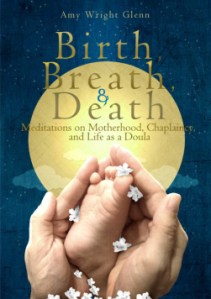
I just finished reading a lovely little book by Amy Wright Glenn. Lyrical, gentle, contemplative, and touching, Birth, Breath, and Death explores Amy’s meditations on life as a doula, mother, and hospital chaplain. birthbreathanddeath-amywrightglenn

Amy Wright Glenn was raised as a Mormon and eventually found her way onto a different faith path, Unitarian Universalism. Her reasons for connecting with the UU church actually closely mirror my own. Amy mentions that she first finds the UU church through her interest in poetry, which I found interesting. She then explains, “I was drawn to the way that Unitarian Universalist (UU) ministers attempt to evoke wonder and exploration in the minds and hearts of their congregants” (p. 10). This attempt to engage with the “transcendent sense of mystery and wonder” is exactly what attracted me to the UU’s, as well as the respect for the interdependent web of life of which we are all a part, the affirmation of the dignity and worth of each human being, and the commitment to social justice.

Amy writes, “I had been raised to acknowledge only one entrance to God’s energy. In fact, one need not use the term ‘God’ at all. Such a term is another doorway into the mysterious heart unifying all existence. However, humans need language to direct the attention to the ineffable. There are many names for this mystery. The doorways were holy too” (p. 13).

She continues with a very UU perspective (I’ve heard of it describes as “the light shines through many windows. We respect all windows and welcome everyone, except for those who think they should throw rocks through everyone else’s window!”):

“Spiritual surface structures open human beings to encounters with the ineffable…I have no doubt when my father bows his head in a small Utah town, and when I meditate in quiet sublime stillness, we touch the same source. At their best, religious traditions affirm the wonder at the heart of existence and provide meaningful contexts for its experience. This mystery allows us to breathe, dream, love, and dimly perceive so,etching beyond time even while we live in time…The moon is simply the moon, a miracle enough” (p 16).

I connect to this sense of wonder, with no need for explanation or interpretation—isn’t it is enough, to just marvel at what is? On my other blog, I once wrote:

I also have a favorite passage from Susan Griffin about the earth in which she exclaims, “We are stunned by this beauty.” That is exactly how I feel. This relationship to the planet is what used to make me feel that a conception of deity was unnecessary—isn’t it enough to just marvel at what is, right here in front of us? The majesty and the miracle of the natural world. I am stunned by this beauty. I am stunned by the realization that we are all suspended in space, spinning timelessly through the universe on this beautiful planet, so small in the vastness of all that surrounds us, and yet so big that it is literally our whole world. Sometimes when I have a bad day or feel overwhelmed by the swirl of daily tasks I remember that old saying about, “sometimes I go about pitying myself when all the while I am being carried by a great wind across the sky.” If we really stopped to think about this—to sense how we are carried by the great wind, I think the whole world would change, how people relate to each other and to the environment would be transformed. Stop, look, listen, breathe, and feel how we spin. Together.

Moving into birth, Glenn addresses the potent, transformative aspects of birth in describing attending her sister’s birth, the birth that led her into doula work (before the birth of her own son): “Birth brings powerful and painful sensations to the most intimate spaces of the female body…I stood transfixed by the life-giving strength found in her feminine power.”

She also explains:

“All forms of birth–physical, intellectual, spiritual, or emotional–bring one to the depths. The power to give birth originates in the creative life spirit birthing all, the seen and the unseen. According to Joseph Campbell, the source of life is beyond gender and the duality of male and female. However, when symbolizing the power that creates, Campbell argues the representation is ‘properly female.’ I agree. From this universal goddess energy emanates the seasons, the mountains, the rivers, and the galaxies. Writ large, human birth embodied the process of manifesting dreams, working diligently through our labors, and bringing vital energies to life. On this level, all human give birth. All humans participate in life’s creative energy…

On this level, we all need the renewing powers of ‘rhythm, ritual, and rest.’ This phrase reminds doulas of three helpful labor techniques outlined by legendary doula trainer, Penny Simkin. Rhythm, ritual, and rest not only aid birthing women, but they support all of us to move skillfully through our life’s labors. The power of rhythm restores vibrancy through dance, music, and motion. The power of ritual opens the way to direct encounter with the mysterious wonder of life. Rest renews and restores the very cells of our often tired and over-stimulated bodies and minds.” (p. 28-29).

And, she makes some poignant observations about breastfeeding, one that almost made me cry: “…only a child knows what his mother’s heartbeat sounds like from the inside” (p. 67) and one that made me cheer: “Family and friends need to draw a fierce circle of protection and non-interference around the nursing mother-child dyad.

In giving birth to her own son, Amy’s awareness and understanding are further deepened and expanded and she explains that:

“For me, birthing was a crucible moment, a dying, a deepening, and a healing. The light of birth transformed me into a mother. The light of birth is love. Looking back I see this clearly. Love was the pain and joy. Love restored me as I rested and held me up when I transformed into a wild eyed Kali. Love chanted with me in the birthing tub and love was certainly the epidural. Love pushed my baby out and gazed at me through Taber’s eyes. Love sustains me now as I watch his sweet small mouth suckle…” (p. 68)

Towards the end of this sweet, thoughtful book, she also used a great analogy that I’m going to borrow for my human services classes. She posits the scenario in which you are passing by a pond on the way to work and notice a small child drowning. You are wearing an expensive pair of new shoes and rushing into the water will ruin them. Do you rush in? The answer is YES. No one should choose their shoes over the life of the child and almost no one would respond to this scenario by saying that they would not save the child, yet, if the pond is world poverty, we do in fact, choose the shoes every day…we just aren’t looking those children in the eyes at the time…

Disclosure: I received a complimentary copy of this book for review purposes.