Archives

Comfort Measures Illustrations

We spend a lot of time in my classes talking about different comfort measures for birth. In fact, one of my most popular classes is my “Labor Support and Comfort Measures” single session class in which we practice all kinds of different skills that may be of use for birthing.

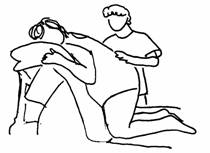
I enjoy Childbirth Connection’s free pdf booklet “Comfort in Labor” and use this as a class resource. Very recently, they added a new section to their website  with lots of helpful, line drawing illustrations for Comfort Measures During Labor.  The illustrations are the same as in the booklet, but presented on one page without a lot of accompanying text—great for visual learners!

As I’ve referenced before, the Transition to Parenthood website also has a helpful section of comfort measures illustrations available to birth educators.

Even if it might feel silly, I encourage people to print out the images and physically practice the techniques illustrated a couple of times—this helps develop a “body memory” so that when you are actually in labor different labor-beneficial positions feel comfortable and familiar. Also, it helps for the birth partner to have a body memory as well to help reinforce healthy positions or suggest fresh ideas.
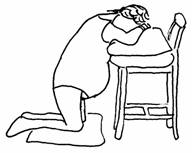
kneeling with head on chair

Childbirth Education Mnemonic Devices

Thanks to the word “tulip,” used by my Western Civilization professor in 1996, I will never forget the 5 basic beliefs of Calvinism. This is an example of a mnemonic device that was (to me) apparently unforgettable. In March of this year, I took the ICEA childbirth educator certification exam. I studied compulsively for the exam and came up with a couple of mnemonic devices (word tricks that help you remember things) for several birth-related anatomy terms that I was otherwise having trouble remembering.

1. “What do you want for Isthmus [Christmas]?”  “A lower uterine segment!”

2. “Brady’s always been a little slow…” (said with a sort of sympathetic grimace. This helped me remember the difference between bradycardia [too slow FHT] and tachycardia [too fast]).

3. “I schitt on my tuberosities” (not pronounced quite as bad as it looks, draw out the “sch.” This helps me remember that the ischial tuberosities are the “sitting bones” at the bottom of the pelvis–I was getting them confused with the iliac bones and perhaps with the ischial spines).

4. And less interesting and more classic, that arteries carry blood *away* from something (both start with A) and veins carry blood to it.

5. I remember the three layers of the uterus by using the start of the word to remind me of its location. Endometrium is on the INside (end–>in). Perimetrium is on the perimeter (the outside. Words both start with “peri”). And, myometrium is in the middle–both start with “m.”

These are the ones that have come to mind right now. Does anyone else have any devices to add that they use for terms like this?

I’d like to find one for the 7 cardinal movements!

Active Birth Video

Lamaze and Injoy videos have teamed up on a nice new website called Mother’s Advocate. The site has a variety of handouts and a booklet to download based on “6 Healthy Birth Practices” (which, in and of themselves form a nice little birth plan for a normal, healthy birth!). I especially enjoyed their video on active birth: “get upright and follow urges to push.” The video urges upright birthing positions and avoidance of directed/forceful pushing (the kind with counting that you see so often on tv!).

Birth Affirmations for Fathers

In my classes, I suggest the use of affirmations. Affirmations are short, positive statements that inspire confidence and positive feelings. I have a handout that is printed on the front side with affirmations for mothers to read to themselves and the reverse has the same affirmations worded in such a way that they can be easily read to the woman.

The book Mind over Labor by Carl Jones, there are some affirmations listed specifically for fathers:

  • I am able to make the best possible choices for a healthy, joyful birth.
  • I see my partner as a strong and capable woman.
  • I am able to support my partner during pregnancy and birth.
  • We are working harmoniously together. We are grateful for this powerful experience.
  • The power of birth strengthens me, my child, and my partner.

For women he shares the following ideas for affirmations, some of which are really nice and I should add to my handout above!

  • Childbirth is a normal, healthy event.
  • My body is my friend.
  • I trust my body to labor smoothly and effectively.
  • I am able to birth in harmony with nature, in the best possible way for myself and my baby.
  • My baby and I are working harmoniously together. We are grateful for this powerful experience.
  • The strength of my contractions is an expression of my feminine power.
  • I fully feel the force of new life within me.
  • I allow myself to celebrate the birth of my child with every sensation I feel.
  • I am giving our baby the very best start in life.

Just Relax?

Most approaches to birth preparation emphasize “relaxation” and being able to “relax” during contractions. Some people have noted that the word “relax” isn’t very descriptive to women in labor–or, it can irritate them (“Just relax?!”) while at the same time not really giving them anything specific  to work with. I recently finished a really incredible book called Birthwork (more about this will follow in several more posts!) and it addresses this topic as follows:

…it can be disconcerting for a mother to be told to ‘just let go and relax’ during labour without some practical guidance on how to  do this or without first acknowledging how tough it is, or how stuck or frustrated the mother may feel. Perhaps a more helpful response might be:

–‘Let’s find a way to open more.’

–‘How can I help you to let go?’

–‘Try softening here.’

–‘Sometimes this works really well. Would you like to try it?’

I particularly like the “soften here” idea. It reminds me of something else I read in The Pink Kit, which was about “directed breathing.” The idea with directed breathing is that you can direct your breath into any specific area of your body–when helping a woman in labor, you might put your hand on her lower back and ask her to “breathe into my hand.” When you practice this at home, it is fascinating to me how you actually have a sensation of “breathing” in your back, or thigh, or shoulder, or wherever–sort of a subtle feeling of expansion.

For Labor Support Remember TLC or BLT

When supporting a woman in labor, remember to use “TLC”:

Touch–this can be massage, hand-holding, foot rubs, stroking her hair, and encouraging frequent position changes. It also includes the use of water (hydrotherapy).

Listen–this is half of the emotional support in labor. Listening builds trust and meets emotional needs. Use active(reflective) listening and lots of encouragement.

Communication–there are two types in labor. One is information sharing–about her progress, her choices, ideas of things to try, interventions, complications. The second is mediation with hospital staff–this can involve reminders about mother’s wishes, and assertiveness about care.

Or, you can use “BLT”:

Breath–remind her to breathe if she is holding her breath. Model a “cleansing breath” if she is stressed. In through the nose and out through the mouth (like a sigh) can be helpful.

Language–this can be mind-body communication, internal conversation, or verbally telling, showing, or modeling (body language).

Touch–as discussed above. Large muscle massage or firm pressure usually feels better to the laboring woman than light patting, stroking,  or “tickling” at the skin or clothing level of her body.

Material on TLC is drawn from the International Journal of Childbirth Education, June 1998. Material on BLT from The Pink Kit–New Focus: Breath, Language, and Touch.

Why Honey Sticks During Labor?

May 2015 146I have already written about eating during labor. One of my suggestions is honey sticks–but why honey sticks and where to buy them? Honey sticks, also called honey straws, are plastic tubes of honey similar in size to a drinking straw. During labor, honey sticks can provide an instant energy boost for a laboring mother. They are especially good to pack along if you are going to be laboring in a birth setting with restrictions on food or drink intake (read more here about why withholding food and drink from laboring women is not a good idea!). They are also handy if a mother is very tired and needs some quick energy, but is not interested in eating anything more substantial. Dads who are feeling a little tired or woozy in the birth room may also find honey sticks a quick boost for themselves as well! The sticks hold about a teaspoon of honey and you can  easily pop the end open with your teeth and suck the honey out.

Where to buy? Here are a couple of ideas:

Online store where you can buy individual fruit-flavored honey sticks.

Online store that carries plain honey sticks.

Online store that carries honey sticks in large quantities (perhaps you have lots of friends who’d like to share?)

Sign up for my Brigid’s Grove Newsletter for resources, monthly freebies, and art announcements.

Movement and pain

A brief quote from Biance Lepori an Italian architect who specializes in the design of birth rooms:

“Even pain dissolves with movement; pain killers are a consequence of stillness.” (emphasis mine)

This architect specifically designs rooms that support physiological birth–birth that unfolds accords to the natural biological processes of the woman, on her own timeline, and under her own power.

I emphasize active, normal (physiological) birth in my classes. I feel like the use of movement is one of the single most important ways we have to embrace labor and its rhythms and also to support healthy, physiological birth. Though I teach a variety of positions for labor and birth, “birthing room” yoga poses, and encourage practicing them, I believe that the movements you need during labor come from within and arise spontaneously during labor, not from specific training and practice. The key is the FREEDOM to use movement in the way you need to (many women end up being denied the right to free movement during labor 😦 ). The benefit to practicing different positions and movements prior to birth is that you gain a “body memory” of how to move your body in labor supporting ways.

How to Use a Hospital Bed Without Lying Down

In classes, I often suggest that when couples enter their hospital room in labor they pile all of their belongings onto the bed rather than the laboring woman hopping into it. I encourage people to start seeing the bed as a tool they can actively use during labor, rather than a place for labor and birth to passively happen to you. To that end, I’ve made a little handout called “helpful ways to use a hospital bed without lying down.” I’m uploading it here in hopes that others may find it useful as well.

Kneeling & leaning on back of hospital bedFor more about the importance of freedom of movement during labor, make sure to check out Lamaze’s Healthy Birth Practice paper: Walk, Move Around, and Change Positions Throughout Labor or this video clip from Mother’s Advocate.

Top Five Birth Plan…

Birth plans are a topic often discussed in birth classes. There are SO many things that could be put onto a birth plan that sometimes it is difficult to sort out the most important. I encourage couples in my classes to complete two different “values clarification” exercises to help them include those things on their plan that are MOST important to them, rather than trying to cover everything on a one page birth plan. They often ask what I think is important to include. So, recently I started thinking that if I needed to create a birth plan for a birth in hospital that was as normal and natural as possible and could only include five elements, what would be most important to me, my baby, and a normal birth?

These are my top five after first going into the hospital as late in labor as possible (this isn’t included on my birth plan and doesn’t need to be on anyone’s birth plan–“I plan to labor at home as long as possible”–because it isn’t relevant by the time you get there and people are reading your plan. It belongs on your own personal plan, but not in your “official” plan):

  1. No pitocin.
  2. Minimal fetal monitoring and preferably with a Doppler only.
  3. Freedom of movement throughout labor (stay out of bed, use it as an active tool rather than as a place to lie down. Stay upright during any necessary monitoring.)
  4. Push with the urge in whatever position works best for me (NO coached, directed, or “cheerleader” style pushing).
  5. Baby immediately to me. NO separation.