Archives

Breastfeeding as an Ecofeminist Issue

Breasts are a scandal because they shatter the border between motherhood and sexuality.

––Iris Marion Young

After Hurricane Katrina, I read a news story about a young mother whose newborn baby died of dehydration during the days in which she had been stranded without access to clean water. Upon admittance to the hospital, the mother was asked if she needed anything and she replied that her breasts were uncomfortable and could she have something to dry up the milk. This story brings tears to my eyes and chills to my body. What does this say about our culture that it is actually possible for mothers to be unaware that they carry the power to completely nourish their own babies with their own bodies? As mammals, all women have the potential to be lactating women until we choose not to be. The genius of formula marketing and advertising is to get women to withhold from their offspring that which they already have and to instead purchase a replacement product of questionable quality. To me this feels like being a given a “choice” between the blood already flowing through your veins and a replacement product that marginally resembles blood.

We are mammals because as a species we nurse our young. This is a fundamental tie between the women of our time and place and the women of all other times and places as well as between the female members of every mammal species that have ever lived. It is our root tie to the planet, to the cycles of life, and to mammal life on earth. It is precisely this connection to the physical, the earthy, the material, the mundane, the body, that breastfeeding challenges men, feminists, and society.

Breastfeeding is a feminist issue and a fundamental women’s issue. And, it is an issue deeply embedded in a sociocultural context. Attitudes towards breastfeeding are intimately entwined with attitudes toward women, women’s bodies, and who has “ownership” of them. Patriarchy chafes at a woman having the audacity to feed her child with her own body, under her own authority, and without the need for any other. Feminism sometimes chafes at the “control” over the woman’s body exerted by the breastfeeding infant.

Part of the root core of patriarchy is a rejection of the female and of women’s bodies as abnormal OR as enticing or sinful or messy, hormonal, complicated, confusing…. Authentic feminism need not be about denying biological differences between women and men, but instead about defining both as profoundly worthy and capable and of never denying an opportunity to anyone for a sex-based reason. Feminism can be about creating a culture that values what is female as well as what is male, not a culture that tries to erase or hide “messy” evidence of femaleness.

However, precisely because of the patriarchal association of the female with the earthy and the physical, feminists have perhaps wanted to distance themselves from breastfeeding. This intensely embodied biologically mandated physical experience so clearly represents a fundamental difference between men and women that it appears to bolster biological reductionism. Yet in so doing feminism then colludes with patriarchy and itself becomes a tool of the patriarchy in the repression and silencing of women and their leaky ever-changing, endlessly cycling bodies: these bodies that change blood into food and bleed without dying and provide safe passage for new souls upon the earth. Sometimes the issue of a woman’s right not to breastfeed is framed as a feminist “choice.” This is a myth, made in the context of a society that places little value on women, children, and caregiving. It is society that needs to change. Not women and not babies.

Systemic and Structural Context

In an essay for the Academy of Breastfeeding Medicine on “What does feminism have to do with breastfeeding?”, Maternal–fetal medicine specialist Dr. Alison Stuebe (2010) points out that for the most part feminist advocacy ignores breastfeeding and that most breastfeeding advocacy sidesteps the complicated contextual issues of women’s lives. Stuebe notes:

…the conventional wisdom is that breastfeeding is a maternal duty that forces women to eschew their career aspirations to fulfill some ideal of motherhood, while feminism is about liberating women from exactly those constraints. Case closed. Or is it?…The result is that women end up fighting among themselves about the choices our society forces us to make — motherhood or career? Breast or bottle? — instead of uniting to address the societal structures that prevent women from realizing their full potential.

Appropriately, Stuebe further notes that:

…breastfeeding is not a ‘choice.’  Breastfeeding is a reproductive right. This is a simple, but remarkably radical, concept. Here’s why: When we frame infant feeding as a choice made by an individual women, we place the entire responsibility for carrying out that choice on the individual woman…Indeed, the ultimate link between breastfeeding and feminism is that in a truly equitable society, women would have the capacity to fulfill to pursue both their productive and reproductive work without penalty.

And, in considering contextual and systemic issues that impact women every day, Stuebe points out that:

These issues transcend breastfeeding. Why, for example, do we pit “stay at home moms” against “working moms,” rather than demand  high-quality, affordable child care, flexible work, and paid maternity leave so that each woman can pursue both market work and caring work, in the proportion she finds most fulfilling? Why do we accept that, if a woman devotes all of her time to caring for her family, she does not earn any social security benefits, whereas if she gets a paying job and sends her children to day care, she and her day care provider earn credits toward financial security in old age? And why do we enact social policies that subsidize child care and require poor mothers to enter the paid work force, rather than support poor mothers to care for their own children?…

Naomi Wolf (2003) also addresses the myth of  “choice” regarding breastfeeding (specifically with regard to lack of support for breastfeeding while working outside the home) in her book Misconceptions: “…it was unconscionable for our culture to insist that women ‘choose’ to leave their suckling babies abruptly at home in order simply to be available for paid work.” (p. 270) Wolf also quotes Robbie Kahn who says, “the job market holds out an all-or-nothing prospect to new mothers: you can give your body and heart and lose much of your status, your money, your equality, and your income; or, you can keep your identity and your income—only if you abandon your baby all day long and try desperately to switch off the most powerful primal drive the human animal can feel.” And, then considering the argument that bottle feeding “liberates” women from the tyranny/restrictiveness of breastfeeding: “The liberation women need is to breastfeed free of social, medical, and employer constraints [emphasis mine]. Instead, they have been presented with the notion that liberation comes with being able to abandon breastfeeding without guilt. This ‘liberation,’ though, is an illusion representing a distorted view of what breastfeeding is, what breastfeeding does, and what both mothers and babies need after birth” (Michels, p. xxx). Often, not breastfeeding is a structural and systemic symptom of a patriarchal society that devalues women and caregiving work and views the masculine body as normative, not a personal choice!

I am a systems thinker and always hold in mind that breastfeeding, like all aspects of women’s lives, occurs in a context, a context that involves a variety of “circles of support” or lack thereof. Women don’t “fail” at breastfeeding because of personal flaws, society fails breastfeeding women and their babies every day through things like minimal maternity leave, no pumping rooms in workplaces, formula advertising and “gifts” in hospitals, formula company sponsorship of research and materials for doctors, the sexualization of breasts and objectification of women’s bodies, and so on and so forth. According to Milk, Money, and Madness (1995), “…infant formula sales comprise up to 50% of the total profits of Abbott Labs, an enormous pharmaceutical concern.” (p. 164) And the US government is the largest buyer of formula, paying for approximately 50% of all formula sold in the nation.

In a brilliant analysis of the politics of breastfeeding in the US, Milk, Money, and Madness (1995), by Dia Michels and Naomi Baumslag, the following salient points are made about why women in the US so often experience breastfeeding problems: “In western society, the baby gets attention while the mother is given lectures [emphasis mine]. Pregnancy is considered an illness; once the ‘illness’ is over, interest in her wanes. Mothers in ‘civilized’ countries often have no or very little help with a new baby. Women tend to be home alone to fend for themselves and the children. They are typically isolated socially and expected to complete their usual chores, including keeping the house clean and doing the cooking and shopping, while being the sole person to care for the infant…” (p. 17)

Michels and Baumslag go on to explain:

According to the US rules and regulations governing the federal worker, the pregnancy and postdelivery period is referred to as “the period of incapacitation.” This reflects the reality of a situation that should be called ‘the period of joy.’ Historically, mothering was a group process shared by the available adults. This provided not only needed relief but also readily available advice and experience. Of the “traditional” and “modern” child-rearing situations, it is the modern isolated western mom who is much more likely to find herself experiencing lactation failure [emphasis mine]. (p. 18)

There is a tendency for modern women to look inward and blame themselves for “failing” at breastfeeding. There is also an unfortunate tendency for other mothers to also blame the mother for “failing”—she was “too lazy” or “just made an excuse,” etc. We live in a bottle-feeding culture; the cards are stacked against breastfeeding from many angles–economically, socially, medically. When I hear women discussing why they couldn’t breastfeed, I don’t hear “excuses,” I hear “broken systems of support” (whether it be the epidural in the hospital that caused fluid retention and the accompanying flat nipples, the employer who won’t provide a pumping location, the husband who doesn’t want to share “his breasts”, or the mother-in-law who thinks breastfeeding is perverted). Of course, there can actually be true “excuses” and “bad reasons” and women theoretically always have the power to choose for themselves rather than be swayed by those around them, but there are a tremendous amount of variables that go into not breastfeeding, besides the quickest answer or what is initially apparent on the surface. As noted previously, breastfeeding occurs in a context and that context is often one that does not reinforce a breastfeeding relationship. In my seven years in breastfeeding support, with well over 800 helping contacts, I’ve more often thought it is a miracle that a mother manages to breastfeed, than I have wondered why she doesn’t.

The ecology of breastfeeding

A breastfeeding baby is the topmost point on the food chain (above other humans who consume other animals, because a breastfeeding baby is consuming a human product) and as such is deeply impacted by the body burden of chemicals stored by the mother. The book Having Faith: An Ecologist’s Journey to Motherhood (2003), Sandra Steingraber closely examines these factors in both an interesting and disturbing read. The body of the mother during pregnancy and breastfeeding is the natural “habitat” of the baby and our larger, very polluted environment has a profound impact on these habitats. Mothers have pesticide residues and dry cleaning chemicals, for example, in their breastmilk. The breastfeeding mother’s body is quite literally the maternal nest and a motherbaby is a single psychobiological organism. At an international breastfeeding conference in 2007, I was fortunate enough to hear Dr. Nils Bergman speak about skin-to-skin contact, breastfeeding, and perinatal neuroscience. The summary version of his findings are that babies need to be with their mothers following birth in order to develop proper neural connections and ensure healthy brain development and proper brain “organization”; mother’s chest is baby’s natural post-birth “habitat” and is of vital developmental and survival significance; and that breastfeeding = brain wiring.

A baby has no concept of the notion of independence. Even though we live in a culture that pushes for independence at young ages, all babies are born hard-wired for connection; for dependence. It is completely biologically appropriate and is the baby’s first and most potent instinct. Mother’s body is baby’s home—the maternal nest. If a baby cries when her mother puts her down, that means she has a smart baby, not a “dependent” or “manipulative” one.

What happens when society and culture pollute the maternal nest? Is that mother and baby’s problem or is it a political and cultural issue that should be of top priority? Unfortunately, many politicians continue to focus on reproductive control of women, rather than on human and planetary health.

Antonelli (1994) explores women’s reproductive rights in this passage in The Politics of Women’s Spirituality:

Human life is valuable and sacred when it is the freely given gift of the Mother—through the human mother. To bear new life is a grave responsibility, requiring a deep commitment—one which no one can force on another. To coerce a woman by force or fear or guilt or law or economic pressure to bear an unwanted child is the height of immorality. It denies her right to exercise her own sacred will and conscience, robs her of her humanity, and dishonors the Goddess manifest in her being. The concern of the anti-abortion forces is not truly with the preservation of life, it is with punishment for sexuality [and devaluation of the female]. If there were genuinely concerned with life, they would be protesting the spraying of our forests and fields with pesticides known to cause birth defects. They would be working to shut down nuclear power plants and dismantle nuclear weapons, to avert the threat of widespread genetic damage which may plague wanted children for generations to come… (p. 420).


If we valued breastfeeding as the birthright of each new member of our species, we would not continue inventing new breastmilk substitutes that encourage mothers to abandon breastfeeding. We would not continue to pollute the earth, water, and sky and in so doing increase the body burden of hazardous chemicals carried by mother and child. We would not treat as normative workplaces that expect and champion mother–baby separation after a few scant weeks of maternity leave. We would not accept broken circles of support as, “just the way things are.” And, we would not settle for a world that continues to sicken its entire population by devaluing, dishonoring, dismissing, and degrading our own biological connection to the natural world. As Charlene Spretnak states in The Womanspirit Sourcebook (1988):

In a broader sense the term patriarchal culture connotes not only injustice toward women but also the accompanying cultural traits: love of hierarchical structure and competition, love of dominance-or-submission modes of relating, alienation from Nature, suppression of empathy or other emotions, and haunting insecurity about all of those matters. The spiritually grounded transformative power of Earth-based wisdom and compassion is our best hope for creating a future worth living. Women have been associated with transformative power from the beginning: we can grow people out of our very flesh, take in food and transform it into milk for the young. Women’s transformative wisdom and energy are absolutely necessary in the contemporary struggle for ecological sanity, secure peace, and social justice. (p. 90)

As Glenys Livingstone stated: “It is not female biology that has betrayed the female…it is the stories and myths we have come to believe about ourselves [emphasis mine].” (p. 78) The stories we have come to believe are many and have complicated roots in both patriarchal social structures and in feminist philosophies that fail to recognize the potent and profound sociocultural legacy represented by the transformation of women’s blood to milk to life

Molly Remer, MSW, ICCE, CCCE is a certified birth educator, writer, and activist who lives with her husband and children in central Missouri. She is the editor of the Friends of Missouri Midwives newsletter, a breastfeeding counselor, a professor of human services, and a doctoral student in women’s spirituality at Ocean Seminary College. She blogs about birth, motherhood, and women’s issues at https://talkbirth.me/.

This is a preprint version of the following article: Remer, M. (2012). Breastfeeding as an ecofeminist issue. Restoration Earth: An Interdisciplinary Journal for the Study of Nature & Civilization, 1(2), 34–39. Copyright © The Authors. All rights
reserved. For reprint information contact: oceanseminary@ verizon.net.

Click here for a typeset pdf version of the original article.

Sign up for the Brigid’s Grove Newsletter for resources, monthly freebies, + art and workshop announcements.

References:

Antonelli, J. (1994). Feminist spirituality: The politics of the psyche. In C. Spretnak (Ed), The politics of women’s spirituality (p. 420) Garden City, NY: Anchor Books.

Baumslag, N., & Michels, D. (1995). Milk, money, and madness: The culture and politics of breastfeeding. Washington, DC, Bergin & Garvey Trade.

Spretnak, C. (1988). The womanspirit sourcebook. New York: Harpercollins.

Steingraber, S. (2003). Having faith: An ecologist’s journey to motherhood. Cambridge, MA: Perseus Books Group.

Stuebe, A. (2010). What does feminism have to do with breastfeeding. Breastfeeding Medicine, http://bfmed.wordpress.com/2010/06/12/what-does-feminism-have-to-do-with-breastfeeding/ Retrieved on March 1, 2012.

Wolf, N. (2003). Misconceptions: Truth, lies, and the unexpected on the journal to motherhood. New York: Anchor Books.

For some more information about breastfeeding as an ecological issue, see this article: Nursing the World Back to Health, http://www.llli.org/nb/nbmayjun95p68.html

New Blogs!

After spending the last year deciding to centralize my blogging efforts in this blog only, I’ve suddenly started two new blogs! Stonehaven is our family/farm blog and it is mainly pictures and updates about life on our land. WomanSpace is a place for me to share my musings on women’s spirituality, thealogy, the Goddess, and a little touch of sociopolitical commentary. While for me these topics have intimate roots in my work with birth, I also recognize that they make some people feel uncomfortable and they also make me feel vulnerable. I’d rather not worry about losing Talk Birth readership over the other topics I’d like to discuss and so I’m going to locate most of my spirituality-oriented writings there and keep Talk Birth to its main focus of birth, motherhood, and women’s issues. Right now, the WomanSpace blog is primarily serving as a place for me to store readings/poems/prayers that I’d like to save for later and there is little original content at the current time.

I’m also considering makes a couple of changes to Talk Birth and accepting advertising and/or sponsors. Any thoughts on that appreciated…

20120613-140316.jpg

Changing Visions

I’ve been moving in this direction for quite some time— really probably since my miscarriage-birth experience in late 2009—but I’ve decided that it is officially time for me to take a break from actively teaching birth classes. When I first started teaching in 2005, I envisioned having classes with 5-6 couples at a time. I quickly realized that the area didn’t really support that client volume–at least not with clients with similar due dates and similar interests in natural birth. I never intended to teach general/generic childbirth education, but focused on designing my classes for women planning for physiological, low-intervention (“natural” or unmedicated) births. I never apologized for that emphasis and my focus is what distinguished me from the locally available hospital-based classes that were free of charge. It became clear to me that my niche was in personalized, private, one-on-one birth education and I spent years delighting in the close relationships formed by working privately with couples rather than in a group. During these years I did teach some group classes as the opportunity and occasion arose and they were not as fulfilling or enriching for me as the one-on-one sessions. I think the pregnant women really benefit from the camaraderie of interacting with other pregnant women, but my relationship with the fathers-to-be and with the couple as a unit is nothing like it is when the couple is on their own with me.

Losing my spark

I also realized that I felt most satisfied and like I was making a genuine contribution/difference if I had clients during every month of the year. I set this intention for myself in 2007 and was able to meet my goal for the subsequent years. After I started teaching college classes, however, I found that I used up a lot of my teaching energy in the college classroom and that birth classes started to feel like more of a drain on my resources than a joy. I also realized that they were not very economically sensible and I became frustrated with having to pack up all my supplies and haul them to town with me each time I needed to teach. Having a new baby fanned the flames of my spirit for birth education again and I found that the spark that had been wavering since Noah died had re-ignited somewhat. However, the damage as it were, was done, in that teaching privately no longer made sense to me from a financial standpoint nor did it make sense from a maternal standpoint—I didn’t want to leave my baby behind to go teach class and I also found that in taking her with me, my attention was splintered and my clients didn’t necessarily get the best from me. Now that she is big enough to leave with my husband while I teach, I find myself “maxed out” with my college teaching schedule (which is only one night a week—who knows how I’d feel if it was more!) and other interests and the thought of trying to work in a series of private birth classes seems like a hurdle that I do not wish to struggle with. I coped for a while by trying to host the classes in my home (which is out-of-town), but that presents its own set of challenges. And, when I am home, I want to be home, not preparing birth class handouts or trying to shuffle the kids off to my parents’ house so that clients can come in for class. I love to be at home. I love where I live. As I wrote on Facebook recently, it is my soul place here.

Give points

As I am wont to do, I once again find myself looking around my life and schedule trying to find “give points” that allow me the life-work-passion-rest balance that best nourishes me, my family, my spirit, and my home life. This time, I find the give point is teaching face-to-face classes. It is hard to let go. I’ve worked on building this for years. I love the work. I have fear that what if someone else “takes over.” I have fear that I’ve “wasted” all of this training and effort. I have fear that I won’t be able to start again if I quit. However, as I’ve noted before, I’m very black-and-white when it comes to my responsibilities. I can either do something or STOP doing something. It doesn’t work for me to wait for things or “come back to it later” or “take a break for now.” I’m either doing it or I’m quitting. And, I always feel the need to “officially” decree this—I can’t just let things slide, or neglect them, I need to officially make the break or split from the task or responsibility. I have accepted that this is how I work and how I feel about tasks and while it is not true of everyone it IS true of me and I need to work with what I know of myself in this way. So, as of today, I am not planning to accept any new clients for the remainder of the year and I’m updating my business side of this site accordingly. I find it so interesting that the blog side of my site is where I have really developed a following and created relationships, and reach women’s lives around the world, even though I originally started it just to provide information for my few little clients here in rural Missouri. Birth writing is my other niche, the one that I feel like continuing to develop. As I’ve written before, I realized several years ago that writing this blog and my other articles is a legitimate form of “doing” childbirth education as well and perhaps actually has more impact than in-person classes (though, in-person classes are not replaceable in terms of the relational aspect).

New directions

Since 2009, I’ve also felt “called” to develop my other birth interests such as birth art facilitation, prenatal yoga, prenatal fitness, childbirth educator trainings, writing books, and pregnancy/birth retreats as well as my interest in women’s spirituality, women’s retreats, and women’s rituals in general. I feel like my interests in helping other women are deepening, maturing, and evolving from these roots in birth work. I think making this official break with my former means of birth education opens up the space in my life and my heart to develop those other areas of my interest and perhaps what I return to offer will be “bigger” and of more value to women and to my community.

When I applied to my doctoral program I had to write an extensive application letter responding to a variety of questions about my interest in the program. To me, applying to (and now participating in) this program represents an integration of something I feel with my mind, heart, and spirit. My whole being. As I wrote in my application, in women’s spirituality I glimpse the multifaceted totality of women’s lives and I long to reach out and serve the whole woman.I wish to extend my range of passion to include the full woman’s life cycle, rather than focus on the maternal aspect of the wheel of life as I have done for some time. I want to create rituals that nourish, to plan ceremonies that honor, to facilitate workshops that uncover, to write articles that inform, and to teach classes that inspire the women in my personal life, my community, and the world.

I also responded to this question:

Who/what inspires you?

I long to speak out the intense inspiration that comes to me from the lives of strong women.” –Ruth Benedict

I believe that these circles of women around us weave invisible nets of love that carry us when we’re weak and sing with us when we’re strong.” –SARK, Succulent Wild Woman

I am most inspired by the everyday women surrounding me in this world. Brave, strong, vibrant, wild, intelligent, complicated women. Women who are also sometimes frightened, depressed, discouraged, hurt, angry, petty, or jealous. Real, multifaceted, dynamic women. Women who keep putting one foot in the front of the other and continue picking themselves back up again when the need arises.

I am also inspired by women from the past who worked for social justice and women’s rights—women who lived consciously and deliberately and with devoted intention to making the world a better place. Jane Addams, Susan B. Anthony, Clara Barton. Women who have studied and written about feminist spirituality—such as Carol Christ, Hallie Ingleheart, Patricia Mongahan, and Barbara Ardinger–are also a source of inspiration. As a mother, I find additional inspiration in the self-care encouraging writings of Jennifer Louden and Renée Trudeau.

My children have provided a powerful source of inspiration and motivation. I wish to model for them a life lived as a complete, fully developed human being. After birthing three sons, I gave birth to a daughter in January, 2011. I always envisioned having daughters and felt well-prepared to raise a “kick-ass” girl. Having sons first presented me with a different type of inspiration (and, to me, a deeper challenge)—to raise healthy men. Men who treat women well and who are balanced, confident, loving, compassionate people. I came to think of myself as a mother of sons exclusively and was very surprised to actually have a girl as my last child. When I found out she was a girl, my sense of “like carries like/like creates like” was very potent and my current need to participate in the creation of a world in which she can bloom to her fullest is very strong.

My own inner fire inspires me—my drive to make a difference and to live well and wisely my one wild and precious life. Good conversations, time alone with my journal, time alone outdoors sitting on a big rock, and simple time in the shower provides additional fuel for this inner fire.

I have both a scholar’s heart and a heart for service. I wish to live so that my life becomes a living, embodied prayer for social change and to do work that is both spiritually based and woman affirming.

It is time for me to move forward with this expanded vision for what I’d like to offer to the world…

A Tale of Two Births

As Penny Simkin has frequently noted: “We can’t control labor, whether it’s hard; that’s a leap of faith. But we can always control how we care for [the mother]” [1]

In 2001 and in 2004, I attended the births of two of my dear friend’s children in the same hospital in a mid-sized Midwestern city.  I was not a childbirth educator or doula at this time, but was there in the capacity of friend and “witness.” Both births were intervention-heavy and not what I would call ideal, natural births; but the feelings were vastly different, which made all the difference.

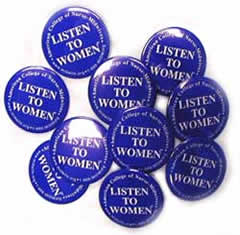
At the 2007 LLL International conference in Chicago, I picked up several of these great "Listen to Women" buttons from the ACNM booth in the exhibit area. I love them. Isn't this what it is all about? So simple and yet so profound. Imagine how the world would change if we just listened to women.

One had an atmosphere of respect, caring and trust; the other had a “climate of doubt” throughout. The difference was a certified nurse-midwife (CNM). My commitment to homebirth midwifery often leads me to forget what a profound and true difference a caring CNM can make in a hospital birth. All the other hospital procedures can be present, but the care factor a CNM provides can transform a woman’s experience from powerless to powerful. Sometimes I forget how CNMs are poised to bridge the gap between home and hospital effectively. The US needs lots of them (not as subordinate “junior obstetricians”—but as expert guardians of normal birth in a hospital setting).

The details were similar in each birth. The babies were both almost 9 lb; a doula was present (same doula in both births); and the mother labored with an IV, spent a large portion of the labor in bed and had internal fetal monitoring. In the first birth (with the CNM), the mother even had several hours of Pitocin augmentation; in the second, with the obstetrician, she had no Pitocin until third stage. With each birth, the mother also had an extensive tear and long repair (a third-degree with the CNM, a second-degree with the obstetrician).

However, some things were very different.

When the mother said, “Can I have a birth ball?” the CNM said, “Yes,” and the obstetrician said, “Not until the baby has been monitored.” And then, “The baby doesn’t like that; you need to get back into bed.”

When the mother’s confidence waned, the CNM said, “You can do it. You are.” The obstetrician said, “I don’t think this baby is moving down.

When the mother said, “This is taking such a long time,” the CNM said, “I know. It is taking for-freaking-ever!” and everyone laughed (including the laboring mother). The obstetrician said, “I think we should consider a c-section based on your history. The baby is not moving down.”

The CNM said, “You have such strong muscles in your legs and bottom, do you exercise a lot? I think because you are so strong, you’re holding a lot of tension here. Try to let it go.” The obstetrician ironed the perineum until the mother screamed with pain.

The CNM waited. The obstetrician did another internal check.

In both, a baby was eventually born (the first after four hours of pushing, the second after a little over an hour). A strong, healthy baby. Vaginally and without pain medications. After the first birth—though she would have done some things differently—my friend felt triumphant, empowered, powerful, strong, capable, happy and proud.

After the second birth she felt abused, disappointed, ashamed, guilty, angry, assaulted, diminished, wounded and scarred.

I believe the CNM’s personality, attitude and basic belief that vaginal birth would work was the critical difference between these two experiences. These births dramatically, viscerally illustrated for me that no matter what else is happening around the birthing woman, we can control how we care for her.

Endnote: My friend went on to have her third baby at home in 2008. She pushed this baby out in fifteen minutes, with no tear, and she shone with her power.

Molly Remer, MSW, ICCE, CCCE is a certified birth educator, writer, and activist who lives with her husband and children in central Missouri. She is the editor of the Friends of Missouri Midwives newsletter, a breastfeeding counselor, a professor of human services, and a doctoral student in women’s spirituality. She blogs about birth, motherhood, and women’s issues at https://talkbirth.me/posts.


[1] Looking to nature, doula Penny Simkin practices the art of delivery, in The Seattle Times, Pacific Northwest Cover Story. Originally published March 23, 2008. Accessed April 27, 2009. http://seattletimes.nwsource.com/html/pacificnw/2004299467_pacificpenny23.html.

This is a preprint of A Tale of Two Births, an article by Molly Remer, MSW, ICCE, published in Midwifery Today, Issue 91, Autumn 2009. Copyright © 2009 Midwifery Today. Midwifery Today’s website is located at: http://www.midwiferytoday.com/

Talk Less, Learn More: Evolving as an Educator

Since late 2006, I have written at the top of each of my teaching outlines: “Talk less, listen more.” This simple reminder has  fundamental importance and has completely revolutionized how I structure and guide my childbirth classes. During each series that I teach, I realize how listening to the women and giving them a space in which to share, is one of the most important things I can offer. Though I studied principles of adult learning and designing effective curricula during my certification program, I started out my childbirth education journey with a lecture and information-heavy approach I’ve since heard called, “opening their heads and dumping information in.” As I continue to teach, I’m continually discovering ways to talk less, but hopefully, impart more, creating a guiding philosophy of “talk less, [they] learn more” for myself as I plan and implement my classes.

Real birth preparation

After my first year of teaching, I realized that couples that sign up for my classes are not really looking for pregnancy and prenatal care information, but for real birth preparation. They are there because the women want to learn, “Can I do this?” and “How will I do this?” and the men are asking, “How I can help her do this?” It feels almost insulting to meet this quest for inner knowing with a discussion about the benefits of prenatal vitamins. I had to confront the fact that some of the things I was teaching seemed irrelevant, redundant, or obvious.

It became clear to me that I had to tackle the slightly embarrassing reality that I was following a model of prenatal education that was not in line with the true needs of the women in my community. I teach independent, natural childbirth classes privately in people’s homes. Maybe with a different population, my original approach would be more successful or I would take a different approach altogether. Also, just as students have different learning styles educators naturally have preferred methods. I have an information-heavy personal style that spilled into my teaching. I continue to wrestle with this tendency and struggle to rein in the information overload approach I gravitate towards.

Action!

As I made my discoveries, I began to drastically cut my talk time (lecture) and focus on action instead. Though it felt nearly sacrilegious to do so, I trimmed many things out of my outlines that were about nutrition, prenatal testing and so forth, because many of the women I work with have already read a great deal and don’t need to hear it again from me. I’ve come to see I really need to skip a great deal of the “book learning” and get them actually moving and practicing and using skills. Then, the “book learning” naturally arises during the course of the class, either via questions or via me needing to explain why something is useful or helpful during pregnancy or in labor.

I totally restructured and rearranged my class outlines to include a whole class about the mind-body connection and psychological preparation for birth. This class took the place of a previous class about birth planning. I was finding that many people already had a birth plan written and/or the birth plan information naturally comes up during the course of the six weeks without my needing to spend an excessive amount of lecture time on it. I tell them that I have the information, ask if you want it! I also dedicated a whole class to labor support with plenty of time to practice hands-on support techniques. In addition, I created a brand new class called “Active Birth” that involves lots of moving and positioning as well as many helpful ways to use a hospital bed without lying down. Informed consent, consumerism, and birth planning naturally arise as topics during this class, rather than being separately scheduled topics.

Information overload

Many pregnant women have information overload. They are faced with more information than they know what to do with. They are bombarded by it. What they really need is “knowing.” They need to know: “What skills do I possess or can learn that will help me greet my birth with anticipation and confidence? What are my tools? My resources? Can I just let it happen?” As an educator I ask myself, “What will help them feel confident? Feel ready? Trust their bodies and their capacities?”

I want people in my classes to learn material that is dynamic, active, exploratory, self-illuminating, supportive, positive, enriching, and affirming. I created a vision statement and asked myself where my classes stood in relationship to my vision. The answer was, “not as close as I want them to!” My vision statement for my classes is: to focus on celebration, exploration, motivation, education, inspiration, validation, initiation, and dedication.

I know I’m hitting the mark when couples comment, “Oh, this makes so much sense! I see how this works!” Or, “This was a really good illustration of what you were just talking about.” In this way, class participants readily reinforce (or modify) my own presentation style and I learn from series to series what to change, continue using, discard, or alter.

“Talk less…” teaching tips

I have many ideas of ways to “talk less” in birth classes, here are a few:

  • Media portrayals of birth—show two contrasting clips, such as a birth from a popular TV show (I often show Rachel’s birth from the show Friends) paired with an empowering birth from a film like Birth as We Know It and then have students discuss the two.
  • Use “The Ice Cube Minute” exercise from Family-Centered Education: The Process of Teaching Birth. In this exercise, couples hold an ice-cube in one hand for one minute and see what coping measures spontaneously arise for them. I do this exercise fairly early in my class series, before we’ve done a lot of formal talking about coping measures. It is very empowering for couples to discover what tools and resources come from within as they try the ice-cube minute.
  • To illustrate the potency of the mind-body contraction, practice two pretend contractions while holding ice. One contraction has an accompanying “stressful” paragraph read with it (“your body fills with tension…it hurts! Oh no!”) and the second contraction has a soothing paragraph read with it (“you greet the wave….it is YOUR power….”). This illustrates the fear-tension-pain cycle viscerally.
  • Use a five minutes series of birthing room yoga poses to begin the class—birth happens in our bodies, not our heads. Practicing the poses opens space to simultaneously discuss and practice: squatting, pelvic rocks, optimal fetal positioning ideas, healthy sitting, pelvic floor exercises, leg cramp prevention, back pain alleviation, and more.
  • Role playing cards—talk through various scenarios. I’ve found that couples are more receptive to talking through the cards than actually getting into a role and playing it through.
  • Values clarification exercise–participants cut out values from a list and arrange them in a grid to help them figure out if they are in alignment with each other and with their caregivers.
  • Leg stretch exercise to explore the use of vocalizations and other coping mechanisms during labor.
  • Ask plenty of open-ended questions that stimulate discussion and ideas, “what have you heard about XYZ?” or “what is your experience with…?”

Evolutionary spiral of a childbirth educator

After I had already done all of this self-inquiry and curriculum modification, I discovered Trish Booth’s concept of “The Evolutionary Spiral of a Childbirth Educator.” I quickly recognized myself and my experiences along the loops of the spiral. In the Early Stage of the spiral, educators are focused on “content and presenting the information.” This perfectly matches where I was when I started out with my “open heads and dump information in” approach. The Intermediate Stage is focused on the “group as a whole” and also “emphasizes learning rather than teaching.” Though I tend to teach one-to-one private classes and not groups, this seems to clearly be the stage I was in when I looked at my vision and realized that I needed to talk less so people would learn more. In the Advanced Stage, the educator “understands the meaning of the childbearing experience” and the focus is on the “individual learners.” This feels like the stage to which my teaching has spiraled. Further along the spiral is the Master Stage in which the educator “integrates the first three stages and moves gracefully between them” with a focus on “cognitive, emotional, and spiritual needs of the group as well as the individual learners” (Booth, 1995).

Perhaps my insights are old news to experienced educators, but they have made a profound difference in the quality of my classes. I’m sure as I continue to teach, I will continue to deepen and refine my approach and will continue to blossom as an effective educator.

Molly Remer, MSW, ICCE, CCCE is a certified birth educator, writer, and activist who lives with her husband and children in central Missouri. She is the editor of the Friends of Missouri Midwives newsletter, a breastfeeding counselor, a professor of human services, and doctoral student in women’s spirituality. She blogs about birth, motherhood, and women’s issues at https://talkbirth.me/posts.

Modified from an article originally published in the International Journal of Childbirth Education, December 2008.

References:

Booth, Trish. Family-Centered Education: The Process of Teaching Birth, ICEA, 1995.

Postpartum Thoughts/Feelings, Part 2

The time of danger, what needs to be survived, comes at different times for mothers. For me, it came early — during my [child]’s infancy.

From Sleeping Beauty & The Fairy Prince: A Modern Retelling By Cassie Premo Steele

After posting my “playing my music” essay containing an exploration of my postpartum feelings after the birth of my first son, I went back and forth about continuing to explore the subject. I’ve written about it a lot, but the feelings are scattered throughout a variety of locations—including partially written articles and also blog posts from my first, no-longer-updated blog. I actually wrote this post last year, immediately after my part 1 post, and then ended up not sharing it, but moving straight on to Postpartum Feelings, Part 3 instead.

Weird thoughts

Anyway, I wanted to briefly address the weird/intrusive thoughts that I experienced postpartum with both of my boys. I think one of the reasons I have trouble broaching this topic on this blog is that to look back at my thoughts and feelings is to begin to acknowledge to myself that I very likely experienced a postpartum mood disorder, even though I—perhaps purposefully—did not identify it as such at the time. With my first, I had a recurrent image of the bookshelf in my computer room at the time falling over and squashing me. I also had the sense that the baby was trying to “squash” me—as in stamp out my life spark (actually, who am I kidding, life with kids still makes me feel like this is their goal sometimes! ;-D) and the best way I could come up with to describe my feelings at the end of a long day was that I had been chewed up and had my bones spit out. This is a pretty intense description that some people might feel is ridiculous or over-the-top, but is the way I would have described it.

When my second son was a baby, I planned much better for postpartum and experienced a fairly pleasant babymoon at home with him. I felt like in general, mothering him was easier than mothering my first and as he grew, I frequently would say (and feel) that having a second child was the best thing I’d ever done. Despite those feelings, I had a recurrent image that would pop into my mind unbidden of falling backwards through a grate, my body dissolving into water as I fell and dripping through the grate and the skin of my face remaining a “mask” on the grate, eventually also dissolving/dripping through. I also had a weird, recurrent sensation that my shin bones were fragile somehow and I would imagine them snapping.

So, after typing this out I officially felt mentally ill, and that is why it hasn’t been posted until now.

The current

With my second son, I described my mood to my husband in this way: There is a current that underlies all of my emotions. I feel like I can “dip” into this current and test out how it feels, beneath the mood that I present outwardly or how I feel on the surface. My current lately is always sad—even when I am happy and feeling/acting happy, if I take the time to “dip” beneath, what I feel is sad. I used to actually chart the feelings on my calendar, with a little notation for the surface feeling and a different notation for the current. I tried to explain to him that I did not feel like I had a neutral point and that I would like to feel “even.” However, I also acknowledged that if to feel “even” or neutral as my “current” would mean trading in all peaks of emotion, rather exuberant or despondent, I’d rather have the ups and downs. During this time I looked up various mood disorders, thinking that I might possible qualify as having cyclothymia.

Wal-Mart “angel”

Then, one day, when my second son was perhaps a year or so old, I had an interesting experience at Wal-Mart with a very friendly and cheerful checker. She chatted along with us and was just very nice and pleasant to be around. That night I had a vivid dream that this checker was actually an angel and that she had come to “heal” my feelings. When I woke up that morning, I had very dramatic sensation and announcement of sorts in my head, “you are not depressed anymore” and indeed, when I dipped into the current it had become a wellspring of joy, rather than sadness. Since this time, my “current” has never again shifted back to sad. While I definitely have sad or “down” moods or get distressed about things, I now feel like it is only that surface emotion that is being buffeted, but that what waits underneath is always doing all right. Perhaps you have to know me in real life to understand how strange of an experience this is for me to describe. I have never had another “angel” experience and do not connect with angel imagery. The word “angel” is not one that I use to describe anything, really, and I feel extraordinarily skeptical and uncomfortable when other people say things about having guardian angels. I suppose if I did have PPD, it could be looked upon as a “hallucination” almost. However, I do not have a way to describe what happened to me without using the word. Indeed, I feel so oddly about it, that I have never actually told anyone else about this—I told my husband about the current shifting, but left out the “Wal-Mart angel” piece of the story.

Why tell it now?

As I noted, I’ve been waffling about posting this. It is close on the heels of another post that may seem woo-tastic. It makes me feel vulnerable and embarrassed. Why? Why bother sharing things that bring up these sorts of feelings? My answer was almost, just don’t, and then I read a fabulously amusing essay in the winter issue of Brain, Child magazine about a woman’s experience teaching “sexuality and the new mother” workshops at Babeland in New York City. In her postscript closing the essay, Meredith Fein Lichtenberg writes the following:

“…writing this now, years after it happened, I still felt that sharing something personal cast stark light on the Inner Vat of Chaotic Shit I Haven’t Figured Out Yet. The desire to hide that is amazingly strong; I see it in my students, and I see it in myself. But I also see that when we bend our lives’ stories into words to be shared, everything changes. Sharing stories reminds us we’re not alone with our icky mess of doubts and questions. In the light of day, frightening concerns and general weirdness become more understandable, forgivable, human.”

Reading this, I knew I wanted to share after all. And, it reminded me of another quote, this one by Carol Christ, a thealogy scholar that I love:

“When one woman puts her experiences into words, another woman who has kept silent, afraid of what others will think, can find validation. And when the second woman says aloud, ‘yes, that was my experience too,’ the first woman loses some of her fear.” –Carol Christ

Postpartum Feelings, Part 1

Postpartum Feelings, Part 3

Footprints on My Heart: A Memoir of Miscarriage & Pregnancy After Loss

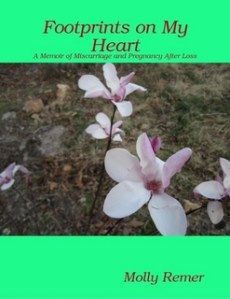
As of this week, my miscarriage memoir, Footprints on My Heart, has finally been published and is now available in eBook format via Kindle and Lulu, Inc. (epub format compatible with Nook and iBooks). There are a few formatting errors and some other general problems (like with the sample/preview–it is totally wonky–and with the lettering on the cover), but guess what, it is DONE, it available, and it is out there. I’m really, really excited about it and I feel this huge sense of relief. I still want to write my Empowered Miscarriage book someday, but for now, this memoir is what I had in me and it will have to do for the time being. I realized after Alaina was born and was, in a sense, the happy “ending” to my Noah story, that in writing my miscarriage blog I had actually ended up writing most of a book. So, the bulk of the book is drawn from my miscarriage blog and from this blog as well (for the pregnancy after loss content). I also included an appendix of resource information/additional thoughts that is fresh.

I’ve felt haunted by the desire to publish this for the entire last year. It took a surprising amount of work, as well as emotional energy, to prepare for publication, even though I actually did most of the actual writing via blog in 2010. Now that it is ready, I just feel lighter somehow and have this really potent sense of relief and ease, as if this was my final task. My final act of tribute. My remaining “to do” in the grief process.

If anyone really, really, really wants it and cannot afford the $3.99 for which I priced it, I do have it available as a pdf file, a mobi file, and an epub file and I will be happy to email it to you in one of those formats.

<deep breath> Aaaaaahhhhhh….

Circles Writing

each time we pose pen or pencil to paper

we connect with who we are         who we were       who we want to be

we are circles of women

writing together     apart    in dialogue     alone

we write: wherever we are     when we’re overwhelmed

to clear our minds

to express our anger, to clarify our thoughts

when we’re too tired to talk, to capture that exact feeling

to release our pain, to honour our truths

we write

to connect ourselves

to this circle

these circles

of women writing

each time we pose

pen or pencil

to paper.

–Wendy Judith Cutler, 1992 (in We’Moon datebook, 2011)

This time last year, I was writing about the circle of women that gathered in my living room for my blessingway. This photo was a beautiful gift from my friend Karen.

I am so amazed and pleased and surprised and blessed by the connections that have come into my life (or that have been made stronger) due to women writing. I love how the perfect “message” springs off the page (or computer screen) at me from another woman’s life, musings, words, and experiences. It is incredible.

I’ve been working on a happy birthday post about my baby girl (who is sick and crabby right now—and, now I’m sick and crabby too, which makes it hard to find the glowing words I want to share). One of the things I wish to express is about having come full circle—we’ve made our first trip around the sun together. I feel like I’ve closed out something by having made this journey with her in my arms. In the book Sisters Singing, I read this quote this morning:

There is an open, flexible, compassionate way of relating to everything we experience, including natural disasters and sudden death. It is not so much a process of learning how to ‘get over’ a profound loss, but rather how to allow it to be there, lightly, gently, like a fine thread woven forever into the tapestry of who we are.” –Nancy J. Rigg

And, then, on FB, I spied this beautiful quote as well: “Rejoicing in ordinary things is not sentimental or trite. It actually takes guts. Each time we drop our complaints and allow everyday good fortune to inspire us, we enter the warrior’s world.”
― Pema Chödrön, The Places That Scare You: A Guide to Fearlessness in Difficult Times

2011 Blog Year in Review

The dawn of 2011 saw me preparing to meet my new baby girl. I was given a beautiful blessingway (and attended several others during the year). Then, I gave birth to her magical, tiny self on January 19. As the year passed, she got bigger and bigger and bigger:

Three Month a-Baby!
Six Months
Eightmonthababy!
Nine Months
Ten Months Old!
Elevenmonthababy!

We took lots of pictures to try to chronicle the sweet, perfect texture of our lives with her in it. I continued to make lots of birth art. I also published several of my originally-in-print articles in blog post format:

Birth Lessons from a Chicken
Nursing Johnny Depp
The Rhythm of Our Lives
The Value of Sharing Story
Listening Well Enough
Mindful Mama: Presence and Perfectionism in Parenting
Listening to my baby…even when we disagreed!
Planning for Postpartum
The Spot

I made slight revisions to the two posts that consistently get a high number of hits each week and didn’t make any changes to the post about good foods to eat during labor that continues to top my blog’s personal charts:

How do I know I’m really in labor?
In-Utero Practice Breathing
Good Foods to Eat in Labor

In addition to some of my articles-turned-posts, several new posts that I wrote in 2011 received a lot of attention, thanks to Facebook shares, and a guest post about alcohol and breastfeeding was enormously popular for the two weeks between Christmas and New Year’s Day.

I just want to grind my corn!
Affordable Fetal Model
Active Birth in the Hospital
Guest Post: Alcohol and Breastmilk

My final post of 2011 also received quite a few hits via Facebook in the last few days, but has not received any comments on the post itself (only FB!):

The Illusion of Choice

I spoke my truth in several other posts that I felt pleased with, but that did not get a lot of airtime via other sites:

What Really Scares Me: Social Attitudes Towards Women
Asking the right questions…
“You’ll Miss This…”
Surrender?
Birthing the Mother-Writer (or: Playing My Music, or: Postpartum Feelings, Part 1)
Milk, Money, & Madness
The “Almost Died…” Remark
Fatherbaby
The Ragged Self

I also started to write a little about homeschooling.

I feel like I spent a lot of 2011 in a writer’s prayer—trying to tell about it—trying to preserve in time these high, sweet, clear, delicious, beautiful notes that composed my year with my new baby.

A Writer’s Prayer

I often use my blog as as a means of saving thoughts and ideas for “later” or for storing the ideas of other people for future reference or reflection. Sometimes I feel like it is silly to do this–why write a blog post that primarily consists of quotes that I want to remember or use in the future? Why not just trust that I can eventually go back to that book or article and re-find the good stuff then? I’ve often chided myself about it–don’t use your blog to “store” stuff, use it for original ideas. Quit writing short little posts and work on your books instead. And, more cruelly, don’t bother, no one cares. However, I’ve also realized that I don’t have the space in my life right now for the sustained concentration it would require for me to write my books. I have ideas for four of them. My miscarriage memoir is almost finished and I do plan to publish it this year, but the others are not and I’ve accepted that they won’t be likely to get any of my attention until my kids are older. I can barely find the time to write any articles lately, let alone books. But, then I realized that in a way, when I collect words and thoughts in my blog–whether just transcribed words from something that caught my attention, or fresh words of my own–I am working on my books. I’m preserving, collecting, storing, and refining ideas, words, memories, and thoughts, so that I will have a rich collection to mine when I’m ready to fully develop it. I might dismiss it as “just blogging” and some posts might just be short quotes from other writers, but I think there is good value to me in this collecting process after all.

From the anthology Sisters Singing, here is a quote from a longer poem called, A Writer’s Prayer, by Sarah Jones:

…The body of a writer
is a political action
with each swing of a letter
each truth written
the world is broken open,
a vein of truth exposed.
A writer’s prayer is for herself.
That she will hold to slowness
that she will hold to the beauty of a candle
that with the dirt and the grit of living under her nails,
she will write her body into language.

I write to remember. I write to share. I write to preserve. I write to collect. I write to store. I write for myself. I write for my children. I write for others. I write for perspective. I write to play my life’s music. I write because I just can’t help it.