Archives

Bits of the (Birth) Net

The following is a collection of the bits and pieces that caught my attention and then were shared via my Talk Birth Facebook page during the last two weeks.

Listening

From a good article by the National Association of Mothers’ Centers in Mother Support: When Words Get in the Way

Words, whether written or voiced, are so very fragile. They can be bent or twisted, even become unrecognizable from their initial intentions. They can have different cultural meanings, regional understandings, and generational perceptions.

There will always be the opportunity for miscommunication…

Such a good reminder. What you say and what people hear are often two different things. What you say and what you mean can be different. How your words are received and interpreted can be very important and intent in many ways doesn’t matter! Communication is transactional process. A two-way process. And, it is symbolic. Meaning can never be fully interpreted and understood completely.

This article also reminded me of one of my own older articles, Listening Well Enough, which came to mind because I’m finishing up with the training of two women. The essay describes my own experience when I was training as a breastfeeding counselor in 2005.

Privacy

The topic of what to risk sharing online came up with friends recently and I enjoyed this article about answering the question of How Much Of Your Private Life Should You Keep Private On Your Blog?

Childbirth Education

Childbirth education is beginning too late in pregnancy; it needs to begin in the first trimester or even before women become pregnant…

The above is one of the concluding points from an interesting article from Birth Works International about supporting women without epidurals.

Good article from Lamaze about your breath and how it can help during pregnancy and birthing!
Virtual labor simulator!

Pushing Positions

Very interesting article on What is the Evidence for Pushing Positions?  Apparently there is more blood loss and second degree tears with upright pushing positions. Personally, I CANNOT imagine giving birth in a supine position. But, I’m also really, really, tired of tearing (tired enough that it is one of the factors in our decision not to have “just one more!” baby). For more thoughts about pushing, see previous post on Following Your Body’s Urges to Push…

And speaking of upright birth, Barbie homebirth photos! 🙂

Informed Consent

Valuable article addressing 10 Responses to Pressure to Consent (remember, it isn’t “informed consent” if you do not have the option of saying NO!)

Posts I’ve written about informed consent:

Prenatal Yoga

Online video prenatal yoga class: Prenatal Yoga – when you feel good, your baby feels good.

And my own prior posts on the subject:

Birthing Room Yoga Handout

Birth, this elegant, simple, yet intricate process has had unnecessary, complex, expensive technology superimposed onto it, creating a dangerous environment for birthing women.” -Alice Bailes

Loved this article on what really matters for midwives!

Epigenetics

NEW STUDY: Epigenetics: Mother’s Nutrition — Before Pregnancy — May Alter Function of Her Children’s Genes. “As parents, we have to understand better that our responsibilities to our children are not only of a social, economical, or educational nature, but that our own biological status can contribute to the fate of our children, and this effect can be long-lasting,” said Mihai Niculescu, M.D., Ph.D., study author from Nutrition Research Institute at the University of North Carolina at Chapel Hill, in Chapel Hill, N.C.–Epigenetics: Mother’s Nutrition — Before Pregnancy — May Alter Function of Her Children’s Genes

After CAPPA this year, I wrote about epigenetics here: Epigentics, Breastfeeding + Diet, and Prenatal Stress

Call the Midwife

Fun! Ms. Magazine linked to one of my blog posts about midwifery in their post about the PBS show Call the Midwife!  And, after posting to the CfM Facebook page about how I didn’t get to watch the show myself because I have no TV channels, CfM fan Jackie clued me in that Call the Midwife is available online (no TV channels required!) Yay! 🙂

Older Posts of My Own

Birth Culture: “Birth is cultural, the way eating is cultural. We don’t just eat what our bodies need to sustain us. If we only did that, there would be no reason for birthday cake. Birthday cake is part of our food culture. The place you are giving birth in has a local culture as well. It also partakes of our national birth culture. Not everything doctors do regarding birth makes the birth faster or physically easier for you or the baby. Some things are just cultural.” -–Jan Mallack & Teresa Bailey

Creating Needle Felted Birth Art Sculptures: My first foray into birth art, before I fell in love with using polymer clay!

Centering for Birth: “Centering is a breath awareness strategy that I’ve adapted for use in birth classes based on the ten second centering process described in the short book Ten Zen Seconds…” Free handout available about centering for birth! (I was reminded of this post by Enjoy Birth!

Breastfeeding as an Ecofeminist Issue:“What happens when society and culture pollute the maternal nest? Is that mother and baby’s problem or is it a political and cultural issue that should be of top priority? Unfortunately, many politicians continue to focus on reproductive control of women, rather than on human and planetary health…”

During a week when I didn’t have time to craft delightful new blog posts, it was fun to have a post from a couple of months ago suddenly getting all kinds of hits and Facebook shares. Thanks, internet! ;-D (Around 150 shares on Facebook apparently. I ♥ Facebook!)

On Parenting Books

Mama Birth: Sadly, Parenting Books CAN’T Actually Raise Your Child: Enjoyed this post! (But I recommend NOT reading the comments on the original article she links to about “detachment parenting.” I lost about 30 minutes of my life, felt my blood pressure rising, and only made it to page three!)

The revolution must have dancing; women know this.
The music will light our hearts with fire,
the stories will bathe our dreams in honey
and fill our bellies
with stars.
-Nina Simons via Rebecca A Wright, Doula

DVD Review: Laboring Under an Illusion


DVD Review: Laboring Under an Illusion: Mass Media Childbirth vs. The Real Thing
Filmmaker: Vicki Elson
50 minutes, $39.99 (personal use­)
www.birth-media.com

Reviewed by Molly Remer, Talk Birth

Laboring under an Illusion is a treasure trove of discussion-provoking material. Filmmaker Vicki Elson is an anthropologist and childbirth educator who has created a striking documentary exploring media-generated myths about childbirth. As a childbirth educator, I often reference in my classes how our attitudes and expectations about birth are shaped by media messages—birth is an emergency, etc. This film eloquently and entertainingly provides 50 minutes of backup material for the idea!

The film blends media messages from comedy shows like Murphy Brown, Mad About You,and I Love Lucy, movie clips such as Juno, Coneheads, and Nine Months, along with “reality” based shows on Discovery Health with the inherently contrasting messages in clips of beautiful births from films like Birth as We Know It, The Business of Being Born, and Orgasmic Birth. It also contains brief voiceover narrations from “regular” women about birth. Occasionally, there is a scene with the filmmaker speaking directly to the viewer about concepts raised in the film. These scenes are less entertaining than the popular media clips and the friends with whom I watched the film wanted to fast-forward these segments—the media clips chosen so clearly speak for themselves that they don’t really need explanation, at least to the already birth-savvy viewer. Because of some strong language in the media clips, I caution parents to preview the film before sharing it with children.

Laboring Under an Illusion is an entertaining and illuminating film for consumers as well as for birth educators, doulas, and midwives. I highly recommend it!

Disclosure: I received a complimentary copy of the DVD for review purposes

Amazon affiliate link included in image.

New Birth Skills Workshop!

Active Birth and Labor Support

Saturday November 17, 6-9:00

Location: Tara Day Spa in Rolla, Missouri

Cost: $35 for the pregnant woman + one support person (husband, partner, relative, friend…)

Workshop description: First, practice active birth techniques and learn about working with pelvic mobility. Next, spend some time learning labor tips and tricks and practicing comfort measures with doulas! Then, enjoy a friendly Q & A session all about what you most want to know. You will have access to three birth professionals for the price of one! We will close with some relaxation skills practice and a guided visualization.

Interested? Please email me and I’ll send you the registration form!

Can I really expect to have a great birth? (updated edition)

Given my limited situation, can I really expect to have a great birth today?” For the woman who asked me this question a homebirth, a birth center, a midwife, and a doula were all not remotely feasible options. My answer to her question is a qualified “yes!” and it really got me thinking about ways to help yourself have a great birth when your overall choices are limited. In fact, there is a long list of ideas of things that may help contribute to a great birth!

  • Choose your doctor carefully—don’t wait for “the next birth” to find a compatible caregiver. Don’t dismiss uneasiness with your present care provider. As Pam England says, “ask questions before your chile is roasted.” A key point is to pick a provider whose words and actions match (i.e. You ask, “how often do you do episiotomies?” The response, “only when necessary”—if “necessary” actually means 90% of the time, it is time to find a different doctor!). Also, if you don’t want surgery, don’t go to a surgeon (that perhaps means finding a family physician who attends births, rather than an OB, or, an OB with a low cesarean rate).
  • If there are multiple hospitals in your area, choose the one with the lowest cesarean rate (not the one with the nicest wallpaper or nicest postpartum meal). Hospitals—even those in the same town—vary widely on their policies and the things they “allow” (i.e. amount of separation of mother and baby following birth, guidelines on eating during labor, etc.) Try checking with Cesareanrates.com for local information!
  • When you get the hospital, ask to have a nurse who likes natural birth couples. My experience is that there are some nurses like this in every hospital—she’ll want you for a patient and you’ll want her, ask who she is! If possible, ask your doctor, hospital staff, or office staff who the nurses are who like natural birth—then you’ll have names to ask for in advance.
  • Put a sign at eye level on the outside of your door that reads, “I would like a natural birth. Please do not offer pain medications.” (It is much easier to get on with your birth if you don’t have someone popping in to ask when you’re “ready for your epidural!” every 20 minutes.)
  • You might want to check out either or both of these two books: Homebirth in the Hospital and/or Natural Hospital Birth
  • Work on clear and assertive communication with your doctor and reinforce your preferences often—don’t just mention something once and assume s/he will remember. If you create a birth plan, have the doctor sign it and put it in your chart (then it is more like “doctor’s orders” than “wishes”). Do be aware that needing to do this indicates a certain lack of trust that may mean you are birthing in the wrong setting for you! Birth is not a time in a woman’s life when she should have to fight for anything! You deserve quality care that is based on your unique needs, your unique birthing, and your unique baby! Do not let a birth plan be a substitute for good communication.
  • Two resources I particularly enjoy that shake up the notion of a birth plan are, 1. the birth as a labyrinth metaphor from Birthing from Within and 2. this article about how does one really PLAN for birth.
  • When making a birth plan, use the Six Healthy Birth Practices as a good, solid foundation.
  • Cultivate a climate of confidence in your life.
  • Once in labor, stay home for a long time. Do not go to the hospital too early—the more labor you work through at home, the less interference you are likely to run into. When I say “a long time,” I mean that you’ve been having contractions for several hours, that they require your full attention, that you are no longer talking and laughing in between them, that you are using “coping measures” to work with them (like rocking, or swaying, or moaning, or humming), and that you feel like “it’s time” to go in. If you’re worried about knowing when you’re really in labor, check out this post: how do I know if I’m really in labor?
  • Ask for the blanket consent forms in advance and modify/initial them as needed—this way you are truly giving “informed consent,” not hurriedly signing anything and everything that is put in front of you because you are focused on birthing instead of signing.
  • Have your partner read a book like The Birth Partner, or Fathers at Birth, and practice the things in the book together. I frequently remind couples in my classes that “coping skills work best when they are integrated into your daily lives, not ‘dusted off’ for use during labor.”
  • Practice prenatal yoga—I love the Lamaze “Yoga for Your Pregnancy” DVD—specifically the short, 5-minute, “Birthing Room Yoga” segment. I teach it to all of my birth class participants.
  • Use the hospital bed as a tool, not as a place to lie down (see my How to Use a Hospital Bed without Lying Down handout)
  • If you feel like you “need a break” in the hospital, retreat to the bathroom. People tend to leave us alone in the bathroom and if you feel like you need some time to focus and regroup, you may find it there. Also, we know how to relax our muscles when sitting on the toilet, so spending some time there can actually help baby descend.
  • Use the “broken record” technique—if asked to lie down for monitoring, say “I prefer to remain sitting” and continue to reinforce that preference without elaborating or “arguing.”
  • During monitoring DO NOT lie down! Sit on the edge of the bed, sit on a birth ball near the bed, sit in a rocking chair or regular chair near the bed, kneel on the bed and rotate your hip during the monitoring—you can still be monitored while in an upright position (as long as you are located very close to the bed). Check out the post Active Birth in the Hospital for some additional ideas.
  • Bring a birth ball with you and use it—sit near the bed if you need to (can have an IV, be monitored, etc. while still sitting upright on the ball). Birth balls have many great uses for an active, comfortable birth!
  • Learn relaxation techniques that you can use no matter what. I have a preference for active birth and movement based coping strategies, but relaxation and breath-based strategies cannot be taken away from you no matters what happens. The book Birthing from Within has lots of great breath-awareness strategies. I also have several good relaxation handouts and practice exercises that I am happy to email to people who would like them. One of my favorites is: Centering for Birth.
  • Use affirmations to help cultivate a positive, joyful, welcoming attitude.
  • Read good books and cultivate confidence and trust in your body, your baby, your inherent birth wisdom.
  • Take a good independent birth class (not a hospital based class).
  • Before birth, research and ask questions when things are suggested to you (an example, having an NST [non-stress test] or gestational diabetes testing). A good place to review the evidence behind common forms of care during pregnancy, labor, and birth is at Childbirth Connection, where they have the full text of the book A Guide to Effective Care in Pregnancy and Childbirth available for free download (this contains a summary of all the research behind common forms of care during pregnancy, labor, and birth and whether the evidence supports or does not support those forms of care).
  • When any type of routine intervention is suggested (or assumed) during pregnancy or labor, remember to use your “BRAIN”—ask about the Benefits, the Risks, the Alternatives, check in with your Intuition, what would happen if you did Nothing/or Now Decide.
  • Along those same lines, if an intervention is aggressively promoted while in the birth room, but it is not an emergency (let’s say a “long labor” and augmentation with Pitocin is suggested, you and baby are fine and you feel okay with labor proceeding as it is, knowing that use of Pitocin raises your chances of having further interventions, more painful contractions, or a cesarean), you can ask “Can you guarantee that this will not harm my baby? Can I have in writing that this intervention will not hurt my baby? Please show me the evidence behind this recommendation.
  • If all your friends have to share is horror stories about how terrible birth was, don’t do what they did.
  • Look at ways in which you might be sabotaging yourself—ask yourself hard and honest questions (i.e. if you greatest fear is having a cesarean, why are you going to a doctor with a 50% cesarean rate? “Can’t switch doctors, etc.” are often excuses or easy ways out if you start to dig below the surface of your own beliefs. A great book to help you explore these kinds of beliefs and questions is Mother’s Intention: How Belief Shapes Birth by Kim Wildner. You might not always want to hear the answers, but it is a good idea to ask yourself difficult questions!
  • Believe you can do it and believe that you and your baby both deserve a beautiful, empowering, positive birth!

I realize that some of these strategies may seem unnecessarily defensive and even possibly antagonistic—I wanted to offer a “buffet” of possibilities. Take what works for you and leave the rest!

I posted on my Facebook page asking for additional thoughts and suggestions and I appreciated this one from doula and educator, Rebecca:

“I think I’d tell people to stop closing doors on themselves you know? Stop making assumptions about what is possible and be open to creating new possibilities – maybe not perfect and exact but inviting in opportunity. No money doesn’t mean no doula in most cases.”

She’s right! A lot of doulas-in-training will offer free birth services, many doulas and midwives do barter arrangements or other trades, and many non-traditional birth professionals also have sliding scale rates.

Great births are definitely possible, in any setting, and there are lots of things you can do to help make a great birth a reality!

This post was revised (from this one) to participate in… And the Empowered Birth Awareness Blog Carnival!

A Bias Toward Breastfeeding?

During World Breastfeeding Week, Lamaze’s Science and Sensibility blog published an interesting and thought-provoking guest post called “Instructor Has A Clear Bias Toward Breastfeeding!” The post explores a birth educator’s experience with teaching breastfeeding classes and receiving the title phrase on one of her evaluations. She is very disturbed by the evaluation and offers this profound and potent reminder: “We must not leave mothers less than whole.”

While I very much appreciate this observation and reminder, we also absolutely need to remember that biased means to exhibit “unfair prejudice”–it simply IS NOT “biased” to support breastfeeding as the biological norm and most appropriate food for babies. I was very concerned to read the comments on the post from other educators talking about their own “biases” toward physiologic birth or breastfeeding and how carefully they guard against exhibiting any such bias in their classes. Hold on! Remember that the burden of proof rests on those who promote an intervention—birth educators and breastfeeding educators should not be in a position of having to “prove” or “justify” the biological norm of unmedicated births or breastfed babies. I hate to see birth instructors being cautioned to avoid being “biased” in teaching about breastfeeding or birth, because in avoiding the appearance of bias they’d be lying to mothers. You can’t “balance” two things that are NOT equal and it is irresponsible to try out of a misplaced intention not to appeared biased. So, while I appreciate some of this educator’s points, I do think she’s off the mark in her fear/guilt and her acceptance of the word “bias.” The very fact that making a statement that someone has a bias toward breastfeeding can be accepted as a reasonable critique is indicative of how very deeply the problem goes and how systemic of an issue it is. If I say that drinking plenty of water is a good idea and is healthier for your body than drinking other liquids, no one ever accuses me of having a “bias towards water.” Breastfeeding should be no different. But, as we all know, breastfeeding occurs in a social, cultural, political, and economic context, one that all too often does not value, support, or understand the process.

This reminds me of an excellent section in the book Mother’s Intention: How Belief Shapes Birth about judgment and bias. The author also address how the word “balanced” is misused in childbirth education–as in, “I’m taking a class at the hospital because it will be more balanced.” Balance means “to make two parts equal”–-what if the two parts aren’t equal though? What is the value of information that appears balanced, but is not factually accurate? Pointing out inequalities and giving evidence-based information does not make an educator “biased” or judgmental-–it makes her honest! (though honesty can be “heard” as judgment when it does not reflect one’s own opinions or experiences).  (formerly quoted in this post. And, see this post for some thoughts about pleonasms.)

I do value the reminder that pregnant and postpartum mothers are vulnerable and how we speak to them really matters. I know that. I also worry that too much “tender” speech regarding breastfeeding as a “choice,” a “personal decision” and “we support you no matter what”—leaves the door wide open for continued systemic support of a bottle feeding culture that treats formula feeding and breastfeeding as similar or interchangeable. I’m not sure what the answer is. Maternal wholeness matters, so does breastfeeding!

Breastfeeding Class Resources

I became certified as a breastfeeding educator in 2004 and accredited as a breastfeeding counselor in 2005, so I’ve been working with breastfeeding mothers for a long time. I lead a monthly support group and offer help/counseling via phone, email, text, Facebook message, Words with Friends messages, you name it. Recently, a nurse contacted me asking for ideas for teaching an early pregnancy breastfeeding class. I think this is a great idea, since mothers’ decisions about breastfeeding are often made before the baby is conceived and if not then, during the first trimester.

These are the initial ideas I suggested:

  • Focus on what the mothers themselves want—what do they need/want to know? What have they heard about breastfeeding? What are their fears? What misconceptions do they need cleared up? I’m very much about peer-to-peer support and allowing space for the women to talk to/connect with each other—the facilitator is then available to clear up misinformation and provide tips.
  • Focus on what mothers can do to prepare for successful breastfeeding—there is evidence that prenatal breast massage/colostrum expression helps with both milk supply AND with mother’s comfort with her own breasts. It also helps her think of herself as a breastfeeding mother BEFORE her baby is actually born!
  • Suggest good books to have on hand and encourage attending a breastfeeding support group (like LLL!) prior to baby’s birth.
  • Promote/discuss/encourage “baby led breastfeeding.” I love sharing with mothers about how smart their babies are and how mother’s chest after birth becomes baby’s new habitat! Check out the resources from Suzanne Colson: http://www.biologicalnurturing.com/
  • Discuss and emphasize all of the other great ways dads and other family members can be involved with baby other than giving a bottle. Dad/grandma can do EVERYTHING ELSE baby needs! That’s cool! Leave the feeding to mom and let dad have the other special and important jobs like baths and burping and tummy time and more.
  • DON’T talk about “myths” and try to dispel them in a myth-fact format, because evidence suggests that this actually helps the myths stick more!
  • Use Diane Wiessinger’s approach to language (http://www.motherchronicle.com/watchyourlanguage) i.e. breastfeeding isn’t a “special bond” it is a NORMAL bond. People want to be normal—special is for celebrities and “other people,” normal is what everyone wants. She also has handouts here: http://normalfed.com/Why.html

Since her email, a couple of other resources and bits have caught my eye. One is that the AAP has a resolution about the distribution of formula “gift bags” by pediatricians and hospitals. Apparently this came out in 2011, but it only came to my attention when I saw this image on Facebook!

In keeping with the 10 Steps and consistent with the AAP’s resolution, the hospital advocacy project from the Illinois State Breastfeeding Taskforce makes available the following useful documents for mothers to communicate with their hospitals:

The Task Force explains:

We encourage you to make the Breastfeeding Bill of rights and Hospital Experience Letters available to moms in your classes, practices, community events, breastfeeding fairs, “rock & rest” stations, etc.

Encourage moms to fill out the appropriate letter and mail back to the hospital where she delivered her baby.  Or collect the letters and mail them from your agency or task force.  Help moms make their voices heard!

We hope that this will show hospital administrators that lactation consultants, knowledgeable staff and breastfeeding friendly practices are valued by moms and families using their hospital services.

The Missouri Breastfeeding Coalition clued me into this Breastfeeding Plan for Mothers (pdf) from the MO Dept. of Health. The handout may be downloaded and printed as needed and is a, “list of requests that support breastfeeding for the postpartum stay. Similar to a birth plan and based on the 10 Steps for Breastfeeding.”

Also, make sure to check out this awesome resource, the WIC Sharing Gallery—free programs, curricula, brochures, and more from different WIC offices. I found this because I was back at the Illinois Breastfeeding Taskforce’s website downloading their Grandmother’s Tea curriculum for intergenerational support of breastfeeding.

Another great resource is the FREE online Tear-Sheet Toolkit from La Leche League.

And, finally, I already touched on this, but remember there are ample handouts/articles available from the incomparable Diane Wiessinger about birth and breastfeeding.

DVD Review: Birth as We Know It

Birth as We Know It: Educational Edition. DVD directed and produced by filmmaker Elena Tonetti-Vladimirova. 2006, www.birthintobeing.com (40 minutes), $39.95.

Reviewed by Molly Remer, MSW, ICCE, Talk Birth

As a birth educator, I am always on the lookout for the “perfect” video to show in classes. Though not a film I would show in its entirety to the average class, Birth as We Know It is a gorgeous compilation and I’m delighted to have it amongst my educational resources.

The film is available in two versions—the feature film edition and the “educational edition.” The feature film contains almost 4 hours of total footage (a number of bonus features), including 11 births. The educational edition consists of two condensed versions of the feature film—a 40 minute presentation and a 25 minute version designed to show in groups. I chose to purchase the educational edition and this review is based on that edition. I have not seen the full length feature film.

The forty minute version of the film contains gentle, moving footage of 7 births. All the births occur in water—some in the ocean, but most at home. It also includes footage about birth trauma, cesarean section, and circumcision that is not included in the 25 minute presentation version (which also includes only 6 of the births). The DVD also contains instrumental versions of both.

The births included on this film are all exceptionally peaceful, beautiful, gentle, quiet, and calm births. Some of the birth footage is in slow motion, the sounds are muted, and there is instrumental music as the soundtrack as well as occasional voiceover commentary by the filmmaker. The film alternates between birth footage and spoken descriptions/interviews about conscious birth, emotional presence, limbic imprinting, etc. The voiceover commentary addresses things like toning and healing one’s own birth trauma.

The births are wonderfully undisturbed and unhindered—in most the only hands near mother’s perineum are her own and this is such a profound difference from the usual media representations of birth! A highlight is during “Tanya’s Birth” in which she speaks to her older child, smiles with extreme beauty and peace, then casually glances down again and as the camera follows her glance, we see the baby’s head has emerged between her legs and she is cradling it gently. I love for people to have a chance to see this powerful moment!

Though interesting, I find the voiceover content and non-birth portions of the film to be too abstract or “metaphysical” to appeal to the average birth consumer. It is even a bit too metaphysical for me and I find that the concepts she mentions are not well explained and do not seem immediately reasonable or easy to accept in stride. The instrumental version is one way to gloss over this element, but then you are unable to scene select to specific content the way you are able to do in the regular versions.

So, though I do not show the complete film in classes, there are several birth clips that I do show routinely. I find two of the births in particular to be potent educational tools and they have been very well received in classes and have had a profound impact. The births are so different from general media representations of birth that they leave couples stunned with amazement about what birth can be. Since the births are in water, they are a very gentle, non-messy, not very “graphic” way to expand people’s understanding of normal birth. People in my classes have said things like, “wow! You never see something like that!” or, “that was so beautiful, I’m just in shock.” I find men in particular are more receptive to this footage than to other, more detailed, videos I show and I have had a few request to borrow and view the whole video instead of just the clips I have chosen for class.

In conclusion, this is a lovely film and though I have some reservations about showing the entire educational edition, some of the birth footage has been a powerful addition to my work with birth.

This review was previously published at Citizens for Midwifery.

Conscious Agreement and Informed Consent

This post is part 2 of my CAPPA Re-Cap series.

During their general sessions at the recent CAPPA conference, Laurel Wilson and Tracy Wilson Peters both advocated a process called “Conscious Agreement” in working with pregnant couples. The basic steps are as follows:

  • Separate yourself from external influences
  • Get quiet and pause
  • Listen in (including mentally checking in with your body and how it feels)
  • Choose and commit

I especially appreciated Tracy’s observations that this process of conscious agreement goes beyond informed consent and, as birth educators, we need to make sure to “marry the two every time,” rather than focusing solely on informed consent. Why? Because there are several things wrong with informed consent as it is practiced today:

  • It fails to address the importance of conscious decision-making
  • Informed consent is made with the mind or intellect (and ignores feeling and intuition)

And…

  • You can “consent” all day long and not feel good about it.

The last point is the crux of the issue to me. When I cover informed consent in my non-birth classes, I always emphasize that the corollary is informed refusal. If “consent” as it is practiced by your hospital means saying yes and there is no option of saying no, it does not qualify as consent! A choice without the option to refuse is NOT a choice at all (see The Illusion of Choice). My students have almost never heard of the notion of “informed refusal” and seem shocked to even consider the possibility! Since I’ve had a special interest in this topic for a long time, I really connected with the idea of conscious agreement, especially when paired, as Tracy suggests, with informed consent information.

Another handy tip offered by Tracy during her presentation was to use HALT before entering into any agreement (or confrontation). Check in to see if you are…

  • H–Hungry
  • A–Angry
  • L–Lonely
  • T–Tired

(Also, consider whether the person you are trying to communicate with is any of these things. This is especially good to remember with children.) And, she shared this little poster:

This little sign may have been made especially for me. I have a terrible problem with getting crabby and snappish and plain old hangry (hungry + angry)—and then having to apologize. You’d think I’d have it figured out by now! (though, I do think nursing exacerbates it)

Incorporating Prenatal Yoga into Childbirth Education Classes

Incorporating Prenatal Yoga into Childbirth Education Classes

By Molly Remer, MSW, ICCE, ICPFE

Note: This is a preprint of an article published in the International Journal of Childbirth Education, Volume 27, Number 2 (April 2012)

The essence of yoga can be distilled into four key elements: breath, feeling, listening to the body, and letting go of judgment and expectation (YogaFit, 2010). When considering the essence of yoga, it is easy to see what a natural complement it is to conscious, active preparation for a healthy birth. Most birth educators would agree that paying attention to her breath and to her feelings, listening to her body, and letting go of preconceived expectations of what birth will be like are perhaps the most crucial messages to convey to the pregnant woman and her partner. Additionally, experts widely agree that exercise during pregnancy has beneficial effects for the cardiovascular and musculoskeletal systems and is associated with physical and psychological well-being. There is also some evidence that recreational exercise may reduce the incidence of premature labor and low birthweight babies (Hyatt & Cram, 2003).

Anyone involved with educating adult learners (in any context) is likely to be familiar with the concept that people are most likely to retain information that they have actually practiced (versus reading about, hearing about or seeing demonstrated). I have found that incorporating a few simple yoga poses into each class session is a beautiful way of illustrating and applying many important elements of childbirth preparation. In approximately 10 minutes of movement, important points can be underscored without having to actually say anything or “lecture” to clients. The hope is that as we move together through a carefully chosen series of poses, subtle emotional development and trust in birth occurs—again, in a more effective manner than by the childbirth educator saying during class: “Trust birth!”

One rationale for incorporating yoga into prenatal classes is as follows: First, people often learn and retain information more effectively by actually doing something. Practicing the yoga poses together allows experiential practice of pelvic floor exercises, pelvic rocks, tailor-sitting, leg cramp alleviation, and back pain coping techniques, to name a few, instead of just hearing me talking!

Second, and most important, Yoga in prenatal classes emphasizes that birth happens in the body. As childbirth educators we spend a significant amount of time talking and sharing information, but birth does not only happen in the mind. Birth happens most profoundly in the body. Not only does birth happen in the woman’s body, but supporting and being with a woman in labor is also an intensely physical process, so it is important for partners to try the yoga series.

People today spend much of their time “living in their heads”, and many of us do not feel comfortable with, or at home in, our bodies. Practicing poses in class helps couples out of their heads and into their bodies and begins a process of feeling comfortable with moving and using their bodies in positive ways. This may help them develop the trust and confidence that will contribute to a smooth and peaceful birth process.

Each pose is followed with a birth affirmation such as, “the magic and mystery of birth delight and amaze me” (Miller, 2003). Positive affirmations help plant positive seeds of confidence and trust in the wisdom of women’s bodies and of the beauty of birth. These cognitive adjustments may also send a welcoming message to the woman’s body and baby as they both prepare for birth.

Opening classes with a series of poses is an effective way to “frame” the class. Class can be opened with a brief check-in period asking how people are feeling, about recent prenatal appointments, and any questions can be addressed. A transition from “regular time” into “class time” occurs with a brief series of simple poses. This routine helps people transition from their normal days into feeling ready and excited for birth class information.

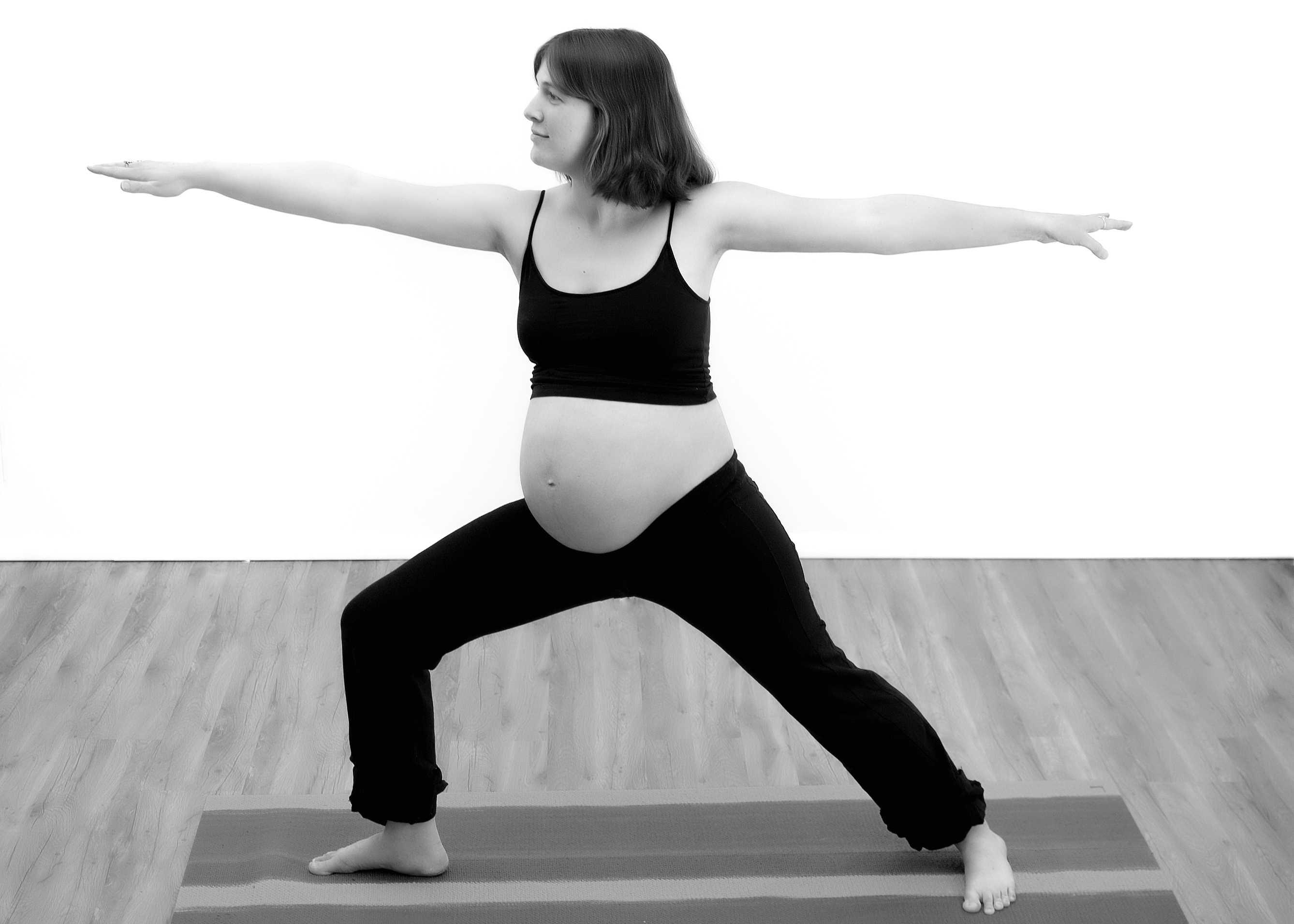
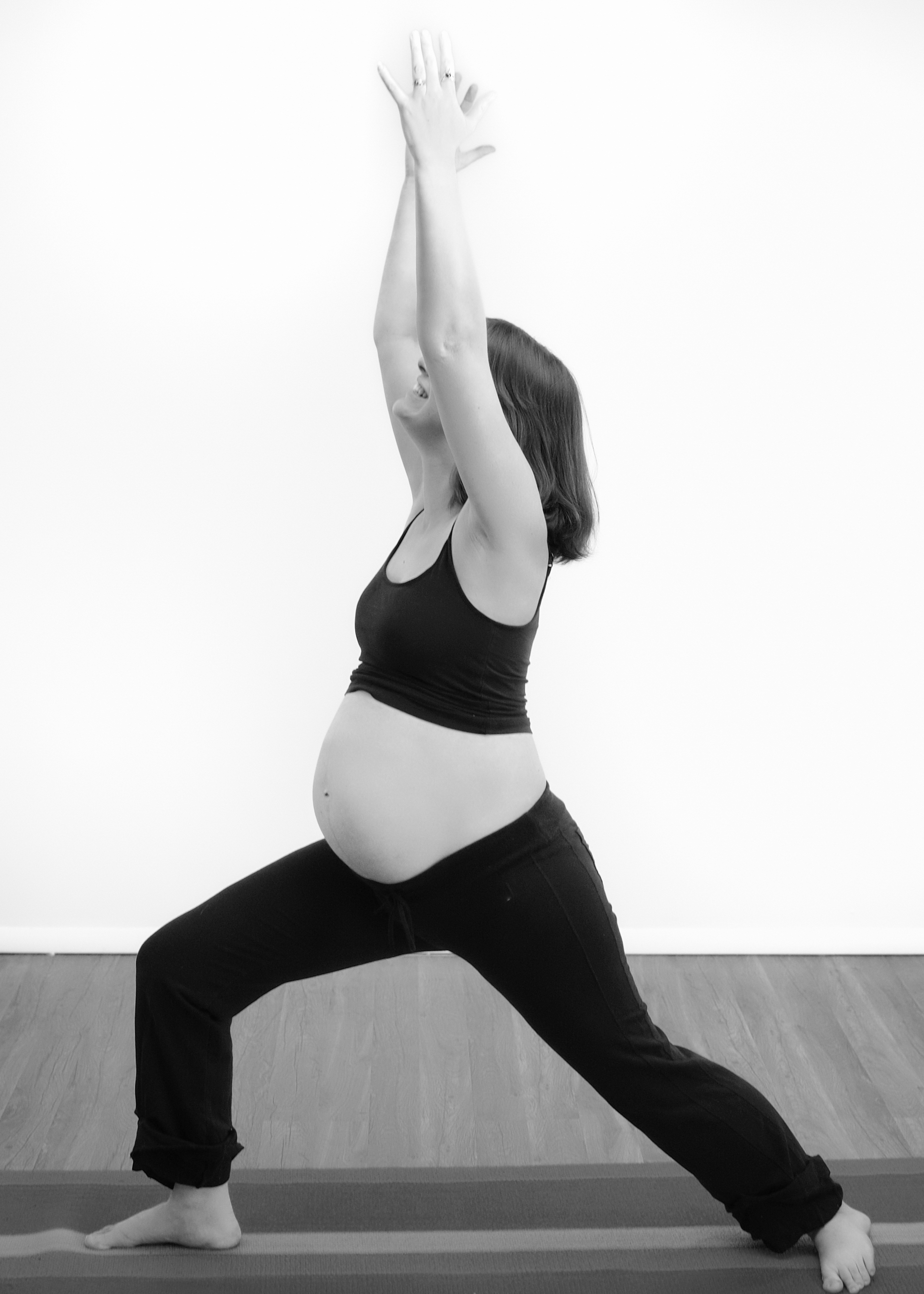
Each pose was chosen because it has specific birth- or pregnancy-related benefits. Begin with healthy sitting—seated crossed legged or tailor-style on the floor with spine straight. Do some neck rolls and shoulder rotations to help release tension. Move into a brief series that includes knee-rocking, leg stretches, Divine Mother Pose, Star Pose, pelvic rock, standing squat, Palm Tree Pose, Half Moon Pose, Triangle Pose and seated Mountain Pose. There is an additional short series of “birthing room yoga” poses described with photographs that is available as a free handout here.

The series is closed with a very brief meditation or visualization exercise. The series of poses and the affirmations are kept the same each week for retention purposes, but the meditation is varied. A quick visualization or relaxation exercise (under two minutes) is often more effective and more readily welcomed by couples than the longer visualization exercises often used in classes (which can seem esoteric to some people). A mindfulness meditation that is effective is:

Inhale and repeat silently: “I exist in the here and now….”

Exhale and repeat silently: “The present moment is all I have to be with…”
Continue inhaling and exhaling as you silently and simply repeat: “Here and now…present moment.”

A favorite resource for easily and smoothly incorporating yoga into classes is The Prenatal Yoga Deck by Olivia Miller, published by Chronicle Books in 2003. The poses listed above were selected from this deck. The deck contains 50 cards, so the educator can easily build a series for use in classes. Each pose card is accompanied by a lovely affirmation. The deck also includes six cards with simple meditations (the meditation above is adapted from one in the deck). The deck format, tidy box for holding the cards and sturdy card for each pose is an ideal format for transport to class as well as serving to provide subtle reminder cards as you lead couples through poses. Each card has a line drawing on the back illustrating the pose, so assessing whether you are doing the pose correctly is easy (sometimes just reading a description of the pose is more complicated than seeing it completed).

Occasionally the childbirth educator may get some eye-rolling or “weird, hippie exercise!” responses from pregnant couples. Regardless of how much or how little they appreciate the practice of yoga in classes, the poses used lay a physical foundation for a positive attitude toward birth and a sense of confidence as a birth-giving woman or supportive partner. Through the simple incorporation of yoga into birth classes, the expectant couple receives an irreplaceable, experiential grounding in the rhythm, focus, release, and conscious awareness so essential to the intensely embodied experience of birthing.

 Molly Remer, MSW, ICCE, ICPFE is a certified birth educator, writer, and activist. She is a professor of Human Services, an LLL Leader, editor of the Friends of Missouri Midwives newsletter, and a doctoral student at Ocean Seminary College. She has two wonderful sons and a toddler daughter and she blogs about birth, motherhood, and women’s issues at Talk Birth (http://talkbirth.me)

Suggested Resources for Birth Educators
The Prenatal Yoga Deck: 50 Poses and Meditations, Olivia H. Miller, ChronicleBooks, (2003)
YogaFit: PreNatal DVD, YogaFit (2009)
Yoga for Your Pregnancy DVD (2004)

All available via Amazon.com

All photos of the author, January 2011, 37 weeks. (c) Karen Orozco, Portraits & Paws Photography

References

Hyatt, G.& Cram, C. (2003). Prenatal & postnatal exercise design. DSW Fitness, Tuscon Arizona (training manual for the ICEA Certified Prenatal Fitness Educator Program)

Miller, O. (2003). The prenatal yoga deck: 50 poses and meditations. Chronicle Books, San Francisco, CA.

Remer, M. (2007). Incorporating prenatal yoga into childbirth educationclasses. Midwifery Today, 4(84), 66.

Talk Birth. (2011). Retrieved from https://talkbirth.me/2010/03/10/birthing-room-yoga-handout/

YogaFit PreNatal/PostpartumSpecialty Program Manual. (2006). YogaFit Training Systems Worldwide, Inc. , www.yogafit.com.

Talk Less, Learn More: Evolving as an Educator

Since late 2006, I have written at the top of each of my teaching outlines: “Talk less, listen more.” This simple reminder has  fundamental importance and has completely revolutionized how I structure and guide my childbirth classes. During each series that I teach, I realize how listening to the women and giving them a space in which to share, is one of the most important things I can offer. Though I studied principles of adult learning and designing effective curricula during my certification program, I started out my childbirth education journey with a lecture and information-heavy approach I’ve since heard called, “opening their heads and dumping information in.” As I continue to teach, I’m continually discovering ways to talk less, but hopefully, impart more, creating a guiding philosophy of “talk less, [they] learn more” for myself as I plan and implement my classes.

Real birth preparation

After my first year of teaching, I realized that couples that sign up for my classes are not really looking for pregnancy and prenatal care information, but for real birth preparation. They are there because the women want to learn, “Can I do this?” and “How will I do this?” and the men are asking, “How I can help her do this?” It feels almost insulting to meet this quest for inner knowing with a discussion about the benefits of prenatal vitamins. I had to confront the fact that some of the things I was teaching seemed irrelevant, redundant, or obvious.

It became clear to me that I had to tackle the slightly embarrassing reality that I was following a model of prenatal education that was not in line with the true needs of the women in my community. I teach independent, natural childbirth classes privately in people’s homes. Maybe with a different population, my original approach would be more successful or I would take a different approach altogether. Also, just as students have different learning styles educators naturally have preferred methods. I have an information-heavy personal style that spilled into my teaching. I continue to wrestle with this tendency and struggle to rein in the information overload approach I gravitate towards.

Action!

As I made my discoveries, I began to drastically cut my talk time (lecture) and focus on action instead. Though it felt nearly sacrilegious to do so, I trimmed many things out of my outlines that were about nutrition, prenatal testing and so forth, because many of the women I work with have already read a great deal and don’t need to hear it again from me. I’ve come to see I really need to skip a great deal of the “book learning” and get them actually moving and practicing and using skills. Then, the “book learning” naturally arises during the course of the class, either via questions or via me needing to explain why something is useful or helpful during pregnancy or in labor.

I totally restructured and rearranged my class outlines to include a whole class about the mind-body connection and psychological preparation for birth. This class took the place of a previous class about birth planning. I was finding that many people already had a birth plan written and/or the birth plan information naturally comes up during the course of the six weeks without my needing to spend an excessive amount of lecture time on it. I tell them that I have the information, ask if you want it! I also dedicated a whole class to labor support with plenty of time to practice hands-on support techniques. In addition, I created a brand new class called “Active Birth” that involves lots of moving and positioning as well as many helpful ways to use a hospital bed without lying down. Informed consent, consumerism, and birth planning naturally arise as topics during this class, rather than being separately scheduled topics.

Information overload

Many pregnant women have information overload. They are faced with more information than they know what to do with. They are bombarded by it. What they really need is “knowing.” They need to know: “What skills do I possess or can learn that will help me greet my birth with anticipation and confidence? What are my tools? My resources? Can I just let it happen?” As an educator I ask myself, “What will help them feel confident? Feel ready? Trust their bodies and their capacities?”

I want people in my classes to learn material that is dynamic, active, exploratory, self-illuminating, supportive, positive, enriching, and affirming. I created a vision statement and asked myself where my classes stood in relationship to my vision. The answer was, “not as close as I want them to!” My vision statement for my classes is: to focus on celebration, exploration, motivation, education, inspiration, validation, initiation, and dedication.

I know I’m hitting the mark when couples comment, “Oh, this makes so much sense! I see how this works!” Or, “This was a really good illustration of what you were just talking about.” In this way, class participants readily reinforce (or modify) my own presentation style and I learn from series to series what to change, continue using, discard, or alter.

“Talk less…” teaching tips

I have many ideas of ways to “talk less” in birth classes, here are a few:

  • Media portrayals of birth—show two contrasting clips, such as a birth from a popular TV show (I often show Rachel’s birth from the show Friends) paired with an empowering birth from a film like Birth as We Know It and then have students discuss the two.
  • Use “The Ice Cube Minute” exercise from Family-Centered Education: The Process of Teaching Birth. In this exercise, couples hold an ice-cube in one hand for one minute and see what coping measures spontaneously arise for them. I do this exercise fairly early in my class series, before we’ve done a lot of formal talking about coping measures. It is very empowering for couples to discover what tools and resources come from within as they try the ice-cube minute.
  • To illustrate the potency of the mind-body contraction, practice two pretend contractions while holding ice. One contraction has an accompanying “stressful” paragraph read with it (“your body fills with tension…it hurts! Oh no!”) and the second contraction has a soothing paragraph read with it (“you greet the wave….it is YOUR power….”). This illustrates the fear-tension-pain cycle viscerally.
  • Use a five minutes series of birthing room yoga poses to begin the class—birth happens in our bodies, not our heads. Practicing the poses opens space to simultaneously discuss and practice: squatting, pelvic rocks, optimal fetal positioning ideas, healthy sitting, pelvic floor exercises, leg cramp prevention, back pain alleviation, and more.
  • Role playing cards—talk through various scenarios. I’ve found that couples are more receptive to talking through the cards than actually getting into a role and playing it through.
  • Values clarification exercise–participants cut out values from a list and arrange them in a grid to help them figure out if they are in alignment with each other and with their caregivers.
  • Leg stretch exercise to explore the use of vocalizations and other coping mechanisms during labor.
  • Ask plenty of open-ended questions that stimulate discussion and ideas, “what have you heard about XYZ?” or “what is your experience with…?”

Evolutionary spiral of a childbirth educator

After I had already done all of this self-inquiry and curriculum modification, I discovered Trish Booth’s concept of “The Evolutionary Spiral of a Childbirth Educator.” I quickly recognized myself and my experiences along the loops of the spiral. In the Early Stage of the spiral, educators are focused on “content and presenting the information.” This perfectly matches where I was when I started out with my “open heads and dump information in” approach. The Intermediate Stage is focused on the “group as a whole” and also “emphasizes learning rather than teaching.” Though I tend to teach one-to-one private classes and not groups, this seems to clearly be the stage I was in when I looked at my vision and realized that I needed to talk less so people would learn more. In the Advanced Stage, the educator “understands the meaning of the childbearing experience” and the focus is on the “individual learners.” This feels like the stage to which my teaching has spiraled. Further along the spiral is the Master Stage in which the educator “integrates the first three stages and moves gracefully between them” with a focus on “cognitive, emotional, and spiritual needs of the group as well as the individual learners” (Booth, 1995).

Perhaps my insights are old news to experienced educators, but they have made a profound difference in the quality of my classes. I’m sure as I continue to teach, I will continue to deepen and refine my approach and will continue to blossom as an effective educator.

Molly Remer, MSW, ICCE, CCCE is a certified birth educator, writer, and activist who lives with her husband and children in central Missouri. She is the editor of the Friends of Missouri Midwives newsletter, a breastfeeding counselor, a professor of human services, and doctoral student in women’s spirituality. She blogs about birth, motherhood, and women’s issues at https://talkbirth.me/posts.

Modified from an article originally published in the International Journal of Childbirth Education, December 2008.

References:

Booth, Trish. Family-Centered Education: The Process of Teaching Birth, ICEA, 1995.