Archives

Controversies in Breastfeeding

20120724-174258.jpg

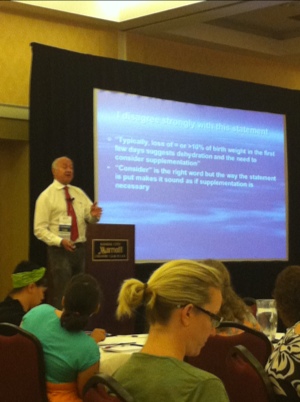
If you get a chance to attend one of his presentations, don’t miss it! In this slide, Dr. Jack explains that he disagrees strongly with the notion that a baby that has lost 10% of its birthweight needs to be supplemented.

Just in time for the start of World Breastfeeding Week, here is part 4 of my CAPPA re-cap series!

This post is a companion to my CAPPA re-cap post about the impact of birth practices on breastfeeding. Dr. Newman’s keynote session about Controversies in Breastfeeding was actually given before his breakout about birth and breastfeeding, but for the chronological value, it made sense to me to put up the birth post first.

As I already shared, in Newman’s perspective we have a huge problem in that many medical care providers do not recognize the critical importance of breastfeeding. Newman also emphasized that there are many people who don’t know squat about breastfeeding and breastmilk and don’t feel like they need to learn anything before they start doing studies and writing papers about it.

Why is hard to study breastmilk?

Because…there is no such thing as “standard” breastmilk. It is a physiological fluid and varies from person to person. We DO NOT have to prove that breastfeeding is better than formula. Those comparison studies are unnecessary.

Some great stuff from Dr. Newman’s presentation about controversies:

  • The exclusively breastfed, well-gaining 5 month old is getting only, at most, 10-15% more milk than the exclusively breastfeeding, well-gaining 1 month old, even though the 5 month old is twice as heavy. Baby continues to gain weight steadily even though it is not “getting enough” compared to its formula fed counterpart. (put that in your pipe and smoke it–yep, he really then said that ;-D)
  • Colostrum has 100,000-5,000,000 leukocytes per ml–that is more than blood. (i.e. colostrum has more white blood cells in it than your actual blood has in it!)
  • Colostrum and formula are the same in the following ways: both are liquid.
  • Breastmilk does not need to supply vitamin D (makes no sense to describe breastmilk as “deficient in” or “lacking” vitamin D).
  • With regard to the high incidence of reflux being diagnosed in babies—his response to why so high is, “because [most] doctors don’t know anything about breastfeeding.”
  • We learn one thing when we hear that the mother has been told to feed her baby X number of minutes per side—>the person telling her this does not understand breastfeeding.
  • There are no such thing as “flat nipples”–women have normal nipples. We live in a bottle feeding culture that makes us assume that if a mother does not have nipples that stick out like a bottle nipple, the nipples are flat (**Molly’s own note–we also live in a culture where 75-90% of women have epidurals during labor which can contribute to edema in the breast and the accompanying appearance of flat nipples).

 And, there should be no controversy about formula feeding vs. breastfeeding. If you actually look at the biochemistry of breastmilk you would know there is no comparison. No controversy. (with a laugh after this he added, “pediatricians are simple folk” ;-D)

In that plainspoken way I found so refreshing, Dr. Jack also pointed out that formula feeding is missing one more thing: breastfeeding. That’s right. Society thinks that bottle feeding is the “same”–it isn’t. Breastfeeding is an intimate relationship. He also pointed out that, “people will lie, lie, lie to sell products.” (see ad to right)

Finally, he explained that this mechanization of breastfeeding (through things like test weighing and nipple shields and timed feedings) will cause more and more mothers to abandon breastfeeding and then she’ll say, ‘we tried everything and it just didn’t work.’ Yes, we did “try everything,” everything to make her not succeed. (And, then she’ll write an article about it complaining about “what’s wrong with breastfeeding.”)

Handouts from Dr. Newman are available here. One I’ve used recently is How to Know a Health Professional is not Supportive of Breastfeeding.

I address other systemic influences on breastfeeding in Breastfeeding as an Ecofeminist Issue

The Impact of Birth on Breastfeeding

Just in time for the start of World Breastfeeding Week, here is part 3 of my CAPPA re-cap series!

…they want you to believe it’s their power, not yours…They stick needles into you so you won’t hear anything, you might as well be a dead pig, your legs are up in metal frames, they bend over you, technicians, mechanics, butchers, students, clumsy or sniggering, practicing on your body, they take your baby out with a fork like a pickle out of a jar.

–Margaret Atwood in her novel Surfacing (opening quote of Dr. Jack’s presentation at the 2012 CAPPA conference)

As I mentioned, my favorite part of the CAPPA conference was hearing Dr. Jack Newman speak about controversies in breastfeeding (see next post) and then about the impact of birth on breastfeeding (breakout session). He was an amazing speaker. Very straightforward and almost blunt as well as funny and fast-paced. I really feel glad to have had the chance to see him in person after years of being familiar with his materials.

The notion of the birth-breastfeeding continuum isn’t new to me, having actually published articles about it previously, however Dr. Newman’s phrasing, descriptions, and reminders was just so perfect that it left me feeling even more enthused about the inextricable link between birth and breastfeeding. It is a biologic continuum that nature does not see distinct events—baby is born and goes to breast, it is part of the same event. Drawing on Diane Wiessinger’s work, Dr. Newman explained

With animal births: following a normal birth, infant feeding just…happens. Following an interventionist birth, the mother rejects the baby and there is no nursing at all.

In some hospitals, separation of mother and baby is routine as a way to “prevent” postpartum mood disorders. Dr. Jack’s own theory was that perhaps human mothers turn this “rejection” against themselves and it shows up as a postpartum mood disorder.

Babies NEED and expect to be with their mothers after birth. It is of critical importance. As I shared via Facebook, Dr. Jack explained this:

Know how much an incubator costs now? $50,000. Why don’t we just give half of that money to the mother and put the baby skin to skin on mother’s chest?

And, this gem:

Our hospital births break every rule in the mammalian list of mother-baby necessities.” –Dr. Newman

He also noted that if baby is put skin-to-skin on mother immediately after birth regardless of original intention, the pair will breastfeed. It is biologically programmed.

Why do hospital births break the rules?

Because, as Dr. Newman explained we have a big, big problem in that HCPs do not recognize the critical importance of breastfeeding. He also repeatedly emphasized (in a very funny way) that there are many people who don’t know squat about breastfeeding and breastmilk and don’t feel like they need to learn anything before they start doing studies and writing papers about it.

Dr. Newman also emphasized the important point that the burden of proof rests upon those who promote an intervention! He was speaking with regard to recommending formula supplementation, but I strongly believe it applies to any birth practice. So simple and yet so profound. One example that he shared that is familiar to birth advocates is that lying down for electronic fetal monitoring is a position of comfort for the care provider, NOT for the mother.

And, he made this excellent point: “All medical interventions, even when necessary, decrease the mother’s sense of control, and increase her sense of her ‘body not being up to the task.” Again, the burden of proof rests on those who promote the intervention, not vice versa.

As I’ve touched on several times before, IV fluids that are commonly administered during labor may increase the baby’s birth weight, leading the baby to be more likely to experience the dreaded 10% weight loss (“totally bogus, by the way”). Also as I’ve noted before, IV fluids lead to significant maternal fluid retention which contributes to edema in the nipples and areolas and then…the dreaded “flat nipples.” The more fluid a mother gets in labor, the more a baby “loses” after birth!

Including the same picture as in my other post, because it is in this picture that Dr. Jack is specifically talking about his next point:

I disagree strongly with this statement:

‘Typically, loss of = or >10% of birth weight in the first few days suggests dehydration and the need to consider supplementation.’

He goes on to note that what is necessary is NOT supplementation but to help the mother and baby breastfeed well. The real question when it comes to newborn weight loss is, “is the mother-baby breastfeeding well?”

Newman also addressed something birth advocates are familiar with, the fact that epidural anesthesia can cause maternal fever. This leads to an infant sepsis workup and antibiotics and usually means separation of mother and baby. Here we again experience the failure of many medical care providers to recognize the importance of breastfeeding as beyond just a feeding method. Breastfeeding protects the baby–this is what most hospitals do not understand.

Of interventions that undermine breastfeeding, Dr. Jack pointed to Demerol (meperidine) as the “worst of the lot,” with newborns experiencing sedation and many of them not sucking at all. He also pointed out that all interventions increase the risk of cesarean section, which leads to increased discomfort for mothers and less willingness to breastfeed and increased likelihood of mother-baby separation.

The importance of skin-to-skin contact

Babies easily find their way to the unwashed nipple. And, given baby’s inborn feeding behaviors and instincts, it seems clear that, “if the baby expresses his or her choice, the baby would choose the breast.” (with regard to breastfeeding as maternal “choice”)

Not putting baby skin to skin with the mother, “increases the risk of hypoglycaemia significantly…Isn’t skin to skin contact a less invasive preventative measure than giving formula?” Newman then points out that most often we see “skin to blankets” which keeps baby from showing they’re ready to feed, doesn’t stimulate milk supply, and leads to engorgement which is not normal.

And, at the end he emphasized that when it comes to birth and breastfeeding, all too often WE MESS IT UP by meddling with the biological processes and rhythms of the mother-baby relationship.

For more about controversies in breastfeeding, check out my next post.

Handouts from Dr. Newman are available here. One I’ve used recently is How to Know a Health Professional is not Supportive of Breastfeeding.

I’ve written about the birth-breastfeeding continuum and about some other systemic influences on breastfeeding in breastfeeding as an ecofeminist issue.

DVD Review: Birth as We Know It

Birth as We Know It: Educational Edition. DVD directed and produced by filmmaker Elena Tonetti-Vladimirova. 2006, www.birthintobeing.com (40 minutes), $39.95.

Reviewed by Molly Remer, MSW, ICCE, Talk Birth

As a birth educator, I am always on the lookout for the “perfect” video to show in classes. Though not a film I would show in its entirety to the average class, Birth as We Know It is a gorgeous compilation and I’m delighted to have it amongst my educational resources.

The film is available in two versions—the feature film edition and the “educational edition.” The feature film contains almost 4 hours of total footage (a number of bonus features), including 11 births. The educational edition consists of two condensed versions of the feature film—a 40 minute presentation and a 25 minute version designed to show in groups. I chose to purchase the educational edition and this review is based on that edition. I have not seen the full length feature film.

The forty minute version of the film contains gentle, moving footage of 7 births. All the births occur in water—some in the ocean, but most at home. It also includes footage about birth trauma, cesarean section, and circumcision that is not included in the 25 minute presentation version (which also includes only 6 of the births). The DVD also contains instrumental versions of both.

The births included on this film are all exceptionally peaceful, beautiful, gentle, quiet, and calm births. Some of the birth footage is in slow motion, the sounds are muted, and there is instrumental music as the soundtrack as well as occasional voiceover commentary by the filmmaker. The film alternates between birth footage and spoken descriptions/interviews about conscious birth, emotional presence, limbic imprinting, etc. The voiceover commentary addresses things like toning and healing one’s own birth trauma.

The births are wonderfully undisturbed and unhindered—in most the only hands near mother’s perineum are her own and this is such a profound difference from the usual media representations of birth! A highlight is during “Tanya’s Birth” in which she speaks to her older child, smiles with extreme beauty and peace, then casually glances down again and as the camera follows her glance, we see the baby’s head has emerged between her legs and she is cradling it gently. I love for people to have a chance to see this powerful moment!

Though interesting, I find the voiceover content and non-birth portions of the film to be too abstract or “metaphysical” to appeal to the average birth consumer. It is even a bit too metaphysical for me and I find that the concepts she mentions are not well explained and do not seem immediately reasonable or easy to accept in stride. The instrumental version is one way to gloss over this element, but then you are unable to scene select to specific content the way you are able to do in the regular versions.

So, though I do not show the complete film in classes, there are several birth clips that I do show routinely. I find two of the births in particular to be potent educational tools and they have been very well received in classes and have had a profound impact. The births are so different from general media representations of birth that they leave couples stunned with amazement about what birth can be. Since the births are in water, they are a very gentle, non-messy, not very “graphic” way to expand people’s understanding of normal birth. People in my classes have said things like, “wow! You never see something like that!” or, “that was so beautiful, I’m just in shock.” I find men in particular are more receptive to this footage than to other, more detailed, videos I show and I have had a few request to borrow and view the whole video instead of just the clips I have chosen for class.

In conclusion, this is a lovely film and though I have some reservations about showing the entire educational edition, some of the birth footage has been a powerful addition to my work with birth.

This review was previously published at Citizens for Midwifery.

Conscious Agreement and Informed Consent

This post is part 2 of my CAPPA Re-Cap series.

During their general sessions at the recent CAPPA conference, Laurel Wilson and Tracy Wilson Peters both advocated a process called “Conscious Agreement” in working with pregnant couples. The basic steps are as follows:

  • Separate yourself from external influences
  • Get quiet and pause
  • Listen in (including mentally checking in with your body and how it feels)
  • Choose and commit

I especially appreciated Tracy’s observations that this process of conscious agreement goes beyond informed consent and, as birth educators, we need to make sure to “marry the two every time,” rather than focusing solely on informed consent. Why? Because there are several things wrong with informed consent as it is practiced today:

  • It fails to address the importance of conscious decision-making
  • Informed consent is made with the mind or intellect (and ignores feeling and intuition)

And…

  • You can “consent” all day long and not feel good about it.

The last point is the crux of the issue to me. When I cover informed consent in my non-birth classes, I always emphasize that the corollary is informed refusal. If “consent” as it is practiced by your hospital means saying yes and there is no option of saying no, it does not qualify as consent! A choice without the option to refuse is NOT a choice at all (see The Illusion of Choice). My students have almost never heard of the notion of “informed refusal” and seem shocked to even consider the possibility! Since I’ve had a special interest in this topic for a long time, I really connected with the idea of conscious agreement, especially when paired, as Tracy suggests, with informed consent information.

Another handy tip offered by Tracy during her presentation was to use HALT before entering into any agreement (or confrontation). Check in to see if you are…

  • H–Hungry
  • A–Angry
  • L–Lonely
  • T–Tired

(Also, consider whether the person you are trying to communicate with is any of these things. This is especially good to remember with children.) And, she shared this little poster:

This little sign may have been made especially for me. I have a terrible problem with getting crabby and snappish and plain old hangry (hungry + angry)—and then having to apologize. You’d think I’d have it figured out by now! (though, I do think nursing exacerbates it)

Epigentics, Breastfeeding + Diet, and Prenatal Stress

This post is part one of my CAPPA Re-Cap series.

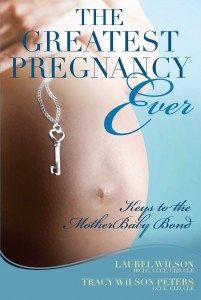
CAPPA linchpins Laurel Wilson and Tracy Wilson Peters are co-authors of a new book, The Greatest Pregnancy Ever, that focuses on the depth, intensity, and value of the MotherBaby bond. As I noted, I listened to Laurel talk about Bridging the Nutrition Gap and to Tracy speak about the “accidental parent.” In both, they addressed the biological wisdom that mothers possess and of the deeply interconnected nature of the maternal relationship.

Laurel reminded us that there is a brain in our gut, essentially. This brain literally tells us how we should be feeling our emotions, based on the nutrition that we’re putting into our bodies. She discussed epigenetics–a term meaning literally “above the gene”—explaining that this is the “translator that ‘reads’ the book of instructions from our genome.” The translator tells the body to turn on or off the genes we’ve inherited from our parents. Epigenetics is essentially the environment–those things in our environment that influence our biology. Laurel pointed out enthusiastically that we want to create an excellent “translator” for our children. She also emphasized repeatedly that one important job of the placenta is to “train” the baby for the environment it will be experiencing. This is why prenatal diet matters, it is helping to prepare the baby to thrive in the environment into which it will be born. So, chronic stress leads to a stressful womb environment, which leads to a baby that is biologically primed to be born into a stressful postnatal environment. Mother’s body primes baby’s body for success in that environment. As I listened to her speak and discuss the things we’ve learned from science about genetics and how our bodies function, I kept thinking: science can do a lot, it can do wonderful things. Mother’s body can do even moreAnd, isn’t that just cool?!

So, what’s going on in the maternal habitat?

One important point Laurel made about prenatal diets was that prenatal diets high in hydrogenated oils predispose mamas to postpartum moods disorders. She said this is because hydrogenated oils essentially “leach” EFA’s out of the mother’s system.

She also noted that mice up to three generations are affected with PCOS by BPA and phthalates (in food packaging. Our food is literally making us sick). These influence change the endocrine system and are connected with reduced sociality and community engagement.

Laurel explained too that no artificial sweeteners are considered safe for pregnant women and that stevia too is linked to epigentic damage. She suggested using honey and molasses as sweeteners if needed.

One tip that I found funny, basic, but so true with regard to choosing healthy foods is to make sure to choose to eat foods that will rot!

In Tracy’s talk she passionately affirmed that we have to eliminate chronic stress from pregnant women’s lives because she is laying an emotional and physical foundation for another person’s life. This matters! Babies are feeling before they are thinking and we are designed to live in the environment we are being born into.

Also remember, babies don’t need to be in nurseries–they need to be with their mothers. This MATTERS!

CAPPA Re-Cap

Yesterday I got home from Kansas City where I’d been attending the annual free birth conference hosted by CAPPA. While there I concluded that Desirre Andrews is officially a superhuman live-tweeter. You can catch up with all of her rapid-fire tweets about the conference at CAPPA’s Twitter account.

I also tried my hand at posting a few things that particularly grabbed my attention to my Talk Birth and Citizens for Midwifery Facebook pages which automatically feed into Twitter. I’m not very good at catching short snippets for live-tweets, but some thoughts that I grabbed to highlight are as follows. If they don’t have quotation marks, they aren’t necessarily direct quotes, just “essence” summaries as I tried to take notes and pay attention!

First I attended Laurel Wilson’s talk about Bridging the Nutrition Gap and next, I listened to Tracy Wilson-Peters speak passionately about the “accidental parent.”

Essence tweets from Laurel and Tracy’s talks:

Babies don’t need to be in nurseries–they need to be with their mothers. This MATTERS!

Science can do a lot, can do wonderful things. Mother’s body can do even more…

Prenatal diets high in hydrogenated oils predispose mamas to postpartum moods disorders.

And, then I attended a breakout session from Darla Burns about postpartum rituals and snagged this interesting tidbit:

In Holland, all pregnant women are required to buy a homebirth kit, “just in case.”

The second day, I found myself entranced by the most awesome Dr. Jack Newman. His presentations were the highlight of the conference for me. I loved him! I attended two–his general session on Controversies in Breastfeeding and then his breakout sessions, Impact of Birth Practice on Breastfeeding:

20120724-174258.jpg

If you ever get a chance to see this man, don’t miss it!

We have a big, big problem in that HCPs do not recognize the critical importance of breastfeeding.

There are many people who don’t know squat about breastfeeding and breastmilk and don’t feel like they need to learn anything before they start doing studies and writing papers about it. –Dr. Jack Newman

There is no such thing as “standard” breastmilk. It is a physiological fluid and varies from person to person. We DO NOT have to prove that breastfeeding is better than formula. Those comparison studies are unnecessary.

The burden of proof rests upon those who promote an intervention! –Dr. Newman

With animal births: following a normal birth, infant feeding just…happens. Following an interventionist birth, the mother rejects the baby and there is no nursing at all.

Our hospital births break every rule in the mammalian list of mother-baby necessities.” –Dr. Newman

Lying down for electronic fetal monitoring is a position of comfort for the care provider, NOT for the mother.

Know how much an incubator costs now? $50,000. Why don’t we just give half of that money to the mother and put the baby skin to skin on mother’s chest? –Dr. Newman

Seriously, Dr. Newman’s talks were amazing. Be prepared to hear more about them soon!

The final day I heard Polly Perez speak about Building Bridges with an emphasis on communication and fear:

Luke: I don’t believe it. Yoda: that is why you fail.

“Use language that lets you share your heart openly.” –Polly Perez

Listening is *active*, not a passive activity. Listen with empathy, openness, and awareness.

We have taken the hearts and minds out of much of our work because we’re frightened of getting too close. But, close is where we need to be.

“We must give people the opportunity to challenge their fears. Not only will this change each person, it will change the political and medical climate in which they make these choices.” –Connie Pike, via Polly Perez

Polly shared the first home birth she attended – made her fear of it “melt away like butter in a pan.”

You do not have to be an OB to be knowledgeable about birth. –doctor working with Polly Perez

Follow up from same doc: “if you tell me a baby is going to come out, I’m a gonna believe you!”

Changing sick systems is not about subterfuge but bringing light to situations that need to be altered.

Since micro-blogging is simply not my gift and is unlikely ever to become so, I am also planning longer posts based on several of the conference sessions. They will be (links will be updated as the posts become live):

At the CAPPA conference I also made a large custom order of great gifts from Joy Belle jewelry.

And, I ate tons of sample honey sticks from Glorybee–yummy! (see prior post: Why Honey Sticks During Labor?)

Other treats involved getting to spend some quality visiting time with a Friends of Missouri Midwives friend from St. Louis. We spent a lot of time talking over the FoMM newsletter (of which I am editor) and I feel very enthused about our ideas for its future.

I also got to meet a Facebook friend who started out originally two years ago as a Talk Birth fan on FB (after finding my site via my all-time most viewed post: In-Utero Practice Breathing). We spent some good time together visiting and laughing and it was fun to make the friendship connection with someone who was previously only an internet friend!

Incorporating Prenatal Yoga into Childbirth Education Classes

Incorporating Prenatal Yoga into Childbirth Education Classes

By Molly Remer, MSW, ICCE, ICPFE

Note: This is a preprint of an article published in the International Journal of Childbirth Education, Volume 27, Number 2 (April 2012)

The essence of yoga can be distilled into four key elements: breath, feeling, listening to the body, and letting go of judgment and expectation (YogaFit, 2010). When considering the essence of yoga, it is easy to see what a natural complement it is to conscious, active preparation for a healthy birth. Most birth educators would agree that paying attention to her breath and to her feelings, listening to her body, and letting go of preconceived expectations of what birth will be like are perhaps the most crucial messages to convey to the pregnant woman and her partner. Additionally, experts widely agree that exercise during pregnancy has beneficial effects for the cardiovascular and musculoskeletal systems and is associated with physical and psychological well-being. There is also some evidence that recreational exercise may reduce the incidence of premature labor and low birthweight babies (Hyatt & Cram, 2003).

Anyone involved with educating adult learners (in any context) is likely to be familiar with the concept that people are most likely to retain information that they have actually practiced (versus reading about, hearing about or seeing demonstrated). I have found that incorporating a few simple yoga poses into each class session is a beautiful way of illustrating and applying many important elements of childbirth preparation. In approximately 10 minutes of movement, important points can be underscored without having to actually say anything or “lecture” to clients. The hope is that as we move together through a carefully chosen series of poses, subtle emotional development and trust in birth occurs—again, in a more effective manner than by the childbirth educator saying during class: “Trust birth!”

One rationale for incorporating yoga into prenatal classes is as follows: First, people often learn and retain information more effectively by actually doing something. Practicing the yoga poses together allows experiential practice of pelvic floor exercises, pelvic rocks, tailor-sitting, leg cramp alleviation, and back pain coping techniques, to name a few, instead of just hearing me talking!

Second, and most important, Yoga in prenatal classes emphasizes that birth happens in the body. As childbirth educators we spend a significant amount of time talking and sharing information, but birth does not only happen in the mind. Birth happens most profoundly in the body. Not only does birth happen in the woman’s body, but supporting and being with a woman in labor is also an intensely physical process, so it is important for partners to try the yoga series.

People today spend much of their time “living in their heads”, and many of us do not feel comfortable with, or at home in, our bodies. Practicing poses in class helps couples out of their heads and into their bodies and begins a process of feeling comfortable with moving and using their bodies in positive ways. This may help them develop the trust and confidence that will contribute to a smooth and peaceful birth process.

Each pose is followed with a birth affirmation such as, “the magic and mystery of birth delight and amaze me” (Miller, 2003). Positive affirmations help plant positive seeds of confidence and trust in the wisdom of women’s bodies and of the beauty of birth. These cognitive adjustments may also send a welcoming message to the woman’s body and baby as they both prepare for birth.

Opening classes with a series of poses is an effective way to “frame” the class. Class can be opened with a brief check-in period asking how people are feeling, about recent prenatal appointments, and any questions can be addressed. A transition from “regular time” into “class time” occurs with a brief series of simple poses. This routine helps people transition from their normal days into feeling ready and excited for birth class information.

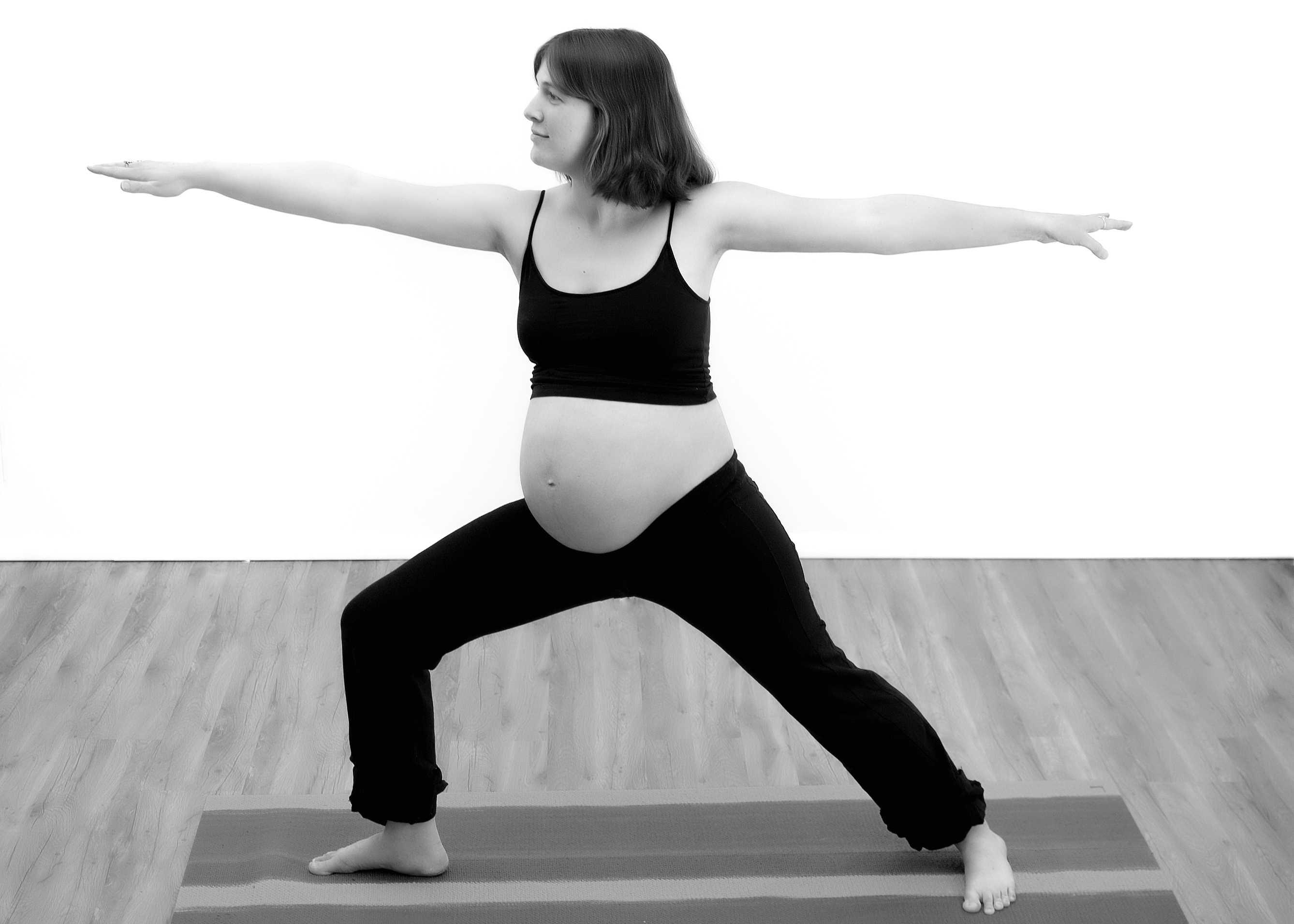
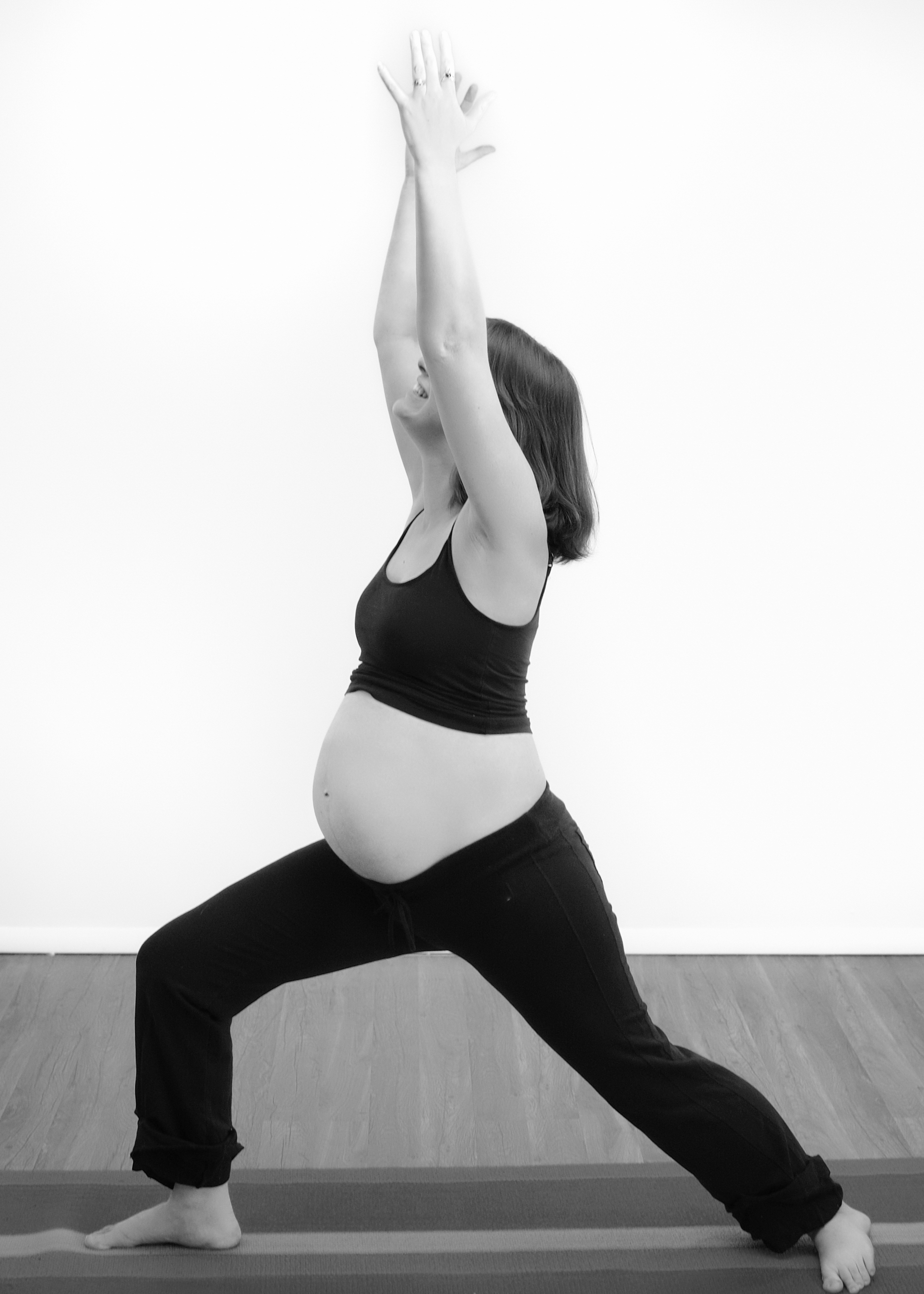
Each pose was chosen because it has specific birth- or pregnancy-related benefits. Begin with healthy sitting—seated crossed legged or tailor-style on the floor with spine straight. Do some neck rolls and shoulder rotations to help release tension. Move into a brief series that includes knee-rocking, leg stretches, Divine Mother Pose, Star Pose, pelvic rock, standing squat, Palm Tree Pose, Half Moon Pose, Triangle Pose and seated Mountain Pose. There is an additional short series of “birthing room yoga” poses described with photographs that is available as a free handout here.

The series is closed with a very brief meditation or visualization exercise. The series of poses and the affirmations are kept the same each week for retention purposes, but the meditation is varied. A quick visualization or relaxation exercise (under two minutes) is often more effective and more readily welcomed by couples than the longer visualization exercises often used in classes (which can seem esoteric to some people). A mindfulness meditation that is effective is:

Inhale and repeat silently: “I exist in the here and now….”

Exhale and repeat silently: “The present moment is all I have to be with…”
Continue inhaling and exhaling as you silently and simply repeat: “Here and now…present moment.”

A favorite resource for easily and smoothly incorporating yoga into classes is The Prenatal Yoga Deck by Olivia Miller, published by Chronicle Books in 2003. The poses listed above were selected from this deck. The deck contains 50 cards, so the educator can easily build a series for use in classes. Each pose card is accompanied by a lovely affirmation. The deck also includes six cards with simple meditations (the meditation above is adapted from one in the deck). The deck format, tidy box for holding the cards and sturdy card for each pose is an ideal format for transport to class as well as serving to provide subtle reminder cards as you lead couples through poses. Each card has a line drawing on the back illustrating the pose, so assessing whether you are doing the pose correctly is easy (sometimes just reading a description of the pose is more complicated than seeing it completed).

Occasionally the childbirth educator may get some eye-rolling or “weird, hippie exercise!” responses from pregnant couples. Regardless of how much or how little they appreciate the practice of yoga in classes, the poses used lay a physical foundation for a positive attitude toward birth and a sense of confidence as a birth-giving woman or supportive partner. Through the simple incorporation of yoga into birth classes, the expectant couple receives an irreplaceable, experiential grounding in the rhythm, focus, release, and conscious awareness so essential to the intensely embodied experience of birthing.

 Molly Remer, MSW, ICCE, ICPFE is a certified birth educator, writer, and activist. She is a professor of Human Services, an LLL Leader, editor of the Friends of Missouri Midwives newsletter, and a doctoral student at Ocean Seminary College. She has two wonderful sons and a toddler daughter and she blogs about birth, motherhood, and women’s issues at Talk Birth (http://talkbirth.me)

Suggested Resources for Birth Educators
The Prenatal Yoga Deck: 50 Poses and Meditations, Olivia H. Miller, ChronicleBooks, (2003)
YogaFit: PreNatal DVD, YogaFit (2009)
Yoga for Your Pregnancy DVD (2004)

All available via Amazon.com

All photos of the author, January 2011, 37 weeks. (c) Karen Orozco, Portraits & Paws Photography

References

Hyatt, G.& Cram, C. (2003). Prenatal & postnatal exercise design. DSW Fitness, Tuscon Arizona (training manual for the ICEA Certified Prenatal Fitness Educator Program)

Miller, O. (2003). The prenatal yoga deck: 50 poses and meditations. Chronicle Books, San Francisco, CA.

Remer, M. (2007). Incorporating prenatal yoga into childbirth educationclasses. Midwifery Today, 4(84), 66.

Talk Birth. (2011). Retrieved from https://talkbirth.me/2010/03/10/birthing-room-yoga-handout/

YogaFit PreNatal/PostpartumSpecialty Program Manual. (2006). YogaFit Training Systems Worldwide, Inc. , www.yogafit.com.

Sharing Stories

Mother-to-mother birthtelling is easy at blessingways!

In an excellent article by Rachel Reed in the Autumn 2011 issue of Midwifery Today, Sharing Stories, Reclaiming Birth Knowledge, she makes this important point: “Women not only learn practical information about pregnancy, birth, and motherhood through exchanging stories, but also gain emotional and social support…Through sharing stories, women created a sense of connection to other mothers and to the ‘universal nature of birthing’ …”

Despite the everyday miracle of birth and potent role in women’s lives and self-identity, “women’s birth stories are largely ignored in mainstream childbirth education programs. Instead, the approach consists of an ‘expert’ transmitting standardized information sanctioned by the maternity system. This approach does not adequately meet the needs of mothers, nor reinforce mothers’ expertise and knowledge. Building childbirth education around mother-to-mother story sharing would reinforce mothers as the experts in birth.”

What do you know about birth that other people don’t know?

As I read this article, I thought of several experiences in my own childbearing experiences that varied from “standardized information sanctioned by the maternity system” and that includes the alternative care system of which I was a part. Things that, for me, were not available from those systems around me—books, professionals, or media, but that nevertheless came through and are part of my own stories:

  • Being able to feel my babies practice breathing in the last 8-10 weeks of my pregnancies.
  • “Skipping” transition–no “freaking out” required to have a baby after all.
  • Tearing “up” into the labia/clitoral area instead of the more common or expected perineal tearing
  • Experiencing a spontaneous birth reflex
  • No bloody show/mucus/fluid until shortly before pushing
  • Long “strings” of post-birth mucus. So tough and sinuous that they are almost like membrane.
  • Experiencing a second trimester miscarriage clearly and potently as a birth event.

I’m curious to know what other women have experienced like this. What happened to you that you had never heard about before? What is a part of your story that isn’t a part of birth books? What do you know about birth that other people don’t know? How does your story enhance the collective culture of women?

The role of story in midwifery education

Reed goes on to explore the role of story in midwifery care and the education of midwives, explaining, “It is time for midwives, informed by being ‘with woman’ and experiencing birth in all its complexities, to reclaim their own unique birth knowledge. Sharing birth stories represents a rich source of knowledge and develops the ‘collective culture of women.’ Mothers are already doing this well, and childbirth education should reinforce this mother-to-mother expertise. Midwifery education also needs to embrace the power of storytelling as a means of developing woman-centered knowledge and practice.”

One of the most valuable elements of La Leche League for breastfeeding mothers is the mother-to-mother support and information sharing. This is irreplaceable. We need a means of providing this type of mother-to-mother support for birth as well. Not in swapping horror stories or “enlightening” others, but in authentic connection based on our own unique birth wisdom.

Birthtellers

In another article in the same issue of Midwifery Today KaRa Ananda shares the following gem in her article about Birthtellers: “…the stories women tell to each other privately–shape cultures, beliefs, choices and lives. Women used to learn about birth and motherhood through the stories of their mothers, sisters, grandmothers, midwives and friends. Today, that knowledge is transmitted primary through television, movies, peers and the internet. Now is the time for the Birthtellers to arise and once again share our inspirational birth stories–both within our communities and globally through new media technology.”

One of the midwife-authors that makes my heart sing with her lyrical, magical writing, is Sister MorningStar (author of Power of Women). She shared her daughter’s birth story in the autumn 2011 edition of Midwifery Today and it is just beautiful.

My own article on the value of sharing story also appeared in the same issue of Midwifery Today.

I am a Midwife Campaign

MANA has a great educational campaign going on right now called I am a Midwife. The campaign involves a series of short videos released once a week about a variety of topics. More than just a general education campaign, each video includes a variety of different women–midwives, mothers, public health activists, maternity care activists, authors—speaking out on important topics in maternity care. Each woman also identifies, “I am a Midwife.” This week’s video is about health disparities in maternity care, which is a very important and too-often ignored topic. It raises the concern that African American women and their babies are more likely to die than their Caucasian counterparts even when other variables are equalized (i.e. same socioeconomic status, same education, etc.) and moves into wider discussions about racism and the treatment of minority group members. It then focuses on the value and role of midwifery care in addressing these concerns.

As MANA states in relationship to this campaign: “For midwives, sharing is daring. We dare to challenge the status quo. We dare to speak up for women’s innate wisdom in pregnancy and birth. We dare to assert that there is a better way for our babies to be born. And we dare to insist that birth belongs to families.

Absolutely! The I am a Midwife public education campaign is extremely powerful. I have to confess that when it originally launched, I didn’t personally make time to watch the videos right away, somehow assuming that they were “generic” videos with a “rah, midwives!” type of message. Don’t make the same mistake I did. These are quality videos with important messages, powerful voices, and essential education and information. You will definitely learn something from watching them!

The videos aren’t only of use to birth professionals, when I teach community organizing at the college level I show videos like this as examples of activism strategies. In fact, for the final exam in that course I show the Crisis in the Crib video about infant mortality and disparities from the Office of Minority Health’s A Healthy Baby Begins With You campaign. This MANA video could be an interesting follow-up addition to the video I already use. As a related side note, during this class I also show footage from The Doula Story, a project by the Georgia Campaign for Adolescent Teen Pregnancy Prevention (whose program director I heard speak at the CAPPA conference in NC in 2010—she was amazing!). So, people do not leave my class without having heard of doulas and midwives and their relationship to community health. Go me and my mad birth activist skills! ;-D

Changing Visions

I’ve been moving in this direction for quite some time— really probably since my miscarriage-birth experience in late 2009—but I’ve decided that it is officially time for me to take a break from actively teaching birth classes. When I first started teaching in 2005, I envisioned having classes with 5-6 couples at a time. I quickly realized that the area didn’t really support that client volume–at least not with clients with similar due dates and similar interests in natural birth. I never intended to teach general/generic childbirth education, but focused on designing my classes for women planning for physiological, low-intervention (“natural” or unmedicated) births. I never apologized for that emphasis and my focus is what distinguished me from the locally available hospital-based classes that were free of charge. It became clear to me that my niche was in personalized, private, one-on-one birth education and I spent years delighting in the close relationships formed by working privately with couples rather than in a group. During these years I did teach some group classes as the opportunity and occasion arose and they were not as fulfilling or enriching for me as the one-on-one sessions. I think the pregnant women really benefit from the camaraderie of interacting with other pregnant women, but my relationship with the fathers-to-be and with the couple as a unit is nothing like it is when the couple is on their own with me.

Losing my spark

I also realized that I felt most satisfied and like I was making a genuine contribution/difference if I had clients during every month of the year. I set this intention for myself in 2007 and was able to meet my goal for the subsequent years. After I started teaching college classes, however, I found that I used up a lot of my teaching energy in the college classroom and that birth classes started to feel like more of a drain on my resources than a joy. I also realized that they were not very economically sensible and I became frustrated with having to pack up all my supplies and haul them to town with me each time I needed to teach. Having a new baby fanned the flames of my spirit for birth education again and I found that the spark that had been wavering since Noah died had re-ignited somewhat. However, the damage as it were, was done, in that teaching privately no longer made sense to me from a financial standpoint nor did it make sense from a maternal standpoint—I didn’t want to leave my baby behind to go teach class and I also found that in taking her with me, my attention was splintered and my clients didn’t necessarily get the best from me. Now that she is big enough to leave with my husband while I teach, I find myself “maxed out” with my college teaching schedule (which is only one night a week—who knows how I’d feel if it was more!) and other interests and the thought of trying to work in a series of private birth classes seems like a hurdle that I do not wish to struggle with. I coped for a while by trying to host the classes in my home (which is out-of-town), but that presents its own set of challenges. And, when I am home, I want to be home, not preparing birth class handouts or trying to shuffle the kids off to my parents’ house so that clients can come in for class. I love to be at home. I love where I live. As I wrote on Facebook recently, it is my soul place here.

Give points

As I am wont to do, I once again find myself looking around my life and schedule trying to find “give points” that allow me the life-work-passion-rest balance that best nourishes me, my family, my spirit, and my home life. This time, I find the give point is teaching face-to-face classes. It is hard to let go. I’ve worked on building this for years. I love the work. I have fear that what if someone else “takes over.” I have fear that I’ve “wasted” all of this training and effort. I have fear that I won’t be able to start again if I quit. However, as I’ve noted before, I’m very black-and-white when it comes to my responsibilities. I can either do something or STOP doing something. It doesn’t work for me to wait for things or “come back to it later” or “take a break for now.” I’m either doing it or I’m quitting. And, I always feel the need to “officially” decree this—I can’t just let things slide, or neglect them, I need to officially make the break or split from the task or responsibility. I have accepted that this is how I work and how I feel about tasks and while it is not true of everyone it IS true of me and I need to work with what I know of myself in this way. So, as of today, I am not planning to accept any new clients for the remainder of the year and I’m updating my business side of this site accordingly. I find it so interesting that the blog side of my site is where I have really developed a following and created relationships, and reach women’s lives around the world, even though I originally started it just to provide information for my few little clients here in rural Missouri. Birth writing is my other niche, the one that I feel like continuing to develop. As I’ve written before, I realized several years ago that writing this blog and my other articles is a legitimate form of “doing” childbirth education as well and perhaps actually has more impact than in-person classes (though, in-person classes are not replaceable in terms of the relational aspect).

New directions

Since 2009, I’ve also felt “called” to develop my other birth interests such as birth art facilitation, prenatal yoga, prenatal fitness, childbirth educator trainings, writing books, and pregnancy/birth retreats as well as my interest in women’s spirituality, women’s retreats, and women’s rituals in general. I feel like my interests in helping other women are deepening, maturing, and evolving from these roots in birth work. I think making this official break with my former means of birth education opens up the space in my life and my heart to develop those other areas of my interest and perhaps what I return to offer will be “bigger” and of more value to women and to my community.

When I applied to my doctoral program I had to write an extensive application letter responding to a variety of questions about my interest in the program. To me, applying to (and now participating in) this program represents an integration of something I feel with my mind, heart, and spirit. My whole being. As I wrote in my application, in women’s spirituality I glimpse the multifaceted totality of women’s lives and I long to reach out and serve the whole woman.I wish to extend my range of passion to include the full woman’s life cycle, rather than focus on the maternal aspect of the wheel of life as I have done for some time. I want to create rituals that nourish, to plan ceremonies that honor, to facilitate workshops that uncover, to write articles that inform, and to teach classes that inspire the women in my personal life, my community, and the world.

I also responded to this question:

Who/what inspires you?

I long to speak out the intense inspiration that comes to me from the lives of strong women.” –Ruth Benedict

I believe that these circles of women around us weave invisible nets of love that carry us when we’re weak and sing with us when we’re strong.” –SARK, Succulent Wild Woman

I am most inspired by the everyday women surrounding me in this world. Brave, strong, vibrant, wild, intelligent, complicated women. Women who are also sometimes frightened, depressed, discouraged, hurt, angry, petty, or jealous. Real, multifaceted, dynamic women. Women who keep putting one foot in the front of the other and continue picking themselves back up again when the need arises.

I am also inspired by women from the past who worked for social justice and women’s rights—women who lived consciously and deliberately and with devoted intention to making the world a better place. Jane Addams, Susan B. Anthony, Clara Barton. Women who have studied and written about feminist spirituality—such as Carol Christ, Hallie Ingleheart, Patricia Mongahan, and Barbara Ardinger–are also a source of inspiration. As a mother, I find additional inspiration in the self-care encouraging writings of Jennifer Louden and Renée Trudeau.

My children have provided a powerful source of inspiration and motivation. I wish to model for them a life lived as a complete, fully developed human being. After birthing three sons, I gave birth to a daughter in January, 2011. I always envisioned having daughters and felt well-prepared to raise a “kick-ass” girl. Having sons first presented me with a different type of inspiration (and, to me, a deeper challenge)—to raise healthy men. Men who treat women well and who are balanced, confident, loving, compassionate people. I came to think of myself as a mother of sons exclusively and was very surprised to actually have a girl as my last child. When I found out she was a girl, my sense of “like carries like/like creates like” was very potent and my current need to participate in the creation of a world in which she can bloom to her fullest is very strong.

My own inner fire inspires me—my drive to make a difference and to live well and wisely my one wild and precious life. Good conversations, time alone with my journal, time alone outdoors sitting on a big rock, and simple time in the shower provides additional fuel for this inner fire.

I have both a scholar’s heart and a heart for service. I wish to live so that my life becomes a living, embodied prayer for social change and to do work that is both spiritually based and woman affirming.

It is time for me to move forward with this expanded vision for what I’d like to offer to the world…