Archives

Breastfeeding Class Resources

I became certified as a breastfeeding educator in 2004 and accredited as a breastfeeding counselor in 2005, so I’ve been working with breastfeeding mothers for a long time. I lead a monthly support group and offer help/counseling via phone, email, text, Facebook message, Words with Friends messages, you name it. Recently, a nurse contacted me asking for ideas for teaching an early pregnancy breastfeeding class. I think this is a great idea, since mothers’ decisions about breastfeeding are often made before the baby is conceived and if not then, during the first trimester.

These are the initial ideas I suggested:

  • Focus on what the mothers themselves want—what do they need/want to know? What have they heard about breastfeeding? What are their fears? What misconceptions do they need cleared up? I’m very much about peer-to-peer support and allowing space for the women to talk to/connect with each other—the facilitator is then available to clear up misinformation and provide tips.
  • Focus on what mothers can do to prepare for successful breastfeeding—there is evidence that prenatal breast massage/colostrum expression helps with both milk supply AND with mother’s comfort with her own breasts. It also helps her think of herself as a breastfeeding mother BEFORE her baby is actually born!
  • Suggest good books to have on hand and encourage attending a breastfeeding support group (like LLL!) prior to baby’s birth.
  • Promote/discuss/encourage “baby led breastfeeding.” I love sharing with mothers about how smart their babies are and how mother’s chest after birth becomes baby’s new habitat! Check out the resources from Suzanne Colson: http://www.biologicalnurturing.com/
  • Discuss and emphasize all of the other great ways dads and other family members can be involved with baby other than giving a bottle. Dad/grandma can do EVERYTHING ELSE baby needs! That’s cool! Leave the feeding to mom and let dad have the other special and important jobs like baths and burping and tummy time and more.
  • DON’T talk about “myths” and try to dispel them in a myth-fact format, because evidence suggests that this actually helps the myths stick more!
  • Use Diane Wiessinger’s approach to language (http://www.motherchronicle.com/watchyourlanguage) i.e. breastfeeding isn’t a “special bond” it is a NORMAL bond. People want to be normal—special is for celebrities and “other people,” normal is what everyone wants. She also has handouts here: http://normalfed.com/Why.html

Since her email, a couple of other resources and bits have caught my eye. One is that the AAP has a resolution about the distribution of formula “gift bags” by pediatricians and hospitals. Apparently this came out in 2011, but it only came to my attention when I saw this image on Facebook!

In keeping with the 10 Steps and consistent with the AAP’s resolution, the hospital advocacy project from the Illinois State Breastfeeding Taskforce makes available the following useful documents for mothers to communicate with their hospitals:

The Task Force explains:

We encourage you to make the Breastfeeding Bill of rights and Hospital Experience Letters available to moms in your classes, practices, community events, breastfeeding fairs, “rock & rest” stations, etc.

Encourage moms to fill out the appropriate letter and mail back to the hospital where she delivered her baby.  Or collect the letters and mail them from your agency or task force.  Help moms make their voices heard!

We hope that this will show hospital administrators that lactation consultants, knowledgeable staff and breastfeeding friendly practices are valued by moms and families using their hospital services.

The Missouri Breastfeeding Coalition clued me into this Breastfeeding Plan for Mothers (pdf) from the MO Dept. of Health. The handout may be downloaded and printed as needed and is a, “list of requests that support breastfeeding for the postpartum stay. Similar to a birth plan and based on the 10 Steps for Breastfeeding.”

Also, make sure to check out this awesome resource, the WIC Sharing Gallery—free programs, curricula, brochures, and more from different WIC offices. I found this because I was back at the Illinois Breastfeeding Taskforce’s website downloading their Grandmother’s Tea curriculum for intergenerational support of breastfeeding.

Another great resource is the FREE online Tear-Sheet Toolkit from La Leche League.

And, finally, I already touched on this, but remember there are ample handouts/articles available from the incomparable Diane Wiessinger about birth and breastfeeding.

Controversies in Breastfeeding

20120724-174258.jpg

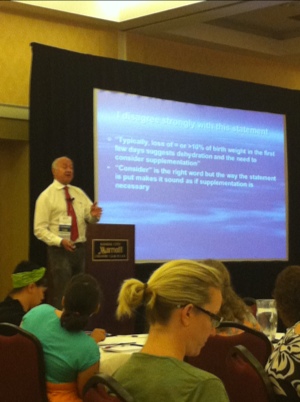
If you get a chance to attend one of his presentations, don’t miss it! In this slide, Dr. Jack explains that he disagrees strongly with the notion that a baby that has lost 10% of its birthweight needs to be supplemented.

Just in time for the start of World Breastfeeding Week, here is part 4 of my CAPPA re-cap series!

This post is a companion to my CAPPA re-cap post about the impact of birth practices on breastfeeding. Dr. Newman’s keynote session about Controversies in Breastfeeding was actually given before his breakout about birth and breastfeeding, but for the chronological value, it made sense to me to put up the birth post first.

As I already shared, in Newman’s perspective we have a huge problem in that many medical care providers do not recognize the critical importance of breastfeeding. Newman also emphasized that there are many people who don’t know squat about breastfeeding and breastmilk and don’t feel like they need to learn anything before they start doing studies and writing papers about it.

Why is hard to study breastmilk?

Because…there is no such thing as “standard” breastmilk. It is a physiological fluid and varies from person to person. We DO NOT have to prove that breastfeeding is better than formula. Those comparison studies are unnecessary.

Some great stuff from Dr. Newman’s presentation about controversies:

  • The exclusively breastfed, well-gaining 5 month old is getting only, at most, 10-15% more milk than the exclusively breastfeeding, well-gaining 1 month old, even though the 5 month old is twice as heavy. Baby continues to gain weight steadily even though it is not “getting enough” compared to its formula fed counterpart. (put that in your pipe and smoke it–yep, he really then said that ;-D)
  • Colostrum has 100,000-5,000,000 leukocytes per ml–that is more than blood. (i.e. colostrum has more white blood cells in it than your actual blood has in it!)
  • Colostrum and formula are the same in the following ways: both are liquid.
  • Breastmilk does not need to supply vitamin D (makes no sense to describe breastmilk as “deficient in” or “lacking” vitamin D).
  • With regard to the high incidence of reflux being diagnosed in babies—his response to why so high is, “because [most] doctors don’t know anything about breastfeeding.”
  • We learn one thing when we hear that the mother has been told to feed her baby X number of minutes per side—>the person telling her this does not understand breastfeeding.
  • There are no such thing as “flat nipples”–women have normal nipples. We live in a bottle feeding culture that makes us assume that if a mother does not have nipples that stick out like a bottle nipple, the nipples are flat (**Molly’s own note–we also live in a culture where 75-90% of women have epidurals during labor which can contribute to edema in the breast and the accompanying appearance of flat nipples).

 And, there should be no controversy about formula feeding vs. breastfeeding. If you actually look at the biochemistry of breastmilk you would know there is no comparison. No controversy. (with a laugh after this he added, “pediatricians are simple folk” ;-D)

In that plainspoken way I found so refreshing, Dr. Jack also pointed out that formula feeding is missing one more thing: breastfeeding. That’s right. Society thinks that bottle feeding is the “same”–it isn’t. Breastfeeding is an intimate relationship. He also pointed out that, “people will lie, lie, lie to sell products.” (see ad to right)

Finally, he explained that this mechanization of breastfeeding (through things like test weighing and nipple shields and timed feedings) will cause more and more mothers to abandon breastfeeding and then she’ll say, ‘we tried everything and it just didn’t work.’ Yes, we did “try everything,” everything to make her not succeed. (And, then she’ll write an article about it complaining about “what’s wrong with breastfeeding.”)

Handouts from Dr. Newman are available here. One I’ve used recently is How to Know a Health Professional is not Supportive of Breastfeeding.

I address other systemic influences on breastfeeding in Breastfeeding as an Ecofeminist Issue

The Impact of Birth on Breastfeeding

Just in time for the start of World Breastfeeding Week, here is part 3 of my CAPPA re-cap series!

…they want you to believe it’s their power, not yours…They stick needles into you so you won’t hear anything, you might as well be a dead pig, your legs are up in metal frames, they bend over you, technicians, mechanics, butchers, students, clumsy or sniggering, practicing on your body, they take your baby out with a fork like a pickle out of a jar.

–Margaret Atwood in her novel Surfacing (opening quote of Dr. Jack’s presentation at the 2012 CAPPA conference)

As I mentioned, my favorite part of the CAPPA conference was hearing Dr. Jack Newman speak about controversies in breastfeeding (see next post) and then about the impact of birth on breastfeeding (breakout session). He was an amazing speaker. Very straightforward and almost blunt as well as funny and fast-paced. I really feel glad to have had the chance to see him in person after years of being familiar with his materials.

The notion of the birth-breastfeeding continuum isn’t new to me, having actually published articles about it previously, however Dr. Newman’s phrasing, descriptions, and reminders was just so perfect that it left me feeling even more enthused about the inextricable link between birth and breastfeeding. It is a biologic continuum that nature does not see distinct events—baby is born and goes to breast, it is part of the same event. Drawing on Diane Wiessinger’s work, Dr. Newman explained

With animal births: following a normal birth, infant feeding just…happens. Following an interventionist birth, the mother rejects the baby and there is no nursing at all.

In some hospitals, separation of mother and baby is routine as a way to “prevent” postpartum mood disorders. Dr. Jack’s own theory was that perhaps human mothers turn this “rejection” against themselves and it shows up as a postpartum mood disorder.

Babies NEED and expect to be with their mothers after birth. It is of critical importance. As I shared via Facebook, Dr. Jack explained this:

Know how much an incubator costs now? $50,000. Why don’t we just give half of that money to the mother and put the baby skin to skin on mother’s chest?

And, this gem:

Our hospital births break every rule in the mammalian list of mother-baby necessities.” –Dr. Newman

He also noted that if baby is put skin-to-skin on mother immediately after birth regardless of original intention, the pair will breastfeed. It is biologically programmed.

Why do hospital births break the rules?

Because, as Dr. Newman explained we have a big, big problem in that HCPs do not recognize the critical importance of breastfeeding. He also repeatedly emphasized (in a very funny way) that there are many people who don’t know squat about breastfeeding and breastmilk and don’t feel like they need to learn anything before they start doing studies and writing papers about it.

Dr. Newman also emphasized the important point that the burden of proof rests upon those who promote an intervention! He was speaking with regard to recommending formula supplementation, but I strongly believe it applies to any birth practice. So simple and yet so profound. One example that he shared that is familiar to birth advocates is that lying down for electronic fetal monitoring is a position of comfort for the care provider, NOT for the mother.

And, he made this excellent point: “All medical interventions, even when necessary, decrease the mother’s sense of control, and increase her sense of her ‘body not being up to the task.” Again, the burden of proof rests on those who promote the intervention, not vice versa.

As I’ve touched on several times before, IV fluids that are commonly administered during labor may increase the baby’s birth weight, leading the baby to be more likely to experience the dreaded 10% weight loss (“totally bogus, by the way”). Also as I’ve noted before, IV fluids lead to significant maternal fluid retention which contributes to edema in the nipples and areolas and then…the dreaded “flat nipples.” The more fluid a mother gets in labor, the more a baby “loses” after birth!

Including the same picture as in my other post, because it is in this picture that Dr. Jack is specifically talking about his next point:

I disagree strongly with this statement:

‘Typically, loss of = or >10% of birth weight in the first few days suggests dehydration and the need to consider supplementation.’

He goes on to note that what is necessary is NOT supplementation but to help the mother and baby breastfeed well. The real question when it comes to newborn weight loss is, “is the mother-baby breastfeeding well?”

Newman also addressed something birth advocates are familiar with, the fact that epidural anesthesia can cause maternal fever. This leads to an infant sepsis workup and antibiotics and usually means separation of mother and baby. Here we again experience the failure of many medical care providers to recognize the importance of breastfeeding as beyond just a feeding method. Breastfeeding protects the baby–this is what most hospitals do not understand.

Of interventions that undermine breastfeeding, Dr. Jack pointed to Demerol (meperidine) as the “worst of the lot,” with newborns experiencing sedation and many of them not sucking at all. He also pointed out that all interventions increase the risk of cesarean section, which leads to increased discomfort for mothers and less willingness to breastfeed and increased likelihood of mother-baby separation.

The importance of skin-to-skin contact

Babies easily find their way to the unwashed nipple. And, given baby’s inborn feeding behaviors and instincts, it seems clear that, “if the baby expresses his or her choice, the baby would choose the breast.” (with regard to breastfeeding as maternal “choice”)

Not putting baby skin to skin with the mother, “increases the risk of hypoglycaemia significantly…Isn’t skin to skin contact a less invasive preventative measure than giving formula?” Newman then points out that most often we see “skin to blankets” which keeps baby from showing they’re ready to feed, doesn’t stimulate milk supply, and leads to engorgement which is not normal.

And, at the end he emphasized that when it comes to birth and breastfeeding, all too often WE MESS IT UP by meddling with the biological processes and rhythms of the mother-baby relationship.

For more about controversies in breastfeeding, check out my next post.

Handouts from Dr. Newman are available here. One I’ve used recently is How to Know a Health Professional is not Supportive of Breastfeeding.

I’ve written about the birth-breastfeeding continuum and about some other systemic influences on breastfeeding in breastfeeding as an ecofeminist issue.

Epigentics, Breastfeeding + Diet, and Prenatal Stress

This post is part one of my CAPPA Re-Cap series.

CAPPA linchpins Laurel Wilson and Tracy Wilson Peters are co-authors of a new book, The Greatest Pregnancy Ever, that focuses on the depth, intensity, and value of the MotherBaby bond. As I noted, I listened to Laurel talk about Bridging the Nutrition Gap and to Tracy speak about the “accidental parent.” In both, they addressed the biological wisdom that mothers possess and of the deeply interconnected nature of the maternal relationship.

Laurel reminded us that there is a brain in our gut, essentially. This brain literally tells us how we should be feeling our emotions, based on the nutrition that we’re putting into our bodies. She discussed epigenetics–a term meaning literally “above the gene”—explaining that this is the “translator that ‘reads’ the book of instructions from our genome.” The translator tells the body to turn on or off the genes we’ve inherited from our parents. Epigenetics is essentially the environment–those things in our environment that influence our biology. Laurel pointed out enthusiastically that we want to create an excellent “translator” for our children. She also emphasized repeatedly that one important job of the placenta is to “train” the baby for the environment it will be experiencing. This is why prenatal diet matters, it is helping to prepare the baby to thrive in the environment into which it will be born. So, chronic stress leads to a stressful womb environment, which leads to a baby that is biologically primed to be born into a stressful postnatal environment. Mother’s body primes baby’s body for success in that environment. As I listened to her speak and discuss the things we’ve learned from science about genetics and how our bodies function, I kept thinking: science can do a lot, it can do wonderful things. Mother’s body can do even moreAnd, isn’t that just cool?!

So, what’s going on in the maternal habitat?

One important point Laurel made about prenatal diets was that prenatal diets high in hydrogenated oils predispose mamas to postpartum moods disorders. She said this is because hydrogenated oils essentially “leach” EFA’s out of the mother’s system.

She also noted that mice up to three generations are affected with PCOS by BPA and phthalates (in food packaging. Our food is literally making us sick). These influence change the endocrine system and are connected with reduced sociality and community engagement.

Laurel explained too that no artificial sweeteners are considered safe for pregnant women and that stevia too is linked to epigentic damage. She suggested using honey and molasses as sweeteners if needed.

One tip that I found funny, basic, but so true with regard to choosing healthy foods is to make sure to choose to eat foods that will rot!

In Tracy’s talk she passionately affirmed that we have to eliminate chronic stress from pregnant women’s lives because she is laying an emotional and physical foundation for another person’s life. This matters! Babies are feeling before they are thinking and we are designed to live in the environment we are being born into.

Also remember, babies don’t need to be in nurseries–they need to be with their mothers. This MATTERS!

CAPPA Re-Cap

Yesterday I got home from Kansas City where I’d been attending the annual free birth conference hosted by CAPPA. While there I concluded that Desirre Andrews is officially a superhuman live-tweeter. You can catch up with all of her rapid-fire tweets about the conference at CAPPA’s Twitter account.

I also tried my hand at posting a few things that particularly grabbed my attention to my Talk Birth and Citizens for Midwifery Facebook pages which automatically feed into Twitter. I’m not very good at catching short snippets for live-tweets, but some thoughts that I grabbed to highlight are as follows. If they don’t have quotation marks, they aren’t necessarily direct quotes, just “essence” summaries as I tried to take notes and pay attention!

First I attended Laurel Wilson’s talk about Bridging the Nutrition Gap and next, I listened to Tracy Wilson-Peters speak passionately about the “accidental parent.”

Essence tweets from Laurel and Tracy’s talks:

Babies don’t need to be in nurseries–they need to be with their mothers. This MATTERS!

Science can do a lot, can do wonderful things. Mother’s body can do even more…

Prenatal diets high in hydrogenated oils predispose mamas to postpartum moods disorders.

And, then I attended a breakout session from Darla Burns about postpartum rituals and snagged this interesting tidbit:

In Holland, all pregnant women are required to buy a homebirth kit, “just in case.”

The second day, I found myself entranced by the most awesome Dr. Jack Newman. His presentations were the highlight of the conference for me. I loved him! I attended two–his general session on Controversies in Breastfeeding and then his breakout sessions, Impact of Birth Practice on Breastfeeding:

20120724-174258.jpg

If you ever get a chance to see this man, don’t miss it!

We have a big, big problem in that HCPs do not recognize the critical importance of breastfeeding.

There are many people who don’t know squat about breastfeeding and breastmilk and don’t feel like they need to learn anything before they start doing studies and writing papers about it. –Dr. Jack Newman

There is no such thing as “standard” breastmilk. It is a physiological fluid and varies from person to person. We DO NOT have to prove that breastfeeding is better than formula. Those comparison studies are unnecessary.

The burden of proof rests upon those who promote an intervention! –Dr. Newman

With animal births: following a normal birth, infant feeding just…happens. Following an interventionist birth, the mother rejects the baby and there is no nursing at all.

Our hospital births break every rule in the mammalian list of mother-baby necessities.” –Dr. Newman

Lying down for electronic fetal monitoring is a position of comfort for the care provider, NOT for the mother.

Know how much an incubator costs now? $50,000. Why don’t we just give half of that money to the mother and put the baby skin to skin on mother’s chest? –Dr. Newman

Seriously, Dr. Newman’s talks were amazing. Be prepared to hear more about them soon!

The final day I heard Polly Perez speak about Building Bridges with an emphasis on communication and fear:

Luke: I don’t believe it. Yoda: that is why you fail.

“Use language that lets you share your heart openly.” –Polly Perez

Listening is *active*, not a passive activity. Listen with empathy, openness, and awareness.

We have taken the hearts and minds out of much of our work because we’re frightened of getting too close. But, close is where we need to be.

“We must give people the opportunity to challenge their fears. Not only will this change each person, it will change the political and medical climate in which they make these choices.” –Connie Pike, via Polly Perez

Polly shared the first home birth she attended – made her fear of it “melt away like butter in a pan.”

You do not have to be an OB to be knowledgeable about birth. –doctor working with Polly Perez

Follow up from same doc: “if you tell me a baby is going to come out, I’m a gonna believe you!”

Changing sick systems is not about subterfuge but bringing light to situations that need to be altered.

Since micro-blogging is simply not my gift and is unlikely ever to become so, I am also planning longer posts based on several of the conference sessions. They will be (links will be updated as the posts become live):

At the CAPPA conference I also made a large custom order of great gifts from Joy Belle jewelry.

And, I ate tons of sample honey sticks from Glorybee–yummy! (see prior post: Why Honey Sticks During Labor?)

Other treats involved getting to spend some quality visiting time with a Friends of Missouri Midwives friend from St. Louis. We spent a lot of time talking over the FoMM newsletter (of which I am editor) and I feel very enthused about our ideas for its future.

I also got to meet a Facebook friend who started out originally two years ago as a Talk Birth fan on FB (after finding my site via my all-time most viewed post: In-Utero Practice Breathing). We spent some good time together visiting and laughing and it was fun to make the friendship connection with someone who was previously only an internet friend!

I See You: talking to mothers about their breastfeeding concerns…

I’m helping to train two women right now to become breastfeeding counselors. As well as discussing how to help other women with the numerous issues that may be a part of the normal course of breastfeeding, we talk a lot about listening skills. As I’ve been working with them, I found a reminder list that I made 7 years ago when I took on this role myself. The list simply consists of ideas for how to talk to mothers about their breastfeeding questions in a way that promotes continued dialogue, demonstrates respect, and employs good active listening.

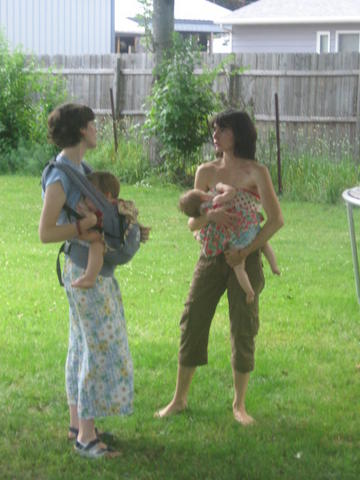
Photo from several years ago of a good friend and I nursing our babies while “seeing” each other.

Talking to mothers about their breastfeeding concerns…

“I hear you saying that….”

“You seem to be telling me that….”

“You seem to be feeling….”

“You sound…”

“How do you…”

“What are you observing that makes you think…”

“Tell me more about…”

“How would you like to see this resolved…”

“Many mothers have found…” **This is my all-time favorite and hands-down most useful. I use it all the time. It is so handy.**

“How would you feel about…”

“For some families it works well to…”

“There are some suggestions I can give you for… that have been helpful for other mothers…”

“It depends….”

“It sounds to me like you are doing a wonderful job as a mother”

“It sounds to me like your baby really responds to you”

“Your baby is so lucky that you want to/did give him the benefit of your milk”

With doctors/others’ opinions:

“How do you feel about those suggestions?”

Some doctors take that approach, but research has shown….” (or, “we’ve noticed…” or, “reliable references indicate…” May also follow-up with, “Would you like me to send you a reference?”). **This is another one of my favorites, it doesn’t smack down the doctor and yet it gently and firmly provides you with a means of sharing alternate—correct—information.

Other good things to remember when listening to mothers:

Breastfeeding is not a by the book procedure—it is an intimate relationship with different dynamics from one nursing couple to the next. Individual mothers and babies respond differently to the same things. There are no hard and fast rules.

Our main message to each mother is how important she is to her baby and how breastfeeding can be a wonderful part of this. We want to help mothers feel good about being a mother, about meeting their babies’ needs in the way that feels best for them, and to trust their own instincts. We wish to leave mothers with a feeling of self-confidence and acceptance.

I See You

I often remind students in my human services classes that all people have a basic need to be both seen and heard. This doesn’t mean agreeing with everything someone else says and does, it means being present and witnessing them as they follow their own paths.

In a newsletter recently, I read an article called “I See You” by Sue Scott, a communication skills instructor. She explains that in South Africa, native peoples greet each other with an expression that literally means, “I see you.” The response is then, “I am here.” She observes, “what a powerful and beautiful gift it is to recognize another individuals in this way: ‘I see you.’ Acknowledgement, recognition, and respect all require focus on the other person…the word respect comes from the Latin word ‘respecere’ meaning ‘to look at again and again…’I see you’…seems to me to be the ultimate in respect.” Sue goes on to explain that when we truly SEE another mother—“when we truly hear her concerns—then we affirm her ability to mother her baby in her own best way.”

A little more than two years ago, I received the precious gift of being seen when a mother that I had previously helped with many breastfeeding questions called to ask me another question. We had become friends over the course of time since she’d had her first baby and I was in the process of my second miscarriage when she called with a question about her own pregnancy. I told her about the miscarriage, but said I felt like I could still talk with her about her question. We ended up then talking for a time about miscarriage and about cesarean birth, because we discover numerous surprising connections between the feelings and experiences of an unexpected outcome to our dreams for our pregnancies. She then said, “You know in that movie Avatar how they say, ‘I see you’?” I said yes, and she said, “I just wanted to let you know that I see you, Molly.” These words were such a gift to me. It was beautiful to hear them and I cried. I felt so seen. It was just what I needed and I hadn’t even known it. I will never forget that simple and yet extremely potent gift of acknowledgement from another woman.

A previous post about Listening Well Enough.

Breastfeeding as a Spiritual Practice

Note: This is a preprint of the following article:  Remer, M. (2012). Breastfeeding as a spiritual practice. Restoration Earth: An Interdisciplinary Journal for the Study of Nature & Civilization, 1(2), 39–43. Copyright © The Authors. All rights reserved. For reprint information contact: oceanseminary@verizon.net.

Click here for a typset pdf version of the original article.

The article was constructed from several of my prior blog posts, so if you’re familiar with my blog, a lot of the content here will sound familiar!

Breastfeeding as a Spiritual Practice

By Molly Remer, MSW, ICCE, CCCE

Every single human being was drummed into this world by a woman, having listened to the heart rhythms of their mother.

––Connie Sauer

When I became a mother, many things in my life changed. I was startled and dismayed by the magnitude in which my free time diminished and one by one many of my leisure pursuits and hobbies were discarded. The time for one of my favorite hobbies increased exponentially, however: reading. As a child I was a voracious reader—my mother had to set a limit for me of “only two books a day.” In college and graduate school, reading for fun fell away and I spent six years reading primarily textbooks and journal articles. In the years following, I began to read for pleasure again and when my first baby was born in 2003, I once again became a truly avid reader. Why? Because of breastfeeding. As I nursed my little son, I read and read and read. This became the rhythm of our lives: suck, swallow, read, and consider.

At first I scoured The Womanly Art of Breastfeeding and the Sears’ The Baby Book to try to make sense of my new life and then began to gobble up books about motherhood and women’s experiences of mothering. Reading did actually help me adjust to motherhood. Subtitled “Breastfeeding as a Spiritual Practice,” an article published in the fall 2003 issue of Mothering magazine was immensely meaningful to me. My baby was about two weeks old when the magazine arrived—the first issue I had received after his birth. This article was in it and it was exactly what I needed to read. Breastfeeding can be a meditative and spiritual act––it is actually a “practice” a “discipline” of sorts. The author, Leslie Davis, explains it better:

I realized I’d never before devoted myself to something so entirely. Of course I’ve devoted myself to my husband, to my family, to friends, to my writing, to mothering, and even to God and other spiritual endeavors at various points in my life…I’d completely given myself to this act of nursing in a way that I never had before. Nothing was more important than nursing my son. Nothing was put before it. There was no procrastination as with exercise, no excuses as with trying to stop eating sugar, no laziness as with housecleaning and other chores. Nursing had to be done, and I did it, over and over again, multiple times a day, for more than 800 days in a row. It was the closest thing to a spiritual practice that I’d ever experienced. 

With my first baby, viewing the act of breastfeeding through a spiritual lens like this was a lifeline to me as a vulnerable, sensitive, and bruised postpartum woman trying desperately to adjust my pace as an overachieving “successful” independent person to one spending hours in my nursing chair attached to a tiny mouth. I marvel at the uncountable number of times I spent nursing my first son and then my second son and now my daughter.  The intensity and totality of the breastfeeding relationship is extremely profound—it requires a more complete physical/body investment with someone than you will ever have with anyone else in your life, including sexual relationships. While I don’t like to lump the breastfeeding relationship in the same category with sex, because it feels like I’m saying breastfeeding is sexual, when it isn’t…though, since lactation is definitely part of a woman’s reproductive functions, I guess maybe it is…my basic line of thought was that if you nurse a couple of kids through toddlerhood, odds are high that you will have nursed them many more times than you will end up having sex with a partner in your entire lifetime.

I calculated that so far in my life I’ve put a baby to my breast more than 12,000 times. Even if I only experienced a single moment of mindful awareness or contemplation or transcendence or sacredness during each of those occasions, that is one heck of a potent, dedicated, and holy practice. In the unique symbiosis of the nursing relationship, I recall a quote from the book The Blue Jay’s Dance (1996) by Louise Erdrich about male writers from the nineteenth century and their longing for an experience of oneness and seeking the mystery of an epiphany. She says: “Perhaps we owe some of our most moving literature to men who didn’t understand that they wanted to be women nursing babies.” (p. 148)

I have learned a lot about the fundamental truth of relatedness through my own experiences as a mother. Relationship is our first and deepest urge. The infant’s first instinct is to connect with others. Before an infant can verbalize or mobilize, she reaches out a hand to her mother. I have seen this with my own babies. Mothering is a profoundly physical experience. The mother’s body is the baby’s “habitat” in pregnancy and for many months following birth. Through the mother’s body the baby learns to interpret and to relate to the rest of the world and it is to mother’s body that she returns for safety, nurturance, and peace. Birth and breastfeeding exist on a continuum as well, with mother’s chest becoming baby’s new “home” after having lived in her womb for nine months. These thoroughly embodied experiences of the act of giving life and in creating someone else’s life and relationship to the world are profoundly meaningful.

How many generations of women have pushed out their babies and fed them at the breast without knowing the exact mechanics of reproduction, let alone milk production. There are all kinds of historical myths and “rules” about breastmilk and breastfeeding and even ten years ago we used to think the inner structure of the breast was completely different than what we think it is like now. Guess what? Our breasts still made milk and we still fed our babies, whether or not we knew exactly how the milk was being produced and delivered. Body knowledge, in this case, definitely still trumped scientific knowledge. I love that feeling when I snuggle down to nurse my own baby—my body is producing milk for her regardless of my conscious knowledge of the patterns or processes. And, guess what, humans cannot improve upon it. The body continues to do what the human mind and hand cannot replicate in a lab. And, has done so for millennia. I couldn’t make this milk myself using my brain and hands and yet day in and day out I do make it for her, using the literal blood and breath of my body, approximately 32 ounces of milk every single day for the last seventeen months. That is beautiful.

A simple meditation technique to use while breastfeeding is: “breathing in, I am nursing my baby. Breathing out, I am at peace.

Parenting as a Spiritual Practice

The spirituality of daily life with children is not only to be found in the breastfeeding relationship, but is woven into the warp and weft of the daily tasks of parenting with mindfulness, connection, and love. In this simple little verse from Eileen Rosensteel in the 2011 We’Moon Datebook, she describes it thusly:

My prayers are

The food I cook

The children I hug

The art I create

The words I write

I need no religion. (p. 152)

In the book Tying Rocks to Clouds (1996) the author interviews Stephen Levine, the father of three children and in response to a question about whether serious spiritual development is possible when having relationships with others (spouse, children, etc.) he says: “Talk about a fierce teaching. It is easier to sit for three years in a cave than to raise a child from the time he is born to three years old.” (p 160)

In the book, The Tao of Motherhood (2011) (literally the Tao Te Ching for mothers—a translation of the ancient Tao Te Ching by Lao-Tzu, but reworked slightly so that every “chapter” is about mothering and mothering well) a quote from the end of the chapter on selflessness:

“You can sit and meditate while

your baby cries himself to sleep.

Or you can go to him and share

his tears, and find your Self.”

And, then from Peggy O’Mara’s (1993) collection of essays, The Way Back Home, she raises this question: “Why is it that to rise gladly at 4:00 am to meditate and meet one’s God is considered a religious experience, and yet to rise at 4:00 am to serve the needs of one’s helpless child is considered the ultimate in deprivation?” (p. 19) O’Mara continues by explaining,

One can learn sitting meditation by rocking and nursing a little one to sleep; one can learn reclining meditation by staying still to avoid disturbing a little one who has been awake for hours; and one can learn walking meditation by walking and swaying with a little one who would like to be asleep for hours. One must learn to breathe deeply in a relaxed and meditative manner in order to still the mind that doubts one’s strength to go on, that sees every speck of dust on the floor and wants to clean it, and that tempts one to be up and about the busyness of accomplishment… (p. 19)

I do find that I have a tendency to think about my own spiritual practices as something that has to wait until I am alone, until I have “down time,” until I have space alone in my head in which to think and to be still. On the flip side, as I noted earlier, the act of breastfeeding, day in and day out, provides all manner of time for spiritual contemplation and meditative reflection. I often find it difficult to stay centered and grounded in mindfulness of breath and spirit during the swirl of life with little ones. I’ve done a lot of reading about “Zen parenting” type topics and it seems like it would be so simple to integrate mothering with mindfulness. Then, I find myself frazzled and scattered and self-berating, and wonder what the heck happened to my Zen. Then, I read an interesting article about anger and Zen Buddhism that clarified that meditation and Zen practices are not about being serene and unfrazzled, but about being present and able to sit with it all. And, it offered this helpful reminder:

I used to imagine that spiritual work was undertaken alone in a cave somewhere with prayer beads and a leather-bound religious tome. Nowadays, that sounds to me more like a vacation from spiritual work. Group monastic living has taught me that the people in your life don’t get in the way of your spiritual practice; these people are your spiritual practice. (Haubner, 2012, “The Angry Monk”)

I don’t need to wait to be alone in order to be “spiritual” in this life with my babies. This sometimes messy, sometimes chaotic, sometimes serene, sometimes frazzling, often joyful life is it.

Motherhood is an intensely embodied experience. It is profoundly empowering to know that you can build a whole person and sustain their lives with nothing but the materials of your own body—this is my blood, my milk, made flesh.

Molly Remer, MSW, ICCE, CCCE is a certified birth educator, writer, and activist who lives with her husband and children in central Missouri. She is the editor of the Friends of Missouri Midwives newsletter, a breastfeeding counselor, a professor of human services, and doctoral student in women’s spirituality at Ocean Seminary College. She blogs about birth, motherhood, and women’s issues at https://talkbirth.me/

References

Davis, L. (2003). Breathing in: I am nursing my baby. Mothering, Issue 120, September/October 2003 (pages unknown—electronic version available here: http://mothering.com/breastfeeding/breathing-i-am-nursing-my-baby-breastfeeding-spiritual-practice)

Erdrich, L. (1996). The Blue Jay’s Dance. New York, NY: Harper Perennial

Haubner, S. J. (September/October, 2012). The angry monk. Utne. Retrieved from http://www.utne.com/Mind-Body/Angry-Monk-Buddhism-Zen-Spiritual-Practice.aspx?page=5 on March 1, 2012.

Elliott, W. (1996). Tying rocks to clouds. New York: Doubleday.

McClure, V., & Thoele, S. P. (2011). The Tao of motherhood. Novato, CA: New World Library.

O’Mara, P. (1993). The way back home. Santa Fe, NM: Mothering Magazine

Rosensteel, E. (2011). Untitled. In We’Moon datebook (p. 152 ). Wolfcreek, OR: Mother Tongue Ink & We’Moon Company.

—-


Breastfeeding as an Ecofeminist Issue

Breasts are a scandal because they shatter the border between motherhood and sexuality.

––Iris Marion Young

After Hurricane Katrina, I read a news story about a young mother whose newborn baby died of dehydration during the days in which she had been stranded without access to clean water. Upon admittance to the hospital, the mother was asked if she needed anything and she replied that her breasts were uncomfortable and could she have something to dry up the milk. This story brings tears to my eyes and chills to my body. What does this say about our culture that it is actually possible for mothers to be unaware that they carry the power to completely nourish their own babies with their own bodies? As mammals, all women have the potential to be lactating women until we choose not to be. The genius of formula marketing and advertising is to get women to withhold from their offspring that which they already have and to instead purchase a replacement product of questionable quality. To me this feels like being a given a “choice” between the blood already flowing through your veins and a replacement product that marginally resembles blood.

We are mammals because as a species we nurse our young. This is a fundamental tie between the women of our time and place and the women of all other times and places as well as between the female members of every mammal species that have ever lived. It is our root tie to the planet, to the cycles of life, and to mammal life on earth. It is precisely this connection to the physical, the earthy, the material, the mundane, the body, that breastfeeding challenges men, feminists, and society.

Breastfeeding is a feminist issue and a fundamental women’s issue. And, it is an issue deeply embedded in a sociocultural context. Attitudes towards breastfeeding are intimately entwined with attitudes toward women, women’s bodies, and who has “ownership” of them. Patriarchy chafes at a woman having the audacity to feed her child with her own body, under her own authority, and without the need for any other. Feminism sometimes chafes at the “control” over the woman’s body exerted by the breastfeeding infant.

Part of the root core of patriarchy is a rejection of the female and of women’s bodies as abnormal OR as enticing or sinful or messy, hormonal, complicated, confusing…. Authentic feminism need not be about denying biological differences between women and men, but instead about defining both as profoundly worthy and capable and of never denying an opportunity to anyone for a sex-based reason. Feminism can be about creating a culture that values what is female as well as what is male, not a culture that tries to erase or hide “messy” evidence of femaleness.

However, precisely because of the patriarchal association of the female with the earthy and the physical, feminists have perhaps wanted to distance themselves from breastfeeding. This intensely embodied biologically mandated physical experience so clearly represents a fundamental difference between men and women that it appears to bolster biological reductionism. Yet in so doing feminism then colludes with patriarchy and itself becomes a tool of the patriarchy in the repression and silencing of women and their leaky ever-changing, endlessly cycling bodies: these bodies that change blood into food and bleed without dying and provide safe passage for new souls upon the earth. Sometimes the issue of a woman’s right not to breastfeed is framed as a feminist “choice.” This is a myth, made in the context of a society that places little value on women, children, and caregiving. It is society that needs to change. Not women and not babies.

Systemic and Structural Context

In an essay for the Academy of Breastfeeding Medicine on “What does feminism have to do with breastfeeding?”, Maternal–fetal medicine specialist Dr. Alison Stuebe (2010) points out that for the most part feminist advocacy ignores breastfeeding and that most breastfeeding advocacy sidesteps the complicated contextual issues of women’s lives. Stuebe notes:

…the conventional wisdom is that breastfeeding is a maternal duty that forces women to eschew their career aspirations to fulfill some ideal of motherhood, while feminism is about liberating women from exactly those constraints. Case closed. Or is it?…The result is that women end up fighting among themselves about the choices our society forces us to make — motherhood or career? Breast or bottle? — instead of uniting to address the societal structures that prevent women from realizing their full potential.

Appropriately, Stuebe further notes that:

…breastfeeding is not a ‘choice.’  Breastfeeding is a reproductive right. This is a simple, but remarkably radical, concept. Here’s why: When we frame infant feeding as a choice made by an individual women, we place the entire responsibility for carrying out that choice on the individual woman…Indeed, the ultimate link between breastfeeding and feminism is that in a truly equitable society, women would have the capacity to fulfill to pursue both their productive and reproductive work without penalty.

And, in considering contextual and systemic issues that impact women every day, Stuebe points out that:

These issues transcend breastfeeding. Why, for example, do we pit “stay at home moms” against “working moms,” rather than demand  high-quality, affordable child care, flexible work, and paid maternity leave so that each woman can pursue both market work and caring work, in the proportion she finds most fulfilling? Why do we accept that, if a woman devotes all of her time to caring for her family, she does not earn any social security benefits, whereas if she gets a paying job and sends her children to day care, she and her day care provider earn credits toward financial security in old age? And why do we enact social policies that subsidize child care and require poor mothers to enter the paid work force, rather than support poor mothers to care for their own children?…

Naomi Wolf (2003) also addresses the myth of  “choice” regarding breastfeeding (specifically with regard to lack of support for breastfeeding while working outside the home) in her book Misconceptions: “…it was unconscionable for our culture to insist that women ‘choose’ to leave their suckling babies abruptly at home in order simply to be available for paid work.” (p. 270) Wolf also quotes Robbie Kahn who says, “the job market holds out an all-or-nothing prospect to new mothers: you can give your body and heart and lose much of your status, your money, your equality, and your income; or, you can keep your identity and your income—only if you abandon your baby all day long and try desperately to switch off the most powerful primal drive the human animal can feel.” And, then considering the argument that bottle feeding “liberates” women from the tyranny/restrictiveness of breastfeeding: “The liberation women need is to breastfeed free of social, medical, and employer constraints [emphasis mine]. Instead, they have been presented with the notion that liberation comes with being able to abandon breastfeeding without guilt. This ‘liberation,’ though, is an illusion representing a distorted view of what breastfeeding is, what breastfeeding does, and what both mothers and babies need after birth” (Michels, p. xxx). Often, not breastfeeding is a structural and systemic symptom of a patriarchal society that devalues women and caregiving work and views the masculine body as normative, not a personal choice!

I am a systems thinker and always hold in mind that breastfeeding, like all aspects of women’s lives, occurs in a context, a context that involves a variety of “circles of support” or lack thereof. Women don’t “fail” at breastfeeding because of personal flaws, society fails breastfeeding women and their babies every day through things like minimal maternity leave, no pumping rooms in workplaces, formula advertising and “gifts” in hospitals, formula company sponsorship of research and materials for doctors, the sexualization of breasts and objectification of women’s bodies, and so on and so forth. According to Milk, Money, and Madness (1995), “…infant formula sales comprise up to 50% of the total profits of Abbott Labs, an enormous pharmaceutical concern.” (p. 164) And the US government is the largest buyer of formula, paying for approximately 50% of all formula sold in the nation.

In a brilliant analysis of the politics of breastfeeding in the US, Milk, Money, and Madness (1995), by Dia Michels and Naomi Baumslag, the following salient points are made about why women in the US so often experience breastfeeding problems: “In western society, the baby gets attention while the mother is given lectures [emphasis mine]. Pregnancy is considered an illness; once the ‘illness’ is over, interest in her wanes. Mothers in ‘civilized’ countries often have no or very little help with a new baby. Women tend to be home alone to fend for themselves and the children. They are typically isolated socially and expected to complete their usual chores, including keeping the house clean and doing the cooking and shopping, while being the sole person to care for the infant…” (p. 17)

Michels and Baumslag go on to explain:

According to the US rules and regulations governing the federal worker, the pregnancy and postdelivery period is referred to as “the period of incapacitation.” This reflects the reality of a situation that should be called ‘the period of joy.’ Historically, mothering was a group process shared by the available adults. This provided not only needed relief but also readily available advice and experience. Of the “traditional” and “modern” child-rearing situations, it is the modern isolated western mom who is much more likely to find herself experiencing lactation failure [emphasis mine]. (p. 18)

There is a tendency for modern women to look inward and blame themselves for “failing” at breastfeeding. There is also an unfortunate tendency for other mothers to also blame the mother for “failing”—she was “too lazy” or “just made an excuse,” etc. We live in a bottle-feeding culture; the cards are stacked against breastfeeding from many angles–economically, socially, medically. When I hear women discussing why they couldn’t breastfeed, I don’t hear “excuses,” I hear “broken systems of support” (whether it be the epidural in the hospital that caused fluid retention and the accompanying flat nipples, the employer who won’t provide a pumping location, the husband who doesn’t want to share “his breasts”, or the mother-in-law who thinks breastfeeding is perverted). Of course, there can actually be true “excuses” and “bad reasons” and women theoretically always have the power to choose for themselves rather than be swayed by those around them, but there are a tremendous amount of variables that go into not breastfeeding, besides the quickest answer or what is initially apparent on the surface. As noted previously, breastfeeding occurs in a context and that context is often one that does not reinforce a breastfeeding relationship. In my seven years in breastfeeding support, with well over 800 helping contacts, I’ve more often thought it is a miracle that a mother manages to breastfeed, than I have wondered why she doesn’t.

The ecology of breastfeeding

A breastfeeding baby is the topmost point on the food chain (above other humans who consume other animals, because a breastfeeding baby is consuming a human product) and as such is deeply impacted by the body burden of chemicals stored by the mother. The book Having Faith: An Ecologist’s Journey to Motherhood (2003), Sandra Steingraber closely examines these factors in both an interesting and disturbing read. The body of the mother during pregnancy and breastfeeding is the natural “habitat” of the baby and our larger, very polluted environment has a profound impact on these habitats. Mothers have pesticide residues and dry cleaning chemicals, for example, in their breastmilk. The breastfeeding mother’s body is quite literally the maternal nest and a motherbaby is a single psychobiological organism. At an international breastfeeding conference in 2007, I was fortunate enough to hear Dr. Nils Bergman speak about skin-to-skin contact, breastfeeding, and perinatal neuroscience. The summary version of his findings are that babies need to be with their mothers following birth in order to develop proper neural connections and ensure healthy brain development and proper brain “organization”; mother’s chest is baby’s natural post-birth “habitat” and is of vital developmental and survival significance; and that breastfeeding = brain wiring.

A baby has no concept of the notion of independence. Even though we live in a culture that pushes for independence at young ages, all babies are born hard-wired for connection; for dependence. It is completely biologically appropriate and is the baby’s first and most potent instinct. Mother’s body is baby’s home—the maternal nest. If a baby cries when her mother puts her down, that means she has a smart baby, not a “dependent” or “manipulative” one.

What happens when society and culture pollute the maternal nest? Is that mother and baby’s problem or is it a political and cultural issue that should be of top priority? Unfortunately, many politicians continue to focus on reproductive control of women, rather than on human and planetary health.

Antonelli (1994) explores women’s reproductive rights in this passage in The Politics of Women’s Spirituality:

Human life is valuable and sacred when it is the freely given gift of the Mother—through the human mother. To bear new life is a grave responsibility, requiring a deep commitment—one which no one can force on another. To coerce a woman by force or fear or guilt or law or economic pressure to bear an unwanted child is the height of immorality. It denies her right to exercise her own sacred will and conscience, robs her of her humanity, and dishonors the Goddess manifest in her being. The concern of the anti-abortion forces is not truly with the preservation of life, it is with punishment for sexuality [and devaluation of the female]. If there were genuinely concerned with life, they would be protesting the spraying of our forests and fields with pesticides known to cause birth defects. They would be working to shut down nuclear power plants and dismantle nuclear weapons, to avert the threat of widespread genetic damage which may plague wanted children for generations to come… (p. 420).


If we valued breastfeeding as the birthright of each new member of our species, we would not continue inventing new breastmilk substitutes that encourage mothers to abandon breastfeeding. We would not continue to pollute the earth, water, and sky and in so doing increase the body burden of hazardous chemicals carried by mother and child. We would not treat as normative workplaces that expect and champion mother–baby separation after a few scant weeks of maternity leave. We would not accept broken circles of support as, “just the way things are.” And, we would not settle for a world that continues to sicken its entire population by devaluing, dishonoring, dismissing, and degrading our own biological connection to the natural world. As Charlene Spretnak states in The Womanspirit Sourcebook (1988):

In a broader sense the term patriarchal culture connotes not only injustice toward women but also the accompanying cultural traits: love of hierarchical structure and competition, love of dominance-or-submission modes of relating, alienation from Nature, suppression of empathy or other emotions, and haunting insecurity about all of those matters. The spiritually grounded transformative power of Earth-based wisdom and compassion is our best hope for creating a future worth living. Women have been associated with transformative power from the beginning: we can grow people out of our very flesh, take in food and transform it into milk for the young. Women’s transformative wisdom and energy are absolutely necessary in the contemporary struggle for ecological sanity, secure peace, and social justice. (p. 90)

As Glenys Livingstone stated: “It is not female biology that has betrayed the female…it is the stories and myths we have come to believe about ourselves [emphasis mine].” (p. 78) The stories we have come to believe are many and have complicated roots in both patriarchal social structures and in feminist philosophies that fail to recognize the potent and profound sociocultural legacy represented by the transformation of women’s blood to milk to life

Molly Remer, MSW, ICCE, CCCE is a certified birth educator, writer, and activist who lives with her husband and children in central Missouri. She is the editor of the Friends of Missouri Midwives newsletter, a breastfeeding counselor, a professor of human services, and a doctoral student in women’s spirituality at Ocean Seminary College. She blogs about birth, motherhood, and women’s issues at https://talkbirth.me/.

This is a preprint version of the following article: Remer, M. (2012). Breastfeeding as an ecofeminist issue. Restoration Earth: An Interdisciplinary Journal for the Study of Nature & Civilization, 1(2), 34–39. Copyright © The Authors. All rights
reserved. For reprint information contact: oceanseminary@ verizon.net.

Click here for a typeset pdf version of the original article.

Sign up for the Brigid’s Grove Newsletter for resources, monthly freebies, + art and workshop announcements.

References:

Antonelli, J. (1994). Feminist spirituality: The politics of the psyche. In C. Spretnak (Ed), The politics of women’s spirituality (p. 420) Garden City, NY: Anchor Books.

Baumslag, N., & Michels, D. (1995). Milk, money, and madness: The culture and politics of breastfeeding. Washington, DC, Bergin & Garvey Trade.

Spretnak, C. (1988). The womanspirit sourcebook. New York: Harpercollins.

Steingraber, S. (2003). Having faith: An ecologist’s journey to motherhood. Cambridge, MA: Perseus Books Group.

Stuebe, A. (2010). What does feminism have to do with breastfeeding. Breastfeeding Medicine, http://bfmed.wordpress.com/2010/06/12/what-does-feminism-have-to-do-with-breastfeeding/ Retrieved on March 1, 2012.

Wolf, N. (2003). Misconceptions: Truth, lies, and the unexpected on the journal to motherhood. New York: Anchor Books.

For some more information about breastfeeding as an ecological issue, see this article: Nursing the World Back to Health, http://www.llli.org/nb/nbmayjun95p68.html

Case Study: Low Carb Diets and Breastfeeding Mothers

(not case study dyad. Molly nursing A in 2011)

I recently had an interesting experience helping a mother with a breastfeeding situation. I received her permission to share her story here as a case study to help other mothers/breastfeeding counselors.

Helping situation:

The mother contacted me because her baby was experiencing poor weight gain. Baby was three months old and after having gained steadily during the first two months had not gained weight in a month and was still at nine and half pounds. In addition to talking about signs of dehydration, we explored a ton of possibilities during the hour-long call, including the fact that baby started daycare and then weight gain stopped. Towards the end of the call, I asked a couple of questions about the mother’s diet, mentioning that sometimes certain proteins in foods can cause sensitivities in the baby. Mother paused and then said, “so protein might possibly be related to this?” She then shared that she has been on a high protein/low-carb diet that she started last month. My brain tickled with a memory and sure enough in the conference notes from Diana West’s presentation at the 2011 LLL of Missouri conference, I found the note that, “Low carb diets have been observed to significantly decrease milk production.” I suggested mama go back to eating the way she used to do.

Follow-up results:

At the beginning of this month, the mother emailed me to let me know that she’d discontinued the low-carb diet and baby gained a pound in a week. A second follow-up email reported another pound of weight gain and a third email showed pictures of a happy, chubby breastfeeding baby. I was fascinated at the potent results from this seemingly small/possibly unrelated change.

LLLI has additional information about low-carb diets and breastfeeding women here, but it does not seem to include information about the possible drastic milk supply consequences that we experienced in the case study above. I do recognize that all mothers are different and that some mothers may not experience this effect from a low-carb diet (I fully expect to get some comments reporting that mother is on a low-carb diet and baby is doing just fine). However, after this experience, I know I am going to remember to ask about low-carb diets in future calls with weight gain issues with young babies, because I’m wonder if this might be more common than I’ve realized. Low carb diets are a popular weight-loss solution and there is a lot of information available about them online. People perceive it as a healthy choice and may not ever think to mention it to me.  Even though we remind people to expect it to take at least nine months to lose the “baby weight,” postpartum mamas can be very concerned with weight loss and may find a low-carb diet a logical “trick” to try. As I reflect back on the numerous helping calls I receive and put these two elements together, I find myself wondering if some of the “not enough milk”/”baby isn’t gaining weight” calls might have a low-carb connection that I’ve not been catching onto…

Mothering as a Spiritual Practice

Why is it that to rise gladly at 4:00 am to meditate and meet one’s God is considered a religious experience, and yet to rise at 4:00 am to serve the needs of one’s helpless child is considered the ultimate in deprivation?

Mothering a child is the greatest act of service one can do. It is an act of surrender, and act of love…

One can learn sitting meditation by rocking and nursing a little one to sleep; one can learn reclining meditation by staying still to avoid disturbing a little one who has been awake for hours; and one can learn walking meditation by walking and swaying with a little one who would like to be asleep for hours. One must learn to breathe deeply in a relaxed and meditative manner in order to still the mind that doubts one’s strength to go on, that sees every speck of dust on the floor and wants to clean it, and that tempts one to be up and about the busyness of accomplishment…

–Peggy O’Mara in The Way Back Home

Zen and the art of baby curl and dimpled finger spotting...

I really enjoyed reading this collection of essays by Peggy O’Mara. I do find that I have a tendency to think about my spiritual practice as something that has to wait until I am alone, until I have “down time,” until I have space alone in my head in which to think and to be still. On the flip side, I’ve also thought and written before about how the act of breastfeeding, day in and day out, provides all manner of time for spiritual contemplation and meditative reflection, but I often find it difficult to stay centered and grounded in mindfulness of breath and spirit during the swirl of life with little ones. I’ve done a lot of reading about “zen parenting” type topics and it seems like it would be so simple to integrate mothering with mindfulness. Then, I find myself frazzled and scattered and self-berating, and wonder what the heck happened to my zen. Today, I read an interesting article about anger and Zen Buddhism that clarified that meditation and zen practices are not about being serene and unfrazzled, but about being present and able to sit with it all. And, it offered this helpful reminder:

I used to imagine that spiritual work was undertaken alone in a cave somewhere with prayer beads and a leather-bound religious tome. Nowadays, that sounds to me more like a vacation from spiritual work. Group monastic living has taught me that the people in your life don’t get in the way of your spiritual practice; these people are your spiritual practice.

via The Angry Monk: Zen Practice for Angry People.

And, then this small snippet from the 2011 We’Moon datebook also reminded me of my 2012 vow to be embodied prayer:

My prayers are

The food I cook

The children I hug

The art I create

The words I write

I need no religion.

–Eileen Rosensteel

I don’t need to wait to be alone in order to be “spiritual” in this life with my babies. This sometimes messy, sometimes chaotic, sometimes serene, sometimes frazzling, often joyful life, is it.

On a somewhat related side note, I’m in the middle of writing an article for a scholarly journal addressing breastfeeding as an ecofeminist AND spiritual issue. I’d love to hear any reader thoughts on the issue!

Previous related posts:

Breastfeeding Toward Enlightenment

The Rhythm of Our Lives

Motherhood as Meditation

How to Meditate with a Baby…

Surrender?

Ode to my nursling

Embodied Prayer

Telling About It…