Archives

Women’s (Birth) History Month

…we  need to grasp an honest understanding of birthing history – one that tells HERstory not HIStory.  Because birth is about Women.  It is a woman’s story. And we need to also understand why and how this herstory compels women to make the choices they make surrounding birth in the present day.

People become the product of the culture that feeds them.

It takes an immense amount of work to deconstruct cultural lies. Especially ones as insidious as the ones that we, as birthing women, have been fed for more than a century. We need to stop blaming women for their place in this System. Women are victims and by-products (not accomplices) of medicalized birth.

via That Joke Never Gets Old. Or Good

March 2013 039In honor of Women’s History Month, I’ve been considering the women in (recent) history who have changed the climate surrounding pregnancy and birth. While I’m sure Ina May Gaskin’s name would probably spring to the lips of most birth activists considering the theme, I felt like taking a quick look at the many other classic authors who have had a profound influence on my own ideas about birth. This thought, coupled with the fact that for some time I’ve wanted to write a post about “older birth books” that are still excellent reads today, has brought me to the present moment: a list of my favorite “old” birth books and the lovely women who wrote them. When I first started out in birthwork, I wanted to read “new” stuff—stuff that was “up to date” and “current.” After I read almost all of the “new” books, I started to cast my eye around for more and guess what I discovered? No surprise to many of you, but many of those “out of date” books with the retro-looking covers are still just as good and just as relevant as they were 20-30 years ago. Since medical information and science/evidence changes fairly rapidly and a pregnancy and childbirth 101 type book from 30 years IS more often than not completely inappropriate today, I had made the mistake of thinking ALL “old” birth books would be similarly irrelevant. Instead, many have a power and passion that is not easy to come by in any decade and that rouses the activism spirit, or stirs the heart, or challenges the psyche just as effectively today. Here are some of my recommendations (and of course, Spiritual Midwifery remains a good choice too, I just want to add some less usual recommendations!):

  • Transformation through Birth by Claudia Panuthos (also known for writing another great resource: Ended Beginnings: Healing Childbearing Losses). Written in 1984, this book “goes beyond” the scope of traditional birth books and really gets into some deep topics and insightful ideas. Previously written about here.
  • Special Delivery by Rahima Baldwin (another good, less well-known one from her is Pregnant Feelings, explored in depth in this post). Revised in 1986, this book is one of my favorite homebirth resource books. Though some segments are in fact, “outdated,” I still find this to be one of the very best (“old” or new!) resource books for women planning to give birth at home.
  • Open Season by Nancy Wainer (Cohen) in 1991 (how can 1991 be called “old”? Well, it is over 20 years ago and considering that many women giving birth today were born after that date, it IS old!). Nancy has a lot of FIRE and I love it. Some people have been known to call her “angry” or “bitter.” I call her…amazing. Her writing lights you up and calls you to action. She has incredible passion, fire, brightness, drive, and enthusiasm. One of her articles in Midwifery Today that is available online is also well worth the read: VBAC and Choice. And, I use some of her quotes in this post.
  • Birth Book by Raven Lang. This is the original counterculture birth book written in 1972 at the launch of what would become the modern movement to return birth to the hands of women.
  • Childbirth with Insight written in 1983 by Elizabeth Noble, is another one of the birth books that I say “goes beyond.” As a childbirth education, I especially benefited from her exploration of some of the failings of traditional approaches to childbirth education.
  • Lots of older books from Sheila Kitzinger are very good also. I particularly enjoy The Experience of Childbirth and Giving Birth: How it Really Feels.
  • My last recommendation for the moment is Mothering the New Mother by Sally Placksin (revised in 2000, which again sounds reasonably recent, but in reality is thirteen years ago–how is that possible?). It is classic must-read for doulas as well as any other birth companions. It is wonderful and I wish I would have read it before my own first child was born.

There are many more excellent books out there, both modern and “herstorical,” but I’ll leave you with these treasures for now. I’m grateful for each of these birth activists whose words and spirits helped deepen and refine my own passion for birth.

I long to speak out the intense inspiration that comes to me from the lives of strong women.” –Ruth Benedict


(Adapted from a post originally made at CfM several years ago.)

Book list: Preparing Children for Homebirth

MR_024The theme of our spring issue of the Friends of Missouri Midwives newsletter was Siblings. Happily, I got a lot of great content for this issue without having to write everything myself (sometimes I prepare issues that should be called “The Molly Issue”). Other than the letter from the editor, the only piece I contributed this time around was a short list of homebirth resources for children. If you have other good resources to add, I’ll gladly accept your contributions and update the list accordingly.

Here’s my list:

(Amazon affiliate link included)

  • Runa’s Birth by Uwe Spillmann and Inga Kamieth– my all-time favorite children’s homebirth book. The illustrations in this book are amazing; I love the tiny details like little shells/rocks on the windowsill and phone messages on the bulletin board.
  • Welcome with Love by Jenni Overend and Julie Vivas (also published as Hello Baby). It has nice, softly drawn pictures that glow with excitement and I really enjoy reading it to my kids.
  • Birth Day DVD by Naoli Vinaver—this one is great because the whole family is involved and older brothers join mom in the birth pool.
  • We’re Having a Homebirth by Kelly Mochel. This book is inexpensive, cute, and informative.
  • Being Born: The Doula’s Role by Jewel Hernandez and R. Michael Mithuna–really nice, detailed illustrations. Focus is on doulas and their job and the wide range of settings in which mothers give birth.
  • Mama Midwife: A Birth Adventure by Christa Tyner— this new children’s book about homebirth and midwifery is available to read for free online. It is cute, though kind of trippy. (I would have preferred it to be just people though, rather than a somewhat incongruous collection of animals.) LOVE the “birth song” at the end.
  • My Mommy’s Midwife by Trish Payne CNM—this one has children’s drawings as the illustrations. It isn’t about homebirth, but instead explains the role of the midwife and that she might come to a birth center, a hospital, or a home birth.

Books that I’ve not read, but would like to check out include:

  • Our Water Baby by Amy Maclean and Jan Nesbitt (water birth specific)
  • Mama, Talk About When Max Was Born by Toni Olson (home waterbirth)
  • Mama, Talk About Our New Baby by Toni Olson (companion book to the above about integrating new baby into the home)

MR_034

Birth Regrets?

March 2013 034I usually talk in my classes about how ‘this’ is the only chance you’re going to get to birth this baby. Sure you may go on to have other babies, but you only get *THIS* chance to birth *THIS* baby. I also share with moms that because of this fact, the significance of this birth is infinitely greater than the significance of this birth is to your nurse, OB, midwife, etc.” – Louise Delaney

As I was writing my post last week about “bragging rights” in birth, I was also considering the role of birth regret. I’ve come to realize that just as each woman has moments of triumph in birth, almost every woman, even those with the most blissful birth stories to share, have birth regrets of some kind of another. And, we may often look at subsequent births as an opportunity to “fix” whatever it was that went “wrong” with the birth that came before it. While it may seem to some that most mother swap “horror stories” more often than tales of exhilaration, I’ve noticed that those who are particularly passionate about birth, may withhold or hurry past their own birth regret moments, perhaps out of a desire not to tarnish the blissful birth image, a desire not to lose crunchy points, or a desire not to contribute to the climate of doubt already potently swirling around pregnant women. I’ve already acknowledged all of my own moments of birth regret, but never all in the same post…so, here they are…

First birth: This birth was great and very empowering, but I also learned a lot of things I’d like to do differently the next time. Maybe “regret” is too strong a word, but there were things I definitely knew I wanted to change for next time. I regretted feeling pushed into several things I wouldn’t have chosen on my own, such as giving birth in a semi-sitting position rather than on hands and knees. I wished I hadn’t had quite so many people around me at the birth and I wished I would have just stayed home, rather than driving to a birth center. I regretting not asking to squat after the placenta to help the “sequestered clots” come out and possibly avoid the manual extraction I experienced which was pretty awful (I swear my uterus actually twinges when writing/thinking about it). I regretted having a pitocin shot after the birth, because I still don’t think I actually needed it and it bothered me for a long time that I couldn’t figure out whether or not I’d really needed it. I was also pretty physically and emotionally traumatized by the labial/clitoral tearing I experienced and desperately wanted to fix that next time! Interestingly, most of these regrets were clearly connected to other people and to events in the immediate postpartum period, rather than anything to do with the labor or birth process itself.

Second birth: With this birth, I see very clearly how I deliberately made choices to “fix” the things that nagged at me from my first birth. I gave birth at home, I had very few people present, I gave birth on hands and knees. I was extremely distraught to tear again in the same unfortunate and traumatic way. I’d been totally convinced before the birth that it was all related to positioning and I could fix it, next time. I regretted getting up and showering, etc. so soon after the birth and I wished for more postpartum care (noticing a theme here…). I wished I hadn’t almost fainted several times and still recall the feeling of my head snapping back as I almost went under. That said, I felt the proudest and most exhilarated after this birth.

Third birth: Aside from the obvious of wishing my baby had been born alive, I “fixed” some things from prior births in that I stayed down after the birth to keep myself from fainting. I regretted drinking Emergen-C after the birth. I regretted not being better informed about coping physically with a miscarriage. And, I wished I’d been better able to assess blood loss. I also wished I’d had an attendant of some kind, particularly for immediate postpartum care. I still feel traumatized from the memory of what felt like extreme blood loss during this birth. This was the most physically demanding experience of my life. Not just my birth life, my whole life.

Fourth birth: My biggest regret from this birth was having tried to use a hypnosis for birth program while in labor. I feel as if there were some pre-birth benefits from using the program, but it was not a match for the way I labor and birth and I actually feel as if using it had a negative impact both on my ability to clearly remember and to focus my energy. I did still tear in the same place and in what seems like some new ways as well. I never want to tear like that again. I hate it. I’ve reached my physical and emotional limit with experiencing that type of tearing and I feel like I still have some negative lasting effects. I also think I had some nerve damage that continued until about six months ago. What I “fixed” this time was having a living baby and rediscovering that I could in fact do this and there was nothing wrong with me. I loved that I caught my own baby. (Best. Moment. Ever.) I also had the immediate postpartum care I’ve finally learned I really, really need. I consumed a small piece of placenta postpartum, I drank chlorophyll (and not vitamin C), when I went to the bathroom and did not look down, so I didn’t get all fainty and woozy from seeing the blood, and my doula encapsulated the placenta and I loved it.

It is interesting to me to look at these feelings and situations in the same place. With my last birth, I finally “fixed” the postpartum and blood loss issues that haunted me, but I created new things to fix by experimenting with hypnosis rather than the active birth, birth warrior, Birthing from Within type of experience that truly suits me. I guess I will never fix the tearing situation (I still want to write about that someday!). I also notice how impacted I was and still am by the two births that involved major blood loss. This came up for me very viscerally in reading the current Midwifery Today issue about hemorrhage. While the topic is important and the issue is really informative and useful, I actually had to put it down by page nine because my uterus was hurting/twinging so much (low back too). I really don’t think it was only my imagination either. (This is one reason my work with birth is never going to actually include becoming a midwife!)

I’m curious to know…do you have birth regrets? Or, things that you used subsequent births to fix, overcome, or cope with? Do you see any patterns to your birth experiences like I see in mine?

The other thing this exercise brought up for me is the important of preparing for the birth you want during this birth. This baby is only born once. This birth only happens once. I have clients tell me sometimes while still pregnant with their first baby, “well, next time, I’ll try XYZ…” Don’t wait for next time, do it this time!

The first birth is the pivotal birth. Every birth experience that follows builds on that one. Our choices now are choices for the NEXT birth. The first birth doesn’t have to be either perfect or awful and earth shattering to make us think. We don’t have to choose differently than the first birth; but it’s the first one that gives us a place to begin experiencing not just birth but ourselves as mothers, women, people. We may not all have ground shaking, earth thundering thoughts but we have them. The experience belongs to us. We choose what to do with it. Choosing to do nothing different is still an influenced choice ~ made on that experience…

…What will YOU do to have a first birth that leaves you with few regrets or changes for your NEXT birth? Why not have the birth of your choosing, rooted in truth and your ability to know yourself and your baby now?…

via The Home Birth Experience: The First Birth is HERstory | Real women. Real options. Real birth..

These types of triumphs and regrets produce both birth professionals dedicated to helping others and also mothers who become so hurt and disillusioned with birth that they may actively reject the “natural birth” movement.

March 2013 049

Book Review: Fathers at Birth

(Amazon affiliate link included)

Fathers at Birth

by Rose St. John
Ringing Bell Press, 2009
Softcover, 255 pages
www.fathersatbirth.com

Reviewed by Molly, Talk Birth

Research has indicated that men at birth take on one of three roles: that of “coach” (20%), “teammate” (20%), or “witness” (60%). I’ve observed both in person and in birth films that this seems accurate. Many men seem to be likely to fall into an “observer” (witness) type of role during birth, instead of a more hands-on one. This can be disappointing to women, or to the men themselves, who pictured a more active role in the birthing process. Particularly in filmed births, I note the father of the baby sitting by a woman’s bedside and holding her hand, or patting her back at most.

Enter the book Fathers at Birth by Rose St. John. This book greatly expands the role of the father at birth to that of “mountain” and “warrior.” The mountain is strong, stable, calm, still, and supportive. The warrior is alert, responsive, focused, and protective of the birth space and laboring woman. He is there to serve.

In the opening chapter of the book, the author says, “If families are to remain strong, men and their roles as partners, husbands, protectors, and fathers cannot be considered dispensable or superfluous. both partners are diminished when the value of a man’s contribution is marginalized, minimized, or not acknowledged. When the man’s vital role during labor and birth is understood, both men and women are empowered.”

I greatly enjoyed reading a book that explores and expands the role of men at birth. In addition to serving as a helpful resource for men who wish to be active partners in the birth process, doulas will find helpful tips and tricks in the book, and childbirth educators will find language and ideas for reaching out to and better connecting with the men in their classes. It is a nice addition to any birth professional’s lending library.

Disclosure: I received a complimentary copy of this book for review purposes.

Review originally published at Citizens for Midwifery.

Multimedia Review: Pregnancy Health Yoga


Multimedia Review: Pregnancy Health Yoga (book/DVD set)
by Tara Lee and Mary Atwood
ISBN: 978-1-84899-081-4
http://www.taraleeyoga.com/shoponline.php

Yoga has played an important role in all of my pregnancies and births. I began practicing yoga daily in 2001 and it was only natural to continue that practice throughout my first pregnancy. I was surprised in realize in hindsight that I’d also used yoga throughout my first labor—spending a lot of time in a modified version of child’s pose and on hands and knees, and also in a supported version of downward facing dog. Later, as a birth educator, I discovered those same poses could be combined in a series of “birthing room yoga” poses. I loved the knowledge that my body had spontaneously used these poses during my own birth experience—it was an affirmation for me that deep birthing wisdom resides in our bodies and will emerge if we have the freedom around us to let it emerge, no books, classes, and “preparation” really necessary, just space, breath, and freedom of movement.

So, naturally I was very excited to receive a copy of the new book and DVD set Pregnancy Health Yoga: Your Essential Guide for Bump, Birth and Beyond. The book is particularly lovely, containing clear, colorful, ample photographs, not only of step-by-step pose instructions, but also close-up photos of flowers. Another special touch is a set of affirmations introducing each section. The affirmations are appropriate for pregnancy, labor, birth, and many can be applied into the rest of life as well (i.e. “Breathing deeply, I let go of tension with each exhalation”). The book and the DVD both do and excellent job connecting yoga to the birth process, something that I do not always find present in prenatal yoga resources (many of which seem to be simply designed as modifications to traditional yoga and completely ignore the connection between prenatal yoga practice and birthing itself). There are ample mentions of the baby and how your yoga practice benefits the baby as well as many integrated connections between the movement of your body and breath in yoga and in the dance of birth.

The included DVD is a restorative, simple, gentle yoga series of about 20 minutes. It includes a closing meditation and the content is basic and easy to follow. It helps pull together the information from the book into actual practice. The lines are clean, the narrator is pleasing, and the pregnant model is comfortable to follow. Many prenatal yoga DVDs include a large amount of modifications based on trimester being demonstrated by multiple models during the practice session, which I find distracting. This DVD is different in that all the poses are appropriate for all trimesters and when a very few modifications or adjustments are offered, they are smoothly incorporated into the flow of the existing pose, rather than being demonstrated by someone else.

My only critique of both the book and DVD is that they feel a bit choppy—the book primarily presents poses alone, rather than as a series of exercises, meaning the reader has to then create their own series of poses to practice from scratch, rather than having a prepared series of poses to practice routinely (there is a step-by-step photo exploration of a sun salutation that is an exception). The DVD helps provide an example series of poses though the manner in which the DVD is filmed contributes to a similar feel (i.e. rather than see the model move from one pose into another, the camera fades out and then back in on her already in the next position, so the sense of continuity between poses is impacted).

Pregnancy Health Yoga: Your Essential Guide for Bump, Birth and Beyond is a beautiful, helpful companion for pregnant women as well as for those who work with them. As well as chapters about breathwork and visualization, creating space, strength and stamina, and relaxation, the book includes a MR_110 useful section about working with common ailments and conditions (including backache, leg cramps, and symphysis pubis dysfunction), exercises specifically for labor and birth, and also section about getting back into shape postpartum.

“Yoga can create space where there was compression, can make open what was closed and can make soft our hard and abrasive edges. The process of pregnancy itself opens and expands our hearts and our capacity to love.” –Pregnancy Health Yoga

Related articles:

Incorporating Prenatal Yoga into Childbirth Education Classes

Moon Salutation Yoga Series for Blessingway or Women’s Gathering

Birthing Room Yoga Handout

Centering for Birth

Birthing Affirmations

How Do Women Really Learn About Birth?

Book Review: Mindful Motherhood

Disclosure: I received a complimentary copy of this product for review purposes.

Guest post: working/parenting interview

In late 2011, I participated in a working/parenting series at the blog First the Egg (authored by another Molly!) As I continue to balance my working/parenting life (and as I take a computer-off retreat during this week), I decided to revisit my guest post and reprint it here. I’m not changing or editing anything about it, so in this universe, I still had an infant, rather than a busy toddler girl!

working/parenting interview: Molly Remer

Balancing working and parenting... ;)

Balancing working and parenting… 😉

By Molly | Published: 18 October 2011

An interview with Molly Remer of Talk Birth, & part of working/parenting series that’s ongoing here. The first three of us were Mollys, but I swear I’m done and will give you guest post authors with other first names soon!

What activities in your life do you consider “work”? Do you think of parenting–or some component of parenting–as “work”?

I do not think of parenting as my “job.” Being a mother is a *relationship* to me, not a role or a job. However, it is an extremely consuming relationship! And, perhaps paradoxically, some elements of mothering do feel like hard work. Like Adrienne Rich, I feel like one’s feelings about motherhood as a relationship and motherhood as an institution are two separate things–I can find motherhood as institution oppressive, while still finding the relationship with my children fulfilling. So, I guess what I’m saying is that there are parenting tasks that are work to me, but that the relationship dimension–which I place primary value on–is not a job or work.

A mothering moment that I’m not proud of came up for me immediately upon reading this question. My son was about three and something challenging had happened that I’ve since forgotten–I believe it was something to do with kitchen mess–and I said to my son with a sigh, “wow! Sometimes you are really hard to take care of” (like I indicated, not the best moment from me) and he replied, “I’m not hard, I’m soft! Just feel my little body!” He rubbed his hands all around his chest and stomach as he shared this–demonstrating his genuine softness. ::sob::

Has your relationship with work changed as a result of your experiences parenting?

Yes, I desperately snatch at free moments, packing one million tasks into my solo hours, like a starving person who is unsure where the next time-meal is coming from. I feel greedy for time alone to work in silence. I continue to require silence for my best work–I hate listening to music while writing, etc. This isn’t new for me, but the advent of motherhood layered on many challenges to experiencing what for me is an ideal work environment (silent and distractionless).

Do you do any non-parenting activities, for pay or without pay, that you consider “work”? If so, how do you juggle these roles and activities with parenting?

An example: I typed this whole response on my phone while nursing my sleeping baby.

Yes, I teach in-seat and online college classes. I write. I am a breastfeeding counselor. I edit a newsletter. I am a D.Min student. I facilitate groups. I teach birth classes. I consider all of these things work activities. I do not distinguish between paid and unpaid activities.

Something I feel is important to mention and is likely a feature of socioeconomic factors, is that to me my work equals passion, commitment, vibrancy, and aliveness. The place where the world’s great hunger and my own gifts meet. It is my “music.” The things I am “called” to do on this planet. The wild and precious life I have to offer to the world. Work to me does not connote drudgery or burden (except when I make it so, by expecting inhuman quantities of productivity from myself).

Is there work that you want to do but can’t right now? What does that look like for you?

Yes, I have three books in partial stages of development and just have to let them rest right now.

Do you ever feel misunderstood or judged because of how work happens in your family, or because of your relationship with work? What does that look like for you?

Yes, but I don’t feel like I have time to explore my answer right now. Women have always worked-–in motherhood capacities and in other capacities (usually simultaneously). I feel like we do all women a disservice by setting up or assuming either-or scenarios. I feel like people who think of me as a WOHM imagine I’m gone all the time and missing milestones, when really I’m out of the house ten hours per week and spend 99% of my waking and sleeping moments in the company of my baby, not to mention the fact that I homeschool my boys. I feel like those who look at me as a SAHM consider my teaching and writing to be my casual little “hobbies” that I dabble with in my free time, rather than career activities for me.

I could go on for ages, but both work and motherhood call to me now and I’m going to have to be okay with this being what I have to offer to the dialog in this moment.

For more on Molly’s relationship with working/parenting, please click through to her lovely post “I just want to grind my corn!” and her follow-up “Surrender?

Timeless Days: More Postpartum Planning

“Understand that the tremendous energy going through you during birth is the same sort of power as the force of ocean waves moving towards shore. Know that just as a bird knows how to build its nest, and when to lay its eggs, you too will build your birthing nest…” –Janice Marsh-Prelesnik (The Roots of Natural Mothering)

So, after writing about postpartum survival tips and about what to share with mothers-to-be about the realities of motherhood, I found some more postpartum notes saved in my always overflowing drafts folder from the sidebar to Time in a Bottle by Beth Bailey Barbeau in Spring 2011 issue of Midwifery Today (p. 44).

  • Encourage realistic contact between mothers-to-be and new mothers to help them shape more realistic expectations of postpartum life.” Yes! This is why I strongly encourage mothers to come to LLL meetings before they have their babies.
  • “Use language that shares your expectations and gives parents a vocabulary to articulate the demanding needs of their new infant.” Like Barbeau, I find it helpful to bring in the concept of the fourth trimester. The first three months are the “fourth trimester” during which baby pretty much wants to live on mom’s chest and replicate the womb (i.e. almost constant feeding–like the umbilical cord–constant holding and lots of motion, like being in the uterus, as well as being able to hear your heartbeat). After the fourth trimester passes, babies “wake up” even more and start really interacting with the world. I explain in a light-hearted way that even if you hold your baby for 12 solid hours a day following birth, that is a 50% reduction in what she is used to. And, I let them know that while the adult’s brain thinks, “how can this baby be hungry, I just fed him 30 minutes ago?!” The baby’s brain thinks, “it is has been 30 minutes since I’ve EATEN ANYTHING!!!!!” I also reinforce the idea that a baby that wants to be held and snuggled and nursed is a smart baby, not a manipulative one. And, of course, I also describe mother’s body as baby’s natural habitat after birth.
My husband and first baby during the first tender postpartum days.

My husband and first baby during the first tender postpartum days.

  • Remind new parents that most cultures around the world have some sort of ‘lying in’ period, typically lasting 30-60 days or more.” Truly the things that support both a healthy birth and healthy postpartum are contrary to the expectations and habits of mainstream society. See Kathleen Kendall-Tackett’s handout on how other cultures prevent postpartum depression.
  • “Matter-of-factly inform the family, especially the extended family (if you have your client’s permission), that mama is going to be encouraged to stay in bed for a while after the birth and that she’s not ‘being lazy.'” Mothers can have a lot of difficulty giving themselves this permission and it can help to have the acknowledgement and encouragement to family members coming from an outside source.
  • “Remind them that a true six-week postpartum window allows for the placenta site to fully heal and supports minimized bleeding and stronger recovery.” An excellent tip for educators and doulas from Barbeau is to illustrate size of placental site healing area with hands like small dinner plate—if this was outside the body, how would you care for yourself
  • “Encourage preparation for postpartum success!” I write about the idea of postpartum expression instead of postpartum depression. See ample past articles about postpartum planning and a nice specific story about creating a nest here.

“Although pregnancy and birth is a richly intuitive and instinctive process, a woman will prepare her ‘nest’ and birth according to the style of her culture, in the same way that a particular species of bird will build its nest with whatever is available.”

–Pam England

Let’s help make sure her nest is rich, resourceful, blessed, and beautiful!

What to tell a mother-to-be about the realities of mothering…

I see new friends starting out on the road to motherhood with mixed feelings. Immense joy at the ecstasy of love they are about to experience, great protectiveness, wishing to shield them from the scars it will make on their souls, the pain, the heart ache, the worry, the exhaustion, the touching of anger which they had been able to keep hidden all these years. But this is the journey. The one that makes us the mothers that we will be. The mothers that our children will live with every day, yet barely know… –Lucy Pearce, Moods of Motherhood

A few years ago, a life coach and women’s health expert I follow online got pregnant. During her pregnancy, she started a new Facebook fan page called Blissful Motherhood* (*not really. It was called something different, but I’m protecting her identity). I am going to confess that my first reaction was to kind of meanly laugh to myself as I thought, “oh honey! You poor thing. You have NO FREAKIN CLUE.” So, a couple of months after she had her baby, she showed back up on her real Facebook page with a familiar lament: oh my goodness, this is SO HARD, why didn’t anyone TELL ME?! And, again, my initial reaction was kind of a mean secret snicker (so, how’s that Blissful Motherhood page treating you now?!). Then, I swallowed that unbecoming reaction and I told her this:

When I had my first baby, I would see women who were pregnant and feel almost a sense of grief for them—like, just wait, you have NO idea what is coming. I also told my husband more than once: “this is both more wonderful and more HORRIBLE than I ever could have imagined.” The fear of being thought a “bad mom” is SO powerful that it keeps us quiet about many things. I’ve felt more than once that my kids were “torturing” or me or literally trying to crush my spirit/soul. It sounds horrible to type it out, but that is how I feel sometimes! I’ve also written about how it interesting to feel both captivated AND captive. Bonded and also bound. I discovered that there was a whole new section of women’s rights I hadn’t even been aware of prekids–mother’s rights. I do think many, many women have written about this, but when you start out you feel like you’re the only one whose “daring” to mention the ugly side [she’d also mentioned, “why doesn’t anyone write about this?” Um, they totally do. A lot]. Start reading “momoirs”—they’re a lifeline! So many good ones out there. I have a big collection of them. Oh, and start reading Brain, Child magazine. The best look at real mothering I’ve ever know.

This, “why didn’t anyone tell me?” and, “why isn’t anyone talking about this?” is a common refrain echoing in the postpartum tales of many mothers. So, why don’t we tell them? Or, what can we actually tell them? Is there a way to really do so? I kind of think there’s not.

Lucy Pearce explains it like this in her Moods of Motherhood book:

Nobody told me… You look at me bewildered, eyes grey with exhaustion. Milk-spattered, baggy clothes, hair awry. “Nobody told me…” you begin. You look at me, urging me to explain myself. How could I have kept this, all of this, secret from her? Surely it was my duty to prepare her. “Nobody told me how much it would hurt, how exhausted I would feel, how much love I have in my heart that I think I will burst, how overwhelming it all is…” her eyes begin to well with the enormity of her new knowing. All I can do is to smile. To hold her. “We tried.” I say softly. Stroking her tousled hair. And I think to myself. It is not so much that we did not tell you, as you could not hear. Until you have your own child, held in your heart, your ears are blocked, your eyes are blind to the reality of motherhood. Its pains and its glories. Once you have been there, stood in the body of motherhood, then you can hold hands with every woman who has ever mothered. You know her joys and pains. You are her.

Looking at my own pre-motherhood life, I think this is right. I could not hear. I didn’t want to hear. I saw frazzled mothers stumbling into LLL meetings and “complaining” about their precious darlings and thought things like, “I’ll never feel that way!” I remember thinking after my first son was born that everything I’d feared it would be like to have a baby was TRUE and everything I’d dreamed it would be like, was also true. My mother told me before he was born that the, “highs are higher and the lows are lower” after a baby, which is also very true, but I don’t think there’s any way to fully prepare for that. My future doula gave me a letter at my blessingway in which she tried to lovingly express what it is really like and I put it away thinking,”for you maybe!”

First baby tender triumph and dazed reality.

First baby: tender triumph and dazed reality.

In response to the Blissful Motherhood life coach, another woman responded: “I remember my mom trying to get real with me before I had my first baby and I was horrified with what she told me, almost angry that she would try to burst my bubble… then I had my little boy came along and I wondered why she hadn’t told me more…Sometimes the realities of motherhood do just seem too harsh to share…” Personally, I didn’t want to hear much about the realities of parenting from my own mother, because if her experience of mothering was terrible, HELLO, that would have been my fault. I didn’t want to know that I’d made her suffer and stress!

My own childbirth educator simply told a story: when her own first child was a newborn, sometimes the baby cried so much and so long, that the educator would put her down in the middle of the living room floor and go outside and run around the house multiple times. While initially only “hearing” this story in brief passing (i.e. I’ll never feel that way), I touched back in with that story multiple times during my first son’s first year. I never actually did the running, but what the story gave me was permission to feel badly about parenting and to want to get away from it. And, you know why? Because that childbirth educator was a rocking cool lady and if someone that rocking cool had to “lose it” and run around her house like a freak, then I must not be doing such a bad job myself.

However, I also don’t tell them, those sparkling, beautiful, bright, glorious, happy, and full of promise pregnant women, what it is really like, because I don’t want to ever be the one to steal their joy, their excitement, their sense of promise, and their happy anticipation of “the greatest days of their life” or the fulfillment of a lifetime dream of parenthood. And, guess what? I think I’ve also realized that that sense of promise and anticipation is reborn, at least in part, during every pregnancy. It isn’t only the territory of the blissfully unaware, it is a gift that accompanies each new baby—the dream that this baby will be wonderful and perfect and so, too, can you be the mother you’ve always imagined being. It is a new, bright, hopeful start, every time.

It wasn’t actually until I had Alaina that I felt like I finally really enjoyed having a baby and being a mother the way I’d always dreamed of. It wasn’t that I didn’t enjoy the others, I certainly did, but not in that delicious, complete, whole, and vibrant way in which I reveled in her. She was the first baby for whom I felt fully capable of totally giving myself to and not feeling captive by that gift. Perhaps not coincidentally, she was also the first baby for which I did not quit doing other things I wanted to do in order to mother her. My first son’s birth necessitated essentially totally dismantling my previous life and identity. It was SO HARD. I felt so much grief and loss about abandoning so much that I’d cared about so deeply. With my second son, I was finding my legs as a mother-person and feeling my way into other roles and responsibilities that were compatible with motherhood. My feelings of depression and fatigue after him were lifted when I started to find my voice as a blogger, as the editor of the Friends of Missouri Midwives newsletter, as a breastfeeding counselor, and as a birth educator. I’d redefined myself to include motherhood as the core facet of my identity, but in a way that allowed me personal expression and the ability to “make a difference” to other women. With my last baby, my mother-voice outlets were firmly established, my tribe was healthy and strong, and my non-mother career was compatible in an integrated and fairly harmonious way with family life. It was then that I finally felt like being a “good mother” AND doing others things at the same time was actually possible and (pretty much) stopped trying to make excuses for never having given up on that desire.

So what do you think? What can we tell mothers-to-be about the realities of mothering? Do we tell them anything or do we just hug them later when they cry and tell us they had no idea, why didn’t anyone tell me? What stories, like that of my own childbirth educator, do you have that you share with clients? Stories are handy ways of imparting life wisdom without being directive or prescriptive, or implying that someone must be exactly like you. I tell my clients a story of reaching out my hand to my husband, our fingers not quite able to touch, and saying, I miss you. I tell them about my feelings of this parenting thing being both more horrible and more wonderful than I ever imagined. I tell them about my childbirth educator running around her house. I give them tips and tips and more tips about making a postpartum plan. And, I tell them they look gorgeous. And, that they’ll be wonderful parents; that their babies are so lucky to have them. I listen to their happy birth plans and celebrate their enthusiasm. I point out how I notice how well they work together and what a great team they are. I wish them beautiful births and happy babymoons and tell them to email me or call me if they need anything. I hope they’ll remember that I’m there and that I do have the capacity to hear “ugly” without rejecting them. I remind them as many times as I can that they’re strong and beautiful and capable…and then, I open my hands and heart and watch them fly away into their own unknown, mysterious, tender, fragile, and precious journey.

hands

Postpartum hands picture, taken by my mother in 2003.

Some relevant past blog posts:
2012 blog year in review

I got an automatically generated report from WordPress this week with my 2012 year in review!

Here’s an excerpt:

About 55,000 tourists visit Liechtenstein every year. This blog was viewed about 180,000 times in 2012. If it were Liechtenstein, it would take about 3 years for that many people to see it. Your blog had more visits than a small country in Europe!

Apparently, I wrote 187 new posts and uploaded 746 pictures!

Click here to see the complete report.

(My family year-in-review update was already published in my Happy Holidays post.)

Here’s my own expanded version of my blog year-in-review…

In 2012, I finished my miscarriage memoir: Footprints on My Heart: A Memoir of Miscarriage & Pregnancy After Loss. I was thankful for My Tribe! I had some thoughts on epidurals, risk, and decision making

and, I changed visions which in part led to offering new birth workshops instead of traditional classes.

My most popular new post was All That Matters is a Healthy Husband (or: why giving birth matters), with my old stand bys, How do I know I’m really in labor? and In-Utero Practice Breathing, still coming in ahead hits-wise, closely followed by the ever-popular Good Foods to Eat in Labor.

A couple of other new posts were also popular:

What If…She’s Stronger than She Knows…

Breastfeeding as an Ecofeminist Issue

Miscarriage and Birth

Some reminders for postpartum mamas & those who love them

Can I really expect to have a great birth? (updated edition)

Becoming an Informed Birth Consumer (updated edition)

Case Study: Low Carb Diets and Breastfeeding Mothers

The Great Birth (of the Universe)

A Bias Toward Breastfeeding?

I wrote a series of posts that I really liked a lot:

The Rest and Be Thankful Stage

Spontaneous Birth Reflex

Birth Pause…

And some other posts I also like:

Blessingways and the role of ritual

Celebrating Pregnancy & Birth Through Art

Talk to Your Baby

Where are the women who know?

Ode to my nursling

I also had an awesome time discovering 300 Things.

And, I wrote a whole series of CAPPA re-cap posts. I also semi-accidentally started a series of posts on a taking it to the body theme, for which I see a lot of ways of continuing.

I reprinted several articles that were published earlier in various magazines:

Talk Less, Learn More: Evolving as an Educator

A Tale of Two Births

Incorporating Prenatal Yoga into Childbirth Education Classes

Breastfeeding as a Spiritual Practice

Breastfeeding as an Ecofeminist Issue

Domestic Violence During Pregnancy

The lifelong impact of breastfeeding support

Small Stone Birth Activism

I hit 300,000 hits (up an additional 46,000 now already) and had a celebration giveaway (for which I still need to draw the winner!) because I also started selling birth jewelry. And, I had my first Blog Break Festival!

What a good year it was 🙂

Happy New Year!

MollyNov 111

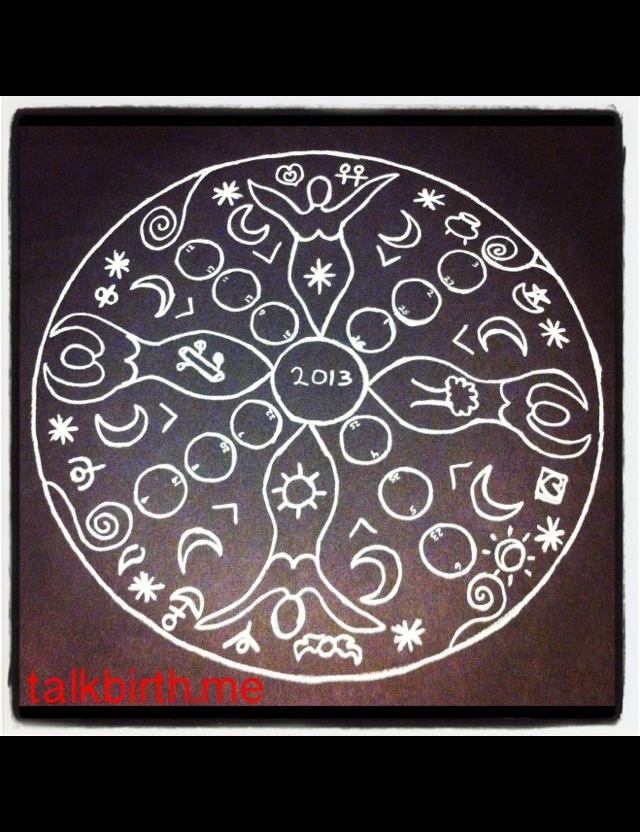
To kick off 2013, I drew a new Full Moon Calamandala!

20121231-011737.jpg

Young Moms: Making Childbirth Education Relevant to Them

This guest post is part of my blog break festival. The festival continues throughout December, so please check it out and consider submitting a post! Also, don’t forget to enter my birth jewelry giveaway. This guest post is about making childbirth education relevant to young mothers. I have a previous post about the classes I taught for a local Young Parents program (some handouts are included): Young Parents Program Prenatal Classes. Another related post, though not specific to childbirth education, is this one about Rites of Passage Resources for Daughters & Sons. If you’re interested in providing birth education specifically for young parents, you might also enjoy checking out CAPPA’s Teen Educator certification program.

Young Moms: Making Childbirth Education Relevant to ThemLoriblessingway 117a

by Keri Samuelson

In this day and age, encountering young mothers is common. With so many of our daughters fitting into this category, updating the ways we educate these expectant mothers should be a top priority. Young people may think they can handle everything on their own, but the truth is that they may still need to learn the basics when it comes to childbirth. They need to know what to expect and how to react. Here’s my take on how to tackle the experience:

Update The Imagery
We have many tools at our fingertips, but some of them require a bit of updating. For instance, it’s imperative to revamp the video and online databases that we frequently employ in hospitals, high school classrooms and the like. Young people today simply do not relate to the characters depicted in movies from the 80s or 90s. They want to see people they can relate to experiencing what they themselves are about to. Do yourself a favor – avoid these outdated resources, and make suggestions to libraries or clinics that still use them.

The Whole Truth
Tell girls the truth – this will need to encompass more than just some action shots of women giving birth. If you are for instance sponsoring a program for expectant mothers, invite women who have recently given birth, and have them detail everything from the beginning to the end of the laboring process. This way, mothers-to-be will have fewer surprises in tow. Also, make sure there is time for questions, and be sure to allow questions to be asked confidentially (on slips of paper, for instance, that you collect and read without announcing the asker), so that the session is truly as relevant as possible.

Technology
Show them that birth is unlikely to be like the shows they watch on television or the movies that they have seen. It sometimes can take many, many hours. It can be exhausting and might be very painful, but it is also very normal and usually safe.

Celebrity Guest Spots
Information is a wonderful tool, but the presenter of this information is what can make or break its effectiveness. In this day and age, celebrities are given the floor more than medical professionals, and so it can be a wise decision to have celebrity mothers give their own testimonies of and their experience. Obviously, not everyone has access to a celebrity, so perform simple Google searches for celebrities you know of that your clients might identify with, and see what they have to say about motherhood on their website, or in interviews. If this still doesn’t work, look for local superstars whom you know have given birth – athletes, state officials, teachers, etc. that you know your young clients will look up to and listen to.

These are, of course, just a few ideas for making childbirth education a little more relatable to youth that are expecting a child. It begins with accurate information, presented by someone who they feel they can trust, and delivered in a manner that doesn’t sugar coat the process either.

Keri Samuelson writes about health promotion, motherhood and helping young people find the best accelerated nursing programs.