Archives

Talk Books: Cycle to the Moon

c2m3D“Moontime opens up our intuition.
By allowing ourselves to honour this time,
we can eliminate premenstrual tendencies…
Moontime is a sacred passage leading
to a greater awareness of self.”

–Veronika Robinson, Cycle to the Moon (p. 142)

In April, on the evening of our local Red Tent Circle, a package arrived for me from the UK. In it was the beautiful book by Veronika Robinson, Cycle to the Moon, that I won in the Red Tent fundraising auction for Moontimes. March 2015 183

Cycle to the Moon is a quick read and an inspiring one. The line illustrations are beautiful and the combination of journal pages/prompts and text is nice.

Cycle to the Moon also suggests a neat idea of creating a “Red Box” for a pre-teen daughter. Either together with your daughter or on your own for a surprise, collect special items in a box to be given to her upon menarche. It can have jewelry, garnet gemstones, books, cloth pads, tea, and so forth. She makes the potent observations that how we welcome young girls into womanhood, sets the stage for how they will view themselves and their life cycles and transitions for a lifetime:

“As we hold the hands of our young sisters when they cross the menstrual threshold, we would be wise to remember that their experience of this cycle will affect them throughout their childbearing years and into menopause. There’s a red thread which weaves through these major themes of our life. Every moment is connected. Whatever we have learned and integrated benefits not only us, but the culture” (p. 41).

Robinson also writes about the idea how you treat yourself during menstruation as a “mirror of your life”:

“The simple truth is that menstruation is a mirror of your life. If you’re not honouring your body through healthy food choices; ample hydration; rest; playtime; calmly managing stressful events; positive thoughts; creativity and sleep; then it will show up in your menstrual cycle…your hormones will come to call; and they will demand that you rest. You might try and quiet them down with headache tablets or something pharmaceutical for cramps, but they will keep talking to you (even if it takes twenty years), until you get the message. If you don’t honour your body during the menstrual years, you are highly likely to suffer when you reach menopause…

She also makes an interesting distinction between what is “normal” and what is “natural”:

“There is such a wide variance in cycle length these days that doctors consider it normal to bleed any time. It might be normal, but it is not natural. Modern statistics relating to menstruating women are taken from huge cities about women whose lifestyles are not in accord with Nature. Artificial street lighting, pollution, stress, foods coated in chemicals, nutritional deficiencies, are just a few contributing factors in the variance of cycle days.

Our body’s cycle is regulated by the Moon’s light. The pituitary and hypothalamus glands are light sensitive, which is why we disrupt our cycle immensely by sleeping near artificial light, such as street lights, computer, mobile/cell phone or clock-radio lights. In fact, keep all electromagnetic devices well out of your sleeping space. If you intend to be conscious of cycling to the Moon, and ensuring optimal health, then don’t sleep under or next to any artificial light. Instead, keep your room dark, and only open your curtain for the week of the full Moon, thus coming into alignment with it. If you live in the country it will not be necessary to keep out starlight…city girls often begin menstruation earlier than country girls because of street lighting” (p. 142).

There are also a number of great resources at the end of Cycle to the Moon, such as:

Red Wisdom

Red Tent

Red Tent Booklet

What we do in our own local Red Tent Circle varies each month, but we start with introductions using our maternal May 2015 047line and a red thread to represent our connection to the women who came before us and who will go after us, we sing, we have a sharing circle where we “pass the rattle” and talk about our lives and have what we say witnessed and held in safe space. We do a guided meditation and journaling and then a project. In April we had a salt bowl ceremony and then did footbaths and in May we made moon necklaces. We close with a poetry reading and a song. There is tea and a “reflection” table with guidance cards, art supplies, and books to look at. At our May Circle, I shared these two quotes:

“The revolution must have dancing; women know this. The music will light our hearts with fire,
The stories will bathe our dreams in honey and fill our bellies with stars…”

–Nina Simons in We’Moon 2012

“A woman’s best medicine is quite simply herself, the powerful resources of her own deep consciousness, giving her deep awareness of her own physiology as it changes from day to day.”

–Veronica Butler and Melanie Brown

I asked the women to share their revolutions and their medicine. As they spoke, I realized that my “revolution” and my “medicine” were in the planning and facilitation of these Circles, as well as in the online Red Tent Initiation Program I will be offering this summer. I’m so glad I decided to go this direction this year.

May 2015 072


Restoring Women to Ceremony: The Red Tent Resource Kit

 “… Every day, we witness the positive, transformative effects of, ‘restoring women to ceremony’…another reason it is vital that we continue our work…”

–D’vorah Grenn (Stepping into Ourselves, p. 56)

We’ve been hard at work over the last three months giving birth to a new project!

Introducing…The Red Tent Resource Kit

redtentkit

I actually ended up sort of accidentally writing a whole new book to go with this kit. It was originally going to be a collection of handouts as a pdf. However, as I put the handouts together, I realized I was actually writing a short book or manual instead. I also reflected on how I am tired of only getting pdf manuals and ebooks when I sign up for different programs, rather than an actual, printed book. One of my mottoes this year is to follow the inspiration, so I went with it, and at the end of last month our new books arrived and they’re beautiful and I’m so excited about them!

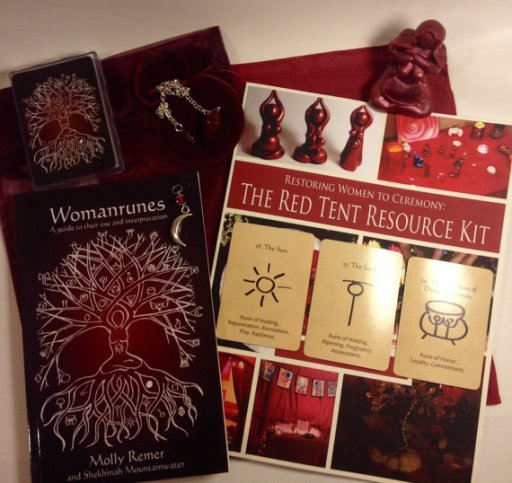
Our unique, signature Red Tent Kit includes ALL of the following resources:

  • Womanrunes Book and Card set: ideal for personal guidance and self-development, or for the inspiration and renewal corner at your Red Tent Circle.
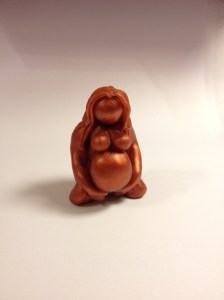
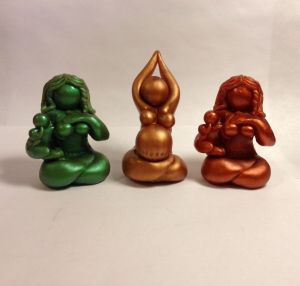
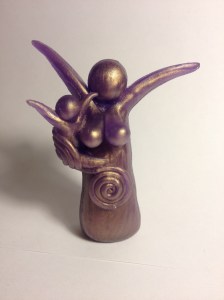
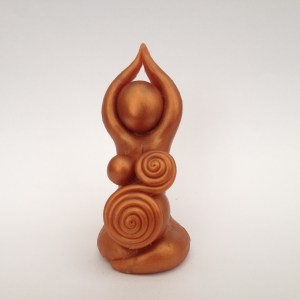
  • Red Tent Goddess Sculpture: symbolic of self-care and of both receiving and giving.
  • Carnelian Pendulum (kit exclusive!)
  • Brand new 58 page book: Restoring Women to Ceremony, The Red Tent Resource Kit, written exclusively for this kit. In this collection of essays and ritual resources, you will find a complete Red Tent “recipe,” circle leadership basics, moontime musings, and readings, quotes, and poems to help you facilitate a rich, inviting, welcoming, creative space for the women of your community.
  • Moontime pendant with silver-tone, solid crescent moon charm
  • Red altar cloth
  • Red organza bag to store your resources
  • Coupon for $100 off the companion Red Tent Initiation online training to be held in July-August
  • Extra surprise bonus goodies intuitively chosen for you!

The contents of this Kit are valued at $100 when sold separately!

When I was taking pictures for the Kit, I randomly drew three Womanrunes cards to include in the pictures. The ones I drew were absolutely perfect for sharing the message of what this collection has to offer to others and what we hope to create in restoring women to ceremony:

IMG_4889


Tuesday Tidbits: International Day of the Midwife

IMG_4848Today is International Day of the Midwife and I find myself reflecting on the many midwives I have known and the incredibly diversity and gifts of the women who join this profession. In addition to the midwives I had for prenatal and postpartum care for each of my births, I’ve been privileged to know many midwives on the state and national level through our shared interest in maternity care activism and birth rights. With my first baby, I had prenatal and birth care with a family practice physician and a CPM. The CPM was gray-haired, pretty, soft-spoken and wryly witty and pretty much exactly what you picture a stereotypical midwife looking like! My prenatal care with this team was excellent, birth care so-so (I didn’t need much), but my postpartum care left a lot to be desired and I felt very cast adrift after the birth. I became very embroiled with midwifery activism and birth work after this birth and as a result my experiences with all subsequent midwives has been an interesting blend of collegial + consumer. My first birth was the only one for which I was consumer only. Though I’m not a midwife myself, my subsequent experiences all involved being a sister birthworker AND client, rather than solely a client. This has both benefits and disadvantages.

My midwife with my second baby was amazing. I loved her so much and I have felt a gap in every pregnancy following that I was not able to have her as a midwife again. She was gentle and caring and passionate and inspiring and wonderful. Cute and upbeat, full-figured, and intelligent, she had a soft and reassuring presence and gave wonderful hugs! We became good friends and she was a very important part of my life. My prenatal care and birth care with her was excellent. She was also helpful with postpartum care, but I don’t think I “allowed” her to be as helpful as she could have been because I couldn’t allow myself to be as vulnerable and needy as I actually felt.

When I was pregnant with my third baby, my much-loved midwife had moved away and found myself at a loss for who to choose for pregnancy and birth care. This baby died early in my second trimester and I found myself calling on the sisterhood of midwives for help when I desperately needed it. From the very busy midwife who talked to me kindly and patiently when I was freaking out over a retained placenta, to the Mennonite midwife who helped me from the road as she was driving to another state and connected me to yet another midwife several hours away who drove in to town to meet and help me when I was very scared and alone, it was during this experience that I realized very viscerally how much we need midwives in our lives. When I was pregnant again, I decided to choose the Mennonite midwife for my prenatal care and immediate postpartum care. She is a very capable and determined and intelligent midwife, but I felt an unbridgeable gap between us spiritually speaking and so was never able to fully connect with her emotionally. She embodied the gray-haired, no-nonsense “granny midwife” archetype. She provided great prenatal care and was very respectful of my wish for immediate postpartum care, but an unassisted birth. Postpartum follow-up care was limited due to snowstorms.

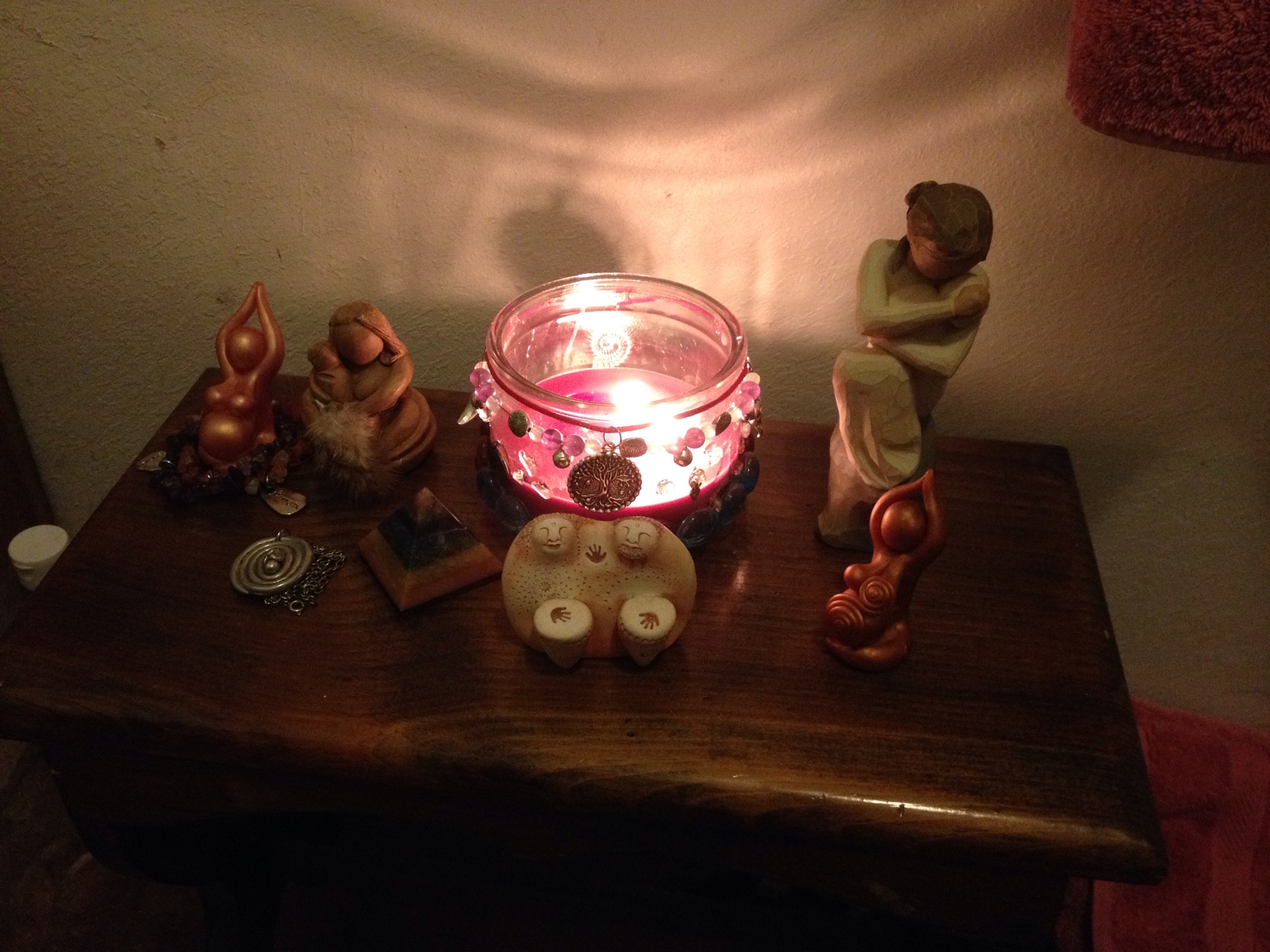
With my last baby, I felt a powerful need to feel taken care of again. I really needed to have some set aside time, Mollyblessingway 027space, and energy that was just focused on me and my baby. I knew that I needed a midwife! While I could have used the same midwife as with the baby before, this time it was important to me to develop the emotional connection I had with my second midwife—I needed a midwife with whom I could feel “safe” with all of me, instead of feeling like I had to hide my goddess sculptures when she came over! 😉 It took some work, but I was able to find that. With this experience, I came to accept that the blur between colleague-consumer is my reality and I will never re-capture the feeling of being client only and being completely focused on in that respect, because I’m simply not just a client only. That’s okay. This midwife has long brown hair, wears lots of skirts and had the hippie-ish midwife feel I was craving. She is funny and talkative and connected to the roots of what midwifery is all about. I was safe with her in the way I needed. I really appreciated the midwife’s prenatal care (and the opportunity to focus on my pregnancy and baby), her respect of my wish for immediate postpartum care rather than birth care, and her postpartum follow-up care. I felt like this midwife offered the most complete postpartum care of all of my birth experiences.

I’ve mentioned before that the only vaginal exam I had during six pregnancies was at ten centimeters dilated when I went to the birth center to push out my baby (I also had to have one for a manual clot extraction following his birth and one for help removing the placenta after my miscarriage-birth of my third baby). This is totally cool with me. Somehow I’ve managed to labor and birth four full-term babies without ever knowing how dilated I am in labor! So, I loved reading this article about the pointlessness of vaginal exams in labor and the cultural attachment, even in midwifery circles, to cervix-focused childbirth:

“…There is also reluctance to change hospital policies, underpinned by a need to maintain cultural norms. The Cochrane review on the use of partograms on the one hand states that they cannot be recommended for use during ‘standard labour care’, and on the other hand states: “Given the fact that the partogram is currently in widespread use and generally accepted, it appears reasonable, until stronger evidence is available, that partogram use should be locally determined.” Once again, an intervention implemented without evidence requires ‘strong’ evidence before it is removed. The reality is that we are unlikely to get what is considered ‘strong evidence’ (ie. randomised controlled trials) due to research ethics and the culture of maternity systems. Guidelines for care in labour continue to advocate ‘4 hourly VEs’ and reference each other rather than any actual research to support this (NICE, Queensland Health). Interesting whilst Queensland Health guidelines recommend 4 hourly VEs, their parent information leaflet states: “While a VE can provide information about how a woman has progressed so far in labour, it cannot predict how much longer you will be in labour…” and that there are “…other factors such as the strength, duration and length of contractions as well as a woman’s behaviour and wellbeing that can indicate progress in labour”. Which begs the question ‘why bother doing a VE’?

The cervical-centric discourse is so embedded that it is evident everywhere. Despite telling women to ‘trust themselves’ and ‘listen to their body’, midwives define women’s labours in centimetres “She’s not in labour, she’s only 2cm dilated”. We do this despite having many experiences of cervixes misleading us ie. being only 2cm and suddenly a baby appears, or being 9cm and no baby for hours. Women’s birth stories are often peppered with cervical measurements “I was 8cm by the time I got to the hospital”. Even women choosing birth outside of the mainstream maternity system are not immune to the cervical-centric discourse. Regardless of previous knowledge and beliefs, once in labour women often revert to cultural norms (Machin & Scamell 1997). Women want to know their labour is progressing and there is a deep subconscious belief that the cervix can provide the answer. Most of the VEs I have carried out in recent years have been at the insistence of labouring women – women who know that their cervix is not a good indicator of ‘where they are at’ but still need that number. One woman even said “I know it doesn’t mean anything but I want you to do it”. Of course, her cervix was still fat and obvious (I didn’t estimate dilatation)… her baby was born within an hour…”

Vaginal examinations: a symptom of a cervical-centric birth culture | MidwifeThinking

I also read this article about the now late, great midwife and activist, Sheila Kitzinger and how she connected her birthwork to feminism (as do I). I despise the article’s title, but it is still worth a read!

…In the Seventies, I was viewed as a radical for saying that birth was being depersonalised and treated as if it were a pathological event, rather than a normal life process.

To my surprise, it wasn’t just obstetricians who dismissed what I had to say. I also found myself in conflict with feminists, who saw birth in very simplistic terms.

Why? Because they claimed it was every woman’s right to give birth painlessly.

An article in Spare Rib, the radical campaigning feminist magazine, went further.

Without any evidence, the authors asserted: ‘Undoubtedly, hospitals, with all their faults, are the safest places in which to give birth. For this reason, we think we should press for improvements in hospitals rather than support a move to more home confinements.’

I was appalled at how my sister-feminists could fail to support woman-centred birth. Polly Toynbee, writing in The Guardian, was particularly virulent, dismissing me as a lentil-eating earth goddess…

via Sheila Kitzinger on why feminists HATE natural childbirth and why it’s harmful | Daily Mail Online.

Lentil-eating earth goddesses unite! Unlike Kitzinger’s experiences with the distance between some expressions of feminism and birth-care, I find that many midwives, whether explicitly or implicitly, understand the deep connection between midwifery care, birth activism, and feminism.

“Midwifery work is feminist work. That is to say, midwives recognize that women’s health care has been subordinated to men’s care by a historically male, physician-dominated medical industry. Midwifery values woman-centered care and puts mothers’ needs first. Though not all midwives embrace the word feminism (the term admittedly carries some baggage), I maintain that providing midwifery care is an expression of feminism’s core values (that women are people who have intrinsic rights).

–Jon Lasser, in Diversity & Social Justice in Maternity Care as an Ethical Concern, Midwifery Today, issue 100, Winter 2011/2012

via Midwifery & Feminism | Talk Birth

Perhaps this is because midwives care so deeply about mothers and feminists might actually make the best mothers…

…As a mother who works extensively with other mothers, I appreciated Caron’s acknowledgement that raising children is a feminist act with potential to create change as well. “Another strategy for change is through raising children to be just and caring people. A media image portrays feminists as being against motherhood—but in fact, feminists make the best mothers. They raise children aware of themselves and the world, of options and values, of what justice means and how to work toward it, and how to be self-critical and self-respecting” (p. 203-204). Caron also explains that “in a just society, women would be free to make whatever decisions they needed to, for however long they needed to, in relation to political action in the public and the private sphere. All people would participate in the decision-making, and women would be supported in their decisions rather than, as sometimes happens, made to feel guilty for not doing enough or not valued for what they do.”

via Thesis Tidbits: Feminism, Midwifery, and Motherhood | Talk Birth.

dayofmidwifeHappy International Day of the Midwife! Thank you for bearing witness to our journeys and for holding the space for the continually unfolding spiral of life.

“…As we ready ourselves to accept new life into our hands,
Let us be reminded of our place in the dance of creation.
Let us be protectors of courage.
Let us be observers of beauty.
Let us be guardians of the passage.
Let us be witnesses to the unfolding…”

—Cathy Moore (in Sisters Singing)

via National Midwifery Week! | Talk Birth.

In addition to midwives, we’re also celebrating mothers all week this week! First on our lineup of activities is our gift to you: our first ever coupon code for $5 off purchases over $15. Use code: MOTHER.

We’ve also got a giveaway upcoming, two new product launches, a new Facebook group, and two class announcements! Stay tuned…

April 2015 021

Tuesday Tidbits: Cesarean Awareness Month

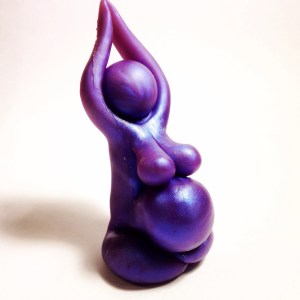
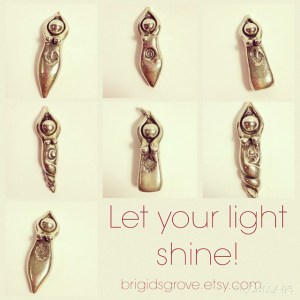
11148668_1614543705424512_3613965156253725168_nIt is Cesarean Awareness Month! We finished several new mama goddess designs this month and have a CAM-themed April newsletter ready to go out (subscriber freebie in this newsletter is a new birth education handout: “Can I really expect to have a great birth?” Sign up for the newsletter at Brigid’s Grove!)

Some Cesarean Awareness Month themed posts for this week. First, a meditation for before a cesarean:

You say you honor choices. 11108844_1614067252138824_1518757261202060615_n
Can you really honor mine?
I will always honor the process which
brought forth flesh of my flesh.
I honor your births too.
Can you ever honor my experience, or will I
forever be a part of your statistics on
the way things shouldn’t be?

via Birthrites: Meditation Before a Cesarean | Talk Birth.

And, some past thoughts on helping a woman give birth…what is the balance between birth interference and birth neglect?

There can be a specific element of “smugness” within the natural birth community that has been gnawing at me for quite some time. A self-satisfied assumption that if you make all the “right choices” everything will go the “right way” and women who have disappointing or traumatic births must have somehow contributed to those outcomes. For example, I’m just now reading a book about natural mothering in which the author states regarding birth: “Just remember that you will never be given more than you can handle.” Oh, really? Perhaps this is an excellent reminder for some women, and indeed, at its very core it is the truth—basically coming out alive from any situation technically means you “handled it,” I suppose. But, the implicit or felt meaning of a statement like this is: have the right attitude and be confident and everything will work out dandily. Subtext: if you don’t get what you want/don’t feel like you “handled it” the way you could or “should” have, it is your own damn fault. How does a phrase like that feel to a woman who has made all the “right choices” and tried valiantly to “handle” what was being thrown at her by a challenging birth and still ended up crushed and scarred? Yes, she’s still here. She “handled it.” But, remarks like that seem hopelessly naive and even insulting to a woman whose spirit, or heart, has been broken. By birth. Not by some evil, medical patriarchy holding her down, but by her own body and her own lived experience of trying to give birth vaginally to her child.

via Helping a Woman Give Birth? | Talk Birth.

An educational video and some cesarean infographics from Lamaze: Lamaze for Parents : Blogs : How to Avoid a Cesarean: Are You Asking the Right Questions?

And a VBAC Primer from Peggy O’Mara: VBAC Primer | Peggy O’Mara

Some thoughts on the flawed assumption of maternal-fetal conflict and how that impacts the climate of birth today:

I think it is fitting to remember that mother and baby dyads are NOT independent of each other. With a mamatoto—or, motherbaby—mother and baby are a single psychobiological organism whose needs are in harmony (what’s good for one is good for the other).

As Willa concluded in her CfM News article, “…we must reject the language that portrays a mother as hostile to her baby, just because she disagrees with her doctor.”

via Maternal-Fetal Conflict? | Talk Birth.

And some past thoughts on Birth Strength:

“Women are strong, strong, terribly strong. We don’t know how strong until we are pushing out our babies. We are too often treated like babies having babies when we should be in training, like acolytes, novices to high priestesshood, like serious applicants for the space program.” –Louise Erdrich, The Blue Jay’s Dance

via Birth Strength | Talk Birth.

(I would revise this slightly to say “until we have birthed our babies,” since strength is found in many different birth, postpartum, breastfeeding, and mothering experiences, not only in pushing out our babies. I still love the quote though!)

11150546_1614074768804739_5920468981887497904_n

Sheila Kitzinger

‘Sheila taught me, from an early age, that the personal was political – not just by what she said but by what she did. As I was growing up I learnt from her campaigns for freedom and choice in childbirth that passionate and committed individuals can create social change. She never hesitated to speak truth to power. –Prof. Celia Kitzinger, Sheila’s oldest daughter

via Sheila Kitzinger 1929-2015 | Pinter & Martin Publishers.

Yesterday morning, I learned that childbirth education trailblazer, maternity activist, and phenomenally influential author, Sheila Kitzinger has died. By the end of the evening, her name was coming up as “trending” on Facebook, which is the first time I’ve ever noticed anything flagged for me as trending that wasn’t mainstream celebrity-related, holiday, sporting-event, OR horrible tragedy, disaster, or scandal related. So, Sheila continues to break new ground in maternity care activism!

My own work with birth and my philosophy of birth education and activism has been deeply shaped by this marvelous woman. She is one of my all-time favorite childbirth authors and may be the most quoted person on my blog! In fact, as I was scrolling through old posts to find some to share in memorial, I had to quit looking after the fourth page of search results because there were simply too many. Here are some of the ones I did find:

I agree with anthropologist Sheila Kitzinger who said that, “In any society, the way a woman gives birth and the kind of care given to her and the baby points as sharply as an arrowhead to the key values of the culture.” Our current birth culture does not value women and children. Though my focus is usually on the women, it also doesn’t much value men or fathers either. I also agree with Kitzinger’s assessment that, “Woman-to-woman help through the rites of passage that are important in every birth has significance not only for the individuals directly involved, but for the whole community. The task in which the women are engaged is political. It forms the warp and weft of society.”

via A Blessing…and more… | Talk Birth.

Same quotes used in two other posts:

These concepts—and the lack of a similar one in American culture—reminds me of a quote from Sheila Kitzinger that I use when talking about postpartum: “In any society, the way a woman gives birth and the kind of care given to her and the baby points as sharply as an arrowhead to the key values of the culture.”

via Some reminders for postpartum mamas & those who love them | Talk Birth.

And, Rites of Passage… Celebrating Real Women’s Wisdom | Talk Birth.

Touching on the political aspects of birth culture:

“In acknowledging woman-to-woman help it is important to recognize that power, within the family and elsewhere, can be used vindictively, and that it is not only powerful men who abuse women; women with power may also abuse other women.” –Sheila Kitzinger

via Birth Quotes of the Week | Talk Birth.

Personally influential to my own labors:

During my first labor, I experienced what Sheila Kitzinger calls the “rest and be thankful stage” after reaching full dilation and before I pushed out my baby. The “rest and be thankful stage” is the lull in labor that some women experience after full dilation and before feeling the physiological urge to push. While commonly described in Kitzinger’s writings and in some other sources, mention of this stage is absent from many birth resources and many women have not heard of it.

via The Rest and Be Thankful Stage | Talk Birth.

And, my own personal postpartum care: Ceremonial Bath and Sealing Ceremony | Talk Birth.

Her books shaped birth HERstory:

Women’s (Birth) History Month | Talk Birth.

And, my own birth education philosophy (as well as my core value in working with women):

Labour is a highly personal experience, and every woman has a right to her own experience and to be honest about the emotions she feels. Joy tends to be catching, and when a teacher has enjoyed her own births this is valuable because she infuses her own sense of wonder and keen pleasure into her relations with those she teachers. But she must go on from there, learn how difficult labour can be for some women, and develop an understanding of all the stresses that may be involved.

via Sheila Kitzinger on a Woman’s Right to Her Own Experience | Talk Birth.

And, she celebrated birth:

I hope all of the women I know who are giving birth in the upcoming season discover that, as Sheila Kitzinger said, “Birth isn’t something we suffer, but something we actively do and exult in.” (from promo for One World Birth)

via Invisible Nets | Talk Birth.

Thanks for everything, Sheila! You’re amazing!

“Childbirth takes place at the intersection of time; in all cultures it links past, present and future. In traditional cultures birth unites the world of ‘now’ with the world of the ancestors, and is part of the great tree of life extending in time and eternity.” –Sheila Kitzinger

via Tuesday Tidbits: Tree Mother | Talk Birth.

IMG_3783

Tuesday Tidbits: Women’s Work

“The minute my child was born, I was reborn as a feminist. It’s so incredible what women can do…Birthing naturally, as most women do around the globe, is a superhuman act. You leave behind the comforts of being human and plunge back into being an animal. My friend’s partner said, ‘Birth is like going for a swim in the ocean. Will there be a riptide? A big storm? Or will it just be a beautiful, sunny little dip?’ Its indeterminate length, the mystery of its process, is so much a part of the nature of birth. The regimentation of a hospital birth that wants to make it happen and use their gizmos to maximum effect is counter to birth in general.”

–Ani DiFranco interviewed in Mothering magazine, May/June 2008

via International Women’s Day, Birth Activism, and Feminism | Talk Birth.

February 2015 020It is Women’s History Month and we just passed International Women’s Day this Sunday, so today I have a collection of posts either about International Women’s Day or the theme of women’s work in general.

The first is this article about the basics of natural birth intended for the “non-hippy” reader:

“But is that really it? Is birth so simple as that? Is it really so simple as just having faith in your body and protecting and working with your natural hormonal flow?

Well mostly – yes!

It is that simple. Natural birth occurs when women feel safe, feel loved, feel listened to, are surrounded by calm loving people, and go with their natural birth flow. In all its intensity – your body was designed to handle it. Even if you don’t know it yet.

It IS hard work. It IS intense. It does help if you’re a bit bendy. It does help if you are active throughout pregnancy and vaguely fit. But no yoga required if that doesn’t float your boat. All the drugs and pain relief you need are right inside you. All the strength you need is right inside you. If you can find birth attendants who will mirror that belief back at you in their eyes, in their hearts, in their hands, in their attitude and manner, and in their language to you – in effect, saying ‘I believe in you’, you are one step closer to discovering the greatest, and the most ordinary and yet extraordinary power known to woman – natural birth…”

go-with-the-flow » Natural homebirth – not just for hippies!

This post made me think of one of my own on the “rest and be thankful stage” that has been linked to a lot over the last few days:

I always make sure to tell my birth class clients about the possibility of experiencing a lull like this, because it is during this resting phase that labor is sometimes described as having “stalled” or as requiring Pitocin to “kick it off again” or as requiring directed or coached pushing. Also, think of the frequency of remarks from mothers such as, “I just never felt the urge to push.” When exploring further, it is often revealed that what the mother actually experienced was no immediate pushing urge instantly following assessment of full dilation. Depending on the baby’s position, this can be extremely normal. The way I explain it to my clients is that the lull represents the conclusion of the physiological shift happening in the uterus—the transition between contractions that open the cervix and the contractions that push the baby down and out.

via The Rest and Be Thankful Stage | Talk Birth.

I came across the not-just-for-hippies post when the author shared the link with me in the self-publishing class we are both enrolled in. (The current class is already in progress, but you can get information about the fall session here: Be Your Own Publisher – the self-publishing e-course.) This course was developed by Lucy Pearce (author of The Rainbow Way and The Moods of Motherhood), who recently wrote a post that really spoke to me about the “labyrinth of self-imposed limitations” we may find ourselves in when pursuing creative work (or any work we feel “called” to do):

Many of us live in a “labyrinth of self-imposed limitations” (thanks to one of my self-publishing students, Linda English, for that phrase).

Especially when it comes to our creativity.

And double-especially when it comes to owning ourselves as writers, or artists, or whatever creative pursuit or ambition we’re holding off on…

via I Will Be a Writer When… – Dreaming Aloud.

I also read this interesting post on the Fortune magazine site about mothering and working and thriving…

I wish I had known five years ago, as a young, childless manager, that mothers are the people you need on your team. There’s a saying that “if you want something done then ask a busy person to do it.” That’s exactly why I like working with mothers now.

via Female Company President: “I’m sorry to all the mothers I worked with” – Fortune.

And, I thought about my past Women’s Day posts, the first about a body prayer that I wrote, but that also quoted some information about the original intention of the day:

“International Women’s Day is not about Hallmark. It’s not about chocolate. (Thought I know many women who won’t turn those down.) It’s about politics, institutions, economics, racism….

As is the case with Mother’s Day and many other holidays, today we are presented with a sanitized, deodorized, nationalized, commoditized version of what were initially radical holidays to emphasize social justice.

Initially, International Women’s Day was called International Working Women’s Day. Yes, every woman is a working woman. Yes, there is no task harder perhaps than raising a child, for a father and a mother. But let us remember that the initial impetus of this International Working Women’s Day was to address the institutional, systematic, political, and economic obstacles that women faced in society…”

International Women’s Day: Body Prayer | Talk Birth

The second offering a prayer for mothers:

…hear your value March 2013 057
sing your body’s power
and potency
dance your dreams
recognize within yourself
that which you do so well
so invisibly
and with such love.

Fill your body with this breath
expand your heart with this message
you are such a good mother…”

International Women’s Day: Prayer for Mothers | Talk Birth.

I re-visited a past post in honor of Women’s (Birth) History Month:

“…we need to grasp an honest understanding of birthing history – one that tells HERstory not HIStory. Because birth is about Women. It is a woman’s story. And we need to also understand why and how this herstory compels women to make the choices they make surrounding birth in the present day.
People become the product of the culture that feeds them…”

Women’s (Birth) History Month | Talk Birth.

And, I did my own work creating our March newsletter covering Women’s Day, Shining Years, Red Tent Fundraiser, and More: Happy International Women’s Day! I’ve also made a lot of changes and additions to our website recently including a Womanrunes 101 page and other pages explaining more about our jewelry and and sculpture work.

I have so many ideas for what I’d like to do and create this year (we also have what feels like a lot of kids, including the babiest of adorable babies who is getting so big, so fast!) and I am trying to hard to do what makes sense and to choose wisely. It is hard to tease out the difference between self-limiting (or self-sabotaging) thought patterns and being sensible/practical/realistic for this stage in my life. I made a huge mind map today to try to help me clear some of this stuff out of my brain and I was going to share a picture of it, because it is freaking intense, but it also made me feel (or look) a little crazy, so I decided not to share it after all!

10985048_1598397140372502_1797564772323157625_n

Talk Books: Women Who Run with the Wolves

“Remember, there is a natural time after childbearing when a woman is considered to be of the underworld. She is dusted with its dust, watered by its water, having seen into the mystery of life and death, pain and joy during her labor. So, for a time she is ‘not here’ but rather still ‘there.’ It takes time to re-emerge.”

–Dr. Clarissa Pinkola Estes, Women Who Run With the Wolves (p. 441)

IMG_9858


I’ve spent years quoting Clarissa Pinkola Estes and yet had never read one of her books. My favorite quote is this one and I’ve returned to it again and again at various points in my life:

Be wild; that is how to clear the river.”

–Clarissa Pinkola Estes

Interestingly enough, I finally began reading Women Who Run with the Wolves while literally sitting in the river this summer while my kids played. One of the remaining items on my Leonie Dawson 100 Thing list for 2014 was to finish this book. And, now here in this “underworld” time with my new baby, I finally did it! In the afterword to the book, she mentions that this is a book meant to be read in small doses. She explains that she took twenty years to write it and that it is meant to be read in sections, thought about, and then returned to again. So, I guess I did exactly the right thing in how I read it this year—it took me more than six months to read it (I also read 90 other books this year in addition to this one!).

One of the quotes I quoted before reading the book was this classic one:

I am wild.

Wild Woman.

When women hear those words, an old, old memory is stirred and brought back to life. The memory is our absolute, undeniable, and irrevocable kinship with the wild feminine, a relationship which may become ghosty from neglect, buried from over domestication, outlawed by the surrounding culture, or no longer understood anymore. We may have forgotten her names, we may not answer when she calls ours, but in our bones we know her, we yearn toward her; we know she belongs to us and we to her.There are times when we experience her, even if only fleetingly, and it makes us mad with wanting to continue. For some women, this vitalizing ‘taste of the wild’ comes during pregnancy, during nursing their young, during the miracle of change in oneself as one raises a child, during attending to a love relationship as one would attend to a beloved garden.As sense of her also comes through the vision; through sights of great beauty. I have felt her when I see what we call in the woodlands a Jesus-God sunset. I have felt her move in me from seeing the fishermen come up from the lake at dusk with lanterns lit, and also from seeing my newborn baby’s toes all lined up like a row of sweet corn. We see her where we see her, which is everywhere.

–Clarissa Pinkola Estes, Women Who Run with the Wolves, quoted in Celebrating Motherhood by Andrea Gosline and Lisa Bossi

via Celebrating Motherhood: The Wild Woman and Sacred Business | Talk Birth.

Photo: "Remember, there is a natural time after childbearing when a woman is considered to be of the underworld. She is dusted with its dust, watered by its water, having seen into the mystery of life and death, pain and joy during her labor. So, for a time she is 'not here' but rather still 'there.' It takes time to re-emerge."</p> <p>--Dr. Clarissa Pinkola Estes, Women Who Run With the Wolves (p. 441)

I also love this quote about doors:

“The doors to the world of the wild Self are few but precious. If you have a deep scar, that is a door, if you have an old, old story, that is a door. If you love the sky and the water so much you almost cannot bear it, that is a door. If you yearn for a deeper life, a full life, a sane life, that is a door.” 

— Clarissa Pinkola Estés, Ph.D (Women Who Run With the Wolves)IMG_0545

While many quotes caught my attention upon this complete reading of her book and spoke to where I am, in addition to the one with which I opened this post, there are two in particular that really grabbed me. The first was about rage and creation. I love the idea that there is a time to show your incisors:

“…there is a time to reveal your incisors, your powerful ability to defend territory, to say ‘This far and no farther, the buck stops here, and hold onto your hat, I’ve got something to say, this is definitely going to change.’”

Dr. Clarissa Pinkola Estes on rage and creation in Women Who Run with the Wolves, p. 363

IMG_0920And, this powerful thought on creativity and the call to listen to the whispers of our own hearts:

“She may feel she will die if she does not dance naked in a thunderstorm, sit in perfect silence, return home ink-stained, paint-stained, tear-stained, moon-stained.” –Dr. Clarissa Pinkola Estes

Photo: "She may feel she will die if she does not dance naked in a thunderstorm, sit in perfect silence, return home ink-stained, paint-stained, tear-stained, moon-stained." --Dr. Clarissa Pinkola Estes

IMG_0928

I just love the way Tanner (now six weeks!) holds my necklace while he is nursing.

Previous posts with Clarissa Pinkola Estes quotes:

Celebrating Motherhood: The Wild Woman and Sacred Business

Tuesday Tidbits: More Wild Woman

The Value of Sharing Story

The Ragged Self

Ceremonial Bath and Sealing Ceremony

IMG_9629At three days postpartum, my mom and my doula, Summer, came over to do a sealing ceremony for me based on what I’d learned during my Sacred Pregnancy and Sacred Postpartum certification trainings. A sealing ceremony is based on the idea of “closing” the birth process. Pregnancy and birth are all about opening. We open up our bodies, minds, spirits, and hearts for our new babies. After birth, the body remains “open” and the idea with sealing the birth experience is to psychologically and physically “close” the body and help the mother integrate her birth experience into the wholeness of who she is. It is part of her “return” to the non-pregnant state and it is transition commonly overlooked by modern culture and sometimes by women themselves. We chose three days postpartum because that is a classic day for the “baby blues” to hit and it seemed like an important day to acknowledge, but it can be done at any point, preferably within the first 40 days. We started with the ceremonial bath. I had a very powerful experience with pre-birth ceremonial bath I did and this postpartum bath experience was very profound as well. My doula ran the bath and added milk and honey and I set up a small altar by the tub. I chose items for the altar that I felt had a connection to the birth altar I set up before birth, but that were now connected to postpartum and mothering another baby. So, I used things that were mother-baby centered primarily, but of course also included the birth goddess sculpture that I held all through my labor as well. Continuity.

IMG_9477IMG_9482 Summer brought me a small glass of strawberry wine and then Mark came in with some rose petals and scattered them in and then left me to rest in my bath. I started my Sacred Pregnancy playlist and the first song to play was the Standing at the Edge song that I’d hummed during labor. Continuity.

IMG_9478It took me a little while to settle into it, but then I did. I reviewed his birth in my mind and sipped my wine. After I finished the wine, I used the glass to pour water over each part of my body as I spoke a blessing of gratitude for each part and what it did for us. I cried a little bit over some parts. I spoke aloud some words of closure about my births and my childbearing years. I felt grateful. I also felt a sense of being restored to wholeness, complete unto myself. As I finally stood to leave the tub…the Standing at the Edge song began to play again.

I’ve written before that I use jewelry to tell my story or to communicate or share something. I wore one of our baby spiral pendants through most of my pregnancy because it helped me feel connected to the baby. I wore it all through labor and birth too. The baby spiral pendant was one of the things I put on the little altar by the tub as a point of continuity between his birth and now. When I got out of the bath, I was going to put the spiral back on, but suddenly it didn’t feel like the one I wanted to wear anymore. I went to my room and there it was–my nursing mama goddess pendant. Putting down the baby spiral and putting on the nursing mama felt like a powerful symbolic indicator of my transition between states.
IMG_9536
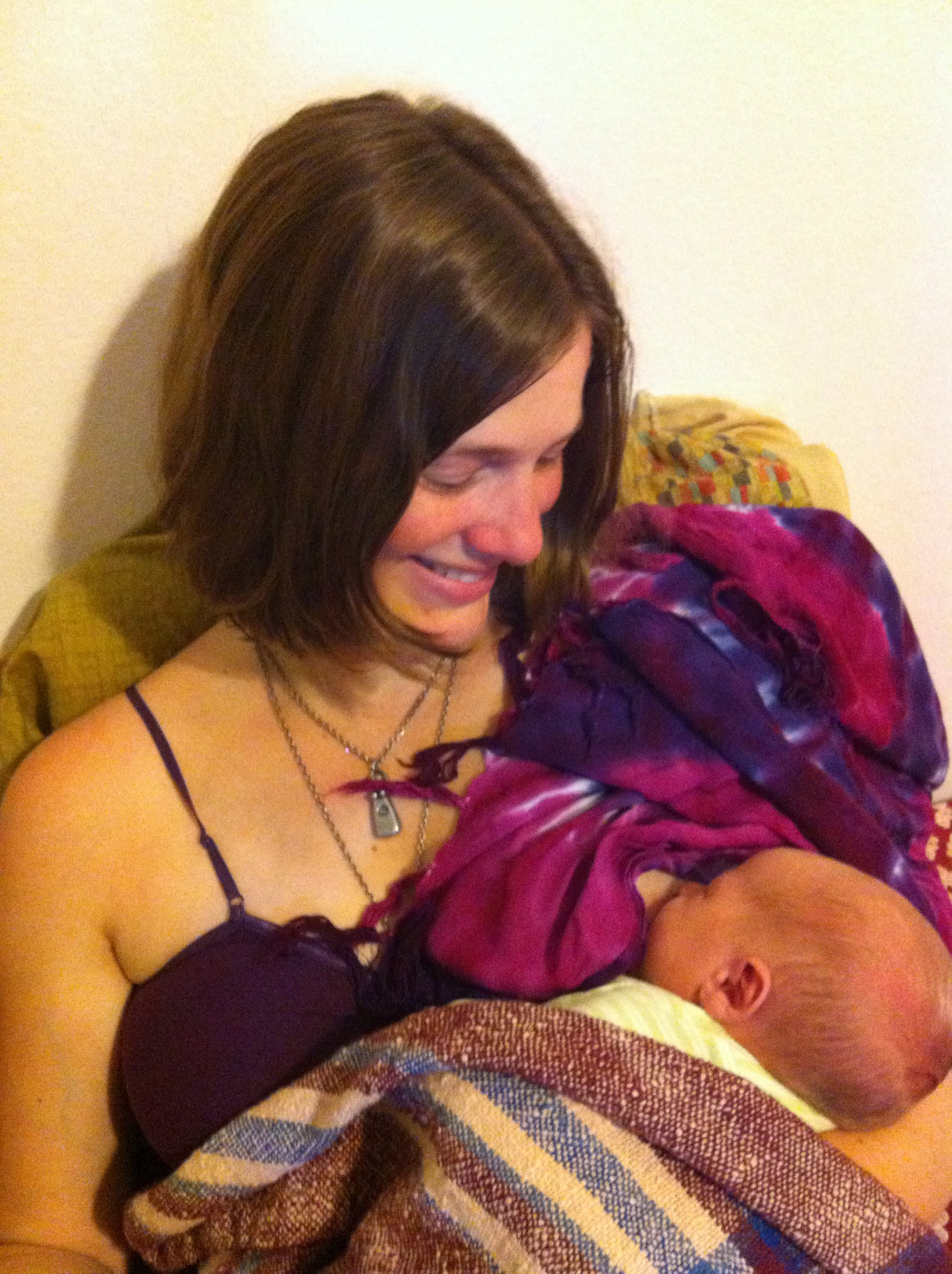
I put on the same purple tank top I’d worn in my pregnancy pictures and nursed Tanner. I had a sarong nearby for the “tuck in” part of the ceremony and I put it over my shoulder and asked my mom to take a picture. After we took the pictures, I realized the sarong was also the same one I wore in my pregnancy pictures. Continuity, again!

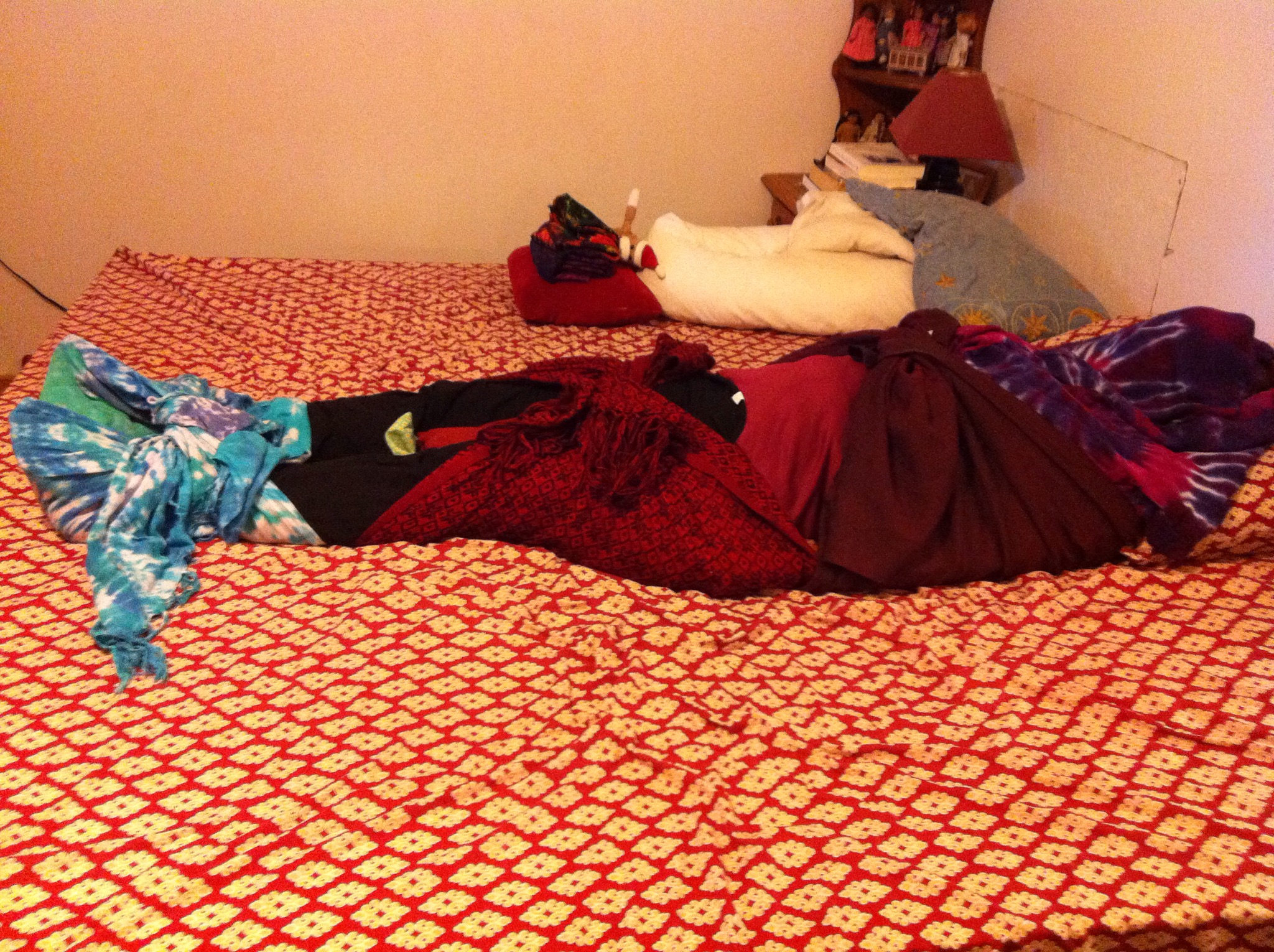
IMG_9515With Mark then holding the baby, Summer and my mom “tucked” me in using heated up flax seed pillows and some large scarves/sarongs. This tucking in symbolically pulls your body back together after the birth (sometimes called “closing the bones”) and also re-warms the body, which according to Chinese medicine and Ayurvedic understanding, is left in a “cold” state following the birth. I felt a little strange and “shroud-ish” while being tucked up and then especially when they put my mother blessing sheet on top of me and left the room.

IMG_9516 IMG_9519As I laid there though, I reflected that the shroud feeling was not so creepy after all. In fact, it was pretty symbolic itself—the ending of something and the emergence of something, someone, new. I felt a sense of wholeness and integration and coming back into myself. I had a sensation of unity and, yes, of my body coming back together into one piece.

When I felt done, I called them to come back in and Summer put a “belly firming paste” of turmeric, ginger, and coconut oil that I’d made in my class on my belly and then she and my mom wrapped me up in the belly bind I’d bought for this purpose. I don’t have time to write a lot about bellybinding right now, but you can read more about it here. It is anatomically functional, not just symbolic or pretty. When I first learned about it, I was sold on the concept, distinctly remember how weak and hunched over I felt after previous births.

I am again reminded of a quote from Sheila Kitzinger that I use when talking about postpartum: “In any society, the way a woman gives birth and the kind of care given to her and the baby points as sharply as an arrowhead to the key values of the culture.” Another quote I use is an Asian proverb paraphrased in the book Fathers at Birth: “The way a woman cares for herself postpartum determines how long she will live.” Every mother deserves excellent care postpartum, however, the “arrowhead” of American postpartum care does not show us a culture that values mothers, babies, or life transitions. I am fortunate to have had the kind of excellent care that every woman deserves and that few women receive. Part of this was because I actively and consciously worked towards building the kind of care I wanted following birth, but part of it is because I am lucky enough to belong to a “tribe” that does value pregnancy, birth, postpartum, and mothering.

IMG_9628

Talk Books: The Secrets of Midwives

“By the time the baby boy spilled into my arms, I knew. Women were warriors. And I wanted to be part of it.” –Neva Bradley

(character in The Secrets of Midwives by Sally Hepworth)

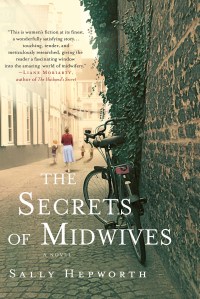
While feeling somewhat pre-laborish in the last days of pregnancy, I stayed up way too late devouring a review copy of the new novel The Secrets of Midwives Secrets of Midwives, theby Sally Hepworth. I  got it in the mail in the afternoon and by 1:30 a.m. that night, I’d finished the whole thing! In the past, I’ve been heard to remark that I can think of few things better than a novel about a midwife. Well…how about a novel about three midwives? That’s right, The Secrets of Midwives interlaces the three stories and pivotal life journeys of three midwives, who happen to be grandmother, mother, and pregnant daughter. Each midwife has a different personality and style of practice. In an intriguing style that kept me turning pages, the chapters are split between the viewpoints of each, allowing for multiple perspectives on the same relationship and personal issues.

Floss, the grandmother/mother, is retired from midwifery, but her chapters alternate between her early experiences as a midwife in the UK and her current life as a natural childbirth instructor. Neva, the daughter/granddaughter, is a hospital birth-center based CNM who is hiding her unexpected pregnancy with her own first child. Grace, the mother/daughter, is a CNM who attends homebirths.

The Secrets of Midwives contains elements of a romance story and elements of a mystery story. It blends the three women’s midwifery journeys in a creative, engaging way, including exploring the complex quality of mother-daughter relationships and communication vs. secret-keeping therein. It is serious enough to keep the pages turning, but not so “heavy” as to be depressing. There is a subplot in which the homebirth midwife is investigated by the state nursing board for possible malpractice and it felt relevant and contemporary to the fears and risks faced by midwives around the country. And, while reading as a pregnant woman myself, I appreciated that in this novel, with one pivotal exception, there are no scary births with bad outcomes—I find that high drama births resulting in maternal or infant death are a common feature of midwifery novels that often makes them somewhat iffy reads for pregnant women!

“That superhuman feeling people describe? It has nothing to do with the way the baby comes out. It’s about what happens to the mother. You become superhuman. You’ll grow extra hands and legs to look after your baby. You’ll definitely grow an extra heart for all the love you’ll feel.” –Neva Bradley

(in The Secrets of Midwives)

October 2014 012

 THE SECRETS OF MIDWIVES by Sally Hepworth

Find the author on Facebook here and her website here.

Published by St. Martin’s Press

On sale February 10, 2015

ISBN-13: 978-1-250-05189-9 | $25.99

Disclosure: I was provided with a complimentary copy of the book for review purposes.


Mother Blessings and the Power of Ritual

Mollyblessingway 116You are the
most powerful
intelligent
inspirational

Woman

Close to my heart.

You continue to
become
exponentially more amazing.

Always giving
others the step UP.

Force of the cosmos
connecting the Web

You are.

Thank you.

–Phanie


At the end of September, my friend sat on the floor during my mother blessing ceremony and wrote the above poem for me. When she gave it to me she said, “I’m not like you, I don’t write things and share them on the internet.” It was very powerful to receive the gift of written word from someone who does not often write, but who knows how deeply writing speaks to me. 

My mother’s circle of friends began holding mother blessing ceremonies for each other in the early 1980’s. At the time they called them “blessingways” in honor and respect for the Navajo traditions that inspired them to begin their own tradition. As awareness of cultural appropriation increased, we shifted our language to use “mother blessing ceremony” instead, though I confess that “blessingway” remains the term rooted in my heart for these powerful, mother-honoring celebrations of the power of the life-giving woman. After having been blessed with a ceremony during her last two pregnancies in the late 1980’s and having co-hosted coming-of-age blessing ceremonies for me and my sisters in the 90’s, my mother reintroduced the mother blessing ceremony to my own circle of friends during my first pregnancy in 2003. We’ve been holding them for women in the area ever since. I believe each pregnant woman deserves a powerful ritual acknowledging her transition through pregnancy and birth and into motherhood, regardless of how many children she has.

Early this year, I became unexpectedly pregnant with the baby who will arrive into our arms at the end of October as our fourth living child. I did not intend to have more children and it has been hard for me to re-open the space in my mind, heart, and family to welcome another baby when I had mentally and emotionally “shut the door” and moved on from the childbearing chapter of my life. (However, it turns out that writing blog posts about how you’re not having any more children is not, in fact, an effective means of birth control.)

In the book Rituals for Our Times, the authors Evan Imber-Black and Janine Roberts, identify five elements that make ritual work. Mother blessing ceremonies very neatly fulfill all of the necessary ritual elements (which I would note are not about symbols, actions, and physical objects, but are instead about the relational elements of connection, affection, and relationship):

  1. Relatingthe shaping, expressing, and maintaining of important relationships…established relationships were reaffirmed and new relationship possibilities opened. Many women choose to invite those from their inner circle to their mother blessings. This means of deeply engaging with and connecting with those closest to you, reaffirms and strengthens important relationships. In my own life, I’ve always chosen to invite more women than just those in my “inner circle” and in so doing have found that it is true that new relationship possibilities emerge from the reaching out and inclusion of those who were originally less close, but who after the connection of shared ritual, then became closer friends.
  2. Changingthe making and marking of transitions for self and others. Birth and the entry into motherhood—an intense and permanent life change—is one of life’s most significant transitions in many women’s lives. A blessingway marks the significance of this huge change.
  3. Healingrecovery from loss, special tributes, recovering from fears or scars from previous births or cultural socialization about birth. My mom and some close friends had a meaningful ceremony for me following the death-birth of my third baby. I’ve also planned several mother blessing ceremonies for friends in which releasing fears was a potent element of the ritual.
  4. Believingthe voicing of beliefs and the making of meaning. By honoring a pregnant woman through ceremony, we are affirming that pregnancy, birth, and motherhood are valuable and meaningful rites of passage deserving of celebration and acknowledgement.
  5. Celebratingthe expressing of deep joy and the honoring of life with festivity. Celebrating accomplishments of…one’s very being.

Notice that what is NOT included on this list is any mention of a specific religion, deity, or “should do” list of what color of candle to include! Mollyblessingway 177I’ve observed that many people are starved for ritual, but they may also be deeply scarred from rituals of their pasts. As an example from the planning of a past ceremony, we were talking about one of the songs that we customarily sing–Call Down Blessing–because we weren’t sure if we should include it in case it would feel too “spiritual” or metaphysical for the atheist-identified honoree (i.e. blessings from where?!). I also remembered another friend asking during a body blessing ritual we did at a women’s retreat, “but WHO’s doing the blessing?” As someone who does not personally come a religious framework in which blessings are bestowed from outside sources–i.e. a priest/priestess or an Abrahamic God–the answer, to me, feels simple, well, WE are. We’re blessing each other. When we “call down a blessing” we’re invoking the connection of the women around us, the women of all past times and places, and of the beautiful world that surrounds us. We might each personally add something more to that calling down, but at the root, to me, it is an affirmation of connection to the rhythms and cycles of relationship, time, and place. Blessings come from within and around us all the time, nothing supernatural required.
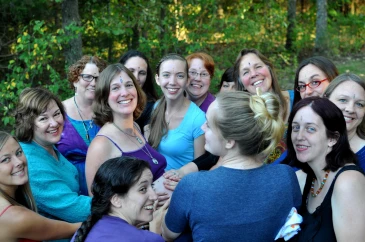
I also find that it is very possible to plan and facilitate women’s rituals that speak to the “womanspirit” in all of us and do not require a specifically shared spiritual framework or belief system in order to gain something special from the connection with other women.

In the book The Power of RitualRachel Pollack explains:

“Ritual opens a doorway in the invisible wall that seems to separate the spiritual and the physical. The formal quality of ritual allows us to move into the space between the worlds, experience what we need, and then step back and once more close the doorway so we can return to our lives enriched.”

She goes on to say:

You do not actually have to accept the ideas of any single tradition, or even believe in divine forces at all, to take part in ritual. Ritual is a direct experience, not a doctrine. Though it will certainly help to suspend your disbelief for the time of the ritual, you could attend a group ritual, take part in the chanting and drumming, and find yourself transported to a sense of wonder at the simple beauty of it all without ever actually believing in any of the claims made or the Spirits invoked. You can also adapt rituals to your own beliefs. If evolution means more to you than a Creator, you could see ritual as a way to connect yourself to the life force…

In the anthology of women’s rituals, The Goddess Celebrates, wisewoman-birthkeeper, Jeannine Pavarti Baker explains:

The entire Blessingway Ceremony is a template for childbirth. The beginning rituals are like nesting and early labor. The grooming and washing like active labor. The gift giving like giving birth and the closing songs/prayers, delivery of the placenta and postpartum. A shamanic midwife learns how to read a Blessingway diagnostically and mythically, sharing what she saw with the pregnant woman in order to clear the road better for birth.

Baker goes on to describe the potent meaning of birth and its affirmation through and by ritual acknowledgement:

Birth is a woman’s spiritual vision quest. When this idea is ritualized beforehand, the deeper meanings of childbirth can more readily be accessed. Birth is also beyond any one woman’s personal desires and will, binding her in the community of all women. Like the birthing beads, her experiences is one more bead on a very long strand connecting all mothers. Rituals for birth hone these birthing beads, bringing to light each facet of the journey of birth…

As my friends spoke to me at my own mother blessing ceremony, I felt seen and heard. They spoke to me of my own capacities, my Mollyblessingway 190strengths as a leader, teacher, and organizer. And, while I believe they were also actually trying to remind me of the opposite message, to take it easy and relax sometimes, one of the things I woke up the next day realizing is that yes, I do feel overwhelmed and overbooked and stretched thin at times. And, yes, I do whine and complain about it on Facebook sometimes, but in the end, I am always enough for whatever it is. I get it done anyway. I don’t think I’ve ever felt overwhelmed and then not done it (assuming “it” wasn’t a self-imposed expectation that I mercifully realized could be let go of). That is one my strengths: feeling the fear or the strain or the pressure or, yes, the excitement and thrill, and NOT getting paralyzed by it or letting myself off the hook. I work my way through and come out the other side, usually with my smile intact, my energy full, my head bubbling with ideas, and my eyes casting around for the next project. Occasionally, I do drop a ball, but pretty rarely, and when I do, I either find it or explain where it went and why I’m going to let it keep rolling away.

I discovered in this post-ritual reflection that it is just part of my personal process to be able to say, and be vulnerable enough to have people hear, see, or read, that I think maybe I can’t do something or that I’ve said yes to too much. The answer for me is not, “then don’t” or “stop” or “quit” or “take it easy,” it is to move forward and to see, again, that I was actually enough for what scared me or felt too big or too exhausting. I woke up the morning following the ritual in appreciation of my own capacities and how they continue to expand, even when I feel as if I’ve reached my own edges. I actually feel “too much,” “too intense,” “too big,” or “too fast” for people a lot, but what I don’t ever need is to be told to make myself smaller. I usually need to be able to say, “Yikes! What am I thinking?!” have that held for me for a minute, and then do it anyway. Just as those of us deeply invested in birthwork would never tell a laboring woman, “you’re right. You probably can’t do this. You should probably quit now,” my mother blessing ceremony reminded me that I am stretched thin precisely because I have it in me.

Mollyblessingway 258

I wish for you a life full of ritual and community.” –Flaming Rainbow Woman, Spiritual Warrior 

(in The Thundering Years: Rituals and Sacred Wisdom for Teens)

Molly is a priestess, writer, teacher, artist, and activist who lives with her husband and children in central Missouri. She is a doctoral student in women’s spirituality at Ocean Seminary College and the author of Womanrunes: A guide to their use and interpretation. Molly and her husband co-create at Brigid’s Grove: http://brigidsgrove.etsy.com.

Portions of this post are excerpted from our Ritual Recipe Kit booklet.

Adapted from a post at Feminism and Religion.

Other posts about mother blessings can be found here.

All photos by my talented friend Karen Orozco of Portraits and Paws Photography.

Mollyblessingway 372