What If…She’s Stronger than She Knows…

“When I dare to be powerful–to use my strength in the service of my vision–then it becomes less and less important whether I am afraid.”

Audre Lorde

As I was writing about shifting the “what if” dialogue of birth to “positive” anticipation rather than fear, another spin on the relationship between pregnancy, birth, womanhood, and what ifs began to emerge for me. I thought about the what ifs that crawl out of our dark places and lodge in our hearts. The what ifs that snake around the edges of our consciousness in the early hours of the morning. The what ifs we try to push down, down, down and away. The what ifs that stalk us. The what ifs so very awful that we fear in giving voice to them, we might give life to them as well.

We may feel guilty, ashamed, negative, and apologetic about our deepest “what ifs.” We worry that if we speak of them, they might come true. We worry that in voicing them, we might make homebirth or midwifery or whatever look bad. We don’t want to add any fuel to the fire of terror that already dominates the “mainstream” birth climate. And, we don’t want to lose “crunchy points.” We want to be blissfully empowered, confident, and courageous. And, guess what? We are. Sometimes that courage comes from looking the “what ifs” right in the eye. Sometimes it comes from living through them. My most powerful gift from my pregnancy with my daughter, my pregnancy-after-loss baby, was to watch myself feel the fear and do it anyway. I was brave. And, it changed me to learn that.

What if we can learn more from our shadows than we ever thought possible? There is power in thinking what if I can’t do this and then discovering that you CAN.

“It is so easy to close down to risk, to protect ourselves against change and growth. But no baby bird emerges without first destroying the perfect egg sheltering it. We must risk being raw and fresh and awkward. For without such openness, life will not penetrate us anew. Unless we are open, we will not be filled.”
–Patricia Monaghan

I also thought about an experience I had recently at a gathering of midwifery supporters. It was an interesting and insightful presentation about language and the impact on birth. The woman speaking urged us to talk in “positive” ways about birth, to use “positive” words and to avoid “negative” stories. As I listened to her, I thought of my own loss story and knew that my experience in giving birth to my little dead baby would likely have ranked way up there as a “negative” story. And, that bothered me. Giving birth via miscarriage to my third son was the most transformative, formative, and powerful experience of my life. He gave me many gifts, he taught me many lessons, and I am a better person than I was without that experience. So, what does it mean for women when we hide away the “negative” stories? What might we be missing by making sure we never hear about a bad outcome? I wondered what if by avoiding “negative stories,” we also miss out on powerful stories of courage, growth, and transformation…

What if she suffered and survived?
What if she danced with death and she’s still here?
What if she faced fear and held on?
What if she was scarred and broken, but she healed?
What if she hasn’t healed, but she’s working on it?
What if she grieved deeply and came out the other side?
What if she felt fear and did it anyway?
What if she was so scared and felt so weak and so helpless and yet she persevered?
What if she sacrificed her body for her baby?
What if she couldn’t keep going…and then she did?
What if she is stronger in her broken places?

In another woman’s strength, may we see our own. In another woman’s fear, our own becomes acceptable.

I have two personal experiences to share with the healing power of other women’s scars and fears. When I was in the middle of my first miscarriage and I was thinking, “how will I do this?!” the faces of other women I knew who had experienced babyloss came floating through my mind. I saw them all and I knew that if they could do it, so could I. After my own baby’s miscarriage-birth, I then made a list of these women. There were 27 names on the list. As I shared my experience and came to know other women’s stories and as multiple friends then experienced losses during that same year, the list grew to at least 40 names (personal connections, not “online only” friends).

The second story is an amalgamation of multiple encounters with in-person acquaintances. After I shared Alaina’s birth story online, in which, as part of the narrative, I mentioned various fears that went through my mind as I was in labor and then concluded with, I was still worried she was going to die until the moment I held her, I spoke with multiple women who thanked me deeply for having shared those “bad” thoughts.

When I read your story and I saw that Molly, Molly, who lives, breathes, and sleeps birth every day, still worried about those things, it healed something in me. I have been carrying around guilt about my own birth experiences. Feeling like I didn’t ‘trust birth’ enough, like I didn’t ‘believe’ strongly enough in homebirth. Reading your story helped me know that my thoughts and worries were okay after all and that I wasn’t a ‘bad mom’ for having fear…

What if I’d been careful to keep anything “negative” out of my story?

“When one woman puts her experiences into words, another woman who has kept silent, afraid of what others will think, can find validation. And when the second woman says aloud, ‘yes, that was my experience too,’ the first woman loses some of her fear.”

–Carol Christ

I first came across the phrase “worry is the work of pregnancy” in my most favorite of birthing books, Birthing from Within by Pam England. I’ve noticed that women often feel like they shouldn’t have worries during pregnancy and that talking about their fears is somehow “dangerous” (like it will make the fear come true). Bringing fear out into the open and “looking at it” instead of keeping it tucked away and bothering you is actually one of the best ways to work with it. Another common concern is that your worries are “silly” or unfounded. It is okay to have worries, even “silly” ones. The strategy Pam suggest for exploring your worries is as follows:

Explore each worry with questions:

° What would you do if this worry /fear actually came true?

° What do you imagine your partner and/or birth attendant would do/say?

° What would it mean about you as a mother if this happened?

° How have you faced crises in the past?

° What, if anything, can you do to prepare for, or even prevent, what you are worrying about? What is keeping you from doing it?

° If there is nothing you can do to prevent it, how would you like to handle the situation?

(For more see: Tracking your Tigers: Effects of Fear on Labor)

During my pregnancy with Alaina, I actually took some time one night to let myself mentally walk through the worst-possible-outcome scenario. I let myself see/feel it all. I’d become tired of stuffing it down and blocking it out and decided to get it out and look it right in the eye. It was amazing how letting the fear wash through me completely, lessened its power and influence.

As I’ve previously written, I’ve also come to realize that despite the many amazing and wonderful, profound and magical things about birth, the experience of giving birth is very likely to take some kind of toll on a woman—whether her body, mind, or emotions. There is usually some type of “price” to be paid for each and every birth and sometimes the price is very high. This is, I guess, what qualifies, birth as such an intense, initiatory rite for women. It is most definitely a transformative event and transformation does not usually come without some degree of challenge. Something to be triumphed over or overcome, but something that also leaves permanent marks. Sometimes those marks are literal and sometimes they are emotional and sometimes they are truly beautiful, but we all earn some of them, somewhere along the line. And, I also think that by glossing over the marks, the figurative or literal scars birth can leave on us, and talking about only the positive side we can deny or hide the full impact of our journeys. What if it was okay to share our scars with each other? Not in a fear-mongering or “horror story” manner, but in honesty, depth, and truth—what if we let other women see the full range of our courage?

And, also as previously shared, during Pam England’s presentation about birth stories at the ICAN conference, she said that the place “where you were the most wounded—the place where the meat was chewed off your bones, becomes the seat of your most powerful medicine and the place where you can reach someone where no one else can.”

What if we withhold our most powerful medicine?

“The purpose of life is not to maintain personal comfort; it’s to grow the soul.”

–Christina Baldwin

“The emerging woman..will be strong-minded, strong-hearted, strong-souled, and strong-bodied…strength and beauty must go together.”

~Louisa May Alcott

What if…she’s stronger than she knows?

What If? Shifting the Dialogue of Birth

Sometimes at mother blessing ceremonies I share a modified version of a piece of writing by Leilah McCracken called, “Shifting the Paradigm of ‘What if?'” (I forget where I originally read it, perhaps in Hypnobabies?).

This is my re-working of McCracken’s words, with the addition of my own thoughts at the end:

Many of us think “What if?!” in fearful ways before giving birth: What if I need to transfer? What if the pain is awful? What if my uterus ruptures? What if the baby won’t come out? What if I lose control? and so on.

Let’s shift the internal dialogue and think “what if?!” in powerful ways: “What if I have the most beautiful experience of my life? What if I could actually feel a wet, moving baby on my belly—just after birth—and fall in love with that feeling forever? What if I give birth and feel pure exhilaration? What will happen if I give birth as a powerful, free woman—what will happen if I claim my right to give birth as my biology impels me to? What if I emerge victorious, free, and powerful? What if—what if my baby never feels anything in her first moments other than my body and my love? What if I push my baby out into my own hands, and pull her up, and kiss her wet head, and cry and moan and weep my joy in private, darkness and love—what if… what if this birth is the most loving, sweet and gentle moment of my life? What if I give birth with wild joy and courageous abandon? What if…

If I read this out loud to a woman, I substitute “you” for “I”—the “you” message puts her directly into that new framework of what if!

What if we become as powerful and wise as we are meant to be? What if we share our wisdom and our strength with other women? What if we act with courage and in solidarity with other women? What if we believe unshakably in the power of women to triumph and to act with courage? What if we expect birth to be beautiful? What if we trust that we can learn so much from each other? What if we trust women’s bodies and the wisdom of babies? What if we listen, really listen? What if we remember that she always has the right to define her own experience? What if we know in our hearts that all mothers love their babies? What if we act as though other women don’t need to be enlightened or “educated”? What if we believe she has the keys within herself to unlock her own steady power? We will change the way the world spins…

What if… the very future rests on our ability to engage with these what if’s?


Note: I then wrote a companion post about the flip side—the going ahead and thinking the “bad” what if’s—because I want to also acknowledge that there is power and value in experiencing and working through the so-called “negative” what if’s as well.

What if…she knows exactly what to do…

Woman-Centered Collaboration

I’ve posted a couple of times about a collaboration with the Women’s Health in Women’s Hands launch of the feminist women’s health classic Woman-Centered Pregnancy and Childbirth as a pdf version for free online. When I wrote my What to Expect post based on Woman-Centered Childbirth in 2009, I had no idea that one of the authors of the book would later find me on the internet, let alone distribute postcards at the National Rally for Change in Los Angeles containing a quote from me and link to my site. As I’ve said several times lately, I just love the internet. It is amazing to me that these types of connections and collaborations can occur over long distances and without face-to-face contact. Very cool!

Anyway, this week I received a promo launch packet for the online release of the book. It includes two printouts from my own website and the re-formatted flier based on my blog post, as well as a folder and postcards.
20121008-164805.jpg

And, then I took picture of the packet and included my own vintage copy of the original Woman-Centered Childbirth book 🙂
20121008-164812.jpgThis has been a fun link between past and present activism and between a foremother in birth activism and my current self!

Bits of the (Birth) Net

The following is a collection of the bits and pieces that caught my attention and then were shared via my Talk Birth Facebook page during the last two weeks.

Listening

From a good article by the National Association of Mothers’ Centers in Mother Support: When Words Get in the Way

Words, whether written or voiced, are so very fragile. They can be bent or twisted, even become unrecognizable from their initial intentions. They can have different cultural meanings, regional understandings, and generational perceptions.

There will always be the opportunity for miscommunication…

Such a good reminder. What you say and what people hear are often two different things. What you say and what you mean can be different. How your words are received and interpreted can be very important and intent in many ways doesn’t matter! Communication is transactional process. A two-way process. And, it is symbolic. Meaning can never be fully interpreted and understood completely.

This article also reminded me of one of my own older articles, Listening Well Enough, which came to mind because I’m finishing up with the training of two women. The essay describes my own experience when I was training as a breastfeeding counselor in 2005.

Privacy

The topic of what to risk sharing online came up with friends recently and I enjoyed this article about answering the question of How Much Of Your Private Life Should You Keep Private On Your Blog?

Childbirth Education

Childbirth education is beginning too late in pregnancy; it needs to begin in the first trimester or even before women become pregnant…

The above is one of the concluding points from an interesting article from Birth Works International about supporting women without epidurals.

Good article from Lamaze about your breath and how it can help during pregnancy and birthing!

Virtual labor simulator!

Pushing Positions

Very interesting article on What is the Evidence for Pushing Positions?  Apparently there is more blood loss and second degree tears with upright pushing positions. Personally, I CANNOT imagine giving birth in a supine position. But, I’m also really, really, tired of tearing (tired enough that it is one of the factors in our decision not to have “just one more!” baby). For more thoughts about pushing, see previous post on Following Your Body’s Urges to Push…

And speaking of upright birth, Barbie homebirth photos! 🙂

Informed Consent

Valuable article addressing 10 Responses to Pressure to Consent (remember, it isn’t “informed consent” if you do not have the option of saying NO!)

Posts I’ve written about informed consent:

Prenatal Yoga

Online video prenatal yoga class: Prenatal Yoga – when you feel good, your baby feels good.

And my own prior posts on the subject:

Birthing Room Yoga Handout

Birth, this elegant, simple, yet intricate process has had unnecessary, complex, expensive technology superimposed onto it, creating a dangerous environment for birthing women.” -Alice Bailes

Loved this article on what really matters for midwives!

Epigenetics

NEW STUDY: Epigenetics: Mother’s Nutrition — Before Pregnancy — May Alter Function of Her Children’s Genes. “As parents, we have to understand better that our responsibilities to our children are not only of a social, economical, or educational nature, but that our own biological status can contribute to the fate of our children, and this effect can be long-lasting,” said Mihai Niculescu, M.D., Ph.D., study author from Nutrition Research Institute at the University of North Carolina at Chapel Hill, in Chapel Hill, N.C.–Epigenetics: Mother’s Nutrition — Before Pregnancy — May Alter Function of Her Children’s Genes

After CAPPA this year, I wrote about epigenetics here: Epigentics, Breastfeeding + Diet, and Prenatal Stress

Call the Midwife

Fun! Ms. Magazine linked to one of my blog posts about midwifery in their post about the PBS show Call the Midwife!  And, after posting to the CfM Facebook page about how I didn’t get to watch the show myself because I have no TV channels, CfM fan Jackie clued me in that Call the Midwife is available online (no TV channels required!) Yay! 🙂

Older Posts of My Own

Birth Culture: “Birth is cultural, the way eating is cultural. We don’t just eat what our bodies need to sustain us. If we only did that, there would be no reason for birthday cake. Birthday cake is part of our food culture. The place you are giving birth in has a local culture as well. It also partakes of our national birth culture. Not everything doctors do regarding birth makes the birth faster or physically easier for you or the baby. Some things are just cultural.” -–Jan Mallack & Teresa Bailey

Creating Needle Felted Birth Art Sculptures: My first foray into birth art, before I fell in love with using polymer clay!

Centering for Birth: “Centering is a breath awareness strategy that I’ve adapted for use in birth classes based on the ten second centering process described in the short book Ten Zen Seconds…” Free handout available about centering for birth! (I was reminded of this post by Enjoy Birth!

Breastfeeding as an Ecofeminist Issue:“What happens when society and culture pollute the maternal nest? Is that mother and baby’s problem or is it a political and cultural issue that should be of top priority? Unfortunately, many politicians continue to focus on reproductive control of women, rather than on human and planetary health…”

During a week when I didn’t have time to craft delightful new blog posts, it was fun to have a post from a couple of months ago suddenly getting all kinds of hits and Facebook shares. Thanks, internet! ;-D (Around 150 shares on Facebook apparently. I ♥ Facebook!)

On Parenting Books

Mama Birth: Sadly, Parenting Books CAN’T Actually Raise Your Child: Enjoyed this post! (But I recommend NOT reading the comments on the original article she links to about “detachment parenting.” I lost about 30 minutes of my life, felt my blood pressure rising, and only made it to page three!)

The revolution must have dancing; women know this.
The music will light our hearts with fire,
the stories will bathe our dreams in honey
and fill our bellies
with stars.
-Nina Simons via Rebecca A Wright, Doula

Dress Deja Vu (Remember to Look)

My family is in a whirlwind of activity and excitement preparing for my brother’s wedding on Sunday and we have relatives visiting from out-of-town. The wedding is at my parents’ house and so there has been a frenzy of cleaning! During said frenzy, my mom found several sweet little smocked dresses made by my grandmother. Alaina wore one to homeschool co-op on Wednesday where she was complimented on her “vintage look.” That night, my grandma arrived from CA and we were talking about the dress. I said I thought it had been mine and a vague memory of Easter pictures of me wearing it surfaced. I snagged my infant photo album and sure enough there it was! (and, appropriately, I’m actually wearing it when we were visiting them in CA.)

Check me out:

20121003-230034.jpg

I took a picture of my aunt holding Alaina before I found the pictures of myself and coincidentally, she was looking off the same direction!
20121003-230115.jpg

20121003-230058.jpg

Hmm. Look familiar?! I’m only about a year old here though and Alaina is now closer to two.


Since my grandma is visiting for my brother’s wedding and she is the person who made the dress in the first place, of course I had to get a photo of her with Alaina:

20121003-230219.jpg

20121003-230513.jpg

Back to me with the Easter egg I was happy to find!

And then one of the former dress-wearer and current dress-wearer together:

20121003-230523.jpg

In this picture, I’m also wearing a lovely new sweater that my grandma knitted for me. It is gorgeous!
If I feel weird about this picture, how must my mom and grandma feel?!

Moments like these are sweet and beautiful, while simultaneously feeling shocking and almost depressing.

And, I’m reminded of this poem I have previously shared:

“Holding tight to my neck, my son
trusts – he knows no other way – my touch lightly
dries his tears. I am his queen, his goddess, handily
his slave. Blink, it’s a photo again, a trick of the eye,

a frozen captive of time, paper, light and silver: my son
is a grown man: he drinks from his own hand.

Reader, I urge you,

spin slowly, take pictures, remember to laugh.

(emphasis mine)

I would say, remember to look. Remember to feel. Remember to notice. Pay attention. Tell about it.

This is what I looked and noticed yesterday when we went to pick my boys up from taekwondo class:

20121005-123042.jpg
Oh, does my heart both swell and ache to see those little tippy-toes.

Guest Post: Homemade Baby Food

Homemade Baby Food

by Cynthia Dorsch

            Given the recent trends in DIY projects and healthy, homemade concoctions, it’s no surprise that baby food is also on board.  Making your own homemade delicacies for your child is not nearly as complicated as it sounds.  Homemade baby food projects can be just as fun as they are economical.  Listed below are some of the best recipes I’ve encountered in my days as a DIY baby food maker.

To begin, any baby food recipe is going to require the use of some type of blender.  Getting the food pureed to a perfect consistency may be essential to pleasing the palate of your young one.

Sweet Potato Based Puree

No baby food recipe arsenal is complete without a good sweet potato based purée.  Infants almost always take sweet potatoes without complaints and the many health benefits associated with them don’t hurt either.  To get this recipe started you will need to

  • Preheat your oven to 375 degrees
  • Take one large sweet potato, and making sure it is properly cleaned, poke a few holes in it with a fork
  • Place it in the oven for about 40-50 minutes, or until it is soft to the touch
  • Once baked, cut the potato in half and scrape the contents into your purée device
  • Depending on your appliance, you may want to wait until it has cooled to blend, but either way, go ahead and give it a whirl to ensure no large chunks or hard pieces will make it to your baby’s tray
  • After it has been blended, make sure it is cool enough for your toddler’s mouth and voila! You have yourself a great supply of baby food!

Apple Based Puree

                Appealing to your baby’s sweet tooth can be a difficult challenge.  You don’t want to overly emphasize sugar and sweetness but you still want to have your little one have a great treat once in a while.  I found this following recipe to be the perfect marriage of both of these and my son (who’s sadly now a little too old for this) thought so too!  To whip up some awesome apple inspired baby food you will need to:

  • Get two apples, I generally favored the Red Delicious variety but I’ve also heard of Braeburns being used as well
  • Peel the apples and carefully cut them into large pieces
  • Set aside about an 8th of cinnamon
  • Place the apples in a steamer above a pot of nicely boiling water
  • Leave them in there for about 4 to 5 minutes or until tender
  • Once they’re nice and soft put them, along with the cinnamon into your blender and blend till smooth
  • After the mixture has cooled, you’ve got a wonderful apple based purée!

Bean Based Puree

            Beans are a great staple for any growing youngster’s body.  With their complete proteins and fiber, giving your baby a great homemade bean purée is a great choice that requires a little more elbow grease than the last recipes. However, this can really pay off with the happy grins and smiles of a satisfied and full youngster. To get the ball rolling you will need to make sure you have:

  • 1 cup of some leafy greens, (Kale or Spinach are great healthy choices)
  • A clove of garlic
  • A tablespoon of chopped onion
  • An 8th of a teaspoon of oregano
  • A half cup of cooked brown rice
  • A cup of cooked white beans
  • And finally, a half cup of cooked tomatoes

You’ll want to make sure your kale is properly cooked or steamed before you add it to the blender.  A great thing you can do here is steam the onions, oregano and the greens all at once.  Place all the ingredients in the blender and purée until everything is smooth.  Make sure this meal is cooled properly before serving and see how fast your baby will eat this treat up.

Cynthia Dorsch loves writing about health and wellness. In her free time she can often be found researching and catching up on trending techniques and new innovations in the medical field. She currently writes and blogs for My Egg Bank, a company specializing in third-party reproduction.

DVD Review: Laboring Under an Illusion


DVD Review: Laboring Under an Illusion: Mass Media Childbirth vs. The Real Thing
Filmmaker: Vicki Elson
50 minutes, $39.99 (personal use­)
www.birth-media.com

Reviewed by Molly Remer, Talk Birth

Laboring under an Illusion is a treasure trove of discussion-provoking material. Filmmaker Vicki Elson is an anthropologist and childbirth educator who has created a striking documentary exploring media-generated myths about childbirth. As a childbirth educator, I often reference in my classes how our attitudes and expectations about birth are shaped by media messages—birth is an emergency, etc. This film eloquently and entertainingly provides 50 minutes of backup material for the idea!

The film blends media messages from comedy shows like Murphy Brown, Mad About You,and I Love Lucy, movie clips such as Juno, Coneheads, and Nine Months, along with “reality” based shows on Discovery Health with the inherently contrasting messages in clips of beautiful births from films like Birth as We Know It, The Business of Being Born, and Orgasmic Birth. It also contains brief voiceover narrations from “regular” women about birth. Occasionally, there is a scene with the filmmaker speaking directly to the viewer about concepts raised in the film. These scenes are less entertaining than the popular media clips and the friends with whom I watched the film wanted to fast-forward these segments—the media clips chosen so clearly speak for themselves that they don’t really need explanation, at least to the already birth-savvy viewer. Because of some strong language in the media clips, I caution parents to preview the film before sharing it with children.

Laboring Under an Illusion is an entertaining and illuminating film for consumers as well as for birth educators, doulas, and midwives. I highly recommend it!

Disclosure: I received a complimentary copy of the DVD for review purposes

Amazon affiliate link included in image.

The dualism of blogging (and life)

Yesterday, I found myself involved in two different conversations about blogging. In the first, I exclaimed to my friend, “do you have any idea how many things I want to blog about that I don’t?! I need a blog for, ‘the things I don’t blog about.'” In the second, some other friends said to me, “you’re just so open on your blog, I don’t think I can be that open.” We then went on to discuss the various crazy people we have known who we do not wish to have access to information about us or to know things about our lives. I’ve been writing this blog since 2007 and had another blog before that. While I have had people read and comment that I sometimes wish were not following my writing and while I’ve had a handful of negative/insulted comments, for all these years I’ve never had an actual bad experience with blogging. Sometimes I think it is the tone I maintain here—I rarely write prescriptively (i.e. here’s what YOU SHOULD DO) and I rarely write inflammatorily (i.e. why are some people such IDIOTS about this?!) and I rarely write controversially (i.e. down with circumcision!). I also consciously choose not to write in what I refer to as a “putting out fires” style. You may notice that when there is some new outrage in the birth or breastfeeding community, I rarely address it here. I’d rather focus on building something new and on what I can offer in terms of information, experience, or idea than to debunk, criticize, or expose. And, I don’t actually have time to keep up with all the drama even if I wanted to. I barely have time to keep up with my own life on my own little patch of the earth! I do occasionally reflect that this probably limits my site traffic in some ways—particularly when I choose to ignore something obnoxious that crosses my email box and later another blogger writes a witty exposé of the same subject and it goes viral throughout Facebookworldland—though I try not to compare myself to other bloggers or to have too much stats envy.

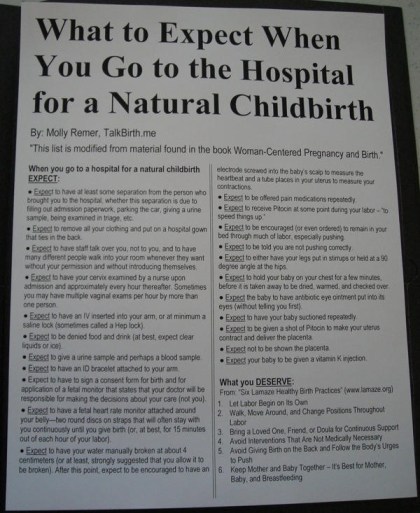
And, periodically, I get lovely emails like one from last week saying, “I love your energy and gentle voice.” 🙂 And, periodically, things happen and I see remarks on twitter referring to something I’ve written as, “I dislike the tone of it and its intention to demonise the health service.” 😦 The latter just happened last night in response to the publication of my What to Expect When You Go to the Hospital for a Natural Childbirth as an informational leaflet in conjunction with Women’s Health in Women’s Hands’ publication of Woman-Centered Childbirth in full text online. Twitter is too character limited for me to respond to the critique in full, so I said I’d write a follow-up blog post to explain. 20120928-141455.jpg A different organization (Women’s Health in Women’s Hands) converted one of my posts into this flier and it does not include my initial disclaimer expressing my trepidation about being perceived as “hospital-bashing” (it shouldn’t include that, because it is flier now, not a rambling blog post!). The article is NOT meant to hospital bash, it is meant to prepare and plan appropriately. I wrote it because I was tired of how betrayed my clients were when they planned beautiful, natural hospital births and then experienced many things on the list in my article. There is also a companion article and series of tips (I think on the back side of the tweeted leaflet as a matter of fact) about how to cope/navigate–the information is not meant to discourage, but to realistically prepare. Have a homebirth is NOT one of the tips, because this isn’t a home vs hospital article! Whew! See…too many words for Twitter, that’s why I rarely use it except FB auto-tweeting stuff.

So, which is it? Am I authentic and open, or keeping my mouth shut all the time?! Maybe both. What I know is there is a lot I don’t write about. I don’t write because I’m too scared, or too sensitive, or too fearful, or too self-righteous, or too busy, or too annoyed, or too scattered, or too embarrassed. I don’t write things because I have relatives who read this or friends who read this and I’d rather not share some things with some people. And, which is it? Do I have nice energy and a gentle voice or am I a strident hospital-basher out to demonize and victimize?!

And, I started to reflect that I guess I am all these things and how people experience me and my writing is in part up to me and in part up to them. Just like in real life. I can be gentle, kind, and nurturing. I can be critical, judgmental, and harsh. I can be helpful and I can be selfish. I can be patient and impatient. I can be friendly, I can be preoccupied. I can be energetic and enthusiastic and upbeat and I can be exhausted and defeated. I can be a fabulous, fun mother and I can be a distracted and grouchy mother. I can be funny and I can take myself too seriously. Different people, relationships, and environments bring out different expressions of who I am. Sometimes I really like myself a lot. I like who I am, I like how I move through the world, and I’m impressed with my own capacities. I have great ideas and solid values and principles and the ability to articulate those in writing. Sometimes I actually hate myself. I see only the bad parts and I wish I could just be better. I feel hypocritical and over aware of inconsistencies in my own thoughts/beliefs and my expression of my values in the world. I often want to be better than I am, but in rare moments of grace and self-compassion, I realize that I’m pretty good already. And, in some moments of self-righteousness and superiority, I actually feel better than some people in some areas/some ways!

There are two things that I know for sure. I never wish to diminish another woman and to make her feel judged as unworthy or “less than” for her birth or mothering choices. And, at the same time, I never wish to lie to another woman either in an effort to prevent her from feeling those things…

Blogging does only convey a slice of the “real me,” but I also find it an authentic slice, an authentic form of expression, and a real experience of who I am, just not all of who I am. Ever. I can be both more and less than what speaks to you from these many, many pages of blog posts. More in that I am more complicated and think deeper and with more intensity than most people will ever know and less in that I’m multidimensional and flawed and real, not just words on a screen from one moment in time.

20120928-150355.jpg

Yesterday..taking my kids to the theater and taking a moment to point out the “hidden” Goddess right in the middle of town. Today, sitting on the bed in the dim light while Alaina naps, typing feverishly and feeling utterly swamped with the one million things I’d like to do with my life…

Domestic Violence During Pregnancy

By Molly Remer, MSW, ICCE, CCCE

Violence during pregnancy is an unfortunately common experience. Between four and eight percent of women experience domestic (intimate partner) violence during their pregnancies. The incidence of violence increases for women with unplanned or unwanted pregnancies with 26% of pregnant teens experiencing intimate partner violence and 15% of all women whose pregnancies are unwanted being in an abusive relationship. Indeed, murder is the second only to car accidents as the most common cause of injury related death for pregnant women.[1] Sadly, these statistics are likely higher in reality due to underreporting or misclassification.

Despite prevalence and severity, domestic violence is not often addressed in the birth community. Books directed at pregnant women rarely even mention violence in pregnancy (and most do not even include it at all), even though the incidence is similar to the rate of premature births and much higher than the incidence of various pregnancy related complications that generally warrant at least a paragraph in birth literature (such as placenta previa). Likewise, books and training programs for doulas, birth educators, and other birth professionals, generally neglect to address intimate partner violence.

An introduction to the issue of domestic violence during pregnancy requires an understanding of the following dynamics:

  • Cycle of Violence—the concept that violent behavior in a relationship tends to occur in three distinct phases. In the tension building phase, the battered partner feels as if she is “walking on eggshells.” The abuser’s temperament and mood becomes increasingly unpredictable and volatile and culminates in the explosion/eruption phase in which an acutely violent incident occurs. Early in a relationship, this phase is often followed by the honeymoon phase during which the batterer is contrite, asks for forgiveness, offers gifts, and assures the woman that, “it will never happen again.” The length of each phase varies by couple and with their relationship. Over time, the tension building or explosion phases may be very prolonged, with little or no time spent in the honeymoon phase.

The cycle of violence continues to repeat and tends to escalate in severity, despite the assurances that the batterer makes during the honeymoon phase.

  • Domestic violence is about power and control. It is NOT about anger management, substance abuse (though substances can increases violent incidents), or “nagging” from a girlfriend or wife.
  • The abusive partner tends to tell the woman that the violence is her fault and that she provokes or deserves the abusive incidents. He often isolates her from people and situations that will help her know otherwise.
  • Abusive relationships may involve physical, emotional, or verbal battering and frequently some combination of the three. Physical abuse includes pushing, choking, kicking, sexual abuse and other means of physical control/harm as well as punching or slapping. Verbal and emotional or psychological abuse involves name calling, insults, berating, shouting/screaming, humiliation, threats, intimidation, destruction of property, isolation, activity restriction, abuse of pets, and withholding of economic, physical, or emotional resources. Women often forget to acknowledge some physical forms of violence like choking or pushing as “real” abuse and will often not consider themselves abused unless they have been punched or slapped by their husband or partner.
  • Women stay in abusive relationships for numerous reasons. Battered women often leave their relationships several times before they end it for good. Reasons are dynamic, complex, and individual. Some very basic reasons include hope, love, and fear. The most dangerous time in the relationship is when she leaves—it is then that she is most likely to be severely injured or killed. As a society, we should NOT be asking why women stay, we should be asking how we can stop domestic violence from happening.

 So, what can you do? If you are a pregnant woman who is being abused, please contact your local domestic violence shelter or hotline. Or, call the National Domestic Violence Hotline at 1-800-799-SAFE. Even if you do not feel ready to leave your relationship, many shelters offer “outpatient” support groups and counseling. If you are a prenatal health care provider (midwife, doctor, nurse, physician assistant), please include domestic violence screening questions during your prenatal visits and be alert and responsive to signs of violence. If you are a doula, birth educator, or other birth professional, include a discussion of domestic violence during your classes or prenatal visits and encourage exploration and acknowledgment of these issues during your networking with other birth workers. You may also wish to download and read the Center for Disease Control’s guide, Intimate Partner Violence during Pregnancy: A Guide for Clinicians. If you are a friend or relative of a pregnant woman experiencing abuse, help her develop a safety plan and encourage her to seek the services of a domestic violence shelter.

Though it can be very awkward to address domestic violence issues with women directly and can feel like an intrusion into private lives, if you choose silence, you contribute to a continued culture of fear, shame, denial, and invisibility for the many women experiencing violence during this time in their lives. Acknowledging the reality and prevalence of violence against women in our culture and encouraging open, respectful, and assertive dialog about it is a powerful tool in reducing the occurrence. Strive to help bring violence against pregnant women into public view instead of considering family violence to be private, family business. Women and babies are too important for us to remain quiet.

Portions of this article are excerpted from the booklet Talking to a Battered Woman: A Guide for the Short Term Helper by Molly Remer, MSW, ICCE. This booklet is available as free pdf file on Molly’s website (http://talkbirth.me). Molly is a certified childbirth educator, the editor of the Friends of Missouri Midwives newsletter, a breastfeeding counselor, and a college professor.


[1] National Coalition Against Domestic Violence Fact Sheet “Reproductive Health & Pregnancy,” http://www.ncadv.org/files/reproductivehealthandpregnancy.pdf

This article was originally published in Citizens for Midwifery News and was later reprinted in International Doula along with a companion sidebar by Susan Hodges.

Related post: Birth Violence

Guest Post: Abuse of pregnant women in the medical setting

This post is a companion piece to my article, Domestic Violence During Pregnancy, and was previously published as a sidebar in Citizens for Midwifery News and later in International Doula.

Abuse of pregnant women in the medical setting

 By Susan Hodges, founder and past President of Citizens for Midwifery

Have you or someone you know experienced rude, abusive or violent treatment at the hands of obstetricians or other hospital staff? Abusive behavior, in or out of the hospital, can include threats, coercion, yelling, belittling, lying, omission of information, lack of informed consent, misrepresentation (of medical situation, of interventions, of reasons they “need” you to do something or not do something), and so on. For example, nurses yelling at a woman to push is abusive, even if the nurses don’t intend to be abusive. An OB lying to a woman that her baby is “too big” (something that neither he/she nor anyone else can predict), telling her she “needs” intervention, and then not providing complete information about the risks and benefits of the intervention, is abusive behavior. Unwanted and unnecessary surgery (such as episiotomy or an avoidable cesarean section) is no less violence against a woman than hitting or strangling – most of us have just not thought about it in that way. The fact that most women are persuaded that they “needed” the intervention, that it was because their body was somehow defective, is another aspect of the abuse (blaming the victim).

While the situation is different from domestic violence in some ways, it is also similar. Abuse in the medical setting is also about power and control, the pregnant or laboring woman is often blamed for her situation, and verbal and emotional abuse can be similar. Because we are taught to “trust your doctor”, and in fact there is an explicit assumption of trust in the “fiduciary relationship” between the woman and her doctor who is an “expert”, most of us do not think about the possibility of abuse, and many of us stay with the OB or feel we have no choice about our health care providers or settings, especially when we are in labor. Also, the doctors and staff generally are not even aware that their behavior or actions are abusive.

Forty years ago, domestic violence happened, but was hidden and accepted. A lot of women had to do a great deal of work to come up with the language and the legal strategies, and to educate women, law enforcement, judges, mental health workers, and many others to get us to the point where we are today, where at least the problem has a name and at least some of the time women can fight back with the law on their side.

It is extremely difficult to deal with an abusive OB (and it might be hidden abuse, manipulation, etc.) in the middle of labor, just as is very difficult to effectively deal with an abusive spouse in the middle of the abuse. The childbirth community is only just now beginning to recognize that women are being abused in many ways in the present system of maternity care.  We don’t really have special words for it yet. We do have some legal underpinnings to fight at least some of it, but we are in the very early stages. It will take recognition of the problem on a larger scale and by women who are not being abused by OBs to bring this issue to public attention, create language for it, and use legal tools to end it. We have a lot of work to do.

Have you experienced abuse? At the least you can file a complaint. See “Unhappy With Your Maternity Care? File a Complaint!” at http://cfmidwifery.org/Resources/item.aspx?ID=1

Related post: Birth Violence